Questions

Solve the Following Question.(5 Marks)

Take a timed test

12 questions · self-marked practice — reveal the answer and mark yourself.

Question 15 Marks
Tangents to the circle $x^2+y^2=a^2$ with inclinations, $\theta_1$ and $\theta_2$ intersect in $P$. Find the locus of P such that

1.$\tan \theta_1+\tan \theta_2=0$

2. $\cot \theta_1+\cot \theta_2=5$

3. $\cot \theta_1 \cdot \cot \theta_2=c$

Answer
Let $P\left(x_1, y_1\right)$ be a point on the required locus.

Equations of the tangents to the circle $x^2+y^2=a^2$ with slope $m$ are

$y=m x \pm \sqrt{a^2\left(1+m^2\right)}$

Since, these tangents pass through $\left(\mathrm{x}_1, \mathrm{y}_1\right)$.

$\begin{array}{ll} & y_1=m x_1 \pm \sqrt{a^2\left(1+m^2\right)} \\ \therefore \quad & y_1-m x_1= \pm \sqrt{a^2\left(1+m^2\right)} \\ \therefore \quad & y_1{ }^2-2 m x_1 y_1+m^2 x_1{ }^2=a^2+a^2 m^2 \\ \therefore \quad & \left(x_1{ }^2-\mathrm{a}^2\right) \mathrm{m}^2-2 m x_1 y_1+\left(y_1{ }^2-\mathrm{a}^2\right)=0\end{array}$

This is a quadratic equation which has two roots

$m_1$ and $m_2$

$\therefore \quad \mathrm{m}_1+\mathrm{m}_2=\frac{2 x_1 y_1}{x_1^2-\mathrm{a}^2}$ and $\mathrm{m}_1 \mathrm{~m}_2=\frac{y_1^2-\mathrm{a}^2}{x_1^2-\mathrm{a}^2}$

1. Let $m_1=\tan \theta_1$ and $m_2=\tan \theta_2$

Given, $\tan \theta_1+\tan \theta_2=0$

$\begin{array}{ll}\therefore \quad & \mathrm{m}_1+\mathrm{m}_2=0 \\ \therefore & \frac{2 x_1 y_1}{x_1^2-\mathrm{a}^2}=0 \\ \therefore & 2 x_1 y_1=0 \\ \therefore \quad & x_1 y_1=0\end{array}$

$\therefore \quad$ Equation of the locus of point $\mathrm{P}$ is $x y=0$.

2. Given, $\cot \theta_1+\cot \theta_2=5$

$\begin{aligned} & \therefore \quad \frac{1}{\tan \theta_1}+\frac{1}{\tan \theta_2}=5 \\ & \therefore \quad \frac{1}{m_1}+\frac{1}{m_2}=5 \\ & \therefore \quad \frac{m_1+m_2}{m_1 m_2}=5\end{aligned}$

$\therefore \quad \frac{\frac{2 x_1 y_1}{x_1^2-a^2}}{\frac{y_1^2-a^2}{x_1^2-a^2}}=5$

$\begin{array}{ll}\therefore & \frac{2 x_1 y_1}{y_1^2-a^2}=5 \\ \therefore & 2 x_1 y_1=5 y_1^2-5 a^2 \\ \therefore & 5 y_1^2-2 x_1 y_1=5 a^2\end{array}$

$\therefore \quad$ Equation of the locus of point $\mathbf{P}$ is

$5 y^2-2 x y=5 a^2$

3. $\cot \theta_1 \cdot \cot \theta_2=\mathbf{c}$

$\begin{aligned} & \therefore \quad \frac{1}{\tan \theta_1} \cdot \frac{1}{\tan \theta_2}=\mathrm{c} \\ & \therefore \quad \frac{1}{m_1 m_2}=\mathrm{c}\end{aligned}$

$\begin{aligned} & \therefore \quad \frac{1}{\frac{y_1^2-\mathrm{a}^2}{x_1^2-\mathrm{a}^2}}=\mathrm{c} \\ & \therefore \quad \frac{x_1^2-\mathrm{a}^2}{y_1^2-\mathrm{a}^2}=\mathrm{c} \\ & \end{aligned}$

$\therefore \quad x_1^2-a^2=c\left(y_1^2-a^2\right)$

$\therefore \quad$ Equation of the locus of point $\mathrm{P}$ is

$x^2-\mathrm{a}^2=\mathrm{c}\left(y^2-\mathrm{a}^2\right)$.
View full question & answer
Question 25 Marks
Show that the circles touch each other internally. Find their point of contact and the equation of their common tangent.

$x^2+y^2+4 x-12 y+4=0$

$x^2+y^2-2 x-4 y+4=0$

Answer
Given equation of the first circle is $x^2+y^2+4 x-12 y+4=0$

Here, g = 2, f = -6, c = 4

Centre of the first circle is C1 = (-2, 6)

Radius of the first circle is

$\begin{aligned} & r_1=\sqrt{2^2+(-6)^2-4} \\ & =\sqrt{4+36-4} \\ & =\sqrt{36} \\ & =6\end{aligned}$

Given equation of the second circle is $x^2+y^2-2 x-4 y+4=0$

Here, g = -1, f = -2, c = 4

Centre of the second circle is C2 = (1, 2)

Radius of the second circle is

$\begin{aligned} & r_2=\sqrt{(-1)^2+(-2)^2-4} \\ & =\sqrt{1+4-4} \\ & =\sqrt{1} \\ & =1\end{aligned}$

By distance formula,

$\begin{aligned} & C_1 C_2=\sqrt{[1-(-2)]^2+(2-6)^2} \\ & =\sqrt{9+16} \\ & =\sqrt{2} 5 \\ & =5 \\ & \left|r_1-r_2\right|=6-1=5 \\ & \text { Since, } C_1 C_2=\left|r_1-r_2\right|\end{aligned}$

the given circles touch each other internally.

Equation of common tangent is

$\begin{aligned} & \left(x^2+y^2+4 x-12 y+4\right)-\left(x^2+y^2-2 x-4 y+4\right)=0 \\ & \Rightarrow 4 x-12 y+4+2 x+4 y-4=0 \\ & \Rightarrow 6 x-8 y=0 \\ & \Rightarrow 3 x-4 y=0 \\ & \Rightarrow y=\frac{3 x}{4}\end{aligned}$

Substituting $y=\frac{3 x}{4}$ in $x^2+y^2-2 x-4 y+4=0$, we get

$\begin{aligned} & x^2+\left(\frac{3 x}{4}\right)^2-2 x-4\left(\frac{3 x}{4}\right)+4=0 \\ & x^2+\frac{9 x^2}{16}-2 x-3 x+4=0 \\ & \frac{25 x^2}{16}-5 x+4=0 \\ & 25 x^2-80 x+64=0 \\ & (5 x-8)^2=0 \\ & 5 x-8=0\end{aligned}$

$x=\frac{8}{5}$

Substituting $x=\frac{8}{5}$ in $y=\frac{3 x}{4}$, we get

$y=\frac{3}{4}\left(\frac{8}{5}\right)=\frac{6}{5}$

$\therefore$ Point of contact is $\left(\frac{8}{5}, \frac{6}{5}\right)$ and equation of common tangent is $3 x-4 y=0$.

View full question & answer
Question 35 Marks
Show that the circles touch each other internally. Find their point of contact and the equation of their common tangent.

$x^2+y^2-4 x-4 y-28=0$

$x^2+y^2-4 x-12=0$

Answer
Given equation of the first circle is $x^2+y^2-4 x-4 y-28=0$

Here, g = -2, f = -2, c = -28

Centre of the first circle is C1 = (2, 2)

Radius of the first circle is

$\begin{aligned} & r_1=\sqrt{(-2)^2+(-2)^2+28} \\ & =\sqrt{4+4+28} \\ & =\sqrt{3} 6 \\ & =6\end{aligned}$

Given equation of the second circle is $x^2+y^2-4 x-12=0$

Here, g = -2, f = 0, c = -12

Centre of the second circle is C2 = (2, 0)

Radius of the second circle is

$\begin{aligned} & r_2=\sqrt{(-2)^2+0^2+12} \\ & =\sqrt{4+12} \\ & =\sqrt{16} \\ & =4\end{aligned}$

By distance formula,

$\begin{aligned} & C_1 C_2=\sqrt{(2-2)^2+(0-2)^2} \\ & =\sqrt{4} \\ & =2 \\ & \left|r_1-r_2\right|=6-4=2 \\ & \text { Since, } C_1 C_2=\left|r_1-r_2\right|\end{aligned}$

∴ the given circles touch each other internally.

Equation of common tangent is

$\begin{aligned} & \left(x^2+y^2-4 x-4 y-28\right)-\left(x^2+y^2-4 x-12\right)=0 \\ & \Rightarrow-4 x-4 y-28+4 x+12=0 \\ & \Rightarrow-4 y-16=0 \\ & \Rightarrow y+4=0 \\ & \Rightarrow y=-4\end{aligned}$

Substituting $y=-4$ in $x^2+y^2-4 x-12=0$, we get

$\begin{aligned} & \Rightarrow x^2+(-4)^2-4 x-12=0 \\ & \Rightarrow x^2+16-4 x-12=0 \\ & \Rightarrow x^2-4 x+4=0 \\ & \Rightarrow(x-2)^2=0 \\ & \Rightarrow x=2\end{aligned}$

∴ Point of contact is (2, -4) and equation of common tangent is y + 4 = 0.

View full question & answer
Question 45 Marks
Show that the circles touch each other externally. Find their point of contact and the equation of their common tangent

$x^2+y^2-4 x-10 y+19=0$

$x^2+y^2+2 x+8 y-23=0$

Answer
Given equation of the first circle is $x^2+y^2-4 x-10 y+19=0$

Here, g = -2, f = -5, c = 19

Centre of the first circle is C1 = (2, 5)

Radius of the first circle is

$\begin{aligned} & r_1=\sqrt{(-2)^2+(-5)^2-19} \\ & =\sqrt{4+25-19} \\ & =\sqrt{10}\end{aligned}$

Given equation of the second circle is $x^2+y^2+2 x+8 y-23=0$

Here, g = 1, f = 4, c = -23 Centre of the second circle is C2 = (-1, -4) Radius of the second circle is

$\begin{aligned} & r_2=\sqrt{(-1)^2+4^2+23} \\ & =\sqrt{1+16+23} \\ & =\sqrt{ } 40 \\ & =2 \sqrt{ } 10\end{aligned}$

By distance formula,

$\begin{aligned} & C_1 C_2=\sqrt{(-1-2)^2+(-4-5)^2} \\ & =\sqrt{9+81} \\ & =\sqrt{90} \\ & =3 \sqrt{ } 10 \\ & r_1+r_2=\sqrt{ } 10+2 \sqrt{ } 10=3 \sqrt{ } 10 \\ & \text { Since, } C_1 C_2=r_1+r_2\end{aligned}$

the given circles touch each other externally.

r1 : r2 = √10 : 2√10 = 1 : 2

Let P(x, y) be the point of contact.

$\therefore P$ divides $C_1 C_2$ internally in the ratio $r_1: r_2$ i.e. $1: 2$

∴ By internal division,

$x=\frac{1(-1)+2(2)}{1+2}=\frac{-1+4}{3}=1$

and $y=\frac{1(-4)+2(5)}{1+2}=\frac{-4+10}{3}=2$

Point of contact = (1, 2)

Equation of common tangent is

$\begin{aligned} & \left(x^2+y^2-4 x-10 y+19\right)-\left(x^2+y^2+2 x+8 y-23\right)=0 \\ & \Rightarrow-4 x-10 y+19-2 x-8 y+23=0 \\ & \Rightarrow-6 x-18 y+42=0 \\ & \Rightarrow x+3 y-7=0\end{aligned}$

View full question & answer
Question 55 Marks
Show that the circles touch each other externally. Find their point of contact and the equation of their common tangent.

$x^2+y^2-4 x+10 y+20=0$

$x^2+y^2+8 x-6 y-24=0$

Answer
Given equation of the first circle is $x^2+y^2-4 x+10 y+20=0$

Here, g = -2, f = 5, c = 20

Centre of the first circle is C1 = (2, -5)

Radius of the first circle is

$\begin{aligned} & r_1=\sqrt{(-2)^2+5^2-20} \\ & =\sqrt{4+25-20} \\ & =\sqrt{9} \\ & =3\end{aligned}$

Given equation of the second circle is $x^2+y^2+8 x-6 y-24=0$

Here, g = 4, f = -3, c = -24

Centre of the second circle is C2 = (-4, 3)

Radius of the second circle is

$\begin{aligned} & r_2=\sqrt{4^2+(-3)^2+24} \\ & =\sqrt{16+9+24} \\ & =\sqrt{49} \\ & =7\end{aligned}$

By distance formula,

$\begin{aligned} & C_1 C_2=\sqrt{(-4-2)^2+[3-(-5)]^2} \\ & =\sqrt{36+64} \\ & =\sqrt{100} \\ & =10 \\ & r_1+r_2=3+7=10 \\ & \text { Since, } C_1 C_2=r_1+r_2\end{aligned}$

∴ the given circles touch each other externally.

$\mathrm{C}_1(2,-5) \bullet \frac{3}{\mathrm{P}(x, y)} \bullet \frac{7}{\longrightarrow} \mathrm{C}_2(-4,3)$

Let P(x, y) be the point of contact.

$\therefore P$ divides $C_1 C_2$ internally in the ratio $r_1: r_2$ i.e. $3: 7$.

∴ By internal division,

$\begin{aligned} & x=\frac{3(-4)+7(2)}{3+7}=\frac{-12+14}{10}=\frac{1}{5} \\ & \text { and } y=\frac{3(3)+7(-5)}{3+7}=\frac{9-35}{10}=-\frac{13}{5}\end{aligned}$

Point of contact $=\left(\frac{1}{5},-\frac{13}{5}\right)$

Equation of common tangent is

$\begin{aligned} & \left(x^2+y^2-4 x+10 y+20\right)-\left(x^2+y^2+8 x-6 y-24\right)=0 \\ & \Rightarrow-4 x+10 y+20-8 x+6 y+24=0 \\ & \Rightarrow-12 x+16 y+44=0 \\ & \Rightarrow 3 x-4 y-11=0\end{aligned}$

View full question & answer
Question 65 Marks
Find the lengths of the intercepts made on the co-ordinate axes, by the circles.

$x^2+y^2-5 x+13 y-14=0$

Answer
Given equation of the circle is

$x^2+y^2-5 x+13 y-14=0$

Substituting y = 0 in (i), we get

$x^2-5 x-14=0$

Let AB represent the x-intercept, where

$A=\left(x_1, 0\right), B=\left(x_2, 0\right)$

Then from (ii),

$\begin{aligned} & x_1+x_2=5 \text { and } x_1 x_2=-14 \\ & \left(x_1-x_2\right)^2=\left(x_1+x_2\right)^2-4 x_1 x_2 \\ & =(5)^2-4(-14) \\ & =25+56 \\ & =81\end{aligned}$

$\therefore\left|x_1-x_2\right|=\sqrt{\left(x_1-x_2\right)^2}=\sqrt{81}=9$

∴ Length of x-intercept = 9 units Substituting x = 0 in (i), we get

$y^2+13 y-14=0 \ldots$. (iii)

Let CD represent they-intercept,

where $C=\left(0, y_1\right), D=\left(0, y_2\right)$.

Then from (iii),

$\begin{aligned} & y_1+y_2=-13 \text { and } y_1 y_2=-14 \\ & \left(y_1-y_2\right)^2=\left(y_1+y_2\right)^2-4 y_1 y_2 \\ & =(-13)^2-4(-14) \\ & =169+56 \\ & =225\end{aligned}$

$\therefore\left|y_1-y_2\right|=\sqrt{\left(y_1-y_2\right)^2}=\sqrt{ } 225=15$

∴ Length ofy-intercept = 15 units

View full question & answer
Question 75 Marks
Find the lengths of the intercepts made on the co-ordinate axes, by the circles.

$x^2+y^2-8 x+y-20=0$

Answer
To find $x$-intercept made by the circle $x^2+y^2+2 g x+2 f y+c=0$,

substitute $y=0$ and get a quadratic equation in $x_1$ whose roots are, say, $x_1$ and $x_2$.

These values represent the abscissae of ends A and B of the x-intercept.

Length of $x$-intercept $=|A B|=\left|x_2-x_1\right|$

Similarly, substituting $x=0$, we get a quadratic equation in $\mathrm{y}$ whose roots, say, $y_1$ and $\mathrm{y}_2$

are ordinates of the ends C and D of the y-intercept.

Length of $y$-intercept $=|C D|=\left|y_2-y_1\right|$

(i) Given equation of the circle is

$x^2-8 x-20=0 \ldots$ (ii)

Substituting y = 0 in (i), we get

$x^2-8 x-20=0 \ldots$ (ii)

Let AB represent the x-intercept, where

$A=\left(x_1, 0\right), B=\left(x_2, 0\right)$

Then from (ii),

$\begin{aligned} & x_1+x_2=8 \text { and } x_1 x_2=-20 \\ & \left(x_1-x_2\right)^2=\left(x_1+x_2\right)^2-4 x_1 x_2 \\ & =(8)^2-4(-20) \\ & =64+80 \\ & =144\end{aligned}$

$\therefore\left|x_1-x_2\right|=\sqrt{\left(x_1-x_2\right)^2}=\sqrt{144}=12$

∴ Length of x – intercept =12 units

Substituting x = 0 in (i), we get

$y^2+y-20=0 \ldots$ (iii)

Let CD represent the y – intercept,

where C = (0, y1) and D = (0, y2)

Then from (iii),

$\begin{aligned} & y_1+y_2=-1 \text { and } y_1 y_2=-20 \\ & \left(y_1-y_2\right)^2=\left(y_1+y_2\right)^2-4 y_1 y_2 \\ & =(-1)^2-4(-20) \\ & =1+80 \\ & =81\end{aligned}$

$\begin{aligned} & \therefore\left|y_1-y_2\right|=\sqrt{\left(y_1-y_2\right)^2}=\sqrt{81}=9 \\ & \therefore \text { Length of } y-\text { intercept }=9 \text { units. } \\ & \end{aligned}$

Alternate Method:

Given equation of the circle is $x^2+y^2-8 x+y-20=0 \ldots \ldots$ (i)

x-intercept: Substituting y = 0 in (i), we get

$\begin{aligned} & x^2-8 x-20=0 \\ & \Rightarrow(x-10)(x+2)=0 \\ & \Rightarrow x=10 \text { or } x=-2\end{aligned}$

length of x-intercept

= |10 – (-2)| = 12 units y-intercept:

Substituting x = 0 in (i), we get

$\begin{aligned} & y^2+y-20=0 \\ & \Rightarrow(y+5)(y-4)=0 \\ & \Rightarrow y=-5 \text { or } y=4\end{aligned}$

length of y-intercept = |-5 – 4| = 9 units

View full question & answer
Question 85 Marks
Show that the points (9, 1), (7, 9), (-2, 12) and (6, 10) are concyclic.
Answer
Let the equation of circle passing through the points (9, 1), (7, 9), (-2, 12) be

$x^2+y^2+2 g x+2 f y+c=0 \ldots \ldots$ (i)

For point (9, 1),

Substituting x = 9 andy = 1 in (i), we get

81 + 1 + 18g + 2f + c = 0

⇒ 18g + 2f + c = -82 …..(ii)

For point (7, 9),

Substituting x = 7 andy = 9 in (i), we get

49 + 81 + 14g + 18f + c = 0

⇒ 14g + 18f + c = -130 ……(iii)

For point

(-2, 12),

Substituting x = -2 and y = 12 in (i), we get

4 + 144 – 4g + 24f + c = 0

⇒ -4g + 24f + c = -148 …..(iv)

By (ii) – (iii), we get

4g – 16f = 48

⇒ g – 4f = 12 …..(v)

By (iii) – (iv), we get

18g – 6f = 18

⇒ 3g – f = 3 ……(vi)

By 3 × (v) – (vi), we get

-11f = 33

⇒ f = -3

Substituting f = -3 in (vi), we get

3g – (-3) = 3

⇒ 3g + 3 = 3

⇒ g = 0 Substituting g = 0 and f = -3 in (ii), we get

18(0) + 2(-3) + c = – 82

⇒ -6 + c = -82

⇒ c = -76

Equation of the circle becomes

$\begin{aligned} & x^2+y^2+2(0) x+2(-3) y+(-76)= \\ & \Rightarrow x^2+y^2-6 y-76=0 \ldots \ldots(\text { vii) }\end{aligned}$

Now for the point (6, 10),

Substituting x = 6 and y = 10 in L.H.S. of (vii), we get

$\begin{aligned} & \text { L.H.S }=6^2+10^2-6(10)-76 \\ & =36+100-60-76 \\ & =0 \\ & =\text { R.H.S. }\end{aligned}$

∴ Point (6,10) satisfies equation (vii).

∴ the given points are concyciic.

View full question & answer
Question 95 Marks
Find the equation of circle passing through the point of intersection of the lines x + 3y = 0 and 2x – 7y = 0 and whose centre is the point of intersection of lines x + y + 1 = 0 and x – 2y + 4 = 0.
Answer
Required circle passes through the point of intersection of the lines x + 3y = 0 and 2x – 7y = 0.

x + 3y = 0

⇒ x = -3y ……..(i)

2x – 7y = 0 ……(ii)

Substituting x = -3y in (ii), we get

⇒ 2(-3y) – 7y = 0

⇒ -6y – 7y = 0

⇒ -13y = 0

⇒ y = 0 Substituting y = 0 in (i), we get

x = -3(0) = 0

Point of intersection is O(0, 0).

This point O(0, 0) lies on the circle.

Let C(h, k) be the centre of the required circle.

Since, point of intersection of lines x + y = -1 and x – 2y = -4 is the centre of circle.

∴ x = h, y = k

∴ Equations of lines become

h + k = -1 ……(iii)

h – 2k = -4 …..(iv)

By (iii) – (iv), we get

3k = 3

⇒ k = 1

Substituting k = 1 in (iii), we get

h + 1 = -1

⇒ h = -2

∴ Centre of the circle is C(-2, 1) and it passes through point O(0, 0).

Radius(r) = OC

$\begin{aligned} & =\sqrt{(0+2)^2+(0-1)^2} \\ & =\sqrt{4+1} \\ & =\sqrt{5}\end{aligned}$

The equation of a circle with centre at (h, k) and radius r is given by

$(x-h)^2+(v-k)^2=r^2$

Here, h = -2, k = 1

the required equation of the circle is

$\begin{aligned} & (x+2)^2+(y-1)^2=(\sqrt{ } 5)^2 \\ & \Rightarrow x^2+4 x+4+y^2-2 y+1=5 \\ & \Rightarrow x^2+y^2+4 x-2 y=0\end{aligned}$

View full question & answer
Question 105 Marks
Show that the points (3, -2), (1, 0), (-1, -2) and (1, -4) are concyclic.
Answer
Let the equation of the circle passing through the points (3, -2), (1, 0) and (-1, -2) be

$x^2+y^2+2 g x+2 f y+c=0 \ldots .$. (i)

For point (3, -2),

Substituting x = 3 and y = -2 in (i), we get

9 + 4 + 6g – 4f + c = 0

⇒ 6g – 4f + c = -13 ….(ii)

For point (1, 0),

Substituting x = 1 andy = 0 in (i), we get

1 + 0 + 2g + 0 + c = 0

⇒ 2g + c = -1 ……(iii)

For point (-1, -2),

Substituting x = -1 and y = -2, we get

1 + 4 – 2g – 4f + c = 0

⇒ 2g + 4f – c = 5 …….(iv)

Adding (ii) and (iv), we get

8g = -8

⇒ g = -1

Substituting g = -1 in (iii), we get

-2 + c = -1

⇒ c = 1

Substituting g = -1 and c = 1 in (iv), we get

-2 + 4f – 1 = 5

⇒ 4f = 8

⇒ f = 2

Substituting g = -1, f = 2 and c = 1 in (i), we get

$x^2+y^2-2 x+4 y+1=0$

If (1, -4) satisfies equation (v), the four points are concyclic. Substituting x = 1, y = -4 in L.H.S of (v), we get

L.H.S. $=(1)^2+(-4)^2-2(1)+4(-4)+1$

= 1 + 16 – 2 – 16 + 1

= 0

= R.H.S.

Point (1, -4) satisfies equation (v).

∴ The given points are concyclic.

View full question & answer
Question 115 Marks
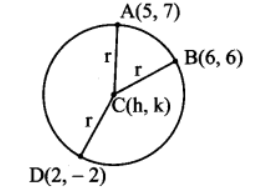
Find the equation of the circle passing through the points $(5, 7), (6, 6),$ and $(2, -2).$
Answer
Let $C(h, k)$ be the centre of the required circle.Since the required circle passes through points $A(5, 7), B(6, 6),$ and $D(2, -2),$
$CA = CB = CD =$ radius
Image
Consider, CA = CD
By distance formula,
$\sqrt{(\mathrm{h}-5)^2+(\mathrm{k}-7)^2}=\sqrt{(\mathrm{h}-2)^2+[\mathrm{k}-(-2)]^2}$
Squaring both the sides, we get
$\Rightarrow(\mathrm{h}-5)^2+(\mathrm{k}-7)^2=(\mathrm{h}-2)^2+(\mathrm{k}+2)^2$
$\Rightarrow \mathrm{h}^2-10 \mathrm{~h}+25+\mathrm{k}^2-14 \mathrm{k}+49=\mathrm{h}^2-4 \mathrm{~h}+4+\mathrm{k}^2+4 \mathrm{k}+4$
$\Rightarrow-10 \mathrm{~h}-14 \mathrm{k}+74=-4 \mathrm{~h}+4 \mathrm{k}+8$
$\Rightarrow 6 \mathrm{~h}+18 \mathrm{k}-66=0$
$\Rightarrow \mathrm{h}+3 \mathrm{k}-11=0 \ldots . .(\mathrm{i})$
Consider, CB = CD
By distance formula,
$\sqrt{(h-6)^2+(k-6)^2}=\sqrt{(h-2)^2+[k-(-2)]^2}$
Squaring both the sides, we get
$\Rightarrow(h-6)^2+(\mathrm{k}-6)^2=(\mathrm{h}-2)^2+(\mathrm{k}+2)^2$
$\Rightarrow \mathrm{h}^2-12 \mathrm{~h}+36+\mathrm{k}^2-12 \mathrm{k}+36=\mathrm{h}^2-4 \mathrm{~h}+4+\mathrm{k}^2+4 \mathrm{k}+4$
$\Rightarrow-12 \mathrm{~h}-12 \mathrm{k}+72=-4 \mathrm{~h}+4 \mathrm{k}+8$
$\Rightarrow 8 \mathrm{~h}+16 \mathrm{k}-64=0$
$\Rightarrow \mathrm{h}+2 \mathrm{k}-8=0 \ldots . . . \text { (ii) }$
By (i) – (ii), we get $k = 3$
Substituting $k = 3$ in (i), we get
$h + 3(3) – 11 = 0$
$\Rightarrow h + 9 – 11 = 0$
$\Rightarrow h = 2$
Centre of the circle is $C(2, 3).$
radius $(r) = CD$
$=\sqrt{(2-2)^2+(3+2)^2}$
$=\sqrt{0+5^2}$
$=\sqrt{ } 25$
$=5$
The equation of a circle with centre at $(h, k)$ and radius r is given by $(x – h)^2+ (y – k)^2 = r^2$ Here, $h = 2, k = 3$ The required equation of the circle is
$(x-2)^2+(y-3)^2=5^2$
$\Rightarrow x^2-4 x+4+y^2-6 y+9=25$
$\Rightarrow x^2+y^2-4 x-6 y+4+9-25=0$
$\Rightarrow x^2+y^2-4 x-6 y-12=0$
View full question & answer
Question 125 Marks
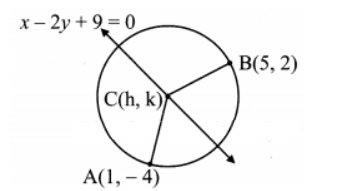
Find the equation of a circle passing through the points $(1, -4), (5, 2)$ and having its centre on line $x – 2y + 9 = 0.$
Answer
Image
Let $C(h, k)$ be the centre of the required circle which lies on the line $x – 2y + 9 = 0.$
Equation of line becomes
$h – 2k + 9 = 0 …..(i)$
Also, the required circle passes through points $A(1, -4)$ and $B(5, 2).$
$CA = CB =$ radius
$CA = CB$
By distance formula,
$\sqrt{(\mathrm{h}-1)^2+[\mathrm{k}-(-4)]^2}=\sqrt{(\mathrm{h}-5)^2+(\mathrm{k}-2)^2}$
Squaring both the sides, we get
$\Rightarrow(\mathrm{h}-1)^2+(\mathrm{k}+4)^2=(\mathrm{h}-5)^2+(\mathrm{k}-2)^2$
$\Rightarrow \mathrm{h}^2-2 \mathrm{~h}+1+\mathrm{k}^2+8 \mathrm{k}+16=\mathrm{h}^2-10 \mathrm{~h}+25+\mathrm{k}^2-4 \mathrm{k}+4$
$\Rightarrow-2 \mathrm{~h}+8 \mathrm{k}+17=-10 \mathrm{~h}-4 \mathrm{k}+29$
$\Rightarrow 8 \mathrm{~h}+12 \mathrm{k}-12=0$
$\Rightarrow 2 \mathrm{~h}+3 \mathrm{k}-3=0 \ldots \ldots .(\mathrm{ii})$
By (ii) – (i) × 2, we get
7k = 21
⇒ k = 3
Substituting k = 3 in (i), we get
h – 2(3) + 9 = 0
⇒ h – 6 + 9 = 0
⇒ h = -3
Centre of the circle is C(-3, 3).
radius (r) = CA
$=\sqrt{[1-(-3)]^2+(-4-3)^2}$
$=\sqrt{4^2+(-7)^2}$
$=\sqrt{16+49}$
$=\sqrt{65}$
The equation of a circle with centre at $(h, k)$ and radius $r$ is given by $(x-h)^2+(y-k)^2=r^2$
Here, h = -3, k = 3, r = √65 The required equation of the circle is
$\Rightarrow[x-(-3)]^2+(y-3)^2=(\sqrt{ } 65)^2$
$\Rightarrow(x+3)^2+(y-3)^2=65$
$\Rightarrow x^2+6 x+9+y^2-6 y+9-65=0$
$\Rightarrow x^2+y^2+6 x-6 y-47=0$
View full question & answer