Question 12 Marks
Find $f(x)$, if
$g(x)=x^2+x-2$ and (gof) $(x)=4 x^2-10 x+4$
Answer$g(x)=x^2+x-2$
$\text { (gof) }(x)=4 x^2-10 x+4$
$=(2 x-3)^2+(2 x-3)-2$
$=g(2 x-3)$
$=g(f(x))$
$\therefore f(x)=2 x-3$
$\text { (gof) }(x)=4 x^2-10 x+4$
$=(-2 x+2)^2+(-2 x+2)-2$
$=g(-2 x+2)$
$=g(f(x))$
$\therefore f(x)=-2 x+2$
View full question & answer→Question 22 Marks
Find (fog) (x) and (gof) (x) : $f(x)=\frac{x}{x+1}, g(x)=\frac{x}{1-x}$
Answer$f(x)=\frac{x}{x+1}, g(x)=\frac{x}{1-x}$
$ (f \circ g)(x)=f(g(x))=f\left(\frac{x}{1-x}\right)$
$=\frac{\frac{x}{1-x}}{\frac{x}{1-x}+1}=\frac{x}{x+1-x}=x$
$\text { (gof) } x=\mathrm{g}(\mathrm{f}(x))$
$=\mathrm{g}\left(\frac{x}{x+1}\right)=\frac{\frac{x}{x+1}}{1-\frac{x}{x+1}}$
$=\frac{x}{x+1-x}=x$
View full question & answer→Question 32 Marks
Find (fog) (x) and (gof) (x) : $f(x)=e^x, g(x)=\log x$
Answer$ f(x)=e^x, g(x)=\log x$
$\text { (fog) }(x)=f(g(x))$
$=f(\log x)$
$=e^{\log x}$
$=x$
$\text { (gof) }(x)=g(f(x))$
$=g\left(e^x\right)$
$=\log \left(e^x\right)$
$=x \log e$
$=x \ldots . .[\because \log e=1] $
View full question & answer→Question 42 Marks
Find the domain of the following functions.
$\mathrm{f}(\mathrm{x})=\sqrt{x-x^2}+\sqrt{5-x}$
Answer$\mathrm{f}(\mathrm{x})=\sqrt{x-x^2}+\sqrt{5-x}$
$\mathrm{x}-\mathrm{x}^2 \geq 0$
$\therefore \mathrm{x}^2-\mathrm{x} \leq 0$
$\therefore \mathrm{x}(\mathrm{x}-1) \leq 0$
$\therefore 0 \leq \mathrm{x} \leq 1 \ldots . . \text { (i) }$
$5-\mathrm{x} \geq 0$
$\therefore \mathrm{x} \leq 5 \ldots . . \text { (ii) }$
Intersection of intervals given in (i) and (ii) gives
Solution set $=[0,1]$
$\therefore$ Domain of $f=[0,1]$
View full question & answer→Question 52 Marks
Find the domain of the following functions.$f(x)=\sqrt{1-\sqrt{1-\sqrt{1-x^2}}}$
Answer$ f(x)=\sqrt{1-\sqrt{1-\sqrt{1-x^2}}}$
$1-x^2 \geq 0 \text { and } 1-\sqrt{1-x^2} \geq 0$
$\text { and } 1-\sqrt{1-\sqrt{1-x^2}} \geq 0$
$\text { Consider } 1-x^2 \geq 0$
$\therefore \quad x^2 \leq 1$
$\therefore \quad-1 \leq x \leq 1$
$\text { Consider } 1-\sqrt{1-x^2} \geq 0$
$\therefore \quad 1 \geq \sqrt{1-x^2}$
$\therefore \quad 1 \geq 1-x^2 \text { MaharashtraBoardSolutions.Guru }$
$\therefore \quad x^2 \geq 0 \text { (true) }$
$\text { Consider } 1-\sqrt{1-\sqrt{1-x^2}} \geq 0$
$\therefore \quad 1 \geq \sqrt{1-\sqrt{1-x^2}}$
$\therefore \quad 1 \geq 1-\sqrt{1-x^2} \quad \therefore \sqrt{1-x^2} \geq 0 \text { (true) }$
Equation (i) gives solution set $=[-1,1]$
$\therefore$ Domain of $\mathrm{f}=[-1,1]$
View full question & answer→Question 62 Marks
If $a^2=b^3=c^4=d^5$, show that loga $b c d=\frac{47}{30}$.
Answer$
a^2=b^3=c^4=d^5
$
Taking log to the base a throughout, we get
$
\log _a a^2=\log _a b^3=\log _a c^4=\log _a d^5
$
$
\begin{array}{ll}
\therefore & 2 \log _a a=3 \log _a b=4 \log _a c=5 \log _a d \\
\therefore & 2(1)=3 \log _a b=4 \log _a c=5 \log _a d \\
\therefore & \log _a b=\frac{2}{3}, \log _a c=\frac{2}{4}=\frac{1}{2} \text { and } \log _a d=\frac{2}{5} \\
\therefore & \log _a b+\log _a c+\log _a d=\frac{2}{3}+\frac{1}{2}+\frac{2}{5}
\end{array}
$
$\therefore \quad \log _{\mathrm{a}} \mathrm{bcd}=\frac{47}{30}$
View full question & answer→Question 72 Marks
If $\frac{\log a}{x+y-2 z}=\frac{\log b}{y+z-2 x}=\frac{\log c}{z+x-2 y}$, show that $a b c=1$.
Answer$\text { Let } \frac{\log a}{x+y-2 z}=\frac{\log b}{y+z-2 x}=\frac{\log c}{z+x-2 y}=k$
$\therefore \log a=k(x+y-2 z), \log b=k(y+z-2 x), \log c=k(z+x-2 y)$
$\log a+\log b+\log c=k(x+y-2 z)+k(y+z-2 x)+k(z+x-2 y)$
$=k(x+y-2 z+y+z-2 x+z+x-2 y)$
$=k(0)$
$=0$
$\therefore \log (a b c)=\log 1 \ldots \ldots .[\because \log 1=0]$
$\therefore a b c=1$
View full question & answer→Question 82 Marks
If $\log \left(\frac{x-y}{5}\right)=\frac{1}{2} \log x+\frac{1}{2} \log y$, show that $\mathrm{x}^2+\mathrm{y}^2=27 \mathrm{xy}$.
Answer$
\log \left(\frac{x-y}{5}\right)=\frac{1}{2}(\log x)+\frac{1}{2}(\log y)
$
Multiplying throughout by 2 , we get
$
\begin{array}{ll}
& 2 \log \left(\frac{x-y}{5}\right)=\log x+\log y \\
\therefore \quad & \log \left(\frac{x-y}{5}\right)^2=\log x y \\
\therefore \quad & \frac{(x-y)^2}{25}=x y \\
\therefore \quad & x^2-2 x y+y^2=25 x y \\
\therefore \quad & x^2+y^2=27 x y
\end{array}
$
View full question & answer→Question 92 Marks
If $b^2=a c$. Prove that, $\log a+\log c=2 \log b$.
Answer$b^2=a c$
Taking log on both sides, we get
$\log b^2=\log a c$
$ \therefore 2 \log b=\log a+\log c$
$\therefore \log a+\log c=2 \log b$
View full question & answer→Question 102 Marks
Show that, $\log \left|\sqrt{x^2+1}+x\right|+\log \left|\sqrt{x^2+1}-x\right|=0$.
Answer$ \text { L.H.S. }=\log \left|\sqrt{x^2+1}+x\right|+\log \left|\sqrt{x^2+1}-\mathrm{x}\right|$
$=\log \left|\left(\sqrt{x^2+1}+x\right)\left(\sqrt{x^2+1}-x\right)\right|$
$=\log \left|x^2+1-x^2\right|$
$=\log 1$
$=0$
$=\text { R.H.S. }$
View full question & answer→Question 112 Marks
If $f(x)=\frac{x+3}{4 x-5}, g(x)=\frac{3+5 x}{4 x-1}$, then show that $(f \circ g)(x)=x$.
Answer$ f(x)=\frac{x+3}{4 x-5}, g(x)=\frac{3+5 x}{4 x-1}$
$(f \circ g)(x)=f(g(x))$
$=f\left(\frac{3+5 x}{4 x-1}\right)$
$=\frac{\frac{3+5 x}{4 x-1}+3}{4\left(\frac{3+5 x}{4 x-1}\right)-5}$
$=\frac{3+5 x+12 x-3}{12+20 x-20 x+5}=\frac{17 x}{17}=x $
View full question & answer→Question 122 Marks
If $\mathrm{f}(\mathrm{x})=\frac{2 x-1}{5 x-2}, x \neq \frac{2}{5}$, show that (fof) $(\mathrm{x})=\mathrm{x}$.
Answer$ (\text { fof })(x)=\mathrm{f}(\mathrm{f}(x))$
$=\mathrm{f}\left(\frac{2 x-1}{5 x-2}\right)$
$=\frac{2\left(\frac{2 x-1}{5 x-2}\right)-1}{5\left(\frac{2 x-1}{5 x-2}\right)-2}$
$=\frac{4 x-2-5 x+2}{10 x-5-10 x+4}=\frac{-x}{-1}=x$
View full question & answer→Question 132 Marks
Find composite of f and g:
f = {(1, 1), (2, 4), (3, 4), (4, 3)}
g = {(1, 1), (3, 27), (4, 64)}
Answerf = {(1, 1), (2, 4), (3, 4), (4, 3)}
g = {(1, 1), (3, 27), (4, 64)}
f(1) = 1, g(1) = 1
f(2) = 4, g(3) = 27
f(3) = 4, g(4) = 64
f(4) = 3
(gof) (x) = g(f(x))
(gof) (1) = g(f(1)) = g(1) = 1
(gof) (2) = g(f(2)) = g(4) = 64
(gof) (3) = g(f(3)) = g(4) = 64
(gof) (4) = g(f(4)) = g(3) = 27
∴ gof = {(1, 1), (2, 64), (3, 64), (4, 27)}
View full question & answer→Question 142 Marks
Find composite of f and g:
f = {(1, 3), (2, 4), (3, 5), (4, 6)}
g = {(3, 6), (4, 8), (5, 10), (6, 12)}
Answerf = {(1, 3), (2, 4), (3, 5), (4, 6)}
g = {(3, 6), (4, 8), (5, 10), (6, 12)}
∴ f(1) = 3, g(3) = 6
f(2) = 4, g(4) = 8
f(3) = 5, g(5)=10
f(4) = 6, g(6) = 12
(gof) (x) = g (f(x))
(gof)(1) = g(f(1)) = g(3) = 6
(gof)(2) – g(f(2)) = g(4) = 8
(gof)(3) = g(f(3)) = g(5) = 10
(gof)(4) = g(f(4)) = g(6) = 12
∴ gof = {(1, 6), (2, 8), (3, 10), (4, 12)}
View full question & answer→Question 152 Marks
If $f(x)=a x^2+b x+2$ and $f(1)=3, f(4)=42$, find $a$ and $b$.
Answer$ f(x)=a x^2+b x+2$
$f(1)=3$
$\therefore a(1)^2+b(1)+2=3$
$\therefore a+b=1 \ldots .(i)$
$f(4)=42$
$\therefore a(4)^2+b(4)+2=42$
$\therefore 16 a+4 b=40 $
Dividing by $4,$ we get
$4 a+b=10$
Solving (i) and (ii), we get
$a=3, b=-2$
View full question & answer→Question 162 Marks
If $f(x)=3 x^4-5 x^2+7$, find $f(x-1)$.
Answer$ f(x)=3 x^4-5 x^2+7$
$\therefore f(x-1)=3(x-1)^4-5(x-1)^2+7$
$=3\left(x^4-{ }^4 C_1 x^3+{ }^4 C_2 x^2-{ }^4 C_3 x+{ }^4 C_4\right)-5\left(x^2-2 x+1\right)+7$
$=3\left(x^4-4 x^3+6 x^2-4 x+1\right)-5\left(x^2-2 x+1\right)+7$
$=3 x^4-12 x^3+18 x^2-12 x+3-5 x^2+10 x-5+7$
$=3 x^4-12 x^3+13 x^2-2 x+5 $
View full question & answer→Question 172 Marks
A function $f: R \rightarrow R$ defined by $f(x)=\frac{3 x}{5}+2, x \in R$. Show that $f$ is one-one and onto. Hence find $f^{-1}$.
Answer$
f(x)=\frac{3 x}{5}+2, x \in \mathrm{R}
$
Let $\mathrm{f}\left(x_1\right)=\mathrm{f}\left(x_2\right)$
$
\therefore \quad \frac{3 x_1}{5}+2=\frac{3 x_2}{5}+2
$
$\therefore \quad x_1=x_2$
$\therefore \mathrm{f}$ is a one-one function.
Let $\mathrm{f}(x)=\frac{3 x}{5}+2=y$ (say), $y \in \mathrm{R}$
$
\therefore \quad x=\frac{5(y-2)}{3}
$
$\therefore \quad$ for every $y \in \mathrm{R}$, there is some $x \in \mathrm{R}$
$\therefore \mathrm{f}$ is an onto function.
$
\begin{aligned}
& x=\frac{5(y-2)}{3}=\mathrm{f}^{-1}(y) \\
\therefore \quad & \mathrm{f}^{-1}(x)=\frac{5(x-2)}{3}
\end{aligned}
$
View full question & answer→Question 182 Marks
Find whether the following functions are one-one.$f: R-\{3\} \rightarrow R$ defined by $f(x)=\frac{5 x+7}{x-3}$ for $x \in R-\{3\}$
Answer$f: R-\{3\} \rightarrow R$, defined by $f(x)=\frac{5 x+7}{x-3}$
Let $\mathrm{f}\left(\mathrm{x}_1\right)=\mathrm{f}\left(\mathrm{x}_2\right)$
$ \therefore \frac{5 x_1+7}{x_1-3}=\frac{5 x_2+7}{x_2-3}$
$\therefore 5 x_1 x_2-15 x_1+7 x_2-21=5 x_1 x_2-15 x_2+7 x_1-21$
$\therefore 22\left(x_1-x_2\right)=0$
$\therefore x_1=x_2$
$\therefore \mathrm{f} \text { is a one-one function. } $
$\therefore \mathrm{f}$ is a one-one function.
View full question & answer→Question 192 Marks
Solve the following for $x$, where $|x|$ is modulus function, $[x]$ is the greatest integer function, $\{x\}$ is a fractional part function.$|x+4| \geq 5$
Answer$|x+4| \geq 5$
The solution of $|x| \geq a$ is $x \leq-a$ or $x \geq a$
$\therefore|x+4| \geq 5$ gives
$\therefore \mathrm{x}+4 \leq-5$ or $\mathrm{x}+4 \geq 5$
$\therefore \mathrm{x} \leq-5-4$ or $\mathrm{x} \geq 5-4$
$\therefore \mathrm{x} \leq-9$ or $\mathrm{x} \geq 1$
$\therefore$ The solution set $=(-\infty,-9] \cup[1, \infty)$
View full question & answer→Question 202 Marks
Check if the following functions have an inverse function. If yes, find the inverse function.$f(x)=5 x^2$
Answer$f(x)=5 x^2=y$ (say)
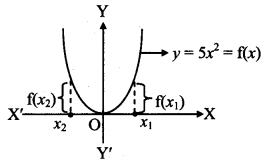
For two values $(x_1$ and $x_2)$ of $x$, values of the function are equal.
$\therefore f$ is not one-one.
$\therefore f$ does not have an inverse. View full question & answer→Question 212 Marks
Verify that $f$ and $g$ are inverse functions of each other, where$\mathrm{f}(\mathrm{x})=\frac{x+3}{x-2}, \mathrm{~g}(\mathrm{x})=\frac{2 x+3}{x-1}$
Answer$\mathrm{f}(\mathrm{x})=\frac{x+3}{x-2}$
Replacing $x$ by $g(x)$, we get
$ f[g(x)]=\frac{g(x)+3}{\mathrm{~g}(x)-2}=\frac{\frac{2 x+3}{x-1}+3}{\frac{2 x+3}{x-1}-2}$
$=\frac{2 x+3+3 x-3}{2 x+3-2 x+2}=\frac{5 x}{5}=x$
$g(x)=\frac{2 x+3}{x-1} $
$\mathbf{g}(x)=\frac{2 x+3}{x-1}$
Replacing $x$ by $\mathrm{f}(x)$, we get
$ \mathrm{g}[\mathrm{f}(x)] & =\frac{2 \mathrm{f}(x)+3}{\mathrm{f}(x)-1}=\frac{2\left(\frac{x+3}{x-2}\right)+3}{\frac{x+3}{x-2}-1}$
$=\frac{2 x+6+3 x-6}{x+3-x+2}=\frac{5 x}{5}=x$
Here, $\mathrm{f}[\mathrm{g}(\mathrm{x})]=\mathrm{x}$ and $\mathrm{g}[\mathrm{f}(\mathrm{x})]=\mathrm{x}$.
$\therefore \mathrm{f}$ and $\mathrm{g}$ are inverse functions of each other.
View full question & answer→Question 222 Marks
Verify that $f$ and $g$ are inverse functions of each other, where
$f(x)=x^3+4, g(x)=\sqrt[3]{x-4}$
Answer$f(x)=x^3+4$
Replacing $x$ by $g(x)$, we get
$ f[g(x)]=[g(x)]^3+4$
$=(\sqrt[3]{x-4})^3+4$
$=x-4+4$
$=x$
$g(x)=\sqrt[3]{x-4}$
Replacing $x$ by $f(x)$, we get
$g[f(x)]=\sqrt[3]{f(x)-4}=\sqrt[3]{x^3+4-4}=\sqrt[3]{x^3}=x$
Here, $\mathrm{f}[\mathrm{g}(\mathrm{x})]=\mathrm{x}$ and $\mathrm{g}[\mathrm{f}(\mathrm{x})]=\mathrm{x}$
$\therefore \mathrm{f}$ and $\mathrm{g}$ are inverse functions of each other.
View full question & answer→Question 232 Marks
Verify that $f$ and $g$ are inverse functions of each other, where$\mathrm{f}(\mathrm{x})=\frac{x-7}{4}, \mathrm{~g}(\mathrm{x})=4 \mathrm{x}+7$
Answer$f(x)=\frac{x-7}{4}$
Replacing $\mathrm{x}$ by $\mathrm{g}(\mathrm{x})$, we get
$
\mathrm{f}[\mathrm{g}(\mathrm{x})]=\frac{g(x)-7}{4}=\frac{4 x+7-7}{4}=\mathrm{x}
$
$
g(x)=4 x+7
$
Replacing $x$ by $f(x)$, we get
$
\mathrm{g}[\mathrm{f}(\mathrm{x})]=4 \mathrm{f}(\mathrm{x})+7=4\left(\frac{x-7}{4}\right)+7=\mathrm{x}
$
Here, $f[g(x)]=x$ and $g[f(x)]=x$.
$\therefore \mathrm{f}$ and $\mathrm{g}$ are inverse functions of each other.
View full question & answer→Question 242 Marks
Let $\mathrm{f}:(2,4,5\} \rightarrow\{2,3,6\}$ and $\mathrm{g}:\{2,3,6\} \rightarrow\{2,4\}$ be given by $\mathrm{f}=\{(2$, $3),(4,6),(5,2)\}$ and $g=\{(2,4),(3,4),(6,2)\}$. Write down gof.
Answer$f=\{(2,3),(4,6),(5,2)\}$
$\therefore f(2)=3, f(4)=6, f(5)=2$
$g=\{(2,4),(3,4),(6,2)\}$
$\therefore g(2)=4, g(3)=4, g(6)=2$
$g \circ f:\{2,4,5\} \rightarrow\{2,4\}$
$\text { (gof) }(2)=g(f(2))=g(3)=4$
$\text { (gof) (4) }=g(f(4))=g(6)=2$
$\text { (gof) }(5)=g(f(5))=g(2)=4$
$\therefore g \circ f=\{(2,4),(4,2),(5,4)\} $
View full question & answer→Question 252 Marks
If $\log \left(\frac{x-y}{4}\right)=\log \sqrt{x}+\log \sqrt{y}$, show that $(x+y)^2=20 x y$.
Answer$ \log \left(\frac{x-y}{4}\right)=\log \sqrt{x}+\log \sqrt{y}$
$\therefore \quad \log \left(\frac{x-y}{4}\right)=\log (\sqrt{x} \cdot \sqrt{y})$
$\ldots[\log m+\log n=\log m n]$
$\therefore \quad \log \left(\frac{x-y}{4}\right)=\log \sqrt{x y}$
$\therefore \quad \frac{x-y}{4}=\sqrt{x y}$
Squaring on both sides, we get
$\frac{(x-y)^2}{16}=x y$
$\therefore x^2-2 x y+y^2=16 x y$
Adding $4 x y$ on both sides, we get
$ x^2+2 x y+y^2=20 x y$
$\therefore (x+y)^2=20 x y$
View full question & answer→Question 262 Marks
Prove that:
$a^{\log _c b}=b^{\log _c a}$
Answer$a^{\text {logec }^b}=b^{\text {hoge }}$
$\text { L.H.S. }=a^{\log _0 b}$
$=\left(\mathrm{e}^{\log _2 x}\right)^{\log _c b} \quad \ldots\left[x=\mathrm{e}^{\log x}\right]$
$=\left(\mathrm{e}^{\log e}\right)^{\frac{\log b}{\log c}}=\left(e^{\log b}\right)^{\frac{\log a}{\log c}}$
$=\left(\mathrm{e}^{\log _{\mathrm{B}}}\right)^{\log _{\mathrm{g}} \mathrm{s}}=\mathrm{b}^{\text {beest }}=\text { R.H.S. }$
View full question & answer→Question 272 Marks
Prove that:$\log _{b^m} a=\frac{1}{m} \log _b a$
Answer$
\begin{aligned}
\log _{\mathrm{b}^{\mathrm{m}}} \mathrm{a} & =\frac{1}{\mathrm{~m}} \log _{\mathrm{b}} \mathrm{a} \\
\text { L.H.S. } & =\log _{\mathrm{b}^{\mathrm{m}}}^{\mathrm{a}}\\
& =\frac{\log \mathrm{a}}{\log \mathrm{b}^{\mathrm{m}}} \quad \ldots\left[\log _y x=\frac{\log x}{\log y}\right] \\
& =\frac{\log \mathrm{a}}{\mathrm{m} \log \mathrm{b}}=\frac{1}{\mathrm{~m}} \log _{\mathrm{b}} \mathrm{a}=\text { R.H.S. }
\end{aligned}
$
View full question & answer→Question 282 Marks
Prove that:$b^{\log _b a}=a$
AnswerWe have to prove that $b^{\log _b a}=a$
i.e., to prove that $\left(\log _b a\right)\left(\log _b b\right)=\log _b a$
(Taking log on both sides with base b)
$ \text { L.H.S. }=\left(\log _b a\right)\left(\log _b b\right)$
$=\log _b a \ldots . .\left[\because \log _b b=1\right]$
$=\text { R.H.S. } $
View full question & answer→Question 292 Marks
$\ln \left[\frac{\sqrt[3]{x-2}(2 x+1)^4}{(x+4) \sqrt{2 x+4}}\right]^2$
Answer$ \ln \left[\frac{\sqrt[3]{x-2}(2 x+1)^4}{(x+4) \sqrt{2 x+4}}\right]^2$
$=2 \ln \left[\frac{\sqrt[3]{x-2}(2 x+1)^4}{(x+4) \sqrt{2 x+4}}\right] \quad \ldots\left[\log \mathrm{m}^{\mathrm{n}}=\mathrm{n} \log \mathrm{m}\right]$
$=2\left[\ln \sqrt[3]{x-2}(2 x+1)^4-\ln (x+4) \sqrt{2 x+4}\right]$
$=2\left[\ln \sqrt[3]{x-2}+\ln (2 x+1)^4-(\ln (x+4)+\ln \sqrt{2 x+4})\right] $
$=2\left[\frac{1}{3} \ln (x-2)+4\right. \ln (2 x+1) \left.-\ln (x+4)-\frac{1}{2} \ln (2 x+4)\right] $
View full question & answer→Question 302 Marks
Show that if $f : A \rightarrow B$ and $g : B \rightarrow C$ are onto, then gof is also onto.
AnswerSince $g$ is surjective (onto),
there exists $y \in B$ for every $z \in C$ such that
$g(y)=z \text {......(i) }$
Since $f$ is surjective,
there exists $x \in A$ for every $y \in B$ such that
$ f(x)=y \ldots \ldots .(i i)$
$(g \circ f) x=g(f(x))$
$=g(y) \ldots . .[\text { From (ii)] }$
$=z \ldots \ldots .[\text { From(i)] } $
i.e., for every $z \in C$, there is $x$ in A such that (gof) $x=z$ $\therefore$ gof is surjective (onto).
View full question & answer→Question 312 Marks
Show that if $f : A \rightarrow B$ and $g : B \rightarrow C$ are one-one, then gof is also one-one.
Answer$f$ is a one-one function.
Let $f\left(x_1\right)=f\left(x_2\right)$
Then, $x_1=x_2$ for all $x_1, x_2 \ldots$...(i)
$g$ is a one-one function.
Let $g\left(y_1\right)=g\left(y_2\right)$
Then, $y_1=y_2$ for all $y_1, y_2$....(ii)
Let $( g \circ f )\left( x _1\right)=( g \circ f )\left( x _2\right)$
$ \therefore g \left( f \left( x _1\right)\right)= g \left( f \left( x _2\right)\right)$
$\therefore g \left( y _1\right)= g \left( y _2\right),$
$\text { where } y _1= f \left( x _1\right), y _2= f \left( x _2\right) \in B$
$\therefore y _1= y _2 \ldots . .[\text { From (ii)] }$
$\text { i.e., } f \left( x _1\right)= f \left( x _2\right)$
$\therefore x _1= x _2 \ldots .[\text { From (i)] }$
$\therefore \text { gof is one-one. } $
View full question & answer→Question 322 Marks
Check the injectivity and surjectivity of the following functions.$f: R \rightarrow R$ given by $f(x)=x^3$
Answer$f: R \rightarrow R$ given by $f(x)=x^3$
Let $x_1{ }^3=x_2{ }^3, x_1, x_2 \in R$
$
\begin{array}{ll}
\therefore & x_1^3-x_2^3=0 \\
\therefore & \left(x_1-x_2\right) \underbrace{\left(x_1^2+x_1 x_2+x_2^2\right)}_{>0}=0 \\
\therefore & x_1=x_2 x_1, x_2 \text { asis diseriminam }<0 \\
\therefore & \text { f is injective. } \\
& \text { Let } y=x^3 \\
\therefore & x=y^{\frac{1}{3}}
\end{array}
$
$\therefore$ For every $y \in R$, there is some $x \in R$.
$\therefore f$ is surjective.
View full question & answer→Question 332 Marks
Check the injectivity and surjectivity of the following functions.$f: N \rightarrow N$ given by $f(x)=x^3$
Answer$
f: N \rightarrow N \text { given by } f(x)=x^3
$
Let $f \left(x_1\right)= f \left(x_2\right), x_1, x_2 \in N$
\begin{array}{ll}
\therefore & x_1^3=x_2^3\\
\therefore & x_1^3-x_2^3=0 \\
\therefore & \left(x_1-x_2\right) \underbrace{\left(x_1^2+x_1 x_2+x_2^2\right)}_{>0 \text { forall } x_1, x_2 \text { sits Gecriminane }<0}=0 \\
\therefore & x_1=x_2
\end{array}
View full question & answer→Question 342 Marks
Check the injectivity and surjectivity of the following functions.$f: R \rightarrow R$ given by $f(x)=x^2$
Answer$f: R \rightarrow R$ given by $f(x)=x^2$
Let $f \left(x_1\right)= f \left(x_2\right), x_1, x_2 \in R$
$
\begin{array}{ll}
\therefore & x_1^2=x_2^2 \\
\therefore & x_1^2-x_2^2=0 \\
\therefore & \left(x_1-x_2\right)\left(x_1+x_2\right)=0 \\
\therefore & x_1=x_2 \text { or } x_1=-x_2
\end{array}
$
$\therefore f$ is not injective.
$
f(x)=x^2 \geq 0
$
Therefore all negative integers of codomain are not images under $f$. $\therefore f$ is not surjective.
View full question & answer→Question 352 Marks
Check the injectivity and surjectivity of the following functions.$f: Z \rightarrow Z$ given by $f(x)=x^2$
Answer$f: Z \rightarrow Z$ given by $f(x)=x 2$
Let $f \left(x_1\right)= f \left(x_2\right), \quad x_1, x_2 \in Z$
$\therefore \quad x_1^2=x_2^2$
$\therefore \quad x_1^2-x_2^2=0$
$\therefore \quad\left(x_1-x_2\right)\left(x_1+x_2\right)=0$
$\therefore \quad x_1=x_2$ or $x_1=-x_2$
$\therefore f$ is not injective.
(Example: $f(-2)=4=f(2)$. So, $-2,2$ have the same image. So, $f$ is not injective.)
Since $x^2 \geq 0$,
$
f(x) \geq 0
$
Therefore all negative integers of codomain are not images under $f$.
$\therefore f$ is not surjective.
View full question & answer→Question 362 Marks
Check the injectivity and surjectivity of the following functions.$f: N \rightarrow N$ given by $f(x)=x^2$
Answer$f : N \rightarrow N$ given by $f ( x )= x ^2$
Let $f \left(x_1\right)= f \left(x_2\right), x_1, x_2 \in N$
$
\begin{array}{ll}
\therefore & x_1^2=x_2^2 \\
\therefore & x_1^2-x_2^2=0 \\
\therefore & \left(x_1-x_2\right) \underbrace{\left(x_1+x_2\right)}_{\text {for } x_1, x_2 \in N}=0 \\
\therefore & x_1=x_2
\end{array}
$
$\therefore f$ is injective.
For every $y = x ^2 \in N$, there does not exist $x \in N$.
Example: $7 \in N$ (codomain) for which there is no $x$ in domain $N$ such that $x ^2=$ 7
$\therefore f$ is not surjective.
View full question & answer→Question 372 Marks
Let $f$ be a subset of $Z \times Z$ defined by $f=\{(a b, a+b): a, b \in Z\}$. Is $f$ a function from $Z$ to $Z$ ? Justify?
Answer$
f=\{(a b, a+b): a, b \in Z\}
$
Let $a=1, b=1$. Then, $a b=1, a+b=2$
$
\therefore(1,2) \in f
$
Let $a=-1, b=-1$. Then, $a b=1, a+b=-2$
$
\therefore(1,-2) \in f
$
Since $(1,2) \in f$ and $(1,-2) \in f$,
$f$ is not a function as element 1 does not have a unique image.
View full question & answer→Question 382 Marks
Find the domain and range of the following functions.
$f(x)=\sqrt{16-x^2}$
Answer$f(x)=\sqrt{16-x^2}$
For $f$ to be defined,
$ 16-\mathrm{x}^2 \geq 0$
$\therefore \mathrm{x}^2 \leq 16$
$\therefore-4 \leq \mathrm{x} \leq 4 $
$\therefore$ Domain of $f=[-4,4]$
Clearly, $f(x) \geq 0$ and the value of $f(x)$ would be maximum when the quantity subtracted from $16$ is minimum i.e. $x=0$
$\therefore$ Maximum value of $f(x)=\sqrt{ 16}=4$
$\therefore$ Range of $f=[0,4]$
View full question & answer→Question 392 Marks
Find the domain and range of the following functions.
$f(x)=\sqrt{\frac{x-3}{7-x}}$
Answer$f(x)=\sqrt{\frac{x-3}{7-x}}$
For $\mathrm{f}$ to be defined,
$\sqrt{\frac{x-3}{7-x}} \geq 0,7-\mathrm{x} \neq 0$
$\therefore \sqrt{\frac{x-3}{7-x}} \leq 0 \text { and } \mathrm{x} \neq 7$
$\therefore 3 \leq \mathrm{x}<7$
$\text { Let } \mathrm{a}<\mathrm{b}, \frac{x-a}{x-b} \leq 0 \Rightarrow \mathrm{a} \leq \mathrm{x}<\mathrm{b} $
Let $a$\therefore$ Domain of $f=[3,7)$
$f(x) \geq 0 \ldots[\because$ The value of square root function is non-negative $]$
$\therefore$ Range of $f=[0, \infty)$
View full question & answer→Question 402 Marks
Find the domain and range of the following functions.$f(x)=\sqrt{(x-2)(5-x)}$
Answer$f(x)=\sqrt{(x-2)(5-x)}$
For $f$ to be defined,
$ (x-2)(5-x) \geq 0$
$\therefore(x-2)(x-5) \leq 0$
$\therefore 2 \leq x \leq 5 \ldots \ldots[\because \text { The solution of }(x-a)(x-b) \leq 0 \text { is } a \leq x \leq b, \text { for } a\therefore \text { Domain of } f=[2,5]$
$(x-2)(5-x)=-x^2+7 x-10$
$=-\left(x-\frac{7}{2}\right)^2+\frac{49}{4}-10$
$=\frac{9}{4}-\left(x-\frac{7}{2}\right)^2 \leq \frac{9}{4}$
$\therefore \sqrt{(x-2)(5-x)} \leq \sqrt{\frac{9}{4}} \leq \frac{3}{2} $
Range of $f=\left[0, \frac{3}{2}\right]$
View full question & answer→Question 412 Marks
Find the domain and range of the following functions.$h(x)=\frac{\sqrt{x+5}}{5+x}$
Answer$
h(x)=\frac{\sqrt{x+5}}{5+x}=\frac{1}{\sqrt{x+5}}, x \neq-5
$
For $x=-5$, function $h$ is not defined.
$\therefore x+5>0$ for function $h$ to be well defined.
$
\therefore \mathrm{x}>-5
$
$\therefore$ Domain of $\mathrm{h}=(-5, \infty)$
Let $y=\frac{1}{\sqrt{x+5}}$
$
\therefore y>0
$
Range of $h=(0, \infty)$ or $\mathrm{R}+$
View full question & answer→Question 422 Marks
Find the domain and range of the following functions.$\mathrm{g}(\mathrm{x})=\frac{x+4}{x-2}$
Answer$g(x)=\frac{x+4}{x-2}$
Function $\mathrm{g}$ is defined everywhere except at $\mathrm{x}=2$.
$\therefore$ Domain of $\mathrm{g}=\mathrm{R}-\{2\}$
Let $y=g(x)=\frac{x+4}{x-2}$
$\therefore(x-2) y=x+4$
$\therefore \mathrm{x}(\mathrm{y}-1)=4+2 \mathrm{y}$
$\therefore$ For every $y$, we can find $\mathrm{x}$, except for $y=1$.
$\therefore y=1 \notin$ range of function $g$
$\therefore$ Range of $g=R-\{1\}$
View full question & answer→Question 432 Marks
Find the domain and range of the following functions.$f(x)=7 x^2+4 x-1$
Answer$f(x)=7 x^2+4 x-1$
$f$ is defined for all $x$.
$\therefore$ Domain of $f=R$ (i.e., the set of real numbers)
$ 7 x^2+4 x-1 =7\left(x^2+\frac{4}{7} x\right)-1$
$ =7\left(x^2+\frac{4}{7} x\right)+\frac{4}{7}-1-\frac{4}{7} $
$ =7\left(x^2+\frac{4}{7} x+\frac{4}{49}\right)-1-\frac{4}{7}$
$=7\left(x+\frac{2}{7}\right)^2-\frac{11}{7} \geq-\frac{11}{7}$
$\text { of } \mathrm{f}=\left[-\frac{11}{7}, \infty\right) $
$\therefore$ Range of $f=\left[-\frac{11}{7}, \infty\right)$
View full question & answer→Question 442 Marks
Find $x$, if $f(x)=g(x)$ where$f(x)=\sqrt{x}-3, g(x)=5-x$
Answer$ f(x)=\sqrt{x}-3, g(x)=5-x$
$f(x)=g(x)$
$\therefore \sqrt{x}-3=5-x$
$\therefore \sqrt{x}=5-x+3$
$\therefore \sqrt{ } x=8-x $
on squaring, we get
$ \mathrm{x}=64+\mathrm{x}^2-16 \mathrm{x}$
$\therefore \mathrm{x}^2-17 \mathrm{x}+64=0$
$\therefore \mathrm{x}=\frac{17 \pm \sqrt{(-17)^2-4(64)}}{2}$
$\therefore \mathrm{x}=\frac{17 \pm \sqrt{289-256}}{2}$
$\therefore \mathrm{x}=\frac{17 \pm \sqrt{33}}{2} $
View full question & answer→Question 452 Marks
Find $x$, if $f(x)=g(x)$ where$f(x)=x^4+2 x^2, g(x)=11 x^2$
Answer$ f(x)=x^4+2 x^2, g(x)=11 x^2$
$f(x)=g(x)$
$\therefore x^4+2 x^2=11 x^2$
$\therefore x^4-9 x^2=0$
$\therefore x^2\left(x^2-9\right)=0$
$\therefore x^2=0 \text { or } x^2-9=0$
$\therefore x=0 \text { or } x^2=9$
$\therefore x=0, \pm 3 $
View full question & answer→