Questions

Solve the Following Question.(5 Marks)

Take a timed test

10 questions · self-marked practice — reveal the answer and mark yourself.

Question 15 Marks
For three events A, B and C, we know that A and C are independent, B and C are

independent, $A$ and $B$ are disjoint, $P(A \cup C)=\frac{2}{3}, P(B \cup C)=\frac{3}{4}, P(A \cup B \cup C)=\frac{11}{12}$. Find

P(A), P(B) and P(C).

Answer
Let P(A) = x, P(B) = y, P(C) = z

Since A, B are disjoint,

A ∩ B = Φ and A ∩ B ∩ C = Φ

∴ P(A ∩ B) = 0, P(A ∩ B ∩ C) = 0 ……(i)

Since A and C are independent,

P(A ∩ C) = P(A) P(C) = xz

Since B and C are independent,

P(B ∩ C) = P(B) P(C) = yz

P(A ∪ C) = P(A) + P(C) – P(A ∩ C)

$\therefore \frac{2}{3}=X+Z-X Z \ldots \ldots \ldots$

..(ii)

P(B ∪ C) = P(B) + P(C) – P(B ∩ C)

$\therefore \frac{3}{4}=y+z-y z$.

……(iii)

P(A ∪ B ∪ C) = P(A) + P(B) + P(C) – P(A ∩ B) – P(B ∩ C) – P(C ∩ A) + P(A ∩ B ∩ C)

$\begin{aligned} & \frac{11}{12}=x+y+z-0-y z-z x+0 \ldots \ldots[\text { From(i)] } \\ & =(x+z-x z)+(y+z-y z)-z \\ & =\frac{2}{3}+\frac{3}{4}-z \ldots \ldots .[\text { From (ii) and (iii)] }\end{aligned}$

$\therefore \quad z =\frac{2}{3}+\frac{3}{4}-\frac{11}{12}=\frac{17-11}{12}=\frac{1}{2}$

Substituting $z=\frac{1}{2}$ in (ii), we get

$\begin{aligned} \frac{2}{3} & =x+\frac{1}{2}-\frac{1}{2} x \\ \therefore \quad x & =2\left(\frac{2}{3}-\frac{1}{2}\right)=\frac{2}{6}\end{aligned}$

$\therefore \quad x=\frac{1}{3}$

Substituting $z=\frac{1}{2}$ in (iii), we get

$\begin{array}{ll} & \frac{3}{4}=y+\frac{1}{2}-\frac{1}{2} y \\ \therefore \quad & y=2\left(\frac{3}{4}-\frac{1}{2}\right)=2\left(\frac{1}{4}\right)=\frac{1}{2} \\ \therefore \quad & P ( A )=\frac{1}{3}, P ( B )=\frac{1}{2}, P ( C )=\frac{1}{2}\end{array}$
View full question & answer
Question 25 Marks
If $P(A)=P(A / B)=\frac{1}{5}, P(B / A)=\frac{1}{3}$, then find

(i) P(A’/B)

Answer
Since $P(A)=P(A / B)=\frac{1}{5}$

$P(A)=\frac{1}{5}$

$\begin{aligned} & \text { and } \frac{P(A \cap B)}{P(B)}=\frac{1}{5} \\ & \therefore P ( A )=\frac{1}{5} \ldots \ldots \text { (i) } \\ & P ( B )=5 P ( A \cap B ) \ldots \ldots . \text { (ii) } \\ & \text { Since } P ( B / A )=\frac{1}{3} \\ & \frac{P(A \cap B)}{P(A)}=\frac{1}{3} \\ & \therefore P ( A )=3 P ( A \cap B ) \ldots \ldots . . \text { (iii) }\end{aligned}$

$\begin{aligned} P\left(A^{\prime} / B\right) & =\frac{P\left(A^{\prime} \cap B\right)}{P(B)} \\ & =\frac{P(B)-P(A \cap B)}{P(B)} \\ & =1-\frac{P(A \cap B)}{P(B)}\end{aligned}$

$=1-\frac{1}{5} \quad \ldots[$ From (ii)]

$=\frac{4}{5}$

2.$3 P ( A \cap B )= P ( A ) \quad \ldots[$ From (iii) $]$

$\therefore \quad P ( A \cap B )=\frac{1}{3}\left(\frac{1}{5}\right)=\frac{1}{15}$

$\therefore \quad P ( B )=5 P ( A \cap B ) \quad \ldots[$ From (ii)]

$\begin{aligned}=\frac{5}{15} & =\frac{1}{3} \\ P(A \cup B) & =P(A)+P(B)-P(A \cap B) \\ & =\frac{1}{5}+\frac{1}{3}-\frac{1}{15}\end{aligned}$

$\begin{aligned} & \quad=\frac{3+5-1}{15}=\frac{7}{15} \\ & P\left(A^{\prime} \cap B^{\prime}\right)= P ( A \cup B )^{\prime} \\ & =1- P ( A \cup B )\end{aligned}$

$=1-\frac{7}{15}=\frac{8}{15}$

$\begin{aligned} P \left( B ^{\prime} / A ^{\prime}\right)=\frac{ P \left( A ^{\prime} \cap B ^{\prime}\right)}{ P \left( A ^{\prime}\right)} & =\frac{\frac{8}{15}}{1-\frac{1}{5}} \\ & =\frac{\frac{8}{15}}{\frac{4}{5}}=\frac{2}{3}\end{aligned}$

iii. $\begin{aligned} P\left(B^{\prime} / A\right) & =\frac{P\left(B^{\prime} \cap A\right)}{P(A)} \\ & =\frac{P\left(B^{\prime}\right) \times P(A)}{P(A)} \\ & =P\left(B^{\prime}\right) \\ & =1-P(B) \\ & =1-\frac{2}{5}=\frac{3}{5}\end{aligned}$

View full question & answer
Question 35 Marks
The probability that a man who is 45 years old will be alive till he becomes 70 is $\frac{5}{12}$. The

probability that his wife who is 40 years old will be alive till she becomes 65 is $\frac{3}{8}$. What is

the probability that, 25 years hence,

the couple will be alive?

(b)exactly one of them will be alive?

(c)none of them will be alive?

(d)at least one of them will be alive?

Answer
Let event A: The man will be alive till 70.

$\therefore P(A)=\frac{5}{12}$

Let event B: The wife will be alive till 65.

$\begin{aligned} & \therefore P(B)=\frac{3}{8} \\ & \therefore P\left(A^{\prime}\right)=1-P(A)=1-\frac{5}{12}=\frac{7}{12} \\ & P\left(B^{\prime}\right)=1-P(B)=1-\frac{3}{8}=\frac{5}{8}\end{aligned}$

Since A and B are independent events, A’ and B’ are also independent events.

(a) Let event C : Both man and his wife will be alive.

∴ P(C) = P(A ∩ B) = P(A) . P(B)

$\begin{aligned} & =\frac{5}{12} \times \frac{3}{8} \\ & =\frac{5}{32}\end{aligned}$

Let event D: Exactly one of them will be alive.

∴ P(D) = P(A’ ∩ B) + P(A ∩ B’)

= P(A’) . P(B) + P(A) . P(B’)

$\begin{aligned} & =\left(\frac{7}{12} \times \frac{3}{8}\right)+\left(\frac{5}{12} \times \frac{5}{8}\right) \\ & =\frac{21}{96}+\frac{25}{96} \\ & =\frac{23}{48}\end{aligned}$

Let event E: None of them will be alive.

∴ P(E) = P(A’ ∩ B’) = P(A’) . P(B’)

$\begin{aligned} & =\frac{7}{12} \times \frac{5}{8} \\ & =\frac{35}{96}\end{aligned}$

Let event F: At least one of them will be alive.

∴ P(F) = 1 – P(none of them will be alive)

$\begin{aligned} & =1-\frac{35}{96} \\ & =\frac{61}{96}\end{aligned}$

View full question & answer
Question 45 Marks
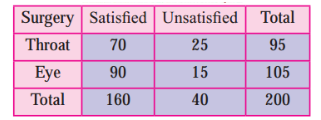
Two hundred patients who had either Eye surgery or Throat surgery were asked whether they were satisfied or unsatisfied regarding the result of their surgery. The following table summarizes their response.

Image

If one person from the 200 patients is selected at random, determine the probability (a) that the person was satisfied given that the person had Throat surgery.

2.that person was unsatisfied given that the person had eye surgery.

3.the person had Throat surgery given that the person was unsatisfied.

Answer
Let event A: The patient was satisfied,

event B: The patient had throat surgery.

Given, n(S) = 200

n(A ∩ B) = 70

$\begin{aligned} & \therefore P ( A \cap B )=\frac{ n ( A n B )}{ n ( S )}=\frac{70}{200} \\ & n ( B )=95 \\ & \therefore P ( B )=\frac{n(B)}{n(S)}=\frac{95}{200}\end{aligned}$

∴ Required probability = P(A / B)

$\begin{aligned} & =\frac{P(A \cap B)}{P(B)} \\ & =\frac{\left(\frac{70}{200}\right)}{\left(\frac{95}{200}\right)} \\ & =\frac{70}{95} \\ & =\frac{14}{19}\end{aligned}$

Check:

Reduce the sample space to the set of throat patients only.

n(S) = 95 Let E : Patient had satisfactory throat surgery.

n(E) = 70

$\therefore P ( E )=\frac{n(E)}{n(S)}=\frac{70}{95}=\frac{14}{19}$

Let event C : The patient was unsatisfied,

event D : The patient had a eye surgery.

Given, n(S) = 200 n(C ∩ D) = 15

$\begin{aligned} & \therefore P (C \cap D )=\frac{n(C \cap D)}{n(S)}=\frac{15}{200} \\ & n ( D )=105 \\ & \therefore P ( D )=\frac{105}{200}\end{aligned}$

Required probability = P(C / D)

$\begin{aligned} & =\frac{P(C \cap D)}{P(D)} \\ & =\frac{\left(\frac{15}{200}\right)}{\left(\frac{105}{200}\right)} \\ & =\frac{1}{7}\end{aligned}$

Let event F : The patient had a throat surgery,

event G : The patient was unsatisfied.

Given, n(S) = 200

n(F ∩ G) = 25

$\begin{aligned} & \therefore P ( F \cap G )=\frac{n(F \cap G)}{n(S)}=\frac{25}{200} \\ & n (G)=40 \\ & \therefore P (G)=\frac{n(G)}{n(S)}=\frac{40}{200}\end{aligned}$

∴ Required probability = P(F / G)

$\begin{aligned} & =\frac{P(F \cap G)}{P(G)} \\ & =\frac{\left(\frac{25}{200}\right)}{\left(\frac{40}{200}\right)} \\ & =\frac{5}{8}\end{aligned}$

View full question & answer
Question 55 Marks
The probability that a student $X$ solves a problem in dynamics is $\frac{2}{5}$ and the probability that

student $Y$ solves the same problem is $\frac{1}{4}$. What is the probability that

i. the problem is not solved?

ii. the problem is solved?

iii. the problem is solved exactly by one of them?

Answer
Let event A: Student X solves the problem in dynamics, event B: Student Y solves the problem in dynamics.

$\begin{aligned} & \therefore P(A)=\frac{2}{5}, P(B)=\frac{1}{4} \\ & \therefore P\left(A^{\prime}\right)=1-P(A)=1-\frac{2}{5}=\frac{3}{5} \\ & P\left(B^{\prime}\right)=1-P(B)=1-\frac{1}{4}=\frac{3}{4}\end{aligned}$

Since A and B are independent events, A’ and B’ are also independent events.

(i) Let event C: Problem is not solved.

$\begin{aligned} & \therefore P(C)=P\left(A^{\prime} \cap B^{\prime}\right) \\ & =P\left(A^{\prime}\right) \cdot P\left(B^{\prime}\right) \\ & =\frac{3}{5} \times \frac{3}{4} \\ & =\frac{9}{20}\end{aligned}$

Let event b: Problem is solved.

Problem can be solved if at least one of the two students solves the problem.

∴ P(D) = P(at least one student solves the problem)

= 1 – P(no student solves the problem)

= 1 – P(A’ ∩ B’)

= 1 – P(A’) P(B’)

$\begin{aligned} & =1-\frac{3}{5} \times \frac{3}{4} \\ & =1-\frac{9}{20} \\ & =\frac{11}{20}\end{aligned}$

Let event c: The problem is solved exactly by one of them.

∴ P(E) = P(A’ ∩ B) ∪ P(A ∩ B’)

= P(A’) . P(B) + P(A) . P(B’)

$\begin{aligned} & =\left(\frac{3}{5} \times \frac{1}{4}\right)+\left(\frac{2}{5} \times \frac{3}{4}\right) \\ & =\frac{3}{20}+\frac{6}{20} \\ & =\frac{9}{20}\end{aligned}$

View full question & answer
Question 65 Marks
A bag contains 75 tickets numbered from 1 to 75. One ticket is drawn at random. Find the probability that,

(i) number on the ticket is a perfect square or divisible by 4.

(ii)number on the ticket is a prime number or greater than 40.
Answer
Out of the 75 tickets, one ticket can be drawn in ${ }^{75} C _1=75$ ways.

∴ n(S) = 75

(i) Let event A: The number on the ticket is a perfect square.

∴ A = {1, 4, 9, 16, 25, 36, 49, 64}

∴ n(A) = 8

$\therefore P ( A )=\frac{n(A)}{n(S)}=\frac{8}{75}$

Let event B: The number on the ticket is divisible by 4.

∴ B = {4, 8, 12, 16, 20, 24, 28, 32, 36, 40, 44, 48, 52, 56, 60, 64, 68, 72}

∴ n(B) = 18

$\therefore P ( B )=\frac{n(B)}{n(S)}=\frac{18}{75}$

Now, A ∩ B = {4, 16, 36, 64}

∴ n(A ∩ B) = 4

$\therefore P(A \cap B)=\frac{n(A \mid B)}{n(S)}=\frac{4}{75}$

∴ Required probability

P(A ∪ B) = P(A) + P(B) – P(A ∩ B)

$\begin{aligned} & =\frac{8}{75}+\frac{18}{75}-\frac{4}{75} \\ & =\frac{22}{75}\end{aligned}$

(ii)Let event A: The number on the ticket is a prime number.

∴ A = {2, 3, 5, 7, 11, 13, 17, 19, 23, 29, 31, 37, 41, 43, 47, 53, 59, 61, 67, 71, 73}

∴ n(A) = 21

$\therefore P(A)=\frac{n(A)}{n(S)}=\frac{21}{75}$

Let event B: The number is greater than 40.

∴ B = {41, 42, 43, 44, 45, 46, 47, 48, 49, 50, 51, 52, 53, 54, 55, 56, 57, 58, 59, 60, 61, 62, 63, 64, 65, 66, 67, 68, 69, 70, 71, 72, 73, 74, 75}

∴ n(B) = 35

$\therefore P ( B )=\frac{ n ( B )}{ n ( S )}=\frac{35}{75}$

Now,

A ∩ B = {41, 43, 47, 53, 59, 61, 67, 71, 73}

∴ n(A ∩ B) = 9

$\therefore n ( A \cap B )=\frac{ n ( A \cap B )}{ n ( S )}=\frac{9}{75}$

∴ Required probability

P(A ∪ B) = P(A) + P(B) – P(A ∩ B)

$\begin{aligned} & =\frac{21}{75}+\frac{35}{75}-\frac{9}{75} \\ & =\frac{47}{75}\end{aligned}$

View full question & answer
Question 75 Marks
A girl is preparing for National Level Entrance exam and State Level Entrance exam for professional courses. The chances of her cracking National Level exam is 0.42 and that of State Level exam is 0.54. The probability that she clears both the exams is 0.11. Find the probability that(i) she cracks at least one of the two exams.
(ii)she cracks only one of the two.
(iii)she cracks none.
Answer
Let event A: The girl cracks the National Level exam.
$\therefore P ( A )=0.42$
Let event B: The girl cracks the State Level exam.
$\therefore P ( B )=0.54$
Also, $P(A \cap B)=0.11$
(i) $P$ (the girl cracks at least one of the two exams)
$ P(A \cup B)=P(A)+P(B)-P(A \cap B)$
$=0.42+0.54-0.11$
$=0.85 $
2. P(the girl cracks only one of the two exams)
= P(A) – P(B) – 2P(A ∩ B)
= 0.42 + 0.54 – 2(0.11)
= 0.74
3. P(the girl cracks none of the exams)
= P(A’ ∩ B’)
= P(A ∪ B)’
= 1 – P(A ∪ B)
= 1 – 0.85
= 0.15
View full question & answer
Question 85 Marks
A card is drawn from a pack of 52 cards. What is the probability that, (i) card is either red or black?

(ii) card is either black or a face card?

Answer
One card can be drawn from the pack of 52 cards in ${ }^{52} C _1=52$ ways.

∴ n(S) = 52

The pack of 52 cards consists of 26 red and 26 black cards.

(i) Let event A: A red card is drawn.

$\therefore$ Red card can be drawn in ${ }^{26} C _1=26$ ways

∴ n(A) = 26

$\therefore P(A)=\frac{n(A)}{n(S)}=\frac{26}{52}$

Let event B: A black card is drawn.

$\therefore$ Black card can be drawn in ${ }^{26} C _1=26$ ways.

∴ n(B) = 26

$\therefore P ( B )=\frac{n(B)}{n(S)}=\frac{26}{52}$

Since A and B are mutually exclusive events,

P(A ∩ B) = 0

∴ Required probability P(A ∪ B)= P(A) + P(B)

$\begin{aligned} & =\frac{26}{52}+\frac{26}{52} \\ & =1\end{aligned}$

Let event A: A black card is drawn.

$\therefore$ Black card can be drawn in ${ }^{26} C _1=26$ ways.

n(A) = 26 n(A) 26 n(S) ~ 52

Let event B: A face card is drawn.

There are 12 face cards in the pack of 52 cards.

$\therefore 1$ face card can be drawn in ${ }^{12} C _1=12$ ways.

∴ n(B) = 12

$\therefore P(B)=\frac{n(B)}{n(S)}=\frac{12}{52}$

There are 6 black face cards. ∴ n(A ∩ B) = 6

$\therefore P ( A \cap B )=\frac{n(A \cap B)}{n(S)}=\frac{6}{52}$

∴ Required probability

P(A ∪ B) = P(A) + P(B) – P(A ∩ B)

$\begin{aligned} & =\frac{26}{52}+\frac{12}{52}-\frac{6}{52} \\ & =\frac{32}{52} \\ & =\frac{8}{13}\end{aligned}$

View full question & answer
Question 95 Marks
Two cards are drawn from a pack of 52 cards. Find the probability that (a) one is a face card and the other is an ace card.

(b)one is a club and the other is a diamond.

(c)both are from the same suit.

(d)both are red cards.

(e)one is a heart card and the other is a non-heart card.

Answer
Two cards are drawn from a pack of 52 cards. Find the probability that (a) one is a face card and the other is an ace card.

(b)one is a club and the other is a diamond.

(c)both are from the same suit.

(d)both are red ca

Two cards can be drawn from a pack of 52 cards in ${ }^{52} C _2$ ways.

$\therefore n(S)={ }^{52} C _2$

Let event A: Out of the two cards drawn, one is a face card and the other is an ace card. There are 12 face cards and 4 ace cards in a pack of 52 cards.

$\therefore$ One face card can be drawn from 12 face cards in ${ }^{12} C _1$ ways and one ace card can be

drawn from 4 ace cards in ${ }^4 C _1$ ways.

$\begin{aligned} & \therefore n ( A )={ }^{12} C _1 \times{ }^4 C _1 \\ & \therefore P ( A )=\frac{ n ( A )}{ n ( S )}=\frac{{ }^{12} C _1 \times{ }^4 C _1}{{ }^{52} C _2}=\frac{12 \times 4}{\frac{52 \times 51}{2 \times 1}}=\frac{8}{221}\end{aligned}$

Let event B: Out of the two cards drawn, one is club and the other is a diamond card.There are 13 club cards and 13 diamond cards.

$\therefore$ One club card can be drawn from 13 club cards in ${ }^{13} C _1$ ways and one diamond card can

be drawn from 13 diamond cards in ${ }^{13} C _1$ ways.

$\begin{aligned} & \therefore n ( B )={ }^{13} C_1 \times{ }^{13} C_1 \\ & \therefore P ( B )=\frac{n(B)}{n(S)}=\frac{{ }^{13} C_1 \times{ }^{13} C_1}{{ }^{52} C_2}=\frac{13 \times 13}{\frac{52 \times 51}{2 \times 1}}=\frac{13}{102}\end{aligned}$

Let event C: Both the cards drawn are of the same suit.A pack of 52 cards consists of 4 suits each containing 13 cards.

$\therefore 2$ cards can be drawn from the same suit in ${ }^{13} C _2$ ways.

$\begin{aligned} & \therefore n ( C )={ }^{13} C _2 \times 4 \\ & \therefore P ( C )=\frac{ n ( C )}{ n ( S )}=\frac{4 \times{ }^{13} C _2}{{ }^{52} C _2}=\frac{4 \times 13 \times 12}{52 \times 51}=\frac{4}{17}\end{aligned}$

Let event D: Both the cards drawn are red. There are 26 red cards in the pack of 52 cards.

$\therefore 2$ cards can be drawn from them in ${ }^{26} C _2$ ways.

$\begin{aligned} & \therefore n ( D )={ }^{26} C _2 \\ & \therefore P ( D )=\frac{n(D)}{n(S)}=\frac{{ }^{26} C_2}{{ }^{52} C_2}=\frac{26 \times 25}{52 \times 51}=\frac{25}{102}\end{aligned}$

Let event E: Out of the two cards drawn, one is heart and other is non-heart. There are 13 heart cards in a pack of 52 cards, i.e., 39 cards are non-heart.

$\therefore$ One heart card can be drawn from 13 hdart cards in ${ }^{13} C _1$ ways and one non-heart card

can be drawn from 39 cards in ${ }^{39} C_1$ ways.

$\begin{aligned} & \therefore n ( E )={ }^{13} C_1\times{ }^{39} C _1 \\ &\therefore P ( E )=\frac{ n ( E )}{ n ( S )}=\frac{{ }^{13} C _1 \times{ }^{39} C _1}{{ }^{52} C _2}=\frac{13\times 39}{\frac{52 \times 51}{2 \times 1}}=\frac{13}{34}\end{aligned}$

View full question & answer
Question 105 Marks
Two fair dice are thrown. State the sample space and write the favourable outcomes for the following events.

A : Sum of numbers on two dice is divisible by 3 or 4.

B : The sum of numbers on two dice is 7.

C : Odd number on the first die.

D : Even number on the first die.

E: Check whether events A and B are mutually exclusive and exhaustive.

F: Check whether events C and D are mutually exclusive and exhaustive.

Answer
When two dice are thrown, the sample space is

S = {(1, 1), (1, 2), (1, 3), (1, 4), (1, 5), (1, 6),

(2, 1), (2, 2), (2, 3), (2, 4), (2, 5), (2, 6),

(3, 1), (3, 2), (3, 3), (3, 4), (3, 5), (3, 6),

(4, 1), (4, 2), (4, 3), (4, 4), (4, 5), (4, 6),

(5, 1), (5, 2), (5, 3), (5, 4), (5, 5), (5, 6),

(6, 1), (6, 2), (6, 3), (6,4), (6, 5), (6, 6)}

∴ n(S) = 36

(a) A: Sum of the numbers on two dice is divisible by 3 or 4.

∴ A = {(1, 2), (1, 3), (1, 5), (2, 1), (2, 2), (2, 4), (2, 6), (3, 1), (3, 3), (3, 5), (3, 6), (4, 2), (4, 4), (4, 5), (5, 1), (5, 3), (5, 4), (6, 2), (6, 3), (6, 6)}

B: Sum of the numbers on two dice is 7.

∴ B = {(1, 6), (2, 5), (3, 4), (4, 3), (5, 2), (6, 1)}

C: Odd number on the first die.

∴ C = {(1, 1), (1, 2), (1, 3), (1, 4), (1, 5), (1, 6), (3, 1), (3, 2), (3, 3), (3, 4), (3, 5), (3, 6), (5, 1), (5, 2), (5, 3), (5, 4), (5, 5), (5, 6)}

D: Even number on the first die.

∴ D = {(2, 1), (2, 2), (2, 3), (2, 4), (2, 5), (2, 6), (4, 1), (4, 2), (4, 3), (4, 4), (4, 5), (4, 6), (6, 1), (6, 2), (6, 3), (6, 4), (6, 5), (6, 6)}

A and B are mutually exclusive events as A ∩ B = Φ.

A ∪ B = {(1, 2), (1, 3), (1, 5), (1, 6), (2, 1), (2, 2), (2, 4), (2, 5), (2, 6), (3, 1), (3, 3), (3, 4), (3, 5), (3, 6), (4, 2), (4, 3), (4, 4), (4, 5), (5, 1), (5, 2), (5, 3), (5, 4), (6, 1), (6, 2), (6, 3), (6, 6)} ≠ S

∴ A and B are not exhaustive events as A ∪ B ≠ S.

C and D are mutually exclusive events as C ∩ D = Φ.

C ∪ D = {(1, 1), (1, 2), (1, 3), (1, 4), (1, 5), (1, 6), (2, 1), (2, 2), (2, 3), (2, 4), (2, 5), (2, 6), (3, 1), (3, 2), (3, 3), (3, 4), (3, 5), (3, 6), (4, 1), (4, 2), (4, 3), (4, 4), (4, 5), (4, 6), (5, 1), (5, 2), (5, 3), (5, 4), (5, 5), (5, 6), (6, 1), (6, 2), (6, 3), (6, 4), (6, 5), (6, 6)} = S

∴ C and D are exhaustive events.

View full question & answer