There are 5 girls and 2 boys, then the probability that no two boys are sitting together for a photograph is
- A$\frac{1}{21}$
- B$\frac{4}{7}$
- C$\frac{2}{7}$
- ✓$\frac{5}{7}$
Answer: D.
View full solution →306 questions across 7 question groups — pick any mix to generate a Maths paper with step-by-step answer keys.
MCQ
194 Q→02Solve the Following Question.(2 Marks)
28 Q→03Solve the Following Question.(3 Marks)
30 Q→04Solve the Following Question.(4 Marks)
31 Q→05Solve the Following Question.(5 Marks)
10 Q→06Answer the following questions in short.
9 Q→07Complete the following activities and rewrite it : (2M)
4 Q→One sample from each question group in this chapter. Select any group above to see the full set with answer keys.
Answer: D.
View full solution →Answer: B.
View full solution →Answer: C.
View full solution →Answer: D.
View full solution →$\frac{2}{3}$. If the student does not know the answer, then the student guesses the answer. Theprobability of the guessed answer being correct is $\frac{1}{4}$. Given that the student has answered
the question correctly, the probability that the student knows the correct answer is
Answer: D.
View full solution →(i) P(B)
2. P(A/B)
3. P(B’/A)
(i) both the children are girls.
ii. both the children are girls given that at least one of them is a girl.
respectively. Their chances of introducing IT in the college are $\frac{1}{2}, \frac{1}{3}, \frac{1}{4}$ respectively. Find
the probability that (a) IT is introduced in the college after one of them is selected as a principal.
B. IT is introduced by Q.
independent, $A$ and $B$ are disjoint, $P(A \cup C)=\frac{2}{3}, P(B \cup C)=\frac{3}{4}, P(A \cup B \cup C)=\frac{11}{12}$. Find
P(A), P(B) and P(C).
(i) P(A’/B)
probability that his wife who is 40 years old will be alive till she becomes 65 is $\frac{3}{8}$. What is
the probability that, 25 years hence,
the couple will be alive?
(b)exactly one of them will be alive?
(c)none of them will be alive?
(d)at least one of them will be alive?
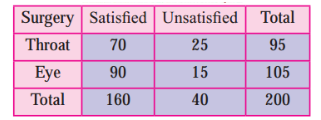
If one person from the 200 patients is selected at random, determine the probability (a) that the person was satisfied given that the person had Throat surgery.
2.that person was unsatisfied given that the person had eye surgery.
3.the person had Throat surgery given that the person was unsatisfied.
student $Y$ solves the same problem is $\frac{1}{4}$. What is the probability that
i. the problem is not solved?
ii. the problem is solved?
iii. the problem is solved exactly by one of them?
Pick question groups from the list above, set marks and difficulty, and export a branded PDF with step-by-step answer keys. First 3 chapters free — no signup.