Questions

Solve the Following Question.(3 Marks)

Take a timed test

14 questions · self-marked practice — reveal the answer and mark yourself.

Question 13 Marks
Prove the following : $\frac{(1+\cot \theta+\tan \theta)(\sin \theta-\cos \theta)}{\sec ^3 \theta-\operatorname{cosec}^3 \theta}=\sin ^2 \theta \cos ^2 \theta$
Answer
$\text { L.H.S. }=\frac{(1+\cot \theta+\tan \theta)(\sin \theta-\cos \theta)}{\sec ^3 \theta-\operatorname{cosec}^3 \theta}$
$=\frac{\left(1+\frac{\cos \theta}{\sin \theta}+\frac{\sin \theta}{\cos \theta}\right)(\sin \theta-\cos \theta)}{\frac{1}{\cos ^3 \theta}-\frac{1}{\sin ^3 \theta}}$
$=\frac{\left(\frac{\sin \theta \cos \theta+\cos ^2 \theta+\sin ^2 \theta}{\sin \theta \cos \theta}\right)(\sin \theta-\cos \theta)}{\frac{\sin ^3 \theta-\cos ^3 \theta}{\sin ^3 \theta \cos ^3 \theta}}$
$=\frac{\left(\sin \theta \cos \theta+\cos ^2 \theta+\sin ^2 \theta\right)(\sin \theta-\cos \theta)}{\sin \theta \cos \theta}\times \frac{\sin ^3 \theta \cos ^3 \theta}{\sin ^3 \theta-\cos ^3 \theta}$
$=\frac{(\sin \theta-\cos \theta)\left(\sin ^2 \theta+\sin \theta \cos \theta+\cos ^2 \theta\right) \sin ^2 \theta \cos ^2 \theta}{\sin ^3 \theta-\cos ^3 \theta}$
$=\frac{(\sin \theta-\cos \theta)\left(\sin ^2 \theta+\sin \theta \cos \theta+\cos ^2 \theta\right) \sin ^2 \theta \cos ^2 \theta}{(\sin \theta-\cos \theta)\left(\sin ^2 \theta+\sin \theta \cos \theta+\cos ^2 \theta\right)}$
$\ldots\left[\because a^3-b^3=(a-b)\left(a^2+a b+b^2\right)\right]$
$=\sin ^2 \theta \cos ^2 \theta$
$=\text { R.H.S. }$
View full question & answer
Question 23 Marks
If $\sec \theta=\sqrt{2}$ and $\frac{3 \pi}{2}<\theta<2 \pi$, then evaluate $\frac{1+\tan \theta+\operatorname{cosec} \theta}{1+\cot \theta-\operatorname{cosec} \theta}$
Answer
Given $\sec \theta=\sqrt{2}$
We know that,
$ \tan ^2 \theta=\sec ^2 \theta-1$
$=(\sqrt{2})-1$
$=2-1=1$
$\therefore \tan \theta= \pm 1$
$\text { Since } \frac{3 \pi}{2}<\theta<2 \pi $
$\theta$ lies in the 4 th quadrant.
$ \therefore \tan \theta<0$
$\therefore \tan \theta=-1$
$\cot \theta=\frac{1}{\tan \theta}=-1$
$\cos \theta=\frac{1}{\sec \theta}=\frac{1}{\sqrt{2}}$
$\tan \theta=\frac{\sin \theta}{\cos \theta} $
$ \therefore$
$\sin \theta=\tan \theta \cos \theta$
$=(-1)\left(\frac{1}{\sqrt{2}}\right)=-\frac{1}{\sqrt{2}} $
$\begin{aligned}
\therefore \quad & \operatorname{cosec} \theta=\frac{1}{\sin \theta}=-\sqrt{2} \\
\therefore \quad & \frac{1+\tan \theta+\operatorname{cosec} \theta}{1+\cot \theta-\operatorname{cosec} \theta} \\
& =\frac{1-1-\sqrt{2}}{1-1+\sqrt{2}}=\frac{-\sqrt{2}}{\sqrt{2}}=-1
\end{aligned}$
View full question & answer
Question 33 Marks
If $\sin \theta=\frac{x^2-y^2}{x^2+y^2}$, then find the values of $\cos \theta, \tan \theta$ in terms of $x$ and $y$.
Answer
Given, $\sin \theta=\frac{x^2-y^2}{x^2+y^2}$
we know that
$
\begin{aligned}
& \cos ^2 \theta=1-\sin ^2 \theta \\
&=1-\frac{\left(x^2-y^2\right)^2}{\left(x^2+y^2\right)^2} \\
&=\frac{\left(x^2+y^2\right)^2-\left(x^2-y^2\right)^2}{\left(x^2+y^2\right)^2} \\
&=\frac{x^4+2 x^2 y^2+y^4-\left(x^4-2 x^2 y^2+y^4\right)}{\left(x^2+y^2\right)^2}
\end{aligned}
$
$
\begin{aligned}
\therefore \quad \cos ^2 \theta & =\frac{4 x^2 y^2 \{\left(x^2+y^2\right)^2} \\
\\ \therefore \quad \cos \theta & = \pm frac{2 x y}{\left(x^2+y^2\right)} \\
\tan \theta= & \frac{\sin \theta}{\cos \theta} \\
& =\frac{\frac{x^2-y^2}{x^2+y^2}}{} \\
& \pm \frac{2 x y}{x^2+y^2} \\
& = \pm \frac{x^2-y^2}{2 x y}
\end{aligned}
$
View full question & answer
Question 43 Marks
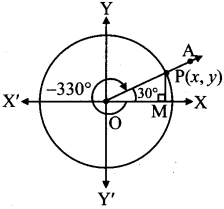
Find the trigonometric functions of $: -330^\circ$
Answer
Image
Angle of measure $\left(-330^{\circ}\right)$ :
Let $m \angle X O A=-330^{\circ}$
Its terminal arm (ray $O A$ ) intersects the standard unit circle at $P(x, y)$.
Draw seg PM perpendicular to the $\mathrm{X}$-axis.
$\therefore \triangle O M P$ is a $30^{\circ}-60^{\circ}-90^{\circ}$ triangle.
$O P=1$
$ \mathrm{OM}  =\frac{\sqrt{3}}{2} \mathrm{OP}$
$ =\frac{\sqrt{3}}{2}(1)$
$ =\frac{\sqrt{3}}{2}$
$\mathrm{PM}  =\frac{1}{2} \mathrm{OP}$
$ =\frac{1}{2}(1)$
$ =\frac{1}{2}$
Since point $P$ lies in the 1st quadrant, $x>0, y>0$
$ \therefore \mathrm{x}=\mathrm{OM}=\frac{\sqrt{3}}{2} \text { and } \mathrm{y}=\mathrm{PM}=\frac{1}{2}$
$\therefore \quad \mathrm{P} \equiv\left(\frac{\sqrt{3}}{2}, \frac{1}{2}\right)$
$\sin \left(-330^{\circ}\right)=y=\frac{1}{2}$
$\cos \left(-330^{\circ}\right)=x=\frac{\sqrt{3}}{2}$
$\tan \left(-330^{\circ}\right)=\frac{y}{x}=\frac{\frac{1}{2}}{\frac{\sqrt{3}}{2}}=\frac{1}{\sqrt{3}}$
$\operatorname{cosec}\left(-330^{\circ}\right)=\frac{1}{y}=\frac{1}{\left(\frac{1}{2}\right)}=2$
$\sec \left(-330^{\circ}\right)=\frac{1}{x}=\frac{1}{\left(\frac{\sqrt{3}}{2}\right)}=\frac{2}{\sqrt{3}}$
$\cot \left(-330^{\circ}\right)=\frac{x}{y}=\frac{\frac{\sqrt{3}}{2}}{\left(\frac{1}{2}\right)}=\sqrt{3} $
View full question & answer
Question 53 Marks
Find the trigonometric functions of : -300°
Answer
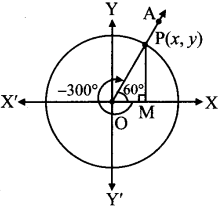
Image
Angle of measure $\left(-300^{\circ}\right)$ :
Let $m \angle X O A=-300^{\circ}$ Its terminal arm (ray $O A$ ) intersects the standard unit circle at $P(x, y)$.
Draw seg PM perpendicular to the $X$-axis.
$\triangle O M P$ is a $30^{\circ}-60^{\circ}-90^{\circ}$ triangle.
$O P=1$
$ \mathrm{OM}  =\frac{1}{2} \mathrm{OP}$
$ =\frac{1}{2}(1)$
$ =\frac{1}{2}$
$\mathrm{PM} =\frac{\sqrt{3}}{2} \mathrm{OP}$
$ =\frac{\sqrt{3}}{2}(1)$
$=\frac{\sqrt{3}}{2} $
Since point $P$ lies in the 1st quadrant, $x>0, y>0$ $ x=O M=\frac{1}{2} \text { and }$
$y=P M=\frac{\sqrt{3}}{2} $
$\therefore \quad P=\left(\frac{1}{2}, \frac{\sqrt{3}}{2}\right)$
$ \sin \left(-300^{\circ}\right)=y=\frac{\sqrt{3}}{2}$
$\cos \left(-300^{\circ}\right)=x=\frac{1}{2} $
$\tan \left(-300^{\circ}\right)=\frac{y}{x}=\frac{\left(\frac{\sqrt{3}}{2}\right)}{\left(\frac{1}{2}\right)}=\sqrt{3}$
$\operatorname{cosec}\left(-300^{\circ}\right)=\frac{1}{y}=\frac{1}{\left(\frac{\sqrt{3}}{2}\right)}=\frac{2}{\sqrt{3}}$
$ \sec \left(-300^{\circ}\right)=\frac{1}{x}=\left(\frac{1}{\frac{1}{2}}\right)=2$
$\cot \left(-300^{\circ}\right)=\frac{x}{y}=\frac{\frac{1}{2}}{\frac{\sqrt{3}}{2}}=\frac{1}{\sqrt{3}} $
View full question & answer
Question 63 Marks
Find the trigonometric functions of $: -180^\circ$
Answer
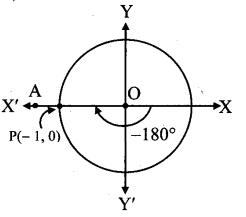
Image
Angle of measure $\left(-180^{\circ}\right)$ :
Let $m \angle X O A=-180^{\circ}$
Its terminal arm (ray $O A)$ intersects the standard unit circle at $P(-1,0)$.
$ \therefore x=-1 \text { andy }=0$
$\sin \left(-180^{\circ}\right)=y=0$
$\cos \left(-180^{\circ}\right)=x$
$=-1 $
$ \tan \left(-180^{\circ}\right) =\frac{y}{x}$
$ =\frac{0}{-1}$
$ =0 $
$ \operatorname{cosec}\left(-180^{\circ}\right) =\frac{1}{y}$
$ =\frac{1}{0}, \text { which is not defined }$
$\sec \left(-180^{\circ}\right)=\frac{1}{x}=\frac{1}{-1}=-1$
$\cot \left(-180^{\circ}\right)=\underline{x}=-\frac{-1}{0}$, which is not defined
View full question & answer
Question 73 Marks
Find the trigonometric functions of $: -150^\circ$
Answer
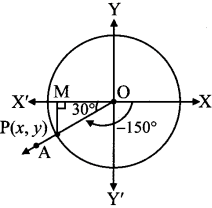
Image
Angle of measure $\left(-150^{\circ}\right)$ :
Let $m \angle X O A=-150^{\circ}$
Its terminal arm (ray $O A)$ intersects the standard unit circle at $P(x, y)$.
Draw seg PM perpendicular to the $X$-axis.
$\therefore \triangle O M P$ is a $30^{\circ}-60^{\circ}-90^{\circ}$ triangle.
$O P=1 =\frac{\sqrt{3}}{2} \mathrm{OP}$
$ =\frac{\sqrt{3}}{2}(1)$
$ =\frac{\sqrt{3}}{2}$
$\mathrm{PM} =\frac{1}{2} \mathrm{OP}$
$ =\frac{1}{2}(1)=\frac{1}{2} $
Since point $\mathrm{P}$ lies in the $3^{\text {rd }}$ quadrant,
$x<0, y<0$
$\therefore \quad x=-\mathrm{OM}=-\frac{\sqrt{3}}{2} \text { and } y=-\mathrm{PM}=-\frac{1}{2}$
$\therefore \quad \mathrm{P} \equiv\left(-\frac{\sqrt{3}}{2}, \frac{-1}{2}\right)$
$ \sin \left(-150^{\circ}\right)=y=-\frac{1}{2}$
$\cos \left(-150^{\circ}\right)=x=\frac{-\sqrt{3}}{2}$
$\tan \left(-150^{\circ}\right)=\frac{y}{x}=\frac{-\frac{1}{2}}{\frac{-\sqrt{3}}{2}}=\frac{1}{\sqrt{3}} $
$ \sec \left(-150^{\circ}\right)=\frac{1}{x}=\frac{1}{\left(\frac{-\sqrt{3}}{2}\right)}=-\frac{2}{\sqrt{3}}$
$\cot \left(-150^{\circ}\right)=\frac{x}{y}=\frac{\frac{-\sqrt{3}}{2}}{-\frac{1}{2}}=\sqrt{3} $
View full question & answer
Question 93 Marks
if $5 \tan A=\sqrt{2}, \pi<A<\frac{3 \pi}{2}$ and $\sec B=\sqrt{11}, \frac{3 \pi}{2}<B<2 \pi$ then find the value of $\operatorname{cosec} A-\tan B$
View full question & answer
Question 103 Marks
Prove that $\frac{\sin \theta}{1-\cos \theta}+\frac{\tan \theta}{1+\cos \theta}=\sec \theta \operatorname{cosec} \theta+\cot \theta$
View full question & answer
Question 113 Marks
Find sin θ such that $3 \cos \theta + 4 \sin \theta = 4.$
Answer
$ 3 \cos \theta+4 \sin \theta=4$
$\therefore 3 \cos \theta=4(1-\sin \theta) $
Squaring both the sides, we get.
$ 9 \cos ^2 \theta=16(1-\sin \theta)^2$
$\therefore 9\left(1-\sin ^2 \theta\right)=16\left(1+\sin ^2 \theta-2 \sin \theta\right)$
$\therefore 9-9 \sin ^2 \theta=16+16 \sin ^2 \theta-32 \sin \theta$
$\therefore 25 \sin ^2 \theta-32 \sin \theta+7=0$
$\therefore 25 \sin ^2 \theta-25 \sin \theta-7 \sin \theta+7=0$
$25 \sin \theta(\sin \theta-1)-7(\sin \theta-1)=0$
$\therefore(\sin \theta-1)(25 \sin \theta-7)=0$
$\therefore \sin \theta-1=0 \text { or } 25 \sin \theta-7=0$
$\therefore \sin \theta=1 \text { or } \sin \theta=\frac{7}{25}$
$\text { Since, }-1 \leq \sin \theta \leq 1$
$\therefore \sin \theta=1 \text { or } \frac{7}{25} $
[Note: Answer given in the textbook is 1 . However, as per our calculation it is 1 or $\frac{7}{25}$.]
View full question & answer
Question 123 Marks
Find the acute angle $0$ such that $5 \tan 2 0 + 3 = 9 \sec 0.$
Answer
$5 \tan ^2 \theta+3=9 \sec \theta$
$\therefore 5\left(\sec ^2 \theta-1\right)+3=9 \sec \theta$
$\therefore 5 \sec ^2 \theta-5+3=9 \sec \theta$
$\therefore 5 \sec ^2 \theta-9 \sec \theta-2=0$
$\therefore 5 \sec ^2 \theta-10 \sec \theta+\sec \theta-2=0$
$\therefore 5 \sec \theta(\sec \theta-2)+1(\sec \theta-2)=0$
$\therefore(\sec \theta-2)(5 \sec \theta+1)=0$
$\therefore \sec \theta-2=0 \text { or } 5 \sec \theta+1=0$
$\therefore \sec \theta=2 \text { or sec } \theta=-1 / 5$
$\text { Since sec } \theta \geq 1 \text { or sec } \theta \leq-1,$
$\sec \theta=2$
$\therefore \theta=60^{\circ} \ldots\left[\because \sec 60^{\circ}=2\right]$
View full question & answer
Question 133 Marks
Find the trigonometric functions of : – 315°
Answer

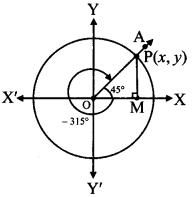
Image
Angle of measure $\left(315^{\circ}\right)$ :
Let $m \angle X O A 315^{\circ}$
Its terminal arm (ray $O A)$ intersects the standard unit circle at $P(x, y)$. Draw seg PM perpendicular to the X-axis.
$\triangle O M P$ is a $45^{\circ}-45^{\circ}-90^{\circ}$ triangle.
$\begin{aligned}
O P= & 1, \\
& O M=\frac{1}{\sqrt{2}} O P=\frac{1}{\sqrt{2}}(1)=\frac{1}{\sqrt{2}} \\
& P M=\frac{1}{\sqrt{2}} O P=\frac{1}{\sqrt{2}}(1)=\frac{1}{\sqrt{2}}
\end{aligned}$
Since point $P$ lies in the $1^{\text {st }}$ quadrant,
$x>0, y>0$
$\therefore \quad x=\mathrm{OM}=\frac{1}{\sqrt{2}} \text { and } y=\mathrm{PM}=\frac{1}{\sqrt{2}}$
$\therefore \quad \mathrm{P} \equiv\left(\frac{1}{\sqrt{2}}, \frac{1}{\sqrt{2}}\right)$
$\sin \left(-315^{\circ}\right)=y$
$=\frac{1}{\sqrt{2}}$
$\cos \left(-315^{\circ}\right)=x$
$=\frac{1}{\sqrt{2}}$
$\tan \left(-315^{\circ}\right)=\frac{y}{x}=\frac{\frac{1}{\sqrt{2}}}{\frac{1}{\sqrt{2}}}=1$
$\operatorname{cosec}\left(-315^{\circ}\right)=\frac{1}{y}=\frac{1}{\left(\frac{1}{\sqrt{2}}\right)}=\sqrt{2}$
$\sec \left(-315^{\circ}\right)=\frac{1}{x}=\frac{1}{\left(\frac{1}{\sqrt{2}}\right)}=\sqrt{2}$
$\cot \left(-315^{\circ}\right)=\frac{x}{y}=\frac{\frac{1}{\sqrt{2}}}{\frac{1}{\sqrt{2}}}=1$
View full question & answer
Question 143 Marks
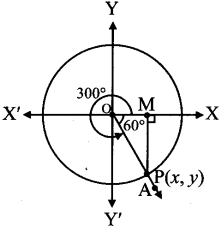
Find the trigonometric functions of : 300°
Answer
Image
Angle of measure $300^{\circ}$ :
Let $\mathrm{m} \angle \mathrm{XOA}=300^{\circ}$
Its terminal arm (ray $O A)$ intersects the standard unit circle at $P(x, y)$. Draw seg PM perpendicular to the $\mathrm{X}$-axis.
$\therefore \triangle \mathrm{OMP}$ is a $30^{\circ}-60^{\circ}-90^{\circ}$ triangle.
$ \mathrm{OP}  =1$
$\mathrm{OM}  =\frac{1}{2} \mathrm{OP}$
$ =\frac{1}{2}(1)$
$ =\frac{1}{2}$
$\mathrm{PM}  =\frac{\sqrt{3}}{2} \mathrm{OP}$
$ =\frac{\sqrt{3}}{2}(1)$
$ =\frac{\sqrt{3}}{2} $
$\mathrm{Y}^{\prime}$
$=\frac{\sqrt{3}}{2}$
Since point $P$ lies in the 1st quadrant, $x>0, y>0$
$ \mathrm{x}=\mathrm{OM}=\frac{1}{2}=\text { and } \mathrm{y}=-\mathrm{PM}=\frac{-\sqrt{3}}{2}$
$\sin 300^{\circ}=y=\frac{-\sqrt{3}}{2}$
$\cos 300^{\circ}=x=\frac{1}{2}$
$\tan 300^{\circ}=\frac{y}{x}=\frac{-\frac{\sqrt{3}}{2}}{\frac{1}{2}}=-\sqrt{3}$
$\operatorname{cosec} 300^{\circ}=\frac{1}{y}=\frac{1}{\left(-\frac{\sqrt{3}}{2}\right)}=-\frac{2}{\sqrt{3}}$
$\sec 300^{\circ}=\frac{1}{x}=\frac{1}{\left(\frac{1}{2}\right)}=2$
$\cot 300^{\circ}=\frac{x}{y}=\frac{\frac{1}{2}}{-\frac{\sqrt{3}}{2}}=-\frac{1}{\sqrt{3}} $
View full question & answer