Questions · Page 2 of 2

M.C.Q (1 Marks)

MCQ 511 Mark
The gravitational potential energy per unit mass at a point gives ________ at that point.
  • A
    gravitational field
  • gravitational potential
  • C
    gravitational potential energy
  • D
    gravitational force
Answer
Correct option: B.
gravitational potential
View full question & answer
MCQ 521 Mark
Calculate angular velocity of Earth so that acceleration due to gravity at $60^\circ$ latitude becomes zero. $($Radius of Earth $= 6400 \ km,$ gravitational acceleration at poles $= 10 \ m/s^2, cos60^\circ = 0.5)$
  • A
    $7.8 \times 10^{-2} \ rad/s$
  • B
    $0.5 \times 10^{-3}  \ radis$
  • C
    $1 \times 10^{-3} \ radis$
  • $2.5 \times 10^{-3} \ rad/s$
Answer
Correct option: D.
$2.5 \times 10^{-3} \ rad/s$
View full question & answer
MCQ 531 Mark
Which of the following statements is not correct for the decrease in the value of acceleration due to gravity?
  • A
    As we go down from the surtce of the Earth towards its centre.
  • B
    As we go up from the surface of the Earth.
  • As we go from equator to the poles on the surface on the Earth.
  • D
    As the rotational velocity of the Earth is increased.
Answer
Correct option: C.
As we go from equator to the poles on the surface on the Earth.
View full question & answer
MCQ 541 Mark
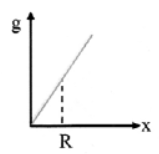
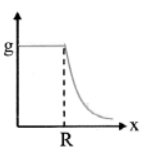
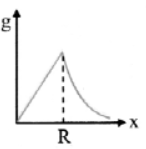
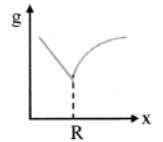
Variation of acceleration due to gravity (g) with distance x from the centre of the Earth is best represented by (R → Radius of the Earth)
  • A

    Image
  • B

    Image
  • C

    Image

  • Image
Answer
Correct option: D.

Image
(D)
View full question & answer
MCQ 551 Mark
If R is the radius of the Earth and g is the acceleration due to gravity on the Earth’s surface, the mean density of the Earth is
  • A
    $\frac{4 g}{3 \pi RG }$
  • B
    $\frac{4 \pi RG }{3 g}$
  • C
    $\frac{\pi Rg }{12 g}$
  • $\frac{3 g}{4 \pi RG }$
Answer
Correct option: D.
$\frac{3 g}{4 \pi RG }$
View full question & answer
MCQ 561 Mark
Acceleration due to gravity above the Earth’s surface at a height equal to the radius of the Earth is $.............$
  • $2.5 \ m/s^2$
  • B
    $5 \ m/s^2$
  • C
    $9.8 \ m/s^2$
  • D
    $10 \ m/s^2$
Answer
Correct option: A.
$2.5 \ m/s^2$
$2.5 \ m/s^2$
View full question & answer
MCQ 571 Mark
The gravitational constant $G$ is equal to $6.67 \times 10^{-11} N m^2/kg^2$ in vacuum. Its value in a dense matter of density $10^{10} g/cm^3$ will be
  • A
    $6.67 \times 10^{-1} N m ^2 / kg ^2$
  • $6.67 \times 10^{-11} N m ^2 / kg ^2$
  • C
    $6.67 \times 10^{-10} N m ^2 / kg ^2$
  • D
    $6.67 \times 10^{-21} N m ^2 / kg ^2$
Answer
Correct option: B.
$6.67 \times 10^{-11} N m ^2 / kg ^2$
View full question & answer
MCQ 581 Mark
If the distance between Sun and Earth is made two third times of the present value, then gravitational force between them will become
  • A
    $\frac{4}{9}$ times
  • B
    $\frac{2}{3}$ times
  • C
    $\frac{1}{3}$ times
  • $\frac{9}{4}$ times
Answer
Correct option: D.
$\frac{9}{4}$ times
$\frac{9}{4}$ times
View full question & answer
MCQ 591 Mark
Which of the following is not a property of gravitational force?
  • A
    It is an attractive force.
  • B
    It acts along the line joining the two bodies.
  • C
    The forces exerted by two bodies on each other form an action-reaction pair.
  • It has a very finite range of action.
Answer
Correct option: D.
It has a very finite range of action.
View full question & answer
MCQ 601 Mark
Mass of a particle at the centre of the Earth is
  • A
    infinite.
  • B
    zero.
  • same as at other places.
  • D
    greater than at the poles.
Answer
Correct option: C.
same as at other places.
View full question & answer
MCQ 611 Mark
The gravitational force between two bodies is ______
  • A
    attractive at large distance only
  • B
    attractive at small distance only
  • C
    repulsive at small distance only
  • attractive at all distances large or small
Answer
Correct option: D.
attractive at all distances large or small
View full question & answer
MCQ 621 Mark
Which of the following statements about the gravitational constant is true?
  • A
    It has no units.
  • B
    It has same value in all systems of units.
  • C
    It is a force.
  • It does not depend upon the nature of medium in which the bodies lie.
Answer
Correct option: D.
It does not depend upon the nature of medium in which the bodies lie.
View full question & answer
MCQ 631 Mark
If the mass of a body is M on the surface of the Earth, the mass of the same body on the surface of the moon is M
  • A
    6M
  • B
    $\frac{M}{6}$
  • M
  • D
    Zero
Answer
Correct option: C.
M
M
View full question & answer
MCQ 641 Mark
Newton’s law of gravitation is called universal law because
  • A
    force is always attractive.
  • B
    it is applicable to lighter and heavier bodies.
  • C
    it is applicable at all times,
  • it is applicable at all places of universe for all distances between all particles.
Answer
Correct option: D.
it is applicable at all places of universe for all distances between all particles.
View full question & answer
MCQ 651 Mark
Time period of revolution of a satellite around a planet of radius R is T. Period of revolution around another planet whose radius is 3R is
  • A
    T
  • B
    9 T
  • C
    3 T
  • $3 \sqrt{3} T$
Answer
Correct option: D.
$3 \sqrt{3} T$
$3 \sqrt{3} T$
View full question & answer
MCQ 661 Mark
A planet is revolving around a star in a circular orbit of radius $R$ with a period $T.$ If the gravitational force between the planet and the star is proportional to $R^{-3/2},$ then
  • $T^2 \propto R^{5 / 2}$
  • B
    $T^2 \propto R^{-7 / 2}$
  • C
    $T^2 \propto R^{3 / 2}$
  • D
    $T^2 \propto R^4$
Answer
Correct option: A.
$T^2 \propto R^{5 / 2}$
View full question & answer
MCQ 671 Mark
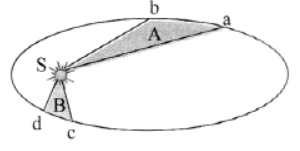
The figure shows the motion of a planet satellite in terms of mean density of Earth. around the Sun in an elliptical orbit with Sun at the focus. The shaded areas $A$ and $B$ are also shown in the figure which can be assumed to be equal. If $t_1$ and $t_2$ represent the time for the planet to move from $a$ to $b$ and $d$ to $c$ respectively, then
Image
  • A
    $t_1 < t_2$
  • B
    $t_1>t_2$
  • $t_1=t_2$
  • D
    $t_1 \leq t_2$
Answer
Correct option: C.
$t_1=t_2$
$t_1=t_2$
View full question & answer
MCQ 681 Mark
Amongst given statements, choose the correct statement.
(I) Kepler derived the laws of planetary motion.
(II) Newton provided the reason behind the laws of planetary motion.
  • A
    (I) is correct.
  • (II) is correct.
  • C
    Both (I) and (II) are correct.
  • D
    Neither (I) nor (II) is correct.
Answer
Correct option: B.
(II) is correct.
(II) is correct.
View full question & answer
MCQ 691 Mark
Kepler’s law of equal areas is an outcome of
  • A
    conservation of energy
  • B
    conservation of linear momentum
  • conservation of angular momentum
  • D
    conservation of mass
Answer
Correct option: C.
conservation of angular momentum
View full question & answer
M.C.Q (1 Marks) - Page 2 - Physics STD 11 Questions - Vidyadip