MCQ 11 Mark
If three particles $A , B$ and $C$ are having velocities $\overrightarrow{v}_A, \overrightarrow{v}_B$ and $\overrightarrow{v}_C$ which of the following formula gives the relative velocity of $A$ with respect to $B$
- A
$\overrightarrow{ v } A+\overrightarrow{ v } B$
- B
$\overrightarrow{ v }_A-\overrightarrow{ v }_C+\overrightarrow{ v }_B$
- ✓
$\overrightarrow{ v }_A-\overrightarrow{ v }_B$
- D
$\overrightarrow{ v }_C-\overrightarrow{ v }_A$
AnswerCorrect option: C. $\overrightarrow{ v }_A-\overrightarrow{ v }_B$
View full question & answer→MCQ 21 Mark
For uniform acceleration in rectilinear motion which of the following is not correct?
- A
Velocity-time graph is linear
- B
Acceleration is the slope of velocity time graph
- C
The area under the velocity-time graph equals displacement
- ✓
Velocity-time graph is nonlinear
AnswerCorrect option: D. Velocity-time graph is nonlinear
Velocity-time graph is nonlinear
View full question & answer→MCQ 31 Mark
The bob of a conical pendulum undergoes ___________
- A
Rectilinear motion in horizontal plane
- ✓
Uniform motion in a horizontal circle
- C
Uniform motion in a vertical circle
- D
Rectilinear motion in vertical circle
AnswerCorrect option: B. Uniform motion in a horizontal circle
Uniform motion in a horizontal circle
View full question & answer→MCQ 41 Mark
For a particle having a uniform circular motion, which of the following is constant ____________.
MCQ 51 Mark
An object thrown from a moving bus is on example of __________
MCQ 61 Mark
A string of length ' $L$ ' fixed at one end carries a body of mass ' $m$ ' at the other end. The mass is revolved in a circle in the horizontal plane about a vertical axis passing through the fixed end of the string. The string makes angle ' $\theta$ ' with the vertical. The angular frequency of the body is ' $\omega$ '. The tension in the string is
- A
$m L^2 \omega$
- ✓
$m L \omega^2$
- C
$\frac{\omega^2}{m L}$
- D
$\frac{m \omega^2}{L}$
AnswerCorrect option: B. $m L \omega^2$
(b) : Tension, $T=$ centripetal force $=m L \omega^2$
View full question & answer→MCQ 71 Mark
A particle at rest starts moving with constant angular acceleration $4
rad / s ^2$ in circular path.At what time the magnitude of its tangential acceleration and centrifugal acceleration will be equal?
- A
$0.4 s$
- ✓
$0.5 s$
- C
$0.8 s$
- D
$1.0 s$
AnswerCorrect option: B. $0.5 s$
(b) : Here : angular acceleration, $\alpha=4 rad / s ^2$
$
\frac{d \omega}{d t}=4 \Rightarrow \omega=4 t rad / s ; v=r \omega=4 t r
$
Given, $a_T=a_C \Rightarrow \alpha r=\frac{v^2}{r} \Rightarrow 4 r=\frac{16 t^2 r^2}{r}$
$
\Rightarrow t^2=\frac{1}{4} \Rightarrow t=0.5 sec
$
View full question & answer→MCQ 81 Mark
The position $x$ of a particle varies with a time as $x=a t^2-b t^3$ where $a$ and $b$ are constants. The acceleration of the particle will be zero at time $t$ is equal to
- A
$\frac{2 a}{3 b}$
- B
$\frac{a}{b}$
- ✓
$\frac{a}{3 b}$
- D
AnswerCorrect option: C. $\frac{a}{3 b}$
Given, $x=a t^2-b t^3$
$v=\frac{d x}{d t}=2 a t-3 b t^2 ; A=\frac{d v}{d t}=2 a-6 b t=0 ;$
$t=\frac{2 a}{6 b}=\frac{a}{3 b}$
View full question & answer→MCQ 91 Mark
A particle moves around a circular path of radius ' $r$ ' with uniform speed ' $V$ '. After moving half the circle, the average acceleration of the particle is
- A
$\frac{V^2}{r}$
- B
$\frac{2 V^2}{r}$
- ✓
$\frac{2 V^2}{\pi r}$
- D
$\frac{V^2}{\pi r}$
AnswerCorrect option: C. $\frac{2 V^2}{\pi r}$
(c) : Change in velocity $=\vec{V}_2-\vec{V}_1=V-(-V)=2 V$
Time, $t=\frac{\pi r}{V}$
Average acceleration $=\frac{2 V }{t}=\frac{2 VV }{\pi r}=\frac{2 V ^2}{\pi r}$
View full question & answer→MCQ 101 Mark
A particles is performing a uniform circular motion along circle of radius ' $R$ '. In half the period of revolution, its displacement and distance covered are respectively
- A
$\sqrt{2 R}, 2 \pi R$
- B
$R, \pi R$
- C
$2 R, 2 \pi R$
- ✓
$2 R, \pi R$
AnswerCorrect option: D. $2 R, \pi R$
(d) : In half the period, particle is diametrically opposite to its initial position. Hence, its displacement is $2 R$.
It has covered a semicircle, hence distance covered by the particle is $\pi R$.
View full question & answer→MCQ 111 Mark
A projectile thrown from the ground has initial speed ' $u$ ' and its direction makes an angle ' $\theta$ ' with the horizontal. If at maximum height from ground, the speed of projectile is half its initial speed of projection, then the maximum height reached b the projectile is [ $g=$ acceleration due to gravity, $\sin 30^{\circ}=\cos 60^{\circ}$ $=0.5, \cos 30^{\circ}=\sin 60^{\circ}=\sqrt{3} / 2$ ]
- A
$\frac{u^2}{g}$
- B
$\frac{u^4}{2 g}$
- C
$\frac{2 u^2}{g}$
- ✓
$\frac{3 u^2}{8 g}$
AnswerCorrect option: D. $\frac{3 u^2}{8 g}$
(d) : At maximum height, $u \cos \theta=\frac{1}{2} u$
$
\Rightarrow \cos \theta=\frac{1}{2} \Rightarrow \theta=60^{\circ}
$
Maximum height, $H=\frac{u^2 \sin ^2 \theta}{2 g}=\frac{u^2 \sin ^2 60^{\circ}}{2 g}=\frac{3 u^2}{8 g}$
View full question & answer→MCQ 121 Mark
- A
$2 r \cos \frac{\theta}{2}$
- B
$2 r \tan \frac{\theta}{2}$
- C
$2 r \sin \theta$
- ✓
$2 r \sin \frac{\theta}{2}$
AnswerCorrect option: D. $2 r \sin \frac{\theta}{2}$
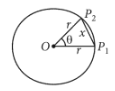
(d) : According to cosine formula
$
\begin{aligned}
& \cos \theta=\frac{r^2+r^2-x^2}{2 r^2} \\
& \text { or } 2 r^2 \cos \theta=r^2+r^2-x^2 \\
& \text { or } \quad x^2=2 r^2-2 r^2 \cos \theta=2 r^2[1-\cos \theta] \\
& =2 r^2\left[2 \sin ^2 \frac{\theta}{2}\right]
\end{aligned}
$
View full question & answer→MCQ 131 Mark
A particle is moving at a speed of $10 m / s$ in a circular motion. The radius of the path is $2 m$ and mass of the particle is $2 kg$. The centripetal force of the particle is
- A
$50 N$
- B
$150 N$
- ✓
$100 N$
- D
$170 N$
AnswerCorrect option: C. $100 N$
(c) : Given : Velocity, $u=10 m / s$ Radius, $r=2 m ; \quad$ Mass, $m=2 kg$
The centripetal force, $F=\frac{m v^2}{r}=\frac{2 \times 100}{2}=100 N$
View full question & answer→MCQ 141 Mark
A particle is performing U.C.M along the circumference of a circle of diameter $50 cm$ with frequency $2 Hz$. The acceleration of the particle in $m / s ^2$ is
- A
$2 \pi^2$
- B
$8 \pi^2$
- C
$\pi^2$
- ✓
$4 \pi^2$
AnswerCorrect option: D. $4 \pi^2$
(d) : We know that, $\omega=2 \pi v=4 \pi$
$
\begin{aligned}
& \therefore \quad \text { Acceleration, } a=\omega^2 r=(4 \pi)^2 \times \frac{50 \times 10^{-2}}{2} \\
& =16 \pi^2 \times \frac{50}{200}=16 \pi^2 \times \frac{1}{4}=4 \pi^2 m / s ^2
\end{aligned}
$
View full question & answer→MCQ 151 Mark
In U.C.M., when time interval $\delta t \rightarrow 0$, the angle between change in velocity ( $\delta \vec{v})$ and linear velocity ( $\vec{v})$ will be
- A
$0^{\circ}$
- ✓
$90^{\circ}$
- C
$180^{\circ}$
- D
$45^{\circ}$
AnswerCorrect option: B. $90^{\circ}$
(b) : In case of uniform circular motion, for time interval $\delta t \rightarrow 0$, angle between change in velocity ( $\delta \vec{v}$ ) and linear velocity $(\vec{v})$ will be $90^{\circ}$.
View full question & answer→MCQ 161 Mark
In non-uniform circular motion, the ratio of tangential to radial acceleration is $(r=$ radius of circle, $v=$ speed of the particle, $\alpha=$ angular acceleration)
- A
$\frac{\alpha^2 r^2}{v}$
- B
$\frac{\alpha^2 r}{v^2}$
- ✓
$\frac{\alpha r^2}{v^2}$
- D
$\frac{v^2}{r^2 \alpha}$
AnswerCorrect option: C. $\frac{\alpha r^2}{v^2}$
(c) : Tangential acceleration, $a_t=\alpha r$
Radial acceleration, $a_r=\frac{v^2}{r}$
Now, $\frac{a_t}{a_r}=\frac{\alpha r}{v^2 / r}=\frac{\alpha r^2}{v^2}$
View full question & answer→MCQ 171 Mark
A particle of mass ' $m$ ' is moving in circular path of constant radius ' $r$ ' such that centripetal acceleration is varying with time ' $t$ ' as $K^2 r t^2$ where $K$ is a constant. The power delivered to the particle by the force acting on it is
- A
$m^2 K^2 r^2 t^2$
- ✓
$m K^2 r^2 t$
- C
$m K^2 r t^2$
- D
$m K r^2 t$
AnswerCorrect option: B. $m K^2 r^2 t$
(b) : $m K^2 r^2 t$
View full question & answer→MCQ 181 Mark
A toy cart is tied to the end of an unstretched string of length ' $T$. When revolved, the toy cart moves in horizontal circle with radius ' $2 l$ and time period $T$. If it is speeded until it moves in horizontal circle of radius ' $3 l$ ' with period $T_1$, relation between $T$ and $T_1$ is (Hooke's law is obeyed)
- A
$T_1=\frac{2}{\sqrt{3}} T$
- B
$T_1=\sqrt{\frac{3}{2}} T$
- C
$T_1=\sqrt{\frac{2}{3}} T$
- ✓
$T_1=\frac{\sqrt{3}}{2} T$
AnswerCorrect option: D. $T_1=\frac{\sqrt{3}}{2} T$
(d) : The extension in the string in first case
$
x_1=2 a-a=a
$
From Hooke's law, $F=k x$
$
\begin{aligned}
& \therefore \quad m(2 a) \omega^2=k a \\
& \text { or } m(2 a)\left(\frac{2 \pi}{T}\right)^2=k a ...(i)
\end{aligned}
$
In second case, $x_2=3 a-a=2 a$
$
\therefore \quad m(3 a)\left(\frac{2 \pi}{T_1}\right)^2=k(2 a)...(ii)
$
Dividing eqn (i) by eqn (ii), we get
$
\frac{2}{T_2} \times \frac{T_1^2}{3}=\frac{1}{2}
$
or $\quad T_1^2=\frac{3}{4} T^2 \quad$ or $\quad T_1=\frac{\sqrt{3}}{2} T$
View full question & answer→MCQ 191 Mark
The difference between angular speed of minute hand and second hand of a clock is
- A
$\frac{59 \pi}{900} rad / s$
- ✓
$\frac{59 \pi}{1800} rad / s$
- C
$\frac{59 \pi}{2400} rad / s$
- D
$\frac{59 \pi}{3600} rad / s$
AnswerCorrect option: B. $\frac{59 \pi}{1800} rad / s$
(b) : Angular speed, $\omega=\frac{\text { Angular distance }(\theta)}{\text { Time taken }(t)}$
For minute hand of a clock, $\theta=2 \pi rad , t =3600 s$
$
\therefore \quad \omega_m=\frac{2 \pi}{3600}=\frac{\pi}{1800} rad s ^{-1}
$
For second hand of a clock, $\theta=2 \pi rad , t=60 s$
$
\therefore \quad \omega_s=\frac{2 \pi}{60}=\frac{\pi}{30} rad s ^{-1}
$
Required difference between angular speeds
$
\begin{aligned}
& =\omega s -\omega m \\
& =\frac{\pi}{30}-\frac{\pi}{1800}=\frac{60 \pi-\pi}{1800}=\frac{59 \pi}{1800} rad s ^{-1}
\end{aligned}
$
View full question & answer→MCQ 201 Mark
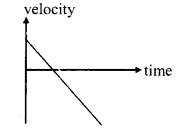
A body is thrown vertically upwards. Which one of the following graphs correctly represent the velocity vs time?
Answer(A)
Hint:
If a body is projected in vertically upward direction, then its acceleration is constant and negative. If direction of motion is positive i.e.. vertically up) and initial position of body is taken as origin, then the velocity decreases uniformly. At highest point its velocity is equal to zero and then it accelerates uniformly downwards returning to its reference position.
View full question & answer→MCQ 211 Mark
Preeti reached the metro station and found that the escalator was not working. She walked up the stationary escalator in time $t_1.$ On other days, if she remains stationary on the moving escalator, then the escalator takes her up in time $t_2.$ The time taken by her to walk up on the moving escalator will be:
AnswerCorrect option: C. $\frac{ t _1 t_2}{ t _2+t_1}$
Let velocity of Preeti be $v_1,$ velocity of escalator be $v_2$ and distance travelled be $L.$
$\therefore \text { Speed }=\frac{\text { distance }}{\text { time }}$
$ \text { time }=\frac{\text { distance }}{\text { Speed }}$
$ t =\frac{l}{ v _1+ v _2}=\frac{l}{\frac{l}{ t _1}+\frac{l}{ t _2}}=\frac{ t _1 t _2}{ t _2+ t _1}$
View full question & answer→MCQ 221 Mark
A particle is moving with a uniform speed in a circular orbit of radius $R$ in a central force inversely proportional to the $n^{th}$ power of $R.$ If the period of rotation of the particle is $T,$ then:
AnswerCorrect option: A. $T ∝ R^{(n+1)/2}$
The centripetal force acting on the particle is provided by the central force,
$\therefore \frac{ mv ^2}{ R }= K \times \frac{1}{ R ^{ n }}$
$\therefore v^2=K \times \frac{R}{m R^n}=K \times \frac{1}{m^{n-1}}$
$\therefore v = K ^{\prime} \times \frac{1}{ R ^{\frac{( n -1)}{2}}} \ldots .\left( K ^{\prime}=\sqrt{\frac{ K }{ m }}\right)$
The time period of rotation is,
$T=\frac{2 \pi R}{v}=\frac{2 \pi R \times R^{\frac{n-1}{2}}}{K^{\prime}}=\frac{2 \pi}{K^{\prime}} \times R^{\frac{n+1}{2}}$
$\therefore T \propto R^{\frac{n+1}{2}}$
View full question & answer→MCQ 231 Mark
All the graphs below are intended to represent the same motion. One of them does it incorrectly. Pick it up.
Answer(d)
Hint:
The graphs (A), (B) and (C) represent the uniformly retarded motion, i.e., velocity decreases uniformly. However, the slope of the curve in graph (D), indicates increasing velocity. Hence, graph (D) is incorrect.
View full question & answer→MCQ 241 Mark
A toy car with charge $q$ moves on a frictionless horizontal plane surface under the influence of a uniform electric field $\vec{E}$. Due to the force $q\vec{E}$, its velocity increases from $0$ to $6 \ m/s$ in one second duration. At that instant the direction of the field is reversed. The car continues to move for two more seconds under the influence of this field. The average velocity and the average speed of the toy car between $0$ to $3$ seconds are respectively
- A
$2 \ m/s, 4 \ m/s$
- ✓
$1 \ m/s, 3 \ m/s$
- C
$1 \ m/s, 3.5 \ m/s$
- D
$1.5 \ m/s, 3 \ m/s$
AnswerCorrect option: B. $1 \ m/s, 3 \ m/s$
Car at rest attains velocity of $6 \ m/s$ in $t_1 = 1 s.$
Now as direction of field is reversed, velocity of car will reduce to $0 \ m/s$ in next $1 s.$
i.e., at $t_2 = 2 s.$ But, it continues to move for next one second.
This will give velocity of $-6 \ m/s$ to car at $t_3 = 3 s.$
Using this data, plot of velocity versus time will be
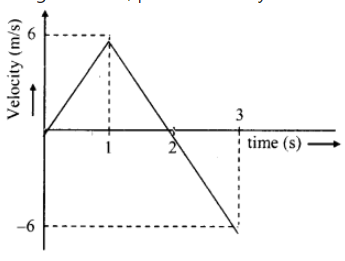
$\begin{aligned} \begin{aligned} \text { Average } \\ \text { velocity }\end{aligned}=\frac{\begin{array}{c}\text { Area under the graph } \\ \text { considering sign }\end{array}}{\text { time }} =\frac{3+3-3}{3} \\ & =1 m / s \end{aligned}$
$\begin{aligned} \underset{\text { speed }}{\text { Average }}=\frac{\begin{array}{c}\text { Area under the graph } \\ \text { without considering sign }\end{array}}{\text { time }} & =\frac{3+3+3}{3} \\ & =3 m / s \end{aligned}$ View full question & answer→MCQ 251 Mark
Two bullets are fired horizontally and simultaneously towards each other from roof tops of two buildings $100 m$ apart and of same height of $200 m,$ with the same velocity of $25 \ m/s.$ When and where will the two bullets collide? $(g = 10$ $m/s^2)$
- A
- ✓
After $2 s$ at a height of $180 m$
- C
After $2 s$ at a height of $20 m$
- D
After $4 s$ at a height of $120 m$
AnswerCorrect option: B. After $2 s$ at a height of $180 m$
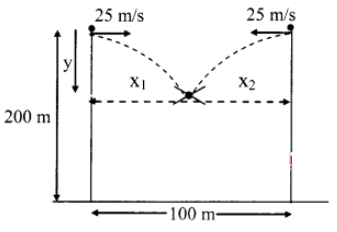
Let the bullets collide at time $t$
The horizontal displacement $x_1$ and $x_2$ is given by the equation
$ x _1= ut$ and $x _2= ut$
$\therefore x _1+ x _2=100$
$\therefore 25 t +25 t =100$
$\therefore t =2 s$
Vertical displacement ' $y$ ' is given by
$y =\frac{1}{2} gt ^2=\frac{1}{2} \times 10 \times 2^2=20 m$
$\therefore h =200-20=180 m$ View full question & answer→MCQ 261 Mark
A person travelling in a straight line moves with a constant velocity $v_1$ for certain distance $x’$ and with a constant velocity $v_2$ for next equal distance. The average velocity $y$ is given by the relation
- A
$v =\sqrt{ v _1 v _2}$
- B
$\frac{1}{v}=\frac{1}{v_1}+\frac{1}{v_2}$
- ✓
$\frac{2}{v}=\frac{1}{v_1}+\frac{1}{v_2}$
- D
$\frac{v}{2}=\frac{v_1+v_2}{2}$
AnswerCorrect option: C. $\frac{2}{v}=\frac{1}{v_1}+\frac{1}{v_2}$
Let, $t'$ be the time taken to travel distance $'x \ '$ with constant velocity $'v_1 \ '$
$\therefore t _1=\frac{ x }{ v _2}$
Let $'t_2 \ '$ be the time taken to travel equal distance $'x \ '$ with constant velocity $'v_2 \ '$
$\therefore t _2=\frac{ x }{ v _2}$
Average velocity,
$v=\frac{x-x}{t_1-t_2} =\frac{2 x}{\frac{x}{v_1} \frac{x}{v_2}}$
$ =\frac{2 v_1 v_2}{v_1+v_2}$
$\therefore \frac{2}{ v }=\frac{1}{ v _1}+\frac{1}{ v _2}$
View full question & answer→MCQ 271 Mark
When an object is shot from the bottom of a long smooth inclined plane kept at an angle $60^\circ$ with horizontal, it can travel a distance $x_1$ along the plane. But when the inclination is decreased to $30^\circ$ and the same object is shot with the same velocity, it can travel $x_2$ distance. Then $x_1 : x_2$ will be:
- ✓
$1: \sqrt{3}$
- B
$1: 2 \sqrt{3}$
- C
$1: \sqrt{2}$
- D
$\sqrt{3}: 1$
AnswerCorrect option: A. $1: \sqrt{3}$
$v ^2= u ^2+2 as$
$\therefore v ^2= u ^2+2 g \sin \theta x$
$\sin \theta \cdot x =\text { constant }$
$\therefore x \propto \frac{1}{\sin \theta}$
$\therefore \frac{x_1}{x_2}=\frac{\sin \theta_2}{\sin \theta_1}=\frac{1 / 2}{\sqrt{3} / 2}=1: \sqrt{3}$
View full question & answer→MCQ 281 Mark
Two particles $A$ and $B$ are moving in uniform circular motion in concentric circles of radii $r_A$ and $r_B$ with speed $v_A$ and $v_B$ respectively. Their time period of rotation is the same. The ratio of angular speed of $A$ to that of $B$ will be:
- A
$r_B : r_A$
- ✓
$1 : 1$
- C
$r_A : r_B$
- D
$v_A : v_B$
AnswerCorrect option: B. $1 : 1$
Time period of rotation $(A$ and $B)$ is same
$\begin{array}{lll}\therefore & T _{ A }= T _{ B } \\ \therefore & \frac{2 \pi}{\omega_A}=\frac{2 \pi}{\omega_B} & {\left[\because t =\frac{2 \pi}{\omega}\right]}\end{array}$
$\therefore \quad \frac{\omega_{ A }}{\omega_{ B }}=1: 1$
View full question & answer→MCQ 291 Mark
The period of a conical pendulum is
- A
equal to that of a simple pendulum of same length l.
- B
more than that of a simple pendulum of same length l.
- ✓
less than that of a simple pendulum of same length l.
- D
independent of length of pendulum.
AnswerCorrect option: C. less than that of a simple pendulum of same length l.
less than that of a simple pendulum of same length l.
View full question & answer→MCQ 301 Mark
Consider a simple pendulum of length $1 m.$ Its bob performs a circular motion in horizontal plane with its string making an angle $600$ with the vertical. The period of rotation of the bob is$($Take $g = 10 m/s^2)$
AnswerCorrect option: B. $1.4s$
$1.4s$
View full question & answer→MCQ 311 Mark
The period of a conical pendulum in terms of its length (l), semivertical angle (θ) and acceleration due to gravity (g) is:
- A
$\frac{1}{2 \pi} \sqrt{\frac{l \cos \theta}{g}}$
- B
$\frac{1}{2 \pi} \sqrt{\frac{l \sin \theta}{ g }}$
- ✓
$4 \pi \sqrt{\frac{l \cos \theta}{4 g}}$
- D
$4 \pi \sqrt{\frac{l \tan \theta}{ g }}$
AnswerCorrect option: C. $4 \pi \sqrt{\frac{l \cos \theta}{4 g}}$
$4 \pi \sqrt{\frac{l \cos \theta}{4 g}}$
View full question & answer→MCQ 321 Mark
A projectile projected with certain velocity reaches ground with (magnitude)
MCQ 331 Mark
The time period of conical pendulum is _________.
- A
$\sqrt{\frac{l \cos \theta}{ g }}$
- B
$2 \pi \sqrt{\frac{l \sin \theta}{g}}$
- ✓
$2 \pi \sqrt{\frac{l \cos \theta}{ g }}$
- D
$\sqrt{\frac{l \sin \theta}{ g }}$
AnswerCorrect option: C. $2 \pi \sqrt{\frac{l \cos \theta}{ g }}$
$2 \pi \sqrt{\frac{l \cos \theta}{ g }}$
View full question & answer→MCQ 341 Mark
A projectile projected with certain angle reaches ground with
- A
- ✓
- C
- D
angle between 90° and 180°
View full question & answer→MCQ 351 Mark
A jet airplane travelling at the speed of $500 \ kmh^{-1}$ejects the burnt gases at the speed of $1400 \ kmh^{-1}$relative to the jet airplane. The speed of burnt gases relative to stationary observer on the earth is
- A
$2.8 \ kmh ^{-1}$
- B
$190 \ kmh ^{-1}$
- C
$700 \ kmh ^{-1}$
- ✓
$900 \ kmh ^{-1}$
AnswerCorrect option: D. $900 \ kmh ^{-1}$
$900 \ kmh^{-1}$
View full question & answer→MCQ 361 Mark
A projectile is thrown with an initial velocity of 50 m/s. The maximum horizontal distance which this projectile can travel is
MCQ 371 Mark
The maximum height attained by projectile is found to be equal to 0.433 of the horizontal range. The angle of projection of this projectile is
MCQ 381 Mark
When air resistance is taken into account while dealing with the motion of the projectile, to achieve maximum horizontal range, the angle of projection should be,
MCQ 391 Mark
Two balls are projected at an angle $\theta$ and $\left(90^{\circ}-\theta\right)$ to the horizontal with the same speed. The ratio of their maximum vertical
- A
$1 : 1$
- B
$\tan \theta : 1$
- C
$1 : \tan \theta$
- ✓
$\tan^2 \theta : 1$
AnswerCorrect option: D. $\tan^2 \theta : 1$
$\tan^2 \theta : 1$
View full question & answer→MCQ 401 Mark
The greatest height to which a man can throw a stone is h. The greatest distance to which he can throw it will be
MCQ 411 Mark
A player kicks up a ball at an angle θ with the horizontal. The horizontal range is maximum when θ is equal to
MCQ 421 Mark
In case of a projectile, what is the angle between the instantaneous velocity and acceleration at the highest point?
MCQ 431 Mark
Which of the following remains constant for a projectile fired from the earth?
- A
- B
- C
Vertical component of velocity
- ✓
Horizontal component of velocity
AnswerCorrect option: D. Horizontal component of velocity
Horizontal component of velocity
View full question & answer→MCQ 441 Mark
The range of projectile is 1 .5 km when it is projected at an angle of 15° with horizontal. What will be its range when it is projected at an angle of 45° with the horizontal?
MCQ 451 Mark
Which of the following is NOT a projectile?
- A
- B
A shell fired from cannon.
- C
A hammer thrown by athlete.
- ✓
View full question & answer→MCQ 461 Mark
A body is thrown vertically upwards, maximum height is reached, then it will have
- A
zero velocity and zero acceleration.
- ✓
zero velocity and finite acceleration.
- C
finite velocity and zero acceleration.
- D
finite velocity and finite acceleration.
AnswerCorrect option: B. zero velocity and finite acceleration.
zero velocity and finite acceleration.
View full question & answer→MCQ 471 Mark
If the particle is at rest, then the x – t graph can be only
- A
parallel to position – axis
- ✓
- C
inclined with acute angle
- D
inclined with obtuse angle
View full question & answer→MCQ 481 Mark
The velocity$-$time relation of a particle starting from rest is given by $v = kt$ where $k = 2 \ m/s^2.$ The distance travelled in $3 \ sec$ is
- ✓
$9 m$
- B
$16 m$
- C
$27 m$
- D
$36 m$
View full question & answer→MCQ 491 Mark
A particle covers equal distances around a circular path in equal intervals of time. Which of the following quantities connected with the motion of the particle remains constant with time?
MCQ 501 Mark
Consider a simple pendulum of length 1 m. Its bob performs a circular motion in horizontal plane with its string making an angle \[60^{\circ}\] with the vertical. The period of rotation of the bob is (Take $g =10 m / s ^2$ )
View full question & answer→