MCQ 511 Mark
A mass of 10 kg is whirled in a horizontal circle by means of a string at an initial speed of 5 r.p.m. Keeping the radius constant, the tension in the string is quadrupled. The new speed is nearly
Answer(B)
$T=m a=m r \omega^2$
$T \propto \omega^2$
$\frac{\omega^{\prime 2}}{\omega^2}=\frac{T^{\prime}}{T}=\frac{4 T}{T}=4$
$\therefore \quad \omega^{\prime 2}=4 \omega^2$
$\therefore \quad \omega^{\prime}=2 \omega$
$n ^{\prime}=2 n =2 \times 5=10 r . p . m$.
View full question & answer→MCQ 521 Mark
If mass, speed and radius of the circular path of the particle are increased by $100 \%$, then the necessary force required to maintain the circular path will have to be increased by
Answer(C)
The centripetal force is given by,
$F =\frac{ mv ^2}{ r }$
$\therefore \frac{ F _2}{F_1}=\frac{ m _2}{m_1}\left(\frac{ v _2}{ v _1}\right)^2\left(\frac{ r _1}{ r _2}\right)$ ... (i)
When, mass, speed and radius of circular path of particle increases by $100 \%$ i.e., then the quantities become double.
Hence, $m _2=2 m_1, v _2=2 v _1, r _2=2 r _1$
$\therefore \quad$ from equation (i),
$\frac{ F _2}{F_1}=\frac{2 m_1}{m_1}\left(\frac{2 v _1}{ v _1}\right)^2\left(\frac{ r _1}{2 r _1}\right)$
$\therefore \quad \frac{ F _2}{F_1}=2 \times 4 \times \frac{1}{2}=4$
$\therefore \quad F _2=4 F_1$
Percentage increase in centripetal force,
i.e., $\frac{ F _2- F _1}{F_1} \times 100=\frac{4 F_1- F _1}{F_1} \times 100=300 \%$
View full question & answer→MCQ 531 Mark
A car of mass 1000 kg moves on a circular path with constant speed of 12 m/s. It turned through $90^{\circ}$ after travelling 471 m on the road. The centripetal force acting on the car is
Answer(B)
Since car turns through 90 deg after travelling 471 m on the circular road, the distance 471 m is quarter of the circumference of the circular path. If R is the radius of the circular path, then
$\frac{1}{4}(2 \pi R)=471$
$\therefore \quad R=\frac{471 \times 2}{\pi}=\frac{471 \times 2}{3.14}=300 m$
$v =12 m / s , m =1000 kg$
∴ Centripetal force,
$F _{ cp }=\frac{ mv ^2}{ R }=\frac{1000 \times(12)^2}{300}=480 N$
View full question & answer→MCQ 541 Mark
A mass 2 kg describes a circle of radius 1.0 m on a smooth horizontal table at a uniform speed. It is joined to the centre of the circle by a string, which can just withstand 32 N. The greatest number of revolutions per minute the mass can make is
Answer(A)
$m =2 kg, r =1 m, F =32 N$
Force, $F = m \omega^2 r$
$\therefore \quad \omega^2=\frac{32}{2 \times 1}=16$
$\therefore \quad \omega=4 rad / s$
$\therefore \quad$ Frequency of revolution per minute
$n =\frac{\omega}{2 \pi} \times 60=\frac{4 \times 7}{2 \times 22} \times 60 \approx 38 rev / min$
View full question & answer→MCQ 551 Mark
A body of mass 500 g is revolving in a horizontal circle of radius 0.49 m. The centripetal force acting on it (if its period is 11 s) will be
Answer(D)
Using, $F _{ cp }= m \omega^2 r$
$= m \left(\frac{2 \pi}{T}\right)^2 r$
$=500 \times 10^{-3} \times\left(2 \times \frac{22}{7} \times \frac{1}{11}\right)^2 \times 0.49$
$=\frac{500 \times 10^{-3} \times 16 \times 0.49}{49}$
$-0.08 N$s
View full question & answer→MCQ 561 Mark
A particle of mass m is executing uniform circular motion on a path of radius r. If p is the magnitude of its linear momentum, the radial force acting on the particle is
- A
- B
$\frac{ rm }{ p }$
- C
$\frac{m p^2}{r}$
- ✓
$\frac{ p ^2}{ rm }$
AnswerCorrect option: D. $\frac{ p ^2}{ rm }$
(D)
Radial force $=\frac{ mv ^2}{ r }=\frac{ m }{ r }\left(\frac{ p }{ m }\right)^2=\frac{ p ^2}{ mr }$$\ldots \ldots[\because p=m v]$
View full question & answer→MCQ 571 Mark
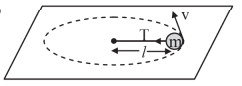
One end of string of length $l$ is connected to a particle of mass 'm' and the other end is connected to a small peg on a smooth horizontal table. If the particle moves in circle with speed 'v', the net force on the particle (directed towards centre) will be (T represents the tension in the string)
- ✓
- B
$T +\frac{ mv ^2}{l}$
- C
$T -\frac{ mv ^2}{l}$
- D
Answer(A)
Here, tension provides required centripetal force.
$\therefore \quad \frac{ mv ^2}{l}= T$
View full question & answer→MCQ 581 Mark
A particle is moving with a uniform speed in a circular orbit of radius R in a central force inversely proportional to the $n ^{\text {th }}$ power of R. If the period of rotation of the particle is T, then:
AnswerCorrect option: A. $T \propto R^{(n+1) 2}$
(A)
The centripetal force acting on the particle is provided by the central force,
$\therefore \quad \frac{ mv ^2}{ R }- K \times \frac{1}{ R ^{ n }}$
$\therefore \quad v ^2= K \times \frac{ R }{ mR ^{ n }}= K \times \frac{1}{ mR ^{ n -1}}$
$\therefore \quad v = K ^{\prime} \times \frac{1}{ R ^{\frac{( n -1)}{2}}} \quad \ldots .\left( K ^{\prime}=\sqrt{\frac{ K }{ m }}\right)$
The time period of rotation is,
$T =\frac{2 \pi R }{ v }=\frac{2 \pi R \times R ^{\frac{ n -1}{2}}}{K^{\prime}}=\frac{2 \pi}{K^{\prime}} \times R ^{\frac{ n +1}{2}}$
$\therefore \quad T \propto R ^{\frac{ n +1}{2}}$
View full question & answer→MCQ 591 Mark
A particle goes round a circular path with uniform speed v. After describing half the circle, what is the change in its centripetal acceleration?
- A
$\frac{v^2}{r}$
- ✓
$\frac{2 v^2}{r}$
- C
$\frac{2 v^2}{\pi \pi}$
- D
$\frac{v^2}{\pi r}$
AnswerCorrect option: B. $\frac{2 v^2}{r}$
(B)
In half a circle, the direction of acceleration is reversed.
It goes from $\frac{v^2}{r}$ to $\frac{-v^2}{r}$
Hence, change in centripetal acceleration$=\frac{v^2}{r}-\left(\frac{-v^2}{r}\right)=\frac{2 v^2}{r}$
View full question & answer→MCQ 601 Mark
A turn table which is rotating uniformly has a particle placed on it. As seen from the ground, the particle goes in a circle with speed 20 cm/s and acceleration $20 cm / s ^2$ The particle is now shifted to a new position where radius is half of the original value. The new values of speed and acceleration will be
- ✓
$10 cm / s , 10 cm / s ^2$
- B
$10 cm / s , 80 cm / s ^2$
- C
$40 cm / s , 10 cm / s ^2$
- D
$40 cm / s , 40 cm / s ^2$
AnswerCorrect option: A. $10 cm / s , 10 cm / s ^2$
(A)
Velocity, $v =\omega r$
$\therefore \quad v ^{\prime}=\omega r ^{\prime}=\frac{\omega r }{2}=\frac{ v }{2}=10 cm / s$
$\therefore \quad a =\omega^2 r$
$\therefore \quad a ^{\prime}=\omega^2 r ^{\prime}=\omega^2 \times \frac{ r }{2}=\frac{ a }{2}=10 cm / s ^2$
View full question & answer→MCQ 611 Mark
An aircraft executes a horizontal loop of radius 1 km with a steady speed of 900 km/h. Ratio of its centripetal acceleration to acceleration due to gravity is
Answer(B)
Radius of horizontal loop, r=1 km = 1000 m
$v =900 km / h =\frac{900 \times 10^3}{3600}=250 m / s$
$\therefore \quad a=\frac{v^2}{r}=\frac{250 \times 250}{1000}=62.5 m / s ^2$
$\therefore \quad \frac{ a }{ g }=\frac{62.5}{10}=6.25$
View full question & answer→MCQ 621 Mark
If the equation for the displacement of a particle moving on a circular path is given by $\theta=2 t ^3+0.5$. Where $\theta$ is in radian and t is in seconds, then the angular velocity of the particle at t = 2 s is
Answer(C)
$\theta=2 t^3+0.5$
$\therefore \quad \omega=\frac{d}{d t}\left(2 t^3+0.5\right)=6 t^2$
At $t =2 s, \omega=6 \times 2^2=24 rad / s$
View full question & answer→MCQ 631 Mark
What is the value of linear velocity if $\vec{\omega}=3 \hat{i}-4 \hat{j}+\hat{k}$ and $\vec{r}=5 \hat{i}-6 \hat{j}+6 \hat{k} ?$
- A
$6 \hat{ i }+2 \hat{ j }-3 \hat{ k }$
- ✓
$-18 \hat{ i }-13 \hat{ j }+2 \hat{ k }$
- C
$4 \hat{ i }-13 \hat{ j }+6 \hat{ k }$
- D
$6 \hat{i}-2 \hat{j}+8 \hat{k}$
AnswerCorrect option: B. $-18 \hat{ i }-13 \hat{ j }+2 \hat{ k }$
(B)
$\vec{v}=\vec{\omega} \times \vec{r}=\left|\begin{array}{ccc}\hat{i} & \hat{j} & \hat{k} \\ 3 & -4 & 1 \\ 5 & -6 & 6\end{array}\right|=-18 \hat{i}-13 \hat{j}+2 \hat{k}$
View full question & answer→MCQ 641 Mark
The radius of the earth is 6400 km. The linear velocity of a point on the equator is nearly
Answer(B)
$T =24 hr , r =6400 km$
$v=\omega r=\frac{2 \pi}{T} \times r=\frac{2 \pi}{24} \times 6400=\frac{2 \times 3.14 \times 6400}{24}$
$v \approx 1675 km / hr$
View full question & answer→MCQ 651 Mark
A stone tied to the end of a string of length 50 cm is whirled in a horizontal circle with a constant speed. If the stone makes 40 revolutions in 20 s, then the speed of the stone along the circle is
- A
$\pi / 2 ms^{-1}$
- B
$\pi ms ^{-1}$
- ✓
$2 \pi ms^{-1}$
- D
$4 \pi ms^{-1}$
AnswerCorrect option: C. $2 \pi ms^{-1}$
(C)
$T =\frac{20}{40}=\frac{1}{2}=0.5 s$
$\omega=\frac{2 \pi}{T}=\frac{2 \pi}{0.5}=4 \pi rad / s$
Let $r =50 cm=0.5 m$
$v=r \omega=0.5 \times 4 \pi=2 \pi m / s$
View full question & answer→MCQ 661 Mark
Two cars $C_1$ and $C_2$ are going round in concentric circles of radii $R_1$ and $R_2$. They complete the circular paths in the same time. Then $\frac{\text { Speed of } C_1}{\text { Speed of } C_2}=$
- A
- ✓
$R _1 / R _2$
- C
$R _2 / R _1$
- D
cannot be determined as data is insufficient
AnswerCorrect option: B. $R _1 / R _2$
(B)
Speed of $C_1=\omega R_1=\frac{2 \pi}{T} R_1$
Speed of $C_2=\omega R_2=\frac{2 \pi}{T} R_2$
$\therefore \quad \frac{\text { Speed of } C_1}{\text { Speed of } C_2}=\frac{2 \pi R_1 / T}{2 \pi R_2 / T}=\frac{R_1}{R_2}$
View full question & answer→MCQ 671 Mark
The linear velocity of a particle on the N-pole of the earth is
Answer(A)
$v=r . \omega$
where r is distance from axis of rotation. At the north-pole,$r = 0 \Rightarrow v = 0$
View full question & answer→MCQ 681 Mark
A particle is describing the circular path of radius 20 m in every 2 s. The average angular speed of the particle during 4 s is
- A
$20 \pi rad s ^{-1}$
- B
$4 \pi rad s ^{-1}$
- ✓
$\pi rad s ^{-1}$
- D
$2 \pi rad s ^{-1}$
AnswerCorrect option: C. $\pi rad s ^{-1}$
(C)
$\omega=\frac{\text { angle des cri bed } }{\text { ti maken }}=\frac{2 \pi}{2}=\pi rad / s$
View full question & answer→MCQ 691 Mark
A wheel rotates with a constant angular velocity of 300 r.p.m. The angle through which the wheel rotates in one second is
- A
$\pi rad$
- B
$5 \pi rad$
- ✓
$10 \pi rad$
- D
$20 \pi rad$
AnswerCorrect option: C. $10 \pi rad$
(C)
Frequency of wheel, $n =\frac{300}{60}=5 r . p . s$.
Angle described by wheel in one rotation$=2 \pi rad$.
Therefore, angle described by wheel in 1 sec$\theta=2 \pi \times 5$ radians $=10 \pi rad$
View full question & answer→MCQ 701 Mark
If the radius of curvature of the path of two particles of same masses are in the ratio 1: 2, then in order to have constant centripetal force, their velocity, should be in the ratio of
- A
- B
- C
$\sqrt{2}: 1$
- ✓
$1: \sqrt{2}$
AnswerCorrect option: D. $1: \sqrt{2}$
(D)
The centripetal force, $F=\frac{ mv ^2}{ r }$
$\therefore \quad r =\frac{ mv ^2}{F}$
$\therefore \quad r \propto v^2$ or $v \propto \sqrt{r}$
(If m and F are constant), $\frac{ v _1}{ v _2}=\sqrt{\frac{ r _1}{ r _2}}=\sqrt{\frac{1}{2}}$
View full question & answer→MCQ 711 Mark
A proton of mass $1.6 \times 10^{-27}$ kg goes round in circular orbit of radius 0.10 m under a centripetal force of $4 \times 10^{-13} N$. Then the frequency of revolution of the proton is about
- ✓
$0.08 \times 10^8$ cycles per s
- B
$4 \times 10^8$ cycles per s
- C
$8 \times 10^8$ cycles per s
- D
$12 \times 10^8$ cycles per s
AnswerCorrect option: A. $0.08 \times 10^8$ cycles per s
(A)
Using, $F=m r \omega^2=m 4 \pi^2 n^2 r$
$\therefore \quad m 4 \pi^2 n ^2 r =4 \times 10^{-13}$
$\therefore \quad n=\sqrt{\frac{4 \times 10^{-13}}{1.6 \times 1 \theta^7 \times 4 \times 314^2 \times 0.1}}$
$\therefore \quad n = 0 . 0 8 \times 10^8$ cycles/second
View full question & answer→MCQ 721 Mark
A string breaks if its tension exceeds 10 newton. A stone of mass 250 g tied to this string of length 10 cm is rotated in a horizontal circle. The maximum angular velocity of rotation can be
Answer(A)
Using, $T = m \omega^2 r$
$\therefore \quad 10=0.25 \times \omega^2 \times 0.1$
$\therefore \quad \omega=20 rad / s$
View full question & answer→MCQ 731 Mark
If a tension in a string is 6.4 N. A load at the lower end of a string is 0.1 kg, the length of string is 6 m then find its angular velocity
$\left( g =10 m / s ^2\right)$
Answer(A)
Using, $T=m r \omega^2 \Rightarrow \omega^2=\frac{T}{m r}$
$\therefore \quad \omega=\sqrt{\frac{6.4}{0.1 \times 6}} \approx 3 rad / s$
View full question & answer→MCQ 741 Mark
Certain neutron stars are believed to be rotating at about 1 rev/s. If such a star has a radius of 20 km, the acceleration of an object on the equator of the star will be
AnswerCorrect option: B. $8 \times 10^5 m / s ^2$
(B)
Using,
$a=\omega^2 r=4 \pi^2 n^2 r=4(3.14)^2 \times 1^2 \times 20 \times 10^3$
$\therefore \quad a \approx 8 \times 10^5 m / s ^2$
View full question & answer→MCQ 751 Mark
The length of second's hand in a watch is 1 cm. The change in velocity of its tip in 15 seconds is
MCQ 761 Mark
The ratio of angular speed of a second-hand to the hour-hand of a watch is
Answer(B) Angular speed of second hand,
$\omega_1=\frac{2 \pi}{60} \quad(T=60$ seconds $)$
Angular speed of hour hand,
$\omega_2=\frac{2 \pi}{12 \times 60 \times 60} \quad(T=12 hr )$
$\frac{\omega_1}{\omega_2}=12 \times 60=\frac{720}{1}$
View full question & answer→MCQ 771 Mark
An athlete completes one round of a circular track of radius 10 m in 40 s. The distance covered by him in 2 min 20 s is
Answer(D)
No. of revolutions $=\frac{\text { Total ti me }}{ Ti \text { mperiod }}$
$=\frac{140 s}{40 s}$
$=3.5 Rev$.
So, distance $=3.5 \times 2 \pi R =3.5 \times 2 \pi \times 10$
$\approx 220 m$
View full question & answer→MCQ 781 Mark
The angular velocity of a wheel is 70 rad/s. If the radius of the wheel is 0.5 m, then linear velocity of the wheel is
Answer(C)
Using, $v = r \omega= 0 .5 \times 7 0 =35 m / s$
View full question & answer→MCQ 791 Mark
If the length of the second's hand in a stop clock is 3 cm, the angular velocity and linear velocity of the tip is
- A
- B
- C
0.1472 rad/s, 0.06314 m/s
- ✓
0.1047 rad/s, 0.00314 m/s
AnswerCorrect option: D. 0.1047 rad/s, 0.00314 m/s
(D)
For seconds hand, T = 60 s ,$r =3 cm=3 \times 10^{-2} m$
$\omega=\frac{2 \pi}{T}=\frac{2 \pi}{60}=0.1047 rad / s$
and $v =\omega r =0.1047 \times 3 \times 10^{-2}=0.00314 m / s$
View full question & answer→MCQ 801 Mark
A wheel starting from rest gains an angular velocity of 10 rad/s after uniformly accelerating for 5 sec. The total angle through which it has turned is
Answer(C)
Given: The wheel starts from rest $\omega_1=0 rad / s$,
The angular velocity after $5 s=\omega_2=10 rad / s$,t= 5 s
The angular displacement is given by,
$\theta=\frac{\omega_1+\omega_2}{2} \times t =\frac{10}{2} \times 5=25 rad$
View full question & answer→MCQ 811 Mark
A body moves along a circular path with certain velocity. What will be the path of body following figure?
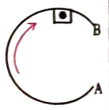
Answer(D)
The instantaneous velocity of a body in U.C.M. is always perpendicular to the radius or along the tangent to the circle at the point.
View full question & answer→MCQ 821 Mark
If a particle moves with uniform speed then it tangential acceleration will be
- A
$\frac{v^2}{r}$
- ✓
- C
$r \omega^2$
- D
View full question & answer→MCQ 831 Mark
A sphere of mass m is tied to end of a stringe length $l$ and rotated through the other end along a horizontal circular path with speed v. The work done in full horizontal circle is
Answer(A)
Work done by centripetal force in uniform circular motion is always equal to zero.
View full question & answer→MCQ 841 Mark
A particle is moving on a circular path with constant speed, then its acceleration will be
- A
- B
external radial acceleration.
- ✓
internal radial acceleration.
- D
AnswerCorrect option: C. internal radial acceleration.
(C)
In uniform circular motion, acceleration is caused due to change in direction and is directed radially towards centre.
View full question & answer→MCQ 851 Mark
A particle performing uniform circular motion has.
- A
radial velocity and radial acceleration.
- B
radial velocity and transverse acceleration
- ✓
transverse velocity and radial acceleration
- D
transverse velocity and transver acceleration.
AnswerCorrect option: C. transverse velocity and radial acceleration
View full question & answer→MCQ 861 Mark
The period of a conical pendulum is
- A
equal to that of a simple pendulum of same length I.
- B
more than that of a simple pendulum of same length I.
- ✓
less than that of a simple pendulum of same length I.
- D
independent of length of pendulum.
AnswerCorrect option: C. less than that of a simple pendulum of same length I.
View full question & answer→MCQ 871 Mark
When the bob of a conical pendulum is moving in a horizontal circle at constant speed, which quantity is fixed?
MCQ 881 Mark
A proton of mass $1.6 \times 10^{-27}$ kg goes round in circular orbit of radius 0.12 m under a centripetal force of $6 \times 10^{-14} N$. Then the frequency of revolution of the proton is about
- A
$1.25 \times 10^6$ cycles per second
- B
$2.50 \times 10^6$ cycles per second
- C
$3.75 \times 10^6$ cycles per second
- ✓
$5.00 \times 10^6$ cycles per second
AnswerCorrect option: D. $5.00 \times 10^6$ cycles per second
(D)
Using, $F=m r \omega^2=m \times 4 \pi^2 n^2 r$
$\therefore \quad m \times 4 \pi^2 n ^2 r =6 \times 10^{-14}$
$\therefore \quad n ^2=\frac{6 \times 10^{-14}}{4 \times 1.6 \times 10^{-27} \times 3.14^2 \times 0.12}$
$\therefore \quad n \approx 5 \times 10^6$ cycles/s
View full question & answer→MCQ 891 Mark
The breaking tension of a string is 50 N. A body of mass 1 kg is tied to one end of a 1 m. long string and whirled in a horizontal circle. The maximum speed of the body should be
AnswerCorrect option: A. $5 \sqrt{2} m / s$
(A)
Using, $v^2=\frac{T r}{m}$
Breaking tension $T =\frac{ mv ^2}{ r }$
( $r =$ length of the string)
$\therefore \quad v ^2=\frac{50 \times 1}{1}$
$\therefore \quad v =5 \sqrt{2} m / s$
View full question & answer→MCQ 901 Mark
Two particles of equal masses are revolving in circular paths of radii $r_1$ and $r_2$ respectively with the same speed. The ratio of their centripetal forces is
AnswerCorrect option: A. $\frac{r_2}{r_1}$
(A)
$F =\frac{ mv ^2}{ r }$
If $m$ and $v$ are constants, then $F \propto \frac{1}{r}$
$\therefore \quad \frac{ F _1}{F_2}=\left(\frac{ r _2}{ r _1}\right)$
View full question & answer→MCQ 911 Mark
A racing car of mass $10^2$ goes around a circular track (horizontal) of radius 10 m. The maximum thrust that track can withstand is $10^5 N$. The maximum speed with which car can go around is
Answer(B)
Using, $F _{ s }=\frac{ mv ^2}{ r }$
$\therefore \quad v ^2=\frac{ F _{ s } r }{ m }=\frac{10^5 \times 10}{10^2}=10^4$
$\therefore \quad v =100 m / s$
View full question & answer→MCQ 921 Mark
The angle between velocity and acceleration of a particle describing uniform circular motion is
- A
$180^{\circ}$
- ✓
$90^{\circ}$
- C
$45^{\circ}$
- D
$60^{\circ}$
AnswerCorrect option: B. $90^{\circ}$
View full question & answer→MCQ 931 Mark
The diameter of a flywheel is 1.2 m and it makes 900 revolutions per minute. Calculate the acceleration at a point on its rim.
- ✓
$540 \pi^2 m / s ^2$
- B
$270 m / s ^2$
- C
$360 \pi^2 m / s ^2$
- D
$540 m / s ^2$
AnswerCorrect option: A. $540 \pi^2 m / s ^2$
(A)
$n =900 r . p . m .=\frac{900}{60} r . p . s =15 r . p . s$,
$d =1.2 m \Rightarrow r =\frac{1.2}{2}=0.6 m$
$a =\omega^2 r =(2 \pi n )^2 \times \frac{1.2}{2}=540 \pi^2 m / s ^2$
View full question & answer→MCQ 941 Mark
An electric fan has blades of length 30 cm as measured from the axis of rotation. If the fan is rotating at 1200 r.p.m., the acceleration of a point on the tip of the blade is about
- A
$1600 cm / s ^2$
- ✓
$4740 cm / s ^2$
- C
$2370 cm / s ^2$
- D
$5055 cm / s ^2$
AnswerCorrect option: B. $4740 cm / s ^2$
(B)
$n =1200 r . p . m .=\frac{1200}{60}$ r.p.s. $=20 r . p . s$.
$a=\omega^2 r=\left(4 \pi^2 n^2\right) r$
$=4 \times(3.142)^2 \times(20)^2 \times 0.3$
$\approx 4740 cm / s ^2$
View full question & answer→MCQ 951 Mark
Two cars of masses $m_1$ and $m_2$ are moving in circles of radii $r_1$ and $r_2$ respectively. Their speeds are such that they make complete circles in the same time $t$. The ratio of their centripetal acceleration is
- A
$m _1 r _1: m _2 r _2$
- B
$m_1: m_2$
- ✓
$r _1: r _2$
- D
AnswerCorrect option: C. $r _1: r _2$
(C)
They have same angular speed $\omega$.
Centripetal acceleration $=\omega^2 r$
$\frac{a_1}{a_2}=\frac{\omega^2 r_1}{\omega^2 r_2}=\frac{r_1}{r_2}$
View full question & answer→MCQ 961 Mark
A particle moves in a circle of radius 5 cm with constant speed and time period 0.2 $\pi$ s. The acceleration of the particle is
- ✓
$5 m / s ^2$
- B
$15 m / s ^2$
- C
$25 m / s ^2$
- D
$36 m / s ^2$
AnswerCorrect option: A. $5 m / s ^2$
(A)
$\quad a =\omega^2 R =\left(\frac{2 \pi}{0.2 \pi}\right)^2\left(5 \times 10^{-2}\right)=5 m / s ^2$
View full question & answer→MCQ 971 Mark
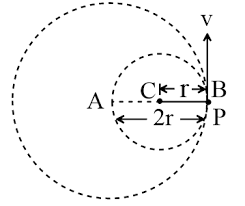
Answer(B)
Angular velocity of particle P about point A,
$\omega_{ A }=\frac{ v }{ r _{ AB }}=\frac{ v }{2 r }$
Angular velocity of particle P about point C,
$\omega_C=\frac{V}{r_{B C}}=\frac{v}{r}$
$\frac{\omega_{ A }}{\omega_{ C }}=\frac{ v }{2 r } \times \frac{ r }{ v }$
$\frac{\omega_{\Delta}}{\omega_C}=\frac{1}{2}$
View full question & answer→MCQ 981 Mark
A particle moves in a circular path, 0.4 m in radius, with constant speed. If particle makes 5 revolutions in each second of its motion, the speed of the particle is
Answer(C)
Using, $v = r \omega$
$= r \times(2 \pi n)=0.4 \times 2 \pi \times 5$
$=0.4 \times 2 \times 3.14 \times 5=12.56 \approx 12.6 m / s$
View full question & answer→MCQ 991 Mark
The tangential velocity of a particle making P rotations along a circle of radius $\pi$ in t seconds is
- A
$\frac{2 \pi p}{t^2}$
- B
$\frac{2 \pi p^2}{t}$
- C
$\frac{x^2 p}{2 x}$
- ✓
$\frac{2 x^2 p}{t}$
AnswerCorrect option: D. $\frac{2 x^2 p}{t}$
(D)
$r =\pi, n =\left(\frac{ p }{ t }\right)$ r.p.s.
$v = r \omega= r \times 2 \pi n =\pi \times 2 \pi \times \frac{ p }{ t }=\frac{2 \pi^2 p }{ t }$
View full question & answer→MCQ 1001 Mark
A wheel has circumference C. If it makes f r.p.s., the linear speed of a point on the circumference is
- A
$2 \pi fC$
- ✓
- C
$fC / 2 \pi$
- D
$fC / 60$
Answer(B)
$C =2 \pi r$
$\therefore \quad r=\frac{C}{2 \pi}$
$\therefore \quad v=r(2 \pi n)=\frac{C}{2 \pi} \times 2 \pi \times f=f C$
$\ldots[\because \omega=2 \pi n ]$
View full question & answer→