Questions

Answer the following in Brief

Take a timed test

6 questions · self-marked practice — reveal the answer and mark yourself.

Question 13 Marks
Derive the expressions for the magnifying power and the length of a compound microscope using two convex lenses.
Answer
i. The final image formed in compound microscope (A” B”) as shown in figure, makes a visual angle β at the eye.
Visual angle made by the object from distance D is α.
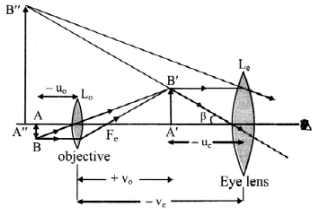
Image
From figure,
$\tan \beta=\frac{A^{\prime \prime} B^{\prime \prime}}{v_c}=\frac{A^{\prime} B^{\prime}}{u_c}$
$\text { and } \tan \alpha=\frac{A B}{D}$
View full question & answer
Question 23 Marks
From the given data set, determine angular dispersion by the prism and dispersive power of its material for extreme colours. $nR = 1.62 nv = 1.66, δR = 3.1^\circ $
Answer
Given: $n_R = 1.62, n_V = 1.66, δ_R = 3.1^\circ $
To find:
i. Angular dispersion $(δ_{vr})$
ii. Dispersive power $(ω_{VR})$
Formula:
i. $δ = A (n – 1)$
ii.$δ_{VR} = δ_V – δ_R$
(iii) $\omega=\frac{\delta_{ V }-\delta_{ R }}{\left(\frac{\delta_{ V }+\delta_{ R }}{2}\right)}$
Calculation: From formula (i),
$ \delta_{ R }= A \left( n _{ R }-1\right)$
$\therefore A =\frac{\delta_R}{\left(n_R-1\right)}=\frac{3.1}{(1.62-1)}=\frac{3.1}{0.62}$
$=5$
$\delta V = A \left( n _{ V }-1\right)=5 \times(1.66-1)=3.3 C $
From formula (ii),
$\delta_{ VR }=3.3-3.1=0.2^{\circ}$
From formula (iii),
$ \omega_{V R}=\frac{3.3-3.1}{\left(\frac{3.3+3.1}{2}\right)}=\frac{0.2}{6.4} \times 2=\frac{0.2}{3.2}=\frac{1}{16}$
$=0.0625 $
View full question & answer
Question 33 Marks
A point object is kept $10\ cm$ away from a double convex lens of refractive index $1.5$ and radii of curvature $10\ cm$ and $8\ cm.$ Determine location of the final image considering paraxial rays only.
Answer
Given that,$R_1 = 10 cm, R_2 = -8 cm$,
$u = -10\ cm$ and $n = 1.5$
From lens maker’s equation,
$ \frac{1}{ f }  =(n-1)\left(\frac{1}{R_1}-\frac{1}{R_2}\right)$
$\therefore \quad \frac{1}{ f }  =(1.5-1)\left(\frac{1}{10}-\frac{1}{-8}\right)$
$=0.5 \times \frac{9}{40}=\frac{9}{80}$
$\therefore  f  =\frac{80}{9} cm $
Now,
$ \frac{1}{ f }=\frac{1}{ v }-\frac{1}{ u }$
$\therefore \quad \frac{1}{v}=\frac{1}{f}+\frac{1}{u}=\frac{9}{80}+\frac{1}{-10}=\frac{1}{80}$
$\therefore \quad v =80 cm$
View full question & answer
Question 43 Marks
State the restrictions for having images produced by spherical mirrors to be appreciably clear.
Answer
i. In order to obtain clear images, the formulae for image formation by mirrors or lens follow the given assumptions:

  • Objects and images are situated close to the principal axis.
  • Rays diverging from the objects are confined to a cone of very small angle.
  • If there is a parallel beam of rays, it is paraxial, i.e., parallel and close to the principal axis.

ii. In case of spherical mirrors (excluding small aperture spherical mirrors), rays farther from the principle axis do not remain parallel to the principle axis. Thus, the third assumption is not followed and the focus gradually shifts towards the pole.
iii. The relation ( $f=\frac{R}{2}$ ) giving a single point focus is not followed and the image does not get converged at a single point resulting into a distorted or defective image.
iv. This defect arises due to the spherical shape of the reflecting surface.

View full question & answer
Question 53 Marks
At which positions of the objects do spherical mirrors produce (i) diminished image (ii) magnified image?
Answer
i. Amongst the two types of spherical mirrors, convex mirror always produces a diminished image at all positions of the object.

ii. Concave mirror produces diminished image when object is placed:

  • Beyond radius of curvature (i.e., u > 2f)
  • At infinity (i.e., u = ∞)

iii. Concave mirror produces magnified image when object is placed:

  • between centre of curvature and focus (i.e., 2f > u > f)
  • between focus and pole of the mirror (i.e., u < f)
View full question & answer
Question 63 Marks
As per recent development, what is the nature of light? Wave optics and particle nature of light are used to explain which phenomena of light respectively?
Answer
  1. As per recent development, it is now an established fact that light possesses dual nature. Light consists of energy carrier photons. These photons follow the rules of electromagnetic waves.
  2. Wave optics explains the phenomena of light such as, interference, diffraction, polarisation, Doppler effect etc.
  3. Particle nature of light can be used to explain phenomena like photoelectric effect, emission of spectral lines, Compton effect etc.
View full question & answer