Question types

Optics question types

72 questions across 5 question groups — pick any mix to generate a Physics paper with step-by-step answer keys.

72
Questions
5
Question groups
5
Question types
Sample Questions

Optics questions

One sample from each question group in this chapter. Select any group above to see the full set with answer keys.

Consider following statements regarding a simple microscope:
(P) It allows us to keep the object within the least distance of distinct vision.
(Q) Image appears to be biggest if the object is at the focus.
(R) It is simply a convex lens.
  • A
    Only (P) is correct
  • B
    Only (P) and (Q) are correct
  • C
    Only (Q) and (R) are correct
  • Only (P) and (R) are correct

Answer: D.

View full solution
Which of the following is not involved in formation of a rainbow?
  • A
    refraction
  • B
    angular dispersion
  • C
    angular deviation
  • total internal reflection

Answer: D.

View full solution
Angles of deviation for extreme colours are given for different prisms. Select the one having maximum dispersive power of its material.
  • 7°, 10°
  • B
    8°, 11°
  • C
    12°, 16°
  • D
    10°, 14°

Answer: A.

View full solution
Select the WRONG statement.
  • Smaller angle of prism is recommended for greater angular dispersion.
  • B
    Right angled isosceles glass prism is commonly used for total internal reflection.
  • C
    Angle of deviation is practically constant for thin prisms.
  • D
    For emergent ray to be possible from the second refracting surface, certain minimum angle of incidence is necessary from the first surface.

Answer: A.

View full solution
A spherical marble, of refractive index 1.5 and curvature 1.5 cm, contains a tiny air bubble at its centre. Where will it appear when seen from outside?
  • A
    1 cm inside
  • at the centre
  • C
    $5 / 3 cm$ inside
  • D
    2 cm inside

Answer: B.

View full solution
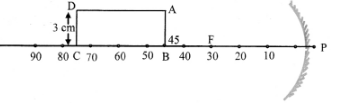
A rectangular sheet of length 30 cm and breadth 3 cm is kept on the principal axis of a concave mirror of focal length 30 cm. Draw the image formed by the mirror on the same diagram, as far as possible on scale.

Image

View full solution
A point object is kept $10\ cm$ away from a double convex lens of refractive index $1.5$ and radii of curvature $10\ cm$ and $8\ cm.$ Determine location of the final image considering paraxial rays only.
View full solution
A spherical surface separates two transparent media. Derive an expression that relates object and image distances with the radius of curvature for a point object. Clearly state the assumptions, if any.
View full solution

Generate a Optics paper free

Pick question groups from the list above, set marks and difficulty, and export a branded PDF with step-by-step answer keys. First 3 chapters free — no signup.

Download App