Questions

M.C.Q (1 Marks)

Take a timed test

29 questions · 27 auto-graded MCQ + 2 self-marked written.

MCQ 11 Mark
Consider following statements regarding a simple microscope:
(P) It allows us to keep the object within the least distance of distinct vision.
(Q) Image appears to be biggest if the object is at the focus.
(R) It is simply a convex lens.
  • A
    Only (P) is correct
  • B
    Only (P) and (Q) are correct
  • C
    Only (Q) and (R) are correct
  • Only (P) and (R) are correct
Answer
Correct option: D.
Only (P) and (R) are correct
View full question & answer
MCQ 21 Mark
Which of the following is not involved in formation of a rainbow?
  • A
    refraction
  • B
    angular dispersion
  • C
    angular deviation
  • total internal reflection
Answer
Correct option: D.
total internal reflection
View full question & answer
MCQ 31 Mark
Angles of deviation for extreme colours are given for different prisms. Select the one having maximum dispersive power of its material.
  • 7°, 10°
  • B
    8°, 11°
  • C
    12°, 16°
  • D
    10°, 14°
Answer
Correct option: A.
7°, 10°
7°, 10°
View full question & answer
MCQ 41 Mark
Select the WRONG statement.
  • Smaller angle of prism is recommended for greater angular dispersion.
  • B
    Right angled isosceles glass prism is commonly used for total internal reflection.
  • C
    Angle of deviation is practically constant for thin prisms.
  • D
    For emergent ray to be possible from the second refracting surface, certain minimum angle of incidence is necessary from the first surface.
Answer
Correct option: A.
Smaller angle of prism is recommended for greater angular dispersion.
View full question & answer
MCQ 51 Mark
A spherical marble, of refractive index 1.5 and curvature 1.5 cm, contains a tiny air bubble at its centre. Where will it appear when seen from outside?
  • A
    1 cm inside
  • at the centre
  • C
    $5 / 3 cm$ inside
  • D
    2 cm inside
Answer
Correct option: B.
at the centre
at the centre
View full question & answer
MCQ 61 Mark
A student uses spectacles of number -2 for seeing distant objects. Commonly used lenses for her/his spectacles are
  • bi-concave
  • B
    piano concave
  • C
    concavo-convex
  • D
    convexo-concave
Answer
Correct option: A.
bi-concave
bi-concave
View full question & answer
MCQ 71 Mark
Consider following phenomena/applications: P) Mirage, Q) rainbow, R) Optical fibre and S) glittering of a diamond. Total internal reflection is involved in
  • Only R and S
  • B
    Only R
  • C
    Only P, R and S
  • D
    all the four
Answer
Correct option: A.
Only R and S
Only R and S
View full question & answer
MCQ 81 Mark
There are different fish, monkeys and water of the habitable planet of the star Proxima b. A fish swimming underwater feels that there is a monkey at 2.5 m on the top of a tree. The same monkey feels that the fish is 1.6 m below the water surface. Interestingly, height of the tree and the depth at which the fish is swimming are exactly same. Refractive index of that water must be
  • A
    $6 / 5$
  • $5 / 4$
  • C
    $4 / 3$
  • D
    $7 / 5$
Answer
Correct option: B.
$5 / 4$
$5 / 4$
View full question & answer
MCQ 91 Mark
Which of the following aberrations will NOT occur for spherical mirrors?
  • Chromatic aberration
  • B
    Coma
  • C
    Distortion
  • D
    Spherical aberration
Answer
Correct option: A.
Chromatic aberration
View full question & answer
MCQ 101 Mark
A concave mirror of curvature 40 cm, used for shaving purpose produces image of double size as that of the object. Object distance must be
  • A
    10 cm only
  • B
    20 cm only
  • C
    30 cm only
  • 10 cm or 30 cm
Answer
Correct option: D.
10 cm or 30 cm
10 cm or 30 cm
View full question & answer
MCQ 111 Mark
Two plane mirrors are inclined at angle 40° between them. Number of images seen of a tiny object kept between them is
  • A
    Only 8
  • B
    Only 9
  • 8 or 9
  • D
    9 or 10
Answer
Correct option: C.
8 or 9
8 or 9
View full question & answer
MCQ 121 Mark
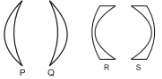
Consider the optically denser lenses P, Q, R and S drawn below. According to Cartesian sign convention which of these have positive focal length?

Image

  • A
    OnlyP
  • Only P and Q
  • C
    Only P and R
  • D
    Only Q and S
Answer
Correct option: B.
Only P and Q
Only P and Q
View full question & answer
MCQ 131 Mark
As per recent understanding light consists of
  • A
    rays
  • B
    waves
  • C
    corpuscles
  • photons obeying the rules of waves
Answer
Correct option: D.
photons obeying the rules of waves
View full question & answer
MCQ 141 Mark
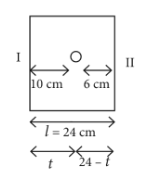
A transparent glass cube of length $24 cm$ has a small air bubble trapped inside. When seen normally through one surface from air outside, its apparent distance is $10 cm$ from the surface. When seen normally from opposite surface, its apparent distance is $6 cm$. The distance of the air bubble from first surface is
  • A
    $15 cm$
  • B
    $14 cm$
  • C
    $12 cm$
  • D
    $8 cm$
View full question & answer
MCQ 151 Mark
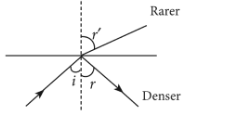
If a ray of light in denser medium strikes a rarer medium at an angle of incidence $i$, the angles of reflection and refraction are $r$ and $r^{\prime}$ respectively. If the reflected and refractive rays are at right angles to each other, the critical angle for the given pair of media is
  • A
    $\sin ^{-1}\left(\tan r^{\prime}\right)$
  • B
    $\sin ^{-1}(\tan r)$
  • C
    $\tan ^{-1}(\sin i)$
  • D
    $\cos ^{-1}(\tan i)$
View full question & answer
MCQ 161 Mark
The rays of different colours fail to converge at a point after passing through a thick converging lens. The defect is called
  • A
    spherical aberration
  • B
    distortion
  • C
    coma aberration.
  • chromatic
Answer
Correct option: D.
chromatic
(d) : Due to chromatic aberration, the rays of different colours fails to converge at a point after passing through a thick converging lens.
View full question & answer
MCQ 171 Mark
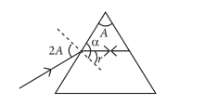
The angle of prism is $A$ and one of its refracting surface is silvered. Light rays falling at an angle of incidence ' $2 A$ ' on the first surface return back through the same path after suffering reflection at the silvered surface. The refractive index of the material of the prism is
  • A
    $2 \sin \left(\frac{A}{2}\right)$
  • B
    $2 \tan A$
  • $2 \cos A$
  • D
    $2 \sin A$
Answer
Correct option: C.
$2 \cos A$
(c) : $\alpha=90-A$
So, $r=A$
$
\begin{aligned}
& \mu=\frac{\sin i}{\sin r}=\frac{\sin 2 A}{\sin A} \\
& \mu=\frac{2 \sin A \cos A}{\sin A}=2 \cos A
\end{aligned}
$
Image
View full question & answer
MCQ 181 Mark
When a monochromatic ray of light is passed through an equilateral glass prism, it is found that the refracted ray in glass is parallel to the base of the prism. If $i$ and $e$ denote the angles of incidence and emergence respectively, then
Answer
Correct option: C.
$i=e$
(c): The refracted ray is parallel to the base.
It means minimum deviation, so, $i=e$.
View full question & answer
MCQ 191 Mark
Refractive index of a glass convex lens is $1.5.$ The radius of curvature of each of the two surfaces of the lens is $20 \ cm$. The ratio of the power of the lens when immersed in a liquid of refractive index $1.25$ to that when placed in air is
  • A
    $2: 3$
  • $2: 5$
  • C
    $3: 2$
  • D
    $5: 2$
Answer
Correct option: B.
$2: 5$
$ \mu_g=1.5, R_1=20 \ cm , R_2=-20 \ cm ; \mu_l=1.25$
$P_g=\left(\mu_g-1\right)\left(\frac{1}{R_1}-\frac{1}{R_2}\right)...(i)$
$P_l=\left({ }^l \mu_g-1\right)\left(\frac{1}{R_1}-\frac{1}{R_2}\right)...(ii)$
$\frac{P_l}{P_g}=\frac{l_{\mu_g-1}}{a_{\mu_g-1}}=\frac{\frac{\mu_g}{\mu_l}-1}{a_{\mu_g-1}}$
$\frac{P_l}{P_g}=\frac{\frac{1.5}{1.25}-1}{1.5-1}=\frac{0.25}{1.25 \times 0.5} ; \frac{P_l}{P_g}=\frac{2}{5}$
View full question & answer
MCQ 201 Mark
The angle of deviation produced by a thin prism when placed in air is $' \delta\ ' $ and that when immersed in water is $' \delta_2\ '.$ The refractive index of glass and water are $\frac{3}{2}$ and $\frac{4}{3}$ respectively. The ratio $\delta_1: \delta_2$ is
  • A
    $1: 2$
  • B
    $2: 1$
  • C
    $1: 4$
  • $4: 1$
Answer
Correct option: D.
$4: 1$
$ \delta=(\mu-1) A$
$\delta_1=\left(\mu_g-1\right) A ...(i)$
$\delta_2=\left({ }^w \mu_g-1\right) A ....(ii)$
$\frac{\delta_1}{\delta_2}=\frac{\frac{3}{2}-1}{\frac{3 \times 3}{2 \times 4}-1}=\frac{\frac{1}{2}}{\frac{1}{8}}=4: 1$
View full question & answer
MCQ 211 Mark
A combination of two thin lenses in contact have power $+10 D$. The power reduces to $+6 D$ when the lenses are $0.25 m$ apart. The power of individual lens is
  • A
    $5 D , 5 D$
  • B
    $6 D , 4 D$
  • C
    $7 D , 3 D$
  • $8 D , 2 D$
Answer
Correct option: D.
$8 D , 2 D$
(d) : $P_1+P_2=10 D$ ...(i)
$
\begin{aligned}
& P_1+P_2-d P_1 P_2=6 D \\
& 10-0.25 P_1 P_2=6  ..(ii)
\end{aligned}
$
Using equation (ii), we have
$
\begin{aligned}
& \therefore \frac{10-6}{0.25}=P_1 P_2 ; P_1 P_2=16 \\
& P_1-P_2=\sqrt{\left(P_1+P_2\right)^2-4 P_1 P_2}=\sqrt{10^2-4 \times 16} \\
& P_1-P_2=6
...(iii)\end{aligned}
$
Using equation (i) and (iii), $P_1=8 D , P_2=2 D$
View full question & answer
MCQ 221 Mark
The refracting angle of a glass prism is $30^{\circ}$. A ray is incident on one of the faces perpendicular to it. The angle of deviation $\delta$ between the incident ray and that leaves the prism is. $($ Refractive index of glass $=1.5)$. $\left(\sin 30^{\circ}=0.5, \sin (48.6)^{\circ}=0.75\right)$
  • A
    $17^{\circ}$
  • $18.6^{\circ}$
  • C
    $12.6^{\circ}$
  • D
    $16^{\circ}$
Answer
Correct option: B.
$18.6^{\circ}$
(b) :Given, $A=30^{\circ}, m =1.5 ; i_1=0^{\circ}$
In a prism, $r_1+r_2=A \quad \therefore r_2=A=30^{\circ}$
from snell's law, $\mu=\frac{\sin i_2}{\sin r_2}$
$
\begin{aligned}
& \Rightarrow 1.5=\frac{\sin i_2}{\sin 30^{\circ}} \Rightarrow \sin i_2=1.5 \sin 30^{\circ} \\
& =1.5 \times \frac{1}{2}=0.75 \\
& i_2=\sin ^{-1}(0.75)=48.6^{\circ}
\end{aligned}
$
Deviation, $\delta=\left(i_1+i_2\right)-A=\left(0+48.6^{\circ}\right)-30^{\circ}=18.6^{\circ}$
View full question & answer
MCQ 231 Mark
A compound microscope is a magnification of 24 . The focal length of the eyepiece is $5 cm$.The final image is formed at the least distance of distinct vision. The magnification produced by the objective is
  • A
    5
  • B
    7
  • 4
  • D
    6
Answer
Correct option: C.
4
(c):For a compound microscope, $M=m_o \times m_e$.
Also, the final image is formed at $D$.
So, $M=m_0\left(1+\frac{D}{f_e}\right)$ $m_0=\frac{M}{1+\frac{D}{f_e}}=\frac{24}{1+\frac{25}{5}}=\frac{24}{6} ; m_0=4$
View full question & answer
MCQ 241 Mark
A glass convex lens is of refractive index 1.55 with both faces of same radius of curvature. What is the radius of curvature required if focal length is to be $20 cm$ ?
  • A
    $18 cm$
  • B
    $21 cm$
  • C
    $20 cm$
  • $22 cm$
Answer
Correct option: D.
$22 cm$
(d): Lens maker's formula,
$
\begin{aligned}
& \frac{1}{f}=(\mu-1)\left(\frac{1}{R_1}-\frac{1}{R_2}\right) \\
& \text { Here, } f=20 cm , \mu=1.55 ; R_1=R ; R_2=-R \\
& \Rightarrow \frac{1}{20}=(1.55-1)\left(\frac{1}{R}+\frac{1}{R}\right) \\
& \Rightarrow \frac{1}{20}=0.55 \times \frac{2}{R} \Rightarrow R=22 cm
\end{aligned}
$
View full question & answer
MCQ 251 Mark
A ray of light is incident on a $60^{\circ}$ prism at the minimum deviation position. The angle of refraction at the first face (i.e., incident face) of the prism is
  • A
    zero
  • $30^{\circ}$
  • C
    $45^{\circ}$
  • D
    $60^{\circ}$
Answer
Correct option: B.
$30^{\circ}$
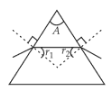
(b) : Angle of prism, $A=r_1+r_2$
For minimum deviation
$
r_1=r_2=r \quad \therefore A=2 r
$
Given, $A=60^{\circ}$
Hence, $r=\frac{A}{2}=\frac{60^{\circ}}{2}=30^{\circ}$Image
View full question & answer
MCQ 261 Mark
A ray of light travelling in a transparent medium of refractive index $\mu$, falls on a surface separating the medium from air at an angle of incidence of $45^{\circ}$. For which of the following value of $\mu$, the ray can undergo total internal reflection?
  • A
    $\mu=1.33$
  • B
    $\mu=1.40$
  • $\mu=1.50$
  • D
    $\mu=1.25$
Answer
Correct option: C.
$\mu=1.50$
(c) : For total internal reflection, $\sin i>\sin C$
where, $i=$ angle of incidence
$C=$ critical angle
But, $\sin C=\frac{1}{\mu} \quad \therefore \sin i>\frac{1}{\mu}$ or $\mu>\frac{1}{\sin i}$
$
\begin{aligned}
& \mu>\frac{1}{\sin 45^{\circ}} \quad \quad\left(i=45^{\circ} \text { (Given) }\right) \\
& \mu>\sqrt{2}
\end{aligned}
$
Hence, option (c) is correct.
View full question & answer
MCQ 271 Mark
A convex lens of focal length $f$ is placed in contact with a concave lens of the same focal length. The equivalent focal length of the combination will be
  • A
    $f$
  • infinity
  • C
    $f / 2$
  • D
    zero
Answer
Correct option: B.
infinity
(b) : Here, equivalent focal length of the combination is,
$
\frac{1}{F_{e q}}=\frac{1}{F_1}+\frac{1}{F_2}-\frac{d}{F_1 F_2}
$
Now, as the lenses are in contact, so, $d=0$
$
\therefore \frac{1}{F_{e q}}=\frac{1}{F_1}+\frac{1}{F_2}=\frac{1}{-f}+\frac{1}{f}=0 \Rightarrow F_{e q}=\infty \text { (infinity) }
$
View full question & answer
MCQ 281 Mark
The equiconvex lens has a focal length ' $f$ '. If the lens is cut along the line perpendicular to principal axis and passing through the pole, what will be the focal length of any half part?
  • A
    $\frac{f}{2}$
  • $2 f$
  • C
    $\frac{3 f}{2}$
  • D
    $f$
Answer
Correct option: B.
$2 f$
(b) : Using lens maker's formula,
$
\frac{1}{f}=(\mu-1)\left(\frac{1}{R_1}-\frac{1}{R_2}\right)
$
Since, $R_1=+R$ and $R_2=-R$ for equiconvex lens.
$
\therefore \frac{1}{f}=(\mu-1)\left(\frac{1}{R}+\frac{1}{R}\right)=(\mu-1)\left(\frac{2}{R}\right)
$
Now, when the lens is cut along the line perpendicular to principal axis then,
$
\begin{aligned}
& R_1=R \text { and } R_2=\infty \\
& \therefore \frac{1}{f^{\prime}}=(\mu-1)\left(\frac{1}{R}+\frac{1}{\infty}\right) \\
& =(\mu-1)\left(\frac{1}{R}\right)=\frac{1}{2}(\mu-1)\left(\frac{2}{R}\right)=\frac{1}{2 f} \quad \therefore f^{\prime}=2 f
\end{aligned}
$
View full question & answer
MCQ 291 Mark
The angle made by incident ray of light with the reflecting surface is called
  • glancing angle
  • B
    angle of incidence
  • C
    angle of deviation
  • D
    angle of refraction
Answer
Correct option: A.
glancing angle
(a) : The angle between incident ray and the reflecting surface is called glancing angle.
View full question & answer