Questions

M.C.Q (1 Marks)

🎯

Test yourself on this topic

35 questions · timed · auto-graded

MCQ 11 Mark
The potential barrier in p-n diode is due to:
  • A
    depletion of positive charges near the junction
  • B
    accumulation of positive charges near the junction
  • C
    depletion of negative charges near the junction,
  • accumulation of positive and negative charges near the junction
Answer
Correct option: D.
accumulation of positive and negative charges near the junction

View full question & answer
MCQ 21 Mark
A reverse biased diode, is equivalent to:
  • an off switch
  • B
    an on switch
  • C
    a low resistance
  • D
    none of the above
Answer
Correct option: A.
an off switch
View full question & answer
MCQ 31 Mark
Current through a reverse biased p-n junction, increases abruptly at:
  • Breakdown voltage
  • B
    0.0 V
  • C
    0.3V
  • D
    0.7V
Answer
Correct option: A.
Breakdown voltage
Breakdown voltage
View full question & answer
MCQ 41 Mark
The energy levels of holes are:
  • A
    in the valence band
  • B
    in the conduction band
  • in the band gap but close to valence band
  • D
    in the band gap but close to conduction band
Answer
Correct option: C.
in the band gap but close to valence band
View full question & answer
MCQ 51 Mark
Electric conduction through a semiconductor is due to:
  • A
    Electrons
  • B
    holes
  • C
    none of these
  • both electrons and holes
Answer
Correct option: D.
both electrons and holes
View full question & answer
MCQ 61 Mark
In the reverse biasing of a $p-n$ junction diode
  • A
    the width of the depletion layer decreases.
  • the width of the depletion layer increases.
  • C
    the number of minority charge carriers increase.
  • D
    the number of majority charge carriers increase.
Answer
Correct option: B.
the width of the depletion layer increases.
(b) the width of the depletion layer increases.
View full question & answer
MCQ 71 Mark
For an intrinsic semiconductor ( $n_h$ and $n_e$ are the number of holes per unit volume and number of electrons per unit volume respectively)
  • A
  • $n_h=n_e$
  • C
    $n_h=\frac{n_c}{2}$
  • D
    $n_h>n_c$
Answer
Correct option: B.
$n_h=n_e$
(b) : For intrinsic semiconductors, $n_e=n_h$
View full question & answer
MCQ 81 Mark
When the conductivity of a semiconductor is only due to the breaking of the covalent bonds, the semiconductor is called
  • A
    donor
  • intrinsic
  • C
    acceptor
  • D
    extrinsic
Answer
Correct option: B.
intrinsic
(b) : In intrinsic semiconductors, conductivity is only due to breaking of the covalent bonds.
View full question & answer
MCQ 91 Mark
In semiconductors at room temperature,
  • A
    the valence band is completely filled.
  • B
    the conduction band is completely filled.
  • the conduction band is partially filled and valence band is partially empty.
  • D
    the valence band is completely filled and the conduction band is partially filled.
Answer
Correct option: C.
the conduction band is partially filled and valence band is partially empty.
(c) : The conduction band is partially filled and valence band is partially empty.
View full question & answer
MCQ 101 Mark
An $n$-type and a $p$-type silicon semiconductor can be obtained by doping pure silicon with
  • A
    indium and sodium respectively
  • B
    boron and arsenic respectively
  • arsenic and boron respectively
  • D
    sodium and magnesium respectively.
Answer
Correct option: C.
arsenic and boron respectively
(c) : An n-type semiconductor has electrons as majority charge carriers. Thus for obtaining a $n$-type semiconductor silicon should be doped with electron rich donor elements of $V$ A group like answer.
Similarly, a p-type semiconductor has holes as majority charge carriers. Thus for obtaining a $p$-type semiconductor silicon should be doped with acceptor elements of group III A like boron.
View full question & answer
MCQ 111 Mark
In a forward bias arrangement of a $p-n$ junction diode, the
  • A
    direction of conventional current is from $n$-region to $p$-region in the diode
  • B
    p-region is connected negative terminal of the battery
  • C
    $n$-region is connected to the positive terminal of battery
  • p-region is connected to the positive terminal of battery.
Answer
Correct option: D.
p-region is connected to the positive terminal of battery.
(d) : In a forward bias arrangement of a $p-n$ junction diode, the $p$-region is connected to the positive terminal of battery while $n$-region is connected to the negative terminal of battery.
View full question & answer
MCQ 131 Mark
In case of $p-n$ junction diode, the width of depletion region is
  • A
    decreased with heavy doping
  • increased by reverse biasing
  • C
    decreased with light doping
  • D
    increased by forward biasing.
Answer
Correct option: B.
increased by reverse biasing
(b) : In case of $p-n$ junction diode, the width of depletion region is increased by reverse biasing. The potential barrier becomes higher as the battery further raises the potential of the $n$-side.
View full question & answer
MCQ 141 Mark
With forward biased mode, the $p-n$ junction diode
  • A
    is one in which width of depletion layer increases
  • B
    is one in which potential barrier increases
  • acts as closed switch
  • D
    acts as open switch
Answer
Correct option: C.
acts as closed switch
(c) : In forward biased mode, the $p-n$ junction diode acts as closed switch.
View full question & answer
MCQ 151 Mark
Photodiode is a device
  • which is always operated in reverse bias
  • B
    which of always operated in forward bias
  • C
    in which photo current is independent of intensity of incident radiation
  • D
    which may be operated in forward or reverse bias.
Answer
Correct option: A.
which is always operated in reverse bias
(a) : Photodiode is a device which is always operated in reverse bias.
View full question & answer
MCQ 161 Mark
In insulators (C.B. is conduction band and V.B. is valence band)
  • A
    V.B. is partially filled with electrons.
  • B
    C.B. is partially filled with electrons.
  • C.B. is empty and V.B. is filled with electrons.
  • D
    C.B. is filled with electrons and V.B. is empty.
Answer
Correct option: C.
C.B. is empty and V.B. is filled with electrons.
(c) : In insulators conduction band is empty and valence band is completely filled with electrons.
View full question & answer
MCQ 171 Mark
For an ideal junction diode,
  • A
    forward bias resistance is infinity.
  • B
    forward bias resistance is zero.
  • C
    reverse bias resistance is infinity.
  • both (B) and (C).
Answer
Correct option: D.
both (B) and (C).
both (B) and (C).
View full question & answer
MCQ 181 Mark
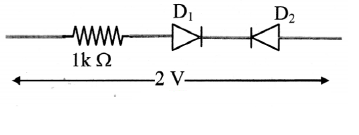
In the circuit shown below Di and D2 are two silicon diodes. The current in the circuit is …………….
Image
  • A
    $ 2 A$
  • B
    $2 mA$
  • C
    $0.8 mA$
  • very small (approx 0)
Answer
Correct option: D.
very small (approx 0)
View full question & answer
MCQ 191 Mark
For p-n junction in reverse bias, which of the following is true?
  • There is no current through P-N junction due to majority carriers from both regions.
  • B
    Width of potential barriers is small and it offers low resistance.
  • C
    Current is due to majority carriers.
  • D
    Both (B) and (C )
Answer
Correct option: A.
There is no current through P-N junction due to majority carriers from both regions.
View full question & answer
MCQ 201 Mark
The width of depletion region ……………
  • becomes small in forward bias of diode
  • B
    becomes large in forward bias of diode
  • C
    is not affected upon by the bias
  • D
    becomes small in reverse bias of diode
Answer
Correct option: A.
becomes small in forward bias of diode
View full question & answer
MCQ 211 Mark
In an unbiased p-n junction, holes diffuse from the p-region to n-region because
  • A
    free electrons in the n-region attract them.
  • B
    they move across the junction by the potential difference.
  • hole concentration in p-region is more as compared to n-region.
  • D
    all the above.
Answer
Correct option: C.
hole concentration in p-region is more as compared to n-region.
View full question & answer
MCQ 221 Mark
If a p-n junction diode is not connected to any circuit, then
  • A
    the potential is same everywhere.
  • B
    potential is not same and n-type side has lower potential than p-type side.
  • C
    there is an electric field at junction direction from p-type side to n-type side.
  • there is an electric field at the junction directed from n-type side to p-type side.
Answer
Correct option: D.
there is an electric field at the junction directed from n-type side to p-type side.
View full question & answer
MCQ 231 Mark
The drift current in a p-n junction is
  • A
    from the p region to n region.
  • from the n region to p region.
  • C
    from n to p region if the junction is forward biased and from p to n region if the junction is reverse biased.
  • D
    from p to n region if the junction is forward biased and from n to p region if the junction is reverse biased.
Answer
Correct option: B.
from the n region to p region.
View full question & answer
MCQ 241 Mark
The movement of a hole is brought about by the valency being filled by a ………………..
  • A
    free electrons
  • valence electrons
  • C
    positive ions
  • D
    negative ions
Answer
Correct option: B.
valence electrons
valence electrons
View full question & answer
MCQ 251 Mark
The number of bonds formed in p-type and n-type semiconductors are respectively
  • A
    4,5
  • 3,4
  • C
    4,3
  • D
    5,4
Answer
Correct option: B.
3,4
3,4
View full question & answer
MCQ 261 Mark
When a hole is produced in P-type semiconductor, there is ……………….
  • A
    extra electron in valence band.
  • B
    extra electron in conduction band.
  • missing electron in valence band.
  • D
    missing electron in conduction band.
Answer
Correct option: C.
missing electron in valence band.
View full question & answer
MCQ 271 Mark
What are majority carriers in a semiconductor?
  • A
    Holes in n-type and electrons in p-type.
  • B
    Holes in n-type and p-type both.
  • C
    Electrons in n-type and p-type both.
  • Holes in p-type and electrons in n-type.
Answer
Correct option: D.
Holes in p-type and electrons in n-type.
View full question & answer
MCQ 281 Mark
In a semiconductor, acceptor impurity is
  • A
    antimony
  • indium
  • C
    phosphorous
  • D
    arsenic
Answer
Correct option: B.
indium
indium
View full question & answer
MCQ 291 Mark
For an extrinsic semiconductor, the valency of the donor impurity is …………..
  • A
    2
  • B
    1
  • C
    4
  • 5
Answer
Correct option: D.
5
5
View full question & answer
MCQ 301 Mark
A pure semiconductor is ……………..
  • A
    an extrinsic semiconductor
  • an intrinsic semiconductor
  • C
    p-type semiconductor
  • D
    n-type semiconductor
Answer
Correct option: B.
an intrinsic semiconductor
View full question & answer
MCQ 311 Mark
In the crystal of pure Ge or Si, each covalent bond consists of …………..
  • A
    1 electron
  • B
    2 electron
  • C
    3 electrons
  • D
    4 electrons
Answer
2 electrons
View full question & answer
MCQ 321 Mark
In conduction band of solid, there is no electron at room temperature. The solid is ……………………..
  • A
    semiconductors
  • insulator
  • C
    conductor
  • D
    metal
Answer
Correct option: B.
insulator
insulator
View full question & answer
MCQ 331 Mark
When N-type semiconductor is heated, the ……………..
  • A
    number of electrons and holes remains same.
  • B
    number of electrons increases while that of holes decreases.
  • C
    number of electrons decreases while that of holes increases.
  • number of electrons and holes increases equally.
Answer
Correct option: D.
number of electrons and holes increases equally.
View full question & answer
MCQ 341 Mark
If the temperature of semiconductor is increased, the number of electrons in the valence band will ……………….
  • decrease
  • B
    remains same
  • C
    increase
  • D
    either increase or decrease
Answer
Correct option: A.
decrease
decrease
View full question & answer
MCQ 351 Mark
The number of electrons in the valence shell of semiconductor is ……………
  • A
    less than 4
  • equal to 4
  • C
    more than 4
  • D
    zero
Answer
Correct option: B.
equal to 4
equal to 4
View full question & answer
M.C.Q (1 Marks) - Physics STD 11 Questions - Vidyadip