Questions

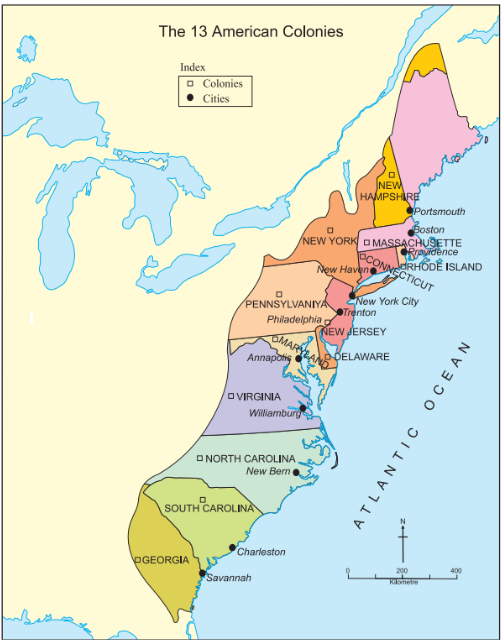
Observe the following graph , chart or map and answer the question given below.

Take a timed test

3 questions · self-marked practice — reveal the answer and mark yourself.

Question 15 Marks
Image
Q.1.Write the names of the thirteen colonies.
Q.2.Name some of the cities in the colonies.
Q.3.What is the name of the ocean that lies to the east of the colonies?
Answer
ANS.1.New Hampshire, New York, Massachusetts, Connecticut, Rhode Island, Pennsylvania, New Jersey, Delaware, Maryland, Virginia, North Carolina, South Carolina, and Georgia.
ANS.2.Portsmouth, Boston, New York City, Trenton, etc.
ANS.3.The Atlantic Ocean lies to the east of the colonies.
View full question & answer
Question 25 Marks
Explain the causes for the rise of Colonialism.
(a) Industrial Consequences
(b) Requirements of Raw Material
(c) Sources of Minerals
(d) Feeling of Racial Superiority
Answer
(a) Industrial Consequences:
Colonialism was a result of the industrial revolution. Production increased enormously because of the new machines. However, the rate of local consumption was much less compared to the surplus rate of production. Hence, the immediate need of the Europeans was to find new markets for selling their products. It was also necessary that these markets be dependable and easy to dominate.
(b) Requirements of Raw Material:
The desire to create a monopoly in the market and the need to procure raw material at cheaper rates were two major factors that made European nations compete with one another for clear Supremacy.
(c) Sources of Minerals:
The countries in Asia and Africa were rich in minerals like gold, diamonds, silver, coal, etc. This attracted the European nations to Asia and Africa.
(d) Feeling of Racial Superiority:
The Europeans felt it was their responsibility to civilise the people of Asia and Africa. This led to the conversion of Asian and African people to Christianity. It also helped the growth of colonialism.
View full question & answer
Question 35 Marks
Write a note on England’s role in Australia.
Answer
  • England first colonised Australia in the 18th century when the first colony of prisoners was deported from England.
  • Later in the 19th century, other regions in Australia were colonised.
  • The British also established their colonies in the island of Tasmania and New Zealand.
  • In the year 1900, the island of Tasmania and the Republic of Australia was created as an integral nation of the British Empire.
  • A bicameral parliament was established and a Governor-General was appointed in Australia by the British king as the viceregal representative.
  • Only European immigrants were allowed to enter Australia.
View full question & answer