Questions

Answer the following in brief.

Take a timed test

16 questions · self-marked practice — reveal the answer and mark yourself.

Question 23 Marks
Write main specialities of Buna-S, Neoprene rubber?
Answer
Buna-S is an elastomer and it is copolymer of styrene with butadiene. Its trade name is SBR. Buna-S is superior to natural rubber, because of its mechanical strength and abrasion resistance. It is used in tyre industry. It is vulcanized with sulphur. Neoprene is a synthetic rubber and it is a condensation polymer of chloroprene (2-chloro-l, 3-butadiene). Vulcanization of neoprene takes place in presence of MgO. It is resistant to petroleum, vegetable oils. Neoprene is used in making hose pipes for transport of gasoline and making gaskets.
View full question & answer
Question 33 Marks
Is synthetic rubber better than natural rubber? If so, in what respect?
Answer
Yes. Synthetic rubber is more resistant to abrasion than natural rubber and is also superior in resistance to heat and the effects of aging (lasts longer). Many types of synthetic rubber are flame-resistant, so they can be used in insulation for electrical devices.

It also remains flexible at low temperatures and is resistant to grease and oil. It is resistant to heat, light and certain chemicals.
View full question & answer
Question 43 Marks
Write reactions involved in the formation of Bakelite
Answer
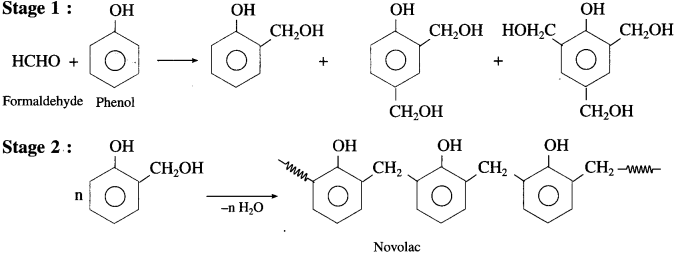
The monomers phenol and formaldehyde undergo polymerisation in the presence of alkali or acid as catalyst.

Image

Phenol reacts with formaldehyde to form ortho or p-hydroxy methyl phenols, which further reacts with phenol to form a linear polymer called Novolac. It is used in paints.

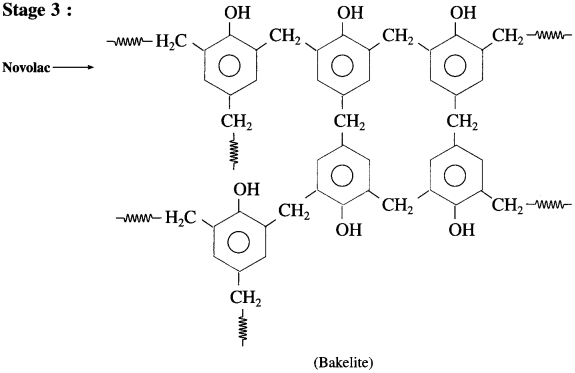
In the third stage, various articles are shaped from novolac by putting it in appropriate moulds and heating at high temperature (138 °C to 176 °C) and at high pressure forms rigid polymeric material called bakelite. Bakelite is insoluble and infusible and has high tensile strength.
Image

Bakelite is used in making articles like telephone instrument, kitchenware, electric insulators frying pans, etc.

View full question & answer
Question 63 Marks
Refer to the following table listing for different polymers formed from respective monomers. Identify from the list whether it is copolymer or homopolymer.
MonomerPolymers
EthylenePolyethene
Vinyl chloridePolyvinyl chloride
IsobutylenePolyisobutylene
AcrylonitrilePolyacrylonitrile
CaprolactamNylon 6
Hexamethylene diammonium adipateNylon 6, 6
Butadiene + styreneBuna-S
Answer
In each of first five cases, there is only one monomer which gives corresponding homopolymer. In the sixth case hexamethylene diamine reacts with adipic acid to form the salt hexamethylene diammonium adipate which undergoes condensation to form Nylon 6, 6. Hence nylon 6, 6 is homopolymer. The polymer Buna-S is formed by polymerization of the monomers butadiene and styrene in presence of each other. The repeating units corresponding to the monomers butadiene and styrene are randomly arranged in the polymer. Hence Buna-S is copolymer.
View full question & answer
Question 83 Marks
Write preparation, properties and uses of Teflon.
Answer
Teflon is polytetrafluoroethylene. The monomer used in preparation of teflon is tetrafluoroethylene, $(CF_2 = CF_2)$ which is a gas at room temperature. Tetrafluoroethylene is polymerized by using free radical initiators such as hydrogen peroxide or ammonium persulphate at high pressure.Image
Properties:
  • Telflon is tough, chemically inert and resistant to heat and attack by corrosive reagents.
  • C – F bond is very difficult to break and remains unaffected by corrosive alkali, organic solvents.
    Uses : Telflon is used in making non-stick cookware, oil seals, gaskets, etc.
View full question & answer
Question 93 Marks
What is meant by LDP and HDP? Mention the basic difference between the same with suitable examples.
Answer
  • LDP is low density polyethylene and HDP is high density polyethylene.
  • LDP is a branched polymer with low density due to chains are loosely held and HDP is a linear polymer with density due to close packing.
  • HDP is much stiffer than LDP and has high tensile strength and hardness.

LDP is mainly used in preparation of pipes for agriculture, irrigation and domestic water line connections. HDP is used in manufacture of toys and other household articles like bucket, bottles, etc.

View full question & answer
Question 103 Marks
Write reactions involved in the formation of Teflon 
Answer

Teflon is polytetrafluoroethylene. The monomer used in preparation of teflon is tetrafluoroethylene, $(CF_2 = CF_2)$ which is a gas at room temperature. Tetrafluoroethylene is polymerized by using free radical initiators such as hydrogen peroxide or ammonium persulphate at high pressure.
Image
Properties:
  • Telflon is tough, chemically inert and resistant to heat and attack by corrosive reagents.
  • C – F bond is very difficult to break and remains unaffected by corrosive alkali, organic solvents.
    Uses : Telflon is used in making non-stick cookware, oil seals, gaskets, etc.
View full question & answer
Question 113 Marks
Explain the vulcanisation of rubber. Which vulcanizing agents are used for the following synthetic rubber.
a. Neoprene
b. Buna-N
Answer
The process by which a network of cross links is introduced into an elastomer is called vulcanization.

Vulcanization enhances the properties of natural rubber like tensile strength, stiffness, elasticity, toughness etc. Sulphur forms cross links between polyisoprene chains which results in improved properties of rubber.
  • For neoprene vulcanizing agent is MgO.
  • For Buna-N vulcanizing agent is sulphur.
View full question & answer
Question 123 Marks
Write the chemical reactions involved in the manufacture of Nylon $6, 6$
Answer
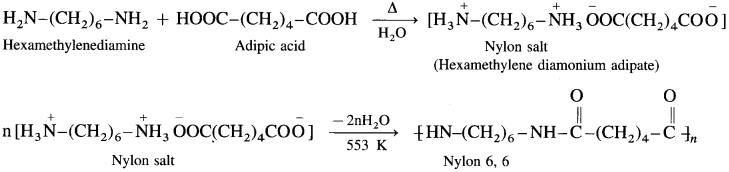
Nylon-$6, 6$ is a linear polyamide polymer formed by the condensation polymerisation reaction.
The monomers used in the preparation of Nylon-$6, 6$ are :
(1) Adipic acid : $HOOC-(CH_2)_4-COOH$
(2) Hexamethylene diamine : $H_2N-(CH_2)_6-NH_2$ When equimolar aqueous solutions of adipic acid and hexamethylene diamine are mixed and heated, there is neutralization to form a nylon salt. During polymerisation at $553\ k$ nylon salt loses a water molecule to form nylon $6, 6$ polymer. Both monomers (hexamethylene diamine and adipic acid) contain six carbon atoms each, hence the polymer is termed as Nylon-$6,6.$​​​​​​​

Image

Properties and uses : Nylon $6,6$ is high molecular mass $(12000 – 50000 u)$ linear condensation polymer. It possesses high tensile strength. It does not soak in water. It is used for making sheets, bristles for brushes, surgical sutures, textile fabrics, etc.
View full question & answer
Question 143 Marks
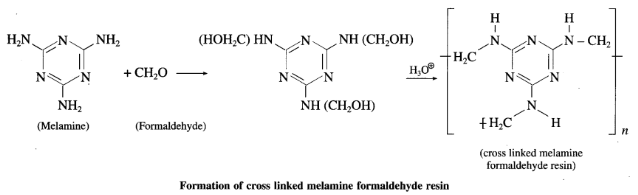
Write the structure of melamine.
Answer
The monomers formaldehyde and melamine undergo condensation polymerisation to form cross-linked melamine formaldehyde. It is used in making crockeries, decorative table tops like formica and plastic dinner-ware.
Image
View full question & answer
Question 153 Marks
How is nylon-6 prepared?
Write the reaction for the preparation of nylon 6.
Answer
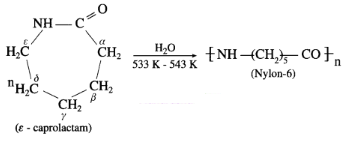
When epsilon ( $\varepsilon$ )-caprolactam is heated with water at high temperature it undergoes ring opening polymerization to form the polyamide polymer called nylon-6.

Image

The name nylon-6 is given on the basis of six carbon atoms present in the monomer unit. Nylon-6 has high tensile strength and luster, nylon-6 fibres are used for manufacture of tyre cords, fabrics and ropes.
View full question & answer
Question 163 Marks
Write the classification of polymers based on source. Give examples.###What are natural and synthetic polymers? Give two examples of each type.
Answer
Based on the source polymers are classified as natural, semisynthetic and synthetic polymers.
  1. Natural polymers : These polymers are obtained either from plants or animals, e.g., cellulose, jute, linene, rubber, silk.
  2. Semisynthetic polymers : The fibres obtained by giving special chemical treatment to natural fibres (cellulose) and further regenerated are called semisynthetic polymers e.g., acetate rayon, viscose rayon, cuprammonium silk.
  3. Synthetic polymers : The man made fibres prepared by polymerization of one monomer or copolymerization of
    two or more monomers are called synthetic polymers, e.g., nylon, terylene, polythene, etc.
View full question & answer