Question 515 Marks
Evaluate the following integrals:
$\int\frac{2\text{x}}{\text{x}^3-1}\ \text{dx}$
AnswerLet $\text{I}=\int\frac{2\text{x}}{\text{x}^3-1}\text{ dx}=\int\frac{2\text{x}}{(\text{x}-1)(\text{x}^2+\text{x}+1)}\ \text{dx}$
Now,
Let $\frac{2\text{x}}{(\text{x}-1)(\text{x}^2+\text{x}+1)}=\frac{\text{A}}{(\text{x}-1)^2}+\frac{\text{Bx}+\text{C}}{\text{x}^2+\text{x}+1}$
$\Rightarrow2\text{x}=\text{A}(\text{x}^2+\text{x}+1)+(\text{Bx}+\text{C})(\text{x}-1)$
$=(\text{A}+\text{B})\text{x}^2+(\text{A}-\text{B}+\text{C})\text{x}+(\text{A}-\text{C})$
Equating similar terms,
A + B = 0, A - B + C = 2, A - C = 0,
Solving, we get, $\text{A}=\frac{2}{3},\text{B}=-\frac{2}{3},\text{C}=\frac{2}{3}$
thus,
$\text{I}=\frac{2}{3}\int\frac{\text{dx}}{\text{x}-1}-\frac{2}{3}\int\frac{(\text{x}-1)\text{dx}}{\text{x}^2+\text{x}+1}$
$=\frac{2}{3}\int\frac{\text{dx}}{\text{x}-1}-\frac{2}{3}\int\frac{(\text{2x}-2)\text{dx}}{\text{x}^2+\text{x}+1}$
$\Rightarrow\text{I}=\frac{2}{3}\int\frac{\text{dx}}{\text{x}-1}-\frac{1}{3}\int\frac{2\text{x}+1}{\text{x}^2+\text{x}+1}\ \text{dx}+\int\frac{\text{dx}}{\text{x}^2+\text{x}+1}$
$=\frac{2}{3}\int\frac{\text{dx}}{\text{x}-1}-\frac{1}{3}\int\frac{2\text{x}+1}{\text{x}^2+\text{x}+1}\ \text{dx}+\int\frac{\text{dx}}{\Big(\text{x}+\frac{1}{2}\Big)^2+\Big(\frac{\sqrt{3}}{2}\Big)^2}$
$=\frac{2}{3}\log|\text{x}-1|-\frac{1}{3}\log|\text{x}^2+\text{x}+1|\\+\frac{2}{\sqrt{3}}\tan^{-1}\Bigg(\frac{\text{x}+\frac{1}{2}}{\frac{\sqrt{3}}{2}}\Bigg)+\text{C}$
Hence,
$\text{I}=\frac{2}{3}\log|\text{x}-1|-\frac{1}{3}\log|\text{x}^2+\text{x}+1|\\+\frac{2}{\sqrt{3}}\tan^{-1}\Big(\frac{2\text{x}+1}{\sqrt{3}}\Big)+\text{C}$
View full question & answer→Question 525 Marks
Evaluate the following integrals:
$ \int\sqrt{\cot}\theta\text{d}\theta$
Answer$ \int\sqrt{\cot}\theta\text{d}\theta$
Let $\cot\theta=\text{x}^2$
$\Rightarrow-\text{cosec}^2\theta\text{d}\theta=2\text{x dx}$
$\Rightarrow\text{d}\theta=\frac{-2\text{x}}{\text{cosec}^2\theta}\ \text{dx}$
$=\frac{-2\text{x}}{1+\cot^2\theta}$
$=\frac{-2\text{x}}{1+\text{x}^4}\ \text{dx}$
$\therefore\text{I}=-\int\frac{2\text{x}^2}{1+\text{x}^4}\ \text{dx}$
$=-\int\frac{2}{\frac{1}{\text{x}^2}+\text{x}^2}\ \text{dx}$
Dividing numerator and denominator by $x^2$
$=-\frac{1+\frac{1}{\text{x}^2}+1-\frac{1}{\text{x}^2}}{\text{x}^2+\frac{1}{\text{x}^2}}\ \text{dx}$
$=-\int\frac{\Big(1+\frac{1}{\text{x}^2}\Big)\text{dx}}{\Big(\text{x}-\frac{1}{\text{x}^2}\Big)+2}-\int\frac{\Big(1-\frac{1}{\text{x}^2}\Big)\text{dx}}{\Big(\text{x}+\frac{1}{\text{x}^2}\Big)^2-2}$
Let $\text{x}-\frac{1}{\text{x}}=\text{t}\Rightarrow\Big(1+\frac{1}{\text{x}^2}\Big)\ \text{dx}=\text{dt}$
and $\text{x}+\frac{1}{\text{x}}=\text{z}\Rightarrow\Big(1-\frac{1}{\text{x}^2}\Big)\text{dx}=\text{dz}$
$\Rightarrow\text{I}=-\int\frac{\text{dt}}{\text{t}^2+2}-\int\frac{\text{dz}}{\text{z}^2-2}$
$=-\frac{1}{\sqrt{2}}\tan^{-1}\Big(\frac{\text{t}}{\sqrt{2}}\Big)-\frac{1}{2\sqrt{2}}\log\Big|\frac{\text{z}-\sqrt{2}}{\text{z}+\sqrt{2}}\Big|+\text{C}$
$=-\frac{1}{\sqrt{2}}\tan^{-1}\Big(\frac{\text{x}^2-1}{\sqrt{2}\text{x}}\Big)-\frac{1}{2\sqrt{2}}\log\Big|\frac{\text{x}^2+1-\sqrt{2}\text{x}}{\text{x}^2+1+\sqrt{2}\text{x}}\Big|+\text{C}$
$\text{I}=-\frac{1}{\sqrt{2}}\tan^{-1}\Big(\frac{\cot\theta-1}{\sqrt{2\cot\theta}}\Big)-\frac{1}{2\sqrt{2}}\log\Big|\frac{\cot\theta+1-\sqrt{2\cot\theta}}{\cot\theta+1-\sqrt{2\cot\theta}}\Big|+\text{C}$
View full question & answer→Question 535 Marks
Evaluate the following intregals:
$\int\frac{1}{\sin\text{x}-\cos\text{x}}\ \text{dx}$
AnswerLet $\text{I}=\int\frac{1}{\sin\text{x}-\cos\text{x}}\ \text{dx}$
Putting $\sin\text{x}=\frac{2\tan\frac{\text{x}}{2}}{1+\tan^2\frac{\text{x}}{2}},\cos\text{x}=\frac{1-\tan^2\frac{\text{x}}{2}}{1+\tan^2\frac{\text{x}}{2}}$
$\text{I}=\int\frac{1}{\frac{2\tan\frac{\text{x}}{2}}{1+\tan\frac{\text{x}}{2}}}+\frac{1-\tan^\frac{\text{x}}{2}}{1+\tan^2\frac{\text{x}}{2}}$
$=\int\frac{1+\tan^2\frac{\text{x}}{2}}{2\tan\frac{\text{x}}{2}+1-\tan^2\frac{\text{x}}{2}}\ \text{dx}$
$=\int\frac{\sec^2\frac{\text{x}}{2}}{2\tan\frac{\text{x}}{2}+1-\tan^2\frac{\text{x}}{2}}\ \text{dx}$
Let $\tan\frac{\text{x}}{2}=\text{t}$
$\frac{1}{2}\sec^2\frac{\text{x}}{2}\text{dx}=\text{dt}$
$\text{I}=\int\frac{2\text{dt}}{2\text{t}+1-\text{t}^2}$
$==-2\int\frac{\text{dt}}{\text{t}^2-2\text{t}+1-1-1}$
$\text{I}=-2\int\frac{\text{dt}}{(\text{t}-1)^2-(\sqrt{2})^2}$
$=2\int\frac{2\text{dt}}{(2\sqrt{2})^2-(\text{t}-1)}$
$=\frac{2}{2\sqrt{2}}\log\Big|\frac{\sqrt{2}+\text{t}-1}{\sqrt{2}-\text{t}+1}\Big|+\text{C}$
$\text{I}=\frac{1}{\sqrt{2}}\log\Big|\frac{\sqrt{2}+\tan\frac{\text{x}}{2}-1}{\sqrt{2}-\tan\frac{\text{x}}{2}+1}\Big|+\text{C}$
View full question & answer→Question 545 Marks
Evaluvate the following intregals:
$\int\frac{\text{x}^2+\text{x}-1}{\text{x}^2+\text{x}-6}\ \text{dx}$
Answer$\int\frac{\text{x}^2+\text{x}-1}{\text{x}^2+\text{x}-6}\ \text{dx}$
$=\int\Big(\frac{\text{x}^2+\text{x}-6+6-1}{\text{x}^2+\text{x}-6}\Big)\text{dx}$
$=\int\Big(\frac{\text{x}^2+\text{x}-6}{\text{x}^2+\text{x}-6}\Big)\ \text{dx}+5\int\frac{1}{\text{x}^2+\text{x}-6}\ \text{dx}$
$=\int\text{dx}+5\int\frac{1}{\text{x}^2+3\text{x}-2\text{x}-6}\text{dx}$
$=\int\text{dx}+5\int\frac{1}{\text{x}(\text{x}+3)-2(\text{x}+3)}\ \text{dx}$
$=\int\text{dx}+5\int\frac{1}{\text{x}(\text{x}+3)-2(\text{x}+3)}\ \text{dx}$
$=\int\text{dx}+5\int\frac{1}{(\text{x}-2)(\text{x}+3)}\ \text{dx}\ \dots(1)$
Let $\frac{1}{(\text{x}-2)(\text{x}+3)}=\frac{\text{A}}{\text{x}-2}+\frac{\text{B}}{\text{x}+3}$
$\Rightarrow\frac{1}{(\text{x}-2)(\text{x}+3)}=\frac{\text{A}(\text{x}+3)+\text{B}(\text{x}-2)}{(\text{x}-2)(\text{x}+3)}$
$\Rightarrow1=\text{A}(\text{x}+3)+\text{B}(\text{x}-2)\ \dots(2)$
putting $\text{x}+3=0\text{ or }\text{x}=-3$ in eq (2)
$\Rightarrow1=\text{A}\times0+\text{B}(-3-2)$
$\Rightarrow\text{B}=-\frac{1}{5}$
Putting $\text{x}-2=0\text{ or }\text{x}=2$ in eq (2)
$\Rightarrow1=\text{A}(2+3)+\text{B}\times0$
$\Rightarrow\text{A}=\frac{1}{5}$
$\therefore\frac{1}{(\text{x}-2)(\text{x}+3)}=\frac{1}{5}(\text{x}-2)-\frac{1}{5}(\text{x}+3)$
$\Rightarrow\int\frac{1}{(\text{x}-2)(\text{x}+3)}\text{ dx}=\frac{1}{5}\int\frac{\text{dx}}{\text{x}-2}-\frac{1}{5}\int\frac{\text{dx}}{\text{x}+3}$
$=\frac{1}{5}\ln|\text{x}-2|-\frac{1}{5}\ln|\text{x}+3|+\text{C}$
$=\frac{1}{5}\ln\Big|\frac{\text{x}-2}{\text{x}+3}\Big|+\text{C}\ ....(3)$
From eq (1) and (3)
$\therefore\int\Big(\frac{\text{x}^2+\text{x}-1}{\text{x}^2+\text{x}-61}\Big)\text{dx}=\text{x}+\frac{5}{5}\ln\Big|\frac{\text{x}-2}{\text{x}+3}\Big|+\text{C}$
$=\text{x}+\ln|\text{x}-2|-\ln|\text{x}+3|+\text{C}$
View full question & answer→Question 555 Marks
Evaluate the following integrals:
$\int\frac{\text{x}^2-3\text{x}+1}{\text{x}^4+\text{x}^2+1}\ \text{dx}$
Answerlet $\text{I}=\int\frac{\text{x}^2-3\text{x}+1}{\text{x}^4+\text{x}^2+1}\ \text{dx}$
Dividing numerator and denominator bt $x^2$
$\therefore\text{I}=\int\frac{1-\frac{3}{\text{x}}+\frac{1}{\text{x}^2}}{\text{x}^2+1+\frac{1}{\text{x}^2}}\ \text{dx}$
$=\int\frac{\Big(1+\frac{1}{\text{x}^2}\Big)\text{dx}}{\Big(\text{x}-\frac{1}{\text{X}}\Big)^2+3}-\int\frac{3\text{x}}{\text{x}^4+\text{x}^2+1}\ \text{dx}$
Let $\Big(\text{x}-\frac{1}{\text{x}}\Big)=\text{t}$
$\Rightarrow\Big(1+\frac{1}{\text{x}^2}\Big)\text{dx}=\text{dt}$ [For 1st part]
Let $\text{x}^2=\text{z}$
$\Rightarrow2\text{x dx}=\text{dz}$ [For 2nd part]
$\therefore\text{I}=\int\frac{\text{dt}}{\text{t}^2+3}-\frac{3}{2}\int\frac{\text{dz}}{\text{z}^2+\text{z}+1}$
$\Rightarrow\text{I}=\int\frac{\text{dt}}{\text{t}^2+3}-\frac{3}{2}\int\frac{\text{dz}}{\Big(\text{z}+\frac{1}{2}\Big)^2+\frac{3}{4}}$
$\Rightarrow\text{I}=\frac{1}{\sqrt{3}}\tan^{-1}\Big(\frac{\text{t}}{\sqrt{3}}\Big)-\frac{3}{2}\times\frac{2}{\sqrt{3}}\tan^{-1}\Bigg(\frac{\text{z}+\frac{1}{2}}{\frac{\sqrt{3}}{2}}\Bigg)+\text{C}$
$\Rightarrow\text{I}=\frac{1}{\sqrt{3}}\tan^{-1}\Big(\frac{\text{x}^2-1}{\sqrt{3}\text{x}}\Big)-\sqrt{3}\tan^{-1}\Big(\frac{2\text{z}+1}{\sqrt{3}}\Big)+\text{C}$
Hence,
$\text{I}=\frac{1}{\sqrt{3}}\tan^{-1}\Big(\frac{\text{x}^2-1}{\sqrt{3}\text{x}}\Big)-\sqrt{3}\tan^{-1}\Big(\frac{2\text{x}^2+1}{\sqrt{3}}\Big)+\text{C}$
View full question & answer→Question 565 Marks
Evaluate the following integrals:$\int\frac{(\text{x}-1)^2}{\text{x}^2+2\text{x}+2}\text{ dx}$
AnswerLet $\int\frac{(\text{x}-1)^2}{\text{x}^2+2\text{x}+2}\text{ dx}$ $=\int\Big(\frac{\text{x}^2-2\text{x}+1}{\text{x}^2-2\text{x}+2}\Big)\text{dx}$ Here,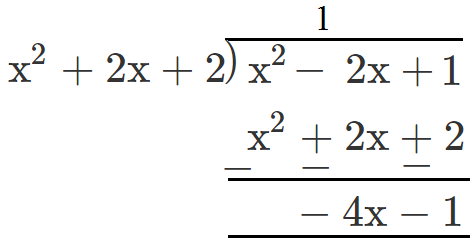
Therefore,
$\frac{\text{x}^2-2\text{x}+1}{\text{x}^2+2\text{x}+2}=1-\frac{(4\text{x}+1)}{\text{x}^2+2\text{x}+2}\ ....(1)$ Let $4\text{x}+1=\text{A}\frac{\text{d}}{\text{dx}}\big(\text{x}^2+2\text{x}+2\big)+\text{B}$ $4\text{x}+1=\text{A}(2\text{x}+2)+\text{B}$ $4\text{x}+1=(2\text{A})\text{x}+2\text{A}+\text{B}$ Equating Cofficients of like terms $2\text{A}=4$ $\text{A}=2$ $2\text{A}+\text{B}=1$ $2\times2+\text{B}=1$ $\text{B}=-3$ $\int\Big(\frac{\text{x}^2-2\text{x}+1}{\text{x}^2-2\text{x}+2}\Big)\text{dx}$ $=\int\text{dx}-2\int\frac{(2\text{x}+2)}{\text{x}^2+2\text{x}+2}\text{ dx}+3\int\frac{\text{ dx}}{\text{x}^2+2\text{x}+2}$ $=\int\text{dx}-2\int\frac{(2\text{x}+2)}{\text{x}^2+2\text{x}+2}\text{ dx}+3\int\frac{\text{dx}}{(\text{x}+1)^2+1^2}$ $=\text{x}-2\log\big|\text{x}^2+2\text{x}+2\big|+\frac{3}{1}\tan^{-1}\Big(\frac{\text{x}+1}{1}\Big)+\text{C}$ $=\text{x}-2\log\big|\text{x}^2+2\text{x}+2\big|+3\tan^{-1}(\text{x}+1)+\text{C}$ View full question & answer→Question 575 Marks
Evaluate the following integrals:
$\int\frac{1}{\text{x}^3}\sin(\log\text{x})\text{dx}$
AnswerLet $\text{I}=\int\frac{1}{\text{x}^3}\sin(\log\text{x})\text{dx}$
Putting log x = t
$\Rightarrow\text{x}=\text{e}^\text{t}$
$\Rightarrow\text{dx}=\text{e}^\text{t}\text{dt}$
$\therefore\ \text{I}=\int\frac{1}{\text{e}^{3\text{t}}}\sin\text{t e}^\text{t}\text{dt}$
$=\int\text{e}^{-2\text{t}}\sin\text{t dt}$
Considering sin t as first function and $e^{-2t}$ as second function
$\text{I}=\sin\text{t}\Big[\frac{\text{e}^{-2\text{t}}}{-2}\Big]-\int\cos\text{t}\frac{\text{e}^{-2\text{t}}}{-2}\text{dt}$
$\Rightarrow\text{I}=\frac{\sin\text{t e}^{-2\text{t}}}{-2}+\frac{1}{2}\int\cos\text{t e}^{-2\text{t}}\text{dt}$
$\Rightarrow\text{I}=\frac{\sin\text{t e}^{-2\text{t}}}{-2}+\frac{1}{2}\Big[\cos\text{t}\frac{\text{e}^{-2\text{t}}}{-2}-\int(-\sin\text{t})\frac{\text{e}^{-2\text{t}}}{-2}\text{dt}\Big]$
$\Rightarrow\text{I}=\frac{\sin\text{t e}^{-2\text{t}}}{-2}-\frac{1}{4}\cos\text{t e}^{-2\text{t}}-\int\frac{\text{e}^{-2\text{t}}\sin\text{t dt}}{4}$
$\Rightarrow\text{I}=\text{e}^{-2\text{t}}\Big[\frac{-2\sin\text{t}-\cos\text{t}}{4}\Big]-\frac{\text{I}}{4}$
$\Rightarrow\frac{5\text{I}}{4}=\text{e}^{-2\text{t}}\Big[\frac{-2\sin\text{t}-\cos\text{t}}{4}\Big]$
$\Rightarrow\text{I}=\frac{\text{e}^{-2\text{t}}}{5}[-2\sin\text{t}-\cos\text{t}]+\text{C}$
$\Rightarrow\text{I}=\frac{-\text{x}^{-2}}{5}[2\sin(\log\text{x})+\cos(\log\text{x})]+\text{C}$
$\Rightarrow\text{I}=\frac{-1}{5\text{x}^2}[\cos(\log\text{x})+2\sin(\log\text{x})]+\text{C}$
View full question & answer→Question 585 Marks
Evaluate the following integrals:
$\int\frac{\text{x}^2}{(\text{x}^2+\text{a}^2)(\text{x}^2+\text{b}^2)}\ \text{dx}$
AnswerLet $\text{I}=\int\frac{1}{\sin\text{x}(3+2\cos\text{x})}\ \text{dx}$
$\int\frac{\sin\text{x dx}}{\sin^2\text{x}(3+2\cos\text{x})}$
$=\int\frac{\sin\text{x dx}}{(1-\cos^2\text{x})(3+2\cos\text{x})}$
Let $\cos\text{x}=\text{t}$
$\Rightarrow-\sin\text{x dx}=\text{dt}$
$\therefore\text{I}=\int\frac{\text{dt}}{(\text{t}^2-1)(3+2\text{t})}$
Now,
Let $\frac{1}{(\text{t}^2-1)(3+2\text{t})}=\frac{\text{A}}{\text{t}-1}+\frac{\text{B}}{\text{t}+1}+\frac{\text{C}}{3+2\text{t}}$
$\Rightarrow 1 = A(t + 1)(3 + 2t) + B (t - 1)(3 + 2t) + C (t^2 - t)$
Put $t = 1$
$\Rightarrow 1 = 10A$
$\Rightarrow $ $\text{A}=\frac{1}{10}$
Put $t = -1$
$\Rightarrow 1 = 2B$
$\Rightarrow $ $\text{B}=-\frac{1}{2}$
Put $\text{t}=-\frac{3}{2}$
$\Rightarrow1=\frac{5}{4}\text{C}\Rightarrow\text{C}=\frac{4}{5}$
thus,
$\text{I}=\frac{1}{10}\int\frac{\text{dt}}{\text{t}-1}-\frac{1}{2}\int\frac{\text{dt}}{\text{t}+1}+\frac{5}{4}\int\frac{\text{dt}}{3+2\text{t}}$
$=\frac{1}{10}\log|\text{t}-1|-\frac{1}{2}\log|\text{t}+1|+\frac{2}{5}\log|3+2\text{t}|+\text{C}$
Hence,
$\text{I}=\frac{1}{10}\log|\cos\text{x}-1|-\frac{1}{2}\log|\cos\text{x}+1|+\frac{2}{5}\log|3+2\cos\text{x}|+\text{C}$
View full question & answer→Question 595 Marks
Evaluate the following intregals:
$\int\frac{1}{\sin\text{x}-\sqrt{3}\cos\text{x}}\ \text{dx}$
AnswerLet $\text{I}=\int\frac{1}{\sin\text{x}-\sqrt{3}\cos\text{x}}\ \text{dx}$
Putting $\sin\text{x}=\frac{2\tan\frac{\text{x}}{2}}{1+\tan^2\frac{\text{x}}{2}}\text{ and }\cos\text{x}=\frac{1-\tan^2\frac{\text{x}}{2}}{1+\tan^2\frac{\text{x}}{2}}$
$\Rightarrow\text{I}=\int\frac{1}{\frac{2\tan\frac{\text{x}}{2}}{1+\tan^2\frac{\text{x}}{2}}-\sqrt{3}\frac{1-\tan^2\frac{\text{x}}{2}}{1+\tan^2\frac{\text{x}}{2}}}\ \text{dx}$
$=\int\frac{1+\tan^2\frac{\text{x}}{2}}{2\tan\frac{\text{x}}{2}-\sqrt{3}+\sqrt{3}\tan^2\frac{\text{x}}{2}}\ \text{dx}$
$=\int\frac{\sec^2\frac{\text{x}}{2}}{\sqrt{3}\tan^2\frac{\text{x}}{2}+2\tan\frac{\text{x}}{2}-\sqrt{3}}\ \text{dx}$
Let $\tan\frac{\text{x}}{2}=\text{t}$
$\Rightarrow\frac{1}{2}\sec^2\frac{\text{x}}{2}\text{dx}=\text{dt}$
$\Rightarrow\sec^2\frac{\text{x}}{2}\text{dx}=2\text{dt}$
$\therefore\text{I}=2\int\frac{\text{dt}}{\sqrt{3}\text{t}^2+2\text{t}-\sqrt{3}}$
$=\frac{2}{\sqrt{3}}\int\frac{\text{dt}}{\text{t}^2+\frac{2}{\sqrt{3}}\text{t}-1}$
$=2\int\frac{\text{dt}}{\text{t}^2+\frac{2}{\sqrt{3}}\text{t}+\Big(\frac{1}{\sqrt{3}}\Big)^2-1-\Big(\frac{1}{\sqrt{3}}\Big)^2}$
$=2\int\frac{\text{dt}}{\Big(\text{t}+\frac{1}{\sqrt{3}}\Big)^2-\Big(\frac{2}{\sqrt{3}}\Big)^2}$
$=\frac{2}{2\times\frac{2}{\sqrt{3}}}\log\Bigg|\frac{\text{t}+\frac{1}{\sqrt{3}}-\frac{2}{\sqrt{3}}}{\text{t}+\frac{1}{\sqrt{3}}+\frac{2}{\sqrt{3}}}\Bigg|+\text{C}$
$=\frac{\sqrt{3}}{2}\log\Bigg|\frac{\tan\frac{\text{x}}{2}-\frac{1}{\sqrt{3}}}{\tan\frac{\text{x}}{2}+\frac{3}{\sqrt{3}}}\Bigg|+\text{C}$
$=\frac{\sqrt{3}}{2}\log\Bigg|\frac{\sqrt{3}\tan\frac{\text{x}}{2}-1}{\sqrt{3}\tan\frac{\text{x}}{2}+3}\Bigg|+\text{C}$
View full question & answer→Question 605 Marks
Evaluate the following intregals:
$\int\frac{\text{x}}{(\text{x}^2+1)(\text{x}-1)}\ \text{dx}$
AnswerConsider the integrals
$\text{I}=\int\frac{\text{x}}{(\text{x}^2+1)(\text{x}-1)}\ \text{dx}$
Now let us separate the fraction $\frac{\text{x}}{(\text{x}^2+1)(\text{x}-1)}$
Through particle fractions.
$\frac{\text{x}}{(\text{x}^2+1)(\text{x}-1)}=\frac{\text{A}}{\text{x}-1}+\frac{\text{Bx}+\text{C}}{\text{x}^2+1}$
$\Rightarrow\frac{\text{x}}{(\text{x}^2+1)(\text{x}-1)}=\frac{\text{A}(\text{x}^2+1)+(\text{Bx}+\text{C})(\text {x}-1)}{(\text{x}^2+1)(\text{x}-1)}$
$\Rightarrow\text{x}=\text{A}(\text{x}^2+1)+(\text{Bx}+\text{C})(\text{x}-1)$
Compairing the coefficient, we have,
A + B = 0, -B + C = 1 and A - C = 0
Solving the equations we, get,
$\Rightarrow\text{A}=\frac{1}{2},\text{B}=-\frac{1}{2}\text{ and }\text{C}=\frac{1}{2}$
$\Rightarrow\frac{\text{x}}{(\text{x}^2+1)(\text{x}-1)}=\frac{\text{A}}{\text{x}-1}+\frac{\text{Bx}+\text{C}}{\text{x}^2+1}$
$\Rightarrow\frac{\text{x}}{(\text{x}^2+1)(\text{x}-1)}=\frac{1}{2}\times\frac{1}{\text{x}-1}-\frac{1}{2}\times\frac{\text{x}-1}{\text{X}^2+1}$
$\Rightarrow\frac{\text{x}}{(\text{x}^2+1)(\text{x}-1)}=\frac{1}{2(\text{x}-1)}-\frac{\text{x}}{2(\text{x}^2+1)}+\frac{1}{2(\text{x}^2+1)}$
Thus, we have,
$=\int\frac{\text{x}}{(\text{x}^2+1)(\text{x}-1)}\ \text{dx}$
$=\int\Big[\frac{1}{2(\text{x}-1)}-\frac{\text{x}}{2(\text{x}^2+1)}+\frac{1}{2(\text{x}^2+1)}\Big]\text{dx}$
$=\int\frac{\text{dx}}{2(\text{x}-1)}-\int\frac{\text{xdx}}{2(\text{x}^2+1)}+\int\frac{\text{dx}}{2(\text{x}^2+1)}$
$=\int\frac{1}{2}\frac{\text{dx}}{(\text{x}-1)}-\int\frac{1}{2}\frac{\text{xdx}}{(\text{x}^2+1)}+\int\frac{1}{2}\frac{\text{dx}}{(\text{x}^2+1)}$
$=\frac{1}{2}\int\frac{\text{dx}}{(\text{x}-1)}-\frac{1}{2}\times\frac{1}{2}\int\frac{2\text{xdx}}{(\text{x}^2+1)}+\frac{1}{2}\int\frac{\text{dx}}{(\text{x}^2+1)}$
$=\frac{1}{2}\log|\text{x}-1|-\frac{1}{4}\log(\text{x}^2+1)+\frac{1}{2}\tan^{-1}\text{x}+\text{C}$
View full question & answer→Question 615 Marks
Evaluate the following integrals:
$\int\text{e}^{2\text{x}}\sin(3\text{x}+1)\text{dx}$
AnswerWe have,
$\text{I}=\int\text{e}^{2\text{x}}\sin(3\text{x}+1)\text{dx}$
Let the first function be sin(3x + 1) and the second function be$ e^{2x}.$
First we find the integral of the second function, i. e., $\int\text{e}^{2\text{x}}\text{dx}$.
$\int\text{e}^{2\text{x}}\text{dx}=\frac{1}{2}\text{e}^{2\text{x}}$
Now, using integration by parts, we get
$\text{I}=\sin(3\text{x}+1)\int\text{e}^{2\text{x}}\text{dx}-\int\Big[\Big(\frac{\text{d}(\sin(3\text{x}+1))}{\text{dx}}\Big)\Big]\text{dx}$
$=\frac{1}{2}\sin(3\text{x}+1)\text{e}^{2\text{x}}\text{dx}-\frac{3}{2}\int\big[\cos(3\text{x}+1)\text{e}^{2\text{x}}\big]\text{dx}$
$=\frac{1}{2}\sin(3\text{x}+1)\text{e}^{2\text{x}}-\frac{3}{2}\Big\{\cos(3\text{x}+1)\int\text{e}^{2\text{x}}\text{dx}-\int\Big[\Big(\frac{\text{d}(\cos(3\text{x}+1))}{\text{dx}}\Big)\int\text{e}^{2\text{x}}\text{dx}\Big]\text{dx}\Big\}$
$=\frac{1}{2}\sin(3\text{x}+1)\text{e}^{2\text{x}}-\frac{3}{4}\cos(3\text{x}+1)\text{e}^{2\text{x}}-\frac{9}{4}\text{I}+\text{C}$
$\text{I}+\frac{9}{4}\text{I}=\frac{1}{2}\sin(3\text{x}+1)\text{e}^{2\text{x}}-\frac{3}{4}\cos(3\text{x}+1)\text{e}^{2\text{x}}+\text{C}$
$\frac{13}{4}\text{I}=\frac{\text{e}^{2\text{x}}}{2}\big[\sin(3\text{x}+1)-\frac{3}{2}\cos(3\text{x}+1)\big]+\text{C}$
$\text{I}=\frac{2}{13}\text{e}^{2\text{x}}\big[\sin(3\text{x}+1)-\frac{3}{2}\cos(3\text{x}+1)\big]+\text{C}$
$=\frac{\text{e}^{2\text{x}}}{13}\big[2\sin(3\text{x}+1)-3\cos(3\text{x}+1)\big]+\text{C}$
Hence,
$\int\text{e}^{2\text{x}}\sin(3\text{x}+1)\text{dx}=\frac{\text{e}^{2\text{x}}}{13}\big[2\sin(3\text{x}+1)-3\cos(3\text{x}+1)\big]+\text{C}$
View full question & answer→Question 625 Marks
Evaluate the following integrals:
$\int\frac{(\text{x}\tan^{-1}\text{x})}{(1+\text{x}^2)^{\frac{3}{2}}}\text{dx}$
AnswerLet $\text{I}=\int\frac{\text{x}\tan^{-1}\text{x}}{(1+\text{x}^2)^{\frac{3}{2}}}\text{dx}$
putting $\text{x}=\tan\theta$
$\Rightarrow\text{dx}=\sec^2 \theta\text{d}\theta$
$\&\theta\tan^{-1}\text{x}$
$\therefore\text{I}=\int\frac{(\tan\theta).\theta\sec^2\theta\text{d}\theta}{\big(1+\tan^2\theta\big)^{\frac{3}{2}}}$
$=\int\frac{\theta.\tan\theta\sec^2\theta\text{d}\theta}{(\sec^2\theta)^{\frac{3}{2}}}$
$=\int\frac{\theta\tan\theta.\sec^2\theta\text{d}\theta}{\sec^3\theta}$
$=\int\frac{\theta.\tan\theta}{\sec\theta}\text{d}\theta$
$=\int\theta.\sin\theta\text{d}\theta$
$=\theta\int\sin\theta\text{d}\theta-\int\big\{\frac{\text{d}}{\text{d}\theta}(\theta)\int\sin\text{d}\theta\big\}\text{d}\theta$
$=\theta(-\cos\theta)-\int1.(-\cos\theta)\text{d}\theta$
$=-\theta\cos\theta+\sin\theta+\text{C}$
$=\frac{-\theta}{\sec\theta}+\frac{1}{\text{cosec}\theta}+\text{C}$
$=\frac{-\theta}{\sqrt{1+\tan^2\theta}}+\frac{1}{\sqrt{1+\cot^2}\theta}+\text{C}$
$=\frac{-\theta}{\sqrt{1+\tan^2\theta}}+\frac{\tan\theta}{\sqrt{\tan^2\theta+1}}+\text{C}$
$=\frac{-\tan^{-1}\text{x}}{\sqrt{1+\text{x}^2}}+\frac{\text{x}}{\sqrt{\text{x}^2+1}}+\text{C}$
View full question & answer→Question 635 Marks
Evaluate the following integrals:
$\int\sin^{-1}\sqrt{\frac{\text{x}}{\text{a+x}}}\text{dx}$
AnswerLet $\text{I}=\int\sin^{-1}\sqrt{\frac{\text{x}}{\text{a+x}}}\text{dx}$
Let $\text{x}=\text{a}\tan^2\theta$
$\text{dx}=2\text{a}\tan\theta\sec^2\theta\text{d}\theta$
$\text{I}=\int\Big(\sin^{-1}\sqrt{\frac{\text{a}\tan^2\theta}{\text{a+a}\tan^2\theta}}\Big)(2\text{a}\tan\theta\sec^2\theta)\text{d}\theta$
$=\int\Big(\sin^{-1}\sqrt{\frac{\tan^2\theta}{\sec^2\theta}}\Big)(2\text{a}\tan\theta\sec^2\theta)\text{d}\theta$
$=\int\sin^{-1}(\sin\theta)(2\text{a}\tan\theta\sec^2\theta)\text{d}\theta$
$=\int2\theta\text{a}\tan\theta\sec^2\theta\text{d}\theta$
$=2\text{a}\int\theta(\tan\theta\sec^2\theta)\text{d}\theta$
$=2\text{a}\big[\theta\int\tan\theta\sec^2\theta\text{d}\theta-\int(\int\tan\theta\sec^2\theta\text{d}\theta)\text{d}\theta\Big]$
$=2\text{a}\Big[\theta\frac{\tan^2\theta}{2}-\int\frac{\tan^2\theta}{2}\text{d}\theta\Big]$
$=\text{a}\theta\tan^2\theta-\frac{2\text{a}}{2}\int(\sec^2\theta-1)\text{d}\theta$
$=\text{a}\theta\tan^2\theta-\text{a}\tan\theta+\text{a}\theta+\text{C}$
$=\text{a}\Big(\tan^{-1}\sqrt{\frac{\text{x}}{\text{a}}}\Big)\frac{\text{x}}{\text{a}}-\text{a}\sqrt{\frac{\text{x}}{\text{a}}}+\text{a}\tan^{-1}\sqrt{\frac{\text{x}}{\text{a}}}+\text{C}$
$\text{I}=\text{x}\tan^{-1}\sqrt{\frac{\text{x}}{\text{a}}}-\sqrt{\text{ax}}+\text{a}\tan^{-1}\sqrt{\frac{\text{x}}{\text{a}}}+\text{C}$
View full question & answer→Question 645 Marks
Evaluate the following integrals:
$\int\tan^{-1}\sqrt{\frac{1-\text{x}}{1+\text{x}}}\text{dx}$
AnswerLet $\text{I =}\int\tan^{-1}\sqrt{\frac{1-\text{x}}{1+\text{x}}}\text{dx}$
Putting $\text{x}=\cos\theta$
$\Rightarrow\text{dx}=-\sin\theta\text{d}\theta$
$\&\theta=\cos^{-1}\text{x}$
$\therefore\text{I}=\int\tan^{-1}\sqrt{\frac{1-\cos\theta}{1+\cos\theta}}(-\sin\theta)\text{d}\theta$
$=\int\tan^{-1}\sqrt{\frac{2\sin^2\frac{\theta}{2}}{2\cos^2\frac{\theta}{2}}}(-\sin\theta)\text{d}\theta$
$=\int\tan^{-1}\Big(\tan\frac{\theta}{2}\Big)(-\sin\theta)\text{d}\theta$
$=-\frac{1}{2}\int\theta\sin\theta\text{d}\theta$
$=-\frac{1}{2}\Big[\theta\int\sin\theta\text{d}\theta-\int\Big\{\Big(\frac{\text{d}}{\text{d}\theta}\theta\Big)\int\sin\theta\text{d}\theta\Big\}\text{d}\theta\Big]$
$=-\frac{1}{2}\big[\theta(-\cos\theta)-\int1.(-\cos\theta)\text{d}\theta\big]$
$=-\frac{1}{2}\big[-\theta\cos\theta+\sin\theta\big]+\text{C}$
$=-\frac{1}2{}\Big[-\theta.\cos\theta+\sqrt{1-\cos^2\theta}\Big]+\text{C}$
$=-\frac{1}{2}\Big[-\cos^{-1}\text{x.x}+\sqrt{1-\text{x}^2}\Big]+\text{C}$ $\big[\because\theta=\cos^{-1}\text{x}\big]$
$=\frac{\text{x}\cos^{-1}\text{x}}{2}-\frac{\sqrt{1-\text{x}^2}}{2}+\text{C}$
View full question & answer→Question 655 Marks
Evaluvate the following intregals:
$\int\frac{1}{1-\cot\text{x}}\text{ dx}$
AnswerLet $\text{I}=\int\frac{1}{1-\cot\text{x}}\text{ dx}$
$=\int\frac{1}{1-\frac{\cos\text{x}}{\sin\text{x}}}\ \text{dx}$
$=\int\frac{\sin\text{x}}{\sin\text{x}-\cos\text{x}}\ \text{dx}$
Let $\sin\text{x}=\lambda\frac{\text{d}}{\text{dx}}(\sin\text{x}-\cos\text{x})+\mu(\sin\text{x}-\cos\text{x})+\text{v}$
$\sin\text{x}=\lambda\frac{\text{d}}{\text{dx}}(\cos\text{x}+\sin\text{x})+\mu(\sin\text{x}-\cos\text{x})+\text{v}$
$\sin\text{x}=\cos(\lambda-\mu)+\sin\text{x}(\lambda+\mu)+\text{v}$
Compairing the cooefficients of $\sin\text{x}\ \&\cos\text{x}$ on the both the sides,
$\lambda+\mu=1\ ...(1)$
$\lambda-\mu=1\ ...(2)$
$\text{v}=0\ ...(3)$
Equation (1), (2), (3) gives
$\lambda=\frac{1}{2},\mu=\frac{1}{2},\text{v}=0$
$\text{I}=\int\frac{\frac{1}{2}(\cos\text{x}+\sin\text{x})+\frac{1}{2}(\sin\text{x}-\cos\text{x}_)}{(\sin\text{x}-\cos\text{x})}\ \text{dx}$
$=\frac{1}{2}\int\frac{(\cos\text{x}+\sin\text{x})}{(\sin\text{x}-\cos\text{x})}\ \text{dx}+\frac{1}{2}\int\ \text{dx}$
$\text{I}=\frac{1}{2}\log|\sin\text{x}-\cos\text{x}|+\frac{1}{2}\text{x}+\text{c}$
View full question & answer→Question 665 Marks
Evaluate the following integrals:
$\int(2\text{x}-5)\sqrt{\text{x}^2-4\text{x}+3}\text{dx}$
AnswerLet $\text{I}=\int(2\text{x}-5)\sqrt{\text{x}^2-4\text{x}+3}\text{dx}$ $=\int(2\text{x}-4-1)\sqrt{\text{x}^2-4\text{x}+3}\text{dx}$$=\int(2\text{x}+4)\sqrt{\text{x}^2-4\text{x}+3}\text{dx}-\int\sqrt{\text{x}^2-4\text{x}+3}\text{dx}$
$=(2\text{x}-4)\sqrt{\text{x}^2-4\text{x}+3}\text{dx}-\int\sqrt{\text{x}^2-4\text{x}+4-4+3}\text{dx}$
$=\int(2\text{x}-4)\sqrt{\text{x}^2-4\text{x}+3}\text{dx}-\int\sqrt{(\text{x}-2)^2-1^2}\text{dx}$
Let $\text{x}^2-4\text{x}+3=\text{t}$
$\Rightarrow({2\text{x}-4})\text{dx = dt}$
$\therefore\ \text{I}=\int\sqrt{\text{t}}\text{dt}-\int\sqrt{(\text{x}-2)^2-1^2}\text{dx}$
$=\frac{2}{3}\text{t}^{\frac{3}{2}}-\Big[\frac{\text{x}-2}{2}\sqrt{(\text{x}-2)^2-1^2}-\frac{1^2}{2}\log\Big|(\text{x}-2)\\+\sqrt{(\text{x}-2)^2-1}\Big|\Big]+\text{C}$
$=\frac{2}{3}(\text{x}^2-4\text{x}+3)^{\frac{3}{2}}-\Big(\frac{\text{x}-2}{2}\Big)\sqrt{\text{x}^2-4\text{x}+3}\\+\frac{1}{2}\log\Big|(\text{x}-2)+\sqrt{\text{x}^2-4\text{x}+3}\Big|+\text{C}$
View full question & answer→Question 675 Marks
Evaluate the following integrals:
$\int\frac{\text{x}^2+1}{\text{x}^4+\text{x}^2+1}\ \text{dx}$
Answer$\text{I}=\int\frac{\text{x}^2+1}{\text{x}^4+\text{x}^2+1}\ \text{dx}$
$=\int\frac{1+\frac{1}{\text{x}^2}}{\text{x}^2+1+\frac{1}{\text{x}^2}}\ \text{dx}$
Dividing numerator and denominator by $x^2$
$=\int\frac{\Big(1+\frac{1}{\text{x}^2}\Big)}{\Big(\text{x}-\frac{1}{\text{x}}\Big)+3}\ \text{dx}$
Let $\text{x}-\frac{1}{\text{x}}=\text{t}\Rightarrow\Big(1+\frac{1}{\text{x}^2}\Big)\text{dx}=\text{dt}$
$\therefore\text{I}=\frac{\text{dt}}{\text{t}^2+3}$
$=\frac{1}{\sqrt{3}}\tan^{-1}\Big(\frac{\text{t}}{\sqrt{3}}\Big)+\text{C}$
$\therefore\text{I}=\frac{1}{\sqrt{3}}\tan^{-1}\Big(\frac{\text{x}^2-1}{\sqrt{3}\text{x}}\Big)+\text{C}$
View full question & answer→Question 685 Marks
Evaluate the following intregals:
$\int\frac{\text{x}}{(\text{x}-1)^2(\text{x}+2)}\ \text{dx}$
Answerwe have$\text{I}=\int\frac{\text{x}\text{dx}}{(\text{x}-1)(\text{x}+2)}$
Let $\frac{\text{x}}{(\text{x}-1)^2(\text{x}+2)}=\frac{\text{A}}{\text{x}-1}+\frac{\text{B}}{(\text{x}-1)^2}+\frac{\text{C}}{\text{x}+2}$
$\Rightarrow\frac{\text{x}}{(\text{x}-1)^2(\text{x}+2)}=\frac{\text{A}(\text{x}-1)(\text{x}+2)+\text{B}(\text{x}+2)+\text{C}(\text{x}-1)^2}{(\text{x}-1)^2(\text{x}+2)}$
$\Rightarrow\text{x}=\text{A}(\text{x}^2+2\text{x}-\text{x}-2)+\text{B}(\text{x}+2)+\text{C}(\text{x}^2-2\text{x}+1)$
$\Rightarrow\text{x}=\text{A}(\text{x}^2+\text{x}-2)+\text{B}(\text{x}+2)+\text{C}(\text{x}^2-2\text{x}+1)$
$\Rightarrow\text{x}=(\text{A}+\text{C})\text{x}^2+(\text{A}+\text{B}-2\text{C})\text{x}+(-2\text{A}+2\text{B}+\text{C})$
A + C = 0 ...(1)
A + B - 2C = 1 ...(2)
-2A + 2B + C = 0 ...(3)
Solving(1), (2) and (3), we get
$\text{A}=\frac{2}{9},\text{B}=\frac{1}{3}\text{ and }\text{C}=-\frac{2}{9}$
$\therefore\frac{\text{x}}{(\text{x}-1)^2(\text{x}+2)}=\frac{2}{9(\text{x}-1)}+\frac{1}{3(\text{x}-1)^2}-\frac{2}{9(\text{x}+2)}$
$\Rightarrow\text{I}=\frac{2}{9}\int\frac{\text{dx}}{\text{x}-1}+\frac{1}{3}\int\frac{\text{dx}}{(\text{x}-1)^3}-\frac{2}{9}\int\frac{\text{dx}}{\text{x}+2}$
$=\frac{2}{9}\log|\text{x}-1|+\frac{1}{3}\times\Big(\frac{-1}{\text{x}-1}\Big)-\frac{2}{9}\log|\text{x}+2 |+\text{C}$
$=\frac{2}{9}\log\Big(\frac{\text{x}-1}{\text{x}+2}\Big)-\frac{1}{3(\text{x}-1)}+\text{C}$
View full question & answer→Question 695 Marks
Evaluate the following integrals:
$\int\frac{1}{\cos\text{x}(5-4\sin\text{x})}\ \text{dx}$
AnswerLet $\text{I}=\int\frac{1}{\sin\text{x}\sin2\text{x}}\ \text{dx}$
$\int\frac{\sin\text{x dx}}{\sin^2\text{x}+2\sin\text{x}\cos\text{x}}$
$=\int\frac{\sin\text{x dx}}{(1-\cos^2\text{x})+2(1-\cos^2\text{x})\cos\text{x}}$
Let $\cos\text{x}=\text{t}$
$\Rightarrow-\sin\text{x dx}=\text{dt}$
$\therefore\text{I}=\int\frac{\text{dt}}{(\text{t}^2-1)+2(\text{t}^2-1)\text{t}}$
Let $\frac{1}{(\text{t}^2-1)(3+2\text{t})}=\frac{\text{A}}{\text{t}-1}+\frac{\text{B}}{\text{t}+1}+\frac{\text{C}}{1+2\text{t}}$
$\Rightarrow 1 = A(t + 1)(1 + 2t) + B (t - 1)(1 + 2t) + C (t^2 - 1)$
Put $t = 1$
$\Rightarrow 1 = 6A$
$\Rightarrow $
$\text{A}=\frac{1}{6}$
Put $t = -1$
$\Rightarrow 1 = 2B $
$\Rightarrow $
$\text{B}=-\frac{1}{2}$
Put $\text{t}=-\frac{1}{2}$
$\Rightarrow1=-\frac{3}{4}\text{C}\Rightarrow\text{C}=-\frac{4}{3}$
thus,
$\text{I}=\frac{1}{6}\int\frac{\text{dt}}{\text{t}-1}+\frac{1}{2}\int\frac{\text{dt}}{\text{t}+1}-\frac{4}{3}\int\frac{\text{dt}}{1+2\text{t}}$
$=\frac{1}{6}\log|\text{t}-1|+\frac{1}{2}\log|\text{t}+1|-\frac{2}{3}\log|1+2\text{t}|+\text{}C$
Hence,
$\text{I}=\frac{1}{6}\log|\cos\text{x}-1|+\frac{1}{2}\log|\cos\text{x}+1|+\frac{2}{3}\log|1+2\cos\text{x}|+\text{C}$
View full question & answer→Question 705 Marks
Evaluate the following intregals:
$\int\frac{1}{(\sin\text{x}-2\cos\text{x})(2\sin\text{x}-\cos\text{x})}\ \text{dx}$
AnswerLet $\text{I}=\int\frac{1}{(\sin\text{x}-2\cos\text{x})(2\sin\text{x}-\cos\text{x})}\ \text{dx}$
Dividing numerator and denominator by $\cos^2\text{x}$
$\Rightarrow\text{I}=\int\frac{\sec^2\text{x}}{\Big(\frac{\sin\text{x}-2\cos\text{x}}{\cos\text{x}}\Big)\times\Big(\frac{2\sin\text{x}+\cos\text{x}}{\cos\text{x}}\Big)}\ \text{dx}$
$=\int\frac{\sec^2\text{x}}{(\tan^2\text{x}-2)(2\tan\text{x}+1)}\ \text{dx}$
Let $\tan\text{x}=\text{t}$
$\Rightarrow\sec^2\text{x dx}=\text{dt}$
$\therefore\text{I}=\int\frac{\text{dt}}{(\text{t}-2)(2\text{t}-1 0)}$
$=\int\frac{\text{dt}}{2\text{t}^2+\text{t}-4\text{t}-2}$
$=\int\frac{\text{dt}}{2\text{t}^2-3\text{t}-2}$
$=\frac{1}{2}\int\frac{\text{dt}}{\text{t}^2-\frac{3}{2}\text{t}-1}$
$=\frac{1}{2}\int\frac{\text{dt}}{\text{t}^2-\frac{3}{2}\text{t}+\Big(\frac{3}{4}\Big)^2-\Big(\frac{3}{4}\Big)^2-1}$
$=\frac{1}{2}\int\frac{\text{dt}}{\Big(\text{t}-\frac{3}{4}\Big)-\frac{9}{16}-1}$
$=\frac{1}{2}\int\frac{\text{dt}}{\Big(\text{t}-\frac{3}{4}\Big)-\Big(\frac{5}{4}\Big)^2}$
$=\frac{1}{2}\times\frac{1}{2\times\frac{5}{4}}\log\Bigg|\frac{\text{t}-\frac{3}{4}-\frac{5}{4}}{\text{t}-\frac{3}{4}+\frac{5}{4}}\Bigg|+\text{C}$
$=\frac{1}{5}\ln\Bigg|\frac{\text{t}-2}{\text{t}+\frac{1}{2}}\Bigg|+\text{C}$
$=\frac{1}{5}\ln\Big|\frac{\text{t}-2}{2\text{t}+1}\Big|+\frac{1}{5}\int(2)+\text{C}$
$=\frac{1}{5}\ln\Big|\frac{\text{t}-2}{2\text{t}+1}\Big|+\text{C}$ where $\text{C}=\text{C}+\frac{1}{5}\int(2)$
$=\frac{1}{5}\ln\Big|\frac{\tan\text{x}-2}{2\tan\text{x}+1}\Big|+\text{C}$
View full question & answer→Question 715 Marks
Evaluate the following integrals:$\int\frac{\text{x}^2+\text{x}+1}{\text{x}^2+\text{x}+1}\text{dx}$
AnswerLet $\text{I}=\int\frac{\text{x}^2+\text{x}+1}{\text{x}^2+\text{x}+1}\text{dx}$ $=\int\begin{bmatrix}1+\frac{\text{2x}}{\text{x}^2-\text{x}+1}\end{bmatrix}\text{dx}$ $\text{I}=\text{x}+\int\frac{2\text{x}}{\text{x}^2-\text{x}+1}\text{ dx}+\text{C}_1\ ....(1)$ Let $\text{I}=\int\frac{2\text{x}}{\text{x}^2-\text{x}+1}\text{ dx}$ Let $2\text{x}=\lambda\frac{\text{d}}{\text{dx}}\big(\text{x}^2-\text{x}+1\big)+\mu$ $=\lambda(2\text{x}-1)+\mu$ $2\text{x}=(2\lambda)\text{x}-\lambda+\mu$Comparing the coefficients of like powers of x,
$2=2\lambda$ $\Rightarrow\lambda=1$ $-\lambda+\mu=0$ $\Rightarrow-1+\mu=0$ $\mu=1$ So, $\text{I}_1=\int\frac{(2\text{x}-1)+1}{\text{x}^2-\text{x}+1}\text{ dx}$ $=\int\frac{(2\text{x}-1)}{\text{x}^2-\text{x}+1}\text{ dx}+\int\frac{1}{\text{x}^2-2\text{x}\big(\frac{1}{2}\big)+\big(\frac{1}{2}\big)^2-\big(\frac{1}{2}\big)^2+1}\text{ dx}$ $\text{I}_1=\int\frac{2\text{x}-1}{\text{x}^2-\text{x}+1}\text{ dx+}\int\frac{1}{\big(\text{x}-\frac{1}{2}\big)^2-\Big(\frac{\sqrt3}{2}\Big)^2}\text{ dx}$ $=\log\big|\text{x}^2-\text{x}+1\big|+\frac{2}{\sqrt3}\tan^{-1}\bigg(\frac{\text{x}-\frac{1}{2}}{\frac{\sqrt3}{2}}\bigg)+\text{C}_2$ $\Big[\text{since},\int\frac{1}{\text{x}^2+\text{a}^2}\text{ dx}=\frac{1}{\text{a}}\tan^{-1}\Big(\frac{\text{x}}{\text{a}}\Big)+\text{C}\Big]$ $=\log\big|\text{x}^2-\text{x}+1\big|+\frac{2}{\sqrt3}\tan^{-1}\Big(\frac{2\text{x}-1}{\sqrt3}\Big)+\text{C}_2\ .....(2)$ Using equation (1) and (2) $\text{I}=\text{x}+\log\big|\text{x}^2-\text{x}+1\big|+\frac{2}{\sqrt3}\tan^{-1}\Big(\frac{2\text{x}-1}{\sqrt3}\Big)+\text{C}$
View full question & answer→Question 725 Marks
Evaluate the following integrals:$\int\frac{(3\sin\text{x}-2)\cos\text{x}}{13-\cos^2\text{x}-7\sin\text{x}}\text{ dx}$
Answer$\text{I}=\int\frac{(3\sin\text{x}-2)\cos\text{x}}{13-\cos^2\text{x}-7\sin\text{x}}\text{ dx}$ $=\int\frac{(3\sin\text{x}-2)\cos\text{x}}{13-(1-\sin^2\text{x})-7\sin\text{x}}\text{ dx}$ $\big(\because\ \cos^2\text{x}=1-\sin^2\text{x}\big)$ $=\int\frac{(3\sin\text{x}-2)\cos\text{x}}{\sin^2\text{x}-7\sin\text{x}+12}\text{ dx}$ $=\int\frac{(3\sin\text{x}-2)\cos\text{x}}{\sin^2\text{x}-4\sin\text{x}-3\sin\text{x}+12}\text{ dx}$ $=\int\frac{(3\sin\text{x}-2)\cos\text{x}}{\sin\text{x}(\sin\text{x}-4)-3(\sin\text{x}-4)}\text{dx}$ $=\int\frac{(3\sin\text{x}-2)\cos\text{x}}{(\sin\text{x}-3)(\sin\text{x}-4)}\text{ dx}$Let $\sin\text{x}=\text{t}$
$\Rightarrow\cos\text{x}\text{ dx}=\text{dt}$
$\therefore\ \text{I}=\int\frac{(3\text{t}-2)}{(\text{t}-3)(\text{t}-4)}\text{ dt}$
Using partial fraction, we get $\frac{(3\text{t}-2)}{(\text{t}-3)(\text{t}-4)}=\frac{\text{A}}{(\text{t}-3)}+\frac{\text{B}}{(\text{t}-4)}$ $=\frac{\text{A}(\text{t}-4)+\text{B}(\text{t}-3)}{(\text{t}-3)(\text{t}-4)}$ $\Rightarrow3\text{t}-2=(\text{A}+\text{B})\text{t}-4\text{A}-3\text{B}$ Comparing coefficients, we get A = -7 and B = 10 So, $\text{I}=-7\int\frac{1}{(\text{t}-3)}\text{ dt}+10\int\frac{1}{(\text{t}-4)}\text{ dt}$$\Rightarrow\text{I}=-7\ln|\text{t}-3|+10\ln|\text{t}-4|+\text{C}$
$\therefore\ \text{I}=-7\ln|\sin\text{x}-3|+10\ln|\sin\text{x}-4|+\text{C}$
View full question & answer→Question 735 Marks
Evaluate the following intregals:
$\int\frac{3\text{x}+1}{\sqrt{5-2\text{x}-\text{x}^2}}\text{dx}$
AnswerLet $\text{I}=\int\frac{3\text{x}+1}{\sqrt{5-2\text{x}-\text{x}^2}}\text{dx}$
let $3\text{x}+1=\lambda\frac{\text{d}}{\text{dx}}(5-2\text{x}-\text{x}^2)+\mu$
$=\lambda(-2-2\text{x})+\mu$
$3\text{x}+1=(-2\lambda)\text{x}-2\lambda+\mu$
Compairing the coefficient of like powewrs of x,
$-2\lambda=3\ \Rightarrow\lambda=-\frac{3}{2}$
$2\lambda+\mu=1\ \Rightarrow -2\big(-\frac{3}{2}\big)+\mu=1$
$\Rightarrow\mu=-2$
So, $\text{I}=\int\frac{-\frac{3}{2}(-2-2\text{x})-2}{\sqrt{5-2\text{x}-\text{x}^2}}\text{dx}$
$-\frac{3}{2}\int\frac{(-2-2\text{x})}{\sqrt{5-2\text{x}-\text{x}^2}}\text{dx}-3\int\frac{1}{\sqrt{-\Big[\text{x}^2+2\text{x}-5\Big]}}\text{dx}$
$=-\frac{3}{2}\int\frac{(-2-2\text{x})}{\sqrt{5-2\text{x}-\text{x}}^2}\text{dx}-2\int\frac{1}{\sqrt{-\big[\text{x}^2+2\text{x}+(1)^2-(1)^2+5\big]}}\text{dx}$
$=-\frac{3}{2}\int\frac{(-2-2\text{x})}{\sqrt{5-2\text{x}-\text{x}}^2}\text{dx}-2\int\frac{1}{\sqrt{-\big[(\text{x}+1)^2-(\sqrt{6})^2\big]}}\text{dx}$
$=-\frac{3}{2}\int\frac{(-2-2\text{x})}{\sqrt{5-2\text{x}-\text{x}}^2}\text{dx}-2\int\frac{1}{\sqrt{(\sqrt{6})^2-(\text{x}+1)^2}}\text{dx}$
$\text{I}=-\frac{3}{2}\times2\sqrt{5-2\text{x}-\text{x}^{-2}}\ 2\sin^{-1}\Big(\frac{\text{x}+1}{\sqrt{6}}\Big)+\text{C}$ $\big[\text{since},\int\frac{1}{\sqrt{\text{x}}}\text{dx}=2\sqrt{\text{x}}+\text{C},\int\frac{1}{\sqrt{\text{a}^2-\text{x}^2}}\text{dx}=\sin^{-1}\big(\frac{\text{x}}{\text{a}}\big)+\text{C}\big]$
$\text{I}=-3\sqrt{5-2\text{x}-\text{x}^2}-2\sin^{-1}\Big(\frac{\text{x}+1}{\sqrt{6}}\Big)+\text{C}$
View full question & answer→Question 745 Marks
Evaluate the following integrals:$\int\frac{\text{x}-3}{\text{x}^2+2\text{x}-4}\text{ dx}$
Answer$\int\Big(\frac{\text{x}-3}{\text{x}^2+2\text{x}-4}\Big)\text{dx}$
$\text{x}-3=\text{A}\frac{\text{d}}{\text{dx}}\big(\text{x}^2+2\text{x}-4\big)+\text{B}$
$\text{x}-3=\text{A}(2\text{x}+2)+\text{B}$
$\text{x}-3=(2\text{A})\text{x}+2\text{A}+\text{B}$
Comparing the coefficients of like power of x,
$2\text{A}=1$
$\text{A}=\frac{1}{2}$
$2\text{A}+\text{B}=-3$
$2\times\frac{1}{2}+\text{B}=-3$
$\text{B}=-4$
Now, $\int\Big(\frac{\text{x}-3}{\text{x}^2+2\text{x}-4}\Big)\text{dx}$
$=\int\bigg(\frac{\frac{1}{2}(2\text{x}+2)-4}{\text{x}^2+2\text{x}-4}\bigg)\text{dx}$
$=\frac{1}{2}\int\frac{(2\text{x}+2)\text{dx}}{(\text{x}^2+2\text{x}-4)}-4\int\frac{\text{dx}}{\text{x}^2+2\text{x}+1-1-4}$
$=\frac{1}{2}\int\frac{(2\text{x}+2)\text{dx}}{(\text{x}^2+2\text{x}-4)}-4\int\frac{\text{dx}}{(\text{x}+1)^2-(\sqrt5)^2}$
$=\frac{1}{2}\log\big|\text{x}^2+2\text{x}+4\big|-\frac{4}{2\sqrt5}\log\Big|\frac{\text{x}+1-\sqrt5}{\text{x}+1+\sqrt5}\Big|+\text{C}$
$=\frac{1}{2}\log\big|\text{x}^2+2\text{x}+4\big|-\frac{2}{\sqrt5}\log\Big|\frac{\text{x}+1-\sqrt5}{\text{x}+1+\sqrt5}\Big|+\text{C}$
View full question & answer→Question 755 Marks
Evaluate the following intregals:
$\int\frac{\text{x}}{(\text{x}+1)(\text{x}^2+1)}\ \text{dx}$
Answerlet $\frac{\text{x}}{(\text{x}+1)(\text{x}^2+1)}=\frac{\text{A}}{\text{x}+1}+\frac{\text{Bx}+\text{C}}{\text{x}^2+1}$$\Rightarrow\text{x}=\text{A}(\text{x}^2+1)+(\text{Bx}+\text{C})(\text{x}+1)$
Equation similar terms, we get
$\text{A}+\text{B}=0,\text{B}+\text{C}=1,\text{A}+\text{C}=0$
Solving, we get, $\text{A}=-\frac{1}{2},\text{B}=\frac{1}{2},\text{C}=\frac{1}{2}$
Thus,
$\text{I}=-\frac{1}{2}\int\frac{\text{dx}}{\text{x}+1}+\frac{1}{2}\int\frac{\text{x dx}}{\text{x}^2+1}+\frac{1}{2}\int\frac{\text{dx}}{\text{x}^2+1}$
$\text{I}=-\frac{1}{2}\log|\text{x}+1|+\frac{1}{4}\log|\text{x}^2+1|+\frac{1}{2}\tan^{-1}\text{x}+\text{c}$
View full question & answer→Question 765 Marks
Evaluate the following integrals:
$\int\frac{\text{x}}{(\text{x}-3)\sqrt{\text{x}+1}}\text{ dx}$
AnswerLet $\text{I}=\int\frac{\text{x}}{(\text{x}-3)\sqrt{\text{x}+1}}\text{ dx}$
$=\int\frac{(\text{x}-3)+3}{(\text{x}-3)\sqrt{\text{x}+1}}\text{ dx}$
$\text{I}=\int\frac{\text{dx}}{\sqrt{\text{x}+1}}+3\int\frac{\text{dx}}{(\text{x}-3)\sqrt{\text{x}+1}}\ ...(\text{i})$
Now, $\int\frac{\text{dx}}{\sqrt{\text{x}+1}}=2\sqrt{\text{x}+1}+\text{C}_1$
and, $\int\frac{\text{dx}}{\sqrt{\text{x}+2}}=2\sqrt{\text{x}+2}+\text{C}_2$
$\int\frac{\text{dx}}{(\text{x}-3)\sqrt{\text{x}+1}}$
Let $\text{x}+1=\text{t}^2$
$\text{dx}=2\text{t dt}$
$\int\frac{\text{dx}}{(\text{x})-3\sqrt{\text{x}+1}}=2\int\frac{\text{t dt}}{(\text{t}^2-4)\text{t}}$
$=2\Big|\frac{\text{dt}}{\text{t}^2-4}\Big|$
$=\frac{2}{2\times2}\log\Big|\frac{\text{t}-2}{\text{t}+2}\Big|+\text{C}_2$
$\therefore\ \int\frac{\text{dx}}{(\text{x}-3)\sqrt{\text{x}+1}}=\frac{1}{2}\log\bigg|\frac{\sqrt{\text{x}+1}-2}{\sqrt{\text{x}}+1+2}\bigg|+\text{C}_2$
Thus, from (i)
$\text{I}=2\sqrt{\text{x}+1}+\frac{3}{2}\log\bigg|\frac{\sqrt{\text{x}+1}-2}{\sqrt{\text{x}+1}+2}\bigg|+\text{C}$ [When $C = C_1 + C_2]$
View full question & answer→Question 775 Marks
Evaluvate the following intregals:
$\int\frac{2\tan\text{x}+3}{3\tan\text{x}+4}\ \text{dx}$
AnswerLet $\text{I}=\int\frac{2\tan\text{x}+3}{3\tan\text{x}+4}\ \text{dx}$
$=\int\frac{2\sin\text{x}+3\cos\text{x}}{3\sin\text{x}+4\cos\text{x}}\ \text{dx}$
Let $2\sin\text{x}+3\cos\text{x}=\lambda\frac{\text{d}}{\text{dx}}(3\sin\text{x}+4\cos\text{x})+\mu(3\sin\text{x}+4\cos\text{x})+\text{v}$
$2\sin\text{x}+3\cos\text{x}=\lambda(3\cos\text{x}-4\sin\text{x})+\mu(3\sin\text{x}+4\cos\text{x})+\text{v}$
$2\sin\text{x}+3\cos\text{x}=(3\lambda+4\mu)\cos\text{x}+(-4\lambda+3\mu)\sin\text{x}+\text{v}$
Comparing the coefficient of $\sin\text{x}\ \&\cos\text{x}$ on the both the sides,
$3\lambda+4\mu=3\ \dots\dots(1)$
$-4\lambda+3\mu=2\ \dots\dots(2)$
Solving the equation (1), (2) and (3),
$\mu=\frac{18}{25}$
$\lambda=\frac{1}{25}$
$\text{V}=0$
$\text{I}=\frac{1}{25}\int\frac{(3\cos\text{x}-4\sin\text{x})}{(3\sin\text{x}+4\cos\text{x})}\ \text{dx}+\frac{18}{25}\int\text{dx}$
$\text{I}=\frac{18}{25}\text{x}+\frac{1}{25}\log|3\sin\text{x}+4\cos\text{x}|+\text{C}$
View full question & answer→Question 785 Marks
Evaluvate the following intregals
$\int\frac{2\text{x}+1}{\sqrt{\text{x}^2+4\text{x}+3}}\text{dx}$
AnswerLet $\text{I}=\int\frac{2\text{x}+1}{\sqrt{\text{x}^2+4\text{x}+3}}\text{dx}$
Let $2\text{x}+1=\lambda\frac{\text{d}}{\text{dx}}(\text{x}^2+4\text{x}+3)+\mu$
$=\lambda(2\text{x}+4)+\mu$
$2\text{x}+1=(2\lambda)\text{x}+4\lambda+\mu$
Compairing the coefficient of like powers of x,
$2\lambda=2\ \Rightarrow\lambda=1$
$4\lambda+\mu=1\Rightarrow4(1)+\mu=1$
$\Rightarrow\mu-3$
So, $\text{I}=\int\frac{(2\text{x}+4)-3}{\sqrt{\text{x}^2+4\text{x}+3}}\text{dx}$
$=\int\frac{(2\text{x}+4)}{\sqrt{\text{x}^2+4\text{x}+3}}\text{dx}-3\int\frac{1}{\sqrt{\text{x}^2+2\text{x}(2)+(2)^2-(2)^2+3}}$
$=\int\frac{(2\text{x}+4)}{\sqrt{\text{x}^2+4\text{x}+3}}\text{dx}-3\int\frac{1}{\sqrt{(\text{x}+2)^2-1}}\text{dx}$
$\text{I}=2\sqrt{\text{x}^2+4\text{x}+3}-3\log\big|\text{x}+2+\sqrt{(\text{x}+2)^2-1}\big|+\text{C}$
$\big[\text{since}, \int\frac{1}{\sqrt{\text{x}}}\text{dx}=2\sqrt{\text{x}}+\text{C},\int\frac{1}{\sqrt{\text{x}^2-\text{a}^2}}\text{dx}=\log\big|\text{x}+\sqrt{\text{x}^2-\text{a}^2}\big|+\text{C}$
$\text{I}=2\sqrt{\text{x}^2+4\text{x}+3}-3\log\big|\text{x}+2+\sqrt{\text{x}^2+4\text{x}+3}\big|+\text{C}$
View full question & answer→Question 795 Marks
Evaluate the following intregals:
$\int\frac{1}{2+\sin\text{x}+\cos\text{x}}\text{dx}$
AnswerLet $\text{I}=\int\frac{1}{2+\sin\text{x}+\cos\text{x}}\text{dx}$
Putting $\sin\text{x}=\frac{2\tan\frac{\text{x}}{2}}{1+\tan^2\frac{\text{x}}{2}},\cos\text{x}=\frac{1-\tan^2\frac{\text{x}}{2}}{1+\tan^2\frac{\text{x}}{2}}$
$\text{I}=-\int\frac{1}{2+\begin{pmatrix}\frac{2\tan\frac{\text{x}}{2}}{1+\tan^2\frac{\text{x}}{2}}\end{pmatrix}+\begin{pmatrix}\frac{1-\tan^2\frac{\text{x}}{2}}{1+\tan^2\frac{\text{x}}{2}}\end{pmatrix}}\text{dx}$
$=\int\frac{\begin{pmatrix}1+\tan^2\frac{\text{x}}{2}\end{pmatrix}}{2+2\tan^2\frac{\text{x}}{2}+2\tan\frac{\text{x}}{2}+1-\tan^2\frac{\text{x}}{2}}\text{dx}$
$=\int\frac{\begin{pmatrix}\sec^2\frac{\text{x}}{2}\end{pmatrix}}{\tan^2\frac{\text{x}}{2}+\tan\frac{\text{x}}{2}+3}\text{dx}$
Let $\tan\frac{\text{x}}{2}=\text{t}$
$\frac{1}{2}\sec^2\frac{\text{x}}{2}\text{dx}=\text{dt}$
$\text{I}=\int\frac{2\text{dt}}{\text{t}^2+2\text{t}+3}$
$\text{I}=2\int\frac{\text{dt}}{\text{t}^2+2\text{t}+1-1+3}$
$\text{I}=2\int\frac{\text{dt}}{(\text{t}+1)^2+(\sqrt2)^2}$
$=\frac{2}{\sqrt2}\tan^{-1}\Big(\frac{\text{t}+1}{\sqrt2}\big)+\text{C}$
$\text{I}=\sqrt{2}\tan^{-1}\Big(\frac{\tan\frac{\text{x}}{2}+1}{\sqrt2}\Big)+\text{C}$
View full question & answer→Question 805 Marks
Evaluate the following intregals:
$\int\frac{1}{\text{x}(\text{x}^3+8)}\ \text{dx}$
AnswerConsider the integral
$\text{I}=\int\frac{1}{\text{x}(\text{x}^3+8)}\ \text{dx}$
Rewriting the above integrade, we have,
$\text{I}=\int\frac{\text{x}^2}{\text{x}^3(\text{x}^3+8)}\ \text{dx}$
$=\frac{1}{3}\int\frac{3\text{x}^2}{\text{x}^3(\text{x}^3+8)}\ \text{dx}$
Now substracting $x^3 = t,$ we have
$3\text{x}^2\text{dx}=\text{dt}$
$\Rightarrow\text{I}=\frac{1}{3}\int\frac{\text{dt}}{\text{t}(\text{t}+8)}$
Let us seprate the integrade by partical fractions.
Thus,
$\frac{1}{\text{t}(\text{t}+8)}=\frac{\text{A}}{\text{t}}+\frac{\text{B}}{\text{t}+8}$
$\Rightarrow\frac{1}{\text{t}(\text{t}+8)}=\frac{\text{A}(\text{t}+8)+\text{Bt}}{\text{t}(\text{t}+8)}$
$\Rightarrow1=\text{A}(\text{t}+8)+\text{Bt}$
$\Rightarrow1=\text{At}+8\text{A}+\text{Bt}$
Compairing the coefficient, we have,
$\text{A}+\text{B}=0$ and $8\text{A}=1$
$\Rightarrow\text{A}=\frac{1}{8}$ and $\text{B}=-\frac{1}{8}$
Therefore,
$\text{I}=\frac{1}{3}\int\frac{\text{dt}}{\text{t}(\text{t}+8)}$
$=\frac{1}{3}\int\bigg[\frac{\frac{1}{8}}{\text{t}}-\frac{\frac{1}{8}}{\text{t}+8}\bigg]\text{dt}$
$=\frac{1}{3}\times\frac{1}{8}\int\frac{\text{dt}}{\text{t}}\text{dt}-\frac{1}{3}\times\frac{1}{8}\int\frac{\text{dt}}{\text{t}+8}$
$=\frac{1}{24}\log\text{t}-\frac{1}{24}\times\log(\text{t}+8)+\text{C}$
$=\frac{1}{24}\log\text{x}^3-\frac{1}{24}\times\log(\text{x}^3+8)+\text{C}$
$=\frac{3}{24}\log\text{x}-\frac{1}{24}\times\log(\text{x}^3+8)+\text{C}$
$=\frac{1}{8}\log\text{x}-\frac{1}{24}\times\log(\text{x}^3+8)+\text{C}$
View full question & answer→Question 815 Marks
Evaluate the following intregals:
$\int\frac{\text{x}^2}{\text{x}^4-\text{x}^2-12}\ \text{dx}$
AnswerLet $\text{I}=\int\frac{\text{x}^2}{\text{x}^4-\text{x}^2-12}\ \text{dx}$We express
$\frac{\text{x}^2}{\text{x}^4-\text{x}^2-12}=\frac{\text{x}^2}{\text{x}^4-4\text{x}^2+3\text{x}^2-12}$
$=\frac{\text{x}^2}{(\text{x}^2-4)(\text{x}^2+3)}$
$=\frac{\text{A}}{\text{x}^2-4}+\frac{\text{B}}{\text{x}^2+3}$
$\Rightarrow\text{x}^2=\text{A}(\text{x}^2+3)+\text{B}(\text{x}^2-4)$
Equating the coefficients of $x^2$ and constant, we get
1 = A + B and 0 = 3A - 4B or
$\text{A}=\frac{4}{7}$ and $\text{B}=\frac{3}{7}$
$\therefore\text{I}=\int\bigg(\frac{\frac{4}{7}}{\text{x}^2-4}+\frac{\frac{3}{7}}{\text{x}^2+3}\bigg)\text{dx}$
$=\frac{4}{7}\int\frac{1}{\text{x}^2-4}\ \text{dx}+\frac{3}{7}\int\frac{1}{\text{x}^2+3}\text{dx}$
$=\frac{4}{7}\times\frac{1}{4}\log\Big|\frac{\text{x}-2}{\text{x}+2}\Big|+\frac{\sqrt{3}}{7}\tan^{-1}\frac{\text{x}}{\sqrt{3}}+\text{C}$
$=\frac{1}{7}\log\Big|\frac{\text{x}-2}{\text{x}+2}\Big|+\frac{\sqrt{3}}{7}\tan^{-1}\frac{\text{x}}{\sqrt{3}}+\text{C}$
Hence, $\int\frac{\text{x}^2}{\text{x}^4-\text{x}^2-12}\ \text{dx}=\frac{1}{7}\log\Big|\frac{\text{x}-2}{\text{x}+2}\Big|+\frac{\sqrt{3}}{7}\tan^{-1}\frac{\text{x}}{\sqrt{3}}+\text{C}$
View full question & answer→Question 825 Marks
Evaluate the following integrals:$\int\sin^{-1}\sqrt{\text{x}}\text{dx}$
Answer$\int\sin^{-1}\sqrt{\text{x}}\text{dx}$
Let $\text{x} = \text{t}^{2}\ \ \ [\therefore\text{dx = 2tdt}]$
$\int\sin^{-1}\sqrt{\text{x}}\text{dx}=\int\sin^{-1}\sqrt{\text{t}^2}2\text{tdt}=\int\sin^{-1}\text{t}2\text{tdt}$
$=\sin^{-1}\text{t}\int2\text{tdt}-\Big(\int\frac{\text{d}\sin^{-1}\text{t}}{\text{dt}}\big(\int2\text{tdt}\big)\text{dt}\Big)$
$=\sin^{-1}\text{t}(\text{t}^2)-\int\frac{1}{\sqrt{1-\text{t}^2}}(\text{t}^2)\text{dt}$
Lets solve $\int\frac{1}{\sqrt{1-\text{t}^2}}(\text{t}^2)\text{dt}$
$\int\frac{1}{\sqrt{1-\text{t}^2}}(\text{t}^2)\text{dt}=\int\frac{\text{t}^2-1+1}{\sqrt{1-\text{t}^2}}\text{dt}=\int\frac{\text{t}^2-1}{\sqrt{1-\text{t}^2}}\text{dt}+\int\frac{1}{\sqrt{1-\text{t}^2}}\text{dt}$
We know that, value of $\int\frac{1}{\sqrt{1-\text{t}^2}}\text{dt}=\sin^{-1}\text{t}$
Remaining integral to evalute is $\int\frac{\text{t}^2-1}{\sqrt{1-\text{t}^2}}\text{dt}=\int-\sqrt{1-\text{t}^2}\text{dt}$
sub $\text{t}=\sin\text{u},\text{dt}=\cos\text{u du}$
$\int-\sqrt{1-\text{t}^2}\text{dt}=\int-\cos^2\text{u du}=-\int\Big[\frac{1+\cos2\text{u}}{2}\Big]\text{du}$
$=-\frac{\text{u}}{2}-\frac{\sin2\text{u}}{4}$
Substitute back $\text{u}=\sin^{-1}\text{t}$ and $\text{t}=\sqrt{\text{x}}$
$=-\frac{\sin^{-1}\sqrt{\text{x}}}{2}-\frac{\sin(2\sin^{-1}\sqrt{\text{x}})}{4}$
$\int\sin^{-1}\sqrt{\text{x}}\text{dx}=\text{x}\sin^{-1}\sqrt{\text{x}}-\frac{\sin^{-1}\sqrt{\text{x}}}{2}-\frac{\sin(2\sin^{-1}\sqrt{\text{x}})}{4}$
$\sin(2\sin^{-1}\sqrt{\text{x}})=2\sqrt{\text{x}}\sqrt{1-\text{x}}$
$\int\sin^{-1}\sqrt{\text{x}}\text{dx}=\text{x}\sin^{-1}\sqrt{\text{x}}-\frac{\sin^{-1}\sqrt{\text{x}}}{2}-\frac{\sqrt{\text{x}(1-\text{x})}}{2}$
View full question & answer→Question 835 Marks
Evaluate the following intregals:
$\int\frac{\text{x}}{\sqrt{8+\text{x}-\text{x}^2}}\text{dx}$
AnswerLet $\text{I}=\int\frac{\text{x}}{\sqrt{8+\text{x}-\text{x}^2}}\text{dx}$
Let $\text{x}=\lambda\frac{\text{d}}{\text{dx}}(8+\text{x}-\text{x}^2)+\mu$
$=\lambda(1-2\text{x})+{\mu}$
$\text{x}=(-2\lambda)\text{x}+\lambda+\mu$
compairing the coefficient of like powers of x,
$-2\lambda=1\ \Rightarrow\ \lambda=-\frac{1}{2}$
$\lambda+\mu=0\ \Rightarrow\Big(-\frac{1}{2}\Big)+\mu=0$
$\mu=\frac{1}{2}$
So, $\text{I}=\int\frac{-\frac{1}{2}(1-2\text{x})+\frac{1}{2}}{\sqrt{8+\text{x}-\text{x}^2}}\text{dx}$
$=-\frac{1}{2}\int\frac{(1-2\text{x})}{\sqrt{8+\text{x}-\text{x}^2}}\text{dx}+\frac{1}{2}\int\frac{1}{\sqrt{-\big[\text{x}^2-\text{x}-8\big]}}\text{dx}$
$=-\frac{1}{2}\int\frac{(1-2\text{x})}{\sqrt{8+\text{x}-\text{x}^2}}\text{dx}+\frac{1}{2}\int\frac{1}{\sqrt{-\Big[\text{x}^2-2\text{x}\big(\frac{1}{2}\big)+\big(\frac{1}{2}\big)^2-\big(\frac{1}{2}\big)^2-8}}\text{dx}$
$$$=-\frac{1}{2}\int\frac{(1-2\text{x})}{\sqrt{8+\text{x}-\text{x}^2}}\text{dx}+\frac{1}{2}\int\frac{1}{\sqrt{-\Big[\big(\text{x}-\frac{1}{2}\big)^2-\big(\frac{33}{4}\big)^2\Big]}}\text{dx}$
$\text{I}=-\frac{1}{2}\times2\sqrt{8+\text{x}-\text{x}^2}+\frac{1}{2}\sin^{-1}\Bigg(\frac{\text{x}-\frac{1}{2}}{\frac{\sqrt{33}}{2}}\Bigg)+\text{C}$ $\big[\text{since}, \int\frac{1}{\sqrt{\text{x}}}\text{dx}=2\sqrt{\text{x}}+\text{c},\int\frac{1}{\sqrt{\text{a}^2-\text{x}^2}}\text{dx}=\sin^{-1}\big(\frac{\text{x}}{\text{a}}\big)+\text{C}\big]$
$\text{I}=\sqrt{8+\text{x}-\text{x}^2}+\frac{1}{2}\sin^{-1}\Big(\frac{2\text{x}-1}{\sqrt{33}}\Big)+\text{C}$
View full question & answer→Question 845 Marks
Evaluvate the following intregals:
$\int\frac{4\sin\text{x}+5\cos\text{x}}{5\sin\text{x}+4\cos\text{x}}\ \text{dx}$
AnswerLet $\text{I}=\int\frac{4\sin\text{x}+5\cos\text{x}}{5\sin\text{x}+4\cos\text{x}}\ \text{dx}$
$4\sin\text{x}+5\cos\text{x}=\lambda\frac{\text{d}}{\text{dx}}(5\sin\text{x}+4\cos\text{x})+\mu(5\sin\text{x}+4\cos\text{x})+\text{v}$
$4\sin\text{x}+5\cos\text{x}=\lambda(5\cos\text{x}-4\sin\text{x})+\mu(5\sin\text{x}+4\cos\text{x})+\text{v}$
$4\sin\text{x}+5\cos\text{x}=(5\lambda+4\mu)\cos\text{x}+(-4\lambda+5\mu)\sin\text{x}+\text{v}$
Compairing the coefficient of $\sin\text{x}\ \&\cos\text{x}$ on the both the sides,
$-4\lambda+5\mu=4\ ...(1) $
$5\lambda+4\mu=5\ ...(2)$
$\text{v}=0\ ...(3)$
Solving equation (1), (2) and (3),
$\lambda=\frac{9}{41}$
$\mu=\frac{40}{41}$
$\text{v}=0$
$\text{I}=\frac{40}{41}\int\text{dx}+\frac{9}{41}\int\frac{(5\cos\text{x}-4\sin\text{x})}{(5\sin\text{x}+4\cos\text{x})}\ \text{dx}$
$\text{I}=\frac{40}{41}\text{x}+\frac{9}{41}\log|5\sin\text{x}+4\cos\text{x}|+\text{C}$
View full question & answer→Question 855 Marks
Evaluate the following integrals:
$\int(\text{x}+1)\sqrt{\text{x}^2+\text{x}+1}\text{dx}$
AnswerLet $\text{I}=\int(\text{x}+1)\sqrt{\text{x}^2+\text{x}+1}\text{dx}$Let $\text{x}+1=\lambda\frac{\text{d}}{\text{dx}}(\text{x}^2+\text{x}+1)+\mu$
$=\lambda(2\text{x}+1)+\mu$ Equating similar terms, we get, $2\lambda=1\Rightarrow\lambda=\frac{1}{2}$ $\lambda+\mu=1\Rightarrow\mu=\frac{1}{2}$ So, $\text{I}=\int\Big(\frac{1}{2}(2\text{x}+1)+\frac{1}{2}\Big)\sqrt{\text{x}^2+\text{x}+1}\text{dx}$ $=\frac{1}{2}\int(2\text{x}+1)\sqrt{\text{x}^2+\text{x}+1}\text{dx}+\frac{1}{2}\int\sqrt{\text{x}^2+\text{x}+1}\text{dx}$ Let $\text{x}^2+\text{x}+1=\text{t}$ $\Rightarrow(2\text{x}+1)\text{dx = dt}$ $=\frac{1}{2}\int\sqrt{\text{t}}\text{dt}+\frac{1}{2}\int\sqrt{\Big(\text{x}+\frac{1}{2}\Big)^2+\Big(\frac{\sqrt3}{2}\Big)^2}\text{dx}$ $=\frac{1}{2}.\frac{\text{t}^{\frac{3}{2}}}{\frac{3}{2}}+\frac{1}{2}\begin{Bmatrix}\frac{\big(\text{x}+\frac{1}{2}\big)}{2}\sqrt{\text{x}^2+\text{x}+1}\\+\frac{3}{8}\log\bigg|\Big(\text{x}+\frac{1}{2}\Big)+\sqrt{\text{x}^2+\text{x}+1}\bigg|\end{Bmatrix}+\text{C}$ $\Rightarrow\text{I}=\frac{1}{3}(\text{x}^2+\text{x}+1)^{\frac{3}{2}}+\frac{1}{8}(2\text{x}+1)\sqrt{\text{x}^2+\text{x}+1}\\+\frac{3}{16}\log\bigg|\Big(\text{x}+\frac{1}{2}\Big)+\sqrt{\text{x}^2+\text{x}+1}\bigg|+\text{C}$ Hence, $\text{I}=\frac{1}{3}(\text{x}^2+\text{x}+1)^{\frac{3}{2}}+\frac{1}{8}(2\text{x}+1)\sqrt{\text{x}^2+\text{x}+1}\\+\frac{3}{16}\log\bigg|\Big(\text{x}+\frac{1}{2}\Big)+\sqrt{\text{x}^2+\text{x}+1}\bigg|+\text{C}$
View full question & answer→Question 865 Marks
Evaluate the following integrals:
$\int\frac{1}{\sin^4\text{x}+\sin^2\text{x}\cos^2\text{x}+\cos^4\text{x}}\ \text{dx}$
AnswerConsider the integral
$\text{I}=\int\frac{1}{\sin^4\text{x}+\sin^2\text{x}\cos^2\text{x}+\cos^4\text{x}}\ \text{dx}$
Divide both the numerator and the denominator by $\cos^4\text{x}$, we have,
$\text{I}=\int\frac{\frac{1}{\cos^4\text{x}}}{\frac{\sin^4\text{x}+\sin^2\text{x}\cos^2\text{x}+\cos^4\text{x}}{\cos^4\text{x}}}\ \text{dx}$
$=\int\frac{\sec^4\text{x}}{\tan^4\text{x}+\tan^2\text{x}+1}\ \text{dx}$
$=\int\frac{\sec^2\text{x}\times\sec^2\text{x}}{\tan^4\text{x}+\tan^2\text{x}+1}\ \text{dx}$
$=\int\frac{(\tan^2\text{x}+1)\text{x}\sec^2\text{x}}{\tan^4\text{x}+\tan^2\text{x}+1}\ \text{dx}$
Substituting $\tan\text{x}=\text{t};\ \sec^2\text{x dx}=\text{dt}$
Thus
$\text{I}=\int\frac{(1+\text{t})^2}{\text{t}^4+\text{t}^2+1}$
$=\int\frac{\Big(1+\frac{1}{\text{t}^2}\Big)\text{dt}}{\Big(\text{t}^2+\frac{1}{\text{t}^2}+1\Big)}$
$=\int\frac{\Big(1+\frac{1}{\text{t}^2}\Big)\text{dt}}{\Big(\text{t}^2+\frac{1}{\text{t}^2}-2+2+1\Big)}$
$=\int\frac{\Big(1+\frac{1}{\text{t}^2}\Big)\text{dt}}{\Big(\text{t}-\frac{1}{\text{t}}\Big)^2+3}$
$=\int\frac{\Big(1+\frac{1}{\text{t}^2}\Big)\text{dt}}{\Big(\text{t}-\frac{1}{\text{t}}\Big)^2+3}$
Substituting $\text{z}=\text{t}=-\frac{1}{\text{t}};\text{dz}=\Big(1+\frac{1}{\text{t}^2}\Big)\text{dt}$
$\text{I}=\int\frac{\text{dz}}{\text{z}^2+3}$
$\Rightarrow\text{I}=\int\frac{\text{dz}}{\text{z}^2+(\sqrt{3})^2}$
$\text{I}=\frac{1}{\sqrt{3}}\tan^{-1}\Big(\frac{\text{z}}{\sqrt{3}}\Big)+\text{C}$
$=\frac{1}{\sqrt{3}}\tan^{-1}\Bigg(\frac{\text{t}-\frac{1}{\text{t}}}{\sqrt{3}}\Bigg)+\text{C}$
$=\frac{1}{\sqrt{3}}\tan^{-1}\bigg(\frac{\tan\text{x}-\frac{1}{\tan\text{x}}}{\sqrt{3}}\bigg)+\text{C}$
$\text{I}=\frac{1}{\sqrt{3}}\tan^{-1}\Big(\frac{\tan\text{x}-\cot\text{x}}{\sqrt{3}}\Big)+\text{C}$
View full question & answer→Question 875 Marks
Evaluate the following intregals:
$\int\frac{1}{3+2\sin\text{x}+\cos\text{x}}\ \text{dx}$
AnswerLet $\text{I}=\int\frac{1}{3+2\sin\text{x}+\cos\text{x}}\ \text{dx}$
Putting $\sin\text{x}=\frac{2\tan\frac{\text{x}}{2}}{1+\tan^2\frac{\text{x}}{2}},\cos\text{x}=\frac{1-\tan^2\frac{\text{x}}{2}}{1+\tan^2\frac{\text{x}}{2}}$
$\text{I}=\int\frac{1}{3+2\Bigg(\frac{2\tan\frac{\text{x}}{2}}{1+\tan^2\frac{\text{x}}{2}}\Bigg)+\Bigg(\frac{1-\tan^2\frac{\text{x}}{2}}{1+\tan^2\frac{\text{x}}{2}}\Bigg)}$
$=\int\frac{\Big(1+\tan^2\frac{\text{x}}{2}\Big)}{3\Big(1+\tan^2\frac{\text{x}}{2}\Big)+4\tan\frac{\text{x}}{2}+1-\tan^2\frac{\text{x}}{2}}\ \text{dx}$
$=\int\frac{\sec^2\frac{\text{x}}{2}}{3+3\tan^2\frac{\text{x}}{2}+4\tan\frac{\text{x}}{2}+1-\tan^2\frac{\text{x}}{2}}\ \text{dx}$
$=\int\frac{\sec^2\frac{\text{x}}{2}}{2\tan^2\frac{\text{x}}{2}+4\tan\frac{\text{x}}{2}+4}\ \text{dx}$
Let $\tan\frac{\text{x}}{2}=\text{t}$
$\frac{1}{2}\sec^2\frac{\text{x}}{2}\text{dx}=\text{dt}$
$\text{I}=\frac{2}{2}\int\frac{\text{dt}}{\text{t}^2+2\text{t}+2}$
$=\int\frac{\text{dt}}{\text{t}^2+2\text{t}+1-1+2}$
$\text{I}=\int\frac{\text{dt}}{(\text{t}+1)^2+(1)^2}$
$=\tan^{-1}(\text{t}+1)+\text{C}$
$\text{I}=\tan^{-1}\Big(\tan\frac{\text{x}}{2}+1\Big)+\text{C}$
View full question & answer→Question 885 Marks
Evaluvate the following intregals:
$\int\frac{1}{1-\tan\text{x}}\text{ dx}$
AnswerLet $\text{I}=\int\frac{1}{1-\tan\text{x}}\text{ dx}$
$=\int\frac{1}{1-\frac{\sin\text{x}}{\cos\text{x}}}\ \text{dx}$
$=\int\frac{\cos\text{x}}{\cos\text{x}-\sin\text{x}}\ \text{dx}$
Let $\cos\text{x}=\lambda\frac{\text{d}}{\text{dx}}(\cos\text{x}-\sin\text{x})+\mu(\cos\text{x}-\sin\text{x})+\text{v}$
$=\lambda\frac{\text{d}}{\text{dx}}(-\sin\text{x}-\cos\text{x})+\mu(\cos\text{x}-\sin\text{x})+\text{v}$
$\cos\text{x}=\sin(-\lambda-\mu)+\cos\text{x}(-\lambda+\mu)+\text{v}$
Compairing the cooefficients of $\cos\text{x}\ \&\sin\text{x}$ on the both the sides,
$-\lambda-\mu=0\ ...(1)$
$-\lambda+\mu=1\ ...(2)$
$\text{v}=0\ ...(3)$
Equation (1), (2), (3) gives
$\lambda=-\frac{1}{2},\mu=\frac{1}{2},\text{v}=0$
$\text{I}=\int\frac{-\frac{1}{2}(-\sin\text{x}-\cos\text{x})+\frac{1}{2}(\cos\text{x}-\sin\text{x}_)}{(\cos\text{x}-\sin\text{x})}\ \text{dx}$
$=\frac{1}{2}\int\frac{(\cos\text{x}+\sin\text{x})}{(\sin\text{x}-\cos\text{x})}\ \text{dx}+\frac{1}{2}\int\ \text{dx}$
$\text{I}=-\frac{1}{2}\log|\cos\text{x}-\sin\text{x}|+\frac{1}{2}\text{x}+\text{C}$
$\text{I}=\frac{1}{2}\text{x}-\frac{1}{2}\log|\cos\text{x}-\sin\text{x}|+\text{C}$
View full question & answer→Question 895 Marks
Evaluvate the following intregals
$\int\frac{2\text{x}+3}{\sqrt{\text{x}^2+4\text{x}+5}}\text{dx}$
AnswerLet $\text{I}=\int\frac{2\text{x}+3}{\sqrt{\text{x}^2+4\text{x}+5}}\text{dx}$
Let $2\text{x}+3=\lambda\frac{\text{d}}{\text{dx}}(\text{x}^2+4\text{x}+5)+\mu$
$=\lambda(2\text{x}+4)+\mu$
$2\text{x}+3=(2\lambda)\text{x}+4\lambda+\mu$
Compairing the coefficient of like powers of x,
$2\lambda=2\ \Rightarrow\lambda=1$
$4\lambda+\mu=3\Rightarrow4(1)+\mu=3$
$\Rightarrow\mu=-1$
So, $\text{I}=\int\frac{(2\text{x}+4)-1}{\sqrt{\text{x}^2+4\text{x}+5}}\text{dx}$
$=\int\frac{(2\text{x}+4)}{\sqrt{\text{x}^2+4\text{x}+5}}\text{dx}-\int\frac{1}{\sqrt{\text{x}^2+2\text{x}(2)+(2)^2-(2)^2+5}}$
$=\int\frac{(2\text{x}+4)}{\sqrt{\text{x}^2+4\text{x}+5}}\text{dx}-\int\frac{1}{\sqrt{(\text{x}+2)^2+(1)^2}}\text{dx}$
$\text{I}=2\sqrt{\text{x}^2+4\text{x}+5}-\log\big|\text{x}+2+\sqrt{(\text{x}+2)^2+1}\big|+\text{C}$
$\Big[\text{since}, \int\frac{1}{\sqrt{\text{x}}}\text{dx}=2\sqrt{\text{x}}+\text{C},\int\frac{1}{\sqrt{\text{x}^2-\text{a}^2}}\text{dx}=\log\big|\text{x}+\sqrt{\text{x}^2-\text{a}^2}\big|+\text{C}\Big]$
$\text{I}=2\sqrt{\text{x}^2+4\text{x}+5}-3\log\big|\text{x}+2+\sqrt{\text{x}^2+4\text{x}+5}\big|+\text{C}$
View full question & answer→Question 905 Marks
Evaluate the following intregals:
$\int\frac{1}{13+3\cos\text{x}+4\sin\text{x}}\ \text{dx}$
AnswerLet $\text{I}=\int\frac{1}{13+3\cos\text{x}+4\sin\text{x}}\ \text{dx}$
Putting $\cos\text{x}=\frac{1-\tan^2\frac{\text{x}}{2}}{1+\tan^2\frac{\text{x}}{2}},\sin\text{x}=\frac{2\tan\Big(\frac{\text{x}}{2}\Big)}{1+\tan^2\Big(\frac{\text{x}}{2}\Big)}$
$\therefore\text{I}=\int\frac{1}{13+3\Bigg(\frac{1-\tan^2\frac{\text{x}}{2}}{1+\tan^2\frac{\text{x}}{2}}\Bigg)+4\times2\frac{\tan\Big(\frac{\text{x}}{2}\Big)}{1+\tan^2\Big(\frac{\text{x}}{2}\Big)}}\ \text{dx}$
$=\int\frac{\Big(1+\tan^2\frac{\text{x}}{2}\Big)}{13\Big(1+\tan^2\frac{\text{x}}{2}\Big)+3-3\tan^2\frac{\text{x}}{2}+16+8\tan\Big(\frac{\text{x}}{2}\Big)}\ \text{dx}$
$=\int\frac{\sec^2\frac{\text{x}}{2}}{13\tan^2\frac{\text{x}}{2}-3\tan^2\frac{\text{x}}{2}+16+8\tan\Big(\frac{\text{x}}{2}\Big)}\ \text{dx}$
$==\int\frac{\sec^2\frac{\text{x}}{2}}{10\tan^2\Big(\frac{\text{x}}{2}\Big)+8\tan\Big(\frac{\text{x}}{2}\Big)+16}\ \text{dx}$
Let $\tan\Big(\frac{\text{x}}{2}\Big)=\text{t}$
$\Rightarrow\frac{1}{2}\sec^2\Big(\frac{\text{x}}{2}\Big)\text{dx}=\text{dt}$
$\Rightarrow\sec^2\Big(\frac{\text{x}}{2}\Big)\text{dx}=2\text{dt}$
$\therefore\text{I}=\int\frac{2\text{dt}}{10\text{t}^2+8\text{t}+16}$
$=\int\frac{\text{dt}}{5\text{t}^2+4\text{t}+8}$
$=\frac{1}{5}\int\frac{\text{dt}}{\text{t}^2+\frac{4}{5}\text{t}+\frac{8}{5}}$
$=\frac{1}{5}\int\frac{\text{dt}}{\text{t}^2+\frac{4}{5}\text{t}+\Big(\frac{2}{5}\Big)^2-\Big(\frac{2}{5}\Big)^2+\frac{8}{5}}$
$=\frac{1}{5}\int\frac{\text{dt}}{\Big(\text{t}+\frac{2}{5}\Big)^2-\frac{4}{25}+\frac{8}{5}}$
$=\frac{1}{5}\int\frac{\text{dt}}{\Big(\text{t}+\frac{2}{5}\Big)^2+\frac{-4+40}{25}}$
$=\frac{1}{5}\int\frac{\text{dt}}{\Big(\text{t}+\frac{2}{5}\Big)+\Big(\frac{6}{5}\Big)^2}$
$=\frac{1}{5}\times\frac{5}{6}\tan^{-1}\Bigg(\frac{\text{t}+\frac{2}{5}}{\frac{6}{5}}\Bigg)+\text{C}$
$=\frac{1}{6}\tan^{-1}\Big(\frac{5\text{t}+2}{6}\Big)+\text{C}$
$=\frac{1}{6}\tan^{-1}\bigg(\frac{5\tan\frac{\text{x}}{2}+2}{6}\bigg)+\text{C}$
View full question & answer→Question 915 Marks
Evaluate the following intregals:
$\int\frac{1}{\text{x}(\text{x}^\text{n}+1)}\text{ dx}$
Answer$\frac{1}{\text{x}(\text{x}^\text{n}+1)}$
Multiplying numerator and denominatoe by $\text{x}^{\text{n}-1},$ we obtain
$\frac{1}{\text{x}(\text{x}^\text{n}+1)}=\frac{\text{x}^{\text{n}-1}}{\text{x}^{\text{n}-1}\text{x}(\text{x}^\text{x}+1)}=\frac{\text{x}^{\text{n}-1}}{\text{x}^{\text{n}}(\text{x}^\text{n}+1)}$
Let $\text{x}^\text{n}=\text{t}\Rightarrow\text{x}^{\text{n}-1}\text{dx}=\text{dt}$
$\therefore\int\frac{1}{\text{x}(\text{x}^\text{n}+1)}\ \text{dx}=\int\frac{\text{x}^{\text{n}-1}}{\text{x}^\text{n}(\text{x}^\text{n}+1)}\ \text{dx}=\frac{1}{\text{n}}\int\frac{1}{\text{t}(\text{t}+1)}\ \text{dt}$
Let $\frac{1}{\text{t}(\text{t}+1)}=\frac{\text{A}}{\text{t}}+\frac{\text{B}}{(\text{t}+1)}$
$\text{I}=\text{A}(1+\text{t})+\text{Bt}\ ...(1)$
Substituting t = 0, -1 in equation (1), we obtain
A = 1 and B = -1
$\therefore\frac{1}{\text{t}(\text{t}+1)}=\frac{1}{\text{t}}-\frac{1}{(1+\text{t})}$
$\Rightarrow\int\frac{1}{\text{x}(\text{x}^\text{n}+1)}\ \text{dx}=\frac{1}{\text{n}}\int\Big\{\frac{1}{\text{t}}-\frac{1}{(\text{t}+1)}\Big\}\text{dx}$
$=\frac{1}{\text{n}}[\log|\text{t}|-\log|\text{t}+1|]+\text{C}$
$=-\frac{1}{\text{n}}[\log|\text{x}^\text{n}|-\log|\text{x}^\text{n}+1|]\text{C}$
$=\frac{1}{\text{n}}\log\Big|\frac{\text{x}^\text{n}}{\text{x}^\text{n}+1}\Big|+\text{C}$
View full question & answer→Question 925 Marks
Evaluate the following intregals:
$\int\frac{2\text{x}+5}{\sqrt{\text{x}^2+2\text{x}+5}}\text{dx}$
AnswerLet $\text{I}=\int\frac{2\text{x}+5}{\sqrt{\text{x}^2+2\text{x}+5}}\text{dx}$let $2\text{x}+5=\lambda\frac{\text{d}}{\text{dx}}(\text{x}^2+2\text{x}+5)+\mu$
$=\mu(2\text{x}+2)+\mu$
$2\text{x}+5=(2\lambda)\text{x}+2\lambda+\mu$
Compairing the coefficient of like powewrs of x,
$2\lambda=2\ \Rightarrow\lambda=1$
$2\lambda+\mu=5\ \Rightarrow 2(1)+\mu=5$
$\Rightarrow\mu=3$
So, $\text{I}=\int\frac{(2\text{x}+2)+3}{\sqrt{\text{x}^2+2\text{x}+5}}\text{dx}$
$=\int\frac{(2\text{x}+3)}{\sqrt{\text{x}^2+2\text{x}+5}}\text{dx}+3\int\frac{1}{\sqrt{\text{x}^2+2\text{x}+(1)^2-(1)^2+5}}\text{dx}$
$\text{I}=\int\frac{2\text{x}+3}{\sqrt{\text{x}^2+2\text{x}+5}}+3\int\frac{1}{\sqrt{(\text{x}+1)^2+(2)^2}}\text{dx}$
$\text{I}=2\sqrt{\text{x}^22\text{x}+5}+3\log\big|\text{x}+1+{\sqrt{(\text{x}+1)^2+(2)^2}}\big|+\text{C}$ $\big[\text{since}, \int\frac{1}{\text{x}}\text{dx}=2\sqrt{\text{x}+\text{C},\int\frac{1}{\sqrt{\text{x}^2+\text{a}^2}}}\text{dx}=\log\big|\text{x}+\sqrt{\text{x}^2+\text{a}^2}+\text{C}\big]$
$\text{I}=2\sqrt{\text{x}^2+2\text{x}+5}+3\log\big|\text{x}+1+\sqrt{\text{x}^2+2\text{x}+5}\big|+\text{C}$
View full question & answer→Question 935 Marks
Evaluate the following integrals:
$\int(\text{x}+2)\sqrt{\text{x}^2+\text{x}+1}\text{dx}$
AnswerLet $\text{I}=\int(\text{x}+2)\sqrt{\text{x}^2+\text{x}+1}\text{dx}$
Let $\text{x}+2=\lambda\frac{\text{d}}{\text{dx}}(\text{x}^2+\text{x}+1)+\mu$
$=\lambda(2\text{x}+1)+\mu$
Equating similar terms, we get,
$2\lambda=1\Rightarrow\lambda=\frac{1}{2}$
$\lambda+\mu=2\Rightarrow\mu=2-\lambda=\frac{3}{2}$
$\therefore\ \mu=\frac{3}{2}$
$\therefore\ \text{I}=\int\Big(\frac{1}{2}(2\text{x}+1)+\frac{3}{2}\Big)\sqrt{\text{x}^2+\text{x}+1}\text{dx}$
$=\frac{1}{2}\int(2\text{x}+1)\sqrt{\text{x}^2+\text{x}+1}+\frac{3}{2}\int\sqrt{\text{x}^2+\text{x}+1}\text{dx}$
Let $\text{x}^2+\text{x}+1=\text{t}$
$(2\text{x}+1)\text{dx = dt}$
$\therefore\ \text{I}=\frac{1}{2}\int\sqrt{\text{t}}\text{dt}+\frac{3}{2}\int\sqrt{\Big(\text{x}+\frac{1}{2}\Big)^2+\Big(\frac{\sqrt3}{2}\Big)^2}\text{dx}$
$\Rightarrow\text{I}=\frac{1}{2}\frac{\text{t}^{\frac{3}{2}}}{\frac{3}{2}}+\frac{3}{2}\begin{Bmatrix}\frac{\big(\text{x}+\frac{1}{2}\big)}{2}\sqrt{\text{x}^2+\text{x}+1}\\+\frac{3}{8}\log\Big|\Big(\text{x}+\frac{1}{2}\Big)+\sqrt{\text{x}^2+\text{x}+1}\Big|\end{Bmatrix}+\text{C}$
Hence,
$\Rightarrow\text{I}=\frac{1}{3}(\text{x}^2+\text{x}+1)^{\frac{3}{2}}+\frac{3}{8}(2\text{x}+1)\sqrt{\text{x}^2+\text{x}+1}\\+\frac{9}{16}\log\Big|\Big(\text{x}+\frac{1}{2}\Big)+\sqrt{\text{x}^2+\text{x}+1}\Big|+\text{C}$
View full question & answer→Question 945 Marks
Evalute the following integrals:
$\int\frac{1}{1+\text{x}+\text{x}^2+\text{x}^3}\text{ dx}$
AnswerWe have,
$\text{I}=\int\frac{\text{dx}}{1+\text{x}+\text{x}^2+\text{x}^3}$
$=\int\frac{\text{dx}}{(\text{x}+1)(\text{x}^2+1)}$
$=\int\frac{\text{dx}}{(\text{x}+1)(\text{x}^2+1)}$
Let $\frac{1}{(\text{x}+1)(\text{x}^2+1)}=\frac{\text{A}}{\text{x}+1}+\frac{\text{Bx}+\text{C}}{\text{x}^2+1}$
$\Rightarrow\frac{1}{(\text{x}+1)(\text{x}^2+1)}=\frac{\text{A}(\text{x}^2+1)+(\text{Bx}+\text{C})(\text{x}+1)}{(\text{x}+1)(\text{x}^2+1)}$
$\Rightarrow1=\text{A}(\text{x}^2+1)+\text{Bx}^2+\text{Bx}+\text{Cx}+\text{C}$
$\Rightarrow1=(\text{A}+\text{B})\text{x}^2+(\text{B}+\text{C})\text{x}+(\text{A}+\text{C})$
Equating coefficient of like terms
A + B = 0 ...(1)
B + C = 0 ...(2)
A + C = 1 ...(3)
Solving (1), (2) and (3), we get
$\text{A}=\frac{1}{2}$
$\text{B}=-\frac{1}{2}$
$\text{C}=\frac{1}{2}$
$\therefore\text{I}=\frac{1}{2}\int\frac{\text{dx}}{\text{x}+1}+\frac{1}{2}\int\Big(\frac{-\text{x}+1}{\text{x}^2+1}\Big)\text{dx}$
$=\frac{1}{2}\int\frac{\text{dx}}{\text{x}+1}-\frac{1}{2}\int\frac{\text{x dx}}{\text{x}^2+1}+\frac{1}{2}\int\frac{\text{dx}}{\text{x}^2+1^2}$
Let $\text{x}^2+1=\text{dt}$
$\Rightarrow2\text{x dx}=\text{dt}$
$\Rightarrow\text{x dx}=\frac{\text{dt}}{2}$
$\therefore\text{I}=\frac{1}{2}\int\frac{\text{dx}}{\text{x}+1}-\frac{1}{4}\int\frac{\text{dt}}{\text{t}}+\frac{1}{2}\int\frac{\text{dx}}{\text{x}^2+1^2}$
$=\frac{1}{2}\log|\text{x}+1|-\frac{1}{4}\log|\text{t}|+\frac{1}{2}\tan^{-1}(\text{x})+\text{C}$
$=\frac{1}{2}\log|\text{x}+1|-\frac{1}{4}\log|\text{x}^2+1|+\frac{1}{2}\tan^{-1}(\text{x})+\text{C}$
View full question & answer→Question 955 Marks
Evaluate the following integrals:
$\int\frac{\text{x}^3-1}{\text{x}^3+\text{x}}\text{ dx}$
AnswerLet $\text{I}=\int\frac{\text{x}^3-1}{\text{x}^3+\text{x}}\text{ dx}$
$=\int1-\frac{(\text{x}+1)}{\text{x}^3+\text{x}}\ \text{dx}$
$=\int\text{dx}-\frac{\text{x}+1}{\text{x}^3+\text{x}}\ \text{dx}$
Let $\frac{\text{x}+1}{\text{x}(\text{x}^2+1)}=\frac{\text{A}}{\text{x}}+\frac{\text{Bx}+\text{C}}{\text{x}^2+1}$
$\Rightarrow\text{x}+1=\text{A}(\text{x}^2+1)+(\text{Bx}+\text{C})(\text{x})$
$=(\text{A}+\text{B})\text{x}^2+(\text{B}+\text{C})\text{x}+\text{A}$
Equating similar terms, we get,
$\text{A}+\text{B}=0,\text{C}=1,\text{A}=1$
Solving we get A = 1, B = -1, C =1
Thus,
$\text{I}=-\int\frac{\text{dx}}{\text{x}}-\int\frac{-\text{x}+1}{\text{x}^2+1}\text{dx}+\int\text{dx}$
$=-\log|\text{x}|+\int\frac{\text{xdx}}{\text{x}^2+1}-\int\frac{\text{dx}}{\text{x}^2+1}+\int\text{dx}$
$\therefore\text{I}=\text{x}-\log|\text{x}|+\frac{1}{2}\log|\text{x}^2+1|-\tan^{-1}\text{x}+\text{C}$
$\therefore\text{I}=\text{x}-\log|\text{x}|+\frac{1}{2}\log|\text{x}^2+1|-\tan^{-1}\text{x}+\text{C}$
View full question & answer→Question 965 Marks
Evaluate the following intregals:
$\int\frac{\text{x}}{(\text{x}^2-\text{a}^2)(\text{x}^2-\text{b}^2)}\ \text{dx}$
AnswerWe have,$\text{I}=\int\frac{\text{x}\ \text{dx}}{(\text{x}^2-\text{a}^2)(\text{x}^2-\text{b}^2)}$
Putting $x^2= t$
$⇒ 2\text{xdx} = \text{dt}$
$\Rightarrow\text{xdx}=\frac{\text{dt}}{2}$
$\therefore\text{I}=\frac{1}{2}\int\frac{\text{dt}}{(\text{t}-\text{a}^2)(\text{t}-\text{b}^2)}$
Let $\frac{1}{(\text{t}-\text{a}^2)(\text{t}-\text{b}^2)}=\frac{\text{A}}{\text{t}-\text{a}^2}+\frac{\text{B}}{\text{t}-\text{b}^2}$
$\Rightarrow\frac{1}{(\text{t}-\text{a}^2)(\text{t}-\text{b}^2)}=\frac{\text{A}(\text{t}-\text{b}^2)+\text{B}(\text{t}-\text{a}^2)}{(\text{t}-\text{a}^2)(\text{t}-\text{b}^2)}$
$\Rightarrow1=\text{A}(\text{t}-\text{b}^2)+\text{B}(\text{t}-\text{a}^2)$
Putting $t = b^2$
$1=\text{A}(\text{a}^2-\text{b}^2)+\text{B}\times0$
$\Rightarrow\text{A}=\frac{1}{\text{a}^2-\text{b}^2}$
$\text{I}=\frac{1}{2}\int\frac{\text{dt}}{(\text{t}-\text{a}^2)(\text{t}-\text{b}^2)}$
$=\frac{1}{2(\text{a}^2-\text{b}^2)}\int\frac{}{}\frac{\text{dt}}{\text{t}-\text{a}^2}+\frac{1}{2((\text{b}^2-\text{a}^2)}\int\frac{\text{dt}}{\text{t}-\text{b}^2}$
$=\frac{1}{2(\text{a}^2-\text{b}^2)}[\log|\text{t}-\text{a}^2|+\frac{1}{2(\text{b}^2-\text{a}^2)}\log|\text{t}-\text{b}^2|+\text{C}$
$=\frac{1}{2(\text{a}^2-\text{b}^2)}[\log|\text{t}-\text{a}^2|-\log|\text{t}-\text{b}^2|]+\text{C}$
$=\frac{1}{2(\text{a}^2-\text{b}^2)}\Big[\log\Big|\frac{\text{t}-\text{a}^2}{\text{t}-\text{b}^2}\Big|\Big]+\text{C}$
$=\frac{1}{2(\text{a}^2-\text{b}^2)}\log\Big|\frac{\text{x}^2-\text{a}^2}{\text{x}^2-\text{b}^2}\Big|+\text{C}$
View full question & answer→Question 975 Marks
Evaluate the following integrals:
$\int(\text{x}+1)\sqrt{2\text{x}^2+3}\text{dx}$
AnswerLet $\text{I}=\int(\text{x}+1)\sqrt{2\text{x}^2+3}\text{dx}$
Let $\text{x}+1=\lambda\frac{\text{d}}{\text{dx}}(2\text{x}^2+3)+\mu$
$=\lambda(4\text{x})+\mu$
Equating similar terms, we get,
$4\lambda=1\ \Rightarrow\ \lambda=\frac{1}{4}$
$\mu=1$
$\therefore\ \text{I}=\int\frac{1}{4}(4\text{x})\sqrt{2\text{x}^2+3}\text{dx}+\int1.\sqrt{2\text{x}^2+3}\text{dx}$
Let $2\text{x}^2+3=\text{t}$
$\Rightarrow4\text{x dx}=\text{dt}$
$\text{I}=\frac{1}{4}\int\sqrt{\text{t}}\text{dt}+\sqrt2\int\sqrt{\text{x}^2+\frac{3}{2}}\text{dx}$
$=\frac{1}{4}.\frac{\text{t}^{\frac{3}{2}}}{\frac{3}{2}}+\sqrt2\begin{Bmatrix}\frac{\text{x}}{2}\sqrt{\text{x}^2+\frac{3}{2}}\\+\frac{3}{4}\log\Big|\text{x}+\sqrt{\text{x}^2+\frac{3}{2}}\Big|+\text{C}\end{Bmatrix}$
Hence,
$\text{I}=\frac{1}{6}(2\text{x}^2+3)^{\frac{3}{2}}+\frac{\text{x}}{2}\sqrt{2\text{x}^2+3}\\+\frac{3}{2\sqrt2}\log\Big|\text{x}+\sqrt{\text{x}^2+\frac{3}{2}}\Big|+\text{C}$
View full question & answer→Question 985 Marks
Evaluate the following integrals:
$\int\frac{(\text{x}^2+1)(\text{x}^2+4)}{(\text{x}^2+3)(\text{x}^2-5)}\ \text{dx}$
Answer$\text{I}=\int\frac{(\text{x}^2+1)(\text{x}^2+4)}{(\text{x}^2+3)(\text{x}^2-5)}\ \text{dx}$
Since,
$\frac{(\text{x}^2+1)(\text{x}^2+4)}{(\text{x}^2+3)(\text{x}^2-5)}=\frac{[(\text{x}^2+3)-][(\text{x}^2-5)+9]}{(\text{x}^2+3)(\text{x}^2-5)}$
$\Rightarrow\frac{(\text{x}^2+1)(\text{x}^2+4)}{(\text{x}^2+3)(\text{x}^2-5)}=\frac{(\text{x}^2+3)(\text{x}^2-5)+9(\text{x}^2+3)-2(\text{x}^2-5)-18}{(\text{x}^2+3)(\text{x}^2-5)}$
$\Rightarrow\frac{(\text{x}^2+1)(\text{x}^2+4)}{(\text{x}^2+3)(\text{x}^2-5)}=1+\frac{9}{(\text{x}^2-5)}-\frac{2}{(\text{x}^2+3)}-\frac{18}{(\text{x}^2+3)(\text{x}^2-5)}\ ...(1)$
Let $\text{I}_1=\int\frac{1}{(\text{x}^2+3)(\text{x}^2-5)}$ and $\text{x}^2=\text{y}$
$\Rightarrow\frac{1}{(\text{y}+3)(\text{y}-5)}=\frac{\text{A}}{(\text{y}+3)}+\frac{\text{B}}{(\text{y}-5 )}$
$=\frac{\text{A}(\text{y}-5)+\text{B}(\text{y}+3)}{(\text{y}+3)(\text{y}-5)}$
$\Rightarrow\frac{1}{(\text{y}+3)(\text{y}-5)}=\frac{(\text{A}+\text{B})\text{y}-(5\text{A}+3\text{B})}{(\text{y}+3)(\text{y}-5)}$
Compairing the coefficient, we get
A + B = 0 and 5A + 3B = -1
By solving the equations, we get
$\text{A}=-\frac{1}{8}$ and $\text{B}=\frac{1}{8}$
From (1) we get
$\text{I}=\int\Big[1+\frac{9}{(\text{x}^2-5)}-\frac{2}{(\text{x}^2+3)}-18\Big(\frac{-1}{8(\text{x}^2+3)}+\frac{1}{8(\text{x}^2-5)}\Big)\Big]\text{dx}$
$\Rightarrow\text{I}\int\Big[1+\frac{27}{4(\text{x}^2-5)}+\frac{1}{(\text{x}^2+3)}\Big]\text{dx}$
$\therefore\text{I}=\text{x}+\frac{27}{8\sqrt{5}}\ln\Big(\big|\frac{\text{x}-\sqrt{5}}{\text{x}+\sqrt{5}}\big|\Big)+\frac{1}{4\sqrt{3}}\tan^{-1}\Big(\frac{\text{x}}{\sqrt{3}}\Big)+\text{C}$
View full question & answer→Question 995 Marks
Evaluate the following intregals:
$\int\frac{2\text{x}^2+1}{\text{x}^2(\text{x}^2+4)}\ \text{dx}$
AnswerConsider the integral
$\text{I}=\int\frac{2\text{x}^2+1}{\text{x}^2(\text{x}^2+4)}\ \text{dx}$
Now let us seoarate the fraction $\frac{2\text{x}^2+1}{\text{x}^2(\text{x}^2+4)}$ through partial fractions.
Substitute $x^2 = t$, then
$\frac{2\text{x}^2+1}{\text{x}^2(\text{x}^2+4)}=\frac{2\text{t}+1}{\text{t}(\text{t}+4)}$
$\Rightarrow\frac{2\text{t}+1}{\text{t}(\text{t}+4)}=\frac{\text{A}}{\text{t}}+\frac{\text{B}}{\text{t}+4}$
$\Rightarrow\frac{2\text{t}+1}{\text{t}(\text{t}+4)}=\frac{\text{A}(\text{t}+4)+\text{Bt}}{\text{t}(\text{t}+4)}$
$=2\text{t}+1=\text{A}(\text{t}+4)+\text{Bt}$
$=2\text{t}+1=\text{At}+4\text{A}+\text{Bt}$
Compairing the coefficient, we have,
$A + B = 2 $and $4A = 1$
$\Rightarrow\text{A}=\frac{1}{2}$ and $\text{B}=\frac{7}{4}$
$\Rightarrow\frac{2\text{x}^2+1}{\text{x}^2(\text{x}^2+4)}=\frac{1}{4\text{x}^2}+\frac{7}{4(\text{x}^2+4)}$
Thus, we have,
$\text{I}=\int\frac{2\text{x}^2+1}{(\text{x}^2+4)}\ \text{dx}$
$=\frac{1}{4}\int\frac{\text{dx}}{\text{x}^2}+\frac{7}{4}\int\frac{\text{dx}}{(\text{x}^2+4)}$
$=-\frac{1}{4\text{x}}+\frac{7}{4}\times\frac{1}{2}\tan^{-1}\Big(\frac{\text{x}}{2}\Big)+\text{C}$
$=-\frac{1}{4\text{x}}+\frac{7}{8}\tan^{-1}\Big(\frac{\text{x}}{2}\Big)+\text{C}$
View full question & answer→Question 1005 Marks
Evaluate the following integrals:
$\int\text{x}^2\text{e}^{\text{x}^3}\cos\text{x}^3\text{dx}$
AnswerGiven integral is,
$\text{I}=\int\text{x}^2\text{e}^{\text{x}^3}\cos(\text{x}^3)\text{dx}$
Let $x^3 = t$
$\Rightarrow3\text{x}^2\text{dx}=\text{dt}$
$\Rightarrow\text{x}^2\text{dx}=\frac{\text{dt}}{3}$
Integral becomes,
$\frac{1}{3}\int\text{e}^\text{t}\cos\text{t dt}$
$=\frac{1}{3}\text{I}\ \dots(1)$
Where, $\text{I}=\int\text{e}^\text{t}\cos\text{t dt}$
$\text{I}=\int\text{e}^\text{t}\cos\text{t dt}$
Considering cos t as first and $e^t$ as second function
$\text{I}=\cos\text{t e}^\text{t}-\int-\sin\text{t e}^\text{t}\text{dt}$
$\Rightarrow\text{I}=\text{e}^\text{t}\cos\text{t}+\int\sin\text{t }\text{e}^\text{t}\text{dt}$
Again considering sin t as first and $e^t$ as second function
$\text{I}=\text{e}^\text{t}\cos\text{t}+\sin\text{t }\text{e}^\text{t}-\int\cos\text{t e}^\text{t}\text{dt}$
$\Rightarrow\text{I}=\text{e}^\text{t}\cos\text{t}+\sin\text{t e}^\text{t}-1$
$\Rightarrow2\text{I}=\text{e}^\text{t}(\sin\text{t}+\cos\text{t})$
$\Rightarrow\text{I}=\frac{\text{e}^\text{t}}{2}(\sin\text{t}+\cos\text{t})$
$\therefore\ \int\text{x}^2\text{e}^{\text{x}^3}\cos(\text{x}^3)\text{dx}=\frac{1}{3}\Big[\frac{\text{e}^\text{t}}{2}(\sin\text{t}+\cos\text{t})\Big]+\text{C}$ [From (1)]
$=\frac{\text{e}^{\text{x}^3}}{6}(\sin\text{x}^3+\cos\text{x}^3)+\text{C}$
View full question & answer→