Question 12 Marks
Find the Cartesian equations of the line passing through $A(2,2,1)$ and $B(1,3,0)$.
Answer$
A=(2,2,1), B=(1,3,0)
$
Direction ratios of $AB$ are : $1-2,3-2,0-1$
i.e. $-1,1,-1$, i.e. $1,-1,1$
$\therefore$ Equations of the line having d.r's $1,-1,1$ and passing through A $(2,2,1)$ in Cartesian form, are
$
\frac{x-x_1}{a}=\frac{y-y_1}{b}=\frac{z-z_1}{c}
$
i.e. $\frac{x-2}{1}=\frac{y-2}{-1}=\frac{z-1}{1}$
View full question & answer→MCQ 22 Marks
The direction ratios of the line which is perpendicular to the two lines $\frac{x-7}{2}=\frac{y+17}{-3}=\frac{z-6}{1}$ and $\frac{x+5}{1}=\frac{y+3}{2}=\frac{z-6}{-2}$ are _____.
- A
$4,5,7$
- B
$4,-5,7$
- C
$4,-5,-7$
- D
$-4,5,8$
Answer4, 5, 7
Vectors along the glven lines are $\bar{a}=2 \hat{i}-3 \hat{\jmath}+\hat{k}$ and $\bar{b}=\hat{i}+2 \hat{j}-2 \hat{k}$
The line which is perpendicular to the given lines is along $\bar{a} \times \bar{b}$.
Now $\bar{a} \times \bar{b}=\left|\begin{array}{ccc}\hat{\imath} & \hat{\jmath} & \hat{k} \\ 2 & -3 & 1 \\ 1 & 2 & -2\end{array}\right|=\hat{i}(4)-\hat{\jmath}(-5)+\hat{k}(7)$
$
=4 \hat{i}+5 \hat{\jmath}+7 \hat{k}
$
$\therefore \quad$ The direction ratios of reguired line are $4,5,7$
View full question & answer→Question 32 Marks
Show that the points $(1,1,1)$ and $(-3,0,1)$ are equidistant from the plane $\bar{L}(3 \bar{i}+4 \bar{\jmath}-12 \bar{k})+13=0$
View full question & answer→Question 42 Marks
Find the direction cosines of the line $\frac{x+2}{2}=\frac{2 y-5}{3} ; z=-1$
AnswerEquation of line is $\frac{x+2}{2}=\frac{2 y-5}{3} ; z=-1$
$\frac{x+2}{2}=\frac{y-\frac{5}{2}}{\frac{3}{2}}=\frac{z+1}{1}$
Direction ratios of the line are 2, 3/2, 1.
∴Direction cosines of the line are
$\frac{2}{\sqrt{4+\left(\frac{9}{4}\right)+1}}, \frac{\frac{3}{2}}{\sqrt{4+\frac{9}{4}+1}}, \frac{1}{\sqrt{4+\frac{9}{4}+1}}$
i.e $\frac{2}{\frac{1}{2} \sqrt{\frac{29}{4}}}, \frac{\frac{3}{2}}{\frac{1}{2} \sqrt{\frac{29}{4}}}, \frac{1}{\frac{1}{2} \sqrt{\frac{29}{4}}}$
$\frac{4}{\sqrt{29}}, \frac{3}{\sqrt{29}}, \frac{2}{\sqrt{29}}$
View full question & answer→Question 52 Marks
Find the vector equation of the plane which is at a distance of 5 units from the origin and which is normal to the vector $2 \hat{i}+\hat{j}+2 \hat{k}$
AnswerThe plane is perpendicular to $\bar{r}=2 \hat{i}+\hat{j}+2 \widehat{k}$
the normal vector $\bar{n}$ to the plane is
$\bar{n}=2 \hat{i}+\hat{j}+2 \widehat{k}$
∴ unit vector along this normal is
$\bar{n}=\frac{\bar{n}}{|\bar{n}|}=\frac{2 \hat{i}+\hat{j}+2 \widehat{k}}{\sqrt{2^2+1^2+2^2}}$
$=\frac{2 \hat{i}+\hat{j}+2 \widehat{k}}{3}$
The vector equation of the plane in normal form is $\bar{r}=\bar{n}=p$ where $p$ is the distance of the plane from the origin. Here $p=5$.
$\bar{r}=\frac{2 \hat{i}+\hat{j}+2 \widehat{k}}{3}=5$
$\therefore \bar{r}=(2 \hat{i}+\hat{j}+2 \widehat{k})=15$
View full question & answer→Question 62 Marks
The Cartesian equations of the line are $3 x+1=6 y-2=1-z$. Find its equation in vector form.
View full question & answer→MCQ 72 Marks
If a line is inclined at $60^{\circ}$ and $30^{\circ}$ with the $X$ and $Y$ - axes respectively, then the angle which it makes with $Z$-axis is
- A
$ \frac{2}{\pi} $
- B
$\frac{\pi}{4}$
- C
$\frac{\pi}{2}$
- D
$\frac{\pi}{6}$
View full question & answer→Question 82 Marks
Find the Cartesian equation of the plane passing through $A (1,2,3)$ and the direction ratios of whose normal are $3,2,5$.
Answer$A=(1,2,3)$, D-r's of normal are $3,2,5$. Cartesian equation of the plane is
$
a\left(x-x_1\right)+b\left(y-y_1\right)+c\left(z-z_1\right)=0
$
Where $\left(x_1, y_1, z_1\right)=(1,2,3)$ and
$
\begin{aligned}
& a=3, b=2, c=5 \\
\therefore & 3(x-1)+2(y-2)+5(z-3)=0 \\
& \text { i.e. } 3 x-3+2 z-4+5 z-15=0 \\
& \text { i.e. } 3 x+2 y+5 z=22
\end{aligned}
$
View full question & answer→MCQ 92 Marks
Equation of line passing through the points $(0,0,0)$ and $(2,1,-3)$ is ______.
- A
$\frac{x}{2}=\frac{y}{1}=\frac{z}{-3}$
- B
$\frac{x}{2}=\frac{y}{-1}=\frac{z}{-3}$
- C
$\frac{x}{1}=\frac{y}{2}=\frac{z}{3}$
- D
$\frac{x}{3}=\frac{y}{1}=\frac{z}{2}$
Answer$\frac{x}{2}=\frac{y}{1}=\frac{z}{-3}$
Let $A=(0,0,0), B=(2,1,-3)$
Direction ratios of $A B$ are $2,1,-3$
$\therefore$ Equations of line $AB$ are
$
\frac{x}{2}=\frac{y}{1}=\frac{z}{-3}
$
Hence option (a)
View full question & answer→Question 102 Marks
If a line makes angles $90^{\circ}, 135^{\circ}, 45^{\circ}$ with $X , Y$ and $Z$ axes respectlvely, then find its direction cosines.
View full question & answer→MCQ 112 Marks
If the line $\bar{r}=(\hat{i}-2 \hat{j}+3 \hat{k})+\lambda(2 \hat{i}+\hat{j}+2 \hat{k})$ is parallel to the plane $\bar{r} \cdot(3 \hat{i}-2 \hat{j}+m \hat{k})=10$, then value of $m$ is $\qquad$
View full question & answer→MCQ 122 Marks
The cartesian equation of the line passing through the points $A (4,2,1)$ and $B (2,-1,3)$ is ______.
- A
$\frac{x+4}{2}=\frac{y-2}{3}=\frac{z-1}{-2}$
- B
$\frac{x-4}{-2}=\frac{y-2}{-3}=\frac{z-1}{-2}$
- C
$\frac{x-4}{2}=\frac{y-2}{3}=\frac{z-1}{-2}$
- D
$\frac{x-4}{-2}=\frac{y-2}{3}=\frac{z-1}{-2}$
View full question & answer→Question 132 Marks
Write the equation of the plane $3 x+4 y-2 z=5$ in the vector form.
AnswerThe equation of the given plane is 3x+ 4y-2z = 5
Let $\bar{r}=x \hat{i}+y \hat{j}+z \hat{k}$ be any vector in the plane and $3,4,-2$ are direction
ratios of $\bar{n}$, which is normal to the plane
$\therefore \overline{ n }=3 \hat{ i }+4 \hat{ j }-2 \hat{ k }$
$\therefore(x \hat{i}+y \hat{j}+z \hat{k}) \cdot(3 \hat{i}+4 \hat{j}-2 \hat{k})=5$
$\therefore \hat{ r } \cdot(3 \hat{ i }+4 \hat{ j }-2 \hat{ k })=5$ which is required form.
View full question & answer→Question 142 Marks
Find the vector equation of the line which passes through the point with position vector $4 \bar{i}-\bar{j}+2 \hat{k}$ and is in the direction of $-2 \bar{i}+\bar{j}+\hat{k}$.
AnswerLet $\bar{a}=4 \hat{i}-\hat{j}+2 \widehat{k}$
$\bar{b}=-\hat{2} i+\hat{j}+\widehat{k}$
Equation of the line passing through point $A(\bar{a})$ and having direction $\bar{b}$ is
$\bar{r}=\bar{a}+\lambda \bar{b}$
$\bar{r}=(4 \hat{i}-\hat{j}+2 \widehat{k})+\lambda(-2 \hat{i}+\hat{j}+\widehat{k})$
View full question & answer→MCQ 152 Marks
The measure of acute angle between the lines whose direction ratios are 3, 2, 6 and $- 2 , 1 , 2$ is ...
- A
$\cos ^{-1}\left(\frac{1}{7}\right)$
- B
$\cos ^{-1}\left(\frac{8}{15}\right)$
- C
$\cos ^{-1}\left(\frac{1}{3}\right)$
- D
$\cos ^{-1}\left(\frac{8}{21}\right)$
Answer$\begin{aligned} & \cos \theta=\left|\frac{3 \times-2+2 \times 1+6 \times 2}{\sqrt{(3)^2+(2)^2+(6)^2} \sqrt{(-2)^2+1^2+2^2}}\right| \\ & =\left|\frac{-6+2+12}{\sqrt{49} \sqrt{9}}\right|=\frac{8}{7 \times 3}=\frac{8}{21} \\ & \Rightarrow \theta=\cos ^{-1}\left(\frac{8}{21}\right)\end{aligned}$
View full question & answer→Question 162 Marks
Find the distance of the point $(1,2,-1)$ from the plane $x-2 y+4 z-10=0$
AnswerThe distance of the point $(x_1,y_1,z_1)$ to plane $ax + by + cz + d = 0$
$D =\left|\frac{a x_1+b y_1+c z_1+d}{\sqrt{a^2+b^2+c^2}}\right|$
$:. (x_1y_1z_1) ≡ (1,2,-1)$
$a = 1, b = -2, c = 4$
$\therefore D=\left|\frac{1-2(2)+4(-1)-10}{\sqrt{1+4+16}}\right|$
$=\left|\frac{-17}{\sqrt{21}}\right|$
$=\frac{17}{\sqrt{21}}$ units
View full question & answer→Question 172 Marks
Find the Cartesian equation of the line passing through the points $A(3,4,-7)$ and $(6,-1,1)$
AnswerEquation of line passing through the point $A\left(x_1, y_1, z_1\right)$ and $B\left(x_2, y_2, z_2\right)$ is
$\frac{x-x_1}{x_2-x_1}=\frac{y-y_1}{y_2-y_1}=\frac{z-z_1}{z_2-z_1}$
Equation of line passing through the point A(3, 4,-7) and B(6,-1,1) is
$\begin{aligned} & \frac{x-3}{6-3}=\frac{y-4}{-1-4}=\frac{z-(-7)}{1-(-7)} \\ & \frac{x-3}{3}=\frac{y-4}{-5}=\frac{z+7}{8}\end{aligned}$
View full question & answer→Question 182 Marks
If from a point $Q (a, b, c)$ perpendiculars $QA$ and $QB$ are drawn to the $YZ$ and $ZX$ planes respectively, then find the vector equation of the plane $QA B$.
AnswerQA and QB are the perpendiculars from the point Q( a, b, c) to YZ and ZX planes.
∴ A = ( 0, b, c) and B = (a, 0, c)
The required plane is passing through O(0, 0, 0), A(0, b, c) and B(a, 0, c)
The vector equation of the plane passing through the O,A,B is
$\bar{r} \cdot(\overline{O A} \times \overline{O B})=\overline{0} \cdot(\overline{O A} \times \overline{O B})$
i.e; $\bar{r} \cdot(\vec{a} \times \vec{b})=0$
Now, $\overline{O A}=\bar{a}=0 . \hat{i}+b \hat{j}+c \widehat{k}$
and $\overline{O B}=\bar{b}=a \hat{i}+0 . \hat{j}+c \widehat{k}$
$\therefore \overline{O A} \times \overline{O B}=\left|\begin{array}{ccc}\hat{i} & \hat{j} & \widehat{k} \\ 0 & b & c \\ a & 0 & c\end{array}\right|$
$=(b c-0) \hat{i}-(0-a c) \hat{j}+(0-a b) \widehat{k}$
$=b c \hat{i}+a c \hat{j}-a b \hat{k}$
∴ from (1), the vector equation of the required plane is
$\bar{r} \cdot(b c \hat{i}+a c \hat{j}-a b \widehat{k})=0$
View full question & answer→Question 192 Marks
If the lines $\frac{x-1}{-3}=\frac{y-2}{2 k}=\frac{z-3}{2}$ and $\frac{x-1}{3 k}=\frac{y-5}{1}=\frac{z-6}{-5}$ are at right angle then find the value of $k$.
AnswerGiven equations of the line are:
Let $\bar{a}$ and $\bar{b}$ be vectors in the direction of lines
$\frac{x-1}{-3}=\frac{y-2}{2 k}=\frac{z-3}{2}$ and $\frac{x-1}{3 k}=\frac{y-5}{1}=\frac{z-6}{-5}$ respectively
$\therefore \bar{a}=-3 \hat{i}+2 k \hat{j}+2 \widehat{k}$ and $\bar{b}=3 k \hat{i}+\hat{j}-5 \widehat{k}$
$\bar{a} \cdot \bar{b}=-9 k+2 k-10=-7 k-10$
Given lines are at right angle
$\theta=90^{\circ}$
$\cos \theta=\frac{\bar{a} \cdot \bar{b}}{|\bar{a}| \cdot|\bar{b}|}$
$\bar{a} \cdot \bar{b}=0$
$-7 k-10=0$
$k=-\frac{10}{7}$
View full question & answer→Question 202 Marks
Find the vector equation of the plane passing through a point having position vector $3 \hat{i}-2 \hat{j}+4 \hat{k}$ and perpendicular to the vector $4 \hat{i}+3 \hat{j}+2 \hat{k}$.
AnswerWe know that the vector equation of a plane passing through a point
$A(\bar{a})$ and normal to $\bar{r} \cdot \bar{n}=\bar{a} \cdot \bar{n}$
Here $\bar{a}=3 \hat{i}-2 \hat{j}+\widehat{k}$ and $\widehat{n}=4 \hat{i}+3 \hat{j}+2 \widehat{k}$
The vector equation of the required plane is
$\bar{r} \cdot \bar{n}=\bar{a} \cdot \bar{n}$
$\bar{r} \cdot(4 \hat{i}+3 \hat{j}+2 \widehat{k})=(3 \hat{i}-2 \hat{j}+\widehat{k}) \cdot(4 \hat{i}+3 \hat{j}+2 \widehat{k})$
$\bar{r} \cdot(4 \hat{i}+3 \hat{j}+2 \widehat{k})=12-6+2$
$\bar{r} \cdot(4 \hat{i}+3 \hat{j}+2 \widehat{k})=8$
The vector equation of the required plane is $\bar{r} \cdot(4 \hat{i}+3 \hat{j}+2 \widehat{k})=8$
View full question & answer→Question 212 Marks
The Cartesian equation of line are $3 x-1=6 y+2=1-z$. Find the vector equation of line.
AnswerGiven equations of the line are:
3x -1 = 6y +2 = 1 - z
Rewriting the above equation, we have,
$3\left(x-\frac{1}{3}\right)=6\left(y+\frac{2}{6}\right)=-(z-1)$
$\frac{\left(x-\frac{1}{3}\right)}{\frac{1}{3}}=\frac{\left(y+\frac{1}{3}\right)}{\frac{1}{6}}=\frac{(z-1)}{-1} \ldots$.(1)
Now consider the general equation of the line:
$\frac{x-a}{l}=\frac{y-b}{m}=\frac{z-c}{n} \ldots(2)$
where, l,m and n are the direction ratios of the line and the point (a,b,c) lies on the line.
Compare the equation (1), with the general equation (2),
we have l=1/3, m=1/6 and n=-1
Also, a=1/3, b=-1/3 and c=1
This shows that the given line passes through (1/3, -1/3, 1)
Therefore, the given line passes through the point having position vector $\bar{a}=\frac{1}{3} \hat{i}-\frac{i}{3} \hat{j}+\widehat{k}$ and is parallel to the vector $\bar{b}=\frac{1}{3} \hat{i}+\frac{1}{6} \hat{j}-\widehat{k}$
So its vector equation is
$\bar{r}=\left(\frac{1}{3} \hat{i}-\frac{1}{3} \hat{j}+\widehat{k}\right)+\lambda\left(\frac{1}{3} \hat{i}+\frac{1}{6} \hat{j}-\widehat{k}\right)$
View full question & answer→Question 222 Marks
Find the angle between the planes $\bar{r} \cdot(2 \bar{i}+\bar{j}-\bar{k})=3$ and $\bar{r} \cdot(\bar{i}+2 \bar{j}+\bar{k})=1$
AnswerGiven planes are:
$\bar{r} \cdot(2 \hat{i}+\hat{j}-\hat{k})=3$ and $\bar{r} \cdot(\hat{i}+2 \hat{j}+\widehat{k})=1$
The angle between two planes with direction ratios,
$\left(a_1, b_1, c_1\right)$ and $\left(a_2, b_2, c_2\right)$ is
$\cos \theta=\frac{a_1 a_2+b_1 b_2+c_1 c_2}{\sqrt{a_1^2+b_1^2+c_1^2} \sqrt{a_2^2+b_2^2+c_2^2}}$
$\cos \theta=\frac{2 \times 1+1 \times 2-1 \times 1}{\sqrt{2^2+1^2+(-1)^2} \sqrt{1^2+2^2+1^2}}$
$\cos \theta=\frac{3}{\sqrt{6} \cdot \sqrt{6}}$
$\cos \theta=\frac{3}{6}$
$\cos \theta=\frac{1}{2}$
$\cos \theta=\cos \left(\frac{\pi}{3}\right)$
$\theta=\frac{\pi}{3}$
View full question & answer→Question 232 Marks
Find the acute angle between the lines whose direction ratios are 5, 12, -13 and 3, -4, 5
Answer$\cos \theta=\left|\frac{a_1 a_2+b_1 b_2+c_1 c_2}{\sqrt{a_1^2+b_1^2+c_1^2} \sqrt{a_2^2+b_2^2+c_2^2}}\right|$
$=\left|\frac{15-48-65}{\sqrt{25+144+169} \sqrt{9+16+25}}\right|$
$=\left|-\frac{98}{13 \sqrt{2} \times 5 \sqrt{2}}\right|$
$=\left|-\frac{98}{13 \times 5 \times 2}\right|$
$=\frac{49}{65}$
$\theta=\cos ^{-1}\left(\frac{49}{65}\right)$
View full question & answer→Question 242 Marks
The Cartesian equation of a line is $\frac{x-6}{2}=\frac{y+4}{7}=\frac{z-5}{3}$, find its vector equation.
View full question & answer→Question 252 Marks
Equation of a plane is $\bar{r} \cdot(3 \hat{i}-4 \hat{j}+12 \hat{k})=8$. Find the length of the perpendicular from the origin to the plane.
Answer$\vec{r}(3 \hat{i}-4 \hat{j}+12 \widehat{k})=8 \ldots \ldots \ldots(i)$
$\vec{n}=3 \hat{i}-4 \hat{j}+12 \widehat{k}$
$|\vec{n}|=\sqrt{9+16+144}=13$
$\therefore \vec{n}=\frac{3 \hat{i}-4 \hat{j}+12 \widehat{k}}{13}$
$\therefore \vec{r} \cdot\left(\frac{3 \hat{i}-4 \hat{j}+12 \widehat{k}}{13}\right)=\frac{8}{13} \ldots \ldots \ldots \ldots . . . b y(i)$
$\vec{r} \cdot \vec{n}=p$
$\therefore$ Perpendicular distance from the origin is $\frac{8}{13}$
View full question & answer→MCQ 262 Marks
The acute angle between the line $\frac{x+1}{2}=\frac{y}{3}=\frac{z-3}{6}$ and plane $10 x+2 y-11 z=8$ is ______.
- A
$\sin ^{-1}\left(\frac{8}{21}\right)$
- B
$\cos ^{-1}\left(\frac{8}{21}\right)$
- C
$\sin ^{-1}\left(\frac{1}{8}\right)$
- D
$\cos ^{-1}\left(\frac{1}{8}\right)$
View full question & answer→Question 272 Marks
If the line $\bar{r}=(\hat{\imath}-2 \hat{\jmath}+3 \hat{k})+\lambda \cdot 2(\hat{\imath}+\hat{j}+2 \hat{k})$ is parallel to the plane $\bar{r}=(3 \hat{i}-2 \hat{\jmath}+p \hat{k})=10$, find the value of $p$.
View full question & answer→Question 282 Marks
Find the angle between the lines whose direction ratios are $4,-3,5$ and $3,4,5$.
AnswerLet θ be the acute angle between the lines whose direction ratios are 4, –3, 5 and 3, 4, 5.
Then,
$\cos \theta=\left|\frac{a_1 a_2+b_1 b_2+c_1 c_2}{\sqrt{a_1^2+b_1^2+c_1^2} \cdot \sqrt{a_2^2+b_2^2+c_2^2}}\right|$
$\cos \theta=\left|\frac{4(3)+(-3)(4)+5(5)}{\sqrt{4^2+(3)^2+5^2} \cdot \sqrt{3^2+4^2+5^2}}\right|$
$=\left|\frac{12-12+25}{\sqrt{16+9+25} \cdot \sqrt{9+16+25}}\right|$
$=\left|\frac{25}{50}\right|=\frac{1}{2}$
$\cos \theta=\frac{1}{2}$
$\theta=\cos ^{-1}\left(\frac{1}{2}\right)=\frac{\pi}{3}$
The angle between the lines is $\frac{\pi}{3}$
View full question & answer→Question 292 Marks
Find the angle between the lines $\bar{r}=3 \hat{i}+2 \hat{j}-4 \widehat{k}+\lambda(\hat{i}+2 \hat{j}+2 \widehat{k})$ and $\bar{r}=5 \hat{i}-2 \widehat{k}+\mu(3 \hat{i}+2 \hat{j}+6 \widehat{k})$
AnswerLet $\bar{b}_1$ and $\bar{b}_2$ be the vectors in the direction of the lines
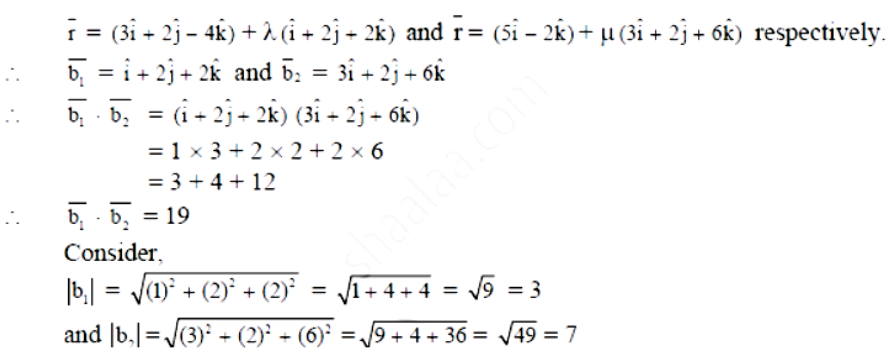
Let θ be the acute angle between the two given lines.
$\therefore \cos \theta=\frac{\bar{b}_1 \bar{b}_2}{\left|\bar{b}_1\right|\left|\bar{b}_2\right|}=\frac{19}{3 \times 7}$
$\therefore \cos \theta=\frac{19}{21}$
$\theta=\cos ^{-1}\left(\frac{19}{21}\right)$
View full question & answer→