MCQ 11 Mark
The foot of perpendicular drawn from the point (0,0,0) to the plane is (4, -2, -5) then the equation of the plane is
MCQ 21 Mark
If the line $\frac{x+1}{2}=\frac{y-m}{3}=\frac{z-4}{6}$ lies in the plane $3 x-14 y+6 z+49=0$, then the value ofm is:
View full question & answer→MCQ 31 Mark
The equation of the plane in which the line $\frac{x-5}{4}=\frac{y-7}{4}=\frac{z+3}{-5}$ and $\frac{x-8}{7}=\frac{y-4}{1}=\frac{z+5}{3}$lie, is
- ✓
17x – 47y – 24z + 172 = 0
- B
17x + 47y – 24z + 172 = 0
- C
- D
17x – 47y + 24z + 172 = 0
AnswerCorrect option: A. 17x – 47y – 24z + 172 = 0
17x – 47y – 24z + 172 = 0
View full question & answer→MCQ 41 Mark
The equation of the plane passing through the points (1, -1, 1), (3, 2, 4) and parallel to Y-axis is :
MCQ 51 Mark
The direction cosines of the normal to the plane 2x – y + 2z = 3 are
- ✓
$\frac{2}{3}, \frac{-1}{3}+\frac{2}{3}$
- B
$\frac{-2}{3}, \frac{1}{3}, \frac{-2}{3}$
- C
$\frac{2}{3}, \frac{1}{3}, \frac{2}{3}$
- D
$\frac{2}{3}, \frac{-1}{3}, \frac{-2}{3}$
AnswerCorrect option: A. $\frac{2}{3}, \frac{-1}{3}+\frac{2}{3}$
$\frac{2}{3}, \frac{-1}{3}, \frac{2}{3}$
View full question & answer→MCQ 61 Mark
Measure of angle between the planes 5x – 2y + 3z – 7 = 0 and 15x – 6y + 9z + 5 = 0 is
MCQ 71 Mark
The equation of the plane passing through (2, -1, 3) and making equal intercepts on the coordinate axes is
MCQ 81 Mark
If the planes $\bar{r} \cdot(2 \bar{i}-\lambda \bar{j}+\bar{k})=3$ and $\bar{r} \cdot(4 \bar{i}-\bar{j}+\mu \bar{k})=5$ are parallel, then thevalues of λ and μ are respectively.
- A
$\frac{1}{2},-2$
- B
$-\frac{1}{2}, 2$
- C
$-\frac{1}{2},-2$
- ✓
$\frac{1}{2}, 2$
AnswerCorrect option: D. $\frac{1}{2}, 2$
$\frac{1}{2}, 2$
View full question & answer→MCQ 91 Mark
The angle between the planes and $\bar{r} \cdot(\bar{i}-2 \bar{j}+3 \bar{k})+4=0$ and$\bar{r} \cdot(2 \bar{i}+\bar{j}-3 \bar{k})+7=0$ is
AnswerCorrect option: D. $\cos ^1\left(\frac{9}{14}\right)$
$\cos ^1\left(\frac{9}{14}\right)$
View full question & answer→MCQ 101 Mark
The perpendicular distance of the plane $2 x+3 y-z=k$ from the origin is $\sqrt{14}$ units, thevalue of k is
- ✓
- B
- C
$2 \sqrt{14}$
- D
$\frac{\sqrt{14}}{2}$
View full question & answer→MCQ 111 Mark
The direction ratios of the line 3x + 1 = 6y – 2 = 1 – z are
MCQ 121 Mark
The angle between the lines 2x = 3y = -z and 6x = -y = -4z is
MCQ 131 Mark
View full question & answer→MCQ 141 Mark
The lines $\frac{x}{1}=\frac{y}{2}=\frac{z}{3}$ and $\frac{x-1}{-2}=\frac{y-2}{-4}=\frac{z-3}{6}$ and are
View full question & answer→MCQ 151 Mark
The lines $\frac{x-2}{1}=\frac{y-3}{1}=\frac{z-4}{-k}$ and $\frac{x-1}{k}=\frac{y-4}{2}=\frac{z-5}{1}$, and coplanar if
View full question & answer→MCQ 161 Mark
The shortest distance between the lines $\bar{r}=(\hat{i}+2 \hat{j}+\hat{k})+\lambda(\hat{i}-\hat{j}-\hat{k})$ and$\bar{r}=(2 \hat{i}-\hat{j}-\hat{k})+\mu(2 \hat{i}+\hat{j}+2 \hat{k})$ is
Question is modified.
The shortest distance between the lines $\bar{r}=(\hat{i}+2 \hat{j}+\hat{k})+\lambda(\hat{i}-\hat{j}+\hat{k})$ and
$\bar{r}=(2 \hat{i}-\hat{j}-\hat{k})+\mu(2 \hat{i}+\hat{j}+2 \hat{k})$ is
- A
$\frac{1}{\sqrt{3}}$
- B
$\frac{1}{\sqrt{2}}$
- ✓
$\frac{3}{\sqrt{2}}$
- D
$\frac{\sqrt{3}}{2}$
AnswerCorrect option: C. $\frac{3}{\sqrt{2}}$
$\frac{3}{\sqrt{2}}$
View full question & answer→MCQ 171 Mark
The length of the perpendicular from $(1,6,3)$ to the line $\frac{x}{1}=\frac{y-1}{2}=\frac{z-2}{3}$
- A
- B
$\sqrt{11}$
- ✓
$\sqrt{13}$
- D
AnswerCorrect option: C. $\sqrt{13}$
$\sqrt{13}$
View full question & answer→MCQ 181 Mark
The direction ratios of the line which is perpendicular to the two lines
$\frac{x-7}{2}=\frac{y+17}{-3}=\frac{z-6}{1}$ and $\frac{x+5}{1}=\frac{y+3}{2}=\frac{z-6}{-2}$ are
View full question & answer→MCQ 191 Mark
The vector equation of line 2x – 1 = 3y + 2 = z – 2 is
- ✓
$\bar{r}=\left(\frac{1}{2} \bar{i}-\frac{2}{3} \bar{j}+2 \bar{k}\right)+\lambda(3 \bar{i}+2 \bar{j}+6 \bar{k})$
- B
$\bar{r}=\bar{i}-\bar{j}+(2 \bar{i}+\bar{j}+\bar{k})$
- C
$\bar{r}=\left(\frac{1}{2} \bar{i}-\bar{j}\right)+\lambda(\bar{i}-2 \bar{j}+6 \bar{k})$
- D
$\bar{r}=(\bar{i}+\bar{j})+\lambda(\bar{i}-2 \bar{j}+6 \bar{k})$
AnswerCorrect option: A. $\bar{r}=\left(\frac{1}{2} \bar{i}-\frac{2}{3} \bar{j}+2 \bar{k}\right)+\lambda(3 \bar{i}+2 \bar{j}+6 \bar{k})$
$\bar{r}=\left(\frac{1}{2} \hat{i}-\frac{2}{3} \hat{j}+2 \hat{k}\right)+\lambda(3 \hat{i}+2 \hat{j}+6 \hat{k})$
View full question & answer→MCQ 201 Mark
If the line $\frac{x}{3}=\frac{y}{4}=z$ is perpendicular to the line $\frac{x-1}{k}=\frac{y+2}{3}=\frac{z-3}{k-1}$ then the value of $\mathrm{k}$ is:
- A
$\frac{11}{4}$
- ✓
$-\frac{11}{4}$
- C
$\frac{11}{2}$
- D
$\frac{4}{11}$
AnswerCorrect option: B. $-\frac{11}{4}$
B) $-\frac{11}{4}$
View full question & answer→MCQ 212 Marks
If the cartesian equation of a line is $6 x-2=3 y+1$ $=2 z-2$, then the vector equation of the line is
Answer(a): Given line $L$ is $6 x-2=3 y+1=2 z-2$
$\begin{aligned}
\text { i.e., } \frac{x-\frac{1}{3}}{\frac{1}{6}} & =\frac{y-\left(-\frac{1}{3}\right)}{\frac{1}{3}}=\frac{z-1}{\frac{1}{2}} \\
\text { i.e., } \frac{x-\frac{1}{3}}{1} & =\frac{y-\left(\frac{-1}{3}\right)}{2}=\frac{z-1}{3}
\end{aligned}$
So, direction ratios of $L$ are $(1,2,3)$ and line is passing through $\left(\frac{1}{3}, \frac{-1}{3}, 1\right)$
$\therefore$ Vector equation of line is
$\vec{r}=\left(\frac{1}{3} \hat{i}-\frac{1}{3} \hat{j}+\hat{k}\right)+\lambda(\hat{i}+2 \hat{j}+3 \hat{k})$
View full question & answer→MCQ 222 Marks
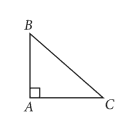
If $\triangle A B C$ is right angled at $A$, where $A \equiv(4,2, x)$, $B \equiv(3,1,8)$ and $C \equiv(2,-1,2)$, then the value of $x$ is
View full question & answer→MCQ 232 Marks
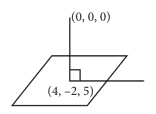
The foot of the perpendicular drawn from the origin to the plane is $(4,-2,5)$, then the cartesian equation of the plane is
Answer(a) : We have, foot of the perpendicular from $(0,0,0)$ to the plane is $(4,-2,5)$.
$\therefore \quad$ Direction ratios of normal to the plane is $(0-4,0+$ $2,0-5)$ i.e., $(-4,2,-5)$
Now, equation of plane passing through $(4,-2,5)$ and having direction ratios of normal $(-4,2,-5)$ is
$\begin{aligned}
& -4(x-4)+2(y+2)-5(z-5)=0 \\
& \Rightarrow \quad-4 x+2 y-5 z+16+4+25=0 \\
& \Rightarrow \quad-4 x+2 y-5 z+45=0 \\
& \Rightarrow \quad 4 x-2 y+5 z=45 \text { is the required equation of the } \\
& \text { plane. }
\end{aligned}$
View full question & answer→MCQ 242 Marks
A vector $\bar{n}$ is inclined to $X$-axis at $45^{\circ}, Y$-axis at $60^{\circ}$ and at an acute angle to $Z$-axis. If $\bar{n}$ is normal to a plane passing through the point $(-\sqrt{2}, 1,1)$, then equation of the plane is
Answer(a) : Let $\vec{x}$ be inclined at $\alpha, \beta$ and $\gamma$ angles to $x, y$ and $z$ axis respectively, where, $\alpha=45^{\circ}$ and $\beta=60^{\circ}$
Now, $\cos \alpha=\cos 45^{\circ}=\frac{1}{\sqrt{2}}$
$\begin{aligned}
& \cos \beta=\cos 60^{\circ}=\frac{1}{2} \\
& \text { Since, } \cos ^2 \alpha+\cos ^2 \beta+\cos ^2 \gamma=1 \\
& \Rightarrow \frac{1}{2}+\frac{1}{4}+\cos ^2 \gamma=1 \Rightarrow \cos ^2 \gamma=1-\frac{3}{4}
\end{aligned}$
$\begin{aligned}
& \Rightarrow \quad \cos ^2 \gamma=\frac{1}{4} \Rightarrow \cos \gamma=\frac{1}{2} \Rightarrow \gamma=60^{\circ} \\
& \therefore \quad \vec{x}=\frac{1}{\sqrt{2}} \hat{i}+\frac{1}{2} \hat{j}+\frac{1}{2} \hat{k}
\end{aligned}$
Equation of plane having $\vec{x}$ as normal and passing through $(-\sqrt{2}, 1,1)$ is given by
$\begin{aligned}
& \frac{1}{\sqrt{2}}(x+\sqrt{2})+\frac{1}{2}(y-1)+\frac{1}{2}(z-1)=0 \\
& \Rightarrow \quad \sqrt{2}(x+\sqrt{2})+(y-1)+(z-1)=0 \\
& \Rightarrow \quad \sqrt{2} x+y+z=0
\end{aligned}$
View full question & answer→MCQ 252 Marks
The mirror image of $P(2,4,-1)$ in the plane $x-y$ $+2 z-2=0$ is $(a, b, c)$, then the value of $a+b+c$ is
Answer(d) : Let $M(a, b, c)$ be the image of $P(2,4,-1)$ in the plane $x-y+2 z-2=0$
$\therefore \quad$ Equation of line passing through $P(2,4,-1)$ and having direction ratio $(1,-1,2)$ is
$\frac{x-2}{1}=\frac{y-4}{-1}=\frac{z+1}{2}=k \text { (let) }$
Any point on this line is of the form $(k+2,-k+4,2 k-1)$.
Substituting this point in equation of plane, we get
$\begin{aligned}
& k+2-(-k+4)+2(2 k-1)-2=0 \\
\Rightarrow & k+2+k-4+4 k-2-2=0 \\
\Rightarrow & 6 k-6=0 \Rightarrow k=1
\end{aligned}$
$\therefore \quad Q(3,3,1)$ lies on the plane. As $M(a, b, c)$ is the image of $P(2,4,-1)$ in the plane $x-y+2 z-2=0$.
$\therefore \quad Q$ is midpoint of $P M$.
$\begin{aligned}
& \Rightarrow 3=\frac{a+2}{2}, 3=\frac{b+4}{2} \text { and } 1=\frac{-1+c}{2} \\
& \Rightarrow a=4, b=2, c=3 \therefore a+b+c=4+2+3=9
\end{aligned}$
View full question & answer→MCQ 262 Marks
The length of the perpendicular drawn from the point $(1,2,3)$ to the line $\frac{x-6}{3}=\frac{y-7}{2}=\frac{z-7}{-2}$ is
Answer(d) : Any point $P$ on the given
line $\frac{x-6}{3}=\frac{y-7}{2}=\frac{z-7}{-2}=\lambda$ (say) is
$(3 \lambda+6,2 \lambda+7,-2 \lambda+7)$
Direction ratios of the line which is perpendicular to given line and passing through $A(1,2,3)$ is given as
$\begin{aligned}
P A & =(3 \lambda+6-1,2 \lambda+7-2,-2 \lambda+7-3) \\
& =(3 \lambda+5,2 \lambda+5,-2 \lambda+4)
\end{aligned}$
and direction ratios of given line are $(3,2,-2)$
$\begin{aligned}
& \Rightarrow \quad 3(3 \lambda+5)+2(2 \lambda+5)-2(-2 \lambda+4)=0 \\
& \Rightarrow \quad 9 \lambda+15+4 \lambda+10+4 \lambda-8=0 \\
& \Rightarrow 17+17 \lambda=0 \Rightarrow \lambda=-1 \\
& \therefore \quad \text { Point } P=(-3+6,-2+7,2+7)=(3,5,9)
\end{aligned}$
Now, length of perpendicular $A P$
$\begin{aligned}
& =\sqrt{(3-1)^2+(5-2)^2+(9-3)^2}=\sqrt{49} \\
& =7 \text { units }
\end{aligned}$
View full question & answer→MCQ 272 Marks
A vector parallel to the line of intersection of the planes $\vec{r} \cdot(3 \hat{i}-\hat{j}+\hat{k})=1$ and $\vec{r} \cdot(\hat{i}+4 \hat{j}-2 \hat{k})=2$ is
Answer(a) : Given equation of planes are $\vec{r} \cdot(3 \hat{i}-\hat{j}+\hat{k})=1$ and $\vec{r} \cdot(\hat{i}+4 \hat{j}-2 \hat{k})=2$
Let $\vec{a}=x \hat{i}+y \hat{j}+z \hat{k}$ be the vector parallel to line of intersection of the given planes.
$\Rightarrow 3 x-y+z=0 \text { and } x+4 y-2 z=0$
On solving these two equations, we get
$\begin{aligned}
& \frac{x}{2-4}=\frac{y}{1+6}=\frac{z}{12+1} \Rightarrow \frac{x}{-2}=\frac{y}{7}=\frac{z}{13}=\lambda \text { (say) } \\
\Rightarrow \quad & x=-2 \lambda, y=7 \lambda \text { and } z=13 \lambda \\
\therefore \quad & \text { Required vector is }-2 \hat{i}+7 \hat{j}+13 \hat{k} .
\end{aligned}$
View full question & answer→MCQ 282 Marks
If the lines $\frac{x-k}{2}=\frac{y+1}{3}=\frac{z-1}{4} \text { and } \frac{x-3}{1}=\frac{y-\frac{9}{2}}{2}=\frac{z}{1}$ intersect, then the value of $k$ is
- A
$\frac{1}{2}$
- B
- C
- D
$\frac{3}{2}$
Answer(c) : Weknow that twolines $\frac{x-x_1}{a_1}=\frac{y-y_1}{b_1}=\frac{z-z_1}{c_1}$ and $\frac{x-x_2}{a_2}=\frac{y-y_2}{b_2}=\frac{z-z_2}{c_2}$ intersect if
$\left|\begin{array}{ccc}
x_2-x_1 & y_2-y_1 & z_2-z_1 \\
a_1 & b_1 & c_1 \\
a_2 & b_2 & c_2
\end{array}\right|=0$
Since, lines $\frac{x-k}{2}=\frac{y+1}{3}=\frac{z-1}{4}$ and $\frac{x-3}{1}=\frac{y-\frac{9}{2}}{2}=\frac{z}{1}$ intresects.
$\begin{aligned}
& \Rightarrow\left|\begin{array}{ccc}
3-k & \frac{9}{2}+1 & 0-1 \\
2 & 3 & 4 \\
1 & 2 & 1
\end{array}\right|=0 \\
& \Rightarrow(3-k)(3-8)-\frac{11}{2}(2-4)-1(4-3)=0 \\
& \Rightarrow-15+5 k+11-1=0 \Rightarrow 5 k-5=0 \Rightarrow k=1
\end{aligned}$
View full question & answer→MCQ 292 Marks
Equation of the plane passing through $(1,-1,2)$ and perpendicular to the planes $x+2 y-2 z=4$ and $3 x+2 y+z=6$ is
Answer(a) : The equation of plane passing through $(1,-1,2)$ is
$a(x-1)+b(y+1)+c(z-2)=0 ...(i)$
It is perpendicular to $x+2 y-2 z=4$ and $3 x+2 y+z=6$
$\begin{aligned}
& \Rightarrow a+2 b-2 c=0 \text { and } 3 a+2 b+c=0 \\
& \Rightarrow \frac{a}{2+4}=\frac{-b}{1+6}=\frac{c}{2-6} \Rightarrow \frac{a}{6}=\frac{b}{-7}=\frac{c}{-4}=k \text { (say) } \\
& \Rightarrow a=6 k, b=-7 k \text { and } c=-4 k
\end{aligned}$
On substituting the values of $a, b, c$ in (i) we get
$6 x-6-7 y-7-4 z+8=0$
$\Rightarrow 6 x-7 y-4 z-5=0$, which is the required equation of plane.
View full question & answer→MCQ 302 Marks
If the shortest distance between the lines $\frac{x-1}{2}=\frac{y-2}{3}=\frac{z-3}{\lambda}$ and $\frac{x-2}{1}=\frac{y-4}{4}=\frac{z-5}{5}$ is $\frac{1}{\sqrt{3}}$, the sum of possible value of $\lambda$ is
Answer(a) : The shortest distance between two lines
$\begin{aligned}
& l_1: \frac{x-x_1}{a_1}=\frac{y-y_1}{b_1}=\frac{z-z_1}{c_1} \\
& l_2: \frac{x-x_2}{a_2}=\frac{y-y_2}{b_2}=\frac{z-z_2}{c_2} \text { is given by } \\
& \left|\frac{\left|\begin{array}{ccc}
x_2-x_1 & y_2-y_1 & z_2-z_1 \\
a_1 & b_1 & c_1 \\
a_2 & b_2 & c_2
\end{array}\right|}{\sqrt{\left(a_1 b_2-a_2 b_1\right)^2+\left(b_1 c_2-b_2 c_1\right)^2+\left(c_1 a_2-c_2 a_1\right)^2}}\right| \\
&
\end{aligned}$
So, shortest distance between the lines
$\begin{aligned}
& \frac{x-1}{2}=\frac{y-2}{3}=\frac{z-3}{\lambda} \text { and } \frac{x-2}{1}=\frac{y-4}{4}=\frac{z-5}{5} \\
& =\left|\frac{\left|\begin{array}{lll}
1 & 2 & 2 \\
2 & 3 & \lambda \\
1 & 4 & 5
\end{array}\right|}{\sqrt{(5)^2+(15-4 \lambda)^2+(\lambda-10)^2}}\right|=\frac{1}{\sqrt{3}} \\
& \Rightarrow\left|\frac{(15-4 \lambda)-2(10-\lambda)+2 \times 5}{\sqrt{25+(15-4 \lambda)^2+(\lambda-10)^2}}\right|=\frac{1}{\sqrt{3}} \\
& \Rightarrow\left|\frac{15-4 \lambda-20+2 \lambda+10}{\sqrt{25+225+16 \lambda^2-120 \lambda+\lambda^2+100-20 \lambda}}\right|=\frac{1}{\sqrt{3}} \\
& \Rightarrow\left|\frac{5-2 \lambda}{\sqrt{350+17 \lambda^2-140 \lambda}}\right|=\frac{1}{\sqrt{3}} \\
& \Rightarrow \frac{(5-2 \lambda)^2}{350+17 \lambda^2-140 \lambda}=\frac{1}{3} \\
& \Rightarrow 3\left(25+4 \lambda^2-20 \lambda\right)=350+17 \lambda^2-140 \lambda \\
& \Rightarrow 75+12 \lambda^2-60 \lambda=350+17 \lambda^2-140 \lambda \\
& \Rightarrow 5 \lambda^2-80 \lambda+275=0 \Rightarrow \lambda^2-16 \lambda+55=0 \\
& \Rightarrow \lambda^2-11 \lambda-5 \lambda+55=0 \Rightarrow \lambda(\lambda-11)-5(\lambda-11)=0 \\
& \Rightarrow(\lambda-5)(\lambda-11)=0 \Rightarrow \lambda=5,11
\end{aligned}$
Sum of all values of $\lambda=5+11=16$
View full question & answer→MCQ 312 Marks
The angle between the lines, whose direction cosines $l, m, n$ satisfy the equations $l+m+n=0$ and $2 l^2+2 m^2-n^2=0$, as
View full question & answer→MCQ 322 Marks
Consider the lines $L_1: \frac{x+1}{3}=\frac{y+2}{1}=\frac{z+1}{2}$ $L_2: \frac{x-2}{1}=\frac{y+2}{2}=\frac{z-3}{3}$, then the unit vector perpendicular to both $L_1$ and $L_2$ is
Answer(b) : We have, $L_1: \frac{x+1}{3}=\frac{y+2}{1}=\frac{z+1}{2}$
$L_2: \frac{x-2}{1}=\frac{y+2}{2}=\frac{z-3}{3}$
$\therefore \quad$ Vector parallel to $L_1$ and $L_2$ are $3 \hat{i}+\hat{j}+2 \hat{k}$ and $\hat{i}+2 \hat{j}+3 \hat{k}$ respectively.
Now, vector perpendicular to both $L_1$ and $L_2$ is vector perpendicular to $3 \hat{i}+\hat{j}+2 \hat{k}$ and $\hat{i}+2 \hat{j}+3 \hat{k}$.
$\begin{aligned}
& \text { Perpendicular vector }=\left|\begin{array}{lll}
\hat{i} & \hat{j} & \hat{k} \\
3 & 1 & 2 \\
1 & 2 & 3
\end{array}\right|=-\hat{i}-7 \hat{j}+5 \hat{k} \\
& \therefore \text { Required unit vector }=\frac{-\hat{i}-7 \hat{j}+5 \hat{k}}{\sqrt{1+49+25}}=\frac{-\hat{i}-7 \hat{j}+5 \hat{k}}{5 \sqrt{3}}
\end{aligned}$
View full question & answer→MCQ 332 Marks
A line with positive direction cosines passes through the point $P(2,-1,2)$ and makes equal angles with the co-ordinate axes. The line meets the plane $2 x+y+z=9$ at point $Q$. The length of the line segment $P Q$ equals
Answer(c) : Since, line makes equal angles with coordinate axes, so direction cosine of line are $\frac{1}{\sqrt{3}}, \frac{1}{\sqrt{3}}, \frac{1}{\sqrt{3}}$ Any point $Q$ on the line at a distance $t$ from $P(2,-1,2)$ is given by $\left(2+\frac{t}{\sqrt{3}},-1+\frac{t}{\sqrt{3}}, 2+\frac{t}{\sqrt{3}}\right)$
This point $Q$ meets the plane $2 x+y+z=9$.
$\begin{aligned}
& \Rightarrow 2\left(2+\frac{t}{\sqrt{3}}\right)+\left(-1+\frac{t}{\sqrt{3}}\right)+\left(2+\frac{t}{\sqrt{3}}\right)=9 \\
& \Rightarrow 4+\frac{2 t}{\sqrt{3}}-1+\frac{t}{\sqrt{3}}+2+\frac{t}{\sqrt{3}}=9 \Rightarrow 5+\frac{4 t}{\sqrt{3}}=9 \\
& \Rightarrow \frac{t}{\sqrt{3}}=1 \Rightarrow t=\sqrt{3}
\end{aligned}$
$\therefore \quad$ Distance between $P$ and $Q$ is $\sqrt{3}$
View full question & answer→MCQ 342 Marks
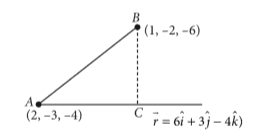
The distance of the point having position vector $\hat{i}-2 \hat{j}-6 \hat{k}$, from the straight line passing through the point $(2,-3,-4)$ and parallel to the vector $6 \hat{i}+3 \hat{j}-4 \hat{k}$ is $\qquad$ units.
View full question & answer→MCQ 352 Marks
The vector equation of the line passing through the point having position vector $2 \hat{i}+\hat{j}-3 \hat{k}$ and perpendicular to vectors $\hat{i}+\hat{j}+\hat{k}$ and $\hat{i}+2 \hat{j}-\hat{k}$ is
Answer(c): Let $\vec{b}=\hat{i}+\hat{j}+\hat{k}$ and $\vec{c}=\hat{i}+2 \hat{j}-\hat{k}$
The vector perpendicular to $\vec{b}$ and $\vec{c}$ is given by
$\begin{aligned}
& \vec{b} \times \vec{c}=\left|\begin{array}{ccc}
\hat{i} & \hat{j} & \hat{k} \\
1 & 1 & 1 \\
1 & 2 & -1
\end{array}\right|=\hat{i}(-1-2)-\hat{j}(-1-1)+\hat{k}(2-1) \\
& =-3 \hat{i}+2 \hat{j}+\hat{k}
\end{aligned}$
Since, the line is perpendicular to $\vec{b}$ and $\vec{c}$ therefore, the line will be parallel to $\vec{b} \times \vec{c}$.
$\therefore \quad$ Vector equation of line passing through $2 \hat{i}+\hat{j}-3 \hat{k}$ and parallel to $\vec{b} \times \vec{c}$ is
$\vec{r}=2 \hat{i}+\hat{j}-3 \hat{k}+\lambda(-3 \hat{i}+2 \hat{j}+\hat{k})$
View full question & answer→MCQ 362 Marks
The equation of the plane passing through the points $(1,2,3),(-1,4,2)$ and $(3,1,1)$ is
- A
$5 x+6 y+2 z-23=0$
- B
$5 x+y+2 z-13=0$
- C
$5 x+y+12 z-43=0$
- D
$5 x+y+z-10=0$
Answer(a) : Let the point $(1,2,3)$ be $\left(x_1, y_1, z_1\right),(-1,4,2)$ be $\left(x_2, y_2, z_2\right)$ and $(3,1,1)$ be $\left(x_3 y_3, z_3\right)$.
The equation of plane is
$\begin{aligned}
& \left|\begin{array}{ccc}
x-x_1 & y-y_1 & z-z_1 \\
x_2-x_1 & y_2-y_1 & z_2-z_1 \\
x_3-x_1 & y_3-y_1 & z_3-z_1
\end{array}\right|=0 \\
\Rightarrow & \left|\begin{array}{ccc}
x-1 & y-2 & z-3 \\
-2 & 2 & -1 \\
2 & -1 & -2
\end{array}\right|=0 \\
\Rightarrow & -5(x-1)-6(y-2)-2(z-3)=0 \\
\Rightarrow & 5 x+6 y+2 z-23=0
\end{aligned}$
View full question & answer→MCQ 372 Marks
The distance between the lines $\frac{x}{2}=\frac{y}{-1}=\frac{z}{2}$ and $\frac{x-1}{2}=\frac{y-1}{-1}=\frac{z-1}{2}$ is
Answer(c) : Given equation of lines are
$\frac{x}{2}=\frac{y}{-1}=\frac{z}{2}$ and $\frac{x-1}{2}=\frac{y-1}{-1}=\frac{z-1}{2}$ The distance between the lines is $d=\frac{\left\|\begin{array}{ccc}\hat{i} & \hat{j} & \hat{k} \\ 1 & 1 & 1 \\ 2 & -1 & 2\end{array}\right\|}{\sqrt{2^2+(-1)^2+2^2}}=\frac{3 \sqrt{2}}{3}=\sqrt{2}$ units
View full question & answer→MCQ 382 Marks
The cartesian equation of aline is $\frac{x+2}{3}=\frac{y-4}{2}=\frac{z-5}{5}$, then the vector equation of the line is
Answer(c) : Given equation of line is
$\frac{x+2}{3}=\frac{y-4}{2}=\frac{z-5}{5}$
Vector equation of line is $\vec{r}=\vec{a}+\lambda \vec{b}$
where $\vec{a}$ is position vector and $\vec{b}$ is obtained from direction ratios.
So, equation of given line in vector form is
$\vec{r}=(-2 \hat{i}+4 \hat{j}+5 \hat{k})+\lambda(3 \hat{i}+2 \hat{j}+5 \hat{k})$
View full question & answer→MCQ 392 Marks
The joint equation of pair of lines which bisects the angle between the lines $x^2+3 x y+2 y^2=0$ is
- A
$3 x^2-2 x y-3 y^2=0$
- B
- C
$3 x^2+2 x y-3 y^2=0$
- D
$2 x^2+3 x y-2 y^2=0$
Answer(c): We have, $x^2+3 x y+2 y^2=0$
$\begin{aligned}
& \Rightarrow x^2+2 x y+x y+2 y^2=0 \\
& \Rightarrow x(x+2 y)+y(x+2 y)=0 \quad \Rightarrow(x+y)(x+2 y)=0
\end{aligned}$
$\therefore \quad$ Separate equations of the lines represented by $x^2+3 x y+2 y^2=0$ are $x+y=0$ and $x+2 y=0$.
Let $P\left(x_0, y_0\right)$ be any point on one of the angle bisector.
Since, the points on the angle bisectors are equidistant from both the lines, therefore, distance of $P\left(x_0, y_0\right)$ from both the lines is same.
$\begin{aligned}
& \text { i.e., }\left|\frac{x_0+2 y_0}{\sqrt{1+4}}\right|=\left|\frac{x_0+y_0}{\sqrt{1+1}}\right| \\
& \text { i.e., } \frac{\left(x_0+2 y_0\right)^2}{5}=\frac{\left(x_0+y_0\right)^2}{2} \\
& \Rightarrow 2\left(x_0^2+4 y_0^2+4 x_0 y_0\right)=5\left(x_0^2+y_0^2+2 x_0 y_0\right) \\
& \Rightarrow 2 x_0^2+8 y_0^2+8 x_0 y_0=5 x_0^2+5 y_0^2+10 x_0 y_0 \\
& \Rightarrow 3 x_0^2-3 y_0^2+2 x_0 y_0=0
\end{aligned}$
$\therefore \quad$ Required joint equation of the lines is
$3 x^2+2 x y-3 y^2=0$
View full question & answer→MCQ 402 Marks
The equation of the plane through the imersection of the planes $x+y+z=1$ and $2 x+3 y-z+4=0$ and parallet to $X$-asis is
- A
$3 y-2 z+6=0$
- B
$3 y-z+6=0$
- ✓
$y-3 t+6=0$
- D
$y+3 z+6=0$
AnswerCorrect option: C. $y-3 t+6=0$
(c) : Equation of plane passing through the intersection of the planes $x+y+z=1$ and $2 x+3 y-z+4=0$ is
$
\begin{array}{c}
(x+y+z-1)+\lambda(2 x+3 y-z+4)=0 \\
\Rightarrow \quad(1+2 \lambda) x+(1+3 \lambda) y+(1-\lambda) z-1+4 \lambda=0
\end{array}
$
Dr's of normal of the plane are $\langle 1+2 \lambda, 1+3 \lambda, 1-\lambda\rangle$
Since, the plane is parallel to $X$-axis.
$
\Rightarrow 1+2 \lambda=0 \Rightarrow \lambda=-1 / 2
$
$\therefore \quad$ Equation of the plane is $-\frac{1}{2} y+\frac{3}{2} z-3=0$ i.e., $y-3 z+6=0$
View full question & answer→MCQ 412 Marks
The co-ordinates of the foot of the perpendicular drawn from the origin to the plane $2 x+6 y-3 z$ $=63$ are
- A
$\left(\frac{2}{7}, \frac{6}{7}, \frac{-3}{7}\right)$
- B
$(4,2,-4)$
- C
$\left(\frac{9}{7}, \frac{6}{7}, \frac{-3}{7}\right)$
- D
$\left(\frac{18}{7}, \frac{34}{7}, \frac{-27}{7}\right)$
Answer(d) : Given, equation of plane is $2 x+6 y-3 z=63$.
$\therefore$ Direction ratios of the normal to the plane are $\langle 2,6,-3\rangle$
$\therefore$ Direction cosines are $l=\frac{2}{\sqrt{2^2+6^2+(-3)^2}}=\frac{2}{7}$ $m=\frac{6}{7}$ and $n=\frac{-3}{7}$
View full question & answer→MCQ 422 Marks
Find the distance of the plane $3 x-4 y+5 z+7=0$ from the origin.
Answer(a) :$\begin{aligned}
& \text { The required distance }=\frac{|0-0+0+7|}{\sqrt{9+16+25}} \\
& =\frac{7}{5 \sqrt{2}} \text { units }
\end{aligned}$
View full question & answer→MCQ 432 Marks
If the planes $x+3 y+k z=0$ and $3 x+y-2 z=0$ are at right angles, then the value of $k$ is
Answer(d): The planes $x+3 y+k z=0$ and $3 x+y-2 z=0$ are at right angles.
$\begin{aligned}
& \Rightarrow \cos 90^{\circ}=\frac{|(1)(3)+(3)(1)+(k)(-2)|}{\sqrt{1^2+3^2+k^2} \sqrt{3^2+1^2+(-2)^2}} \\
& \Rightarrow 0=\frac{|3+3-2 k|}{\sqrt{10+k^2} \sqrt{14}} \Rightarrow 6-2 k=0 \Rightarrow 2 k=6 \Rightarrow k=3
\end{aligned}
$
View full question & answer→MCQ 442 Marks
The shortest distance between the lines $x=y=z$ and $x=1-y=\frac{z}{0}$ is
- A
$\frac{1}{2}$
- B
$\frac{1}{\sqrt{2}}$
- C
$\frac{1}{\sqrt{3}}$
- D
$\frac{1}{\sqrt{6}}$
Answer(d) : The lines are $\frac{x}{1}=\frac{y}{1}=\frac{z}{1}$ and $\frac{x}{1}=\frac{y-1}{-1}=\frac{z}{0}$.
Here, $\vec{a}_1=0, \vec{b}_1=\hat{i}+\hat{j}+\hat{k}, \vec{a}_2=\hat{j}$ and $\vec{b}_2=\hat{i}-\hat{j}$
$\therefore \quad \vec{b}_1 \times \vec{b}_2=(\hat{i}+\hat{j}+\hat{k}) \times(\hat{i}-\hat{j})=\hat{i}+\hat{j}-2 \hat{k}$
Now, S.D. $=\frac{|\hat{j} \cdot(\hat{i}+\hat{j}-2 \hat{k})|}{|\hat{i}+\hat{j}-2 \hat{k}|}=\frac{1}{\sqrt{6}}$.
View full question & answer→MCQ 452 Marks
The equation of the plane passing through the point $(-1,2,1)$ and perpendicular to the line joining the points $(-3,1,2)$ and $(2,3,4)$ is
Answer(a) : Equation of a plane passing through a point $\vec{a}$ and perpendicular to $\vec{n}$ is
$\vec{r} \cdot \vec{n}=\vec{a} \cdot \vec{n}$
Here, $\vec{a}=-\hat{i}+2 \hat{j}+\hat{k}$
$\vec{n}=(2-(-3)) \hat{i}+(3-1) \hat{j}+(4-2) \hat{k}=5 \hat{i}+2 \hat{j}+2 \hat{k}$
$\therefore$ Required equation of plane is
$\begin{aligned}
& \vec{r} \cdot(5 \hat{i}+2 \hat{j}+2 \hat{k})=(-\hat{i}+2 \hat{j}+\hat{k})(5 \hat{i}+2 \hat{j}+2 \hat{k}) \\
& \Rightarrow \quad \vec{r} \cdot(5 \hat{i}+2 \hat{j}+2 \hat{k})=-5+4+2 \\
& \Rightarrow \quad \vec{r} \cdot(5 \hat{i}+2 \hat{j}+2 \hat{k})=1
\end{aligned}$
View full question & answer→MCQ 462 Marks
The coordinates of the foot of perpendicular drawn from origin to the plane $2 x-y+5 z-3=0$ are
Answer(d) : Given plane is $2 x-y+5 z-3=0$
The d.r.'s of normal to plane (i) are $2,-1,5$.
Let $A$ be the foot of perpendicular drawn from the origin $O(0,0,0)$ to plane (i).
Equation of perpendicular $O A$ is given by
$\frac{x-0}{2}=\frac{y-0}{-1}=\frac{z-0}{5}=\lambda \text { (say) }$
So, $A \equiv(2 \lambda,-\lambda, 5 \lambda)$ lies on plane (i).
$\begin{aligned}
& \therefore \quad 2 \times 2 \lambda-(-\lambda)+5(5 \lambda)-3=0 \\
& \Rightarrow \quad 4 \lambda+\lambda+25 \lambda=3 \Rightarrow 30 \lambda=3 \Rightarrow \lambda=\frac{1}{10} \\
& \therefore \quad A \equiv\left(2 \times \frac{1}{10}, \frac{-1}{10}, 5 \times \frac{1}{10}\right)=\left(\frac{1}{5}, \frac{-1}{10}, \frac{1}{2}\right)
\end{aligned}$
View full question & answer→MCQ 472 Marks
If the foot of the perpendicular drawn from the point $(0,0,0)$ to the plane is $(4,-2,-5)$ then the equation of the plane is
- A
$4 x+2 y+5 z=-13$
- ✓
$4 x-2 y-5 z=45$
- C
- D
$4 x-2 y+5 z=-5$
AnswerCorrect option: B. $4 x-2 y-5 z=45$
(b) : The required plane passes through $P(4,-2$,
-5) and perpendicular to $\overrightarrow{O P}=4 \hat{i}-2 \hat{j}-5 \hat{k}$.
$\therefore \quad$ Normal to the plane is, $4 \hat{i}-2 \hat{j}-5 \hat{k}$
$\therefore$ Equation of the plane is $(\vec{r}-\vec{a}) \cdot \vec{n}=0$
$\Rightarrow \vec{r} \cdot \vec{n}=\vec{a} \cdot \vec{n}$
$
\Rightarrow \vec{r} \cdot(4 \hat{i}-2 \hat{j}-5 \hat{k})=16+4+25=45
$
$\therefore$ Cartesian equation of plane is
$
(x \hat{i}+y \hat{j}+z \hat{k}) \cdot(4 \hat{i}-2 \hat{j}-5 \hat{k})=45 \Rightarrow 4 x-2 y-5 z=45
$
View full question & answer→MCQ 482 Marks
If the line passes through the points $P(6,-1,2)$, $Q(8,-7,2 \lambda)$ and $R(5,2,4)$ then value of $\lambda$ is
Answer(d) : Equation of any plane parallel to the plane
$x-2 y+2 z+4=0 \text { is } x-2 y+2 z+\lambda=0 \text {. }$
Its distance from the point $(1,2,3)$ is 1 unit.
$\begin{aligned}
& \therefore \frac{|1-2(2)+2(3)+\lambda|}{\sqrt{1^2+(-2)^2+(2)^2}}=1 \Rightarrow \frac{|1-4+6+\lambda|}{3} \\
& \Rightarrow|3+\lambda|=3 \\
& \Rightarrow 3+\lambda= \pm 3 \Rightarrow \lambda=0,-6
\end{aligned}$
$\therefore$ Equations of planes are
$x-2 y+2 z=0 \text { and } x-2 y+2 z-6=0$
View full question & answer→MCQ 492 Marks
If the line passes through the points $P(6,-1,2)$, $Q(8,-7,2 \lambda)$ and $R(5,2,4)$ then value of $\lambda$ is
Answer(c) : Let $\vec{a}$ and $\vec{b}$ be the position vectors of the points $P(6,-1,2)$ and $R(5,2,4)$.
Thus, $\vec{a}=6 \hat{i}-\hat{j}+2 \hat{k}, \vec{b}=5 \hat{i}+2 \hat{j}+4 \hat{k}$
Now, $\vec{b}-\vec{a}=-\hat{i}+3 \hat{j}+2 \hat{k}$
$\therefore \quad$ Vector equation of the line passing through $P$ and $R$
$\begin{aligned}
& \text { is } \vec{r}=\vec{a}+\mu \vec{b} \Rightarrow \vec{r}=(6 \hat{i}-\hat{j}+2 \hat{k})+\mu(-\hat{i}+3 \hat{j}+2 \hat{k}) \\
& \Rightarrow \vec{r}=(6-\mu) \hat{i}+(3 \mu-1) \hat{j}+(2 \mu+2) \hat{k}
\end{aligned}
$
This equation passes through $Q(8,-7,2 \lambda)$.
$\begin{aligned}
& \therefore 8 \hat{i}-7 \hat{j}+2 \lambda \hat{k}=(6-\mu) \hat{i}+(3 \mu-1) \hat{j}+(2 \mu+2) \hat{k} \\
& \Rightarrow 6-\mu=8,3 \mu-1=-7,2 \mu+2=2 \lambda \\
& \Rightarrow \mu=-2 \Rightarrow 2(-2)+2=2 \lambda \Rightarrow \lambda=-1
\end{aligned}$
View full question & answer→MCQ 502 Marks
If lines $\frac{x-1}{2}=\frac{y+1}{3}=\frac{z-1}{4}$ and $\frac{x-3}{1}=\frac{y-\lambda}{2}=\frac{z}{1}$ intersect each other, then $\lambda=$
- A
$7 / 2$
- B
$3 / 2$
- C
- D
$5 / 2$
Answer(c) : Given lines are
$\begin{aligned}
& \frac{x-1}{2}=\frac{y+1}{3}=\frac{z-1}{4}=p \text { (say) } ...(i) \\
& \text { and } \frac{x-3}{1}=\frac{y-\lambda}{2}=\frac{z}{1}=\mu \text { (say) } ...(ii)
\end{aligned}$
$\therefore \quad$ The coordinates of a point on the line (i) are
$(2 p+1,3 p-1,4 p+1)$
The coordinates of a point on the line (ii) are
$(\mu+3,2 \mu+\lambda, \mu)$
Since two lines intersect each other.
$\begin{aligned}
\therefore \quad 2 p+1 & =\mu+3 ...(iii) \\
3 p-1 & =2 \mu+\lambda ...(iv) \\
4 p+1 & =\mu ...(v)
\end{aligned}$
Substituting value of $\mu$ from (v) in (iii) and (iv), we get
$\begin{aligned}
& 2 p+1=4 p+1+3 \Rightarrow 2 p=-3 \\
& \Rightarrow p=-3 / 2
\end{aligned}$
And $3 p-1=2(4 p+1)+\lambda$
$\begin{aligned}
& \Rightarrow 3\left(-\frac{3}{2}\right)-1=2\left(4 \times\left(\frac{-3}{2}\right)+1\right)+\lambda \\
& \Rightarrow \frac{-9}{2}-1=2(-6+1)+\lambda \Rightarrow \lambda=\frac{9}{2}
\end{aligned}$
View full question & answer→