Questions

Solve the Following Question.(2 Marks)

🎯

Test yourself on this topic

22 questions · timed · auto-graded

Question 12 Marks
Write converse and inverse of the following statement: "If $x>y$ then $x^2>y^{2 }$"
Answer
Given statement :
If $x>y$ then $x^2>y^2$
Converse: If $x^2>y^2$ then $x>y$.
Inverse : If $x$ is not greater than $y$, then $x^2$ is
not greater than $y^2$.
i.e. If $x \ngtr y$ then $x^2 \ngtr y^2$
OR If $x \leq y$ then $x^2 \leq y^2$
View full question & answer
MCQ 22 Marks
$\sim[p \rightarrow(p \wedge \sim q)] \equiv$
  • A
    $p$
  • B
    $q$
  • $(p \wedge q)$
  • D
    $(p \vee q)$
Answer
Correct option: C.
$(p \wedge q)$
$\sim[p \rightarrow(p \wedge \sim q)]$
$=\sim[\sim p \vee(p \wedge \sim q)] ($implication equivalence$)$
$=p \wedge \sim(p \wedge \sim q) ($De Morgan's law$)$
$=p \wedge(\sim p \vee q) ($De Morgan's law$)$
$=(p \wedge \sim p) \vee(p \wedge q) ($Distributive law$)$
$=F \vee(p \wedge q) ($Complement law$)$
$=p \wedge q ($Identity law$)$
View full question & answer
MCQ 32 Marks
If $p \wedge q= F , p \rightarrow q= F$, then the truth value of $p$ and $q$ is :
  • A
    T , T
  • B
    T, F
  • C
    F, T
  • D
    F, F
Answer

If p ∧ q is F, p → q is F then the truth values of p and q are T, F.
Explanation:
Consider the following truth table:

pq$p \wedge q$$p \rightarrow q$
TTTT
TFFF
FTFT
FFFT
If (p ∧ q) is F and (p → q) is F, the their truth value must be T and F respectively.
View full question & answer
Question 42 Marks
Using truth table, prove the following logical equivalence : $(p \wedge q) \rightarrow r=p \rightarrow(q \rightarrow r)$
Answer
1234567
pqr$p \wedge q$$(p \wedge q) \rightarrow r$$q \rightarrow r$$p \rightarrow(q \rightarrow r)$
TTTTTTT
TFTTFFF
TTFFTTT
TFFFTTT
FTFFTTT
FTFFTFT
FFFFTTT
FFFFTTT

The entries in columns 5 and 7 are identical.
∴ (p ∧ q) → r ≡ p → (q → r).

View full question & answer
Question 52 Marks
Write truth values of the following statements :
(a) $\sqrt{5}$ is an irrational number but $3+\sqrt{5}$ is a complex number.
(b) $\exists n \in N$ such that $n+5>10$.
Answer

(a) True
(b) ∃ n ∈ N, such that n + 5 > 10  is a true statement, hence its truth value is T.
(All n $\geq$ 6, where n ∈ N, satisfy n + 5 > 10).

View full question & answer
MCQ 62 Marks
If $A=\{2,3,4,5,6\}$, then which of the following is 'not' true ?
  • A
    $\exists x \in$ A such that $x+3=8$
  • B
    $\exists x \in$ A such that $x+2<5$
  • C
    $\exists x \in$ A such that $x+2<9$
  • D
    $\forall x \in$ A such that $x+6 \geq 9$)
Answer

Since, x = 2 ∈ A does not satisfy x + 6 ≥ 9.
∴ option (D) is not true

View full question & answer
Question 72 Marks
Using truth table verify that : $(p \wedge q) \vee \sim q \equiv p \vee \sim q$
Answer
To verify $(p \wedge q) \vee \sim q \equiv p \vee \sim q$
$p$$q$$\sim q$$(p \wedge q)$$(p \wedge q) \vee \sim q$$p \vee \sim q$
123456
TTFTTT
TFTFTT
FTFFFF
FFTFTT
From columns 5 and 6 :
$(p \wedge q) \vee \sim q \equiv p \vee \sim q$
View full question & answer
MCQ 82 Marks
The negation of $p \wedge(q \rightarrow r)$ is :
Answer
$p \rightarrow(q \wedge \sim r)$

$\begin{aligned}& \sim[p \wedge(q \rightarrow r)] & & \\ & =\sim(p \wedge(\sim q \vee r)) & & \text { (Equivalence of implication) } \\ & =\sim p \vee \sim(\sim q \vee r) & & \text { (De Morgan's law) } \\ & =\sim p \vee(q \wedge \sim r) & & \text { (De Morgan's law) } \\ & =p \rightarrow(q \wedge \sim r) & & \text { (Implies equivalence) } \\ & \text { Hence option (d) } & & \end{aligned}$
View full question & answer
Question 112 Marks
Write the negations of the following. statements:
(a) All students of this college live in the hostel.
(b) 6 is an even number or 36 is a perfect square.
Answer

1) p: All students of this college live in the hostel.
Negation:
~ p: Some students of this college do not live in the hostel.
2) p: 6 is an even number.
q: 36 is a perfect square.
Symbolic form:pvq ..
~(pvq) = ~p^~q
Negation:
6 is not an even number and 36 is not a perfect square.

View full question & answer
Question 122 Marks
Write the following statement in symbolic form and find its truth value : $\forall n \in N , n^2+n$ is an even number and $n^2-n$ is an odd number.
Answer
Let $p ≡ \forall n \in N, n^2 + n$ is an even number
Let $q ≡ \forall n \in N, n^2 - n$ is an odd number
The symbolic form of given statement is $(p ∧ q)$
Truth value of given statement is
$p ≡ \forall n \in N, n^2 + n$ is an even number $(T)$
$q ≡ \forall n \in N, n^2 - n$ is an odd number $(F)$
$(\because$ from $n = 1, n^2 - n = 0,$ which is not an odd number$)$
$\therefore (p ∧ q) ≡ T ∧ F ≡ F$
$\therefore$ the given statement is false
View full question & answer
MCQ 132 Marks
The negation of $p \wedge(q \rightarrow r)$ is :...
  • A
    $p \vee(\sim q \vee r)$
  • B
    $\sim p \wedge(q \rightarrow r)$
  • C
    $\sim p \wedge(\sim q \rightarrow \sim r)$
  • D
    $\sim p \vee(q \wedge \sim r)$
Answer

~ [P ∧ (q → r)
=~[( P)] ∨ [~ (q → r)]                             ...(By De Morgan's law)
=~[( P)] ∨ [~ (~q ∨ r )]                           ...(By Conditional Law)
=~[( P)] ∨ [( q ∧ ~r )]                             ...(By De Morgan's law)
~ [ P ∧ ( q → r )] = ~ P ∨ ( q ∧ ~r ) 

View full question & answer
Question 142 Marks
Write the converse and contrapositive of the statement -
"If two triangles are congruent, then their areas are equal".
Answer

The given statement -
"If two triangles are congruent, then their areas are equal."

  • Converse of the above statement :
    If the areas of the two triangles are equal, then the triangles are congruent.
  • Contrapositive of the given statement :
    If the areas of two traingles are not equal then the triangles are not congruent.
View full question & answer
Question 152 Marks
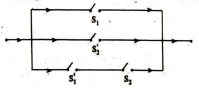
Find the symbolic form of the following switching circuit. Construct its switching table and interpret it.
Image
Answer
coming soon
View full question & answer
Question 162 Marks
Using truth table prove that : $\sim p \wedge q=(p \vee q) \wedge \sim p$
Answer
IIIIIIIVVVI
pq$\sim p$$\sim p \wedge q$$p \vee q$$(p \vee q) \wedge \sim p$
TTFFTF
TFFFTF
FTTTTT
FFTFFF

From column (IV) and (VI), we get
∴ ∼p ˄ q ≡ (p ˅ q) ˄ ∼p

View full question & answer
Question 172 Marks
Write the dual of the following statement :
(1) $(p \vee q) \wedge T$
(2) Madhuri has curly hair and brown eyes.
Answer

(1) Dual of (p ∨ q) ∧ T is (p ∧ q) ∨ F
(2) Dual of Madhuri has curly hair and brown eyes is “Madhuri has curly hair or brown eyes”.

View full question & answer
Question 182 Marks
Write down the following statements in symbolic form :
(a) A triangle is equilateral if and only if it is equiangular.
(b) Price increases and demand falls.
Answer

(a) p ≡ A triangle is equilateral & q ≡ A traingle is equiangular
∴Symbolic form p↔q
(b) Let p ≡ Price increases & q≡Demand falls
∴ Symbolic form p ∧ q

View full question & answer
Question 192 Marks
Write the dual of each of the following statements :
(a) $\sim p \wedge( q \vee c )$
(b) "Shweta is a doctor or Seema is a teacher."
Answer
coming soon
View full question & answer
Question 202 Marks
Write the, negations of the following statements:
(a) $\forall n \in N , n+7>6$
(b) The kitchen is neat and tidy
Answer

(a). $\exists n \in N$ such that $n+7 \leq 6$
(b) The kitchen is not neat or it is not tidy.

View full question & answer
Question 212 Marks
If $p, q, r$ are the statements with truth values T, F, T, respectively then find the truth value of
$(r \wedge q) \leftrightarrow \sim p$
Answer

(r ∧ q) ↔ ∼ p
≡ (T ∧ F) ↔ ∼T
≡(T ∧ F) ↔ F [1]
≡ F ↔ F
≡ T
Hence, the truth value is ‘T’

View full question & answer
MCQ 222 Marks
Inverse of the statement pattern $(p \vee q) \rightarrow(p \wedge q)$ is
  • A
    $(p \wedge q) \rightarrow(p \vee q)$
  • B
    $\sim(p \vee q) \rightarrow(p \wedge q)$
  • C
    $(\sim p \vee \sim q) \rightarrow(\sim p \wedge \sim q)$
  • D
    $(\sim p \wedge \sim q) \rightarrow(\sim p \vee \sim q)$
Answer

(D) (∼ p ∧ ∼ q) → (∼ p ∨ ∼ q)
statement pattern: (p ∨ q ) → ( p ∧ q)
Its inverse is
~ (p ∨ q ) → ~ ( p ∧ q)
≡ (∼ p ∧ ∼ q) → (∼ p ∨ ∼ q)

View full question & answer
Solve the Following Question.(2 Marks) - Maths STD 12 Science Questions - Vidyadip