MCQ 11 Mark
If $A = \{1, 2, 3, 4, 5\}$ then which of the following is not true?
- A
$Ǝ x \in A$ such that $x + 3 = 8$
- B
$Ǝ x \in A$ such that $x + 2 < 9$
- ✓
$Ɐ x \in A, x + 6 \geq 9$
- D
$Ǝ x \in A$ such that $x + 6 < 10$
AnswerCorrect option: C. $Ɐ x \in A, x + 6 \geq 9$
$Ǝ x \in A, x + 6 \geq 9.$
View full question & answer→MCQ 21 Mark
The negation of p ∧ (q → r) is ________.
MCQ 31 Mark
The negation of inverse of ~p → q is ________.
MCQ 41 Mark
If p ∧ q is F, p → q is F then the truth values of p and q are ________.
MCQ 51 Mark
Inverse of statement pattern (p ∨ q) → (p ∧ q) is ________.
MCQ 61 Mark
(p ∧ q) → r is logically equivalent to ________.
Answer p → (q → r) [Hint: Use truth table.]
View full question & answer→MCQ 71 Mark
If p ∧ q is false and p ∨ q is true, the ________ is not true.
MCQ 82 Marks
The negative of the statement $(p \wedge q) \rightarrow(-p \vee r)$ is
AnswerCorrect option: B. $p \wedge q \wedge \sim r$
(b) : We know that negation for $P \rightarrow Q$ is $P \wedge \sim Q$
$\therefore \quad$ Negation of $(p \wedge q) \rightarrow(\sim p \vee r)$ is
$
\begin{aligned}
& =(p \wedge q) \wedge \sim(\sim p \vee r) \\
& =p \wedge q \wedge p \wedge \sim r=p \wedge q \wedge \sim r
\end{aligned}
$
View full question & answer→MCQ 92 Marks
If the statement $p \leftrightarrow(q \rightarrow p)$ is false, then true statement/statement pattern is
- A
$p$
- ✓
$p \rightarrow(p \vee \sim q)$
- C
$p \wedge(\sim p \wedge q)$
- D
$(p \vee \sim q) \rightarrow p$
AnswerCorrect option: B. $p \rightarrow(p \vee \sim q)$
| $p$ |
$q$ |
$\sim q$ |
$ (p∨\sim q)$ |
$p \rightarrow(p \vee \sim q)$ |
$\sim p$ |
$(\sim p \wedge q)$ |
$p \wedge(\sim p \wedge q)$ |
$(p \vee \sim q) \rightarrow p$ |
| $T$ |
$T$ |
$F$ |
$T$ |
$T$ |
$F$ |
$F$ |
$F$ |
$T$ |
| $T$ |
$F$ |
$T$ |
$T$ |
$T$ |
$F$ |
$F$ |
$F$ |
$T$ |
| $F$ |
$T$ |
$F$ |
$F$ |
$T$ |
$T$ |
$T$ |
$F$ |
$T$ |
$\therefore p\rightarrow (p∨\sim q)$ is true statement. View full question & answer→MCQ 102 Marks
The statement $[p \wedge(q \vee r)] \vee[\sim r \wedge \sim q \wedge p]$ is equivalent to
- A
$\sim r$
- ✓
$p$
- C
$\sim q$
- D
$q$
Answer(b) :
| p | q | r | q v r | p^(q v r) |
| T | T | T | T | T |
| T | T | F | T | T |
| T | F | T | T | T |
| T | F | F | F | F |
| F | T | T | T | F |
| F | T | F | T | F |
| F | F | T | T | F |
| F | F | F | F | F |
| ∼r | ∼q | (∼r)^(∼q) | (∼r)^(∼q)^(∼p) | p^(q v r)v(∼r^∼q^p |
| F | F | F | F | T |
| T | F | F | F | T |
| F | T | F | F | T |
| T | T | T | T | T |
| F | F | F | F | F |
| T | F | F | F | F |
| F | T | F | F | F |
| T | T | T | F | F |
which is equivalent to p
View full question & answer→MCQ 112 Marks
The negation of the statement "The number is an odd number if and only if it is divisible by 3 ".
- ✓
The number is an odd number but not divisible by 3 or the number is divisible by 3 but not odd.
- B
The number is not an odd number iff it is not divisible by 3 .
- C
The number is not an odd number but it is divisible by 3 .
- D
The number is not an odd number or is not divisible by 3 but the number is divisible by 3 or odd.
AnswerCorrect option: A. The number is an odd number but not divisible by 3 or the number is divisible by 3 but not odd.
(a) : The number is an odd number but not divisible by 3 or the number is divisible by 3 but not odd.
View full question & answer→MCQ 122 Marks
The statement $[(p \rightarrow q) \wedge \sim q] \rightarrow r$ is a tautology, when $r$ is equivalent to
- A
$p \wedge \sim q$
- B
$q \vee p$
- C
$p \wedge q$
- D
Answer$\begin{aligned} & ( d ):[(p \rightarrow q) \wedge \sim q] \rightarrow r \\ \equiv & {[(\sim p \vee q) \wedge \sim q] \rightarrow r } \\ \equiv & {[(\sim p \wedge(\sim q) \vee(q \wedge(\sim q))] \rightarrow r} \\ \equiv & {[[(\sim p) \wedge(\sim q) \vee \phi] \rightarrow r \equiv((\sim p) \wedge(\sim q)) \rightarrow r} \\ \equiv & (\sim(\sim p \wedge(\sim q))) \vee r \equiv(p \vee q) \vee r\end{aligned}$
| p | q | $p \vee q$ | $\sim q$ | $(p \vee q) \vee(\sim q)$ |
| T | T | T | F | T |
| T | T | T | F | T |
| T | F | T | T | T |
| T | F | T | T | T |
| F | T | T | F | T |
| F | T | T | F | T |
| F | F | F | T | T |
| F | F | F | T | T |
$\Rightarrow(p \vee q) \vee(\sim q)$ is a tautology, so $r$ must be equivalent to $\sim q$.
View full question & answer→MCQ 132 Marks
If $p: A$ man is happy, $q: A$ man is rich, then the symbolic form of A man is neither happy nor rich is
- ✓
$\sim(p \vee q)$
- B
$p \wedge q$
- C
$-p \vee-q$
- D
$\sim p \wedge q$
AnswerCorrect option: A. $\sim(p \vee q)$
(a) : Given, $p$ : A man is happy
$\sim p$ : A man is not happy
$q:$ A man is rich
$\sim q$ : A man is not rich
Then symbolic form of A man is nether happy nor rich is; $\sim(p \vee q)$
View full question & answer→MCQ 142 Marks
If $(p \wedge \sim r) \rightarrow(\sim p \vee q)$ has truth value ' $F$ ', then truth values of $p, q$ and $r$ respectively
Answer(b) : Truth table is
| p | q | r | $\sim p$ | $\sim r$ | $p \wedge \sim r$ | $\sim p \vee q$ | $(p \wedge \sim r) \rightarrow(\sim p \vee q)$ |
| T | T | T | F | F | T | F | T |
| T | T | F | F | T | T | F | T |
| T | F | T | F | F | T | T | T |
| T | F | F | F | T | T | T | T |
| F | T | T | T | F | T | F | T |
| F | T | F | T | T | T | F | T |
| F | F | T | T | F | F | T | T |
| F | F | F | T | T | F | T | T |
So, truth values of p, q and r are T, F, F respectively. View full question & answer→MCQ 152 Marks
If $p \rightarrow(p \sim q)$ is false, then the truth values of $p$ and $q$ are respectively
- ✓
$T , T$
- B
$T, F$
- C
$F, F$
- D
$F , T$
AnswerCorrect option: A. $T , T$
| $p$ |
$q$ |
$\sim q$ |
$(p\sim q)$ |
$p \rightarrow (p \vee q)$ |
| $T$ |
$T$ |
$F$ |
$F$ |
$F$ |
| $F$ |
$T$ |
$F$ |
$F$ |
$T$ |
| $T$ |
$F$ |
$T$ |
$T$ |
$T$ |
| $F$ |
$F$ |
$T$ |
$F$ |
$T$ |
When $p \rightarrow ( p \sim q )$ is false then $p = T$ and $q = T .$ View full question & answer→MCQ 162 Marks
Negation of a statement 'If $\forall x, x$ is a complex number then $x^2<0^3$' is
- ✓
$\exists x, x$ is not a complex number and $x^2 \geq 0$
- B
$\forall x, x$ is a complex number and $x^2<0$.
- C
$\exists x, x$ is a not complex number and $x^2<0$
- D
$\forall x, x$ is a complex number and $x^2 \geq 0$
AnswerCorrect option: A. $\exists x, x$ is not a complex number and $x^2 \geq 0$
(a) $\exists x, x$ is not a complex number and $x^2 \geq 0$
View full question & answer→MCQ 172 Marks
The negation of the proposition $(\sim p \wedge \sim q) \vee$ $(p \wedge \sim q)$ is
- A
$(p \wedge q) \vee(\sim p \wedge q)$
- B
$(p \vee q) \wedge(\sim p \vee q)$
- C
$(p \vee q) \vee \sim(p \wedge q)$
- D
$-(p \vee q) \wedge(-p \vee q)$
View full question & answer→MCQ 182 Marks
The compound proposition $(p \wedge q) \rightarrow p$ is
Answer| p | q | p^q | $(p \wedge q) \rightarrow p$ |
| T | T | T | T |
| T | F | F | T |
| F | T | F | T |
| F | F | F | T |
Hence, it is a tautology View full question & answer→MCQ 192 Marks
The statement pattern $(p \wedge q) \wedge[\sim r \vee(p \wedge q)] \vee(\sim p \wedge q)$ is equivalent to
View full question & answer→MCQ 202 Marks
The equivalent form of the statement $\sim(p \rightarrow \sim q)$ is
- ✓
$p \wedge q$
- B
$p \wedge \sim q$
- C
$p \vee \sim q$
- D
$\sim p \vee q$
AnswerCorrect option: A. $p \wedge q$
(a) : We have, $\sim(p \rightarrow \sim q) \equiv \sim(\sim p \vee \sim q) \equiv p \wedge q$
View full question & answer→MCQ 212 Marks
Which of the following is NOT equivalent to $p \rightarrow q$.
AnswerCorrect option: C. $q$ only if $p$
(c) $q$ only if $p$
View full question & answer→MCQ 222 Marks
Which of the following statement is contingency?
AnswerCorrect option: C. $(p \vee q) \wedge \sim q$
| $p$ |
$q$ |
|
|
|
|
|
|
$p \rightarrow(p \vee q)$ |
| $T$ |
$T$ |
$F$ |
$F$ |
$T$ |
$T$ |
$T$ |
$F$ |
$T$ |
| $T$ |
$F$ |
$F$ |
$T$ |
$T$ |
$T$ |
$T$ |
$T$ |
$T$ |
| $F$ |
$T$ |
$T$ |
$F$ |
$T$ |
$T$ |
$T$ |
$F$ |
$T$ |
| $F$ |
$F$ |
$T$ |
$T$ |
$F$ |
$T$ |
$T$ |
$F$ |
$T$ |
View full question & answer→MCQ 232 Marks
The negation of " $\forall n \in N, n+7>6$ " is
- ✓
$\exists n \in N$, such that $n+7 \leq 6$
- B
$\exists n \in N$, such that $n+7 \geq 6$
- C
$\forall n \in N, n+7 \leq 6$
- D
$\exists n \in N$, such that $n+7<6$
AnswerCorrect option: A. $\exists n \in N$, such that $n+7 \leq 6$
(a): The negation of given statement is $" \exists n \in N$, such that $n+7 \leq 6$ ".
View full question & answer→MCQ 242 Marks
If $p$ and $q$ are true and $r$ and $s$ are false statements, then which of the following is true?
- A
$(q \wedge r) \vee(\sim p \wedge s)$
- B
$(-p \rightarrow q) \leftrightarrow(r \wedge s)$
- ✓
$(p \rightarrow q) \vee(r \leftrightarrow s)$
- D
$(p \wedge \sim r) \wedge(\sim q \vee s)$
AnswerCorrect option: C. $(p \rightarrow q) \vee(r \leftrightarrow s)$
(c) : We have, $p, q$ are true and $r, s$ are false.
(a) $( T \wedge F ) \vee( F \wedge F )= F \vee F = F$
(b) $( F \rightarrow T ) \leftrightarrow( F \wedge F )= T \leftrightarrow F = F$
(c) $( T \rightarrow T ) \vee( F \leftrightarrow F )= T \vee T = T$
(d) $( T \wedge T ) \wedge( F \vee F )= T \wedge F = F$
View full question & answer→MCQ 252 Marks
The statement pattern $p \wedge(\sim p \wedge q)$ is
Answer(b) : $p \wedge(\sim p \wedge q)=(p \wedge \sim p) \wedge q$ $=F \wedge q=F$ i.e. contradiction.
View full question & answer→MCQ 262 Marks
The contrapositive of the statement: "If the weather is fine then my friends will come and we go for a picnic."
- A
The weather is fine but my friends will not come or we do not go for a picnic
- ✓
If my friends do not come or we do not go for pienic then weather will not be fine
- C
If the weather is not fine then my friends will not come or we do not go for a picnic
- D
The weather is not fine but my friends will come and we go for a picnic
AnswerCorrect option: B. If my friends do not come or we do not go for pienic then weather will not be fine
(b) : Contrapositive of given statement is : If my friends do not come or we do not go for picnic then weather will not be fine.
View full question & answer→MCQ 272 Marks
The negation of the statement: ${ }^{\circ}$ Getting above $95 \%$ marks is necessary condition for Hema to get the admission in good college".
- A
Hema gets above $95 \%$ marks but she does not get the admission in good college
- ✓
Hema does not get above $95 \%$ marks and she gets admission in good college
- C
If Hema does not get above $95 \%$ marks then she will not get the admission in good college
- D
Hema does not get above $95 \%$ marks or she gets the admission in good college
AnswerCorrect option: B. Hema does not get above $95 \%$ marks and she gets admission in good college
(b) : Negation of given statement is ; Hema does not get above $95 \%$ marks and she gets admission in good college
View full question & answer→MCQ 282 Marks
Which of the following statement pattern is a tautology?
- A
$p \vee(q \rightarrow p)$
- B
$\sim q \rightarrow \sim p$
- C
$(q \rightarrow p) \vee(\sim p \leftrightarrow q)$
- D
$p \wedge \sim p$
View full question & answer→MCQ 292 Marks
If $c$ denotes the contradiction, then dual of the compound statement $\sim p \wedge(q \vee c)$ is
AnswerCorrect option: A. $\sim p \vee(q \wedge t)$
(a) : Dual of $\sim p \wedge(q \vee c)$ is $\sim p \vee(q \wedge t)$
View full question & answer→MCQ 302 Marks
The statement pattern $(\sim p \wedge q)$ is logically equivalent to
- A
$(p \vee q) \vee \sim p$
- B
$(p \vee q) \wedge \sim p$
- C
$(p \wedge q) \rightarrow p$
- D
$(p \vee q) \rightarrow p$
Answer
$
\begin{aligned}
& \text { (b) : }(p \vee q) \wedge \sim p \\
& \equiv(p \wedge \sim p) \vee(q \wedge \sim p) \\
& \equiv F \vee(q \wedge \sim p) \equiv q \wedge \sim p \equiv \sim p \wedge q
\end{aligned}
$
View full question & answer→MCQ 312 Marks
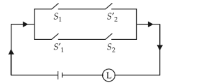
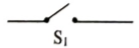
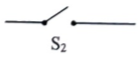
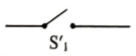
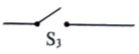
Symbolic form of the given switching circuit is equivalent to
- A
$p \vee \sim q$
- B
$p \wedge \sim q$
- C
$p \leftrightarrow q$
- ✓
Answer(d) : Let $p$ : Switch $S _1$ is closed
$q$ : Switch $S_2$ is closed
$\sim p$ : Switch $S_1$ is closed
$\sim q$ : Switch $S_2$ is closed
Symbolic form of the given circuit is
$
(p \wedge \sim q) \vee(-p \wedge q) \equiv \sim(p \leftrightarrow q)
$
View full question & answer→MCQ 322 Marks
Which of the following quantified statement is true?
- A
The square of every real number is positive
- B
There exists a real number whose square is negative
- ✓
There exists a real number whose square is not positive
- D
Every real number is rational
AnswerCorrect option: C. There exists a real number whose square is not positive
(c) There exists a real number whose square is not positive
View full question & answer→MCQ 332 Marks
If $p$ : Every square is a rectangle
$q$ : Every rhombus is a kite then truth values of $p \rightarrow q$ and $p \leftrightarrow q$ are ________ and ________ respectively.
View full question & answer→MCQ 342 Marks
Consider the following statements $P$ : Suman is brilliant $Q$ : Suman is rich $R$ : Suman is honest The negation of the statement "Suman is brilliant and dishonest if and only if Suman is rich" can be expressed as
- A
$\sim Q \leftrightarrow \sim P \wedge R$
- B
$\sim(P \wedge \sim R) \leftrightarrow Q$
- C
$\sim P \wedge(Q \leftrightarrow \sim R)$
- ✓
$\sim(Q \leftrightarrow(P \wedge \sim R))$
AnswerCorrect option: D. $\sim(Q \leftrightarrow(P \wedge \sim R))$
(d) : The statement can be written as
$
(P \wedge \sim R) \leftrightarrow Q
$
Thus the negation is
$
\sim(Q \leftrightarrow(P \wedge \sim R))
$
View full question & answer→MCQ 352 Marks
The negation of the statement
"If I become a teacher, then I will open a school", is
- A
Neither I will become a teacher nor I will open a school.
- B
I will not become a teacher or I will open a school.
- ✓
I will become a teacher and I will not open a school.
- D
Either I will not become a teacher or I will not open a school.
AnswerCorrect option: C. I will become a teacher and I will not open a school.
(c) : The given statement is
"If I become a teacher, then I will open a school" Negation of the given statement is "I will become a teacher and I will not open a school" $(\because \sim(p \rightarrow q)=p \wedge \sim q)$
View full question & answer→MCQ 362 Marks
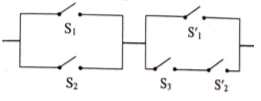
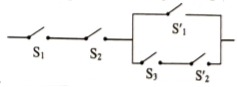
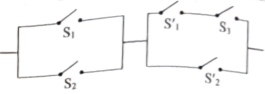
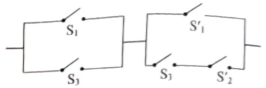
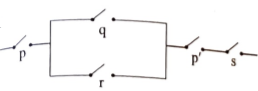
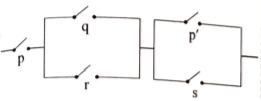
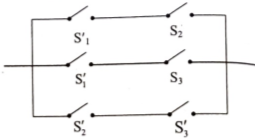
The simplified circuit for the following circuit is
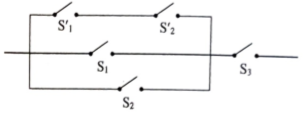
MCQ 372 Marks
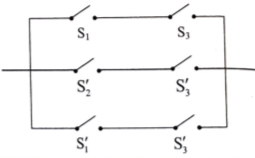
The simplified circuit for the following circuit is
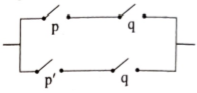
MCQ 382 Marks
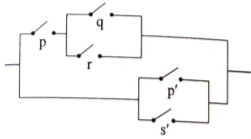
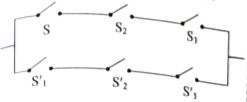
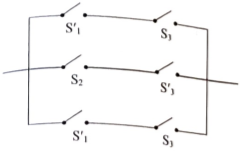
The symbolic form of logic for the following circuit is
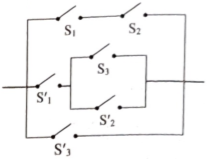
- A
$(p \vee q) \wedge(\sim p \wedge r \vee \sim q) \vee \sim r$
- B
$(p \wedge q) \wedge(\sim p \vee r \wedge \sim q) \vee \sim r$
- C
$(p \wedge q) \vee[\sim p \wedge(r \vee \sim q)] \vee \sim r$
- D
$(p \vee q) \wedge[\sim p \vee(r \wedge \sim q)] \vee \sim r$
View full question & answer→MCQ 392 Marks
The switching circuit for the symbolic form $(p \vee q) \wedge[\sim p \vee(r \wedge \sim q)]$ is
View full question & answer→MCQ 402 Marks
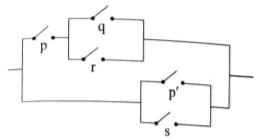
The switching circuit for the statement $[p \wedge(q \vee r)] \vee(\sim p \vee s)$ is
View full question & answer→MCQ 412 Marks
If the symbolic form is $(p \wedge r) \vee(\sim q \wedge \sim r) \vee(\sim p \wedge \sim r)$ then switching circuit is
View full question & answer→MCQ 422 Marks
The negation of the statement, $\exists x \in \mathrm{R}$, such that $x^2+3>0$, is.
- A
$\exists x \in \mathrm{R}$, such that $x^2+3<0$
- B
$\forall x \in \mathrm{R}, x^2+3>0$
- C
$\forall x \in R \cdot x^2+3<0$
- D
$\exists x \in \mathrm{R}$, such that $x^2+3=0$
View full question & answer→MCQ 432 Marks
The negation of the statement "If Saral Marn does not reduce the prices, I will not shop there any more" is
- A
Saral Mart reduces the prices and still I will shop there.
- B
Saral Mart reduces the prices and I will not shop there.
- C
Saral Mart does not reduce the prices and still I will shop there.
- D
Saral Mart does not reduce the prices or I will shop there.
View full question & answer→MCQ 442 Marks
The negation of the proposition "If 2 is prime then 3 is odd" is
- A
If 2 is not prime, then 3 is not odd.
- B
2 is prime and 3 is not odd.
- C
2 is not prime and 3 is odd.
- D
If 2 is not prime then 3 is odd.
View full question & answer→MCQ 452 Marks
Which of the following is logically equivalent to $\sim[p \rightarrow(p \vee \sim q)]$ ?
- A
$p \vee(\sim p \wedge q)$
- B
$p \wedge(\sim p \wedge q)$
- C
$p \wedge(p \vee \sim q)$
- D
$p \vee(p \wedge \sim q)$
View full question & answer→MCQ 462 Marks
For any two statements P and q, the negation of the expression $p \vee(-p \wedge q)$ is:
- A
$\sim p \vee \sim q$
- B
$p \leftrightarrow q$
- C
$p \wedge q$
- D
$\sim p \wedge \sim q$
View full question & answer→MCQ 472 Marks
The Boolean expression $\sim(p \rightarrow \sim q)$ is equivalent to:
- A
$p \wedge q$
- B
$(\sim p) \rightarrow q$
- C
$q \rightarrow \sim p$
- D
$p \vee q$
View full question & answer→MCQ 482 Marks
The negation of the Boolean expression $\sim s \vee(\sim r \wedge s)$ is equivalent to:
- A
$\sim S \wedge \sim r$
- B
- C
$s \wedge r$
- D
$S \vee r$
View full question & answer→MCQ 492 Marks
The negation of $p \vee(\sim q \wedge \sim p)$ is
- ✓
$\sim p \wedge q$
- B
$\mathrm{p} \vee \sim \mathrm{q}$
- C
$\sim \mathrm{p} \wedge \sim \mathrm{q}$
- D
$\sim \mathrm{p} \vee \sim \mathrm{q}$
AnswerCorrect option: A. $\sim p \wedge q$
(A)
$\sim[p \vee(\sim q \wedge \sim p)]$
$\equiv \sim p \wedge \sim(\sim q \wedge \sim p ) \quad \ldots$ [De Morgan's law]
$\equiv \sim p \wedge[\sim(\sim q) \vee \sim(\sim p)]$
$\equiv \sim p \wedge(q \vee p)$
$\equiv(\sim p \wedge q ) \vee(\sim p \wedge p ) \ldots[$ Distributive law]
$\equiv(\sim p \wedge q ) \vee F \quad \ldots[$ Complement law $]$
$
\equiv \sim p \wedge q
$ ...[Identity law]
View full question & answer→MCQ 502 Marks
The Boolean expression sim$\sim(p \vee q) \vee(\sim p \wedge q)$ is equivalent to
- A
- B
- C
$\sim \mathrm{q}$
- ✓
$\sim \mathrm{p}$
AnswerCorrect option: D. $\sim \mathrm{p}$
(D)
$\sim(p \vee q) \vee(\sim p \wedge q)$
$\equiv(\sim p \wedge \sim q) \vee(\sim p \wedge q) \ldots[$ De Morgan's law]
$\equiv \sim p \wedge(\sim q \vee q) \quad \ldots[$ Distributive law $]$
$\equiv \sim p \wedge T \quad \ldots[$ Complement law $]$
$\equiv \sim p \quad \ldots$ [Identity law]
View full question & answer→