Questions

Solve the Following Question.(4 Marks)

Take a timed test

18 questions · self-marked practice — reveal the answer and mark yourself.

Question 14 Marks
In $\triangle A B C$ with usual notations, prove that $\frac{a}{\sin A}=\frac{b}{\sin B}=\frac{c}{\sin C}=2 R$ where $R$ is the circumradius of $\triangle ABC$.
Answer
To prove : $\frac{a}{\sin A}=\frac{b}{\sin B}=\frac{c}{\sin C}=2 R$
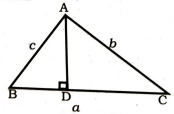
Let $AD$ be perpendicular to $BC$.
Image
$\operatorname{Sin} C =\frac{ AD }{ b } \text {. }$
$\therefore AD =b \sin C$
$\therefore A (\triangle ABC )=\frac{1}{2} BC \times AD$
$=\frac{1}{2} a \times b \sin C$
$=\frac{1}{2} a b \sin C$
$\therefore 2 A (\triangle ABC )=a b \sin C$
Similarly : $2 A (\triangle ABC )=a c \sin B =b c \sin A$
$\therefore b c \sin A =a c \sin B =a b \sin C$
Dividing by $a b c$
$\frac{\sin A}{a}=\frac{\sin B}{b}=\frac{\sin C}{c}$
$\therefore \frac{a}{\sin A}=\frac{b}{\sin B}=\frac{c}{\sin C} \ldots .(1)$
To prove each ratio is equal to $2 R$.
Since the sum of angles of a triangle is $180^{\circ}$, at least one of the angle of $\triangle ABC$ is not a right angle.
Suppose $A$ is not right angle.
Image
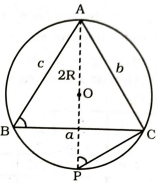
Draw diameter $AP$ through $A$.
Let it meets the circle in $P$.
$\therefore AP =2 R$ and $\triangle ACP$ is a right angled triangle at $C$.
Also $m \angle ABC = m \angle APC\ ($angles in same arc$)$
$\therefore \sin B =\operatorname{Sin} P =\frac{b}{ AP }=\frac{b}{2 R }$
$\therefore \sin B =\frac{b}{2 R }, $
$\therefore \frac{b}{\sin B }=2 R ....(2)$
$\therefore$ From $(1)$ and $(2)$ :
$\frac{a}{\sin A}=\frac{b}{\sin B}=\frac{c}{\sin C}=2 R$
View full question & answer
Question 24 Marks
If $\tan ^{-1}\left(\frac{x-1}{x-2}\right)+\cot ^{-1}\left(\frac{x+2}{x+1}\right)=\frac{\pi}{4}$; find $x$.
Answer

Given, $\tan ^{-1}\left(\frac{x-1}{x-2}\right)+\cot ^{-1}\left(\frac{x+2}{x+1}\right)=\frac{\pi}{4}$
$\tan ^{-1}\left(\frac{x-1}{x-2}\right)+\tan ^{-1}\left(\frac{x+1}{x+2}\right)=\frac{\pi}{4}$;
$\tan ^{-1}\left(\frac{x-1}{x-2}\right)=\frac{\pi}{4}-\tan ^{-1}\left(\frac{x+1}{x+2}\right)$
$=\tan ^{-1}(1)-\tan ^{-1}\left(\frac{x+1}{x+2}\right)$
$=\tan ^{-1}\left[\frac{1-\frac{x+1}{x+2}}{1+\frac{x+1}{x+2}}\right] \ldots \ldots \ldots .\left[\because \tan ^{-1} x-\tan ^{-1} y=\tan ^{-1}\left(\frac{x-y}{1+x y}\right)\right]$
$=\tan ^{-1}\left[\frac{x+2-x-1}{x+2+x+1}\right]$
$\tan ^{-1}\left(\frac{x-1}{x-2}\right)=\tan ^{-1}\left(\frac{1}{2 x+3}\right)$
$\frac{x-1}{x-2}=\frac{1}{2 x+3}$
$(x-1)(2 x+3)=x-2$
$2 x^2-1=0$
$2 x^2=1$
$x^2=\frac{1}{2}$
$x= \pm \frac{1}{\sqrt{2}}$

View full question & answer
Question 34 Marks
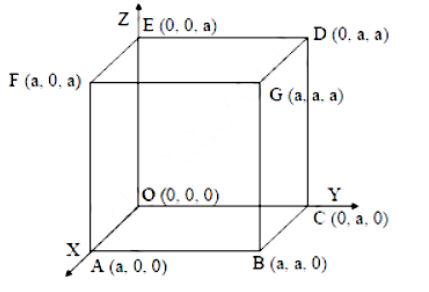
Show that the angle between any two diagonals of a cube is $\cos ^{-1}\left(\frac{1}{3}\right)$
Answer

Image

Let ‘a’ be the edge of the cube with one vertex at the origin.
The diagonals of the cube are OG, AD, CF and EB.
Consider the diagonals OG and AD.
The d.r.s of OG are
a - 0, a - 0, a - 0 = a, a, a
The d.r.s of AD are
0 - a, a -0, a -0 = a, a, a [1]
Let θ be the angle between OG and AD
$\cos \theta=\frac{a(-a)+a(a)+a(a)}{\sqrt{a^2+a^2+a^2} \cdot \sqrt{(-a)^2+a^2+a^2}}$
$=\frac{a^2}{3 a^2}$
$\cos \theta=\frac{1}{3}$
$\theta=\cos ^{-1}\left(\frac{1}{3}\right)$

View full question & answer
Question 44 Marks
In $\triangle ABC$, prove that : $\tan \frac{( A - B )}{2}=\left(\frac{a-b}{a+b}\right) \cdot \cot \frac{ C }{2}$
Answer

In ΔABC by sine rule, we have
$\frac{a}{\sin A}=\frac{b}{\sin B}=\frac{c}{\sin C}= k$
∴ a = k sin A, b = k sin B and c = k sin C
Now, consider
$\frac{a-b}{a+b}=\frac{k \sin A-k \sin B}{k \sin A+k \sin B}$
$=\frac{\sin A-\sin B}{\sin A+\sin B}$
$=\frac{2 \cos \left(\frac{A+B}{2}\right) \sin \left(\frac{A-B}{2}\right)}{2 \sin \left(\frac{A+B}{2}\right) \cos \left(\frac{A-B}{2}\right)}$
$=\cot \left(\frac{A+B}{2}\right) \cdot \tan \left(\frac{A-B}{2}\right)$
$=\cot \left(\frac{\pi}{2}-\frac{C}{2}\right) \cdot \tan \left(\frac{A-B}{2}\right) \ldots \ldots[\because A + B + C =\pi]$
$=\tan \left(\frac{C}{2}\right) \tan \left(\frac{A-B}{2}\right)$
$\therefore \frac{a-b}{a+b}=\tan \frac{C}{2} \cdot \tan \left(\frac{A-B}{2}\right)$
$\therefore \tan \left(\frac{A-B}{2}\right)=\frac{a-b}{a+b} \cot \left(\frac{C}{2}\right)$

View full question & answer
Question 54 Marks
Find the general solution of : $\sin x \tan x=\tan x-\sin x+1$.
Answer

sinx · tanx = tanx - sinx + 1
$\sin x \cdot\left(\frac{\sin x}{\cos x}\right)-1=\frac{\sin x}{\cos x}-\sin x$
$\frac{\sin ^2 x-\cos x}{\cos x}=\frac{\sin x-\sin x \cdot \cos x}{\cos x}$
$\sin ^2 x-\cos x=\sin x-\sin x \cdot \cos x$
now $x$ can't equal to $\frac{\pi}{2}$
$\sin ^2 x-\cos x-\sin x+\sin x \cos x=0$
$\sin ^2 x+\sin x \cos x-\cos x-\sin x=0$
$\sin x(\sin x+\cos x)-1(\sin x+\cos x)=0$
$(\sin x-1)(\sin x+\cos x)=0$
since $x$ is not $\frac{\pi}{2}$
$\sin x+\cos x=0$
$\sin x=-\cos x$
$x=$ multiple of $\frac{\pi}{4}$ in even quads.

View full question & answer
Question 64 Marks
Prove that : $\sin ^{-1}\left(-\frac{1}{2}\right)+\cos ^{-1}\left(-\frac{\sqrt{3}}{2}\right)=\cos ^{-1}\left(-\frac{1}{2}\right)$
Answer
coming soon
View full question & answer
Question 74 Marks
In $\triangle ABC$, if $a+b+c=2 s$, then prove that $\sin \left(\frac{A}{2}\right)=\sqrt{\frac{(s-b)(s-c)}{b c}}$, with usual notations.
Answer
coming soon
View full question & answer
Question 84 Marks
Prove that : $\sin ^{-1}\left(\frac{3}{5}\right)+\cos ^{-1}\left(\frac{12}{13}\right)=\sin ^{-1}\left(\frac{56}{65}\right)$
Answer

Let $\cos ^{-1} \frac{12}{13}=x$
$\therefore \cos x=\frac{12}{13}$
$\therefore \sin x=\frac{5}{13}$
and let $\sin ^{-1} \frac{3}{5}=y$
$\sin y=\frac{3}{5}$
$\therefore \cos y=\frac{4}{5}$
∴ using sin (x + y) = sin x cos y + cos x sin y
$=\frac{5}{13} \times \frac{4}{5}+\frac{12}{13} \times \frac{3}{5}$
$=\frac{20+36}{13 \times 5}$
$=\frac{56}{65}$
$\therefore x+y=\sin ^{-1} \frac{56}{65}$
$\cos ^{-1} \frac{12}{13}+\sin ^{-1} \frac{3}{5}=\sin ^{-1} \frac{56}{65}$
Hence proved.

View full question & answer
Question 94 Marks
In $\triangle ABC$, prove that $\tan \left(\frac{ C - A }{2}\right)=\left(\frac{c-a}{c+a}\right) \cot \frac{ B }{2}$
Answer
coming soon
View full question & answer
Question 104 Marks
In $\triangle ABC$ with the usual notations prove that $(a-b)^2 \cos ^2\left(\frac{ C }{2}\right)+(a+b)^2 \sin ^2\left(\frac{ C }{2}\right)=c^2$
Answer

$LHS =(a-b)^2 \cos ^2\left(\frac{C}{2}\right)+(a+b)^2 \sin ^2\left(\frac{C}{2}\right)$
$=a^2\left[\cos ^2\left(\frac{C}{2}\right)+\sin ^2\left(\frac{C}{2}\right)\right]+b^2\left[\cos ^2\left(\frac{C}{2}\right)+\sin ^2\left(\frac{C}{2}\right)\right]-2 a b\left[\cos ^2\left(\frac{C}{2}\right)-\sin ^2\left(\frac{C}{2}\right)\right]$
$=a^2+b^2-a^2-b^2+c^2$
$=c^2$
=RHS
Hence proved

View full question & answer
Question 124 Marks
Find the general solution of : $\cos x-\sin x=1$.
Answer

cos x - sin x = 1
Dividing by $\sqrt{1^2+(-1)}=\sqrt{2}$
$\frac{1}{\sqrt{2}} \cos x-\frac{1}{\sqrt{2}} \sin x=\frac{1}{\sqrt{2}}$
$\cos \frac{\pi}{4} \cos x -\sin \frac{\pi}{4} \sin x =\frac{1}{\sqrt{2}}$
$\cos \left( x +\frac{\pi}{4}\right)=\cos \frac{\pi}{4} \quad \ldots$ (i)
The general solution of $\cos \theta=\cos \alpha$ is $\theta=2 n \pi \pm \frac{\pi}{4} ; n \in z$
∴ The genera; solution of equation (i) given by 
$x +\frac{\pi}{4}=2 n \pi \pm \frac{\pi}{4} ; n \in z$
$x =2 n \pi ; x=2 n \pi-\frac{\pi}{2} ; n \in z$

View full question & answer
Question 134 Marks
In any $\triangle A B C$, if $a^2, b^2, c^2$ are in arithmetic progression, then prove that $\cot A,\cot B, \cot C$ are in arithmetic progression.
Answer
Given that $a^2 ,b^2 ,c^2$ are in arithmetic progression.
We need to prove that cot $A$, cot $B$ and cot $C$ are in
arithmetic progression.
$a^2 ,b^2 ,c^2$ are in $A.P$.
$-2 a^2,-2 b^2,-2 c^2$ are in $A.P$
$\left(a^2+b^2+c^2\right)-2 a^2,\left(a^2+b^2+c^2\right)-2 b^2,\left(a^2+b^2+c^2\right)-2 c^2$ are in $A.P$
$\left(b^2+c^2-a^2\right),\left(c^2+a^2-b^2\right),\left(a^2+b^2-c^2\right)$ are in $A.P$
$\frac{b^2+c^2-a^2}{2 a b c}, \frac{c^2+a^2-b^2}{2 a b c}, \frac{a^2+b^2-c^2}{2 a b c}$ are in $A.P$
$\frac{1}{a} \frac{b^2+c^2-a^2}{2 b c}, \frac{1}{b} \frac{c^2+a^2-b^2}{2 a c}, \frac{1}{c} \frac{a^2+b^2-c^2}{2 a b}$ are in $A.P$
$\frac{1}{a} \cos A, \frac{1}{b} \cos B, \frac{1}{c} \cos C$ are in $A.P$
$\frac{k}{a} \cos A, \frac{k}{b} \cos B, \frac{k}{c} \cos C$ are in $A.P$
$\frac{\cos A}{\sin A}, \frac{\cos B}{\sin B}, \frac{\cos C}{\sin C}$ are in $A.P$
$\cot A, \cot B, \cot C$ are in $A.P$
View full question & answer
Question 144 Marks
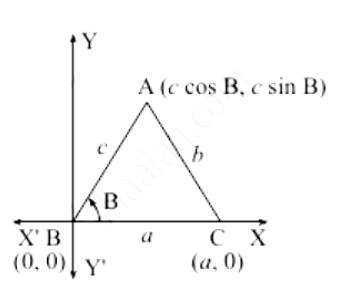
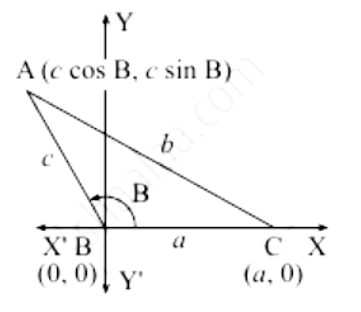
In any $\triangle ABC$, with usual notations, prove that $b^2=c^2+a^2-2 c a \cos B$.
Answer
Image
Image
Let us take the angle $B$ of$ \triangle ABC$ in standard position,
$i.e. B$ as origin, $X-$axis along the line $BC$ and the $Y-$axis perpendicular to the line $BC$.
In the two figures,$ \angle B$ is shown as acute in one and obtuse in the other.
$\because l(BC) = a$
$\therefore C ≡ (a, 0$)
Let $A ≡ (x, y)$
Since $l (BA) = c,$ we have
$\cos B =\frac{x}{c}$ and $\sin B =\frac{y}{c}$
$\therefore x = c \cos B$ and $y = c \sin B$
$\therefore A ≡ (c \cos B, c \sin B)$
$\therefore$ By the distance formula
$b^2 = AC^2 = (a – c \cos B)^2 + (0 – c \sin B)^2$
$= a^2 – 2ca \cos B + c^2 \cos^2B + c^2 \sin^2B$
$= c^2(\cos^2B + \sin^2B) + a^2 – 2ca \cos B$
$\therefore b^2 = c^2 + a^2 – 2ca \cos B.$
View full question & answer
Question 154 Marks
Show that : $\cos ^{-1}\left(\frac{4}{5}\right)+\cos ^{-1}\left(\frac{12}{13}\right)=\cos ^{-1}\left(\frac{33}{65}\right)$
Answer
Let $a=\cos ^{-1}\left(\frac{4}{5}\right)$ and $b=\cos ^{-1}\left(\frac{12}{13}\right)$
Let $a=\cos ^{-1}\left(\frac{4}{5}\right)$
$\cos a =\frac{4}{5}$
We know that
$\sin^2a = 1 - \cos^2a $
$\sin a=\sqrt{1-\cos ^2 a}$
$=\sqrt{1-\left(\frac{4}{5}\right)^2}=\sqrt{1-\frac{16}{25}}$
$=\sqrt{\frac{25-16}{25}}=\sqrt{\frac{9}{25}}=\frac{3}{5}$
Let $b=\cos ^{-1}\left(\frac{12}{13}\right)$
$\cos b=\frac{12}{13}$
We know that
$\sin ^2 b=1-\cos ^2 b$
$\sin b=\sqrt{1-\cos ^2 b}$
$=\sqrt{1-\left(\frac{12}{13}\right)^2}=\sqrt{1-\frac{144}{169}}$
$=\sqrt{\frac{169-144}{169}}=\sqrt{\frac{25}{169}}=\frac{5}{13}$
We know that
$\cos (a+b) = \cos$ a $\cos b - \sin a \sin b$
Putting values
$\cos a=\frac{4}{5}, \sin a=\frac{3}{5}$
$\ \cos b=\frac{12}{13}, \sin b=\frac{5}{13}$
$\cos (a+b)=\frac{4}{5} \times \frac{12}{13} \times \frac{3}{5} \times \frac{5}{13}$
$=\frac{48}{65}-\frac{3}{13}$
$=\frac{48-15}{65}$
$=\frac{33}{65}$
$\therefore \cos (a+b)=\frac{33}{65}$
$a+b=\cos ^{-1}\left(\frac{33}{65}\right)$
$\cos ^{-1} \frac{4}{5}+\cos ^{-1}\left(\frac{12}{15}\right)=\cos ^{-1}\left(\frac{33}{65}\right)$
Hence $\text{LH.S = R.H.S}$
Hence proved.
View full question & answer
Question 174 Marks
Find the general solution of $\sin 2 x+\sin 4 x+\sin 6 x=0$
Answer

$(\sin 2 x+\sin 6 x)+\sin 4 x=0$
$2 \sin 4 x \cdot \cos 2 x+\sin 4 x=0$
$\sin 4 x(2 \cos 2 x+1)=0$
$\sin 4 x=0$ or $2 \cos 2 x+1=0$
$\sin 4 x=0$ or $\cos 2 x=-\frac{1}{2}=-\cos \frac{\pi}{3}=\cos \left(\pi-\frac{\pi}{3}\right)$
Using $\sin x=0 \Rightarrow x=n \pi$
$\sin 4 x=0$
$4 x=n \pi$
The genral solution is $x$
$x=\frac{n \pi}{4}$
using $\cos x=\cos \alpha \Rightarrow x=2 m x \pm \alpha$
$\cos 2 x=\cos \left(\frac{2 \pi}{3}\right)$
$2 x=2 \mp i \pm \frac{2 \pi}{3}$
The genral solution is x
$x=\mp i \pm \frac{\pi}{3}$ where $m, n \in z$

View full question & answer
Question 184 Marks
The angles of the $\triangle ABC$ are in A.P. and $b: c=\sqrt{3}: \sqrt{2}$ then find $\angle A , \angle B , \angle C$.
Answer

$\angle A, \angle B, \angle C$ are in A.P and $b: c=\sqrt{3}: \sqrt{2}$
$\therefore 2 B=A+C$
$2 B=180^{\circ}-B \quad \ldots \ldots \ldots \ldots \ldots . .\left[\because A+B+C=180^{\circ}\right]$
$3 B=180^{\circ}$
$\angle B=60^{\circ}$
In ΔABC by sine rule, we have
$\frac{\sin B}{b}=\frac{\sin C}{c}$
$\frac{\sin B}{\sin C}=\frac{b}{c}$
$\frac{\sin 60^{\circ}}{\sin c}=\frac{\sqrt{3}}{\sqrt{2}}$
$\frac{\sqrt{3}}{2}=\frac{\sqrt{3}}{\sqrt{2}}=\sin C$
$\sin C=\frac{1}{\sqrt{2}}$
$\angle C=45^{\circ}$
$\angle A=180^{\circ}-60^{\circ}-45^{\circ}=75^{\circ}$
Thus, the angles of $\triangle ABC$ are $\angle A=75^{\circ}, \angle B=60^{\circ}, \angle C=45^{\circ}$

View full question & answer
Solve the Following Question.(4 Marks) - Maths STD 12 Science Questions - Vidyadip