MCQ 11 Mark
If any ∆ABC, if a cos B = b cos A, then the triangle is ________.
MCQ 21 Mark
If tan θ + tan 2θ + tan 3θ = tan θ∙tan 2θ∙tan 3θ, then the general value of the θ is _______.
AnswerCorrect option: B. $\frac{n \pi}{6}$
(b) $\frac{n \pi}{6}$[Hint: $\tan (A+B+C)=\frac{\tan A+\tan B+\tan C-\tan A \cdot \tan B \cdot \tan C}{1-\tan A \cdot \tan B-\tan B \cdot \tan C-\tan C-\tan A}$
Since , tan θ + tan 2θ + tan 3θ = tan θ ∙ tan 2θ ∙ tan 3θ, we get, tan (θ + 2θ + 3θ) = θ ∴ tan6θ = 0
$\left.\therefore 6 \theta=n \pi, \theta=\frac{n \pi}{6}.\right]$
View full question & answer→MCQ 31 Mark
$\cos \left[\tan ^{-1} \frac{1}{3}+\tan ^{-1} \frac{1}{2}\right]=$
- ✓
$\frac{1}{\sqrt{2}}$
- B
$\frac{\sqrt{3}}{2}$
- C
$\frac{1}{2}$
- D
$\frac{\pi}{4}$
AnswerCorrect option: A. $\frac{1}{\sqrt{2}}$
(a) $\frac{1}{\sqrt{2}}$
View full question & answer→MCQ 41 Mark
The principal value branch of $\sec ^{-1} x$ is
- A
$\left[-\frac{\pi}{2}, \frac{\pi}{2}\right]-\{0\}$
- ✓
$[0, \pi]-\left\{\frac{\pi}{2}\right\}$
- C
$(0, \pi)$
- D
$\left(-\frac{\pi}{2}, \frac{\pi}{2}\right)$.
AnswerCorrect option: B. $[0, \pi]-\left\{\frac{\pi}{2}\right\}$
(b) $[0, \pi]-\left\{\frac{\pi}{2}\right\}$
View full question & answer→MCQ 51 Mark
$\tan \left(2 \tan ^{-1}\left(\frac{1}{5}\right)-\frac{\pi}{4}\right)=$
- A
$\frac{17}{7}$
- B
$-\frac{17}{7}$
- C
$\frac{7}{17}$
- ✓
$-\frac{7}{17}$
AnswerCorrect option: D. $-\frac{7}{17}$
(d) $-\frac{7}{17}$$\left[\right.$ Hint : $2 \tan ^{-1}\left(\frac{1}{5}\right)=\tan ^{-1}\left[\frac{2 \times \frac{1}{5}}{1-\left(\frac{1}{5}\right)^2}\right]=\tan ^{-1}\left(\frac{5}{12}\right)$
$\therefore 2 \tan ^{-1}\left(\frac{1}{5}\right)-\frac{\pi}{4}=\tan ^{-1}\left(\frac{5}{12}\right)-\tan ^{-1}(1)$
$=\tan ^{-1}\left[\frac{\frac{5}{12}-1}{1+\frac{5}{12} \times 1}\right]=\tan ^{-1}\left(\frac{-7}{17}\right)$
$\begin{array}{r}\therefore \tan \left[2 \tan ^{-1}\left(\frac{1}{5}\right)-\frac{\pi}{4}\right]=\tan \left[\tan ^{-1}\left(-\frac{7}{17}\right)\right] \\ \left.=-\frac{7}{17} .\right]\end{array}$
View full question & answer→MCQ 61 Mark
$2 \tan ^{-1} \frac{1}{3}+\tan ^{-1} \frac{1}{7}=$
- A
$\tan ^{-1} \frac{4}{5}$
- B
$\frac{\pi}{2}$
- C
- ✓
$\frac{\pi}{4}$
AnswerCorrect option: D. $\frac{\pi}{4}$
(d) $\frac{\pi}{4}$
View full question & answer→MCQ 71 Mark
If $\tan ^{-1}(2 x)+\tan ^{-1}(3 x)=\frac{\pi}{4}$, then $x=$
- A
$-1$
- ✓
$\frac{1}{6}$
- C
$\frac{2}{6}$
- D
$\frac{3}{2}$
AnswerCorrect option: B. $\frac{1}{6}$
(b) $\frac{1}{6}$
View full question & answer→MCQ 81 Mark
If $\sin ^{-1} \frac{4}{5}+\cos ^{-1} \frac{12}{13}=\sin ^{-1} \alpha$, then $\alpha=$
- ✓
$\frac{63}{65}$
- B
$\frac{62}{65}$
- C
$\frac{61}{65}$
- D
$\frac{60}{65}$
AnswerCorrect option: A. $\frac{63}{65}$
(a) $\frac{63}{65}$
View full question & answer→MCQ 91 Mark
The principal value of $\sin ^{-1}\left(-\frac{\sqrt{3}}{2}\right)$ is
AnswerCorrect option: D. $-\frac{\pi}{3}$
d) $-\frac{\pi}{3}$
View full question & answer→MCQ 101 Mark
The value of $\cot \left(\tan ^{-1} 2 x+\cot ^{-1} 2 x\right)$ is
View full question & answer→MCQ 111 Mark
$\cos ^{-1}\left(\cos \frac{7 \pi}{6}\right)=$
- A
$\frac{7 \pi}{6}$
- ✓
$\frac{5 \pi}{6}$
- C
$\frac{\pi}{6}$
- D
$\frac{3 \pi}{2}$
AnswerCorrect option: B. $\frac{5 \pi}{6}$
Here, we will use $\cos (\pi+x)=\cos (\pi-x)$
$\therefore \cos \left(\frac{7 \pi}{6}\right)=\cos \left(\pi+\frac{\pi}{6}\right)=\cos \left(\pi-\frac{\pi}{6}\right) \\
=\cos \left(\frac{5 \pi}{6}\right) \\
\therefore \cos ^{-1}\left(\cos \left(\frac{7 \pi}{6}\right)\right)=\cos ^{-1}\left(\cos \left(\frac{5 \pi}{6}\right)\right)$
$=\frac{5 \pi}{6}$, which is the required principal value as it is between 0 and $\pi$.
View full question & answer→MCQ 121 Mark
If in a triangle, the are in A.P. and $b: c=\sqrt{3}: \sqrt{2}$ then $A$ is equal to
View full question & answer→MCQ 131 Mark
In ABC, ac cos B – bc cos A = ____________.
- ✓
$a^2-b^2$
- B
$b^2-c^2$
- C
$c^2-a^2$
- D
$a^2-b^2-c^2$
AnswerCorrect option: A. $a^2-b^2$
(a) $a^2-b^2$
View full question & answer→MCQ 141 Mark
In $\triangle A B C$, if $c^2+a^2-b^2=a c$, then $\angle B=$
- A
$\frac{\pi}{4}$
- ✓
$\frac{\pi}{3}$
- C
$\frac{\pi}{2}$
- D
$\frac{\pi}{6}$
AnswerCorrect option: B. $\frac{\pi}{3}$
(b) $\frac{\pi}{3}$
View full question & answer→MCQ 151 Mark
In ∆ABC if ∠A = 45°, ∠B = 60° then the ratio of its sides are _________.
- ✓
$2: \frac{\pi}{2}: \frac{\pi}{3}+1$
- B
$\frac{\pi}{2}: 2: \frac{\pi}{3}+1$
- C
$2 \frac{\pi}{2}: \frac{\pi}{2}: \frac{\pi}{3}$
- D
$2: 2 \frac{\pi}{2}: \frac{\pi}{3}+1$
AnswerCorrect option: A. $2: \frac{\pi}{2}: \frac{\pi}{3}+1$
(a) $2: \frac{\pi}{2}: \frac{\pi}{3}+1$
View full question & answer→MCQ 161 Mark
If $\sqrt{3} \cos x-\sin x=1$, then general value of $x$ is
- A
$2 n \pi \pm \frac{\pi}{3}$
- B
$2 n \pi \pm \frac{\pi}{6}$
- ✓
$2 n \pi \pm \frac{\pi}{3}-\frac{\pi}{6}$
- D
$n \pi+(-1)^n \frac{\pi}{3}$
AnswerCorrect option: C. $2 n \pi \pm \frac{\pi}{3}-\frac{\pi}{6}$
(c) $2 n \pi \pm \frac{\pi}{3}-\frac{\pi}{6}$
View full question & answer→MCQ 171 Mark
If polar co-ordinates of a point are $\left(2, \frac{\pi}{4}\right)$ then its cartesian co-ordinates are
- A
$(2, \sqrt{2})$
- B
$(\sqrt{2}, 2)$
- C
$(2,2)$
- ✓
$(\sqrt{2}, \sqrt{2})$
AnswerCorrect option: D. $(\sqrt{2}, \sqrt{2})$
(d) $(\sqrt{2}, \sqrt{2})$
View full question & answer→MCQ 181 Mark
If $\cos p \theta=\cos q \theta, p \neq q$ rhen
AnswerCorrect option: A. $\theta=\frac{2 n \pi}{p+q}$
(a) $\theta=\frac{2 n \pi}{p+q}$
View full question & answer→MCQ 191 Mark
The general solution of $\sec x=\sqrt{2}$ is
- ✓
$2 n \pi \pm \frac{\pi}{4}, n \in Z$
- B
$2 n \pi \pm \frac{\pi}{2}, n \in Z$
- C
$n \pi \pm \frac{\pi}{2}, n \in Z$
- D
$2 n \pi \pm \frac{\pi}{3}, n \in Z$
AnswerCorrect option: A. $2 n \pi \pm \frac{\pi}{4}, n \in Z$
$2 n \pi \pm \frac{\pi}{4}, n \in Z$
View full question & answer→MCQ 201 Mark
The principal solution of equation $\cot \theta=\sqrt{3}$
- ✓
$\frac{\pi}{6}, \frac{7 \pi}{6}$
- B
$\frac{\pi}{6}, \frac{5 \pi}{6}$
- C
$\frac{\pi}{6}, \frac{8 \pi}{6}$
- D
$\frac{7 \pi}{6}, \frac{\pi}{3}$.
AnswerCorrect option: A. $\frac{\pi}{6}, \frac{7 \pi}{6}$
(a) $\frac{\pi}{6}, \frac{7 \pi}{6}$
View full question & answer→MCQ 211 Mark
The principal of solutions equation $\sin \theta=\frac{-1}{2}$ are
- A
$\frac{5 \pi}{6}, \frac{\pi}{6}$
- ✓
$\frac{7 \pi}{6}, \frac{11 \pi}{6}$
- C
$\frac{\pi}{6}, \frac{7 \pi}{6}$
- D
$\frac{7 \pi}{6}, \frac{\pi}{3}$.
AnswerCorrect option: B. $\frac{7 \pi}{6}, \frac{11 \pi}{6}$
(b) $\frac{7 \pi}{6}, \frac{11 \pi}{6}$
View full question & answer→MCQ 222 Marks
The number of solutions in $[0,2 \pi]$ of the equation $16^{\sin 2 x}+16^{\cos 2 x}=10$ is
Answer(d) : We have, $16^{\sin ^2 x}+16^{\cos ^2 x}=10$
$
\begin{aligned}
& \Rightarrow 16^{\sin ^2 x}+16^{\left(1-\sin ^2 x\right)}=10 \Rightarrow 16^{\sin ^2 x}+\frac{16}{16^{\sin ^2 x}}=10 \\
& \text { Let } 16^{\sin ^2 x}=t \Rightarrow t+\frac{16}{t}=10
\end{aligned}
$
$
\Rightarrow t^2-10 t+16=0 \Rightarrow(t-2)(t-8)=0 \Rightarrow t=2 \text { and } t=8
$
Now, $16^{\sin ^2 x}=2$ and $16^{\sin ^2 x}=8$
$\Rightarrow 2^{4 \sin ^2 x}=2^1$ and $2^{4 \sin ^2 x}=2^3$
$\Rightarrow 4 \sin ^2 x=1$ and $4 \sin ^2 x=3$
$\Rightarrow \sin x= \pm \frac{1}{2}$ and $\sin x= \pm \frac{\sqrt{3}}{2}$
$\therefore \quad$ Number of solutions $=8$
View full question & answer→MCQ 232 Marks
If $\sum_{r=1}^{50} \tan ^{-1} \frac{1}{2 r^2}=p$, then $\tan p$ is
- A
$\frac{100}{101}$
- B
$\frac{51}{50}$
- ✓
$\frac{50}{51}$
- D
$\frac{101}{102}$
AnswerCorrect option: C. $\frac{50}{51}$
(c) : $\sum_{r=1}^{50} \tan ^{-1} \frac{1}{2 r^2}=\sum_{r=1}^{50} \tan ^{-1}\left(\frac{2}{4 r^2}\right)$
$=\sum_{r=1}^5 \tan ^{-1}\left(\frac{(2 r+1)-(2 r-1)}{1+(2 r+1)(2 r-1)}\right)$
$=\sum_{r=1}^{50}\left[\tan ^{-1}(2 r+1)-\tan ^{-1}(2 r-1)\right]$
$=\tan ^{-1}(101)-\tan ^{-1}(1)$
$=\tan ^{-1}\left[\frac{101-1}{1+101}\right]=\tan ^{-1} \frac{100}{102}=\tan ^{-1} \frac{50}{51}=p$
$\therefore \tan p=\frac{50}{51}$
View full question & answer→MCQ 242 Marks
The value of $\tan ^{-1}\left(\frac{1}{8}\right)+\tan ^{-1}\left(\frac{1}{2}\right)+\tan ^{-1}\left(\frac{1}{5}\right)$ is
- A
$\frac{\pi}{6}$
- ✓
$\frac{\pi}{4}$
- C
$\frac{\pi}{3}$
- D
$\frac{\pi}{2}$
AnswerCorrect option: B. $\frac{\pi}{4}$
(b) : $\tan ^{-1} \frac{1}{8}+\tan ^{-1} \frac{1}{2}+\tan ^{-1} \frac{1}{5}$
$
=\tan ^{-1}\left[\frac{\frac{1}{8}+\frac{1}{2}}{1-\frac{1}{16}}\right]+\tan ^{-1} \frac{1}{5}=\tan ^{-1}\left[\frac{5}{8} \times \frac{16}{15}\right]+\tan ^{-1} \frac{1}{5}
$
$=\tan ^{-1}\left[\frac{2}{3}\right]+\tan ^{-1} \frac{1}{5}=\tan ^{-1}\left(\frac{\frac{2}{3}+\frac{1}{5}}{1-\frac{2}{15}}\right)=\tan ^{-1}\left(\frac{\frac{13}{15}}{\frac{13}{15}}\right)$ $=\tan ^{-1}(1)=\frac{\pi}{4}$
View full question & answer→MCQ 252 Marks
If $\cos ^{-1} x-\cos ^{-1} \frac{y}{3}=\alpha$, where $-1 \leq x \leq 1,-3 \leq y$ $\leq 3, x \leq \frac{y}{3}$, then for all $x, y, 9 x^2-6 x y \cos \alpha+y^2$ is equal to
AnswerCorrect option: C. $9 \sin ^2 \alpha$
(c) : Given, $\cos ^{-1} x-\cos ^{-1} \frac{y}{3}=\alpha$
$
\begin{aligned}
& \Rightarrow \cos ^{-1}\left(\frac{x y}{3}+\sqrt{1-x^2} \sqrt{1-\frac{y^2}{9}}\right)=\alpha \\
& \Rightarrow \frac{x y}{3}+\frac{\sqrt{1-x^2} \sqrt{9-y^2}}{3}=\cos \alpha \\
& \Rightarrow \sqrt{\left(1-x^2\right)\left(9-y^2\right)}=3 \cos \alpha-x y
\end{aligned}
$
$
\Rightarrow \sqrt{9-y^2-9 x^2+x^2 y^2}=3 \cos \alpha-x y
$
On squaring both sides, we get
$
\begin{aligned}
& 9-y^2-9 x^2+x^2 y^2=9 \cos ^2 \alpha+x^2 y^2-6 x y \cos \alpha \\
\Rightarrow & -9 x^2+6 x y \cos \alpha-y^2=9 \cos ^2 \alpha-9 \\
\Rightarrow & 9 x^2-6 x y \cos \alpha+y^2=9\left(1-\cos ^2 \alpha\right)=9 \sin ^2 \alpha
\end{aligned}
$
View full question & answer→MCQ 262 Marks
Given $0 \leq x \leq \frac{1}{2}$, then the value of $\left(\sin ^{-1}\left(\frac{x}{\sqrt{2}}+\frac{\sqrt{1-x^2}}{\sqrt{2}}\right)-\sin ^{-1} x\right)$ is
- ✓
- B
$\sqrt{3}$
- C
- D
$\frac{1}{\sqrt{3}}$
Answer(a) : Let $\sin ^{-1} x=0$, Since $0 \leq x \leq \frac{1}{2}$ $\Rightarrow 0^{\circ} \leq \theta \leq 30^{\circ}$
$
\Rightarrow 0^{\circ} \leq \theta \leq 30^{\circ}
$
Now, $\tan \left(\sin ^{-1}\left(\frac{x}{\sqrt{2}}+\frac{\sqrt{1-x^2}}{\sqrt{2}}\right)-\sin ^{-1} x\right)$
$
\begin{aligned}
& =\tan \left(\sin ^{-1}\left(\frac{\sin \theta}{\sqrt{2}}+\frac{\cos \theta}{\sqrt{2}}\right)-\sin ^{-1}(\sin \theta)\right) \\
& =\tan \left(\sin ^{-1}\left(\cos 45^{\circ} \sin \theta+\sin 45^{\circ} \cos \theta\right)-\theta\right) \\
& =\tan \left(\sin ^{-1}\left(\sin \left(\theta+45^{\circ}\right)-\theta\right)=\tan \left(\theta+45^{\circ}-\theta\right)\right. \\
& =\tan 45^{\circ}=1
\end{aligned}
$
View full question & answer→MCQ 272 Marks
In a triangle $A B C, m \angle A, m \angle B, m \angle C$ are in A.P. and lengths of two larger sides are 10 units, 9 units respectively, then the length (in units) of the third side is
- ✓
$5+\sqrt{6}$
- B
$\sqrt{5}-1$
- C
$\sqrt{6}+1$
- D
$\sqrt{5}+1$
AnswerCorrect option: A. $5+\sqrt{6}$
(a) : Let three angles $\angle A, \angle B$, and $\angle C$ of triangle $A B C$ have measure $x-d, x, x+d$ as they are in A.P.
By angle sum property of triangle, we have,
$
\begin{aligned}
& x-d+x+x+d=180^{\circ} \\
\Rightarrow & 3 x=180^{\circ} \Rightarrow x=60^{\circ} \\
\Rightarrow & x-d=30^{\circ} \text { and } x+d=90^{\circ}
\end{aligned}
$
$\therefore$ Triangle is a right angled triangle and the third side i.e., smaller side is perpendicular.
Now, $\cos B=\frac{a^2+c^2-b^2}{2 a c}$
$
\cos 60^{\circ}=\frac{a^2+10^2-9^2}{20 a}
$
$\Rightarrow \frac{1}{2}=\frac{10^2-9^2+a^2}{20 a}$
$\Rightarrow a^2-10 a+19=0$
$\Rightarrow a=\frac{10 \pm \sqrt{100-76}}{2}=\frac{10 \pm \sqrt{24}}{2}=5 \pm \sqrt{6}$
$\therefore$ Length of third side is $5 \pm \sqrt{6}$

View full question & answer→MCQ 282 Marks
The principal solutions of the equation $\sec x+\tan x$ $=2 \cos x$ are
- ✓
$\frac{\pi}{6}, \frac{5 \pi}{6}$
- B
$\frac{\pi}{6}, \frac{\pi}{20}$
- C
$\frac{\pi}{6}, \frac{2 \pi}{3}$
- D
$\frac{\pi}{6}, \frac{\pi}{12}$
AnswerCorrect option: A. $\frac{\pi}{6}, \frac{5 \pi}{6}$
(a) : $\tan x+\sec x=2 \cos x$
$\Rightarrow \frac{\sin x+1}{\cos x}=2 \cos x \Rightarrow 1+\sin x=2 \cos ^2 x$
$\Rightarrow 1+\sin x=2\left(1-\sin ^2 x\right) \Rightarrow 1+\sin x=2(1-\sin x)(1+\sin x)$
$\Rightarrow 1+\sin x-2(1+\sin x)(1-\sin x)=0$
$\Rightarrow(1+\sin x)[(1-2(1-\sin x))]=0$
$\Rightarrow(1+\sin x)(2 \sin x-1)=0$
$\Rightarrow \sin x=-1$ and $\sin x=\frac{1}{2} \Rightarrow x=\frac{3 \pi}{2}, \frac{\pi}{6}, \frac{5 \pi}{6}$
View full question & answer→MCQ 292 Marks
If $\cos ^{-1} x+\cos ^{-1} y+\cos ^{-1} z=3 \pi$, then the value of $x^{2025}+x^{2026}+x^{2027}$ is
Answer(a) : Given, $\cos ^{-1} x+\cos ^{-1} y+\cos ^{-1} z=3 \pi$
We, know that $0 \leq \cos ^{-1} x \leq \pi$
$\therefore \quad$ Maximum value of $\cos ^{-1} x=\pi$
Similarly, $\cos ^{-1} y=\cos ^{-1} z=\pi$
$
\therefore x=y=z=\cos \pi=-1
$
So, $(-1)^{2025}+(-1)^{2026}+(-1)^{2027}=-1+1-1=-1$
View full question & answer→MCQ 302 Marks
If $f^{\prime}(x)=\tan ^{-1}(\sec x+\tan x),-\frac{\pi}{2}<(x)<\frac{\pi}{2}$ and $f(0)=0$, then $f(1)$ is
- ✓
$\frac{\pi+1}{4}$
- B
$\frac{\pi+2}{4}$
- C
$\pi+\frac{1}{4}$
- D
$\frac{\pi-1}{4}$
AnswerCorrect option: A. $\frac{\pi+1}{4}$
$f^{\prime}(x)=\tan ^{-1}(\sec x+\tan x)$
$\Rightarrow \tan ^{-1}\left(\frac{1+\sin x}{\cos x}\right)$
$=\tan ^{-1}\left(\frac{1+\frac{2 \tan \frac{x}{2}}{1+\tan ^2 \frac{x}{2}}}{\frac{1-\tan ^2 \frac{x}{2}}{1+\tan ^2 \frac{x}{2}}}\right)$
$=\tan ^{-1}\left(\frac{\left(1+\tan \frac{x}{2}\right)^2}{\left(1-\tan \frac{x}{2}\right)\left(1+\tan \frac{x}{2}\right)}\right)$
$=\tan ^{-1}\left(\frac{1+\tan \frac{x}{2}}{1-\tan \frac{x}{2}}\right)$
$=\tan ^{-1}\left(\tan \left(\frac{\pi}{4}+\frac{x}{2}\right)\right)=\frac{\pi}{4}+\frac{x}{2}$
$\Rightarrow f^{\prime}(x)=\frac{\pi}{4}+\frac{x}{2}$
On integrating both sides,
we get $f(x)=\frac{\pi}{4} x+\frac{x^2}{4}+C$
Since $f(0)=0$
$\Rightarrow C=0$
$\therefore f(x)=\frac{\pi}{4} x+\frac{x^2}{4}$
$\Rightarrow f(1)=\frac{\pi+1}{4}$
View full question & answer→MCQ 312 Marks
In $\triangle A B C$, with usual notations, $2 a c \sin \left(\frac{1}{2}(A-B+C)\right)$ is equal to
- A
$a^2+b^2-c^2$
- ✓
$c^2+a^2-b^2$
- C
$b^2-c^2-a^2$
- D
$c^2-a^2-b^2$
AnswerCorrect option: B. $c^2+a^2-b^2$
(b) : In $\triangle A B C$, we have $A+B+C=180^{\circ}$ ...(i)
Now, $2 a c \sin \left(\frac{A-B+C}{2}\right)$
$
\begin{aligned}
& =2 a c \sin \left(\frac{180^{\circ}-2 B}{2}\right) \quad \text { [Using (i)] } \\
& =2 a c \sin \left(90^{\circ}-B\right)=2 a c \cos B \\
& =2 a c\left(\frac{c^2+a^2-b^2}{2 a c}\right)=c^2+a^2-b^2
\end{aligned}
$
View full question & answer→MCQ 322 Marks
If the angles $A, B$ and $C$ of a triangle are in an Arithmetic Progression and if $a, b$ and $c$ denote the lengths of the sides opposite to $A, B$ and $C$ respectively, then the value of the expression $\frac{a}{c} \sin 2 C+\frac{c}{a} \sin 2 A$ is
- A
$\frac{1}{2}$
- B
$\frac{\sqrt{3}}{2}$
- C
- ✓
$\sqrt{3}$
AnswerCorrect option: D. $\sqrt{3}$
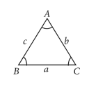
(d) : In triangle $A B C$, we have $2 B=A+C$ as $A, B$ and $C$ are in A.P.
Now, $A+B+C=180^{\circ} \Rightarrow B+2 B=180^{\circ}$
$\Rightarrow 3 B=180^{\circ} \Rightarrow B=60^{\circ}$
Also $\frac{a}{\sin A}=\frac{b}{\sin B}=\frac{c}{\sin C}$
$
\begin{aligned}
\therefore \quad & \frac{a}{c} \sin 2 C+\frac{c}{a} \sin 2 A \\
& =\frac{\sin A}{\sin C} 2 \sin C \cos C+\frac{\sin C}{\sin A} 2 \sin A \cos A \\
& 2 \sin A \cos C+2 \cos A \sin C \\
& =2 \sin (A+C)=2 \sin (180-B) \\
& =2 \sin B=2 \sin 60^{\circ}=2 \frac{\sqrt{3}}{2}=\sqrt{3}
\end{aligned}
$
View full question & answer→MCQ 332 Marks
Considering only the principal values of inverse functions, the set$ A=\left\{x \geq 0 / \tan ^{-1}(2 x)+\tan ^{-1}(3 x)=\frac{\pi}{4}\right\} $
- ✓
- B
contains more than two elements
- C
- D
Answer(a) : $\tan ^{-1}(2 x)+\tan ^{-1}(3 x)=\pi / 4$
$\Rightarrow \tan ^{-1}\left(\frac{2 x+3 x}{1-6 x^2}\right)=\frac{\pi}{4}$
$\Rightarrow \frac{5 x}{1-6 x^2}=\tan \frac{\pi}{4} \Rightarrow \frac{5 x}{1-6 x^2}=1$
$\Rightarrow 5 x=1-6 x^2 \Rightarrow 6 x^2+5 x-1=0$
$\Rightarrow 6 x^2+6 x-x-1=0 \Rightarrow x=-1$ or $x=\frac{1}{6}$
Since, $x \geq 0$ therefore $x=\frac{1}{6}$
Hence, $A$ is a singleton set.
View full question & answer→MCQ 342 Marks
The value of $2 \sin ^{-1}\left(\frac{1}{2}\right)+\cot ^{-1}\left(\frac{1}{\sqrt{3}}\right)$ is
- ✓
$2 \pi / 3$
- B
$\pi / 4$
- C
$\pi / 6$
- D
$\pi / 3$
AnswerCorrect option: A. $2 \pi / 3$
$2 \sin ^{-1}\left(\frac{1}{2}\right)+\cot ^{-1}\left(\frac{1}{\sqrt{3}}\right)=\frac{2 \pi}{6}+\frac{\pi}{3}$
$=\frac{\pi}{3}+\frac{\pi}{3}=\frac{2 \pi}{3} \quad [\because \sin \frac{\pi}{6}=\frac{1}{2}$ and $ \cot \frac{\pi}{3}=\frac{1}{\sqrt{3}}]$
View full question & answer→MCQ 352 Marks
If $A=2 \tan ^{-1}\left(\frac{1+x}{1-x}\right)$ and $B=\cos ^{-1}\left(\frac{1-x^2}{1+x^2}\right)$, where $x \in(0,1)$, then $A-B=$
- ✓
$\pi / 2$
- B
$4 \tan ^{-1} x$
- C
$\pi / 4$
- D
$\tan ^{-1} x$
AnswerCorrect option: A. $\pi / 2$
(a) : Given,
$A=2 \tan ^{-1}\left(\frac{1+x}{1-x}\right), B=\cos ^{-1}\left(\frac{1-x^2}{1+x^2}\right)$,
where $x \in(0,1)$
Let $x=\tan \theta$
$\therefore A-B=2 \tan ^{-1}\left[\frac{\tan \frac{\pi}{4}+\tan \theta}{1-\tan \frac{\pi}{4} \tan \theta}\right]-\cos ^{-1}\left(\frac{1-\tan ^2 \theta}{1+\tan ^2 \theta}\right)$
$=2 \tan ^{-1}\left[\tan \left(\frac{\pi}{4}+\theta\right)\right]-\cos ^{-1}(\cos 2 \theta)$
$=2\left(\frac{\pi}{4}+\theta\right)-2 \theta=\frac{\pi}{2}+2 \theta-2 \theta=\frac{\pi}{2}$
View full question & answer→MCQ 362 Marks
The number of solution(s) of $\sin ^4 x+\cos ^3 x \geq 1$ in ] $0,2 \pi$ [is
Answer(c) : We know that $\sin ^2 x+\cos ^2 x=1,-1 \leq \sin x$, $\cos x \leq 1$
Now, $\sin ^4 x+\cos ^3 x>\mid 1$, we have $\sin ^4 x+\cos ^3 x= \pm 1$, which is possible only if $\sin x=1$ and $\cos x=0$ or $\sin x=0$ and $\cos x=-1$
$\Rightarrow x=(4 n+1) \frac{\pi}{2}, x=(2 n+1) \frac{\pi}{2}$, or $x=n \pi, x=2 n \pi$ Now, we need solution in $(0,2 \pi)$
$\therefore x=\frac{\pi}{2}, \frac{3 \pi}{2}$ or $x=\pi$ as $x \neq 0,2 \pi$
$\therefore \quad$ Number of solutions are 3 i.e., $\frac{\pi}{2}, \pi, \frac{3 \pi}{2} \in(0,2 \pi)$
View full question & answer→MCQ 372 Marks
If $\cot ^{-1} \frac{3}{4}+\sin ^{-1} \frac{5}{13}=\sin ^{-1}(k)$, then $k=$
- ✓
$\frac{63}{65}$
- B
$\frac{12}{13}$
- C
$\frac{65}{68}$
- D
$\frac{5}{12}$
AnswerCorrect option: A. $\frac{63}{65}$
(a) : Let $\cot ^{-1} \frac{3}{4}=\theta \Rightarrow \cot \theta=\frac{3}{4}$ and $\sin \theta=\frac{1}{\sqrt{1+\cot ^2 \theta}}=\frac{1}{\sqrt{1+(9 / 16)}}=\frac{4}{5}$ Hence, $\cot ^{-1} \frac{3}{4}+\sin ^{-1} \frac{5}{13}=\sin ^{-1} \frac{4}{5}+\sin ^{-1} \frac{5}{13}$ $=\sin ^{-1}\left[\frac{4}{5} \cdot \sqrt{1-\frac{25}{169}}+\frac{5}{13} \cdot \sqrt{1-\frac{16}{25}}\right]$ $=\sin ^{-1} \frac{63}{65}$
View full question & answer→MCQ 382 Marks
Which of the following equation has no solution?
AnswerCorrect option: B. $\cos \theta=\sqrt{2}$
(b) : Since range of $y=\cos x$ is $[-1,1]$.
$\therefore \quad \cos \theta=\sqrt{2}$ is not possible.
$\therefore \cos \theta=\sqrt{2}$ has no solution.
View full question & answer→MCQ 392 Marks
If $4 \sin ^{-1} x+6 \cos ^{-1} x=3 \pi$ then $x=$
- A
$1 / \sqrt{2}$
- B
$1 / 2$
- ✓
- D
$-1 / 2$
Answer(c) : $4 \sin ^{-1} x+6 \cos ^{-1} x=3 \pi$
$
\begin{gathered}
\Rightarrow 4 \sin ^{-1} x+6\left(\frac{\pi}{2}-\sin ^{-1} x\right)=3 \pi \\
{\left[\because \sin ^{-1} x+\cos ^{-1} x=\frac{\pi}{2}\right]} \\
\Rightarrow 4 \sin ^{-1} x+3 \pi-6 \sin ^{-1} x=3 \pi \\
\Rightarrow-2 \sin ^{-1} x=0 \Rightarrow \sin ^{-1} x=0 \Rightarrow x=0
\end{gathered}
$
View full question & answer→MCQ 402 Marks
The number of solutions of $\sin x+\sin 3 x+\sin 5 x=0$ in the interval $\left[\frac{\pi}{2}, \frac{3 \pi}{2}\right]$ is
Answer(d) : We have $\sin x+\sin 3 x+\sin 5 x=0$
$
\begin{aligned}
& \Rightarrow 2 \sin \left(\frac{6 x}{2}\right) \cdot \cos \left(\frac{4 x}{2}\right)+\sin 3 x=0 \\
& \Rightarrow 2 \sin 3 x \cdot \cos 2 x+\sin 3 x=0 \\
& \Rightarrow \sin 3 x(2 \cos 2 x+1)=0 \\
& \Rightarrow \sin 3 x=0 \text { or } 2 \cos 2 x+1=0
\end{aligned}
$
When $\sin 3 x=0$, then $3 x=n \pi \Rightarrow x=\frac{n \pi}{3}, n \in Z$
$\therefore$ Three values exist in the given interval.
When $2 \cos 2 x+1=0$, then $\cos 2 x=\frac{-1}{2}$
$
\begin{aligned}
& \Rightarrow \cos 2 x=-\cos \frac{\pi}{3} \Rightarrow \cos 2 x=\cos \left(\pi-\frac{\pi}{3}\right) \\
& \Rightarrow \cos 2 x=\cos \frac{2 \pi}{3} \Rightarrow 2 x=2 n \pi \pm \frac{2 \pi}{3}, n \in Z \\
& \Rightarrow x=n \pi \pm \frac{\pi}{3}, n \in Z
\end{aligned}
$
$\therefore$ Two values exist in the given interval.
$\therefore$ Required number of solutions $=5$
View full question & answer→MCQ 412 Marks
If $\tan ^{-1} 2 x+\tan ^{-1} 3 x=\frac{\pi}{4}$, then $x=$
- A
- B
$\frac{1}{3}$
- ✓
$\frac{1}{6}$
- D
$\frac{1}{2}$
AnswerCorrect option: C. $\frac{1}{6}$
(c) : We have $\tan ^{-1} 2 x+\tan ^{-1} 3 x=\frac{\pi}{4}$
$
\begin{aligned}
& \Rightarrow \tan ^{-1}\left(\frac{2 x+3 x}{1-2 x \times 3 x}\right)=\frac{\pi}{4} ; x>0 \Rightarrow \frac{5 x}{1-6 x^2}=1 \\
& \Rightarrow 6 x^2+5 x-1=0 \Rightarrow(6 x-1)(x+1)=0 \Rightarrow x=\frac{1}{6}(\because x \neq-1)
\end{aligned}
$
View full question & answer→MCQ 422 Marks
The value of $\cos ^{-1}\left(\cot \left(\frac{\pi}{2}\right)\right)+\cos ^{-1}\left(\sin \left(\frac{2 \pi}{3}\right)\right)$ is
- ✓
$\frac{2 \pi}{3}$
- B
$\frac{\pi}{3}$
- C
$\frac{\pi}{2}$
- D
$\pi$
AnswerCorrect option: A. $\frac{2 \pi}{3}$
(a) : $\cos ^{-1}\left(\cot \frac{\pi}{2}\right)+\cos ^{-1}\left(\sin \frac{2 \pi}{3}\right)$
$=\cos ^{-1}(0)+\cos ^{-1}\left(\frac{\sqrt{3}}{2}\right)$
$=\frac{\pi}{2}+\cos ^{-1}\left(\cos \frac{\pi}{6}\right)=\frac{\pi}{2}+\frac{\pi}{6}=\frac{4 \pi}{6}=\frac{2 \pi}{3}$
View full question & answer→MCQ 432 Marks
In $\triangle A B C$ if $\sin ^2 A+\sin ^2 B=\sin ^2 C$ and $l(A B)=10$, then the maximum value of the area of $\triangle A B C$ is
- A
- B
$10 \sqrt{2}$
- ✓
- D
$25 \sqrt{2}$
Answer(c) : $\sin ^2 A+\sin ^2 B=\sin ^2 C$
$\Rightarrow a^2+b^2=c^2$
(Using Sine Rule)
$\therefore \triangle A B C$ is right triangle right angled at $C$.
Area of $\triangle A B C=\frac{1}{2} a b$ ...(i)
From sine rule $\frac{a}{\sin A}=\frac{b}{\sin B}=\frac{c}{\sin C}$
$\Rightarrow \quad \frac{a}{\sin A}=\frac{b}{\sin B}=\frac{10}{1} \quad\left[\right.$ as $C=90^{\circ}$ and $\left.\sin 90^{\circ}=1\right]$
$\Rightarrow a=10 \sin A, b=10 \sin B$
From equation (i),
Area of $(\triangle A B C)=\frac{1}{2}(10 \sin A)(10 \sin B)=50 \sin A \sin B$
But maximum value of $\sin A \sin B=\frac{1}{2}$
$\therefore$ Maximum value of area of $\triangle A B C=50 \times \frac{1}{2}=25$
View full question & answer→MCQ 442 Marks
The number of principal solutions of $\tan 2 \theta=1$ is
Answer(b) : We have, $\tan 2 \theta=1$
$\Rightarrow \tan 2 \theta=\tan \frac{\pi}{4}$ or $\tan 2 \theta=\tan \left(\pi+\frac{\pi}{4}\right)$
$\Rightarrow 2 \theta=\frac{\pi}{4}$ or $2 \theta=\frac{5 \pi}{4} \Rightarrow \theta=\frac{\pi}{8}$ or $\frac{5 \pi}{8}$
View full question & answer→MCQ 452 Marks
If $\alpha$ and $\beta$ are roots of the equation $x^2+5|x|-6=0$ then the value of $\left|\tan ^{-1} \alpha-\tan ^{-1} \beta\right|$ is
- ✓
$\frac{\pi}{2}$
- B
- C
$\pi$
- D
$\frac{\pi}{4}$
AnswerCorrect option: A. $\frac{\pi}{2}$
(a) : We have,
$
\begin{aligned}
& x^2+5|x|-6=0 \\
\Rightarrow & |x|^2+5|x|-6=0 \\
\Rightarrow & |x|^2+6|x|-|x|-6=0 \\
\Rightarrow & (|x|-1)(|x|+6)=0 \\
\Rightarrow & |x|=1 \text { but }|x| \neq-6
\end{aligned}
$
(Since modulus cannot give negative values)
$
\begin{aligned}
\therefore & x=+1 \\
\therefore & \left|\tan ^{-1} \alpha-\tan ^{-1} \beta\right|=\left|\tan ^{-1} 1-\tan ^{-1}(-1)\right| \\
& =\left|\frac{\pi}{4}-\left(-\frac{\pi}{4}\right)\right|=\left|\frac{\pi}{2}\right|=\frac{\pi}{2}
\end{aligned}
$
View full question & answer→MCQ 462 Marks
The general solution of the equation $\tan ^2 x=1$ is
AnswerCorrect option: C. $n \pi \pm \frac{\pi}{4}$
(c) : $\tan ^2 x=1 \Rightarrow \tan x= \pm 1$
$\Rightarrow \tan x= \pm \tan \frac{\pi}{4} \Rightarrow x=n \pi \pm \frac{\pi}{4}$
View full question & answer→MCQ 472 Marks
Principal solutions of the equation $\sin 2 x+\cos 2 x=0$, where pi < x < 2pi" are "
- A
$\frac{7 \pi}{8}, \frac{11 \pi}{8}$
- B
$\frac{9 \pi}{8}, \frac{13 \pi}{8}$
- ✓
$\frac{11 \pi}{8}, \frac{15 \pi}{8}$
- D
$\frac{15 \pi}{8}, \frac{19 \pi}{8}$
AnswerCorrect option: C. $\frac{11 \pi}{8}, \frac{15 \pi}{8}$
(c) : $\sin 2 x+\cos 2 x=0, \pi<x<2 \pi$
$\Rightarrow \sin 2 x=-\cos 2 x \Rightarrow \tan 2 x=-1$
$\Rightarrow \tan 2 x=-\tan \left(\frac{\pi}{4}\right) \Rightarrow 2 x=n \pi-\frac{\pi}{4}, n \in Z$
$\Rightarrow 2 x=\frac{11 \pi}{4}, \frac{15 \pi}{4} \Rightarrow x=\frac{11 \pi}{8}, \frac{15 \pi}{8}$
View full question & answer→MCQ 482 Marks
$\frac{\tan ^{-1}(\sqrt{3})-\sec ^{-1}(-2)}{\operatorname{cosec}^{-1}(-\sqrt{2})+\cos ^{-1}\left(-\frac{1}{2}\right)}=$
- A
$\frac{4}{5}$
- B
$-\frac{4}{5}$
- C
$\frac{3}{5}$
- D
Answer
(b) : $
\begin{aligned}
& \frac{\tan ^{-1}(\sqrt{3})-\sec ^{-1}(-2)}{\operatorname{cosec}^{-1}(-\sqrt{2})+\cos ^{-1}\left(\frac{-1}{2}\right)}=\frac{(\pi / 3)-(2 \pi / 3)}{(-\pi / 4)+(2 \pi / 3)} \\
& =\frac{-\pi / 3}{5 \pi / 12}=\frac{-4}{5}
\end{aligned}
$
View full question & answer→MCQ 492 Marks
In $\triangle A B C,(a-b)^2 \cos ^2 \frac{c}{2}+(a+b)^2 \sin ^2 \frac{c}{2}=$
- A
$b^2$
- ✓
$c^2$
- C
$a^2$
- D
$a^2+b^2+c^2$
Answer(b) $:(a-b)^2 \cos ^2 \frac{c}{2}+(a+b)^2 \sin ^2 \frac{c}{2}$
$=(a-b)^2\left[\frac{1+\cos c}{2}\right]+(a+b)^2\left[\frac{1-\cos c}{2}\right]$
$=(a-b)^2\left[\frac{1+\frac{a^2+b^2-c^2}{2 a b}}{2}\right]+(a+b)^2$
$
\times\left[\frac{1-\left(\frac{a^2+b^2-c^2}{2 a b}\right)}{2}\right]
$
$=(a-b)^2\left[\frac{2 a b+a^2+b^2-c^2}{4 a b}\right]+(a+b)^2$
$
\left[\frac{2 a b-a^2-b^2+c^2}{4 a b}\right]
$
$
\begin{aligned}
& =\frac{1}{4 a b}\left[(a-b)^2(a+b)^2-(a-b)^2 c^2\right. \\
& \left.+(a+b)^2 c^2-(a+b)^2(a-b)^2\right] \\
& =\frac{1}{4 a b}\left[a^2 c^2+b^2 c^2+2 a b c^2-a^2 c^2-b^2 c^2+2 a b c^2\right] \\
& =\frac{1}{4 a b}\left[4 a b c^2\right]=c^2 \\
&
\end{aligned}
$
View full question & answer→MCQ 502 Marks
If $2 \tan ^{-1}(\cos x)=\tan ^{-1}(2 \operatorname{cosec} x)$, then $\sin x+\cos x=$
- A
$2 \sqrt{2}$
- ✓
$\sqrt{2}$
- C
$\frac{1}{\sqrt{2}}$
- D
$\frac{1}{2}$
AnswerCorrect option: B. $\sqrt{2}$
(b) : $2 \tan ^{-1}(\cos x)=\tan ^{-1}(2 \operatorname{cosec} x)$
$\Rightarrow \tan ^{-1}\left(\frac{2 \cos x}{1-\cos ^2 x}\right)=\tan ^{-1}(2 \operatorname{cosec} x)$
$\Rightarrow \tan ^{-1}\left(\frac{2 \cos x}{\sin ^2 x}\right)=\tan ^{-1}\left(\frac{2}{\sin x}\right) \Rightarrow \frac{2 \cos x}{\sin ^2 x}=\frac{2}{\sin x}$
$\Rightarrow \sin x=\cos x \quad \therefore x=\pi / 4$
$\therefore \sin x+\cos x=\sin \frac{\pi}{4}+\cos \frac{\pi}{4}=2\left[\frac{1}{\sqrt{2}}\right]=\sqrt{2}$
View full question & answer→