Question 13 Marks
Prove that $(\bar{a} \times \bar{b}) \cdot(\bar{c} \times \bar{d})\left|\begin{array}{ll}\bar{a} \cdot \bar{c} & \bar{b} \cdot \bar{c} \\ \bar{a} \cdot \bar{d} & \bar{b} \cdot \bar{d}\end{array}\right|$
AnswerLet $\bar{a} \times \bar{b}=\bar{m}$$\mathrm{LHS}=(\bar{a} \times \bar{b}) \cdot(\bar{c} \times \bar{d})$
$=\bar{m} \cdot(\bar{c} \times \bar{d})$
$=(\bar{m} \times \bar{c}) \cdot \bar{d}$
$=[(\bar{a} \times \bar{b}) \times \bar{c}] \cdot \bar{d}$
$=[(\bar{c} \cdot \bar{a}) \bar{b}-(\bar{c} \cdot \bar{b}) \bar{a}] \cdot \bar{d}$
$=(\bar{c} \cdot \bar{a})(\bar{b} \cdot \bar{d})-(\bar{c} \cdot \bar{b})(\bar{a} \cdot \bar{d})$
$\begin{aligned} & =\left|\begin{array}{ll}\bar{c} \cdot \bar{a} & \bar{c} \cdot \bar{b} \\ a \cdot d & \frac{b}{b} \cdot \frac{d}{}\end{array}\right| \\ & =\left|\begin{array}{ll}\bar{a} \cdot \bar{c} & \bar{b} \cdot \bar{c} \\ \bar{a} \cdot d & \bar{b} \cdot d\end{array}\right|\end{aligned}$
[Dot product is commutative]
$=$ RHS.
View full question & answer→Question 23 Marks
Let $\hat{a}, \hat{b}, \hat{c}$ be unit vectors such that $\hat{a} \cdot \hat{b}=\hat{a} \cdot \hat{c}=0$ and the angle between $\hat{b}$ and $\hat{c}$ be$\frac{\pi}{6}$.
Prove that $\hat{a}= \pm 2(\hat{b} \times \hat{c})$
Answer$\hat{a} \cdot \hat{b}=\hat{a} \cdot \hat{c}=0$$\therefore \hat{a}$ is perpendicular to $\hat{b}$ and $\hat{c}$ both
$\therefore \hat{a}$ is parallel to $\hat{b} \times \hat{c}$
$\therefore \hat{a}=\mathrm{m}(\hat{b} \times \hat{c})_t \mathrm{~m}$ is a scalar.
$\begin{aligned} & \therefore|\hat{a}|=|m||\hat{b} \times \hat{c}| \\ & \therefore|\vec{a}|=|m||\hat{b}||\hat{c}| \sin \frac{\pi}{6}\end{aligned}$
$\therefore 1=|m| \times 1 \times 1 \times \frac{1}{2}=\frac{|m|}{2} \quad \ldots[\because|\hat{a}|=|b|=|\hat{c}|=1]$
$\begin{aligned} & \therefore 2=|m| \\ & \therefore m= \pm 2\end{aligned}$
$\therefore \hat{a}= \pm 2(\hat{b} \times \hat{c})$.
View full question & answer→Question 33 Marks
Let $\mathrm{A}, \mathrm{B}, \mathrm{C}, \mathrm{D}$ be any four points in space. Prove that$|\overline{A B} \times \overline{C D}+\overline{B C} \times \overline{A D}+\overline{C A} \times \overline{B D}|=4$ (area of $\triangle A B C$ )
AnswerLet $\mathrm{A}, \mathrm{B}, \mathrm{C}, \mathrm{D}$ have position vectors $\bar{a}, \bar{b}, \bar{c}_i \bar{d}$ respectively.Consider $|\overline{A B} \times \overline{C D}+\overline{B C} \times \overline{A D}+\overline{C A} \times \overline{B D}|$
$\begin{aligned}=(\bar{b}-\bar{a}) \times(\bar{d}-\bar{c})+(\bar{c}-\bar{b}) \times(\bar{d}-\bar{a})+(\bar{a}-\bar{c}) \times(\bar{d}-\bar{b}) \\ =\bar{b} \times(\bar{d}-\bar{c})-\bar{a} \times(\bar{d}-\bar{c})+\bar{c} \times(\bar{d}-\bar{a})-\bar{b} \times(\bar{d}-\bar{a})+ \\ \bar{a} \times(\bar{d}-\bar{b})-\bar{c} \times(\bar{d}-\bar{b})\end{aligned}$
$\begin{array}{r}=\bar{b} \times \bar{d}-\bar{b} \times \bar{c}-\bar{a} \times \bar{d}+\bar{a} \times \bar{c}+\bar{c} \times \bar{d}-\bar{c} \times \bar{a}-\bar{b} \times \bar{d}+ \\ \bar{b} \times \bar{a}+\bar{a} \times \bar{d}-\bar{a} \times \bar{b}-\bar{c} \times \bar{d}+\bar{c} \times \bar{b} \\ =\bar{b} \times \bar{d}-\bar{b} \times \bar{c}-\bar{a} \times \bar{d}-\bar{c} \times \bar{a}+\bar{c} \times \bar{d}-\bar{c} \times \bar{a}-\bar{b} \times \bar{d}- \\ \bar{a} \times \bar{b}+\bar{a} \times \bar{d}-\bar{a} \times \bar{b}-\bar{c} \times \bar{d}-\bar{b} \times \bar{c} \\ \ldots[\because \bar{p} \times \bar{q}=-\bar{q} \times \bar{p}]\end{array}$
$-2(\bar{a} \times \bar{b}+\bar{b} \times \bar{c}+\bar{c} \times \bar{a})$
$\begin{aligned} & \therefore|\overline{\mathrm{AB}} \times \overline{\mathrm{CD}}+\overline{\mathrm{BC}} \times \overline{\mathrm{AD}}+\overline{\mathrm{CA}} \times \overline{\mathrm{BD}}| \\ & =|-2(\bar{a} \times \bar{b}+\bar{b} \times \bar{c}+\bar{c} \times \bar{a})| \\ & =4\left[\frac{1}{2}|\bar{a} \times \bar{b}+\bar{b} \times \bar{c}+\bar{c} \times \bar{a}|\right]\end{aligned}$
$=4($ area of $\triangle A B C)$
View full question & answer→Question 43 Marks
Show that the area of a triangle ABC, the position vectors of whose vertices are a, b and cis $\frac{1}{2}[\vec{a} \times \vec{b}+\vec{b} \times \vec{c}+\vec{c} \times \vec{a}]$
Question is modified.
Show that the area of a triangle $A B C$, the position vectors of whose vertices are $\bar{a}, \bar{b}$ and $\bar{c}$
is $\frac{1}{2}[\bar{a} \times \bar{b}+\bar{b} \times \bar{c}+\bar{c} \times \bar{a}]$.
Answer
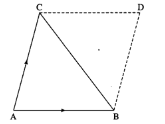
Consider the triangle ABC. Complete the parallelogram ABDC. Vector area of ∆ABC
$=\frac{1}{2}($ vector area of parallelogram ABDC $)$
$=\frac{1}{2}(\overline{A B} \times \overline{A C})$
$\begin{aligned} & =\frac{1}{2}[(\bar{b}-\bar{a}) \times(\bar{c}-\bar{a})] \ldots[\because \overline{\mathrm{AB}}=\bar{b}-\bar{a} \text { and } \overline{\mathrm{AC}}=\bar{c}-\bar{a}] \\ & =\frac{1}{2}[\bar{b} \times \bar{c}-\bar{b} \times \bar{a}-\bar{a} \times \bar{c}+\bar{a} \times \bar{a}] \\ & =\frac{1}{2}[\bar{b} \times \bar{c}+\bar{a} \times \bar{b}+\bar{c} \times \bar{a}+\overline{0}] \\ & =\frac{1}{2}[\bar{a} \times \bar{b}+\bar{b} \times \bar{c}+\bar{c} \times \bar{a}]\end{aligned}$
View full question & answer→Question 53 Marks
Show that no line in space can make angle $\frac{\pi}{6}$ and $\frac{\pi}{4}$ with $X$ - axis and $Y$-axis.
AnswerLet, if possible, a line in space make angles $\frac{\pi}{6}$ and $\frac{\pi}{4}$ with $X$-axis and $Y$-axis.$\therefore \alpha=\frac{\pi}{6}, \beta=\frac{\pi}{4}$
Let the line make angle $y$ with $\mathrm{Z}$-axis.
$\begin{aligned} & \because \cos ^2 \alpha+\cos ^2 \beta+\cos ^2 \gamma=1 \\ & \therefore \cos ^2\left(\frac{\pi}{6}\right)+\cos ^2\left(\frac{\pi}{4}\right)+\cos ^2 \gamma=1 \\ & \therefore\left(\frac{\sqrt{3}}{2}\right)^2+\left(\frac{1}{\sqrt{2}}\right)^2+\cos ^2 \gamma=1\end{aligned}$
$\therefore \cos ^2 \gamma=1-\frac{3}{4}-\frac{1}{2}=-\frac{1}{4}$
This is not possible, because cos γ is real
$\therefore \cos ^2 Y$ cannot be negative.
$\therefore \cos ^2 \gamma$ cannot be negative.
Hence, there is no line in space which makes angles $\frac{\pi}{6}$ and $\frac{\pi}{4}$ with $X$-axis and $Y$-axis,
View full question & answer→Question 63 Marks
Find the direction cosines and direction angles of the vector.$(1 / 2) \hat{i}+\hat{j}+\hat{k}$
View full question & answer→Question 73 Marks
Find the direction cosines and direction angles of the vector.$2 \hat{i}+\hat{j}+2 \hat{k}$
AnswerLet $\bar{a}=2 \hat{i}+\hat{j}+2 \hat{k}$$|\bar{a}|=\sqrt{2^2+1^2+2^2}=\sqrt{4+1+4}=\sqrt{9}=3$
$\therefore$ unit vector along $\bar{a}$
$=\hat{a}=\frac{\bar{a}}{|\bar{a}|}=\frac{2 \hat{i}+\hat{j}+2 \hat{k}}{3}=\frac{2}{3} \hat{i}+\frac{1}{3} \hat{j}+\frac{2}{3} \hat{k}$
$\therefore$ its direction cosines are $\frac{2}{3}, \frac{1}{3}, \frac{2}{3}$.
If $\alpha, \beta, y$ are the direction angles, then $\cos \alpha=\frac{2}{3}, \cos \beta=\frac{1}{3}$
$\cos \gamma=\frac{2}{3}$
$\therefore \alpha=\cos ^{-1}\left(\frac{2}{3}\right), \beta=\cos ^{-1}\left(\frac{1}{3}\right), \gamma=\cos ^{-1}\left(\frac{2}{3}\right)$
Hence, direction cosines are $\frac{2}{3}, \frac{1}{3}, \frac{2}{3}$ and direction angles
are $\cos ^{-1}\left(\frac{2}{3}\right), \cos ^{-1}\left(\frac{1}{3}\right), \cos ^{-1}\left(\frac{2}{3}\right)$
View full question & answer→Question 83 Marks
Prove that the sum of the three vectors determined by the medians of a triangle directed from the vertices is zero.
AnswerLet $\vec{a}, \vec{b}$ and $\overrightarrow{\mathrm{c}}$ are the position vectors of the vertices $A, B$ and $C$ respectively.Then we know that the position vector of the centroid O of the triangle is $\frac{\vec{a}+\vec{b}+\vec{c}}{3}$
Therefore sum of the three vectors $\overrightarrow{\mathrm{OA}}, \overrightarrow{\mathrm{OB}}$ and $\overrightarrow{\mathrm{OC}}$, is
$\overrightarrow{O A}+\overrightarrow{O B}+\overrightarrow{O C}=\vec{a}-\left(\frac{\vec{a}+\vec{b}+\vec{c}}{3}\right)+\vec{b}-\left(\frac{\vec{a}+\vec{b}+\vec{c}}{3}\right)+\vec{c}-\left(\frac{\vec{a}+\vec{b}+\vec{c}}{3}\right)$
$=(\vec{a}+\vec{b}+\vec{c})-3\left(\frac{\vec{a}+\vec{b}+\vec{c}}{3}\right)$
$=\overrightarrow{0}$
Hence, Sum os the three vectors determined by the medians of a triangle directed from the vertices is zero.
View full question & answer→Question 93 Marks
The position vectors $\mathrm{f}$ three consecutive vertices of a parallelogram are $\hat{i}+\hat{j}+\hat{k}$$\hat{i}+3 \hat{j}+5 \hat{k}$ and $7 \hat{i}+9 \hat{j}+11 \hat{k}$ Find the position vector of the fourth vertex.
AnswerLet ABCD be a parallelogram.Let $\bar{a}_r, \bar{b}, \bar{c}, \bar{d}$ be the position vectors of the vertices
A, B, C, D of the parallelogram,
where $\bar{a}=\hat{i}+\hat{j}+\hat{k}, \bar{b}=\hat{i}+3 \hat{j}+5 \hat{k}, \bar{c}=7 \hat{i}+9 \hat{j}+11 \hat{k}$.
Since $A B C D$ is a parallelogram, $\overline{\mathrm{AB}}=\overline{\mathrm{DC}}$
$\begin{aligned} & \therefore \bar{b}-\bar{a}=\bar{c}-\bar{d} \\ & \therefore \bar{d}=\bar{a}+\bar{c}-\bar{b}\end{aligned}$
$\begin{aligned} & =(\hat{i}+\hat{j}+\hat{k})+(7 \hat{i}+9 \hat{j}+11 \hat{k})-(\hat{i}+3 \hat{j}+5 \hat{k}) \\ & =7 \hat{i}+7 \hat{j}+7 \hat{k}=7(\hat{i}+\hat{j}+\hat{k})\end{aligned}$
Hence, the position vector of the fourth vertex is $7(\hat{i}+\hat{j}+\hat{k})$.
View full question & answer→Question 103 Marks
If $\mathrm{D}, \mathrm{E}, \mathrm{F}$ are the mid-points of the sides $\mathrm{BC}, \mathrm{CA}, \mathrm{AB}$ of a triangle $\mathrm{ABC}$, prove that $\overline{A D}+$$\overline{B E}+\overline{C F}=0$
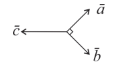
AnswerLet $\bar{a}_t \bar{b}, \bar{c}_{,}, \bar{d}_{,}, \bar{e}, \bar{f}$ be the position vectors of the points $\mathrm{A}, \mathrm{B}, \mathrm{C}, \mathrm{D}, \mathrm{E}, \mathrm{F}$ respectively.Since D, E, F are the midpoints of BC, CA, AB respec-tively, by the midpoint formula
$\bar{d}=\frac{\bar{b}+\bar{c}}{2}, \bar{e}=\frac{\bar{c}+\bar{a}}{2}, \bar{f}=\frac{\bar{a}+\bar{b}}{2}$
$\therefore \overline{\mathrm{AD}}+\overline{\mathrm{BE}}+\overline{\mathrm{CF}}=(\bar{d}-\bar{a})+(\bar{e}-\bar{b})+(\bar{f}-\bar{c})$
$=\left(\frac{\bar{b}+c}{2}-\bar{a}\right)+\left(\frac{\bar{c}+\bar{a}}{2}-\bar{b}\right)+\left(\frac{\bar{a}+\bar{b}}{2}-\bar{c}\right)$
$=\frac{1}{2} \bar{b}+\frac{1}{2} \bar{c}-\bar{a}+\frac{1}{2}-\bar{c}+\frac{1}{2} \bar{a}-\bar{b}+\frac{1}{2} \bar{a}+\frac{1}{2} \bar{b}-\bar{c}$
$=(\vec{a}+\bar{b}+\bar{c})-(\bar{a}+\bar{b}+\bar{c})=\overline{0}$
View full question & answer→Question 113 Marks
Find the lengths of the sides of the triangle and also determine the type of a triangle. L(3, -2, -3), M(7, 0, 1), N (1, 2, 1)
AnswerThe position vectors bar $\bar{a}, \bar{b}_r \bar{c}$ of the points $L M, N$ are$\overline{\mathrm{a}}=3 \hat{\mathrm{i}}-2 \hat{\mathrm{j}}-3 \hat{\mathrm{k}}, \overline{\mathrm{b}}=7 \hat{\mathrm{i}}+\hat{\mathrm{k}}, \overline{\mathrm{c}}=\hat{\mathrm{i}}+2 \hat{\mathrm{j}}+\hat{\mathrm{k}}$
$\overline{\mathrm{LM}}=\overline{\mathrm{b}}-\overline{\mathrm{a}}=(7 \hat{\mathrm{i}}+\hat{\mathrm{k}})-(3 \hat{\mathrm{i}}-2 \hat{\mathrm{j}}-3 \hat{\mathrm{k}})=4 \hat{\mathrm{i}}+2 \hat{\mathrm{j}}+4 \hat{\mathrm{k}}$
$\begin{aligned} & \overline{\mathrm{MN}}=\overline{\mathrm{c}}-\overline{\mathrm{b}}=(\hat{\mathrm{i}}+2 \hat{\mathrm{j}}+\hat{\mathrm{k}})-(7 \hat{\mathrm{i}}+\hat{\mathrm{k}})=-6 \hat{\mathrm{i}}+2 \hat{\mathrm{j}} \\ & \overline{\mathrm{NL}}=\overline{\mathrm{a}}-\overline{\mathrm{c}}=(3 \hat{\mathrm{i}}-2 \hat{\mathrm{j}}-3 \hat{\mathrm{k}})-(\hat{\mathrm{i}}+2 \hat{\mathrm{j}}+\hat{\mathrm{k}})=2 \hat{\mathrm{i}}-4 \hat{\mathrm{j}}-4 \hat{\mathrm{k}} \\ & \therefore \mathrm{I}(\mathrm{LM})=|\overline{\mathrm{AB}}|=\sqrt{4^2+2^2+4^2}-\sqrt{16+4+16}=\sqrt{36}=6 \\ & \mathrm{I}(\mathrm{MN})=|\overline{\mathrm{MN}}|=\sqrt{(-6)^2+2^2}-\sqrt{36+4}=\sqrt{40}=\sqrt{10 \times 4}=2 \sqrt{10} \\ & I(\mathrm{NL})=|\overline{\mathrm{NL}}|=\sqrt{(2)^2+(-4)^2+(-4)^2}=\sqrt{4+16+16}=\sqrt{36}=6\end{aligned}$
$I(\mathrm{LM})=6, I(\mathrm{MN})=2 \sqrt{10}, I(\mathrm{NL})=6$
∆LMN is sosceles
View full question & answer→Question 123 Marks
Find the lengths of the sides of the triangle and also determine the type of a triangle. A(2, -1, 0), B(4, 1, 1,), C(4, -5, 4)
AnswerThe position vectors $\bar{a}_i \bar{b}, \bar{c}$ of the points $\mathrm{A}_t \mathrm{~B}_t \mathrm{C}$ are$\begin{aligned} & \bar{a}=2 \hat{i}-\hat{j}, \bar{b}=4 \hat{i}+\hat{j}+\hat{k}, \bar{c}=4 \hat{i}-5 \hat{j}+4 \hat{k} \\ & \overline{\mathrm{AB}}=\bar{b}-\bar{a}=(4 \hat{i}+\hat{j}+\hat{k})-(2 \hat{i}-\hat{j})=2 \hat{i}+2 \hat{j}+\hat{k} \\ & \overline{\mathrm{BC}}=\bar{c}-\bar{b}=(4 \hat{i}-5 \hat{j}+4 \hat{k})-(4 \hat{i}+\hat{j}+\hat{k})=-6 \hat{j}+3 \hat{k} \\ & \overline{\mathrm{CA}}=\bar{a}-\bar{c}=(2 \hat{i}-\hat{j})-(4 \hat{i}-5 \hat{j}+4 \hat{k})=-2 \hat{i}+4 \hat{j}-4 \hat{k}\end{aligned}$
$\begin{aligned} \therefore l(A B) & =|\overline{A B}|=\sqrt{2^2+2^2+1^2} \\ & =\sqrt{4+4+1}=\sqrt{9}=3\end{aligned}$
$\begin{aligned} l(\mathrm{BC}) & =|\overline{\mathrm{BC}}|=\sqrt{(-6)^2+3^2} \\ & =\sqrt{36+9}=\sqrt{45}=3 \sqrt{5}\end{aligned}$
$\begin{aligned} l(\mathrm{CA}) & =|\overline{\mathrm{CA}}|=\sqrt{(-2)^2+4^2+(-4)^2} \\ & =\sqrt{4+16+16}=\sqrt{36}=6\end{aligned}$
$\begin{aligned} \therefore[l(\mathrm{AB})]^2+[l(\mathrm{CA})]^2 & =3^2+6^2 \\ & =9+36=45=(3 \sqrt{5})^2 \\ & =[l(\mathrm{BC})]^2\end{aligned}$
∴ ∆ ABC is right angled at A.
View full question & answer→Question 133 Marks
If two sides of a triangle are $\hat{i}+2 \hat{j}$ and $\hat{i}+\hat{k}$, then find the length of the third side.
Answer
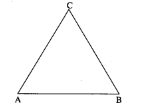
Let $\mathrm{ABC}$ be a triangle with $\overline{A B}=\hat{i}+2 \hat{j}, \overline{B C}=\hat{i}+\hat{k}$.
By triangle law of vectors
$\overline{A C}=\overline{A B}+\overline{B C}$
$\begin{aligned} & =(\hat{i}+2 \hat{j})+(\hat{i}+\hat{k})=2 \hat{i}+2 \hat{j}+\hat{k} \\ \therefore & l(\mathrm{AC})=|\overline{\mathrm{AC}}|=\sqrt{2^2+2^2+1^2}=\sqrt{9}=3 \text { units }\end{aligned}$
Hence, the length of third side is 3 units.
View full question & answer→Question 143 Marks
If in parallelogram $A B C D$, diagonal vectors are $\overline{A C}=2 \hat{i}+3 \hat{j}+4 \hat{k}$ and $\overline{B D}=$$-6 \hat{i}+7 \hat{j}-2 \hat{k}$, then find the adjacent side vectors $\overline{A B}$ and $\overline{A D}$
AnswerABCD is a parallelogram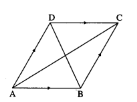
$\begin{aligned} & \therefore \overline{\mathrm{AB}}=\overline{\mathrm{DC}}, \overline{\mathrm{AD}}=\overline{\mathrm{BC}} \\ & \overline{\mathrm{AC}}=\overline{\mathrm{AB}}+\overline{\mathrm{BC}}\end{aligned}$
$\begin{gathered}=\overline{\mathrm{AB}}+\overline{\mathrm{AD}}$\ldots$ (1) \\ \overrightarrow{\mathrm{BD}}=\overline{\mathrm{BA}}+\overline{\mathrm{AD}}=-\overline{\mathrm{AB}}+\overline{\mathrm{AD}}\end{gathered}$
Adding (1) and (2), we get
$2 \overline{\mathrm{AD}}=\overline{\mathrm{AC}}+\overline{\mathrm{BD}}=(2 \hat{i}+3 \hat{j}+4 \hat{k})+(-6 \hat{i}+7 \hat{j}-2 \hat{k})$
$=-4 \hat{i}+10 \hat{j}+2 \hat{k}$
$\therefore \overline{\mathrm{AD}}=\frac{1}{2}(-4 \hat{i}+10 \hat{j}+2 \hat{k})$
$=-2 \hat{i}+5 \hat{j}+\hat{k}$
$\operatorname{From}(1), \overline{\mathrm{AB}}=\overline{\mathrm{AC}}-\overline{\mathrm{AD}}$
$\begin{aligned} & =(2 \hat{i}+3 \hat{j}+4 \hat{k})-(-2 \hat{i}+5 \hat{j}+\hat{k}) \\ & =4 \hat{i}-2 \hat{j}+3 \hat{k}\end{aligned}$
View full question & answer→Question 153 Marks
If $\bar{a}, \bar{b}, \bar{c}$ are non coplanar vectors, then show that the four points $2 \bar{a}+\bar{b}, \bar{a}+2 \bar{b}+\bar{c}, 4 \bar{a}-2 \bar{b}-\bar{c}$ and $3 \bar{a}+4 \bar{b}-5 \bar{c}$ are coplanar.
AnswerLet 4 prints be, $\mathrm{P}(\bar{p}), \mathrm{Q}(\bar{q}), \mathrm{R}(\bar{r})$ and $\mathrm{S}(\bar{s})$
$
\begin{aligned}
& \bar{P}=2 \bar{a}+\bar{b}, q=\bar{a}+2 \bar{b}+\bar{c}, \\
& \bar{r}=4 \bar{a}-2 \bar{b}-\bar{c}, \bar{s}=3 \bar{a}+4 \bar{b}-5 \bar{c}
\end{aligned}
$
Let us form 3 coinitial vectors
$
\begin{aligned}
& \overline{P Q}=\bar{q}-\bar{p}=(\bar{a}+2 \bar{b}+\bar{c})-(2 \bar{a}+\bar{b})=-\bar{a}+\bar{b}+\bar{c} \\
& \overline{P R}=\bar{r}-\bar{p}=(4 \bar{a}-2 \bar{b}-\bar{c})-(2 \bar{a}+\bar{b})=2 \bar{a}-3 \bar{b}-\bar{c} \\
& \overline{P S}=\bar{s}-\bar{p}=(3 \bar{a}+4 \bar{b}-5 \bar{c})-(2 \bar{a}+\bar{b})=\bar{a}+3 \bar{b}-5 \bar{c}
\end{aligned}
$
If $\mathrm{P}, \mathrm{Q}, \mathrm{R}, \mathrm{S}$, are coplanar then these three vectors $\overline{P Q}, \overline{P R}$ and $\overline{P S}$ are also coplanar this is possible only if $\overline{P Q} \cdot(\overline{P R} \times \overline{P S})=0$
$
\overline{P Q} \cdot(\overline{P R} \times \overline{P S})=\left|\begin{array}{ccc}
-1 & 1 & 1 \\
2 & -3 & -1 \\
1 & 3 & -5
\end{array}\right| \quad=-1(15+3)-1(-10+1)+1(6+3)=-18+9+9=0
$
View full question & answer→Question 163 Marks
Show that the points $A(2,-1,0) B(-3,0,4), C(-1,-1,4)$ and $D(0,-5,2)$ are non coplanar.
Answer$
\begin{aligned}
& \text { Let } \bar{a}=2 \hat{i}-\hat{j}, \bar{b}=-3 \hat{i}+4 \hat{k}, \bar{c}=-\hat{i}-\hat{j}+4 \hat{k}, \bar{c}=\hat{i}+\hat{j}+4 \hat{k}, \bar{d}=5 \hat{i}+2 \hat{k} \\
& \overline{A B}=\bar{b}-\bar{c}=-5 \hat{i}+\hat{i}+4 \hat{k} \\
& \overline{A C}=\bar{c}-\bar{a}=-3 \hat{i}+4 \hat{k} \\
& \overline{A D}=\bar{d}-\bar{a}=-2 \hat{i}-4 \hat{j}+2 \hat{k} \\
\end{aligned}
$
$\begin{aligned}
\text { Consider : }
(\overline{A B}) \cdot(\overline{A C}) \times(\overline{A D}) & =\left[\begin{array}{ccc}
-5 & 1 & 4 \\
-3 & 0 & 4 \\
-2 & -4 & 2
\end{array}\right] \\
& =-5[0+16)-1[-6+8]+4[12] \\
& =-80-2+48 \\
& =34 \neq 0
\end{aligned}
$
Therefore, the points $A, B, C, D$ are non-coplanar.
View full question & answer→Question 173 Marks
If M is the foot of the perpendicular drawn from A(4, 3, 2) on the line joining the points B(2, 4, 1) and C (4, 5, 3), find the coordinates of M.
AnswerLet the point $\mathrm{M}$ divides $\mathrm{BC}$ internally in the ratio $\mathrm{k}: 1$
$
\therefore M \equiv\left(\frac{4 k+2}{k+1}, \frac{5 k+4}{k+1}, \frac{3 k+1}{k+1}\right)
$
$\therefore$ Direction ratios of AM are
$
\frac{4 k+2}{k+1}-4, \frac{5 k+4}{k+1}-3, \frac{3 k+1}{k+1}-2=\bar{p} \text { (say) }
$
i.e. $\frac{-2}{K+1}, \frac{2 k+1}{k+1}, \frac{k-1}{k+1}$ and direction ratios of $\mathrm{BC}$ are $4-2,5-4,3-1$ i.e. $2,1,2=\bar{q}$ (say)
since AM is perpendicular to $\mathrm{BC}, \bar{p} \cdot \bar{q}=0$
$
\text { i.e. } 2 \frac{(-2)}{k+1}+1 \frac{(2 k+1)}{k+1}+2 \frac{(k-1)}{k+1}=0
$
i.e. $-4+2 k+1+2 k-2=0$
$
\begin{aligned}
& \therefore \quad 4 \mathrm{k}-5=0 \\
& \therefore \quad k=\frac{5}{4} \\
\end{aligned}
$
from (I) $M \equiv\left(\frac{28}{9}, \frac{41}{9}, \frac{19}{9}\right)$
View full question & answer→Question 183 Marks
Find the direction cosines of the line which is perpendicular to the lines with direction ratios $-1,2,2$ and $0,2,1$.
AnswerGiven $-1,2,2$ and $0,2,1$ be direction ratios of lines $\mathrm{L}_1$ and $\mathrm{L}_2$.
Let $l, m, n$ be direction cosines of line $\mathrm{L}$. As line $\mathrm{L}$ is perpendicular to lines $\mathrm{L}_1$ and $\mathrm{L}_2$.
Then
$
\begin{aligned}
& -l+2 m+2 n=0 \quad \text { and } 2 m+n=0 \\
& 2 m+n=0 \\
& \therefore \quad 2 m=-n \\
& \therefore \quad \underline{m}=\underline{n} \quad 2 \\
& -l+2 m+2 n=0 \\
& \text { becomes } \\
& -l-n+2 n=0 \\
& -l+n=0 \\
& l=n \\
& \frac{l}{1}=\frac{n}{1} \\
& \text { i.e. } \quad \frac{1}{2}=\frac{n}{2} \\
\end{aligned}
$
from (I) and (II) $\frac{l}{2}=\frac{m}{-1}=\frac{n}{2}$
The direction ratios of line $\mathrm{L}$ are $2,-1,2$ and the direction cosines of line $\mathrm{L}$ are $\frac{2}{3}, \frac{-1}{3}, \frac{2}{3}$.
View full question & answer→Question 193 Marks
If $|\bar{a}|=5,|\bar{b}|=13$ and $|\bar{a} \times \bar{b}|=25$, find $\bar{a} \cdot \bar{b}$.
AnswerGiven $|\bar{a} \times \bar{b}|=25$
$\therefore|\bar{a}| \cdot|\bar{b}| \sin \theta=25(\theta$ is the angle between $\bar{a}$ and $\bar{b})$ $5 \times 13 \sin \theta=25$
$
\sin \theta=\frac{25}{5 \times 13}=\frac{5}{13}
$
$
\begin{aligned}
\therefore \cos \theta & =\sqrt{1-\sin ^2 \theta}=\sqrt{1-\frac{25}{169}}= \pm \frac{12}{13} \\
\therefore \bar{a} \cdot \bar{b} & =|\bar{a}| \cdot|\bar{b}| \cos \theta \\
& =5 \times 13 \times\left( \pm \frac{12}{13}\right) \\
& = \pm 60
\end{aligned}
$
Thus $\bar{a} \cdot \bar{b}=60$ if $0<\theta^{\circ}<\pi / 2$ and
$
\bar{a} \cdot \bar{b}=-60 \text { if } \theta / 2<\theta<\pi .
$
View full question & answer→Question 203 Marks
If $\vec{a}=3 \hat{i}-\hat{j}+2 \hat{k}, \vec{b}=2 \hat{i}+\hat{j}-\hat{k}, \vec{c}=\hat{i}-2 \hat{j}+2 \hat{k}$, find $(\vec{a} \times \vec{b}) \times \vec{c}$ and $\vec{a} \times(\vec{b} \times \vec{c})$ and hence show that $(\vec{a} \times \vec{b}) \times \vec{c} \neq \vec{a} \times(\vec{b} \times \vec{c})$.
Answer$
\vec{a} \times \vec{b}=\left|\begin{array}{ccc}
\hat{i} & \hat{j} & \hat{k} \\
3 & -1 & 2 \\
2 & 1 & -1
\end{array}\right|=-\hat{i}+7 \hat{j}+5 \hat{k}
$
$
\begin{array}
(\bar{a} \times \bar{b}) \times c=(-\hat{i}+7 \hat{j}+5 \hat{k}) \times(\hat{i}-2 \hat{j}+2 \hat{k})=\left|\begin{array}{ccc}
\hat{i} & \hat{j} & \hat{k} \\
-1 & 7 & 5 \\
1 & -2 & 2
\end{array}\right| \\
=24 \hat{i}+7 \hat{j}-5 \hat{k}
\end{array}
$
Now, $\vec{b} \times \vec{c}=\left|\begin{array}{ccc}\hat{i} & \hat{j} & \hat{k} \\ 2 & 1 & -1 \\ 1 & -2 & 2\end{array}\right|=-5 \hat{j}-5 \hat{k}$
$
\vec{a} \times(\vec{b} \times \vec{c})=(3 \hat{i}-\hat{j}+2 \hat{k}) \times(-5 \hat{j}-5 \bar{k})
$$
\vec{a} \times(\vec{b} \times \vec{c})=\left|\begin{array}{ccc}
\hat{i} & \hat{j} & \hat{k} \\
3 & -1 & 2 \\
0 & -5 & -5
\end{array}\right|=15(\hat{i}+\hat{j}-\hat{k})
$
from (1) and (2), we conclude that
$
(\vec{a} \times \vec{b}) \times \vec{c} \neq \vec{a} \times(\vec{b} \times \vec{c})
$
View full question & answer→Question 213 Marks
A line passes through the points $(6,-7,-1)$ and $(2,-3,1)$. Find the direction ratios and the direction cosines of the line so that the angle $\alpha$ is acute.
AnswerLet $\mathrm{A}(6,-7,-1)$ and $\mathrm{B}(2,-3,1)$ be the given points. So $\bar{a}=6 \hat{i}-7 \hat{j}-\hat{k}, \bar{b}=2 \hat{i}-3 \hat{j}+\hat{k}$
$
\overline{A B}=\bar{b}-\bar{a}=(2-6) \hat{i}+(-3+7) \hat{j}+(1+1) \hat{k}=-4 \hat{i}+4 \hat{j}+2 \hat{\vec{k}}
$
the direction ratios of $\overline{A B}$ are $-4,4,2$.
Let the direction cosines of $\overline{A B}$ be $-4 \mathrm{k}, 4 \mathrm{k}, 2 \mathrm{k}$. Then
$
(-4 k)^2+(4 k)^2+(2 k)^2=1
$
i.e. $16 k^2+16 k^2+4 k^2=1$ i.e. $36 k^2=1$ i.e. $k= \pm \frac{1}{6}$
Since the line AB is so directed that the angle $\alpha$ which it makes with the $\mathrm{x}$-Axis is acute,
$
\therefore \quad \cos \alpha=-4 \mathrm{k}>0
$
$\therefore \quad$ As $k<0 \quad \therefore k=-\frac{1}{6}$
$\therefore \quad$ the direction cosines of $\overline{A B}$ are $-4\left(-\frac{1}{6}\right), 4\left(-\frac{1}{6}\right), 2\left(-\frac{1}{6}\right)$ i.e. $\frac{2}{3}, \frac{-2}{3}, \frac{-1}{3}$
View full question & answer→Question 223 Marks
Using vector method, find the incenter of the triangle whose vertices are $\mathrm{A}(0,3,0)$, $\mathrm{B}(0,0,4)$ and $\mathrm{C}(0,3,4)$.
AnswerLet $\bar{a}=3 \hat{j}, \bar{b}=4 \hat{k}$ and $\bar{c}=3 \hat{j}+4 \hat{k}$
$
\begin{array}{ll}
\therefore & \overline{\mathrm{AB}}=\bar{b}-\bar{a}=-3 \hat{j}+4 \hat{k}, \overline{\mathrm{AC}}=\bar{c}-\bar{a}=4 \hat{k}, \overline{\mathrm{BC}}=\bar{c}-\bar{b}=3 \hat{j} \\
\therefore & |\overline{\mathrm{AB}}|=5,|\overline{\mathrm{AC}}|=4,|\overline{\mathrm{BC}}|=3
\end{array}
$
If $\mathrm{H}(\bar{h})$ is the incenter of triangle $\mathrm{ABC}$ then,
$
\begin{aligned}
& \therefore & \bar{h} & =\frac{|\overline{\mathrm{BC}}| \bar{a}+|\overline{\mathrm{AC}}| \bar{b}+|\overline{\mathrm{AB}}| \bar{c}}{|\overline{\mathrm{BC}}|+|\overline{\mathrm{AC}}|+|\overline{\mathrm{AB}}|} \\
& \therefore & \bar{h} & =\frac{3(3 j)+4(4 k)+5(3 j+4 k)}{3+4+5} \\
& & & =\frac{9 j+16 k+15 j+20 k}{12} \\
& \therefore & \bar{h} & =\frac{24 \hat{j}+36 \hat{k}}{12} \\
& \therefore & \bar{h} & =2 \hat{j}+3 \hat{k} \\
& \text { And } & \mathrm{H} & \equiv(0,2,3)
\end{aligned}
$
Note : In $\triangle \mathrm{ABC}$,
1) P.V. of Centroid is given by $\frac{\bar{a}+\bar{b}+\bar{c}}{3}$
2) P.V. of Incentre is given by $\frac{|\overline{\mathrm{AB}}| \bar{c}+|\overline{\mathrm{BC}}| \bar{a}+|\overline{\mathrm{AC}}| \bar{b}}{|\overline{\mathrm{AB}}|+|\overline{\mathrm{BC}}|+|\overline{\mathrm{AC}}|}$
3) P.V. of Orthocentre is given by $\frac{\tan \mathrm{A} \bar{a}+\tan \mathrm{B} \bar{b}+\tan \mathrm{C} \bar{c}}{\tan \mathrm{A}+\tan \mathrm{B}+\tan \mathrm{C}}$ (Verify)
View full question & answer→Question 233 Marks
If $\mathrm{A}(5,1, p), \mathrm{B}(1, q, p)$ and $\mathrm{C}(1,-2,3)$ are vertices of triangle and $\mathrm{G}\left(r,-\frac{4}{3}, \frac{1}{3}\right)$ is its centroid, then find the values of $p, q$ and $r$.
AnswerLet
$
\begin{aligned}
& \bar{b}=\hat{i}+q \hat{j}+p \hat{k} \\
& \bar{c}=\hat{i}-2 \hat{j}+3 \hat{k} \text { and } \bar{g}=r \hat{i}-\frac{4}{3} \hat{j}+\frac{1}{3} \hat{k} \\
&
\end{aligned}
$
By centroid formula we have $\bar{g}=\frac{\bar{a}+\bar{b}+\bar{c}}{3}$
$
\begin{array}{ll}
\therefore & 3 \bar{g}=\bar{a}+\bar{b}+\bar{c} \\
\therefore & 3\left(r \hat{i}-\frac{4}{3} j+\frac{1}{3} k\right)=(5 \hat{i}+\hat{j}+p \hat{k})+(\hat{i}+q \hat{j}+p \hat{k})+(\hat{i}-2 \hat{j}+3 \hat{k}) \\
\therefore & (3 r) \hat{i}-4 \hat{j}+\hat{k}=7 \hat{i}+(q-1) \hat{j}+(2 p+3) \hat{k} \\
\therefore & 3 r=7,-4=q-1,1=2 p+3 \\
\therefore & r=\frac{7}{3}, q=-3, \quad p=-1
\end{array}
$
View full question & answer→Question 243 Marks
Find the co-ordinates of the point which divides the line segment joining the points $\mathrm{A}(2,-6,8)$ and $\mathrm{B}(-1,3,-4)$. (i) Internally in the ratio $1: 3$. (ii) Externally in the ratio $1: 3$.
AnswerIf $\bar{a}$ and $\bar{b}$ are position vectors of the points A and B respectively, then $\bar{a}=2 \hat{i}-6 \hat{j}+8 \hat{k}$ and $\bar{b}=-\hat{i}+3 \hat{j}-4 \hat{k}$.
Suppose $\mathrm{R}(\bar{r})$ is the point which divides the line segment joining the points $\mathrm{A}(\bar{a})$ and $\mathrm{B}(\bar{b})$ internally in the ratio $1: 3$ then,
$
\begin{aligned}
& \bar{r}=\frac{1(\bar{b})+3(\bar{a})}{1+3}=\frac{-1(\hat{i}+3 \hat{j}-4 \hat{k})+3(2 \hat{i}-6 \hat{j}+8 \hat{k})}{4} \\
& \therefore \bar{r}=\frac{5 \hat{i}-15 \hat{j}+20 \hat{k}}{4}
\end{aligned}
$
$\therefore$ The coordinates of the point $\mathrm{R}$ are $\left(\frac{5}{4}, \frac{-15}{4}, 5\right)$.
Suppose $\mathrm{S}(\bar{s})$ is the point which divides the line joining the points $\mathrm{A}(\bar{a})$ and $\mathrm{B}(\bar{b})$ externally in the ratio $1: 3$ then,
$
\begin{aligned}
& \bar{s}=\frac{1 \bar{b}-3 \bar{a}}{1-3}=\frac{(-\hat{i}+3 \hat{j}-4 \hat{k})-3(2 \hat{i}-6 \hat{j}+8 \hat{k})}{-2} \\
& \therefore \bar{s}=\frac{-7 \hat{i}+21 \hat{j}-28 \hat{k}}{-2}
\end{aligned}
$
$\therefore$ The coordinates of the point $\mathrm{S}$ are $\left(\frac{7}{2}, \frac{-21}{2}, 14\right)$.
View full question & answer→Question 253 Marks
If $\bar{a}=\hat{i}+2 \hat{j}+3, \bar{b}=3 \hat{i}+2 \hat{j}$ and $\bar{c}=2 \hat{i}+\hat{j}+3$ then verify that $\bar{a} \times(\bar{b} \times \bar{c})=(\bar{a} \cdot \bar{c})$$\bar{b}-(\bar{a} \cdot \bar{b}) \bar{c}$
Answer$\bar{b} \times \bar{c}=\left|\begin{array}{ccc}\hat{i} & \hat{j} & \hat{k} \\ 3 & 2 & 0 \\ 2 & 1 & 3\end{array}\right|$$=(6-0) \hat{i}-(9-0) \hat{j}+(3-4) \hat{k}$
$=6 \hat{i}-9 \vec{j}-\vec{k}$
$\therefore \bar{a} \times(\bar{b} \times \bar{c})=\left|\begin{array}{rrr}\hat{i} & \hat{j} & \hat{k} \\ 1 & 2 & 3 \\ 6 & -9 & -1\end{array}\right|$
$=(-2+27) \hat{i}-(-1-18) \hat{j}+(-9-12) \hat{k}$
$=25 \hat{i}+19 \hat{j}-21 \hat{k}$
$\ldots$ (1)
$\begin{aligned} \bar{a} \cdot \bar{c} & =(\hat{i}+2 \hat{j}+3 \hat{k}) \cdot(2 \hat{i}+\hat{j}+3 \hat{k}) \\ & =(1)(2)+(2)(1)+(3)(3)\end{aligned}$
$\begin{aligned} & =2+2+9=13 \\ \therefore & (\vec{a} \cdot \bar{c}) \bar{b}=13(3 \hat{i}+2 \hat{j})=39 \hat{i}+26 \hat{j}\end{aligned}$
Also, $\begin{aligned} \bar{a} \cdot \bar{b} & =(\vec{i}+2 \vec{j}+3 \hat{k}) \cdot(3 \vec{i}+2 \hat{j}) \\ & =(1)(3)+(2)(2)+(3)(0)\end{aligned}$
$\begin{aligned} & =(1)(3)+(2)(2)+(3)(0) \\ & =3+4+0=7\end{aligned}$
$\therefore(\vec{a} \cdot \bar{b}) \bar{c}=7(2 \hat{i}+\hat{j}+3 \hat{k})=14 \hat{i}+7 \hat{j}+21 \hat{k}$
$\therefore(\bar{a} \cdot \bar{c}) \bar{b}-(\bar{a} \cdot \bar{b}) \bar{c}$
$\begin{aligned} & =(39 \hat{i}+26 \hat{j})-(14 \hat{i}+7 \hat{j}+21 \hat{k}) \\ & =25 \hat{i}+19 \hat{j}-21 \hat{k}\end{aligned}$
$\ldots$ (1)
$\begin{aligned} \bar{a} \cdot \bar{c} & =(\hat{i}+2 \hat{j}+3 \hat{k}) \cdot(2 \hat{i}+\hat{j}+3 \hat{k}) \\ & =(1)(2)+(2)(1)+(3)(3)\end{aligned}$
$=2+2+9=13$
$\therefore(\bar{a} \cdot \bar{c}) \bar{b}=13(3 \hat{i}+2 \hat{j})=39 \hat{i}+26 \hat{j}$ Also, $\begin{aligned} \bar{a} \cdot \bar{b} & =(\hat{i}+2 \hat{j}+3 \hat{k}) \cdot(3 \hat{i}+2 \hat{j}) \\ & =(1)(3)+(2)(2)+(3)(0) \\ & =3+4+0=7\end{aligned}$ $\therefore(\bar{a} \cdot \bar{b}) \bar{c}=7(2 \hat{i}+\hat{j}+3 \hat{k})=14 \hat{i}+7 \hat{j}+21 \hat{k}$
$\therefore(\bar{a} \cdot \bar{c}) \bar{b}-(\bar{a} \cdot \bar{b}) \bar{c}$
$\begin{aligned} & =(39 \hat{i}+26 \hat{j})-(14 \hat{i}+7 \hat{j}+21 \hat{k}) \\ & =25 \hat{i}+19 \hat{j}-21 \hat{k}\end{aligned}$
$\ldots(2)$
From (1) and (2), we get
$\bar{a} \times(\bar{b} \times \bar{c})=(\bar{a}-\bar{c}) \bar{b}-(\bar{a} \cdot \bar{b}) \bar{c}$
View full question & answer→Question 263 Marks
Find the volume of a tetrahedron whose vertices are A( -1, 2, 3) B(3, -2, 1), C (2, 1, 3) and D(-1, -2, 4).
AnswerThe position vectors $\bar{a}_t, \bar{b}, \bar{c}$ and $\bar{d}$ of the points $\mathrm{A}, \mathrm{B}, \mathrm{C}$ and $\mathrm{D}$ w.r.t. the origin are $\bar{a}=$$-\hat{i}+2 \hat{j}+3 \hat{k}_t \bar{b}=3 \hat{i}-2 \hat{j}+\hat{k}_z \bar{c}=2 \hat{i}+\hat{j}+3 \hat{k}$ and
$\bar{d}=-\hat{i}-2 \hat{j}+4 \hat{k}$
$\therefore \overline{\mathrm{AB}}=\bar{b}-\bar{a}=(3 \hat{i}-2 \hat{j}+\hat{k})-(-\hat{i}+2 \hat{j}+3 \hat{k})$
$=4 \hat{i}-4 \hat{j}-2 \hat{k}$
$\overline{\mathrm{AC}}=\bar{c}-\bar{a}=(2 \hat{i}+\hat{j}+3 \hat{k})-(-\hat{i}+2 \hat{j}+3 \hat{k})$
$=3 \hat{i}-\hat{j}$
and $\overline{\mathrm{AD}}=\bar{d}-\bar{a}=(-\hat{i}-2 \hat{j}+4 \hat{k})-(-\hat{i}+2 \vec{j}+3 \hat{k})$
$=-4 \hat{j}+\hat{k}$
$\therefore[\overline{\mathrm{AB}} \overline{\mathrm{AC}} \overline{\mathrm{AD}}]=\left|\begin{array}{rrr}4 & -4 & -2 \\ 3 & -1 & 0 \\ 0 & -4 & 1\end{array}\right|$
$=4(-1+0)+4(3-0)-2(-12+0)$
$=-4+12+24=32$
$\therefore$ volume of the tetrahedron $=\frac{1}{6}|[\overline{\mathrm{AB}} \overline{\mathrm{AC}} \overline{\mathrm{AD}}]|$
$=\frac{1}{6}(32)=\frac{16}{3}$ cu units.
View full question & answer→Question 273 Marks
If $\mathrm{u}=\hat{\mathbf{i}}-2 \hat{\mathbf{j}}+\hat{k}, \bar{v}=3 \hat{\mathbf{i}}+\hat{k}$ and $\bar{w}=\hat{\mathbf{j}}-\hat{\mathbf{k}}$ are given vectors, then find(i) $[\bar{u}+\bar{w}] \cdot[(\bar{w} \times \bar{r}) \times(\bar{r} \times \bar{w})]$
Question is modified.
If $\bar{u}=\hat{\mathbf{i}}-2 \hat{\mathbf{j}}+\hat{k}, \bar{r}=3 \hat{\mathbf{i}}+\hat{k}$ and $\bar{w}=\hat{\mathbf{j}}-\hat{\mathbf{k}}$ are given vectors, then find $[\bar{u}+\bar{w}] \cdot[(\bar{u} \times$
$\bar{r}) \times(\bar{r} \times \bar{w})]$
Answer$\bar{u}+\bar{w}=(\hat{i}-2 \hat{j}+\hat{k})+(\hat{j}-\hat{k})$$=\vec{i}-\vec{j}$
$\bar{u} \times \bar{r}=\left|\begin{array}{rrr}\hat{i} & \hat{j} & \hat{k} \\ 1 & -2 & 1 \\ 3 & 0 & 1\end{array}\right|$
$\begin{aligned} & =(-2-0) \hat{i}-(1-3) \hat{j}+(0+6) \hat{k} \\ & =-2 \hat{i}+2 \hat{j}+6 \hat{k}\end{aligned}$
$\bar{r} \times \bar{w}=\left|\begin{array}{rrr}\hat{i} & \hat{j} & \hat{k} \\ 3 & 0 & 1 \\ 0 & 1 & -1\end{array}\right|$
$=(0-1) \hat{i}-(-3-0) \hat{j}+(3-0) \hat{k}$
$=-\hat{i}+3 \hat{j}+3 \hat{k}$
$\operatorname{Now}_r(\bar{u}+\bar{w}) \cdot[(\bar{u} \times \bar{r}) \times(\bar{r} \times \bar{w})]=\left|\begin{array}{rrr}1 & -1 & 0 \\ -2 & 2 & 6 \\ -1 & 3 & 3\end{array}\right|$
= 1(6 – 18) + 1 (-6 + 6) + 0
= -12 + 0 + 0 = -12.
View full question & answer→Question 283 Marks
If $\bar{c}=3 \bar{a}-2 \bar{b}$ prove that $[\bar{a} \bar{b} \bar{c}]=0$
AnswerWe use the results $: \bar{b} \times \bar{b}=0$ and if in a scalar triple product, two vectors are equal, thenthe scalar triple product is zero.
$\begin{aligned} {\left[\begin{array}{lll}\bar{a} & \bar{b} & \bar{c}\end{array}\right] } & =\bar{a} \cdot(\bar{b} \times \bar{c}) \\ & =\bar{a} \cdot[\bar{b} \times(\bar{a}-2 \bar{b})] \\ & =\bar{a} \cdot(3 \bar{b} \times \bar{a}-2 \bar{b} \times \bar{b}) \\ & =\bar{a} \cdot(3 \bar{b} \times \bar{a}-\overline{0}) \\ & =3 \bar{a} \cdot(\bar{b} \times \bar{a})=3 \times 0=0\end{aligned}$
Alternative Method:
$\begin{aligned} & \bar{c}=3 \bar{a}-2 \bar{b} \\ & \therefore \bar{c} \text { is a linear combination of } \bar{a} \text { and } \bar{b} \\ & \therefore \bar{a}, \bar{b}, \bar{c} \text { are coplanar } \\ & \therefore[\bar{a} \bar{b} \bar{c}]=0 .\end{aligned}$
View full question & answer→Question 293 Marks
Find the direction ratios of a vector perpendicular to the two lines whose direction ratios are(i) -2, 1, -1 and -3, -4, 1
AnswerLet a, b, c be the direction ratios of the vector which is perpendicular to the two lines whose direction ratios are -2, 1, -1 and -3, -4, 1 ∴ -2a + b – c = 0 and -3a – 4b + c = 0$\begin{aligned} & \therefore \frac{a}{\left|\begin{array}{cc}1 & -1 \\ -4 & 1\end{array}\right|}=\frac{b}{\left|\begin{array}{cc}-1 & -2 \\ 1 & -2\end{array}\right|}=\frac{c}{\left|\begin{array}{cc}-2 & 1 \\ -3 & -4\end{array}\right|} \\ & \therefore \frac{a}{1-4}=\frac{b}{3+2}=\frac{c}{8+3}\end{aligned}$
$\therefore \frac{a}{-3}=\frac{b}{5}=\frac{c}{11}$
∴ the required direction ratios are -3, 5, 11 Alternative Method:
Let $\bar{a}$ and $\bar{b}$ be the vectors along the lines whose direction ratios are $-2,1,-1$ and $-3,-4,1$
respectively.
Then $\bar{a}=-2 \hat{i}+\hat{j}-\hat{k}$ and $\bar{b}=-3 \hat{i}-4 \hat{j}+\hat{k}$
The vector perpendicular to both $\bar{a}$ and $\bar{b}$ is given by
$\bar{a} \times \bar{b}=\left|\begin{array}{ccc}\hat{i} & \hat{j} & \hat{k} \\ -2 & 1 & -1 \\ -3 & -4 & 1\end{array}\right|$
$=(1-4) \hat{i}-(-2-3) \hat{j}+(8+3) \hat{k}$
$=-3 \hat{i}+5 \hat{j}+11 \hat{k}$
Hence, the required direction ratios are -3, 5, 11.
View full question & answer→Question 303 Marks
Find $\bar{a}_1$ if $\bar{a} \times \hat{i}+2 \bar{a}-5 \hat{j}=\overline{0}$.
AnswerLet $\bar{a}=x \hat{i}+y \hat{j}+z \hat{k}$Then $\begin{aligned} \bar{a} \times \hat{i} & =(x \hat{i}+y \hat{j}+z \hat{k}) \times \hat{i} \\ & =x(\hat{i} \times \hat{i})+y(\hat{j} \times \hat{i})+z(\hat{k} \times \hat{i}) \\ & =z \hat{j}-y \hat{k} \ldots[\because \hat{i} \times \hat{i}=\overline{0}, \hat{j} \times \hat{i}=-\hat{k}, \hat{k} \times \hat{i}=\hat{j}]\end{aligned}$
It is given that
$\bar{a} \times \hat{i}+2 \bar{a}-5 \hat{j}=\overline{0}$
$\begin{aligned} & \therefore z \hat{j}-y \hat{k}+2(x \hat{i}+y \hat{j}+z \hat{k})-5 \hat{j}=0 \\ & \therefore z \hat{j}-y \hat{k}+2 x \hat{i}+2 y \hat{j}+2 z \hat{k}-5 \hat{j}=\overline{0} \\ & \therefore 2 x \hat{i}+(2 y+z-5) \hat{j}+(2 z-y) \hat{k}=\overline{0}\end{aligned}$
By equality of vectors
2x = 0 i.e. x = 0 2y + z – 5 = 0 … (1) 2z – y = 0 … (2) From (2), y = 2z Substituting y = 2z in (1), we get 4z + z = 5 ∴ z = 1 ∴ y = 2z = 2(1) = 2 ∴ x = 0, y = 2, z = 1
$\therefore \bar{a}=2 \hat{j}+\hat{k}$
View full question & answer→Question 313 Marks
If $\bar{a}_{,} \bar{b}, \bar{c}$ and $\bar{d}$ are four distinct vectors such that $\bar{a} \times \bar{b}=\bar{c} \times \bar{d}$ and $\bar{a} \times \bar{c}=\bar{b} \times \bar{d}$,
prove that $\bar{a}-\bar{d}$ is parallel to $\bar{b}-\bar{c}$.
Answer$\bar{a}, \bar{b}, \bar{c}$ and $\bar{d}$ are four distinct vectors$\therefore \bar{a} \neq \bar{b} \neq \bar{c} \neq \bar{d}$
$\therefore \bar{a}-\bar{d} \neq \overline{0}$ and $\bar{b}-\bar{c} \neq \overline{0}$
$\ldots(1)$
Now, $\bar{a} \times \bar{b}=\bar{c} \times \bar{d}$
$\ldots(2)$
and $\bar{a} \times \bar{c}=\bar{b} \times \bar{d}$
$\ldots(3)$
Subtracting (3) from (2), we get
$\bar{a} \times \bar{b}-\bar{a} \times \bar{c}=\bar{c} \times \bar{d}-\bar{b} \times \bar{d}$
$\begin{aligned} & \therefore \bar{a} \times(\bar{b}-\bar{c})=(\bar{c}-\bar{b}) \times \bar{d}=-(\bar{b}-\bar{c}) \times \bar{d} \\ & \quad=\bar{d} \times(\bar{b}-\bar{c}) \\ & \therefore \bar{a} \times(\bar{b}-\bar{c})-\bar{d} \times(\bar{b}-\bar{c})=\overline{0} \\ & \therefore(\bar{a}-\bar{d}) \times(\bar{b}-\bar{c})=\overline{0}\end{aligned}$
$\therefore \bar{a}-\bar{d}$ and $\bar{b}-\bar{c}$ are parallel to each other.
$\ldots[B y(1)]$
View full question & answer→Question 323 Marks
Show that vector area of a quadrilateral $\mathrm{ABCD}$ is $\frac{1}{2}(\overline{A C} \times \overline{B D})$, where $\mathrm{AC}$ and $\mathrm{BD}$ are its diagonals.
AnswerLet ABCD be a parallelogram.Then $\overline{\mathrm{AC}}=\overline{\mathrm{AB}}+\overline{\mathrm{BC}}$
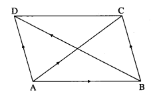
and $\begin{aligned} \overline{\mathrm{BD}} & =\overline{\mathrm{BA}}+\overline{\mathrm{AD}}=-\overline{\mathrm{AB}}+\overline{\mathrm{BC}} \quad \ldots[\because \overline{\mathrm{BC}}=\overline{\mathrm{AD}}] \\ & =\overline{\mathrm{BC}}-\overline{\mathrm{AB}}\end{aligned}$
$\therefore \overline{\mathrm{AC}} \times \overline{\mathrm{BD}}=(\overline{\mathrm{AB}}+\overline{\mathrm{BC}}) \times(\overline{\mathrm{BC}}-\overline{\mathrm{AB}})$
$\begin{aligned} & =\overline{\mathrm{AB}} \times(\overline{\mathrm{BC}}-\overline{\mathrm{AB}})+\overline{\mathrm{BC}} \times(\overline{\mathrm{BC}}-\overline{\mathrm{AB}}) \\ & =\overline{\mathrm{AB}} \times \overline{\mathrm{BC}}-\overline{\mathrm{AB}} \times \overline{\mathrm{AB}}+\overline{\mathrm{BC}} \times \overline{\mathrm{BC}}-\overline{\mathrm{BC}} \times \overline{\mathrm{AB}} \\ & =\overline{\mathrm{AB}} \times \overline{\mathrm{BC}}+\overline{\mathrm{AB}} \times \overline{\mathrm{BC}}\end{aligned}$
$\ldots[\overline{\mathrm{AB}} \times \overline{\mathrm{AB}}=\mathrm{BC} \times \overline{\mathrm{BC}}=0$ and $-\overline{\mathrm{BC}} \times \overline{\mathrm{AB}}=\overline{\mathrm{AB}} \times \overline{\mathrm{BC}}]$
$\therefore \overline{\mathrm{AC}} \times \overline{\mathrm{BD}}=2(\overline{\mathrm{AB}} \times \overline{\mathrm{BC}})$
$=2$ (vector area of parallelogram $\mathrm{ABCD})$
$\therefore$ vector area of parallelogram $\mathrm{ABCD}=\frac{1}{2}(\overline{\mathrm{AC}} \times \overline{\mathrm{BD}})$.
View full question & answer→Question 333 Marks
The direction ratios of $\overline{A B}$ are $-2,2$, 1. If $A=(4,1,5)$ and $I(A B)=6$ units, find $B$.
AnswerThe direction ratio of $\overline{A B}$ are $-2,2,1$.$\therefore$ the direction cosines of $\overline{A B}$ are
$l=\frac{-2}{\sqrt{(-2)^2+2^2+1^2}}=\frac{-2}{3}$,
$m=\frac{2}{\sqrt{(-2)^2+2^2+1^2}}=\frac{2}{3}$,
$n=\frac{1}{\sqrt{(-2)^2+2^2+1^2}}=\frac{1}{3}$.
i.e. $l=\frac{-2}{3}, m=\frac{2}{3}, n=\frac{1}{3}$
The coordinates of the points which are at a distance of d units from the point (x1, y1, z1) are given by (x1 ± ld, y1 ± md, z1 ± nd)
Here $x_1=4, y_1=1, z_1=5, d=6,1=-\frac{2}{3}, m=\frac{2}{3}, n=\frac{1}{3}$
∴ the coordinates of the requited points are
$\begin{aligned} & \left(4 \pm\left(-\frac{2}{3}\right) 6,1 \pm \frac{2}{3}(6), 5 \pm \frac{1}{3}(6)\right) \\ & \text { i.e. }(4-4,1+4,5+2) \text { and }(4+4,1-4,5-2) \\ & \text { i.e. }(0,5,7) \text { and }(8,-3,3) \text {. }\end{aligned}$
View full question & answer→Question 343 Marks
If a line has the direction ratios, 4, -12, 18 then find its direction cosines.
AnswerThe direction ratios of the line are a = 4, b = -12, c = 18. Let l, m, n be the direction cosines of the line.Then $l=\frac{a}{\sqrt{a^2+b^2+c^2}}=\frac{4}{\sqrt{4^2+(-12)^2+(18)^2}}$
$=\frac{4}{\sqrt{16+144+324}}=\frac{4}{22}=\frac{2}{11}$
$m=\frac{b}{\sqrt{a^2+b^2+c^2}}=\frac{-12}{\sqrt{4^2+(-12)^2+(18)^2}}$
$=\frac{-12}{\sqrt{16+144+324}}=\frac{-12}{22}=\frac{-6}{11}$
and $n=\frac{c}{\sqrt{a^2+b^2+c^2}}=\frac{18}{\sqrt{4^2+(-12)^2+(18)^2}}$
$=\frac{18}{\sqrt{16+144+324}}=\frac{18}{22}=\frac{9}{11}$
Hence, the direction cosines of the line are $\frac{2}{11}, \frac{-6}{11}, \frac{9}{11}$.
View full question & answer→Question 353 Marks
If a vector has direction angles 45ºand 60º find the third direction angle.
AnswerLet α = 45°, β = 60° We have to find γ.$\begin{aligned} & \therefore \cos ^2 \alpha+\cos ^2 \beta+\cos ^2 \gamma=1 \\ & \therefore \cos ^2 45^{\circ}+\cos ^2 60^{\circ}+\cos ^2 \gamma=1\end{aligned}$
$\begin{aligned} & \therefore\left(\frac{1}{\sqrt{2}}\right)^2+\left(\frac{1}{2}\right)+\cos ^2 \gamma=1 \\ & \therefore \cos ^2 \gamma=1-\frac{1}{2}-\frac{1}{4}=\frac{1}{4}\end{aligned}$
$\therefore \cos \gamma= \pm \frac{1}{2}$
$\therefore \cos \gamma=\frac{1}{2}$ or $\cos \gamma=-\frac{1}{2}$
$\therefore \cos \gamma=\cos \frac{\pi}{3}$ or $\cos \gamma=-\cos \frac{\pi}{3}$
$=\cos \left(\pi-\frac{\pi}{3}\right)=\cos \frac{2 \pi}{3}$
$\therefore \gamma=\frac{\pi}{3}$ or $\gamma=\frac{2 \pi}{3}$
Hence, the third direction angle is $\frac{\pi}{3}$ or $\frac{2 \pi}{3}$.
View full question & answer→Question 363 Marks
Prove by vector method that the angle subtended on semicircle is a right angle.
AnswerLet seg AB be a diameter of a circle with centre C and P be any point on the circle other than A and B. Then ∠APB is an angle subtended on a semicircle.Let $\overline{\mathrm{AC}}=\overline{\mathrm{CB}}=\bar{a}$ and $\overline{\mathrm{CP}}=\bar{r}$.
Then $|\bar{a}|=|\bar{r}| \ldots(1)$
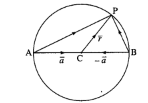
$\overline{\mathrm{AP}}=\overline{\mathrm{AC}}+\overline{\mathrm{CP}}=\bar{a}+\bar{r}=\bar{r}+\bar{a}$
$\overline{\mathrm{BP}}=\overline{\mathrm{BC}}+\overline{\mathrm{CP}}=-\overline{\mathrm{CB}}+\overline{\mathrm{CP}}=-\bar{a}+\bar{r}$
$\begin{aligned} \therefore \overline{\mathrm{AP}} \cdot \overline{\mathrm{BP}}= & (\bar{r}+\bar{a}) \cdot(\bar{r}-\bar{a}) \\ & \bar{r} \cdot \bar{r}-\bar{r} \cdot \bar{a}+\bar{a} \cdot \bar{r}-\bar{a} \cdot \bar{a}\end{aligned}$
$=|\vec{r}|^2-|\bar{a}|^2=0 \quad \ldots(\because \bar{r} \cdot \bar{a}=\bar{a} \cdot \bar{r})$
$\therefore \overline{\mathrm{AP}} \perp \overline{\mathrm{BP}} \quad \therefore \angle \mathrm{APB}$ is a right angle.
Hence, the angle subtended on a semicircle is the right angle.
View full question & answer→Question 373 Marks
Suppose that all sides of a quadrilateral are equal in length and opposite sides are parallel. Use vector methods to show that the diagonals are perpendicular.
Answer
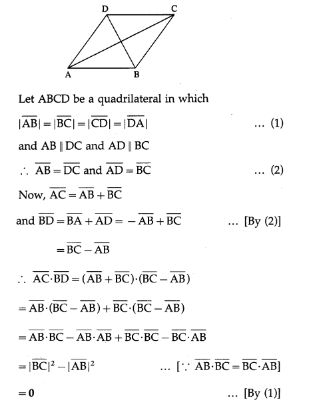
$\because \overline{\mathrm{AC}}, \overline{\mathrm{BD}}$ are non-zero vectors
$\therefore \overline{\mathrm{AC}}$ is perpendicular to $\overline{\mathrm{BD}}$
Hence, the diagonals are perpendicular.
View full question & answer→Question 383 Marks
Find the values of $c$ so that for all real $x$ the vectors $x c \hat{i}-6 \hat{j}+3 \hat{k}$ and $x \hat{i}+2 \hat{j}+2 c x \hat{k}$make an obtuse angle.
AnswerLet $\bar{a}=x c \hat{i}-6 \hat{j}+3 \hat{k}$ and $\bar{b}=x \hat{i}+2 \hat{j}+2 c x \hat{k}$Consider $\bar{a} \cdot \bar{b}=(x c \hat{i}-6 \hat{j}+3 \hat{k}) \cdot(x \hat{i}+2 \hat{j}+2 c x \hat{k})$
$=(x c)(x)+(-6)(2)+(3)(2 c x)$
$=c x^2-12+6 c x$
$=c x^2+6 c x-12$
If the angle between $\bar{a}$ and $\bar{b}$ is obtuse, $\bar{a} \cdot \bar{b}<0$.
$\begin{aligned} & \therefore c x^2+6 c x-12<0 \\ & \therefore c x^2+6 c x<12 \\ & \therefore c\left(x^2+6 x\right)<12 \\ & \therefore c<\frac{12}{x^2+6 x}\end{aligned}$
$\therefore c<\frac{12}{x^2+6 x}$
$\therefore c<\frac{12}{\left(x^2+6 x+9\right)-9}=\frac{12}{(x+3)^2-9}$
$\therefore c<\min \left\{\frac{12}{(x+3)^2-9}\right\}$
Now, $\frac{12}{(x+3)^2-9}$ is minimum if $(x+3)^2-9$ is maximum
$\begin{aligned} & \text { i.e. }(x+3)^2-9=\infty-9=\infty \\ & \therefore c<\min \left\{\frac{12}{\infty}\right\}=0 \\ & \therefore c<0 .\end{aligned}$
Hence, the angle between a and b is obtuse if c < 0.
View full question & answer→Question 393 Marks
If $\bar{a}$ and $\bar{b}$ are two vectors perpendicular to each other, prove that $(\bar{a}+\bar{b})^2=(\bar{a}-\bar{b})^2$
Answer$\bar{a}$ and $\bar{b}$ are perpendicular to each other.$\therefore \bar{a} \cdot \bar{b}=\bar{b} \cdot \bar{a}=0$
...(1)
$\begin{aligned} \mathrm{LHS} & =(\bar{a}+\bar{b})^2 \\ & =(\bar{a}+\bar{b}) \cdot(\bar{a}+\bar{b}) \\ & =\bar{a} \cdot(\bar{a}+\bar{b})+\bar{b} \cdot(\bar{a}+\bar{b}) \\ & =\bar{a} \cdot \bar{a}+\bar{a} \cdot \bar{b}+\bar{b} \cdot \bar{a}+\bar{b} \cdot \bar{b} \\ & =\bar{a} \cdot \bar{a}+0+0+\bar{b} \cdot \bar{b} \\ & =|\bar{a}|^2+|\bar{b}|^2\end{aligned}$
$\ldots$... [By (1)]
$\operatorname{RHS}=(\bar{a}-\bar{b})^2$
$\begin{aligned} & =(\bar{a}-\bar{b}) \cdot(\bar{a}-\bar{b}) \\ & =\bar{a} \cdot(\bar{a}-\bar{b})+\bar{b} \cdot(\bar{a}-\bar{b}) \\ & =\bar{a} \cdot \bar{a}-\bar{a} \cdot \bar{b}-\bar{b} \cdot \bar{a}+\bar{b} \cdot \bar{b} \\ & =\bar{a} \cdot \bar{a}+\bar{b} \cdot \bar{b} \\ & =|\bar{a}|^2+|\bar{b}|^2\end{aligned}$
$\ldots[$ By (1)]
Hence, $(\bar{a}+\bar{b})^2=(\bar{a}-\bar{b})^2$.
∴ LHS = RHS
Hence, $(\bar{a}+\bar{b})^2=(\bar{a}-\bar{b})^2$.
View full question & answer→Question 403 Marks
Find two unit vectors each of which is perpendicular to both$\bar{u}$ and $\bar{v}_{\text {, where }} \bar{u}=2 \hat{i}+\hat{j}-2 \hat{k}, \bar{v}=\hat{i}+2 \hat{j}-2 \hat{k}$
AnswerLet $\bar{u}=2 \hat{i}+\hat{j}-2 \hat{k}$$\bar{v}=\hat{i}+2 \hat{j}-2 \hat{k}$
Then $\bar{u} \times \bar{v}=\left|\begin{array}{ccc}\hat{i} & \hat{j} & \hat{k} \\ 2 & 1 & -2 \\ 1 & 2 & -2\end{array}\right|$
$=(-2+4) \hat{i}+(-4+2) \hat{j}+(4-1) \hat{k}$
$=2 \hat{i}-2 \hat{j}+3 \hat{k}$
$\therefore|\bar{u} \times \bar{v}|=\sqrt{(2)^2+(-2)^2+(3)^2}$
$\begin{aligned} & =\sqrt{4+4+9} \\ & =\sqrt{17}\end{aligned}$
$\begin{aligned} & = \pm \frac{\bar{u} \times \overline{\mathrm{v}}}{|\overline{\mathrm{u}} \times \overline{\mathrm{v}}|}= \pm \frac{2 \hat{\mathrm{i}}-2 \hat{\mathrm{j}}+3 \hat{k}}{\sqrt{17}} \\ & = \pm\left(\frac{2}{\sqrt{17}} \hat{\mathrm{i}}-\frac{2}{\sqrt{17}} \hat{\mathrm{j}}+\frac{3}{\sqrt{17}} \hat{\mathrm{k}}\right)\end{aligned}$
View full question & answer→Question 413 Marks
If two of the vertices of the triangle are A(3, 1, 4) and B(-4, 5, -3) and the centroid of a triangle is G(-1, 2, 1), then find the coordinates of the third vertex C of the triangle.
AnswerLet $\bar{a}_{,}, \bar{b}, \bar{c}$ and $\bar{g}$ be the position vectors of $A, B, C$ and $G$ respectively.Then $\bar{a}=3 \hat{i}+\hat{j}+4 \hat{k}, \bar{b}=-4 \hat{i}+5 \hat{j}-3 \hat{k}$ and $\bar{g}=-\hat{i}+2 \hat{j}+\hat{k}$
Since G is the centroid of the ∆ABC, by the centroid formula,
$\bar{g}=\frac{\bar{a}+\bar{b}+\bar{c}}{3} \quad \therefore 3 \bar{g}=\bar{a}+\bar{b}+\bar{c}$
$\begin{aligned} & \therefore 3(-\hat{i}+2 \hat{j}+\hat{k})=(3 \hat{i}+\hat{j}+4 \hat{k})+(-4 \hat{i}+5 \hat{j}-3 \hat{k})+\bar{c} \\ & \therefore-3 \hat{i}+6 \hat{j}+3 \hat{k}=(-\hat{i}+6 \hat{j}+\vec{k})+\bar{c}\end{aligned}$
$\therefore \bar{c}=(-3 \hat{i}+6 \hat{j}+3 \hat{k})-(-\hat{i}+6 \hat{j}+\hat{k})$
$\therefore \bar{c}=-2 \hat{i}+0 \cdot \hat{j}+2 \hat{k}$
∴ the coordinates of third vertex C are (-2, 0, 2).
View full question & answer→Question 423 Marks
The position vector of points $A$ and $B$ are $6 \bar{a}+2 \bar{b}$ and $\bar{a}-3 \bar{b}$. If the point $C$ divides $A B$ inthe ratio $3: 2$ then show that the position vector of $C$ is $3 \bar{a}-\bar{b}$.
Answerlet $\bar{c}$ be the nosition vector of $C$Since C divides AB in the ratio 3 : 2,
$\begin{aligned} \bar{c} & =\frac{3(\bar{a}-3 \bar{b})+2(6 \bar{a}+2 \bar{b})}{3+2} \\ & =\frac{3 \bar{a}-9 \bar{b}+12 \bar{a}+4 \bar{b}}{5}\end{aligned}$
$=\frac{1}{5}(15 \bar{a}-5 \bar{b})=3 \bar{a}-\bar{b}$
Hence, the position vector of $C$ is $3 \bar{a}-\bar{b}$.
View full question & answer→Question 433 Marks
Find the position vector of midpoint M joining the points L (7, -6, 12) and N (5, 4, -2).
AnswerThe position vectors $\bar{l}$ and $\bar{n}$ of the points $L(7,-6,12)$ and $N(5,4,-2)$ are given by$\bar{l}=7 \hat{i}-6 \hat{j}+12 \hat{k}, \bar{n}=5 \hat{i}+4 \hat{j}-2 \hat{k}$
If $\mathrm{M}(\bar{m})$ is the midpoint of $\mathrm{LN}$, by midpoint formula,
$\bar{m}=\frac{\bar{l}+\bar{n}}{2}=\frac{(7 \hat{i}-6 \hat{j}+12 \hat{k})+(5 \hat{i}+4 \hat{j}-2 \hat{k})}{2}$
$=\frac{1}{2}(12 \hat{i}-2 \hat{j}+10 \hat{k})=6 \hat{i}-\hat{j}+5 \hat{k}$
∴ coordinates of M = (6, -1, 5).
Hence, position vector of $\mathrm{M}$ is $6 \hat{i}-\hat{j}+5 \hat{k}$ and the coordinates of $\mathrm{M}$ are $(6,-1,5)$.
View full question & answer→Question 443 Marks
Find the area of the triangle with vertices (1, 1, 0), (1, 0, 1) and (0, 1, 1).
AnswerLet A = (1, 1, 0), B = (1, 0, 1), C = (0, 1, 1)$\begin{aligned} & l(\mathrm{AB})=\sqrt{(1-1)^2+(1-0)^2+(0-1)^2}=\sqrt{0+1+1}=\sqrt{2} \\ & l(\mathrm{BC})=\sqrt{(1-0)^2+(0-1)^2+(1-1)^2}=\sqrt{1+1+0}=\sqrt{2} \\ & l(\mathrm{CA})=\sqrt{(0-1)^2+(1-1)^2+(1-0)^2}=\sqrt{1+0+1}=\sqrt{2}\end{aligned}$
$\therefore l(\mathrm{AB})=l(\mathrm{BC})=l(\mathrm{CA})$
$\therefore$ the triangle is equilateral
$\begin{aligned} \therefore \text { its area } & =\frac{\sqrt{3}}{4}(\text { side })^2 \\ & =\frac{\sqrt{3}}{4}(\sqrt{2})^2 \\ & =\frac{\sqrt{3}}{2} \text { sq units }\end{aligned}$
View full question & answer→Question 453 Marks
In the figure 5.34 express $\bar{c}$ and $d$ in terms of $\bar{a}$ and $b$. Find a vector in the direction of $\bar{a}=$$\hat{i}-2 \hat{j}$ that has magnitude 7 units.
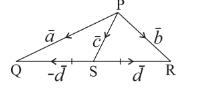
Answer$\begin{aligned} & \overline{\mathrm{PQ}}=\overline{\mathrm{PS}}+\overline{\mathrm{SQ}} \\ & \therefore \bar{a}=\bar{c}-\bar{d} \ldots(1) \\ & \overline{\mathrm{PR}}=\overline{\mathrm{PS}}+\overline{\mathrm{SR}} \\ & \therefore \bar{b}=\bar{c}+\bar{d} \ldots(2)\end{aligned}$Adding equations (1) and (2), we get
$\begin{aligned} & \bar{a}+\bar{b}=(\bar{c}-\bar{d})+(\bar{c}+\bar{d})=2 \bar{c} \\ & \therefore \bar{c}=\frac{1}{2}(\bar{a}+\bar{b})=\frac{1}{2} \bar{a}+\frac{1}{2} \bar{b}\end{aligned}$
Substituting for $\bar{c}$ in (2), we get
$\bar{d}=\bar{b}-\bar{c}=\bar{b}-\frac{1}{2}(\bar{a}+\bar{b})$
$\begin{aligned} & =\frac{2 \bar{b}-(\bar{a}+\bar{b})}{2} \\ & =\frac{1}{2}(\bar{b}-\bar{a})=\frac{1}{2} \bar{b}-\frac{1}{2} \bar{a}\end{aligned}$
Hence, $\bar{c}=\frac{1}{2} \bar{a}+\frac{1}{2} \bar{b}$ and $\bar{d}=\frac{1}{2} \bar{b}-\frac{1}{2}-\bar{a}$.
View full question & answer→Question 463 Marks
If $A B C D E F$ is a regular hexagon, show that $\overline{\mathrm{AB}}+\overline{\mathrm{AC}}+\overline{\mathrm{AD}}+\overline{\mathrm{AE}}+\overline{\mathrm{AF}}=6 \overline{\mathrm{AO}}$, where $\mathrm{O}$ is the center of the hexagon.
Answer
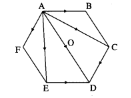
ABCDEF is a regular hexagon.
$\therefore \overline{\mathrm{AB}}=\overline{\mathrm{ED}}$ and $\overline{\mathrm{AF}}=\overline{\mathrm{CD}}$
∴ by the triangle law of addition of vectors,
$\begin{aligned} & \overline{\mathrm{AC}}+\overline{\mathrm{AF}}=\overline{\mathrm{AC}}+\overline{\mathrm{CD}}=\overline{\mathrm{AD}} \\ & \overline{\mathrm{AE}}+\overline{\mathrm{AB}}=\overline{\mathrm{AE}}+\overline{\mathrm{ED}}=\overline{\mathrm{AD}} \\ & \therefore \mathrm{LHS}=\overline{\mathrm{AB}}+\overline{\mathrm{AC}}+\overline{\mathrm{AD}}+\overline{\mathrm{AE}}+\overline{\mathrm{AF}}\end{aligned}$
$\begin{aligned} & =\overline{\mathrm{AD}}+(\overline{\mathrm{AC}}+\overline{\mathrm{AF}})+(\overline{\mathrm{AE}}+\overline{\mathrm{AB}}) \\ & =\overline{\mathrm{AD}}+\overline{\mathrm{AD}}+\overline{\mathrm{AD}} \\ & =3 \overline{\mathrm{AD}}=3(2 \overline{\mathrm{AO}}) \quad \ldots[\mathrm{O} \text { is midpoint of } \mathrm{AD}] \\ & =6 \overline{\mathrm{AO}} .\end{aligned}$
View full question & answer→Question 473 Marks
In the triangle $\mathrm{PQR}, \overline{\mathrm{PQ}}=2 \bar{a}$ and $\overline{\mathrm{QR}}=2 \bar{b}$. The mid-point of $\mathrm{PR}$ is $\mathrm{M}$. Find followingvectors in terms of $\bar{a}$ and $\bar{b}$.
1.$\overline{\mathrm{PR}}$
2.$\overline{\mathrm{PM}}$
3.$\overline{\mathrm{QM}}$
Answer
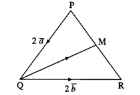
Given : $\overline{\mathrm{PQ}}=2 \bar{a}_r \overline{\mathrm{QR}}=2 \bar{b}$
$\begin{aligned} & \text { (i) } \overline{\mathrm{PR}}=\overline{\mathrm{PQ}}+\overline{\mathrm{QR}} \\ & =2 \bar{a}+2 \bar{a} .\end{aligned}$
View full question & answer→Question 483 Marks
The vector $\bar{a}$ is directed due north and $|\bar{a}|=24$. The vector $\bar{b}$ is directed due west and $|\bar{b}|$$=7$. Find $|\bar{a}+\bar{b}|$.
Answer
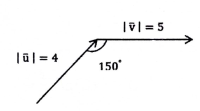
Let $\overline{\mathrm{AB}}=\bar{a}_r \overline{\mathrm{BC}}=\bar{b}$
Then $\overline{\mathrm{AC}}=\overline{\mathrm{AB}}+\overline{\mathrm{BC}}=\mathrm{a}+b$
Given: $|\bar{a}|=|\overline{\mathrm{AB}}|=1(\mathrm{AB})=24$ and
$|\bar{b}|=|\overline{\mathrm{BC}}|=\mid(\mathrm{BC})=7$
$\begin{aligned} & \therefore \angle A B C=90^{\circ} \\ & \therefore[I(A C)]^2=[I(A B)]^2+[I(B C)]^2\end{aligned}$
$\begin{aligned} & =(24)^2+(7)^2=625 \\ & \therefore|(\mathrm{AC})=25 \therefore| \overline{\mathrm{AC}} \mid=25 \\ & \therefore|\bar{a}+\bar{b}|=|\overline{\mathrm{AC}}|=25 .\end{aligned}$
View full question & answer→