Questions

Answer the following in Brief

🎯

Test yourself on this topic

18 questions · timed · auto-graded

Question 13 Marks
Define moment of inertia. State its SI unit and dimensions
Answer
The moment of inertia of a rotating rigid body is the sum of the product of each point mass and square of its distance from the axis of rotations.
S.I unit $= kg m^2$
Dimention $= (M^1 L^2 T^0)$
View full question & answer
Question 23 Marks
A stone of mass \(100 g\) attached to a string of length \(50 cm\) is whirled in a vertical circle by giving velocity at lowest point as \(7 m / s\). Find the velocity at the highest point. [Acceleration due to gravity \(=9.8 m / s ^2\) ].
Answer
Given: \(m =100 g =0.1 kg , r =50 cm =0.5 m , g =9.8 m / s ^2, v _{ L }=7 m / s\)
To find:Velocity at the highest point \(v _{ H }\)
\(v _{ H }=\sqrt{\frac{2\left( TE _{ H }\right)}{ m }-4 gr }\)
Calculation:Total energy at highest point,
T.E \(( H )= K \cdot E\) at lowest point \(=\frac{1}{2} mv _{ L }^2\)
\(\therefore T . E _{ H }=\frac{1}{2} \times 0.1 \times 7^2\)
\(=2.45 J\)
From formula,
\(v _{ H }=\sqrt{\frac{2(2.45)}{0.1}-4 \times 9.8 \times 0.5}\)
\(=\sqrt{29.4}=5.422 m / s\)
The velocity at the highest point is \(5.422 m / s\)
View full question & answer
Question 33 Marks
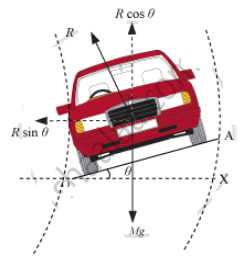
Draw a diagram showing all components of forces acting on a vehicle moving on a curved banked road. Write the necessary equation for maximum safety, speed and state the significance of each term involved in it.
Answer
  • Motion of a car on a banked road:
For the vehicle to go round the curved track at a reasonable speed without skidding, the greater centripetal force is managed for it by raising the outer edge of the track a little above the inner edge. It is called banking of circular tracks.
Image
Consider a vehicle of weight Mg, moving round a curved path of radius r, with a speed v, on a road banked through angleθ.
The vehicle is under the action of the following forces:
  • The weight Mg acting vertically downwards
  • The reaction R of the ground to the vehicle, acting along the normal to the banked road OA in the upward direction
The vertical component R cos θ of the normal reaction R will balance the weight of the vehicle and the horizontal component R sin θ will provide the necessary centripetal force to the vehicle. Thus,
R cosθ = Mg …(i)
\(R \sin \theta=\frac{M v^2}{r} \ldots \ldots .\). (ii)
On dividing equation (ii) by equation (i), we get
\(\frac{R \sin \theta}{R \cos \theta}=\frac{M v^2 / r}{M} g\)
\(\tan \theta=\frac{v^2}{r g}\)
As the vehicle moves along the circular banked road OA, the force of friction between the road and the tyres of the vehicle, F = μR, acts in the direction AO.
The frictional force can be resolved into two components:
  • μ R sinθ in the downward direction
  • μ R cosθ in the inward direction
Since there is no motion along the vertical,
R cos θ = Mg + μ R sinθ ……. (iii)
Let vmax be the maximum permissible speed of the vehicle. The centripetal force is now provided by the components R sinθ and μ Mg cosθ, i.e.,
\(R \sin \theta+\mu R \cos \theta=\frac{M v_{\max }^2}{r}\).....(iv)
From equation(iii),we have
Mg = R cosθ (1−μ tanθ)…(v)
Again from equation (iv), we have
\(\frac{M v_{\max }{ }^2}{r}\)
= R cosθ (μ + tanθ) …(vi)
On dividing equation (iv) by (v), we have
\(\frac{v_{\max }^2}{g r}=\frac{\mu+\tan \theta}{1-\tan \theta}\)
\(\Rightarrow v_{\max }=\left(\left(g r \frac{\mu+\tan \theta}{1-\mu \tan \theta}\right)^{1 / 2}\right.\)
Maximum optimum speed depends on:
1) Radius of the curved path,
2) Coefficient of friction
3) angle on inclination
Regards
View full question & answer
Question 43 Marks
A body starts rotating from rest. Due to a couple of \(20 Nm\) it completes $60$ revolutions in one minute. Find the moment of inertia of the body.
Answer
$T = 20\ N m, n = 60$ revolutions in $60\ s = 1 r.p.s., t = 1\ min = 60\ s$
Moment of inertia $(I) = ?$
Angular displacement $θ = ωt = 2πnt$
$= 2\pi \times 1 \times 60$
$= 120 \pi rad$
\(\theta=\omega_0 t+\frac{1}{2} \alpha t^2\)
\(120 \pi=0+\frac{1}{2} \alpha \times 60^2\)
\(\alpha=\frac{240 \pi}{60^2}\)
\(=\frac{\pi}{15} rad / s ^2\)
\(\tau= I \alpha\)
\(I=\frac{\tau}{\alpha}\)
\(=\frac{20}{\pi / 15}\)
\(=95.48 kg m ^2\)
∴ Moment of inertia of the body is $95.48\ kg m^2$
View full question & answer
Question 53 Marks
In a conical pendulum, a string of length \(120 cm\) is fixed at rigid support and carries a mass of \(150 g\) at its free end. If the mass is revolved in a horizontal circle of radius \(0.2 m\) around a vertical axis, calculate tension in the string \(\left(g=9.8 m / s ^2\right)\)
Answer
$I=120 cm=1.2 m$
$r=0.2 m$
$m=150 g=150 \times 10-3 kg=0.15 kg$
Tension in the supporting thread ( T )
By Pythagoras theorem,
$I^2=r^2+h^2$
$h^2=I^2-r^2$
$h^2=1.44-0.04=1.4$
$\therefore h=1.183 m$
Image
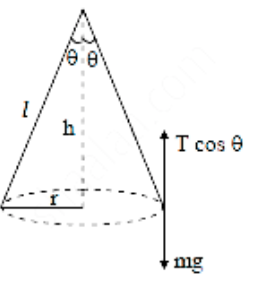
The weight of bob is balanced by vertical component of tension $T$
$\therefore T \cos \theta=mg$
$\cos \theta=\frac{h}{l}=\frac{1.183}{1.2}=0.9858$
$\therefore T=\frac{m g}{\cos \theta}=\frac{0.15 \times 9.8}{0.9858}=(\log (0.15)+\log (9.8)-\log (0.9858))$
$=(\overline{1} .1761+0.9912-\overline{1} .9938)$
$=\text { antilog }(0.1735)$
$=1.491 N$
$\therefore T=1.491 N$
The tension in the string is $1.491\ N$ .
View full question & answer
Question 63 Marks
A ballet dancer spins about a vertical axis at \(2.5 (\pi\) rad / sec). with his both arms outstretched. With the arms folded, the moment of inertia about the same axis of rotation changes by \(25 \%\). Calculate the new rotation in r.p.m.
Answer
$\omega_1=2.5 \pi rad / s=2 \pi n_1$
$\therefore I_2=\frac{3}{4} I_1, n_2(r \cdot p \cdot m)=?$
By conservation of angular momentum,
$I_2 \omega_2=I_1 \omega_1 \text { or } I_2\left(2 \pi n_2\right)=I_1\left(2 \pi n_1\right)$
$\therefore \quad n_2=\frac{I_1 n_1}{I_2}=\frac{I_1 \times 1.25}{\frac{3}{4} I_1}=\frac{1.25 \times 4}{3}$
$\therefore \quad n_2=\frac{5}{3} \text { r.p.s. }$
$=\frac{5}{3} \times 60=100 \text { r.p.m }$
The new speed of rotation in r.p.m is $100 r.p.m$
View full question & answer
Question 73 Marks
State and prove the principle of parallel axes in rotational motion
Answer
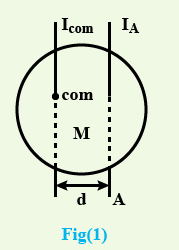
The theorem of parallel axis states that the moment of inertia of a body about an axis parallel to an axis passing through the center of mass is equal to the sum of the moment of inertia of the body about the axis passing through the centre of mass and product of mass and square of the distance between the two axes.
Refer image. $1$
Now Let's take a rigid body composed of several small masses.
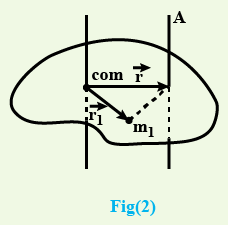
Refer image. $2$
position vector of $(m_1)$ with respect to axis passing through centre of mass \(=\overrightarrow{r_1}\)
position vector of axis parallel to axis passing through centre of mass \(=\vec{r}\)
Position vector of $(m_1)$ with respect to the parallel axis
\(=\overrightarrow{r_1}-\vec{r}\)
$\ce{MOI}$ of \(m_1\) with respect to axis passing through $\ce{COM}$
\(=m_1\left|\overrightarrow{r_1}\right|^2\)
Similarly for all other masse from which the body is mode
\(\ce{I}_{\ce{COM}}=m_1\left|\vec{r}_1\right|^2+m_2\left|\overrightarrow{r_2}\right|^2+------m_n\left|\vec{r}_n\right|^2\)
$\ce{MOI}$ about passing parallel to the axis passing through $\ce{IOM}$
\(I_A=m_1\left|\overrightarrow{r_1}-\vec{r}\right|^2+m_2\left|\overrightarrow{r_2}-\vec{r}\right|^2+-----+m_n\left|\overrightarrow{r_n}-\vec{v}\right|^2\)
\(\begin{array}{l}=m_1\left(r_1^2+r^2-2 \overrightarrow{r_1} \cdot \vec{r}\right)+m_2\left(r_2^2+r^2-2 \overrightarrow{r_2} \cdot \vec{r}\right)+----+m_n\left(r_n^2+r^2\right. \\ \left.-2 \overrightarrow{r_n} \cdot \vec{r}\right)\end{array}\)
\(\begin{array}{l}=m_1 r_1^2+m_2 r_2^2+-----+m_n r_n^2+r^2\left(m_1 m_2+----m_n\right)- \\ 2 \vec{r}\left(m_1 \overrightarrow{r_1}+m n_2 \overrightarrow{r_2}-----m_m \overrightarrow{r_n}\right)\end{array}\)
Multiplying dividing third term by \(\left(m_1+m_2+----m_n\right)\)
\(\Rightarrow m_1 r_1^2+m_2 r_2^2+-----+m_n r_n^2+r^2\left(m_1+m_2+---m_n\right)\)
\(-2 r\left(\frac{m_1 \vec{r}_1+m_2 \vec{r}_2-----m_n \vec{r}_2}{m_1+m_2+----m_n}\right)\left(m_1+m_2----m_n\right)\)
\(\downarrow\)
\(\vec{r}_{C O M}=0\) $($as $\ce{COM}$ is taken as origin$)$
\(\underbrace{m_1 r_1^2+m_2 r_2^2+----+m_n r_n^2}+r^2\left(m_1+m_2+---m_n\right)\)
\(I_{C O M}\)
\(\therefore I_A=I+r^2\left(m_1+m_2+---m_n\right)\)
\(I_A=I_{C O M}+r^2 M\left(\right.\) as \(\left.M=m_1+m_2+------m_n\right)\)Image
Image
View full question & answer
Question 83 Marks
In a circus, a motor-cyclist having mass of \(50 kg\) moves in a spherical cage of radius \(3 m\). Calculate the last velocity with which he must pass the highest point without losing contact. Also calculate his angular speed at the highest point.
Answer
\(14 m / s ; 1.796 s\)
View full question & answer
Question 93 Marks
Obtain expressions of energy of a particle at different positions in the vertical circular motion.
Answer
Lowest point of circular motion:
Total energy = KE
\(=\frac{1}{2} m v^2\)
Substitute \(v =\sqrt{5 rg }\)
Total energy \(=\frac{1}{2} m(\sqrt{5 r g})^2\)
\(=\frac{5 m r g}{2}\)
Highest point of circular motion:
Total enery = PE + KE
= mgh + KE
\(=m g(2 r)+\frac{1}{2} m v^2\)
Substitute \(v =\sqrt{r g}\)
Total energy \(=2 mgr +\frac{1}{2} m(\sqrt{r g})^2\)
\(=2 m g r+\frac{m g r}{2}\)
\(=\frac{5 m r g}{2}\)
View full question & answer
Question 103 Marks
A vehicle is moving on a circular track whose surface is inclined towards the horizontal at an angle of \(10^{\circ}\). The maximum velocity with which it can move safely is \(36 km / hr\). Calculate the length of the circular track.
Answer
Given, angle of banking, $\theta=10^{\circ}$
Optimum speed, $V_0=36 km / hr =36 \times \frac{5}{18} m / s$
Or, $V_0=10 m / s$
Let $R$ be the radius of the circular track
We have,
$V_0=\sqrt{g R \tan \theta}$
$\Rightarrow V_0^2=g R \tan \theta$
$\Rightarrow R=\frac{V_0^2}{g \tan \theta}$
$=\frac{\left(10 \frac{m}{3}\right)^2}{\left(9.8 \frac{m}{3}\right) \times \tan 10^0}$
$=\frac{100 m}{9.8 \times 0.1763}$
$\Rightarrow R=57.88 m$
$\therefore \text { Length of the circular track }=2 \pi R=2 \times 3.142 \times 57.88=363.72 m .$
View full question & answer
Question 113 Marks
Derive an expression for kinetic energy, when a rigid body is rolling on a horizontal surface without slipping. Hence find kinetic energy for a solid sphere.
Answer
Total Rolling kinetic energy = Translational K. E. + Rotational K. E.
\(=\frac{1}{2} M V^2+\frac{1}{2} I \omega^2\)
But
\(\omega=\frac{V}{R}\)
Total Rolling K.E \(=\frac{1}{2} M V^2+\frac{1}{2} I\left(\frac{V^2}{R^2}\right)\)
for solid sphere \(I=\frac{2}{5} M R^2\)
Total Rolling K.E. \(=\frac{1}{2} M V^2+\frac{1}{2} \frac{2 M R^2}{5}\left(\frac{V^2}{R^2}\right)\)
\(=\frac{1}{2} M V^2+\frac{1}{5} M V^2\)
\(=\frac{7}{10} M V^2\) 
View full question & answer
Question 123 Marks
A particle of mass m, just completes the vertical circular motion. Derive the expression for the difference in tensions at the highest and the lowest points
Answer
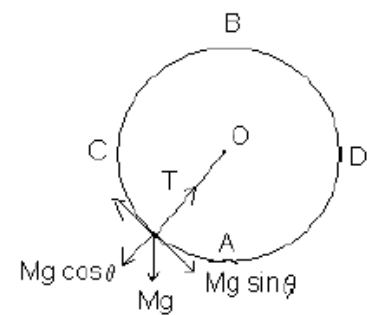
Consider a body of mass ' $M$ ' moving in a vertical circle of radius ' $R$ '. At any position $P$, the forces are acting body are weight Mg vertically downward and tension ' $T$ ' towards centre. Centripetal force $F _{ C }= T - Mg \cos \theta$
$T=FC+Mg \cos \theta$
Image
The body is moving such that it can move in a vertical circle.
At position \(B : \theta=180^{\circ}, \cos \theta=-1 . T_B=F_C-M g\)
\(\therefore T_B=\frac{M V_B^2}{R}-M g\)
\(\therefore T_B=\frac{M g R}{R}-M g\)
\(\therefore T_B=0\)
At position A : \(\theta=0^{\circ}, \cos \theta=1, T_B=F_C-M g\)
\(T_A=F_C+M g\)
\(\therefore T_A=\frac{M V_A^2}{R}+M g\)
\(\therefore T_A=\frac{5 M g R}{R}+M g\)
\(\therefore T_A=6 M g\)
Difference in tension \(T_B-T_A=6 Mg\)
View full question & answer
Question 133 Marks
Derive an expression for kinetic energy of a rotating body.
Answer
The kinetic energy of an object is the energy that it possesses due to its motion. It is defined as the work needed to accelerate a body of a given mass from rest to its stated velocity.
Consider a body of mass "m" starts moving from rest. After a time interval "t" its velocity becomes V.
If initial velocity of the body is Vi = 0 ,final velocity Vf = V and the displacement of body is "d". Then Derivation for the equation of Kinetic Energy:
The relation connecting the initial velocity (u) and final velocity (v) of an object moving with a uniform acceleration a, and the displacement, S is
v2 - u2 = 2aS
This gives
S = ½a(v2 - u2)
We know F = ma. Thus using above equations, we can write the workdone by the force, F as
W = ma × ½a(v2 - u2)
or
W =m( v 2 - u 2 ) ½
If object is starting from its stationary position, that is, u = 0, then
W = ½mv2
It is clear that the work done is equal to the change in the kinetic energy of an object.
If u = 0, the work done will be W = ½mv2
Thus, the kinetic energy possessed by an object of mass, m and moving with a uniform velocity, v is Ek= ½mv2
View full question & answer
Question 143 Marks
A solid sphere of diameter \(50 cm\) and mass \(25 kg\) rotates about an axis through its centre. Calculate its moment of inertia. If its angular velocity changes from \(2 rad / s\) to \(1 rad / s\) in 5 seconds, calculate the torque applied.
Answer
I \(=0.625 kg \cdot m ^2 ; \tau=1.25 N \cdot m\)
View full question & answer
Question 153 Marks
A meter gauge train is moving at \(72 km / hr\) along a curved railway of radius of curvature \(500 m\) at a certain place. Find the elevation of outer rail above the inner rail so that there is no side pressure on the rail. \(\left(g=9.8 m / s ^2\right)\)
Answer
\(0.08163 m\)
View full question & answer
Question 163 Marks
A uniform solid sphere has radius \(0.2 m\) and density \(8 \times 10^3 kg m ^3\). Find the moment of inertia about the tangent to its surface. \((\pi=3.142)\)
Answer
Given:$R = 0.2m, \rho = 8000 Kg/m^3$
To find: Moment of inertia (I)
Formulae:
i. \(I_0=I_c+M R^2\)
\(I_0=\frac{2}{5} M R^2+M R^2\)
\(I_0=\frac{7}{5} M R^2\)
ii. Mass (M) = volume x density
from formula 2
\(M=V \rho=\left(\frac{4}{3} \pi R^3\right) \rho\)
from formula 1
\(I=\frac{7}{5}\left(\frac{4}{3} \pi R^3 \rho\right) R^2\)
\(=\frac{28}{15} \pi R^5 \rho\)
\(=\frac{28}{15} \times 3.14 \times\left(2 \times 10^{-1}\right)^5 \times 8000\)
\(I=15.02 kgm ^2\)
View full question & answer
Question 173 Marks
Obtain an expression for torque acting on a body rotating with uniform angular acceleration.
Answer
Expression for torque acting on a rotating body
Image
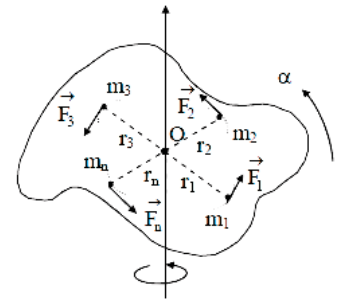
a) Suppose a rigid body consists of n particles of masses $m_1, m_2, m_3,$ ......, mn which are situated at distances $r_1, r_2, r_3,$ …, rn respectively, from the axis of rotation as shown in figure
b) Each particle revolves with angular acceleration α
c) Let$ F_1, F_2, F_3,$ …., Fn be the tangential force acting on particles of masses, $m_1, m_2, m_3,$ …, mn respectively.
d) Linear acceleration of particles of masses $m_1, m_2,$…, mn are given by, $a_1 = r_1\alpha , a_2 = r_2\alpha , a_3 = r_3\alpha = rn\alpha$
e) Magnitude of force acting on particle of mass m1 is given by $F_1 = m_1a_1 = m_1r_1\alpha ( a = r\alpha )$
Magnitude of torque on particle of mass m1 is given by,
$t_1 = F_1 r_1 sin Θ$                         ($\because$ Radius vector is $\perp ^{ar}​​​​​​​$​​​​​​​ to tangential force)
\(\therefore \quad \tau_1= F _1 r _1 \sin 90^{\circ}\)
\(= F _1 r _1\)
\(=m_1 a_1 r_1\)
\(\therefore \quad \tau_1= m _1 r _1^2 \alpha \quad\left(\because a _1= r _1 \alpha\right)\)
Similarly,
\(\tau_2=m_2 r_2^2 \alpha\)
\(\tau_3= m _3 r _3^2 \alpha\),
\(\tau_n=m_n r_n^2 \alpha\)
f. Total torque acting on the body,
\(\tau=\tau_1+\tau_2+\tau_3+\ldots .+\tau_n\)
\(\therefore \quad \tau=m_1 r_1^2 \alpha+m_2 r_2^2 \alpha+m_3 r_3^2 \alpha+\ldots+m_n r_n^2 \alpha\)
\(\therefore \quad \tau=\left(m_1 r_1{ }^2+m_2 r_2{ }^2+m_3 r_3^2+\ldots .+m_n r_n^2\right) \alpha\)
\(\therefore \quad \tau=\left(\sum_{ i =1}^{ n } m _{ i } r _{ i }^2\right) \alpha\)
But, \(\sum_{ i =1}^{ n } m _{ i } r _{ i }{ }^2= I\)
\(\therefore \quad \tau= I \alpha\)
g. If \(\alpha=1 rad / s ^2\) then \(\tau= I\).
Thus, when a torque rotates the body with uniform angular acceleration of $1 rad/s^2$​​​​​​​ then M.I of the body about a given axis of rotation becomes equal to torque acting on it.
View full question & answer
Question 183 Marks
A horizontal disc is freely rotating about a transverse axis passing through its centre at the rate of 100 revolutions per minute. A 20 gram blob of wax falls on the disc and sticks to the disc at a distance of \(5 cm\) from its axis. Moment of inertia of the disc about its axis passing through its centre of mass is \(2 \times 10^{-4} kg m ^2\). Calculate the new frequency of rotation of the disc.
Answer
80 r.p.m
View full question & answer
Answer the following in Brief - Physics STD 12 Science Questions - Vidyadip