Questions

Answer the following in detail.

Take a timed test

20 questions · self-marked practice — reveal the answer and mark yourself.

Question 14 Marks
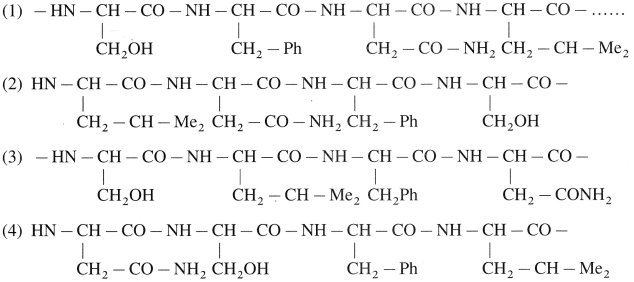
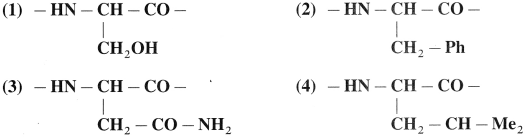
A protein chain has the following amino acid residues. Show and label the interactions that can be present in various pairs from these giving rise to tertiary level structure of protein.

Image

Answer
Tertiary level structure from amino residues.

Image

View full question & answer
Question 24 Marks
(1) Is galactose an aldohexose or a ketohexose?
(2) Which carbon in galactose has different configuration compared to glucose?
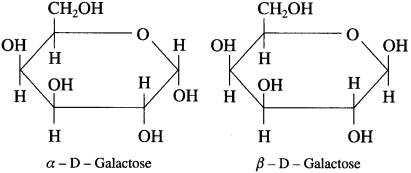
(3) Draw Haworth formulae of α-D-galactose and β-D-galactose.
(4) Which disaccharides among sucrose, maltose and lactose is/are expected to give positive Fehling test?
(5) What are the expected products of hydrolysis of lactose?
Answer
    1. Galactose is an aldohexose.
    2. Fourth carbon in galactose has different configuration compared to glucose.
    3. Image
    4. Maltose and lactose are expected to give positive Fehling solution test.
    5. The expected products of hydrolysis of lactose are D – ( +) glucose and D – ( +) galactose.

View full question & answer
Question 34 Marks
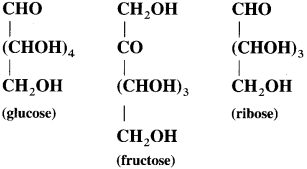
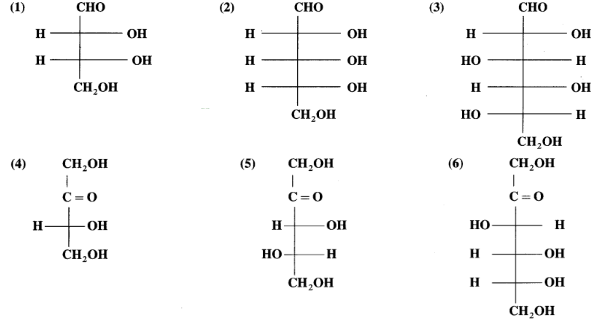
Observe the following structural formulae carefully and answer the questions.

Image

(1) How many OH groups are present in glucose, fructose and ribose respectively?
(2) Which other functional groups are present in these three compounds?

Answer
1) Glucose contains five hydroxyl (- OH) groups.
Fructose contains five hydroxyl ( – OH) groups.
Ribose contains four hydroxyl ( – OH) groups.

(2) Glucose contains aldehyde ( – CHO) as other functional group.

Fructose contains ketonic group Image as other functional group. Ribose contains aldehyde ( – CHO) as other functional group.

View full question & answer
Question 44 Marks
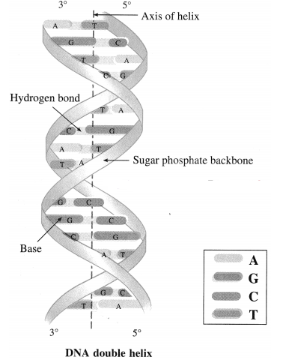
Explain double helix.###State the salient features of the Watson and Crick mode of DNA.
Answer

Image
The Salient features are :
  1. DNA is made of two polynucleotide strands that wind into a right-handed double helix.
  2. The two strands run in opposite directions: one from the Y end to the 3’ end, while the other from the 3’ end to the Y end.
  3. Pcrpcndicular to the axis of the helix, the sugar – phosphate backbone lies on the outside of the helix and the bases lic on the inside.
  4. The hydrogen bonding between the hases of the two DNA strands stabilizes the double helix. This gives rise to a ladder-like structure of DNA double helix.
  5. Adenine always forms two hydrogen bonds with thymine and guanine forms three hydrogen bonds with cytosinc. Thus A – T arid C – G arc complementary hase pairs and the Two strands of the double helix arc complementary to each other.
View full question & answer
Question 54 Marks
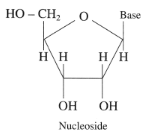
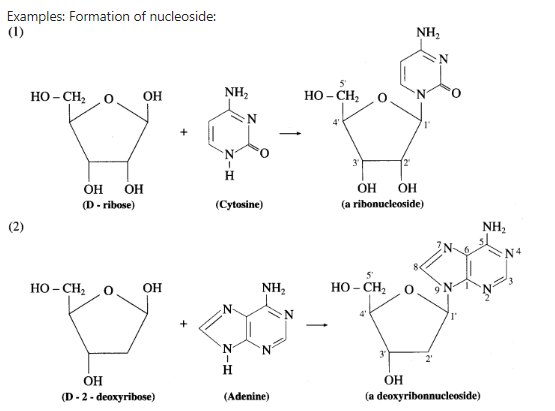
What is meant by nucleosides?###Write the structure of nucleoside. Give examples.
Answer

Image

A nucleoside contains two basic components of nucleic acids i.e. a pentose sugar and a nitrogenous base.

A nucleoside is formed when 1 -position of a pyrimidine (cytosine, thymine or uracil) or 9 -position of guanine or adenine base is attached to $C$ - I of sugar by $\beta$-linkage.
Image
View full question & answer
Question 64 Marks
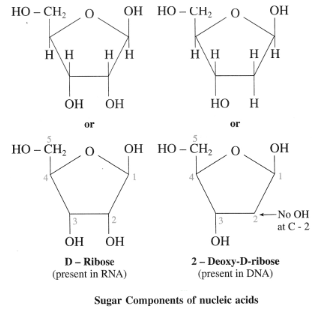
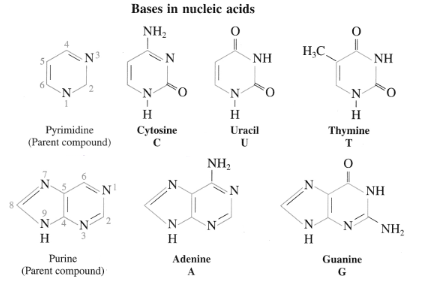
Explain chemical composition of nucleic acids.
View full question & answer
Question 74 Marks
Draw a neat labelled diagram for the secondary structure of protein.
Answer
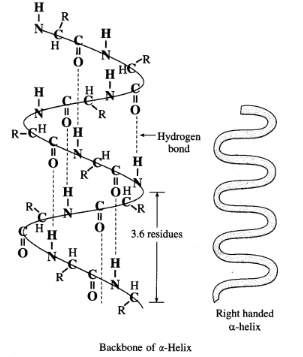
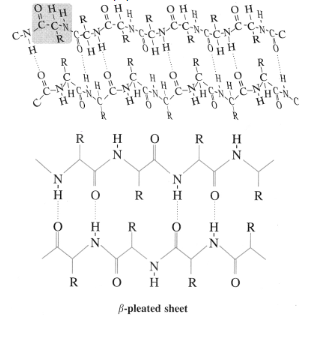
 Secondary structure of proteins : The three-dimensional arrangement of Idalized regions of a long polypeptide chain is called the secondary structure of protein. Hydrogen bonding between $N - H$ proton of one amide linkage and $C = O$ oxygen of another gives rise to the secondary structure. There are two different types of secondary structures i.e. $\alpha$-helix and $\beta$-pleated sheet.
$\alpha$-Helix: In a-helix structure, a polypeptide chain gets coiled by twisting into a right handed or clakwise spiral known as a-helixn. The characteristic features of $\alpha$-helical structure of protein are :
Image
(1) Each turn of the helix has 3.6 amino acids.
(2) $AC = O$ group of one amino acid is hydrogen bonded to $N - H$ group of the fourth amino acid along the chain.
(3) Hydrogen bonds are parallel to the axis of helix while R groups extend outward from the helix core.
Myosin in muscle and a-keratin in hair are proteins with almost entire a-helical secondary structure.
$\beta$-Pleated sheet: In secondary structure, when two or more polypeptide chains (strands) line up side-by-side is called $\beta$-pleated sheets. The $\beta$-picate sheet structure of protein consists of extended strands of polypeptide chains held together by intermolecular hydrogen bonding. The characteristics of $\beta$-pleated sheet structure are :
Image
  • The C = O and N – H bonds lie in the planes of the sheet.
  • Hydrogen bonding occurs between the N – H and C = O groups of nearby amino acid residues in the neighbouring chains.
  • The R groups are oriented above and below the plane of the sheet.
The β-pleated sheet arrangement is favoured by amino acids with small R groups.
View full question & answer
Question 84 Marks
Distinguish between globular and fibrous proteins.
Answer
Globular proteinsFibrous proteins
(1) The chains of polypeptides of protein coil around to give a spherical shape.(1) The proteins in which the polypeptide chains lie parallel to form fibre like structure.
(2) Globular proteins are soluble in water.(2) Fibrous proteins are insoluble in water.
(3) They are sensitive to small changes of temperature and pH.(3) They are stable to moderate changes of temperature and pH.
(4) They possess biological activity.(4) They do not possess biological activity.
View full question & answer
Question 94 Marks
Write the classification of amino acids, giving examples.
Answer
The amino acids are of three types : acidic, basic and neutral. The symbol ' $R$ ' in the structure of aamino acids represents side chain and may contain additional functional groups.

(1) Acidic amino acids : If ' $R$ ' contains a carboxyl $(- COOH )$ group the amino acid is acidic amino acid, i.e. If carboxyl groups are more in number than amino groups, then amino acids are acidic in nature.
Examples : Glutamic acid $HOOC - CH _2- CH _2-$ : Aspartic acid $HOO - CH _2-$

(2) Basic amino acids : If ' $R^{\prime}$ contains an amino $\left(1^{\circ}, 2^{\circ}\right.$, or $\left.3^{\circ}\right)$ group, it is called basic amino acid i.e. If amino groups are more in number than carboxyl groups then amino acids are basic in nature.
Image


(3) Neutral amino acids : The other amino acids having neutral or no functional group in 'R' are called neutral amino acids, i.e. The amino acids having equal number of amino and carboxyl groups are neutral amino acids.
Examples : Alanine $CH _3$-; Valine $\left( CH _3\right)_2- CH$
View full question & answer
Question 104 Marks
Explain the structure of starch.
Answer
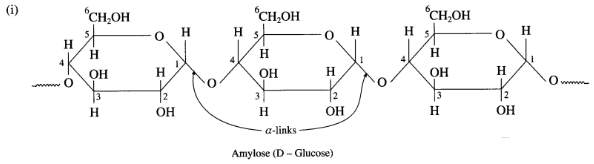
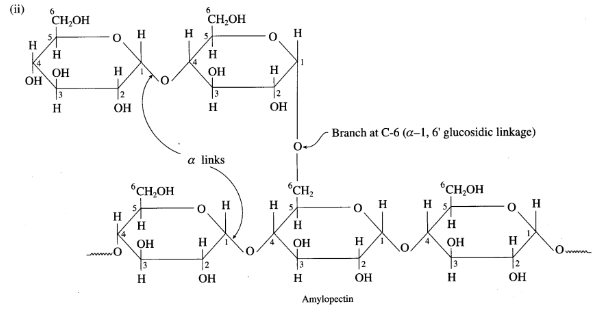
Starch is found in cereal grains, roots, tubers, potatoes, etc. It is a polymer of $\alpha$-D-glucose and consists of two components, amylose and amylopectin.

Amylose is water soluble component forms blue coloured complex with iodine. It constitutes about $20 \%$ of starch. Amylose contains 200 to $1000 \alpha$-D-glucose units linked together by glycosidic linkage between C-I of one unit and C-4 of another unit. i.e. $\alpha-1,4$ glycosidic linkages.

Image

Amylopectin is insoluble in water and constitutes about $80 \%$ starch which forms blue-violet coloured complex with iodine. It is a branched chain polymer. In amylopectin, $\alpha$-D-glucose molecules are linked together by glycosidic linkage between $C _1$ - of one unit and $C -4$ of another unit to form long chain and branching acurs by glycosidic linkage between C-I and C6 glycosidic linkage.

Image
View full question & answer
Question 114 Marks
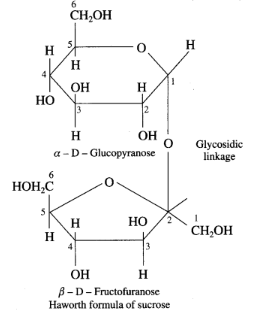
Explain the structure of sucrose.
View full question & answer
Question 134 Marks
Explain Haworth formula of glycopyranose.
Answer

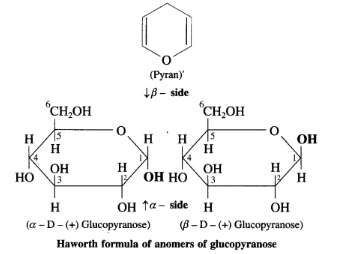
Image
In the Haworth formula the pyranose ring is considered to be in a perpendicular plane with respect to the plane of paper. The carbons and oxygen in the ring are in the places as they appear in figure. The lower side of the ring is called $\alpha$-side and the upper side is the $\beta$-side. The $\alpha$-anomer has its anomeric hydroxyl $(- OH )$ group (at $C -1$ ) on the $\alpha$-side, whereas the $\beta$-anomer has its anomeric hydroxyl $(- OH )$ group (at $C -1)$ on the $\beta$-side. The groups which appear on right side in the Fischer projection formula appear on $\alpha$-side in the Haworth formula, and the groups which appear on left side in the fischer projection formula appear on a $\beta$-side in the Haworth formula.
View full question & answer
Question 144 Marks
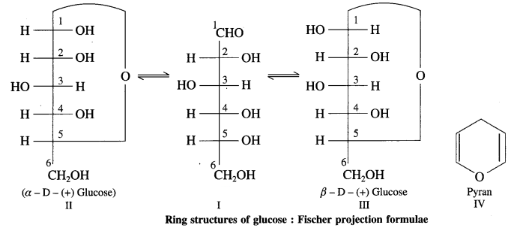
Explain ring structure of glucose.
View full question & answer
Question 164 Marks
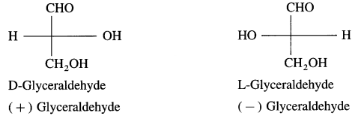
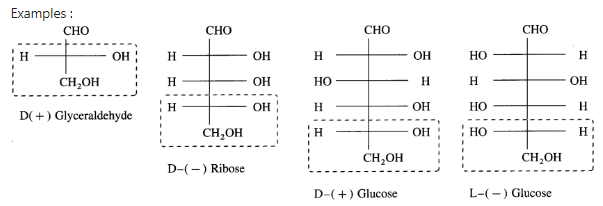
Explain D and L configuration in sugars.
View full question & answer
Question 174 Marks
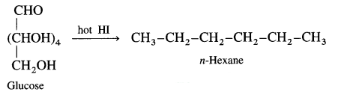
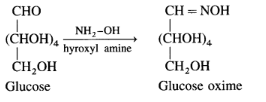
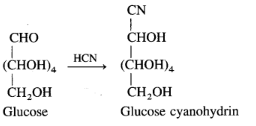
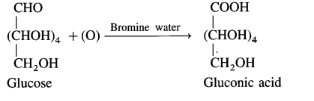
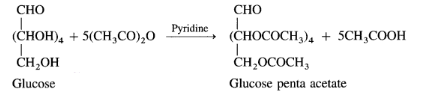
Describe the action of following reagents on glucose :
(1) $HI$
(2) Hydroxyl amine $\left( NH _2 OH \right)$
(3) Hydrogen cyanide
(4) Bromine water
(5) dil. Nitric acid
(6) Acetic anhydride.
View full question & answer
Question 184 Marks
Classify the following carbohydrates.
(1) Cellulose,
(2) Maltose,
(3) Raffinose,
(4) Fructose.
Answer
 
CarbohydratesClass
(1) CellulosePolysaccharide
(2) MaltoseDisaccharide
(3) RaffinoseTrisaccharide
(4) FructoseMonosaccharide
View full question & answer
Question 194 Marks
Classify the following carbohydrates into Monosaccharide, Disaccharide, Oligosaccharide, Polysaccharide.
(1) Glucose
(2) Starch
(3) Sucrose
(4) Maltose
(5) Galactose
(6) Lactose
(7) Ribose.
Answer
 
CarbohydratesClass
(1) GlucoseMonosaccharide
(2) StarchPolysaccharide
(3) SucroseDisaccharide
(4) MaltoseDisaccharide
(5) GalactoseMonosaccharide
(6) LactoseDisaccharide
(7) RiboseMonosaccharide
View full question & answer
Question 204 Marks
How are carbohydrates classified?###Classification of carbohydrates with examples.
Answer
Carbohydrates are classified as monosaccharides oligosaccharides and polysaccharides.
(1) Monosaccharides : These carbohydrates cannot be further hydrolysed into smaller units. They are basic units of all carbohydrates, and are called monosaccharides.
Examples : Glucose, fructose, ribose
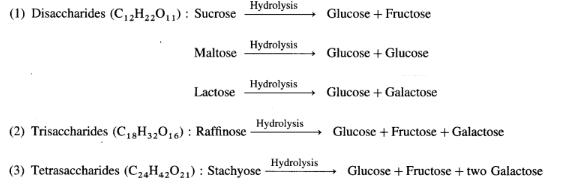
(2) Oligosaccharides : An oligosaccharide is a carbohydrate (sugar) which on hydrolysis gives two to ten monosaccharide units.
Depending on the number of monosaccharides produced on hydrolysis, oligosaccharides are further classified as :
Image
Oligosaccharide is homogeneous. In this, each molecule of oligosaccharide contains the same number of monosaccharide units joined together in the same order as every other molecule of the same oligosaccharide.
(3) Polysaccharides : These are carbohydrates which on hydrolysis give a large number of monosaccharides.

Polysaccharides are tasteless, amorphous, insoluble in water. They are long chain, naturally αcurring polymers of carbohydrates.

Example : Cellulose, starch, glycogen.
View full question & answer