MCQ 11 Mark
If $\text{f(x)}=\begin{cases}\frac{|\text{x}+2|}{\tan^{-1}(\text{x}+2)}, & \text{x}\neq-2\\2, & \text{x}=-2\end{cases},$ then $f(x)$ is:
- A
Continuous at $x = -2$
- ✓
Not continuous at $x = -2$
- C
Diffrentiable at $x = -2$
- D
Continuous but nit derivable at $x = -2$
AnswerCorrect option: B. Not continuous at $x = -2$
$\lim\limits_{\text{x}\rightarrow-2}\frac{|\text{x}+2|}{\tan^{-1}(\text{x}+2)}$
Let, $x = -2 + h$
$x \rightarrow -2$
$\Rightarrow h \rightarrow 0$
$\lim\limits_{\text{h}\rightarrow0}\frac{|-2+\text{h}+2|}{\tan^{-1}(-2+\text{h}+2)}$
$\lim\limits_{\text{h}\rightarrow0}\frac{\text{h}}{\tan^{-1}\text{h}}=1$
$\lim\limits_{\text{h}\rightarrow0}\frac{|\text{x}+2|}{\tan^{-1}(\text{x}+2)}\neq\text{f}(-2)$
Function is not continuous at $x = -2.$
View full question & answer→MCQ 21 Mark
If $f(x) = |3 − x| + (3 + x),$ where $(x)$ denotes the least integer greater than or equal to $x,$ then $f(x)$ is:
- A
Continuous and differentiable at $x = 3$
- B
Continuous but not differentiable at $x = 3$
- C
Differentiable nut not continuous at $x = 3$
- ✓
Neither differentiable nor continuous at $x = 3$
AnswerCorrect option: D. Neither differentiable nor continuous at $x = 3$
Given function can be writter as
$\text{f(x)}=-\text{x}+9\ \text{ x}<3$
$=\text{x}+4\ \text{ x}>3$
$\lim\limits_{\text{x}\rightarrow3^{+}}\text{f(x)}=\lim\limits_{\text{x}\rightarrow3}-\text{x}+9=6$
$\lim\limits_{\text{x}\rightarrow3^{-}}\text{f(x)}=\lim\limits_{\text{x}\rightarrow3}\text{x}+4=7$
Function is not continuous at $x = 3$
$\Rightarrow$ Function is not diffentiable at $x = 3.$
View full question & answer→MCQ 31 Mark
If $\text{f(x)}=\text{a}|\sin\text{x}|+\text{be}^{|\text{x}|}+\text{c|x|}^3$and if $f(x)$ is differentiable at $x = 0,$ then:
- A
$\text{a}=\text{b}=\text{c}=0$
- ✓
$\text{a}=0,\text{b}=0;\text{c}\in\text{R}$
- C
$\text{b}=\text{c}=0,\text{a}\in\text{R}$
- D
$\text{c}=0,\text{a}=0,\text{b}\in\text{R}$
AnswerCorrect option: B. $\text{a}=0,\text{b}=0;\text{c}\in\text{R}$
We have,
$\text{f(x)}=\text{a}|\sin\text{x}|+\text{be}^{|\text{x}|}+\text{c|x|}^3$
$=\begin{cases}\text{a}\sin\text{x}+\text{bx}^\text{x}+\text{cx}^3 & 0<\text{x}<\frac{\pi}{2}\\-\text{a}\sin\text{x}+\text{be}^{-\text{x}}-\text{cx}^3 & -\frac{\pi}{2}<\text{x}<0\end{cases}$
Here, $f(x)$ is differentiable at $x = 0$
Therefore, $(\text{LHL}$ at $x = 0) = (\text{RHL}$ at $x = 0)$
$\Rightarrow\lim\limits_{\text{x}\rightarrow0^{-}}\frac{\text{f(x)}-\text{f}(0)}{\text{x}-0}=\lim\limits_{\text{x}\rightarrow0^{+}}\frac{\text{f(x)}-\text{f}(0)}{\text{x}-0}$
$\Rightarrow\lim\limits_{\text{x}\rightarrow0^{-}}\frac{-\text{a}\sin\text{x}+\text{be}^{-\text{x}}-\text{cx}^3-\text{b}}{\text{x}}=\lim\limits_{\text{x}\rightarrow0^{+}}\frac{\text{a}\sin\text{x}+\text{be}^{\text{x}}-\text{cx}^3-\text{b}}{\text{x}}$
$\Rightarrow\lim\limits_{\text{h}\rightarrow0}\frac{-\text{a}\sin(0-\text{h})+\text{be}^{-(0-\text{h)}}-\text{c}(0-\text{h})^3-\text{b}}{0-\text{h}}$ $=\lim\limits_{\text{h}\rightarrow0}\frac{\text{a}\sin(0+\text{h})+\text{be}^{(0+\text{h)}}+\text{c}(0+\text{h})^3-\text{b}}{0+\text{h}}$
$\Rightarrow\lim\limits_{\text{h}\rightarrow0}\frac{\text{a}\sin\text{h}+\text{be}^{\text{h}}+\text{ch}^3-\text{b}}{-\text{h}}=\lim\limits_{\text{h}\rightarrow0}\frac{\text{a}\sin\text{h}+\text{be}^{\text{h}}+\text{ch}^3-\text{b}}{\text{h}} $
$\Rightarrow\lim\limits_{\text{h}\rightarrow0}\frac{\text{a}\cos\text{h}+\text{be}^{\text{h}}+3\text{ch}^2}{-1}=\lim\limits_{\text{h}\rightarrow0}\frac{\text{a}\cos\text{h}+\text{be}^{\text{h}}+3\text{ch}^2}{1} ($By L'Hospital rule$)$
$\Rightarrow-(\text{a}+\text{b})=\text{a}+\text{b}$
$\Rightarrow-2(\text{a}+\text{b})=0$
$\Rightarrow\text{a}+\text{b}=0$
This is true for all value of $c$
$\therefore\text{c}\in\text{R}$
In the given option $(b)$ satisfies $a + b = 0$ and $\text{c}\in\text{R.}$
View full question & answer→MCQ 41 Mark
The set points where the function $f(x)$ given by $\text{f(x)=}|\text{x}-3|\cos\text{x}$ is diffrentiable, is:
- ✓
$R$
- B
$R - \{3\}$
- C
$(0,\infty)$
- D
Answer$(\text{LHL}$ at $x = 3) =\lim\limits_{\text{x}\rightarrow3^{-}}\frac{\text{f(x)}-\text{f}(3)}{\text{x}-3}$
$(\text{LHL}$ at $x = 3) =\lim\limits_{\text{h}\rightarrow0}\frac{\text{f}(3-\text{h})-\text{f}(3)}{3-\text{h}-3}$
$(\text{LHL}$ at $x = 3) =\lim\limits_{\text{h}\rightarrow0}\frac{\text{f}(3-\text{h})-\text{f}(3)}{-\text{h}}$
$(\text{LHL}$ at $x = 3) =\lim\limits_{\text{h}\rightarrow0}\frac{|3-\text{h}-3|\cos(3-\text{h})-\text{f}(3)}{-\text{h}}$
$(\text{LHL}$ at $x = 3) =\lim\limits_{\text{h}\rightarrow0}\frac{\text{h}\cos(3-\text{h})-0}{-\text{h}}=-\cos3$
$(\text{RHL}$ at $x = 3) =\lim\limits_{\text{x}\rightarrow3^{+}}\frac{\text{f(x)}-\text{f}(3)}{\text{x}-3}$
$(\text{RHL}$ at $x = 3) =\lim\limits_{\text{h}\rightarrow0}\frac{\text{f}(3+\text{h})-\text{f}(3)}{3+\text{h}-3}$
$(\text{RHL}$ at $x = 3) =\lim\limits_{\text{h}\rightarrow0}\frac{\text{f}(3+\text{h})-\text{f}(3)}{\text{h}}$
$(\text{RHL}$ at $x = 3) =\lim\limits_{\text{h}\rightarrow0}\frac{|3+\text{h}-3|\cos(3+\text{h})-\text{f}(3)}{\text{h}}$
$(\text{RHL}$ at $x = 3) =\lim\limits_{\text{h}\rightarrow0}\frac{\text{h}\cos(3+\text{h})-0}{\text{h}}=\cos3$
So, $f(x)$ is not diffrentiable at $x = 3.$
Also,$f(x)$ is diffrentiable at all other points because both modulus and cosine function are differentiable and the product of two differentiable function is differentiable.
View full question & answer→MCQ 51 Mark
If $\text{f(x)}=\begin{cases}\frac{1-\cos\text{x}}{\text{x}\sin\text{x}}, & \text{x}\neq 0\\\frac{1}{2} & \text{x}= 0\end{cases}$ then at $x = 0, f(x)$ is:
- ✓
Continuous and differentiable.
- B
Differentiable but not continuous.
- C
Continuous but not differentiable.
- D
Neither continuous not differentiale.
AnswerCorrect option: A. Continuous and differentiable.
We have,
$\text{f(x)}=\begin{cases}\frac{1-\cos\text{x}}{\text{x}\sin\text{x}}, & \text{x}\neq 0\\\frac{1}{2}, & \text{x}= 0\end{cases}$
Continuity at $x = 0$
$(\text{RHL}$ at $x = 0) =\lim\limits_{\text{x}\rightarrow0^{+}}\text{f(x)}$
$=\lim\limits_{\text{h}\rightarrow0}\text{f}(0+\text{h})$
$=\lim\limits_{\text{h}\rightarrow0}\text{f(h)}$
$=\lim\limits_{\text{h}\rightarrow0}\frac{1-\cos\text{h}}{(\text{h})\sin(\text{h})}$
$=\lim\limits_{\text{h}\rightarrow0}\frac{1-\cos\text{h}}{\text{h}\sin\text{h}}$
$=\lim\limits_{\text{h}\rightarrow0}1-\cos\text{h}\lim\limits_{\text{h}\rightarrow0}\frac{1}{\text{h}\sin\text{h}}$
$=1-\cos0.\frac{1}{0\sin0}$
$=0$
Hence, $f(x)$ is continuous at $x = 0.$
For differentiable at $= 0$
$(\text{LHL}$ at $x = 0) =\lim\limits_{\text{x}\rightarrow0^{-}}\frac{\text{f(x)}-\text{f}(0)}{\text{x}-0}$
$=\lim\limits_{\text{h}\rightarrow0}\frac{\text{f}(0-\text{h})-\text{f}(0)}{0-\text{h}-0}$
$=\lim\limits_{\text{h}\rightarrow0}\frac{\text{f}(-\text{h})-\frac{1}{2}}{-\text{h}}$
$=\lim\limits_{\text{h}\rightarrow0}\frac{\frac{1-\cos(-\text{h})}{-\text{h}\sin(-\text{h})}-\frac{1}{2}}{-\text{h}}$
$=\frac{1}{\text{h}}\lim\limits_{\text{h}\rightarrow0}\frac{1-\cos\text{h}}{\text{h}\sin\text{h}}-\lim\limits_{\text{h}\rightarrow0}\frac{1}{2}$
$=\frac{1}{2}-0=\frac{1}{2}$
$(\text{RHL}$ at $x = 0) =\lim\limits_{\text{x}\rightarrow0^{+}}\frac{\text{f(x)}-\text{f}(0)}{\text{x}-0}$
$=\lim\limits_{\text{h}\rightarrow0}\frac{\text{f}(0+\text{h})-\text{f}(0)}{0-\text{h}-0}$
$=\lim\limits_{\text{h}\rightarrow0}\frac{\text{f}(\text{h})-\frac{1}{2}}{-\text{h}}$
$=\lim\limits_{\text{h}\rightarrow0}\frac{\frac{1-\cos(\text{h})}{-\text{h}\sin(\text{h})}-\frac{1}{2}}{-\text{h}}$
$=-\frac{1}{\text{h}}\lim\limits_{\text{h}\rightarrow0}\frac{1-\cos\text{h}}{\text{h}\sin\text{h}}-\lim\limits_{\text{h}\rightarrow0}\frac{1}{2}$
$=\frac{1}{2}-0=\frac{1}{2}$
$(\text{LHL}$ at $x = x) =\lim\limits_{\text{x}\rightarrow0^{-}}\text{f(x)}$
$=\lim\limits_{\text{h}\rightarrow0}\text{f}(0-\text{h})$
$=\lim\limits_{\text{h}\rightarrow0}\text{f}(-\text{h})$
$=\lim\limits_{\text{h}\rightarrow0}\frac{1-\cos(-\text{h})}{(-\text{h})\sin(-\text{h})}$
$=\lim\limits_{\text{h}\rightarrow0}\frac{1-\cos\text{h}}{\text{h}\sin\text{h}}$
$=\lim\limits_{\text{h}\rightarrow0}1-\cos\text{h}\lim\limits_{\text{h}\rightarrow0}\frac{1}{\text{h}\sin\text{h}}$
$=1-\cos(0).\frac{1}{0\sin0}$
View full question & answer→MCQ 61 Mark
The function$\text{f(x)}=1+|\cos\text{x}|$ is:
AnswerGraph of the function $\text{f(x)}=1+|\cos\text{x}|$ is as show blow:
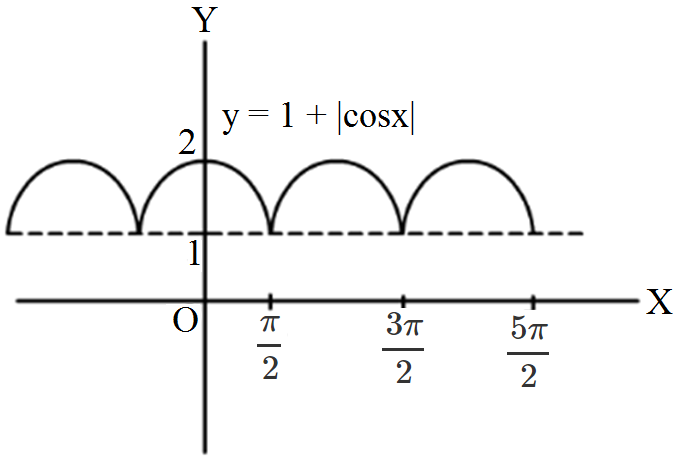
From the graph, we can see that $f(x)$ is everywhere continuous but not differentiable at $\text{x}=(2\text{n}+1)\frac{\pi}{2},\text{n}\in\text{Z}.$ View full question & answer→MCQ 71 Mark
Let $f(x) = (x + |x|) |x|.$ Then, for all $x:$
AnswerCorrect option: A. $f$ is continuous.
$\text{f(x)}=(\text{x}+|\text{x}|)|\text{x}|$
$\Rightarrow\text{f(x)}=2\text{x}^2,\text{ x}>0$
$=0,\text{ x}<0$
$\lim\limits_{\text{x}\rightarrow0}2\text{x}^2=0$
Function is continuous at $x = 0.$
Also, differentiable at $x = 0$ as it is polynomial function.
View full question & answer→MCQ 81 Mark
If $\text{f(x)}=|\log_\text{e}\text{x}|,$ then:
- ✓
$\text{f}'(1^+)=1$
- B
$\text{f}'(1^-)=-1$
- C
Both $A$ and $B$
- D
$\text{f}'(1)=-1$
AnswerCorrect option: A. $\text{f}'(1^+)=1$
$\text{f(x)}=|\log_\text{e}\text{x}|,=\begin{cases}-\log_\text{e}\text{x}, & \text{for}0<\text{x}<1\\\log_\text{e}\text{x}, & \text{for x}\geq1\end{cases}$
Differentiability at $x = 1,$
We have,
$(\text{LHL}$ at $x = 1)$
$=\lim\limits_{\text{x}\rightarrow1^{-}}\frac{\text{f(c)}-\text{f}(1)}{\text{x}-1}$
$=\lim\limits_{\text{x}\rightarrow1^{-}}\frac{-\log\text{x}-\log12}{\text{x}-1}$
$=\lim\limits_{\text{x}\rightarrow1^{-}}\frac{\log\text{x}}{\text{x}-1}$
$=\lim\limits_{\text{h}\rightarrow0}\frac{\log(1-\text{h})}{1-\text{h}-1}$
$=\lim\limits_{\text{h}\rightarrow0}\frac{\log(1-\text{h})}{-\text{h}}$
$=-1$
$(\text{RHL}$ at $x = 1)$
$=\lim\limits_{\text{x}\rightarrow1^{+}}\frac{\text{f(c)}-\text{f}(1)}{\text{x}-1}$
$=\lim\limits_{\text{x}\rightarrow1^{+}}\frac{\log\text{x}-\log1}{\text{x}-1}$
$=\lim\limits_{\text{h}\rightarrow0}\frac{\log(1+\text{h})}{\text{x}-1}$
$=\lim\limits_{\text{h}\rightarrow0}\frac{\log(1+\text{h})}{\text{h}}$
$=1$
View full question & answer→MCQ 91 Mark
Let $\text{f(x)}\begin{cases}\text{ax}^2+1,&\text{x}<1\\\text{x}+\frac{1}{2},&\text{x}\leq1\end{cases}.$ Then, $f(x)$ is derivable at $x = 1,$ if:
- A
$a = 2$
- B
$a = 1$
- C
$a = 0$
- ✓
$\text{a}=\frac{1}{2}$.
AnswerCorrect option: D. $\text{a}=\frac{1}{2}$.
Given: $\text{f(x)}=\begin{cases}\text{ax}^2+1,&\text{x}<1\\\text{x}+\frac{1}{2},&\text{x}\leq1\end{cases}$
The function is derivable at $x = 1$, if left hand derivative and right hand derivative of the function are equal at $x = 1.$
$(\text{LHL}$ at $x = 1) =\lim\limits_{\text{x}\rightarrow1^{-}}\frac{\text{f(x)}-\text{f}(1)}{\text{x}-1}$
$(\text{LHL}$ at $x = 1) =\lim\limits_{\text{h}\rightarrow0}\frac{\text{f}(1-\text{h})-\text{f}(1)}{1-\text{h}-1}$
$(\text{LHL}$ at $x = 1) =\lim\limits_{\text{h}\rightarrow0}\frac{\text{f}(1-\text{h})-\text{f}(1)}{-\text{h}}$
$(\text{LHL}$ at $x = 1) =\lim\limits_{\text{h}\rightarrow0}\frac{\Big(1-\text{h}+\frac{1}{2}\Big)-\frac{3}{2}}{-\text{h}}=1$
$(\text{RHL}$ at $x = 1) =\lim\limits_{\text{x}\rightarrow1^{+}}\frac{\text{f(x)}-\text{f}(1)}{\text{x}-1}$
$(\text{RHL}$ at $x = 1) =\lim\limits_{\text{h}\rightarrow0}\frac{\text{f}(1+\text{h})-\text{f}(1)}{1+\text{h}-1}$
$(\text{RHL}$ at $x = 1) =\lim\limits_{\text{h}\rightarrow0}\frac{\text{f}(1+\text{h})-\text{f}(1)}{\text{h}}$
$(\text{RHL}$ at $x = 1) =\lim\limits_{\text{h}\rightarrow0}\frac{\text{a}(1+\text{h})^2+1-\frac{3}{2}}{\text{h}}$
$(\text{RHL}$ at $x = 1) =\lim\limits_{\text{h}\rightarrow0}\frac{\text{a}(1-\text{h}^2+2\text{h})-\frac{1}{2}}{\text{h}}$
$\therefore\text{LHL}=\text{RHL}$
$\Rightarrow\text{a}-\frac{1}{2}=0$
$\Rightarrow\text{a}-\frac{1}{2}$
View full question & answer→MCQ 101 Mark
The function $\text{f(x)}=|\cos\text{x}|$ is:
- A
Differentiable at $\text{x}=(2\text{n}+1)\frac{\pi}{2},\text{n}\in\text{Z}$
- ✓
Continuous but not differentiable at $\text{x}=(2\text{n}+1)\frac{\pi}{2},\text{n}\in\text{Z}$
- C
Neither differentiable nor continuous at $\text{x}=\text{n}\in\text{Z}$
- D
AnswerCorrect option: B. Continuous but not differentiable at $\text{x}=(2\text{n}+1)\frac{\pi}{2},\text{n}\in\text{Z}$
$\text{f(x)}=|\cos\text{x}|$
Given function is trigonometric function.
$\Rightarrow$ Hence, it is continuous.
Function is not differentiable at odd multiples of $\frac{\pi}{2}$
$\Rightarrow f(x)$ is not differentiable at $\text{x}=(2+\text{n}+1)\frac{\pi}{2}.$
View full question & answer→MCQ 111 Mark
Let $\text{f(x)}=\text{x}+\text{b}|\text{x}|+\text{c}|\text{x}|^4,$ where $a, b,$ and $c$ are real constants. Then, $f (x)$ is differentiable at $x = 0,$ if:
- A
$a = 0$
- ✓
$b = 0$
- C
$c = 0$
- D
AnswerCorrect option: B. $b = 0$
We have,
$\text{f(x)}=\text{x}+\text{b}|\text{x}|+\text{c}|\text{x}|^4$
$\text{f(x)}=\begin{cases}\text{x}+\text{b}\text{x}+\text{c}\text{x}^4&\text{x}\geq0\\\text{x}+\text{b}\text{x}+\text{c}\text{x}^4&\text{x}<0\end{cases}$
Here, $f(x)$ is differentiable at $x = 0$
$\therefore (\text{LHL}$ at $x = 0) = (\text{RHL}$ at $x = 0)$
$\Rightarrow\lim\limits_{\text{x}\rightarrow0^{-}}\frac{\text{f(x)}-\text{x}(0)}{\text{x}-0}=\lim\limits_{\text{x}\rightarrow0^{+}}\frac{\text{f(x)}-\text{x}(0)}{\text{x}-0}$
$\Rightarrow\lim\limits_{\text{x}\rightarrow0^{-}}\frac{\text{a}-\text{bx}+\text{cx}^4-\text{a}}{\text{x}}=\lim\limits_{\text{x}\rightarrow0^{+}}\frac{\text{a}+\text{bx}^4-\text{a}}{\text{x}}$
$\Rightarrow\lim\limits_{\text{h}\rightarrow0}\frac{\text{a}-\text{b}(0-\text{h})+\text{c}(0-\text{h})^4-\text{a}}{0-\text{h}}=\lim\limits_{\text{h}\rightarrow0}\frac{\text{a}+\text{b}(0+\text{h})+\text{c}(0+\text{h})^4-\text{a}}{0+\text{h}}$
$\Rightarrow\lim\limits_{\text{h}\rightarrow0}\frac{\text{a}+\text{b}\text{h}+\text{c}\text{h}^4-\text{a}}{-\text{h}}=\lim\limits_{\text{h}\rightarrow0}\frac{\text{a}+\text{b}\text{h}+\text{c}\text{h}^4-\text{a}}{\text{h}}$
$\Rightarrow\lim\limits_{\text{h}\rightarrow0}\frac{\text{b}\text{h}+\text{c}\text{h}^4}{-\text{h}}=\lim\limits_{\text{h}\rightarrow0}\frac{\text{b}\text{h}+\text{c}\text{h}^4}{\text{h}}$
$\Rightarrow\lim\limits_{\text{h}\rightarrow0}(-\text{b}-\text{bh}^3)=\lim\limits_{\text{h}\rightarrow0}(\text{b}+\text{ch}^3)$
$\Rightarrow-\text{b}=\text{b}$
$\Rightarrow2\text{b}=0$
$\Rightarrow\text{b}=0$
View full question & answer→MCQ 121 Mark
Let $f(x) = |x|$ and $g(x) = |x^3|$, then:
- ✓
$f(x)$ and $g(x)$ both are continuous at $x = 0$
- B
$f(x)$ and $g(x)$ both are differentiable at $x = 0$
- C
$f(x)$ is differentiable but $g(x)$ is not differentiable at $x = 0$
- D
$f(x)$ and $g(x)$ both are not differentiable at $x = 0$
AnswerCorrect option: A. $f(x)$ and $g(x)$ both are continuous at $x = 0$
Absolute value function is continuous on $R.$
View full question & answer→MCQ 131 Mark
If $\text{f(x)}=\begin{cases}\frac{1}{1+\text{e}^{\frac{1}{\text{x}}}},&\text{x}\neq0\\0,&\text{x}=0\end{cases}$ then $f(x)$ is:
- A
Continuous as well as differentiable at $x = 0$
- B
Continuous but not differentiable at $x = 0$
- C
Differentiable but not continuous at $x = 0$
- ✓
Answer$\lim\limits_{\text{x}\rightarrow0^{-}}\frac{1}{1+\text{e}^{\frac{1}{\text{x}}}}=\lim\limits _{\text{x}\rightarrow0}\frac{1}{1+\text{e}^{\frac{-1}{\text{x}}}}=1\ \Big(\because\lim\limits_{\text{x}\rightarrow0}\text{e}^{\frac{-1}{\text{x}}}=0\Big)$
$\lim\limits_{\text{x}\rightarrow0^{-}}\text{f(x)}\neq\text{f}(0)$
Function is not continuous,
$\lim\limits_{\text{x}\rightarrow0^{-}}\frac{\text{f(x)}-\text{f}(0)}{\text{x}}=\lim\limits_{\text{h}\rightarrow0}\frac{\text{f}(-\text{h})-\text{f}(0)}{-\text{h}}$
$\lim\limits_{\text{x}\rightarrow0^{-}}\frac{\text{f(x)}-\text{f}(0)}{\text{x}}=\lim\limits_{\text{h}\rightarrow0}\frac{\frac{1}{1+\text{e}^{\frac{1}{\text{h}}}}-0}{-\text{h}}$
$\lim\limits_{\text{x}\rightarrow0^{-}}\frac{\text{f(x)}-\text{f}(0)}{\text{x}}=\lim\limits_{\text{h}\rightarrow0}\frac{1}{-\Big(1+\text{e}^{\frac{1}{\text{h}}}\Big)\text{h}}=-\infty$
Similarly,
$\lim\limits_{\text{x}\rightarrow0^{+}}\frac{\text{f(x)}-\text{f}(0)}{\text{x}}=\infty$
View full question & answer→MCQ 141 Mark
Let $\text{f(x)}=\begin{cases}1, & \text{x}\leq-1\\|\text{x}|, & -1 <\text{x} <1\\0,&\text{x}\geq1\end{cases}$ then, $f$ is:
AnswerCorrect option: B. Differentible at $x = -1$
$\text{f(x)}=\begin{cases}1, & \text{x}\leq-1\\|\text{x}|, & -1 <\text{x} <1\\0,&\text{x}\geq1\end{cases}$
$\lim\limits_{\text{x}\rightarrow-1^{-}}\frac{\text{f(x)}-\text{f}(-1)}{\text{x}+1}=\lim\limits_{\text{x}\rightarrow1^{-}}\frac{-\text{x}+1}{\text{x}+1}=0$
Similarly,
$\lim\limits_{\text{x}\rightarrow-1^{+}}\frac{\text{f(x)}-\text{f}(-1)}{\text{x}+1}=\lim\limits_{\text{x}\rightarrow-1^{+}}\frac{\text{x}+1}{\text{x}+1}=0$
Function is diffrentiable at $x = -1.$
View full question & answer→MCQ 151 Mark
The function $\text{f(x)}=\sin^{-1}(\cos\text{x})$ is:
AnswerCorrect option: B. Continuous at $x = 0$
$\text{f(x)}=\sin^{-1}(\cos\text{x})$
$\text{f(x)}=\sin^{-1}\Big[\sin\Big(\frac{\pi}{2}-\text{x}\Big)\Big]$
$\text{f(x)}=\frac{\pi}{2}-\text{x}$
Function is continuous at $x = 0.$
View full question & answer→MCQ 161 Mark
The function $f(x) = x − [x],$ where $[⋅]$ denotes the greatest integer function is:
AnswerCorrect option: C. Continuous at non$-$integer points only.
$f(x) = x - x$
Consider $n$ be an integer.
$\text{f(x)}=\text{x}-[\text{x}]=\begin{cases}\text{x}-(\text{n}-1)&\text{n}-1\leq\text{x}<\text{n}\\0&\text{x}=\text{n}\\\text{x}-\text{n}&\text{n}\leq\text{x}<\text{n}+1\end{cases}$
Now,
$\text{LHL}$ at $x = n$
$=\lim\limits_{\text{x}\rightarrow\text{n}^{-}}\text{f(x)}=\text{x}-\text{n}-1=\text{x}-\text{n}+1$
$\text{RHL}$ at $x = n$
$=\lim\limits_{\text{x}\rightarrow\text{n}^{+}}\text{f(x)}=\text{x}-\text{n}=\text{x}-\text{nAs},$
$\text{LHL}\neq\text{RHL}$ at $x = n$
i.e., given function is not continuous at $n.$
Now, $n$ is any integer.
Therefore, given function is not continuous at integers.
Therefore, given points are continuous at non$-$integer points only.
View full question & answer→MCQ 171 Mark
If $\text{f(x)}=|\log_\text{e}|\text{x}||,$ then:
- A
$f(x)$ is continuous and differentiable for all $x$ in its domain.
- ✓
$f(x)$ is continuous for all for all $x$ in its domain but not differentiable at $\text{x}=\pm1$
- C
$f(x)$ is neither continuous nor differentiable at $\text{x}=\pm1$
- D
AnswerCorrect option: B. $f(x)$ is continuous for all for all $x$ in its domain but not differentiable at $\text{x}=\pm1$
We have,
$\text{f(x)}=|\log_\text{e}|\text{x}||$
We know that log function is defined for posirive value.
Here, $|x|$ is positive for all non zero $x.$
Therefore, domian of function is $R - \{0\}$
And we know that logarithmic function continuous in its domain.
Therefore, $|\log_\text{e}|\text{x}||$ is continuous in its domain.
We will check the differentiability at its critical points.
$|\log_\text{e}|\text{x}||=\begin{cases}\log_\text{e}(-\text{x}) & -\infty<\text{x<-1}\\-\log_\text{e}(-\text{x}) &-1<\text{x}<0\\-\log_\text{e}(\text{x})&0<\text{x}<1\\\log_\text{e}(\text{x})&1<\text{x}<\infty\end{cases}$
$(\text{LHL}$ at $x = -1) =\lim\limits_{\text{x}\rightarrow-1^{-}}\frac{\text{f(x)}-\text{f}(0)}{\text{x}-(-1)}$
$=\lim\limits_{\text{x}\rightarrow-1^{-}}\frac{\log_\text{e}(-\text{x})-0}{\text{x}+1}$
$=\lim\limits_{\text{h}\rightarrow0}\frac{\log_\text{e}[-(-1-\text{h})]}{-1-\text{h}+1}$
$=\lim\limits_{\text{h}\rightarrow0}\frac{\log_\text{e}(1+\text{h})}{-\text{h}}$
$=-1$
$(\text{RHL}$ at $x = -1) =\lim\limits_{\text{x}\rightarrow-1^{+}}\frac{\text{f(x)}-\text{f}(0)}{\text{x}-(-1)}$
$=\lim\limits_{\text{x}\rightarrow-1^{+}}\frac{-\log_\text{e}(-\text{x})-0}{\text{x}+1}$
$=\lim\limits_{\text{h}\rightarrow0}\frac{-\log_\text{e}[-(-1+\text{h})]}{-1+\text{h}+1}$
$=\lim\limits_{\text{h}\rightarrow0}\frac{-\log_\text{e}(1-\text{h})}{\text{h}}$
$=-\lim\limits_{\text{h}\rightarrow0}\frac{\log_\text{e}(1-\text{h})}{\text{h}}$
$=-1\times-1=1$
Here, $\text{LHL}\neq\text{RHL}$
Therefore, the given function is not differentiable at $x = -1.$
$(\text{LHL}$ at $x = 1) =\lim\limits_{\text{x}\rightarrow-1^{-}}\frac{\text{f(x)}-\text{f}(1)}{\text{x}-1}$
$=\lim\limits_{\text{x}\rightarrow-1^{-}}\frac{-\log_\text{e}(\text{x})-0}{\text{x}-1}$
$=\lim\limits_{\text{h}\rightarrow0}\frac{-\log_\text{e}[(1-\text{h})]}{1-\text{h}-1}$
$=\lim\limits_{\text{h}\rightarrow0}\frac{\log_\text{e}(1-\text{h})}{\text{h}}$
$=-1$
$(\text{RHL}$ at $x = 1) =\lim\limits_{\text{x}\rightarrow1^{+}}\frac{\text{f(x)}-\text{f}(1)}{\text{x}-(1)}$
$=\lim\limits_{\text{x}\rightarrow1^{+}}\frac{\log_\text{e}(\text{x})-0}{\text{x}-1}$
$=\lim\limits_{\text{h}\rightarrow0}\frac{\log_\text{e}[(1+\text{h})]}{1+\text{h}-1}$
$=\lim\limits_{\text{h}\rightarrow0}\frac{\log_\text{e}(1+\text{h})}{\text{h}}$
$=1$
Here, $\text{LHL}\neq\text{RHL}$
Therefore, the given function is not differentiable at $x =1.$
Therefore, given function is continuous for all $x$ in its domain but not differentiable at $\text{x}=\pm1.$
View full question & answer→MCQ 181 Mark
The set of points where the function $f(x) = x |x|$ is differentiable is:
- ✓
$(-\infty,\infty)-\infty,\infty$
- B
$(-\infty,0)\cup(0,\infty)-\infty,0\cup0,\infty$
- C
$(0,\infty)0,\infty$
- D
$[0,\infty]0,\infty$
AnswerCorrect option: A. $(-\infty,\infty)-\infty,\infty$
We have,
$\text{f(x)}=\text{x}|\text{x}|$
$\Rightarrow\text{f(x)}=\begin{cases}-\text{x}^2, & \text{x}<0\\0 ,& \text{x}= 0\\\text{x}^2,&\text{x}>0\end{cases}$
When, $x<0$, we have
$f(x)=-x^2$ which being a polynomial function is continuous and differentable in $(-\infty, 0)$
When, $x>0$, we have $f(x)=-x^2$ which being a polynomial function is continuous and differentable in $(0, \infty$,
Thus possible point of non$-$differentiability of $f(x)$ is $x=0$
$\text { Now, LHL (at } x=0)=\lim _{x \rightarrow 0^{-}} \frac{f(x)-f(0)}{x-0}$
$=\lim _{x \rightarrow 0^{-}} \frac{-x^2-0}{x}$
$=\lim _{ h \rightarrow 0} \frac{(-h)^2}{- h }$
$=\lim _{ h \rightarrow 0} h$
$=0$
And $\text{RHL} ($at $x=0)=\lim _{x \rightarrow 0^{+}} \frac{f(x)-f(0)}{x-0}$
$=\lim _{x \rightarrow 0^{+}} \frac{x^2-0}{x}$
$=\lim _{h \rightarrow 0} \frac{h^2}{h}$
$=\lim _{h \rightarrow 0} h$
$=0$
$\therefore \text { LHL (at } x=0 \text { ) = RHL (at } x=0 \text { ) }$
So, $f ( x )$ is also differentiable at $x =0$
i.e. $f(x)$ is differentiable in $(-\infty, \infty)$.
View full question & answer→MCQ 191 Mark
Let $\text{f(x)}=|\cos\text{x}|.$ Then,
- A
$f(x)$ is everywhere differentiable.
- B
$f(x)$ is everywhere continuous but not differentiable at $\text{x}=\text{n}\pi,\text{n}\in\text{Z}$
- ✓
$f(x)$ is everywhere continuous but not differentiable at $\text{x}=(2\text{n}+1)\frac{\pi}{2},\text{n}\in\text{Z}.$
- D
AnswerCorrect option: C. $f(x)$ is everywhere continuous but not differentiable at $\text{x}=(2\text{n}+1)\frac{\pi}{2},\text{n}\in\text{Z}.$
$\text{f}(\text{x)} = |\cos\text{x}|$
Given function is trigonometric function.
$\Rightarrow$ Hence, it is continuous.
Function is not differentiable at odd multiples of $\frac{\pi}{2}.$
$\Rightarrow f(x)$ is not differentiable at $\text{x} = (2\text{n} + 1) \frac{\pi}{2}$
View full question & answer→MCQ 201 Mark
The function $\text{f(x)}=\frac{\sin(\text{x}|\text{x}-\pi|)}{4+|\text{x}|^2},$ where$[.]$ denotes the greatest integer function, is:
- ✓
Continuous as well as differentiable for all $\text{x}\in\text{R}$
- B
Continuous for all $x$ but differentiable at some $x$
- C
Differentiable for all $x$ but not continuous at some $x$
- D
AnswerCorrect option: A. Continuous as well as differentiable for all $\text{x}\in\text{R}$
Here,
$\text{f(x)}=\frac{\sin(\text{x}|\text{x}-\pi|)}{4+|\text{x}|^2}$
Since, we know that $\pi(\text{x}-\pi)=\text{n}\pi$ and $\sin\text{n}\pi=0.$
$\because4+\text{x}[\text{x}]^2\neq0$
$\therefore\text{f(x)}=0$ for all $x$
Thus, $f(x)$ is a constant function and it is continuous and differentible everywhere.
View full question & answer→MCQ 211 Mark
The function $\text{f(x)}=|\cos\text{x}|$ is:
- A
Everywhere continuous and differentiable.
- ✓
Everywhere continuous but not differentiable at $(2\text{n}+1)\frac{\pi}{2},\text{n}\in\text{Z}$
- C
Neither continuous nor differentiable at $(2\text{n}+1)\frac{\pi}{2},\text{n}\in\text{Z}$
- D
AnswerCorrect option: B. Everywhere continuous but not differentiable at $(2\text{n}+1)\frac{\pi}{2},\text{n}\in\text{Z}$
As $\cos x$ is even function it is continuous everywhere but not differentiable at $(2\text{n}+1)\frac{\pi}{2},\text{n}\in\text{Z}$
$\cos\Big[(2\text{n}+1)\frac{\pi}{2}=\cos\Big(\text{n}\pi+\frac{\pi}{2}\Big)=-\sin\text{n}\pi$
For $n$ as an integer $\Rightarrow\sin\text{n}\pi=0$
For $n$ as rational $\Rightarrow\sin\text{n}\pi=-1$
View full question & answer→MCQ 221 Mark
Let $\text{f(x)}=|\sin\text{x}|.$ then,
- A
$f(x)$ is everywhere differentiable.
- ✓
$f(x)$ is everywhere continuous but not differentiable at $\text{x}=\text{n}\pi,\text{n}\in\text{Z}$
- C
$f(x)$ is everywhere continuous but not differentiable at $\text{x}=(2\text{n}+1)\frac{\pi}{2},\text{n}\in\text{Z}.$
- D
AnswerCorrect option: B. $f(x)$ is everywhere continuous but not differentiable at $\text{x}=\text{n}\pi,\text{n}\in\text{Z}$
$\text{f(x)}=|\sin\text{x}|$
Given function is continuous and differentiable on $(2\text{n}\pi,(2\text{n}+1)\pi)$
But not differentiable at $\text{x}=\text{n}\pi,\text{n}\in\text{Z}.$
As $\sin\text{n}\pi=0$ for $\text{n}\in\text{Z}.$
View full question & answer→MCQ 231 Mark
Let $\text{f(x)}=\begin{cases}\frac{1}{|\text{x}|} & \text{for |x|}\geq1\\\text{ax}^2+\text{b} & \text{for |x|}<1\end{cases}$ if $f(x)$ is continuous and differentiable at any point, then:
- A
$\text{a}=\frac{1}{2},\text{b}=-\frac{3}{2}$
- ✓
$\text{a}=-\frac{1}{2},\text{b}=\frac{3}{2}$
- C
$\text{a}=1,\text{b}=-1$
- D
AnswerCorrect option: B. $\text{a}=-\frac{1}{2},\text{b}=\frac{3}{2}$
Given function is continuous at $x = 1.$
$\Rightarrow\lim\limits_{\text{x}\rightarrow1^{+}}\text{f(x)}=\lim\limits_{\text{x}\rightarrow1^{-}}\text{f(x)}$
$\Rightarrow\lim\limits_{\text{x}\rightarrow1}\frac{1}{\text{x}}=\lim\limits_{\text{x}\rightarrow1^{-}}\text{ax}^2+\text{b}$
$\Rightarrow1=\text{a}+\text{b}\ \dots(1)$
Function is derivable at $x = 1.$
$\Rightarrow\lim\limits_{\text{h}\rightarrow0^{+}}\frac{\text{f}(1+\text{h}-\text{f}(1))}{\text{h}}=\lim\limits_{\text{h}\rightarrow0^{-}}\frac{\text{f}(0+\text{h}-\text{f}(1))}{\text{h}}$
$\Rightarrow\lim\limits_{\text{h}\rightarrow0^{+}}\frac{\frac{1}{1+\text{h}}+1}{\text{h}}=\lim\limits_{\text{h}\rightarrow0^{-}}\frac{\text{a}(1+\text{h})^2-\text{a}}{\text{h}}$
$\Rightarrow-1=\lim\limits_{\text{h}\rightarrow0^{-}}\frac{\text{h}(2\text{a}+\text{h})}{\text{h}}$
$\Rightarrow2\text{a}=-1$
$\Rightarrow\text{a}=\frac{-1}{2}$
$\text{a}+\text{b}=1\ (\text{From(1)})$
$\frac{-1}{2}+\text{a}=1$
$\Rightarrow\text{b}=\frac{3}{2}$
View full question & answer→MCQ 241 Mark
If $\text{f(x)}=\text{x}^2+\frac{\text{x}^2}{1+\text{x}^2}+\frac{\text{x}^2}{(1+\text{x}^2)}+....+\frac{\text{x}^2}{(1+\text{x}^2)}+....,$ then at $x = 0, f(x):$
- A
- ✓
- C
Is continuous but not differentiable.
- D
Answer$\lim\limits_{\text{x}\rightarrow0}\text{f(x)}=\lim\limits_{\text{x}\rightarrow0}\Big(\text{x}^2+\frac{\text{x}^2}{1+\text{x}^2}+\frac{\text{x}^2}{(1+\text{x}^2)^2}+....+\frac{\text{x}^2}{(1+\text{x}^2)^\text{n}}+....,\Big)$
$\lim\limits_{\text{x}\rightarrow0}\text{f(x)}=\lim\limits_{\text{x}\rightarrow0}\text{x}^2\Big(1+\frac{\text{x}^2}{1+\text{x}^2}+\frac{\text{x}^2}{(1+\text{x}^2)^2}+....+\frac{\text{x}^2}{(1+\text{x}^2)^\text{n}}+....,\Big)$
$\lim\limits_{\text{x}\rightarrow0}\text{f(x)}=\lim\limits_{\text{x}\rightarrow0}\text{x}^2\bigg(\frac{1}{1-\frac{1}{1+\text{x}^2}}\bigg)$
$\lim\limits_{\text{x}\rightarrow0}\text{f(x)}=\lim\limits_{\text{x}\rightarrow0}(1+\text{x}^2)$
$\lim\limits_{\text{x}\rightarrow0}\text{f(x)}=\lim\limits_{\text{x}\rightarrow0}=1$
But, $f(0)=0$
$\text{f}(0)\neq\lim\limits_{\text{x}\rightarrow0}\text{f(x)}$
Function is discontinuous.
View full question & answer→MCQ 251 Mark
If $\text{f(x)}=\sqrt{1-\sqrt{1-\text{x}^2}},$ then $f(x)$ is:
- A
Continuous on $[-1, 1]$ and differentiable on $(-1, 1)$
- ✓
Continuous on $[-1, 1]$ and differentiable on $(-1,0)\cup(0,1)$
- C
Continuous and differentiable on $[-1, 1]$
- D
AnswerCorrect option: B. Continuous on $[-1, 1]$ and differentiable on $(-1,0)\cup(0,1)$
We have
$\text{f(x)}=\sqrt{1-\sqrt{1-\text{x}^2}}$
Here, function will be defined for those values of $x$ for which
$1-\text{x}^2\geq0$
$\Rightarrow1\geq\text{x}^2$
$\Rightarrow\text{x}^2\leq1$
$\Rightarrow|\text{x}\leq1|$
$\Rightarrow-1\leq\text{x}\leq1$
Therefore, function is continuous in $-1, 1$
Now, we need to check the differentiability of $\text{f(x)}=\sqrt{1-\sqrt{1-\text{x}^2}}$ in the interval $-1, 1$
Now,
We will check the differentiable at $x = 0$
$\text{LHL}$ at $x = 0$
$=\lim\limits_{\text{x}\rightarrow\infty}\frac{\text{f(x)}-\text{f}(0)}{\text{x}-0}$
$=\lim\limits_{\text{x}\rightarrow\infty}\frac{\sqrt{1-\sqrt{1-\text{x}^2}}-0}{\text{x}}$
$=\lim\limits_{\text{x}\rightarrow\infty}\frac{\sqrt{1-\sqrt{1-\text{x}^2}}}{\text{x}}$
$=\lim\limits_{\text{h}\rightarrow0}\frac{\sqrt{1-\sqrt{1-(0-\text{h})^2}}}{0-\text{h}}$
$=\lim\limits_{\text{h}\rightarrow0}\frac{\sqrt{1-\sqrt{1-\text{h}^2}}}{-\text{h}}$
$=-\infty$
$\text{RHL}$ at $x = 0$
$=\lim\limits_{\text{x}\rightarrow0^{+}}\frac{\text{f(x)}-\text{f}(0)}{\text{x}-0}$
$=\lim\limits_{\text{x}\rightarrow0^{+}}\frac{\sqrt{1-\sqrt{1-\text{x}^2}}-0}{\text{x}}$
$=\lim\limits_{\text{h}\rightarrow0}\frac{\sqrt{1-\sqrt{1-(0+\text{h})^2}}}{0+\text{h}}$
$=\lim\limits_{\text{h}\rightarrow0}\frac{\sqrt{1-\sqrt{1-\text{h}^2}}}{\text{h}}$
$=\infty$
So, the function is not differentiable at $x = 0.$
View full question & answer→