Question 11 Mark
Differentiate the following w. r. t. x.$y=\log \left[\cos \left(x^5\right)\right]$
Answer$y=\log \left[\cos \left(x^5\right)\right]$ Differentiate $w . r . t . x$ $ \begin{aligned} \frac{d y}{d x} & =\frac{d}{d x}\left(\log \left[\cos \left(x^5\right)\right]\right) \\ & =\frac{1}{\cos \left(x^5\right)} \cdot \frac{d}{d x}\left[\cos \left(x^5\right)\right] \\ & =\frac{1}{\cos \left(x^5\right)}\left(-\sin \left(x^5\right)\right) \frac{d}{d x}\left(x^5\right) \\ \therefore \quad \frac{d y}{d x} & =-\tan \left(x^5\right)\left(5 x^4\right)=-5 x^4 \tan \left(x^5\right) \end{aligned} $
View full question & answer→Question 21 Mark
Differentiate the following w. r. t. x.$y=\sqrt{\sin x^3}$
View full question & answer→Question 31 Mark
Differentiate the following w. r. t. x.$y=\frac{3}{\left(2 x^2-7\right)^5}$
View full question & answer→Question 41 Mark
Differentiate the following w. r. t. x.$5^{3 \cos x-2}$
View full question & answer→Question 51 Mark
Differentiate the following w. r. t. x.$\log \left(x^5+4\right)$
View full question & answer→Question 61 Mark
Differentiate the following w. r. t. x.$y=e^{\tan x}$
View full question & answer→Question 71 Mark
Differentiate the following w. r. t. x.$y=\sin (\log x)$
View full question & answer→Question 81 Mark
Differentiate the following w. r. t. x.$y=\sqrt{x^2+5}$
View full question & answer→Question 91 Mark
Differentiate the following w. r. t. x.$\tan ^{-1}\left(\frac{2 e^x}{1-e^{2 x}}\right)$
View full question & answer→Question 101 Mark
Differentiate the following w. r. t. x.$\tan ^{-1}\left(\frac{1-\cos 3 x}{\sin 3 x}\right)$
View full question & answer→Question 111 Mark
Differentiate the following w. r. t. x.$\sin ^{-1}\left(\sqrt{\frac{1-\cos x}{2}}\right)$
View full question & answer→Question 121 Mark
Differentiate the following w. r. t. x.$\cos ^{-1}\left[\sin \left(4^x\right)\right]$
View full question & answer→Question 131 Mark
Differentiate the following w. r. t. x.$\cos ^{-1}\left(4 \cos ^3 x-3 \cos x\right)$
View full question & answer→Question 141 Mark
Differentiate the following w. r. t. x.$\sin ^2\left(\sin ^{-1}\left(x^2\right)\right)$
Answer$
\begin{aligned}
& \text { (vi) Let } y=\sin ^2\left(\sin ^{-1}\left(x^2\right)\right) \\
& =\left[\sin \left(\sin ^{-1}\left(x^2\right)\right]^2=\left(x^2\right)^2\right. \\
& \therefore \quad y=x^4 \\
&
\end{aligned}
$
Differentiate w.r.t.x.
$
\frac{d y}{d x}=\frac{d}{d x}\left(x^4\right) \quad \therefore \frac{d y}{d x}=4 x^3
$
View full question & answer→Question 151 Mark
Differentiate the following w. r. t. x.$\cot ^{-1}\left(\frac{1}{x^2}\right)$
AnswerLet $y=\cot ^{-1}\left(\frac{1}{x^2}\right)=\tan ^{-1}\left(x^2\right)$
Differentiate $w, r . t . x$.
$
\begin{aligned}
\frac{d y}{d x} & =\frac{d}{d x}\left(\tan ^{-1}\left(x^2\right)\right) \\
& =\frac{1}{1+\left(x^2\right)^2} \cdot \frac{d}{d x}\left(x^2\right) \\
\therefore \quad \frac{d y}{d x} & =\frac{2 x}{1+x^4}
\end{aligned}
$
View full question & answer→Question 161 Mark
Differentiate the following w. r. t. x.$\sin ^{-1}\left(2^x\right)$
Answer Let $y=\sin ^{-1}\left(2^x\right)$
Differentiate $w . r . t . x$.
$
\begin{aligned}
\frac{d y}{d x} & =\frac{d}{d x}\left(\sin ^{-1}\left(2^x\right)\right) \\
& =\frac{1}{\sqrt{1-\left(2^x\right)^2}} \cdot \frac{d}{d x}\left(2^x\right) \\
& =\frac{1}{\sqrt{1-2^{2 x}}}\left(2^x \log 2\right) \\
\therefore \quad \frac{d y}{d x} & =\frac{2^x \log 2}{\sqrt{1-4^x}}
\end{aligned}
$
View full question & answer→Question 171 Mark
Differentiate the following w. r. t. x.$\sin ^{-1}\left(x^3\right)$
AnswerLet $y=\sin ^{-1}\left(x^3\right)$
Differentiate $w . r . t . x$.
$
\begin{aligned}
\frac{d y}{d x} & =\frac{d}{d x}\left(\sin ^{-1}\left(x^3\right)\right) \\
& =\frac{1}{\sqrt{1-\left(x^3\right)^2}} \cdot \frac{d}{d x}\left(x^3\right) \\
& =\frac{1}{\sqrt{1-x^6}}\left(3 x^2\right) \\
\therefore \quad \frac{d y}{d x} & =\frac{3 x^2}{\sqrt{1-x^6}}
\end{aligned}
$
View full question & answer→Question 181 Mark
Let $f(x)=x^5+2 x-3$. Find $\left(f^{-1}\right)^{\prime}(-3)$.
AnswerGiven : $f(x)=x^5+2 x-3$
Diff. w. r.t.x we get,
$
f^{\prime}(x)=5 x^4+2
$
Note that $y=-3$ corresponds to $x=0$.
$
\begin{aligned}
\therefore \quad\left(f^{-1}\right)^{\prime}(-3) & =\frac{1}{f^{\prime}(0)} \\
& =\frac{1}{5(0)+2}=\frac{1}{2}
\end{aligned}
$
View full question & answer→Question 191 Mark
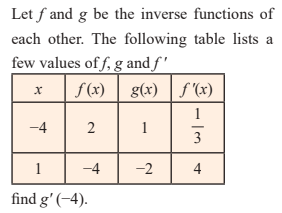
View full question & answer→Question 201 Mark
Find the derivative of the inverse of function $y=2 x^3-6 x$ and calculate its value at $x=-2$
View full question & answer→Question 211 Mark
Find the derivative of the function $y=f(x)$ using the derivative of the inverse function $x=f^{-1}(y)$ in the following$y=\ln x$
Answer$
y=\log x
$
We first find the inverse of the function $y=f(x)$, i.e. $x$ in term of $y$.
$
\begin{aligned}
& y=\log x \therefore x=f^{-1}(y)=e^y \\
& \frac{d y}{d x}=\frac{1}{\frac{d x}{d y}}=\frac{1}{\frac{d}{d y}\left(e^y\right)}=\frac{1}{e^y}=\frac{1}{e^{\ln x}}=\frac{1}{x}
\end{aligned}
$
View full question & answer→Question 221 Mark
Find the derivative of the function $y=f(x)$ using the derivative of the inverse function $x=f^{-1}(y)$ in the following$y=\sqrt[3]{x+4}$
Answer$
y=\sqrt[3]{x+4}
$
We first find the inverse of the function $y=f(x)$, i.e. $x$ in term of $y$.
$
\begin{aligned}
& y^3=x+4 \therefore x=y^3-4 \therefore x=f^{-1}(y)=y^3-4 \\
& \frac{d y}{d x}=\frac{1}{\frac{d x}{d y}}=\frac{1}{\frac{d}{d y}\left(y^3-4\right)}=\frac{1}{3 y^2} \\
&=\frac{1}{3(\sqrt[3]{x+4})^2}=\frac{1}{3 \sqrt[3]{(x+4)^2}} \quad \text { for } x \neq-4
\end{aligned}
$
View full question & answer→Question 231 Mark
Select the appropriate hint from the hint basket and fill in the blank spaces in the following paragraph. [Activity]
"Let $f(x)=\sin x$ and $g(x)=\log x$ then $f[g(x)]=$ and $g[f(x)]=$ and $g^{\prime}(x)=$
The derivative of $f[g(x)] w . r . t . x$ in terms of $f$ and $g$ is
Therefore $\frac{d}{d x}[f[g(x)]]=$ and $\left[\frac{d}{d x}[f[g(x)]]\right]_{x=1}=$
The derivative of $g[f(x)] w . r . t . x$ in terms of $f$ and $g$ is
Therefore $\frac{d}{d x}[g[f(x)]]=$ and $\left[\frac{d}{d x}[g[f(x)]]\right]_{x=\frac{\pi}{3}}=$
Answer$\sin (\log x), \log (\sin x), \cos x, \frac{1}{x}, f^{\prime}[g(x)] \cdot g^{\prime}(x), \frac{\cos (\log x)}{x}, 1, g^{\prime}[f(x)] \cdot f^{\prime}(x), \cot x, \sqrt{3}$
View full question & answer→Question 241 Mark
Diffrentiate the following w. r. t. x.$\cot ^{-1}\left[\cot \left(e^{ x 2}\right)\right]$
AnswerLet $y=\cot ^{-1}\left[\cot \left( e ^{ x 2}\right)\right]= e ^{ x 2}$Differentiating w.r.t. $x$, we get
$\frac{d y}{d x}=\frac{d}{d x}\left(e^{x^2}\right)=e^{x^2} \cdot \frac{d}{d x}\left(x^2\right)$
$=e^{x^2} \times 2 x=2 x e^{x^2}$
View full question & answer→Question 251 Mark
Diffrentiate the following w. r. t. x.
$\sin ^4\left[\sin ^{-1}(\sqrt{x})\right]$
Answer$\text { Let } y =\sin ^4\left[\sin ^{-1}(\sqrt{x})\right]$
$=\left\{\sin \left[\sin ^{-1}(\sqrt{x})\right]\right\}^8$
$=(\sqrt{x})^4= x ^2$
Differentiating w.r.t. x, we get
$\frac{d y}{d x}=\frac{d}{d x}\left( x ^2\right)=2 X$
View full question & answer→Question 261 Mark
Diffrentiate the following w. r. t. x.
$\cos ^3\left[\cos ^{-1}\left(x^3\right)\right]$
AnswerLet $y=\cos ^3\left[\cos ^{-1}\left(x^3\right)\right]$
$=\left[\cos \left(\cos ^{-1} x^3\right)\right]^3$
$=\left(x^3\right)^3=x^9$
Differentiating w.r.t. x, we get
$\frac{d y}{d x}=\frac{d}{d x}\left( x ^9\right)=9 x ^8$
View full question & answer→Question 271 Mark
Diffrentiate the following w. r. t. x.
$\sin ^{-1}\left(x^{\frac{3}{2}}\right)$
AnswerLet $y =\sin ^{-1}\left(x^{\frac{3}{2}}\right)$Differentiating w.r.t. x, we get
$\frac{d y}{d x}=\frac{d}{d x}\left[\sin ^{-1}\left(x^{\frac{3}{2}}\right)\right]$
$=\frac{1}{\sqrt{1-\left(x^{\frac{3}{2}}\right)^2}} \cdot \frac{d}{d x}\left(x^{\frac{3}{2}}\right)$
$=\frac{1}{\sqrt{1-x^3}} \times \frac{3}{2} x^{\frac{1}{2}}$
$=\frac{3 \sqrt{x}}{2 \sqrt{1-x^3}} .$
View full question & answer→Question 281 Mark
Diffrentiate the following w. r. t. x.$\cos ^{-1}\left(1-x^2\right)$
AnswerLet $y=\cos ^{-1}\left(1-x^2\right)$Differentiating w.r.t. x, we get
$\begin{aligned} \frac{d y}{d x} & =\frac{d}{d x}\left[\cos ^{-1}\left(1-x^2\right)\right] \\ & =\frac{-1}{\sqrt{1-\left(1-x^2\right)^2}} \cdot \frac{d}{d x}\left(1-x^2\right) \\ & =\frac{-1}{\sqrt{1-\left(1-2 x^2+x^4\right)}} \cdot(0-2 x) \\ & =\frac{2 x}{\sqrt{2 x^2-x^4}} \\ & =\frac{2 x}{x \sqrt{2-x^2}}=\frac{2}{\sqrt{2-x^2}} .\end{aligned}$
View full question & answer→Question 291 Mark
Diffrentiate the following w. r. t. x.$\sin ^{-1}\left(\sqrt{\frac{1+x^2}{2}}\right)$
AnswerLet $y=\sin ^{-1}\left(\sqrt{\frac{1+x^2}{2}}\right)$Differentiating w.r.t. x, we get
$\begin{aligned} \frac{d y}{d x} & =\frac{d}{d x}\left[\sin ^{-1}\left(\sqrt{\frac{1+x^2}{2}}\right)\right] \\ & =\frac{1}{\sqrt{1-\left(\sqrt{\frac{1+x^2}{2}}\right)^2}} \cdot \frac{d}{d x}\left(\sqrt{\frac{1+x^2}{2}}\right) \\ & =\frac{1}{\left.\sqrt{1-\left(\frac{1+x^2}{2}\right.}\right)} \times \frac{1}{\sqrt{2}} \frac{d}{d x}\left(\sqrt{1+x^2}\right) \\ & =\frac{\sqrt{2}}{\sqrt{2-1-x^2}} \times \frac{1}{\sqrt{2}} \times \frac{1}{2 \sqrt{1+x^2}} \cdot \frac{d}{d x}\left(1+x^2\right) \\ & =\frac{1}{\sqrt{1-x^2}} \times \frac{1}{2 \sqrt{1+x^2}} \cdot(0+2 x) \\ & =\frac{x}{\sqrt{\left(1-x^2\right)\left(1+x^2\right)}}=\frac{x}{\sqrt{1-x^4}} .\end{aligned}$
View full question & answer→Question 301 Mark
Diffrentiate the following w. r. t. x. $\tan ^{-1}(\sqrt{x})$
AnswerLet $y =\tan ^{-1}(\sqrt{x})$Differentiating w.r.t. x, we get
$\begin{aligned} \frac{d y}{d x} & =\frac{d}{d x}\left[\tan ^{-1}(\sqrt{x})\right] \\ & =\frac{1}{1+(\sqrt{x})^2} \cdot \frac{d}{d x}(\sqrt{x}) \\ & =\frac{1}{1+x} \times \frac{1}{2 \sqrt{x}}\end{aligned}$
$=\frac{1}{2 \sqrt{x}(1+x)}$
View full question & answer→Question 311 Mark
Diffrentiate the following w. r. t. x. $\cot ^{-1}\left(4^x\right.$
AnswerLet $y=\cot ^{-1}\left(4^x\right.$Differentiating w.r.t. x, we get
$\begin{aligned} \frac{d y}{d x} & =\frac{d}{d x}\left[\cot ^{-1}\left(4^x\right)\right] \\ & =\frac{-1}{1+\left(4^x\right)^2} \cdot \frac{d}{d x}\left(4^x\right) \\ & =\frac{-1}{1+4^{2 x}} \times 4^x \log 4 \\ & =-\frac{4^x \log 4}{1+4^{2 x}}\end{aligned}$
View full question & answer→Question 321 Mark
Diffrentiate the following w. r. t. x. $\cot ^{-1}\left(x^3\right)$
AnswerLet $y=\cot ^{-1}\left(x^3\right)$Differentiating w.r.t. x, we get
$\begin{aligned} \frac{d y}{d x} & =\frac{d}{d x}\left[\cot ^{-1}\left(x^3\right)\right] \\ & =\frac{-1}{1+\left(x^3\right)^2} \cdot \frac{d}{d x}\left(x^3\right) \\ & =\frac{-1}{1+x^6} \times 3 x^2 \\ & =\frac{-3 x^2}{1+x^6}\end{aligned}$
View full question & answer→Question 331 Mark
Diffrentiate the following w. r. t. x.
$\operatorname{cosec}^{-1}\left(e^{-x}\right)$
AnswerLet $y=\operatorname{cosec}^{-1}\left(e^{-x}\right)$Differentiating w.r.t. x, we get
$ \frac{d y}{d x} =\frac{d}{d x}\left[\operatorname{cosec}^{-1}\left(e^{-x}\right)\right]$
$ =\frac{-1}{e^{-x} \sqrt{\left(e^{-x}\right)^2-1}} \cdot \frac{d}{d x}\left(e^{-x}\right)$
$ =\frac{-1}{e^{-x} \sqrt{e^{-2 x}-1}} \times e^{-x} \cdot \frac{d}{d x}(-x)$
$ =\frac{-1}{\sqrt{e^{-2 x}-1}} \times-1$
$=\frac{1}{\sqrt{\frac{1}{e^{2 x}}-1}}$
$=\frac{e^x}{\sqrt{1-e^{2 x}}}$
View full question & answer→Question 341 Mark
Diffrentiate the following w. r. t. x. $\tan ^{-1}(\log x)$
AnswerLet $y =\tan ^{-1}(\log x )$Differentiating w.r.t. x, we get
$\begin{aligned} \frac{d y}{d x} & =\frac{d}{d x}\left[\tan ^{-1}(\log x)\right] \\ & =\frac{1}{1+(\log x)^2} \cdot \frac{d}{d x}(\log x) \\ & =\frac{1}{1+(\log x)^2} \times \frac{1}{x} \\ & =\frac{1}{x\left[1+(\log x)^2\right]} .\end{aligned}$
View full question & answer→