Questions

Solve the Following Question.(4 Marks)

Take a timed test

54 questions · self-marked practice — reveal the answer and mark yourself.

Question 24 Marks
Differentiate the following w.r.t. x:

$\tan ^{-1}\left(\frac{x}{1+6 x^2}\right)+\cot ^{-1}\left(\frac{1-10 x^2}{7 x}\right)$

View full question & answer
Question 44 Marks
Differentiate the following w.r.t. x:

$\sin ^2\left[\cot ^{-1}\left(\sqrt{\frac{1+x}{1-x}}\right)\right]$
View full question & answer
Question 54 Marks
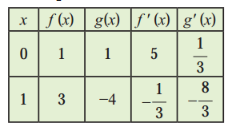
Suppose that the functions f and g and their derivatives with respect to x have the following values at x = 0 and x = 1.

Image

(i) The derivative of f[g(x)] w.r.t. x at x = 0 is _______ (ii) The derivative of g[f(x)] w.r.t. x at x = 0 is _______

(iii) The value of $\left[\frac{d}{d x}\left[x^{10}+f(x)\right]^{-2}\right]_{x=1}$ is

(iv) The derivative of f[(x+g(x))] w.r.t. x at x = 0 is _______
View full question & answer
Question 74 Marks
Differentiate the following w. r. t. x.$y=\log \left[\sqrt{\frac{1-\cos \left(\frac{3 x}{2}\right)}{1+\cos \left(\frac{3 x}{2}\right)}}\right]$
Answer
$
\begin{aligned}
y=\log \left[\sqrt{\left.\frac{1-\cos \left(\frac{3 x}{2}\right)}{1+\cos \left(\frac{3 x}{2}\right)}\right)}\right] & =\log \left[\sqrt{\left.\frac{2 \sin ^2\left(\frac{3 x}{4}\right)}{2 \cos ^2\left(\frac{3 x}{4}\right)}\right]}\right. \\
\therefore \quad y & =\log \left[\tan \left(\frac{3 x}{4}\right)\right]
\end{aligned}
$
Differentiate $w . r . t . x$
$
\begin{aligned}
& \frac{d y}{d x}=\frac{d}{d x}\left\{\log \left[\tan \left(\frac{3 x}{4}\right)\right]\right\} \\
& =\frac{1}{\tan \left(\frac{3 x}{4}\right)} \cdot \frac{d}{d x}\left[\tan \left(\frac{3 x}{4}\right)\right] \\
& =\cot \left(\frac{3 x}{4}\right) \cdot \sec ^2\left(\frac{3 x}{4}\right) \cdot \frac{d}{d x}\left(\frac{3 x}{4}\right) \\
& =\frac{\cos \left(\frac{3 x}{4}\right)}{\sin \left(\frac{3 x}{4}\right)} \times \frac{1}{\cos ^2\left(\frac{3 x}{4}\right)} \times \frac{3}{4} \\
& =\frac{3}{2\left[2 \sin \left(\frac{3 x}{4}\right) \cdot \cos \left(\frac{3 x}{4}\right)\right]}=\frac{3}{2 \sin \left(\frac{3 x}{2}\right)} \\
& \therefore \quad \frac{d y}{d x}=\frac{3}{2} \operatorname{cosec}\left(\frac{3 x}{2}\right) \\
&
\end{aligned}
$
View full question & answer
Question 84 Marks
Differentiate the following w. r. t. x.$y=\log \left[e^{3 x} \cdot \frac{(3 x-4)^{\frac{2}{3}}}{\sqrt[3]{2 x+5}}\right]$
Answer
$
\begin{aligned}
y=\log \left[e^{3 x} \cdot \frac{(3 x-4)^{\frac{2}{3}}}{\sqrt[3]{2 x+5}}\right] & =\log \left[\frac{e^{3 x} \cdot(3 x-4)^{\frac{2}{3}}}{(2 x+5)^{\frac{1}{3}}}\right] \\
& =\log \left[e^{3 x} \cdot(3 x-4)^{\frac{2}{3}}\right]-\log \left[(2 x+5)^{\frac{1}{3}}\right] \\
& =\log e^{3 x}+\log (3 x-4)^{\frac{2}{3}}-\log (2 x+5)^{\frac{1}{3}} \\
\therefore \quad y & =3 x+\frac{2}{3} \log (3 x-4)-\frac{1}{3} \log (2 x+5) \quad[\because \log e=1]
\end{aligned}
$
Differentiate w.r.t. $x$
$
\begin{aligned}
\frac{d y}{d x} & =\frac{d}{d x}\left[3 x+\frac{2}{3} \log (3 x-4)-\frac{1}{3} \log (2 x+5)\right] \\
& =3 \frac{d}{d x}(x)+\frac{2}{3} \cdot \frac{d}{d x}[\log (3 x-4)]-\frac{1}{3} \cdot \frac{d}{d x}[\log (2 x+5)] \\
& =3(1)+\frac{2}{3} \cdot \frac{1}{3 x-4} \cdot \frac{d}{d x}(3 x-4)-\frac{1}{3} \cdot \frac{1}{2 x+5} \cdot \frac{d}{d x}(2 x+5) \\
& =3(1)+\frac{2}{3} \cdot \frac{1}{3 x-4} \cdot(3)-\frac{1}{3} \cdot \frac{1}{2 x+5} \cdot(2) \\
\therefore \quad \frac{d y}{d x} & =3+\frac{2}{3 x-4}-\frac{2}{3(2 x+5)}
\end{aligned}
$
View full question & answer
Question 94 Marks
If $y=\cos \left(m \cos ^{-1} x\right)$ then show that $\left(1-x^2\right) \frac{d^2 y}{d x^2}-x \frac{d y}{d x}+m^2 y=0$.
Answer
$
\begin{aligned}
& \text { Given that } y=\cos \left(m \cos ^{-1} x\right) \\
& \therefore \quad \cos ^{-1} y=m \cos ^{-1} x \\
& \text { Differentiate (I) w.r.t. } x \\
& \frac{d}{d x}\left(\cos ^{-1} y\right)=m \frac{d}{d x}\left(\cos ^{-1} x\right) \\
& -\frac{1}{\sqrt{1-y^2}} \cdot \frac{d y}{d x}=-\frac{m}{\sqrt{1-x^2}}
\end{aligned}
$
$
\sqrt{1-x^2} \cdot \frac{d y}{d x}=m \sqrt{1-y^2}
$
Squaring both sides
$
\left(1-x^2\right) \cdot\left(\frac{d y}{d x}\right)^2=m^2\left(1-y^2\right)
$
Differentiate w.r.t. $x$
$
\begin{aligned}
& \left(1-x^2\right) \frac{d}{d x}\left(\frac{d y}{d x}\right)^2+\left(\frac{d y}{d x}\right)^2 \frac{d}{d x}\left(1-x^2\right)=m^2 \frac{d}{d x}\left(1-y^2\right) \\
& \left(1-x^2\right) \cdot 2\left(\frac{d y}{d x}\right) \cdot \frac{d}{d x} \cdot\left(\frac{d y}{d x}\right)+\left(\frac{d y}{d x}\right)^2(-2 x)=m^2(-2 y) \frac{d y}{d x} \\
& 2\left(1-x^2\right) \cdot \frac{d y}{d x} \cdot \frac{d^2 y}{d x^2}-2 x\left(\frac{d y}{d x}\right)^2=-2 m^2 y \frac{d y}{d x}
\end{aligned}
$
Dividing throughout by $2 \frac{d y}{d x}$ we get,
$
\begin{aligned}
& \left(1-x^2\right) \cdot \frac{d^2 y}{d x^2}-x \frac{d y}{d x}=-m^2 y \\
\therefore \quad & \left(1-x^2\right) \cdot \frac{d^2 y}{d x^2}-x \frac{d y}{d x}+m^2 y=0
\end{aligned}
$
View full question & answer
Question 104 Marks
If $a x^2+2 h x y+b y^2=0$ then show that $\frac{d^2 y}{d x^2}=0$.
Answer
$
\begin{gathered}
\text { Given that } a x^2+2 h x y+b y^2=0 \\
a x^2+h x y+h x y+b y^2=0 \\
x(a x+h y)+y(h x+b y)=0 \\
y(h x+b y)=-x(a x+h y) \\
\frac{y}{x}=-\frac{a x+h y}{h x+b y}
\end{gathered}
$
Differentiate (I) w.r. t.x
$
\begin{aligned}
& a \frac{d}{d x}\left(x^2\right)+2 h \frac{d}{d x}(x y)+b \frac{d}{d x}\left(y^2\right)=0 \\
& a(2 x)+2 h\left[a \frac{d y}{d x}+y(1)\right]+b(2 y) \frac{d y}{d x}=0 \\
& 2\left[a x+h x \frac{d y}{d x}+h y+b y \frac{d y}{d x}\right]=0 \\
& (h x+b y) \frac{d y}{d x}=-a x-h y \\
& \frac{d y}{d x}=-\frac{a x+h y}{h x+b y}
\end{aligned}
$
From (II), we get
$
\therefore \quad \frac{d y}{d x}=\frac{y}{x}
$
Differentiate (III), w. r. t. $x$
$
\begin{aligned}
& \frac{d}{d x}\left(\frac{d y}{d x}\right)=\frac{d}{d x}\left(\frac{y}{x}\right) \\
& \frac{d^2 y}{d x^2}=\frac{x \frac{d y}{d x}-y(1)}{x^2}=\frac{x\left(\frac{y}{x}\right)-y}{x^2} \ldots[\text { From (II) }] \\
\therefore \quad & \frac{d^2 y}{d x^2}=\frac{y-y}{x^2}=0
\end{aligned}
$
View full question & answer
Question 114 Marks
Find the derivative of $\tan ^{-1}\left(\frac{\sqrt{1+x^2}-1}{x}\right)$ w.r.t. $\sin ^{-1}\left(\frac{2 x}{1+x^2}\right)$.
Answer
Let $u=\tan ^{-1}\left(\frac{\sqrt{1+x^2}-1}{x}\right)$ and $v=\sin ^{-1}\left(\frac{2 x}{1+x^2}\right)$, then we have to find $\frac{d u}{d v}$.
i.e. $\frac{d u}{d v}=\frac{\frac{d u}{d x}}{\frac{d v}{d x}}$
Now, $u=\tan ^{-1}\left(\frac{\sqrt{1+x^2}-1}{x}\right)$
Put $x=\tan \theta \therefore \theta=\tan ^{-1} x$
$u=\tan ^{-1}\left(\frac{\sqrt{1+\tan ^2 \theta}-1}{\tan \theta}\right)=\tan ^{-1}\left(\frac{\sec \theta-1}{\tan \theta}\right)=\left(\frac{\frac{1}{\cos \theta}-1}{\frac{\sin \theta}{\cos \theta}}\right)=\tan ^{-1}\left(\frac{1-\cos \theta}{\sin \theta}\right)$
$=\tan ^{-1}\left[\frac{2 \sin ^2\left|\frac{\theta}{2}\right|}{2 \sin \left|\frac{\theta}{2}\right| \cos \left|\frac{\theta}{2}\right|}\right]=\tan ^{-1}\left[\tan \left(\frac{\theta}{2}\right)\right]$
$u=\frac{\theta}{2}=\frac{1}{2} \tan ^{-1} x$
Differentiate $w . r . t . x$
$\frac{d u}{d x}=\frac{1}{2} \frac{d}{d x}\left(\tan ^{-1} x\right)=\frac{1}{2\left(1+x^2\right)}$

And, $\quad v=\sin ^{-1}\left(\frac{2 x}{1+x^2}\right)=\sin ^{-1}\left(\frac{2 \tan \theta}{1+\tan ^2 \theta}\right)=\sin ^{-1}(\sin 2 \theta)=2 \theta$
$
v=2 \tan ^{-1} x
$
Differentiate $w . r . t . x$
$
\frac{d v}{d x}=2 \frac{d}{d x}\left(\tan ^{-1} x\right)=\frac{2}{1+x^2}
$
Substituting (II) and (III) in (I) we get,
$
\frac{d u}{d v}=\frac{\frac{1}{2\left(1+x^2\right)}}{\frac{2}{1+x^2}}=\frac{1}{4}
$

View full question & answer
Question 124 Marks
If $x=\sqrt{a^{\sin ^{-1} t}}$ and $y=\sqrt{a^{\cos ^{-1 t}}}$, then show that $\frac{d y}{d x}=-\frac{y}{x}$.
Answer
Given that, $x=\sqrt{a^{\sin ^{-1} t}}$ and $y=\sqrt{a^{\cos ^{-1} t}}$
i.e. $x=\sqrt{a^{\sin ^{-1} t}} \ldots$ (I) and $y=\sqrt{a^{\cos ^{-1} t}}$
Differentiate (I) w.r.t.t
$
\begin{aligned}
& =\frac{1}{2 \sqrt{a^{\sin ^{-1} t}}} \cdot a^{\sin ^{-1} t} \cdot \log a \frac{d}{d t}\left(\sin ^{-1} t\right) \\
&
\end{aligned}
$
$
\begin{aligned}
&=\frac{a^{\sin ^{-1} t} \cdot \log a}{2 \sqrt{a^{\sin ^{-1} t}}} \cdot \frac{1}{\sqrt{1-x^2}} \\
& \frac{d x}{d t}=\frac{\sqrt{a^{\sin ^{-1} t}} \cdot \log a}{2 \sqrt{1-x^2}}=\frac{x \log a}{2 \sqrt{1-x^2}} \ldots \text { (III) } \ldots[\text { From (I) }] \\
& \text { Now } y=\sqrt{a^{\cos ^{-1} t}}
\end{aligned}
$
Differentiate (II) w. r. t.t
$
\begin{aligned}
& =\frac{1}{2 \sqrt{a^{\cos ^{-1} t}}} \cdot a^{\cos ^{-1} t} \cdot \log a \frac{d}{d t}\left(\cos ^{-1} t\right) \\
& =\frac{a^{\cos ^{-1} t} \cdot \log a}{2 \sqrt{a^{\cos ^{-1} t}}}\left(-\frac{1}{\sqrt{1-x^2}}\right) \\
& \frac{d y}{d t}=\frac{-\sqrt{a^{\cos ^{-1} t} \cdot} \log a}{2 \sqrt{1-x^2}}=-\frac{y \log a}{2 \sqrt{1-x^2}} \ldots \text { (IV) } \ldots \text { [From (II)] } \\
&
\end{aligned}
$
Now, $\quad \frac{d y}{d x}=\frac{\frac{d y}{d t}}{\frac{d x}{d t}}=\frac{-\frac{y \log a}{2 \sqrt{1-x^2}}}{\frac{x \log a}{2 \sqrt{1-x^2}}} \quad \ldots$. [From (III) and (IV)]
$
\therefore \frac{d y}{d x}=-\frac{y}{x}
$
View full question & answer
Question 134 Marks
If $\sqrt{1-x^2}+\sqrt{1-y^2}=a(x-y)$, then show that $\frac{d y}{d x}=\sqrt{\frac{1-y^2}{1-x^2}}$.
Answer
Given that : $\sqrt{1-x^2}+\sqrt{1-y^2}=a(x-y)$
Put $x=\sin \alpha, y=\sin \beta$
$
\therefore \alpha=\sin ^{-1} x, \beta=\sin ^{-1} y
$
Equation (I) becomes,
$
\begin{aligned}
& \sqrt{1-\sin ^2 \alpha}+\sqrt{1-\sin ^2 \beta}=a(\sin \alpha-\sin \beta) \\
& \cos \alpha+\cos \beta=a(\sin \alpha-\sin \beta) \\
& 2 \cos \left(\frac{\alpha+\beta}{2}\right) \cos \left(\frac{\alpha-\beta}{2}\right)=2 a \cos \left(\frac{\alpha+\beta}{2}\right) \sin \left(\frac{\alpha-\beta}{2}\right) \\
& \cos \left(\frac{\alpha-\beta}{2}\right)=a \sin \left(\frac{\alpha+\beta}{2}\right) \Rightarrow \cot \left(\frac{\alpha-\beta}{2}\right)=a \\
& \frac{\alpha-\beta}{2}=\cot ^{-1} a \quad \therefore \quad \alpha-\beta=2 \cot ^{-1} a \\
\therefore \quad & \sin ^{-1} x-\sin ^{-1} y=2 \cot ^{-1} a \\
& \text { Differentiate } w \cdot r \cdot t \cdot x \\
& \frac{d}{d x}\left(\sin ^{-1} x\right)-\frac{d}{d x}\left(\sin ^{-1} y\right)=\frac{d}{d x}\left(2 \cot ^{-1} a\right) \\
& \frac{1}{\sqrt{1-x^2}}-\frac{1}{\sqrt{1-y^2}} \cdot \frac{d y}{d x}=0 \\
\therefore \quad & \frac{d y}{d x}=\sqrt{\frac{1-y^2}{1-x^2}}
\end{aligned}
$
View full question & answer
Question 144 Marks
Find $x^{m \cdot} \cdot y^n=(x+y)^{m+n}$, then prove that $\frac{d y}{d x}=\frac{y}{x}$.
Answer
Given that : $x^m \cdot y^n=(x+y)^{m+n}$
Taking log on both the sides, we get
$
\begin{aligned}
& \log \left[x^{m \prime} \cdot y^n\right]=\log \left[(x+y)^{m+n}\right] \\
& m \log x+n \log y=(m+n) \log (x+y)
\end{aligned}
$
Differentiate $w, r, l, x$.
$
\begin{aligned}
& m \frac{d}{d x}(\log x)+n \frac{d}{d x}(\log y)=(m+n) \frac{d}{d x}[\log (x+y)] \\
& \frac{m}{x}+\frac{n}{y} \cdot \frac{d y}{d x}=\frac{m+n}{x+y} \cdot \frac{d}{d x}(x+y) \\
& \frac{m}{x}+\frac{n}{y} \cdot \frac{d y}{d x}=\frac{m+n}{x+y} \cdot\left[1+\frac{d y}{d x}\right] \\
& \frac{m}{x}+\frac{n}{y} \cdot \frac{d y}{d x}=\frac{m+n}{x+y}+\frac{m+n}{x+y} \cdot \frac{d y}{d x} \\
& \frac{n}{y} \cdot \frac{d y}{d x}-\frac{m+n}{x+y} \cdot \frac{d y}{d x}=\frac{m+n}{x+y}-\frac{m}{x}
\end{aligned}
$
$
\begin{aligned}
& {\left[\frac{n}{y}-\frac{m+n}{x+y}\right] \frac{d y}{d x}=\frac{m+n}{x+y}-\frac{m}{x} } \\
& {\left[\frac{n(x+y)-(m+n) y}{y(x+y)}\right] \frac{d y}{d x}=\left[\frac{(m+n) x-m(x+y)}{x(x+y)}\right] } \\
& {\left[\frac{n x+n y-m y-n y}{y}\right] \frac{d y}{d x}=\frac{m x+n x-m x-m y}{x} } \\
& {\left[\frac{n x-m y}{y}\right] \frac{d y}{d x}=\frac{n x-m y}{x} } \\
\therefore & \frac{d y}{d x}=\frac{y}{x}
\end{aligned}
$
View full question & answer
Question 154 Marks
Differentiate the following w. r. t. x.$x^a+x^x+a^x$
Answer
Let $y=x^a+x^x+a^x$
Here the derivatives of $x^a$ and $a^x$ can be found directly but we can not find the derivative of $x^x$ without the use of logarithm. So the given function is split in to two functions, find their derivatives and then add them.
Let $u=x^a+a^x$ and $v=x^x$
$\therefore \quad y=u+v$, where $u$ and $v$ are differentiable functions of $x$.
$
\frac{d y}{d x}=\frac{d u}{d x}+\frac{d v}{d x}
$
Now, $u=x^a+a^x$
$
\begin{aligned}
& \text { Differentiate w.r.t.x. } \\
& \frac{d u}{d x}=\frac{d}{d x}\left(x^a\right)+\frac{d}{d x}\left(a^x\right) \\
& \frac{d u}{d x}=a x^{-1}+a^x \log a
\end{aligned}
$
And, $v=x^x$
Taking log of both the sides we get,
$
\begin{aligned}
& \log v=\log x^x \\
& \log v=x \log x
\end{aligned}
$
Differentiate w.r. t. $x$.
$
\begin{aligned}
\frac{d}{d x}(\log v) & =\frac{d}{d x}(x \log x) \\
\frac{1}{v} \frac{d v}{d x} & =x \frac{d}{d x}(\log x)+\log x \frac{d}{d x}(x) \\
\frac{d v}{d x} & =v\left[x \times \frac{1}{x}+\log x(1)\right] \\
\frac{d v}{d x} & =x^x[1+\log x]
\end{aligned}
$
Substituting (II) and (III) in (I) we get,
$
\frac{d y}{d x}=a x^{-1}+a^x \log a+x^x[1+\log x]
$
View full question & answer
Question 164 Marks
Differentiate the following w. r. t. x.$(x+1)^{\frac{3}{2}}(2 x+3)^{\frac{5}{2}}(3 x+4)^{\frac{2}{3}}$ for $x \geq 0$
Answer
Let $y=(x+1)^{\frac{3}{2}}(2 x+3)^{\frac{5}{2}}(3 x+4)^{\frac{2}{3}}$
Taking log of both the sides we get,
$
\begin{aligned}
\log y & =\log \left[(x+1)^{\frac{3}{2}}(2 x+3)^{\frac{5}{2}}(3 x+4)^{\frac{2}{3}}\right] \\
& =\log (x+1)^{\frac{3}{2}}+\log (2 x+3)^{\frac{5}{2}}+\log (3 x+4)^{\frac{2}{3}} \\
\log y & =\frac{3}{2} \log (x+1)+\frac{5}{2} \log (2 x+3)+\frac{2}{3} \log (3 x+4)
\end{aligned}
$
Differentiate w.r.t. $x$.
$
\begin{aligned}
\frac{d}{d x}(\log y) & =\frac{d}{d x}\left[\frac{3}{2} \log (x+1)+\frac{5}{2} \log (2 x+3)+\frac{2}{3} \log (3 x+4)\right] \\
\frac{1}{y} \cdot \frac{d y}{d x} & =\frac{3}{2} \cdot \frac{d}{d x}[\log (2 x+1)]+\frac{5}{2} \cdot \frac{d}{d x}[\log (3 x+2)]+\frac{2}{3} \cdot \frac{d}{d x}[\log (3 x+4)] \\
& =\frac{3}{2(2 x+1)} \cdot \frac{d}{d x}(2 x+1)+\frac{5}{2(3 x+1)} \cdot \frac{d}{d x}(3 x+2)+\frac{2}{3(3 x+4)} \cdot \frac{d}{d x}(3 x+4) \\
\frac{d y}{d x} & =y\left[\frac{3}{2(2 x+1)}(2)+\frac{5}{2(3 x+1)}(3)+\frac{2}{3(3 x+4)}(3)\right] \\
\therefore \quad \frac{d y}{d x} & =(x+1)^{\frac{3}{2}}(2 x+3)^{\frac{3}{2}}(3 x+4)^{\frac{2}{3}}\left[\frac{3}{2 x+1}+\frac{15}{2(3 x+1)}+\frac{2}{3 x+4}\right]
\end{aligned}
$
View full question & answer
Question 214 Marks
If $y=\sin \left(m \cos ^{-1} x \right)$, then show that $\left(1-x^2\right) \frac{d^2 y}{d x^2}-x \frac{d y}{d x}+m^2 y=0$
View full question & answer
Question 224 Marks
If $x =\cos t , y = e ^{ mt }$, show that $\left(1-x^2\right) \frac{d^2 y}{d x^2}-x \frac{d y}{d x}-m^2 y=0$
View full question & answer
Question 234 Marks
If $y =e^{m \tan ^{-1} x}$, show that $\left(1+x^2\right) \frac{d^2 y}{d x^2}+(2 x-m) \frac{d y}{d x}=0$
View full question & answer
Question 304 Marks
Differentiate $\tan ^{-1}\left(\frac{\sqrt{1+x^2}-1}{x}\right)$ w.r.t. $\tan ^{-1}\left(\frac{2 x \sqrt{1-x^2}}{1-2 x^2}\right)$
View full question & answer
Question 334 Marks
If $x =\frac{2 b t}{1+t^2}, y =a\left(\frac{1-t^2}{1+t^2}\right)$, show that $\frac{d x}{d y}=-\frac{b^2 y}{a^2 x}$
View full question & answer
Question 364 Marks
Find $\frac{d y}{d x}$, if

$x = t ^2+ t +1, y =\sin \left(\frac{\pi t}{2}\right)+\cos \left(\frac{\pi t}{2}\right)$ at $t =1$

View full question & answer
Question 384 Marks
Find $\frac{d y}{d x}$, if

$x=\operatorname{cosec}^2 \theta, y=\cot ^3 \theta$ at $\theta=\frac{\pi}{6}$

View full question & answer
Question 394 Marks
Show that $\frac{d y}{d x}=\frac{y}{x}$ in the following, where a and $p$ are constants.

$\sin \left(\frac{x^3-y^3}{x^3+y^3}\right)=a^3$

View full question & answer
Question 404 Marks
Show that $\frac{d y}{d x}=\frac{y}{x}$ in the following, where a and $p$ are constants.

$e^{\frac{x^7-y^7}{x^7+y^7}}=a$

View full question & answer
Question 414 Marks
Show that $\frac{d y}{d x}=\frac{y}{x}$ in the following, where a and $p$ are constants.

$\log \left(\frac{x^{20}-y^{20}}{x^{20}+y^{20}}\right)=20$

View full question & answer
Question 424 Marks
Show that $\frac{d y}{d x}=\frac{y}{x}$ in the following, where a and $p$ are constants.

$\cos ^{-1}\left(\frac{7 x^4+5 y^4}{7 x^4-5 y^4}\right)=\tan ^{-1} a$

View full question & answer
Question 434 Marks
Show that $\frac{d y}{d x}=\frac{y}{x}$ in the following, where a and $p$ are constants.

$\tan ^{-1}\left(\frac{3 x^2-4 y^2}{3 x^2+4 y^2}\right)=a^2$

View full question & answer
Question 444 Marks
Show that $\frac{d y}{d x}=\frac{y}{x}$ in the following, where a and $p$ are constants.

$\sec \left(\frac{x^5+y^5}{x^5-y^5}\right)=a^2$

View full question & answer
Question 454 Marks
Show that $\frac{d y}{d x}=\frac{y}{x}$ in the following, where a and $p$ are constants.

$x^p y^4=(x+y)^{p+4}, p \in N$

View full question & answer
Question 464 Marks
Show that $\frac{d y}{d x}=\frac{y}{x}$ in the following, where a and $p$ are constants.

$x^7 y^5=(x+y)^{12}$

View full question & answer
Question 494 Marks
Differentiate the following w.r.t. x:

$\frac{\left(x^2+2 x+2\right)^{\frac{3}{2}}}{(\sqrt{x}+3)^3(\cos x)^x}$

View full question & answer
Question 504 Marks
Differentiate the following w.r.t. x:

$\left(x^2+3\right)^{\frac{3}{2}} \cdot \sin ^3 2 x \cdot 2^{x^2}$

View full question & answer
Question 534 Marks
Diffrentiate the following w. r. t. x.$\cot ^{-1}\left(\frac{\sqrt{1+\sin \left(\frac{4 x}{3}\right)}+\sqrt{1-\sin \left(\frac{4 x}{3}\right)}}{\sqrt{1+\sin \left(\frac{4 x}{3}\right)}-\sqrt{1-\sin \left(\frac{4 x}{3}\right)}}\right)$
Answer
$\text { Let } y=\cot ^{-1}\left(\frac{\sqrt{1+\sin \left(\frac{4 x}{3}\right)}+\sqrt{1-\sin \left(\frac{4 x}{3}\right)}}{\sqrt{1+\sin \left(\frac{4 x}{3}\right)}-\sqrt{1-\sin \left(\frac{4 x}{3}\right)}}\right]$
$1+\sin \left(\frac{4 x}{3}\right)=1+\cos \left(\frac{\pi}{2}-\frac{4 x}{3}\right)=2 \cos ^2\left(\frac{\pi}{4}-\frac{2 x}{3}\right)$
$\therefore \sqrt{1+\sin \left(\frac{4 x}{3}\right)}=\sqrt{2} \cos \left(\frac{\pi}{4}-\frac{2 x}{3}\right)$
Also, $1-\sin \left(\frac{4 x}{3}\right)=1-\cos \left(\frac{\pi}{2}-\frac{4 x}{3}\right)=2 \sin ^2\left(\frac{\pi}{4}-\frac{2 x}{3}\right)$
$\therefore \sqrt{1-\sin \left(\frac{4 x}{3}\right)}=\sqrt{2} \sin \left(\frac{\pi}{4}-\frac{2 x}{3}\right)$
$\therefore \frac{\sqrt{1+\sin \left(\frac{4 x}{3}\right)}+\sqrt{1-\sin \left(\frac{4 x}{3}\right)}}{\sqrt{1+\sin \left(\frac{4 x}{3}\right)}-\sqrt{1-\sin \left(\frac{4 x}{3}\right)}}$
$=\frac{\sqrt{2} \cos \left(\frac{\pi}{4}-\frac{2 x}{3}\right)+\sqrt{2} \sin \left(\frac{\pi}{4}-\frac{2 x}{3}\right)}{\sqrt{2} \cos \left(\frac{\pi}{4}-\frac{2 x}{3}\right)-\sqrt{2} \sin \left(\frac{\pi}{4}-\frac{2 x}{3}\right)}$
$=\frac{\cos \left(\frac{\pi}{4}-\frac{2 x}{3}\right)+\sin \left(\frac{\pi}{4}-\frac{2 x}{3}\right)}{\cos \left(\frac{\pi}{4}-\frac{2 x}{3}\right)-\sin \left(\frac{\pi}{4}-\frac{2 x}{3}\right)}$
$=\frac{1+\tan \left(\frac{\pi}{4}-\frac{2 x}{3}\right)}{1-\tan \left(\frac{\pi}{4}-\frac{2 x}{3}\right)} \quad \cdots\left[\right.$ Dividing by $\left.\cos \left(\frac{\pi}{4}-\frac{2 x}{3}\right)\right]$
$=\frac{\tan \frac{\pi}{4}+\tan \left(\frac{\pi}{4}-\frac{2 x}{3}\right)}{1-\tan \frac{\pi}{4} \cdot \tan \left(\frac{\pi}{4}-\frac{2 x}{3}\right)} \quad \cdots\left[\because \tan \frac{\pi}{4}=1\right]$
$=\tan \left[\frac{\pi}{4}+\frac{\pi}{4}-\frac{2 x}{3}\right]=\tan \left(\frac{\pi}{2}-\frac{2 x}{3}\right)$
$=\cot \left(\frac{2 x}{3}\right)$
$\therefore y=\cot ^{-1}\left[\cot \left(\frac{2 x}{3}\right)\right]=\frac{2 x}{3}$
Differentiating w.r.t. $x$, we get
$\frac{d y}{d x}  =\frac{d}{d x}\left(\frac{2 x}{3}\right)=\frac{2}{3} \frac{d}{d x}(x)$
$=\frac{2}{3} \times 1=\frac{2}{3} .$
View full question & answer
Question 544 Marks
Find the x co-ordinates of all the points on the curve y = sin 2x – 2 sin x, 0 ≤ x < 2π where

$\frac{d y}{d x}=0$

Answer
$\begin{aligned} & y=\sin 2 x-2 \sin x, 0 \leq x<2 \pi \\ & \begin{aligned} \therefore \frac{d y}{d x} & =\frac{d}{d x}(\sin 2 x-2 \sin x) \\ & =\frac{d}{d x}(\sin 2 x)-2 \frac{d}{d x}(\sin x) \\ & =\cos 2 x \cdot \frac{d}{d x}(2 x)-2 \cos x\end{aligned}\end{aligned}$

$\begin{aligned} & =\cos 2 x \times 2-2 \cos x \\ & =2\left(2 \cos ^2 x-1\right)-2 \cos x \\ & =4 \cos ^2 x-2-2 \cos x \\ & =4 \cos ^2 x-2 \cos x-2\end{aligned}$

$\begin{aligned} & \text { If } \frac{d y}{d x}=0 \text {, then } 4 \cos ^2 x-2 \cos x-2=0 \\ & \therefore 4 \cos ^2 x-4 \cos x+2 \cos x-2=0 \\ & \therefore 4 \cos x(\cos x-1)+2(\cos x-1)=0 \\ & \therefore(\cos x-1)(4 \cos x+2)=0 \\ & \therefore \cos x-1=0 \text { or } 4 \cos x+2=0 \\ & \therefore \cos x=1 \text { or } \cos x=-\frac{1}{2} \\ & \therefore \cos x=\cos 0\end{aligned}$

$\begin{aligned} & \text { or } \cos x=-\cos \frac{\pi}{3}=\cos \left(\pi-\frac{\pi}{3}\right)=\frac{\cos 2 \pi}{3} \\ & \text { or } \cos x=-\cos \frac{\pi}{3}=\cos \left(\pi-\frac{\pi}{3}\right)=\cos \frac{4 \pi}{3}\end{aligned}$

$\ldots[\because 0 \leqslant x<2 \pi]$

$\begin{aligned} & \therefore x=0 \text { or } x=\frac{2 \pi}{3} \text { or } x=\frac{4 \pi}{3} \text {. } \\ & \therefore x=0 \text { or } \frac{2 \pi}{3} \text { or } \frac{4 \pi}{3} .\end{aligned}$

View full question & answer