Questions

Solve the Following Question.(2 Marks)

Take a timed test

28 questions · self-marked practice — reveal the answer and mark yourself.

Question 12 Marks
Find the distance of the point (13, 13, -13) from the plane 3x + 4y – 12z = 0.
Answer
The distance of the point $\left(x_1, y_1, z_1\right)$ from the plane $a x+b y+c z+d=0$ is $\left|\frac{a x_1+b y_1+c z_1+d}{\sqrt{a^2+b^2+c^2}}\right|$

$\therefore$ the distance of the point $(1,1,-1)$ from the plane $3 x+4 y-12 z=0$ is $\frac{3(1)+4(1-12(-1))}{\sqrt{3^2+4^2+(-12)^2}}$

$=\left|\frac{3+4+12}{\sqrt{9+16+144}}\right|$

$=\frac{19}{\sqrt{169}}$

$=\frac{19}{13}$

$=19$ units.
View full question & answer
Question 22 Marks
Find the distance of the point $3 \hat{i}+3 \hat{j}+\hat{k}$ from the plane $\bar{r} \cdot(2 \hat{i}+3 \hat{j}+6 \hat{k})=21$
Answer
The distance of the point A( $\bar{a})$ from the plane $\bar{r} \cdot \bar{n}=p$ is given by $d=\frac{|\bar{a} \cdot \bar{n}-p|}{|\bar{n}|} \ldots \ldots(1)$

Here, $\bar{a}=3 \hat{\mathrm{i}}+3 \hat{\mathrm{j}}+\hat{k}, \bar{n}=2 \hat{i}+3 \hat{j}+6 \hat{k}, p=21$

$\therefore \overline{\mathrm{a}} \cdot \overline{\mathrm{n}}=(3 \hat{\mathrm{i}}+3 \hat{\mathrm{j}}+\hat{\mathrm{k}}) \cdot(2 \hat{\mathrm{i}}+3 \hat{\mathrm{j}}+6 \hat{\mathrm{k}})$

= (3)(2) + (3)(3) + (1)(-6) = 6 + 9 – 6 = 9

Also, $|\bar{n}|=\sqrt{3^2+3^2+(-6)^2}=\sqrt{-12}=0$

$\therefore$ from (1), the required distance

$=\frac{|-12-21|}{12}$

$=0$ units.

View full question & answer
Question 32 Marks
The foot of the perpendicular drawn from the origin to a plane is M(1, 2,0). Find the vector equation of the plane.
Answer
The vector equation of the plane passing through $\mathrm{A}(\bar{a})$ and perpendicular to $\bar{n}$ is

$\bar{r} \cdot \bar{n}=\bar{a} \cdot \bar{n}$

M(1, 2, 0) is the foot of the perpendicular drawn from origin to the plane. Then the plane is passing through M and is perpendicular to OM.

If $\bar{m}$ is the position vector of $M_t$ then $\bar{m}=\hat{i}$.

Normal to the plane is

$\begin{aligned} & \overline{\mathrm{n}}=\overline{\mathrm{OM}}=\hat{\mathrm{i}} \\ & \overline{\mathrm{m}} \cdot \overline{\mathrm{n}}=\hat{\mathrm{i}}, \hat{i}=5\end{aligned}$

∴ the vector equation of the required plane is

$\bar{r} \cdot(\hat{i}+2 \hat{j})=5$

View full question & answer
Question 42 Marks
Find the Cartesian equation of the plane passing through A(7, 8, 6) and parallel to the

plane $\bar{r} \cdot(6 \hat{i}+8 \hat{j}+7 \hat{k})=0$

Answer
The cartesian equation of the plane $\bar{r} \cdot(6 \hat{i}+8 \hat{j}+7 \hat{k})=0$ is $6 x+8 y+7 z=0$ The

required plane is parallel to it ∴ its cartesian equation is 6x + 8y + 7z = p …(1) A (7, 8, 6) lies on it and hence satisfies its equation ∴ (6)(7) + (8)(8) + (7)(6) = p i.e., p = 42 + 64 + 42 = 148. ∴ from (1), the cartesian equation of the required plane is 6x + 8y + 7z = 148.

View full question & answer
Question 52 Marks
Find the Cartesian equation of the plane passing through A(1, -2, 3) and the direction ratios of whose normal are 0, 2, 0.
Answer
The Cartesian equation of the plane passing through (x1, y1, z1), the direction ratios of whose normal are a, b, c, is a(x – x1) + b(y – y1) + c(z – z1) = 0 ∴ the cartesian equation of the required plane is o(x + 1) + 2(y + 2) + 5(z – 3) = 0 i.e. 0 + 2y – 4 + 10z – 15 = 0 i.e. y + 2 = 0.
View full question & answer
Question 62 Marks
Find the coordinates of the foot of the perpendicular drawn from the origin to the plane 2x + 3y + 6z = 49.
Answer
The equation of the plane is 2x + 3y + 6z = 49 Dividing each term by

$\begin{aligned} & \sqrt{2^2+3^2+(-6)^2} \\ & =\sqrt{49} \\ & =7\end{aligned}$

we get

$\frac{2}{7} x+\frac{3}{7} y-\frac{6}{7} z=\frac{49}{7}=7$

This is the normal form of the equation of plane. ∴ the direction cosines of the perpendicular drawn from the origin to the plane are

$I=\frac{2}{7}, m=\frac{3}{7}, n=\frac{6}{7}$

and length of perpendicular from origin to the plane is p = 7. the coordinates of the foot of the perpendicular from the origin to the plane are (lp, ∓, np)i.e.(2, 3, 6)

View full question & answer
Question 72 Marks
Find the perpendicular distance of the origin from the plane 6x + 2y + 3z – 7 = 0
Answer
The distance of the point $\left(x_1, y_1, z_1\right)$ from the plane $a x+b y+c z+d$ is $\left|\frac{a x_1+b y_1+c z_1+d}{\sqrt{a^2+b^2+c^2}}\right|$

∴ the distance of the point (1, 1, -1) from the plane 6x + 2y + 3z – 7 = 0 is

$\left|\frac{6(1)+2(1-3(-1)+7)}{\sqrt{3^2+4^2+(-12)^2}}\right|$

$=\left|\frac{6+4+6+7}{\sqrt{9+16+144}}\right|$

$=\frac{23}{\sqrt{169}}$

$=\frac{23}{13}$

= 1units.

View full question & answer
Question 82 Marks
Find the direction cosines of the line $\bar{r}=\left(-2 \hat{i}+\frac{5}{2} \hat{j}-\hat{k}\right)+\lambda(2 \hat{i}+3 \hat{j})$.
Answer
The line $\bar{r}=\left(-2 \hat{i}+\frac{5}{2} \hat{j}-\hat{k}\right)+\lambda(2 \hat{i}+3 \hat{j})$ is

parallel to $\bar{b}=2 \hat{i}+3 \hat{j}$.

$\therefore$ direction ratios of the line are $2,3,0$.

$\therefore$ direction cosines of the line are

$\frac{2}{\sqrt{2^2+3^2+0}}, \frac{3}{\sqrt{2^2+3^2+0}}, 0$

i.e. $\frac{2}{\sqrt{13}}, \frac{3}{\sqrt{13}}, 0$.

View full question & answer
Question 92 Marks
Find the vector equation of the line which passes through the origin and the point (5, -2, 3).
Answer
Let $\bar{b}$ be the position vector of the point $B(5,-2,3)$.

Then $\bar{b}=5 \hat{i}-2 \hat{j}+3 \hat{k}$

Origin has position vector $\overline{0}=0 \hat{i}+0 \hat{j}+0 \hat{k}$.

The vector equation the line passing through $A(\bar{a})$ and $B(\bar{b})$ is $\bar{r}=\bar{a}+\lambda(\bar{b}-\bar{a})$ where $\lambda$

is a scalar.

$\therefore$ the vector equation of the required line is $\bar{r}=\overline{0}+\lambda(\bar{b}-\overline{0})=\lambda(5 \hat{i}-2 \hat{j}+3 \hat{k})$

View full question & answer
Question 102 Marks
Find the angle between the line $\bar{r}=(\hat{i}+2 \hat{j}+\hat{k})+\lambda(\hat{i}+\hat{j}+\hat{k})$ and the plane $\bar{r} \cdot(2 \hat{i}-\hat{j}+\hat{k})=8$
Answer
The angle between the line $\bar{r}=\bar{a}+\lambda \bar{b}$ and the plane $\bar{r} \cdot \bar{n}=d$ is given by $\sin \theta=\left|\frac{\bar{b} \cdot \bar{n}}{|\bar{b}| \cdot|\bar{n}|}\right|$ Here $\bar{b}=\hat{i}+\hat{j}+\hat{k}$ and $\bar{n}=2 \hat{i}-\hat{j}+\hat{k}$
$
\begin{aligned}
& \therefore \bar{b} \cdot \bar{n}=(\hat{i}+\hat{j}+\hat{k}) \cdot(2 \hat{i}-\hat{j}+\hat{k})=2-1+1=2 \\
& |\bar{b}|=\sqrt{1+1+1}=\sqrt{3} \text { and }|\bar{n}|=\sqrt{4+1+1}=\sqrt{6} \\
& \therefore \sin \theta=\left|\frac{\bar{b} \cdot \bar{n}}{|\bar{b}| \cdot|\bar{n}|}\right|=\frac{2}{\sqrt{3} \cdot \sqrt{6}}=\frac{\sqrt{2}}{3} \\
& \therefore \theta=\sin ^{-1}\left(\frac{\sqrt{2}}{3}\right)
\end{aligned}
$
View full question & answer
Question 112 Marks
Find the angle between planes $\bar{r} \cdot(\hat{i}+\hat{j}-2 \hat{k})=8$ and $\bar{r} \cdot(-2 \hat{i}+\hat{j}+\hat{k})=3$
Answer
Normal to the given planes are $\bar{n}_1=\hat{i}+\hat{j}-2 \hat{k}$ and $\bar{n}_2=-2 \hat{i}+\hat{j}+\hat{k}$
The acute angle $\theta$ between normal is given by
$
\begin{aligned}
& \cos \theta=\left|\frac{\bar{n}_1 \cdot \bar{n}_2}{\left|\bar{n}_1\right| \cdot\left|\bar{n}_2\right|}\right| \\
& \therefore \cos \theta=\left|\frac{\mid(\hat{i}+\hat{j}-2 \hat{k}) \cdot(-2 \hat{i}+\hat{j}+\hat{k})}{\sqrt{6} \cdot \sqrt{6}}\right|=\left|\frac{-3}{6}\right|=\frac{1}{2} \\
& \therefore \cos \theta=\frac{1}{2} \quad \therefore \theta=60^{\circ}=\frac{\pi}{3}
\end{aligned}
$
The acute angle between normals $\bar{n}_1$ and $\bar{n}_2$ is $60^{\circ}$.
$\therefore \quad$ The angle between given planes is $60^{\circ}$.
View full question & answer
Question 122 Marks
Find the coordinates of the foot of the perpendicular drawn from the origin to the plane
$
2 x+y-2 z=18
$
Answer
The Direction ratios of the normal to the plane $2 x+y-2 z=18$ are $2,1,-2$.
$\therefore \quad$ Direction cosines are $\frac{2}{3}, \frac{1}{3},-\frac{2}{3}$
The normal form of the given Cartesian equation is $\frac{2}{3} x+\frac{1}{3} y-\frac{2}{3} z=6$
$
\therefore \quad p=6
$
The coordinates of the foot of the perpendicular are $(l p, m p, n p)=\left(6\left(\frac{2}{3}\right), 6\left(\frac{1}{3}\right), 6\left(-\frac{2}{3}\right)\right) \equiv(4,2,-4)$
View full question & answer
Question 132 Marks
Find the perpendicular distance of the origin from the plane $x-3 y+4 z-6=0$
Answer
First we write the given Cartesian equation in normal form.
i.e. in the form $l x+m y+n z=p$
Direction ratios of the normal are $1,-3,4$.
$\therefore \quad$ Direction cosines are $\frac{1}{\sqrt{26}}, \frac{-3}{\sqrt{26}}, \frac{4}{\sqrt{26}}$
Given equation can be written as $\frac{1}{\sqrt{26}} x-\frac{-3}{\sqrt{26}} y+\frac{4}{\sqrt{26}} z=\frac{6}{\sqrt{26}}$
$\therefore \quad$ The distance of the origin from the plane is $\frac{6}{\sqrt{26}}$
View full question & answer
Question 142 Marks
Find the vector equation of the plane which is at a distance of 6 unit from the origin and to which the vector $2 \hat{i}-\hat{j}+2 \hat{k}$ is normal.
Answer
Here $p=6$ and $\bar{n}=2 \hat{i}-\hat{j}+2 \hat{k}$
$
\therefore|\bar{n}|=3
$
$
\therefore \hat{n}=\frac{\bar{n}}{|\bar{n}|}=\frac{2 \hat{i}-\hat{j}+2 \hat{k}}{3}
$
The required equation is $\therefore \bar{r} \cdot \hat{n}=p$
$
\begin{aligned}
& \therefore \bar{r} \cdot\left(\frac{2 \hat{i}-\hat{j}+2 \hat{k}}{3}\right)=6 \\
& \therefore \bar{r} \cdot(2 \hat{i}-\hat{j}+2 \hat{k})=18
\end{aligned}
$
View full question & answer
Question 152 Marks
Find the vector equation of the plane passing through the point $\mathrm{A}(-1,2,-5)$ an parallel to vectors $4 \hat{i}-\hat{j}+3 \hat{k}$ and $\hat{i}+\hat{j}-\hat{k}$.
Answer
The vector equation of the plane passing through point $\mathrm{A}(\bar{a})$ and parallel to $\bar{b}$ and $\bar{c}$ is $\bar{r} \cdot(\bar{b} \times \bar{c})=\bar{a} \cdot(\bar{b} \times \bar{c})$
Here $\bar{a}=-\hat{i}+\widehat{2 j}-5 \hat{k}, \bar{b}=4 \hat{i}-\hat{j}+3 \hat{k}, \bar{c}=\hat{i}+\hat{j}-\hat{k}$
$
\begin{aligned}
& \bar{b} \times \bar{c}=\left|\begin{array}{rrr}
\hat{i} & \hat{j} & \hat{k} \\
4 & -1 & 3 \\
1 & 1 & -1
\end{array}\right|=-2 \hat{i}+7 \hat{j}+5 \hat{k} \\
& \bar{a} \cdot(\bar{b} \times \bar{c})=(-\hat{i}+2 \hat{j}-5 \hat{k}) \cdot(-2 \hat{i}+7 \hat{j}+5 \hat{k})=-9
\end{aligned}
$
The required equation is $\bar{r} \cdot(-2 \hat{i}+7 \hat{j}+5 \hat{k})=-9$
View full question & answer
Question 162 Marks
The foot of the perpendicular drawn from the origin to a plane is $\mathrm{M}(2,1,-2)$. Find vector equation of the plane.
Answer
OM is normal to the plane.
$\therefore$ The direction ratios of the normal are $2,1,-2$.
The plane passes through the point having position vector $2 \hat{i}+\hat{j}-2 \hat{k}$ and vector $\overline{\mathrm{OM}}=2 \hat{i}+\hat{j}-2 \hat{k}$ is normal to it.
Its vector equation is $\bar{r} \cdot \bar{n}=\bar{a} \cdot \bar{n}$.
$\begin{aligned} & \bar{r} \cdot(2 \hat{i}+\hat{j}-2 \hat{k})=(2 \hat{i}+\hat{j}-2 \hat{k}) \cdot(2 \hat{i}+\hat{j}-2 \hat{k}) \\ & \bar{r} \cdot(2 \hat{i}+\hat{j}-2 \hat{k})=9\end{aligned}$
View full question & answer
Question 172 Marks
$\text{Show that lines :}\bar{r}=(\hat{i}+\hat{j}-\hat{k})+\lambda(2 \hat{i}-2 \hat{j}+\hat{k}) \text { and } \bar{r}=(4 \hat{i}-3 \hat{j}+2 \hat{k})+\mu(\hat{i}-2 \hat{j}+2 \hat{k})$ intersect each other.
Answer
Lines $\bar{r}=\bar{a}_1+\lambda_1 \bar{b}_1$ and $\bar{r}=\bar{a}_2+\lambda_2 \bar{b}_2$ intersect each other if and only if
$
\left(\bar{a}_2-\bar{a}_1\right) \cdot\left(\bar{b}_1 \times \bar{b}_2\right)=0
$
Here $\bar{a}_1=\hat{i}+\hat{j}-\hat{k}, \bar{a}_2=4 \hat{i}-3 \hat{j}+2 \hat{k}, \quad \bar{b}_1=2 \hat{i}-2 \hat{j}+\hat{k}, \bar{b}_2=\hat{i}-2 \hat{j}+2 \hat{k}$,
$
\begin{aligned}
& \bar{a}_2-\bar{a}_1=3 \hat{i}-4 \hat{j}+3 \hat{k} \\
& \left(\bar{a}_2-\bar{a}_1\right) \cdot\left(\bar{b}_1 \times \bar{b}_2\right)=\left|\begin{array}{lll}
3 & -4 & 3 \\
2 & -2 & 1 \\
1 & -2 & 2
\end{array}\right|=3(-2)+4(3)+3(-2)=-6+12-6=0
\end{aligned}
$
Given lines intersect each other.
View full question & answer
Question 182 Marks
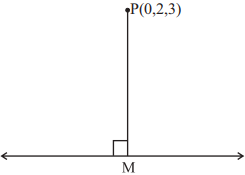
Find the distance of the point $\mathrm{P}(0,2,3)$ from the line $\frac{x+3}{5}=\frac{y-1}{2}=\frac{z+4}{3}$.

Image

Answer
Let $\mathrm{M}$ be the foot of the perpendicular drawn from the point $\mathrm{P}(0,2,3)$ to the given line.
$\mathrm{M}$ lies on the line. Let co-ordinates of $\mathrm{M}$ be $(5 \lambda-3,2 \lambda+1,3 \lambda-4)$.
The direction ratios of PM are $(5 \lambda-3)-0,(2 \lambda+1)-2,(3 \lambda-4)-3$ i.e. $5 \lambda-3,2 \lambda-1,3 \lambda-7$
The direction ratios of given line are 5, 2, 3 and PM is perpendicular to the given line.
$
\begin{aligned}
& \therefore \quad 5(5 \lambda-3)+2(2 \lambda-1)+3(3 \lambda-7)=0 \\
& \therefore \quad \lambda=1 \\
& \therefore \quad \text { The co-ordinates of } \mathrm{M} \text { are }(2,3,-1) .
\end{aligned}
$
$\therefore$ The co-ordinates of $\mathrm{M}$ are $(2,3,-1)$.
The distance of $\mathrm{P}$ from the line is $\mathrm{PM}=\sqrt{(2-0)^2+(3-2)^2+(-1-3)^2}=\sqrt{21}$ unit
View full question & answer
Question 192 Marks
Find the co-ordinates of points on the line $\frac{x+1}{2}=\frac{y-2}{3}=\frac{z+3}{6}$, which are at 3 unit distance from the base point $\mathrm{A}(-1,2,-3)$.
Answer
Let $\mathrm{Q}(2 \lambda-1,3 \lambda+2,6 \lambda-3)$ be a point on the line which is at 3 unit distance from the point $\mathrm{A}(-1,2,-3) \therefore \mathrm{AQ}=3$
$
\begin{aligned}
& \left.\therefore \quad \sqrt{(2 \lambda)^2+(3 \lambda)^2+(6 \lambda)^2}=3 \quad \therefore \quad(2 \lambda)^2+(3 \lambda)^2+(6 \lambda)^2\right)=9 \quad \therefore 49 \lambda^2=9 \\
& \therefore \quad \lambda=-\frac{3}{7} \text { or } \frac{3}{7}
\end{aligned}
$
$\therefore$ There are two points on the line which are at a distance of 3 units from $P$. Their co-ordinates are $\mathrm{Q}(2 \lambda-1,3 \lambda+2,6 \lambda-3)$
Hence, the required points are
$
\left(-\frac{1}{7}, 3 \frac{2}{7},-\frac{3}{7}\right) \text { and }\left(-1 \frac{6}{7}, \frac{5}{7},-5 \frac{4}{7}\right)
$
View full question & answer
Question 202 Marks
Find the angle between lines $\bar{r}=(\hat{i}+2 \hat{j}+3 \hat{k})+\lambda(2 \hat{i}-2 \hat{j}+\hat{k})$
$\text { and } \bar{r}=(\hat{i}+2 \hat{j}+3 \hat{k})+\lambda(\hat{i}+2 \hat{j}+\hat{k})$
Answer
Let $\bar{b}$ and $\bar{c}$ be vectors along given lines.
$
\therefore \quad \bar{b}=2 \hat{i}-2 \hat{j}+\hat{k} \text { and } \bar{c}=\hat{i}+2 \hat{j}+2 \hat{k}
$
Angle between lines is same as the angle between $\bar{b}$ and $\bar{c}$.
The angle between $\bar{b}$ and $\bar{c}$ is given by,
$
\begin{aligned}
& \cos \theta=\frac{\bar{b} \cdot \bar{c}}{|\bar{b}| \cdot|\bar{c}|}=\frac{(2 \hat{i}-2 \hat{j}+\hat{k}) \cdot(\hat{i}+2 \hat{j}+2 \hat{k})}{3 \times 3}=\frac{0}{9}=0 \\
& \therefore \cos \theta=0 \quad \therefore \theta=90^{\circ}
\end{aligned}
$
Lines are perpendicular to each other.
View full question & answer
Question 212 Marks
Find the Cartesian equations of the line passing through $\mathrm{A}(1,2,3)$ and $\mathrm{B}(2,3.4)$.
Answer
The Cartesian equations of the line passing through $\mathrm{A}\left(\mathrm{x}_1, \mathrm{y}_1, \mathrm{z}_1\right)$ and $\mathrm{B}\left(\mathrm{x}_2, \mathrm{y}_2, \mathrm{z}_2\right)$ are $\frac{x-x_1}{x_2-x_1}=\frac{y-y_1}{y_2-y_1}=\frac{z-z_1}{z_2-z_1}$
Here $\left(x_1, y_1, z_1\right)=(1,2,3)$ and $\left(x_2, y_2, z_2\right)=(2,3,4)$.
$\therefore$ Required Cartesian equations are $\frac{x-1}{2-1}=\frac{y-2}{3-2}=\frac{z-3}{4-3}$.
$
\begin{aligned}
& \therefore \frac{x-1}{1}=\frac{y-2}{1}=\frac{z-3}{1} . \\
& \therefore x-1=y-2=z-3 .
\end{aligned}
$
View full question & answer
Question 222 Marks
Find the vector equation of the line passing through $2 \hat{i}+\hat{j}-\hat{k}$ and parallel to the line joining points $-\hat{i}+\hat{j}+4 \hat{k}$ and $\hat{i}+2 \hat{j}+2 \hat{k}$.
Answer
Let $\mathrm{A}, \mathrm{B}, \mathrm{C}$ be points with position vectors $\bar{a}=2 \hat{i}+\hat{j}-\hat{k}, \bar{b}=-\hat{i}+\hat{j}+4 \hat{k}$ and $\bar{c}=\hat{i}+2 \hat{j}+2 \hat{k}$ respectively.
$
\overline{B C}=\bar{c}-\bar{b}=(\hat{i}+2 \hat{j}+2 \hat{k})-(-\hat{i}+\hat{j}+4 \hat{k})=2 \hat{i}+\hat{j}-2 \hat{k}
$
The required line passes through $2 \hat{i}+\hat{j}-\hat{k}$ and is parallel to $2 \hat{i}+\hat{j}-2 \hat{k}$
Its equation is $\bar{r}=(2 \hat{i}+\hat{j}-\hat{k})+\lambda(2 \hat{i}+\hat{j}-2 \hat{k})$
View full question & answer
Question 232 Marks
Find the vector equation of the line passing through the point having position vector $2 \hat{i}+\hat{j}-3 \hat{k}$ and perpendicular to vectors $\hat{i}+\hat{j}+\hat{k}$. and $\hat{i}+2 \hat{j}-\hat{k}$
Answer
Let $a=2 \hat{i}+\hat{j}-3 \hat{k}, \bar{b}=\hat{i}+\hat{j}+\hat{k}$ and $\mathrm{c}=\hat{i}+2 \hat{j}-\hat{k}$
We know that $\bar{b} \times \bar{c}$ is perpendicular to both $\bar{b}$ and $\bar{c}$.
$\therefore \bar{b} \times \bar{c}$ is parallel to the required line.
$
\bar{b} \times \bar{c}=\left|\begin{array}{ccc}
\hat{i} & \hat{j} & \hat{k} \\
1 & 1 & 1 \\
1 & 2 & -1
\end{array}\right|=-3 \hat{i}+2 \hat{j}+\hat{k}
$
Thus required line passes through $a=2 \hat{i}+\hat{j}-3 \hat{k}$ and parallel to $-3 \hat{i}+2 \hat{j}+\hat{k}$.
$\therefore$ Its equation is $\bar{r}=(2 \hat{i}+\hat{j}-3 \hat{k})+\lambda(-3 \hat{i}+2 \hat{j}+\hat{k})$
View full question & answer
Question 242 Marks
The equation of the line passing through A $(\bar{a})$ and $\mathrm{B}(\bar{b})$ is $\bar{r}=\bar{a}+\lambda(\bar{b}-\bar{a})$.
Answer
Let $L$ be the line which passes through $\mathrm{A}(\bar{a})$ and $\mathrm{B}$ $(\bar{b})$.
Let $\mathrm{P}(\bar{r})$ be a variable point on the line L other than $\mathrm{A}$.
$\therefore \overline{A P}$ and $\lambda \overline{A B}$ are collinear.
$\therefore \overline{A P}=\lambda \overline{A B}$, where $\lambda$ is a scalar.
$\therefore \bar{r}-\bar{a}=\lambda(\bar{b}-\bar{a}) \quad \bar{r}=\bar{a}+\lambda(\bar{b}-\bar{a})$
$\therefore \bar{r}=\bar{a}+\lambda(\bar{b}-\bar{a})$ is the required equation of the line.
View full question & answer
Question 252 Marks
Find the vector equation of the line passing through the point having position vector

$-\hat{i}-\hat{j}+2 \hat{k}$ and parallel to the line $\bar{r}=(\hat{i}+2 \hat{j}+3 \hat{k})+\lambda(3 \hat{i}+2 \hat{j}+\hat{k})$.

Answer
Let $\mathrm{A}$ be point having position vector $\bar{a}=-\hat{i}-\hat{j}+2 \hat{k}$

The required line is parallel to the line

$\bar{r}=(\hat{i}+2 \hat{j}+3 \hat{k}+2(3 \hat{i}+2 \hat{j}+\hat{k})$

$\therefore$ it is parallel to the vector

$\bar{b}=3 \hat{i}+2 \hat{j}+\hat{k}$

The vector equation of the line passing through $A(\bar{a})$ and parallel to $\bar{b}$ is $\bar{r}=\bar{a}+\lambda \bar{b}$ where

λ is a scalar. ∴ the required vector equation of the line is

$\overline{\mathrm{r}}=(-\hat{i}-\hat{j}+2 \hat{k})+\lambda(3 \hat{i}+2 \hat{j}+\hat{k})$

View full question & answer
Question 262 Marks
Find the vector equation of line passing through the point having position vector

$5 \hat{i}+4 \hat{j}+3 \hat{k}$ and having direction ratios $-3,4,2$.

Answer
Let $\mathrm{A}$ be the point whose position vector is $\bar{a}=5 \hat{i}+4 \hat{j}+3 \hat{k}$.

Let $\bar{b}$ be the vector parallel to the line having direction ratios $-3,4,2$

Then, $\bar{b}=-3 \hat{i}+4 \hat{j}+2 \hat{k}$

The vector equation of the line passing through $\mathrm{A}(\bar{a})$ and parallel to $\bar{b}$ is $\bar{r}=\bar{a}+\lambda \bar{b}$,

where λ is a scalar. ∴ the required vector equation of the line is

$\bar{r}=5 \hat{i}+4 \hat{j}+3 \hat{k}+\lambda(-3 \hat{i}+4 \hat{j}+2 \hat{k})$.

View full question & answer
Question 272 Marks
Find the vector equation of the line passing through points having position vectors
Answer
$3 \hat{i}+4 \hat{j}-7 \hat{k}$ and $6 \hat{i}-\hat{j}+\hat{k}$.

The vector equation of the line passing through the $A(\bar{a})$ and $B(\bar{b})$ is $\bar{r}=\bar{a}+\lambda(\bar{b}-\bar{a}), \lambda$

is a scalar

∴ the vector equation of the line passing through the points having position vectors

$3 \hat{i}+4 \hat{j}-7 \hat{k}$ and $6 \hat{i}-\hat{j}+\hat{k}$ is

is $\bar{r}=(3 \hat{i}+4 \hat{j}-7 \hat{k})+\lambda[(6 \hat{i}-\hat{j}+\hat{k})-(3 \hat{i}+4 \hat{j}-7 \hat{k})]$

i.e. $\bar{r}=(3 \hat{i}+4 \hat{j}-7 \hat{k})+\lambda(3 \hat{i}-5 \hat{j}+8 \hat{k})$.

View full question & answer
Question 282 Marks
Find the vector equation of the line passing through the point having position vector

$-2 \hat{i}+\hat{j}+\hat{k}$ and parallel to vector $4 \hat{i}-\hat{j}+2 \hat{k}$

Answer
The vector equation of the line passing through $\mathrm{A}(\bar{a})$ and parallel to the vector $\bar{b}$ is $\bar{r}=\bar{a}$

∴ the vector equation of the line passing through the point having position vector

$-2 \hat{i}+\hat{j}+\hat{k}$ and parallel to the vector $4 \hat{i}-\hat{j}+2 \hat{k}$ is

$\bar{r}=(-2 \hat{i}+\hat{j}+\hat{k})+\lambda(4 \hat{i}-\hat{j}+2 \hat{k})$

View full question & answer