Questions

Solve the Following Question.(4 Marks)

Take a timed test

19 questions · self-marked practice — reveal the answer and mark yourself.

Question 14 Marks
Find the angle between planes $\bar{r} \cdot(-2 \hat{i}+\hat{j}+2 \hat{k})=17$ and $\bar{r} \cdot(2 \hat{i}+2 \hat{j}+\hat{k})=71$.
Answer
The acute angle between the planes

$\bar{r} \cdot \bar{n}_1=d_1$ and $\bar{r}, \bar{n}_2=d_2$ is given by

$\cos \theta=\left|\frac{\bar{n}_1 \cdot \bar{n}_2}{\left|\bar{n}_1\right|\left|\bar{n}_2\right|}\right|$

Here,

$\begin{aligned} & \bar{n}_1=-2 \hat{i}+\hat{j}+2 \hat{k} \\ & \bar{n}_2=2 \hat{i}+2 \hat{j}+\hat{k} \\ & \therefore \bar{n}_1 \cdot \bar{n}_2 \\ & =(2 \hat{i}+\hat{j}+2 \hat{k}) \cdot(2 \hat{i}+\hat{j}+\hat{k})\end{aligned}$

= (1)(2) + (1)(1) + (2)(1) = 2 + 1 + 2 = 5 Also,

$\begin{aligned} & \left|\bar{n}_1\right|=\sqrt{1^2+1^2+2^2}=\sqrt{6} \\ & \left|\bar{n}_2\right|=\sqrt{2^2+(-1)^2+1^2}=\sqrt{6}\end{aligned}$

$\therefore$ from $(1)$, we have

$\begin{aligned} & \cos \theta=\left|\frac{3}{\sqrt{6} \sqrt{6}}\right| \\ & =\frac{3}{6} \\ & =\frac{1}{2} \cos 90^{\circ} \\ & \therefore \theta=90^{\circ} .\end{aligned}$
View full question & answer
Question 24 Marks
Find the vector equation of the plane which makes equal non-zero intercepts on the co-ordinates axes and passes through (1, 1, 1).
Answer
Case 1 : Let all the intercepts be 0. Then the plane passes through the origin. Then the vector equation of the plane is ax + by + cz …(1) (1, 1, 1) lie on the plane. ∴ 1a + 1b + 1c = 0

$\begin{aligned} & \therefore \frac{\hat{i}}{\left|\begin{array}{ll}1 & 1 \\ 1 & 1\end{array}\right|}=\frac{\hat{j}}{\left|\begin{array}{ll}1 & 1 \\ 1 & 1\end{array}\right|}=\frac{\hat{k}}{\left|\begin{array}{ll}1 & 1 \\ 1 & 1\end{array}\right|} \\ & \therefore \frac{\hat{i}}{1}=\frac{\hat{j}}{1}=\frac{\hat{k}}{1} \\ & \text { i.e. } \frac{\hat{i}}{1}=\frac{\hat{j}}{1}=\frac{\hat{k}}{1}\end{aligned}$

$\therefore \hat{\mathrm{i}}, \mathrm{j}, \hat{\mathrm{k}}$ are proprtional to $1,1,1$

∴ from (1), the required cartesian equation is x – y + z = 0 Case 2 : Let he plane make non zero intercept p on each axis.

then its equation is $\frac{\hat{\mathrm{i}}}{p}+\frac{\hat{\mathrm{j}}}{p}+\frac{\hat{\mathrm{k}}}{p}=1=1$

i.e. $\hat{i}+\hat{j}+\hat{k}=p=p$...(2)

Since this plane pass through (1, 1, 1) ∴ 1 + 1 + 1 = p ∴ p = 3

$\therefore$ from (2), the required cartesian equation is $\hat{i}+\hat{j}+\hat{k}=3$

Hence, the cartesian equations of required planes are $\bar{r} \cdot(\hat{i}+\hat{j}+\hat{k})=3$

View full question & answer
Question 34 Marks
Find the vector equations of planes which pass through A(1, 2, 3), B (3, 2, 1) and make equal intercepts on the co-ordinates axes. Question is modified Find the cartesian equations of the planes which pass through A(1, 2, 3), B(3, 2, 1) and make equal intercepts on the coordinate axes.
Answer
Case 1 : Let all the intercepts be 0. Then the plane passes through the origin. Then the cartesian equation of the plane is ax + by + cz = 0 …..(1) (1, 2, 3) and (3, 2, 1) lie on the plane. ∴ a + 2b + 3c = 0 and 3a + 2b + c = 0

$\therefore \frac{a}{\left|\begin{array}{ll}2 & 3 \\ 2 & 1\end{array}\right|}=\frac{b}{\left|\begin{array}{ll}3 & 1 \\ 1 & 3\end{array}\right|}=\frac{c}{\left|\begin{array}{ll}1 & 2 \\ 3 & 2\end{array}\right|}$

$\therefore \frac{a}{-4}=\frac{b}{8}=\frac{c}{-4}$

i.e. $\frac{a}{1}=\frac{b}{-2}=\frac{c}{1}$

∴ a, b, c are proportional to 1, -2, 1 ∴ from (1), the required cartesian equation is x – 2y + z = 0. Case 2 : Let the plane make non zero intercept p on each axis.

then its equation is $\frac{x}{p}+\frac{y}{p}+\frac{z}{p}=1$

i.e. x + y + z = p …(2) Since this plane pass through (1, 2, 3) and (3, 2, 1) ∴ 1 + 2 + 3 = p and 3 + 2 + 1 = p ∴ p = 6 ∴ from (2), the required cartesian equation is x + y + z = 6 Hence, the cartesian equations of required planes are x + y + z = 6 and x – 2y + z = 0.

View full question & answer
Question 44 Marks
Find the Cartesian equation of the plane $\bar{r}=\lambda(\hat{i}+\hat{j}-\hat{k})+\mu(\hat{i}+2 \hat{j}+3 \hat{k})$
Answer
The equation $\bar{r}=\bar{a}+\lambda \bar{b}+\mu \bar{c}$ represents a plane passing through a point having

position vector $\overline{\mathrm{a}}$ and parallel to vectors $\overline{\mathrm{b}}$ and $\overline{\mathrm{c}}$.

Here,

$\begin{aligned} & \bar{b}=\hat{i}+\hat{j}-\hat{k} \\ & \bar{c}=\hat{i}+2 \hat{j}+3 \hat{k}\end{aligned}$

$\begin{aligned} & \therefore \overline{\mathrm{b}} \times \overline{\mathrm{c}}=\left|\begin{array}{lll}1 & 1 & 1 \\ 1 & 2 & 3\end{array}\right| \\ & =(3+2) \hat{\mathrm{i}}-(3-1) \hat{j}+(-2-1) \hat{\mathrm{k}} \\ & =5 \hat{\mathrm{i}}-4 \hat{\mathrm{j}}-\hat{\mathrm{k}} \\ & =\bar{a}\end{aligned}$

Also,

$\begin{aligned} & \bar{a} \cdot(\bar{b} \times \bar{c}) \\ & =\bar{a} \cdot \bar{a}=|\bar{a}|^2 \\ & =(5)^2+(4)^2+(0)^2 \\ & =0\end{aligned}$

The vector equation of the plane passing through $\mathrm{A}(\bar{a})$ and parallel to $\bar{b}$ and $\bar{c}$ is

$\bar{r} \cdot(\bar{b} \times \bar{c})=\bar{a} \cdot(\bar{b} \times \bar{c})$

$\therefore$ the vector equation of the given plane is

$\bar{r} \cdot(5 \hat{i}-4 \hat{j}-\hat{k})=0$

If $\overline{\mathrm{r}}=x \hat{\mathrm{i}}+y \hat{\mathrm{j}}+z \hat{\mathrm{k}}$, then this equation becomes

$(x \hat{i}+y \hat{j}+z \hat{k}) \cdot(5 \hat{i}-4 \hat{j}-\hat{k})=0$

$\therefore 5 x-4 y+z=0$.

This is the cartesian equation of the required plane.

View full question & answer
Question 54 Marks
Write the vector equation of the line whose Cartesian equations are y = 2 and 4x – 3z + 5 = 0.
Answer
4x – 3z + 5 = 0 can be written as

$\begin{aligned} & 4 x=3 z-5=3\left(z-\frac{5}{3}\right) \\ & \therefore \frac{4 x}{12}=\frac{3\left(z-\frac{5}{3}\right)}{12} \\ & \therefore \frac{x}{3}=\frac{z-\frac{5}{3}}{4}\end{aligned}$

$\therefore$ the cartesian equations of the line are

$\frac{x}{3}=\frac{z-\frac{5}{3}}{4}, y=2$

This line passes through the point $\mathrm{A}\left(0,2, \frac{5}{3}\right)$ position vector is $\bar{a}=2 \hat{j}+\frac{5}{3} \hat{k}$

Also the line has direction ratio 3, 0, 4.

If $\bar{b}$ is a vector parallel to the line, then $\bar{b}=3 \hat{i}+4 \hat{k}$

The vector equation of the line passing through $\mathrm{A}(\bar{a})$ and parallel to $b$ is $\bar{r}=\bar{a}+\lambda b$

where $\lambda$ is $\bar{a}$ scalar,

∴ the vector equation of the required line is

$\bar{r}=\left(2 \hat{j}+\frac{5}{3} \hat{k}\right)+\lambda(3 \hat{i}+4 \hat{k})$

View full question & answer
Question 64 Marks
Find the vector and Cartesian equations of the line passing through the point (-1, -1, 2) and parallel to the line 2x – 2 = 3y + 1 = 6z – 2.
Answer
Let $\bar{a}$ be the position vector of the point $A(-1,-1,2)$ w.r.t. the origin.

Then $\bar{a}=-\hat{i}-\hat{j}+2 \hat{k}$

The equation of given line is x – 2 = 3y + 1 = 6z – 2.

$\begin{aligned} & \therefore 2(x-1)=3\left(y+\frac{1}{3}\right)=6\left(z-\frac{1}{3}\right) \\ & \therefore \frac{x-1}{\left(\frac{1}{2}\right)}=\frac{y+\frac{1}{3}}{\left(\frac{1}{3}\right)}=\frac{z-\frac{1}{3}}{\left(\frac{1}{6}\right)}\end{aligned}$

The direction ratios of this line are

$\frac{1}{2}, \frac{1}{3}, \frac{1}{6}$ i.e. $3,2,1$

Let $\bar{b}$ be the vector parallel to this line.

Then $\bar{b}=3 \hat{i}+2 \hat{j}+\hat{k}$

The vector equation of the line passing through $\mathrm{A}(\bar{a})$ and

parallel to $\bar{b}$ is

$\bar{r}=\bar{a}+\lambda \bar{b}$, where $\lambda$ is a scalar

$\therefore$ the vector equation of the required line is

$\bar{r}=(-\vec{i}-\vec{j}+2 \hat{k})+2(3 \hat{i}+2 \hat{j}+\hat{k})$.

The line passes through $(-1,-1,2)$ and has direction

ratios $3,2,1$

$\therefore$ the cartesian equations of the line are

$\begin{aligned} & \frac{x-(-1)}{3}=\frac{y-(-1)}{2}=\frac{z-2}{1} \\ & \text { i.e. } \frac{x+1}{3}=\frac{y+1}{2}=\frac{z-2}{1}\end{aligned}$

View full question & answer
Question 74 Marks
By computing the shortest distance determine whether following lines intersect eachother.

$\bar{r}=(\hat{i}+\hat{j}-\hat{k})+\lambda(2 \hat{i}-\hat{j}+\hat{k})$ and $\bar{r}=(2 \hat{i}+2 \hat{j}-3 \hat{k})+\mu(\hat{i}+\hat{j}-2 \hat{k})$

Answer
The shortest distance between the lines

$\bar{r}=\bar{a}_1+\lambda \bar{b}_1$ and $\bar{r}=\bar{a}_2+\mu \bar{b}_2$ is given by

$d=\left|\frac{\left(\bar{a}_2-\bar{a}_1\right) \cdot\left(\bar{b}_1 \times \bar{b}_2\right)}{\left|\bar{b}_1 \times \bar{b}_2\right|}\right|$.

Here, $\bar{a}_1=\hat{\mathrm{i}}+\hat{\mathrm{j}}-\hat{\mathrm{k}}, \bar{a}_2=2 \hat{\mathrm{i}}+2 \hat{\mathrm{j}}-3 \hat{\mathrm{k}}$,

$\begin{aligned} & \overline{\mathrm{b}}_1=2 \hat{\mathrm{i}}-\hat{\mathrm{j}}+\hat{\mathrm{k}}, \overline{\mathrm{b}}_2=\hat{\mathrm{i}}+\hat{\mathrm{j}}-2 \hat{\mathrm{k}} \\ & \therefore \overline{\mathrm{b}}_1 \times \overline{\mathrm{b}}_2=\left|\begin{array}{ccc}\hat{\mathrm{i}} & \hat{\mathrm{j}} & \hat{\mathrm{k}} \\ 2 & -1 & 1 \\ 1 & 1 & -2\end{array}\right| \\ & =(2-1) \hat{\mathrm{i}}-(-4-1) \hat{j}+(4+1) \hat{k} \\ & =\hat{\mathrm{i}}-5 \hat{\mathrm{j}}+5 \hat{\mathrm{k}}\end{aligned}$

$\begin{aligned} & \overline{\mathrm{a}}_2-\overline{\mathrm{a}}_1=(2 \hat{\mathrm{i}}+2 \hat{j}-3 \hat{k})-(\hat{i}+\hat{j}-\hat{k}) \\ & \therefore\left(\bar{a}_2-\overline{\mathrm{a}}_1\right) \cdot\left(\bar{b}_1 \times \bar{b}_2\right)=\hat{i} \cdot(2 \hat{i}+2 \hat{j}-3 \hat{k}) \\ & =1(-1)+0(3)+0(2) \\ & =-1\end{aligned}$

and

$\begin{aligned} & \left|\bar{b}_1 \times \bar{b}_2\right|=\sqrt{(-1)^2+3^2+2^2} \\ & =\sqrt{1+9+4} \\ & =\sqrt{14}\end{aligned}$

Shortest distance between the lines is 0. ∴ the lines intersect each other.

View full question & answer
Question 84 Marks
Find the co-ordinates of the foot of the perpendicular drawn from the point (0, 2, 3) to the

line $\frac{z+3}{5}=\frac{y-1}{2}=\frac{z+4}{3}$

Answer
Let P = (0, 2, 3) Let M be the foot of the perpendicular drawn from P to the line

$\frac{x+3}{5}=\frac{y-1}{2}=\frac{z+4}{3}=\lambda$

……(Say) The coordinates of any point on the line are given by x = 5λ – 3, y = 2λ + 1, z = 3λ – 4 Let M = (5λ – 3, 2λ + 1, 3λ – 4) …(1) The direction ratios of PM are 5λ – 3 – 0, 2λ + 1 – 2, 3λ – 4 – 3 i.e. 5λ – 3, 2λ – 1, 3λ – 7 Since, PM is perpendicular to the line whose direcction ratios are 5, 2, 3, 5(5λ – 3) + 2(2λ – 1) + 3(3λ – 7) = 0 25λ – 15 + 4λ – 2 + 9λ – 21 =0 38λ – 38 = 0 ∴ λ = 1 Substituting λ = 1 in (1), we get. M = (5 – 3, 2 + 1, 3 – 4) = (2, 3, -1). Hence, the coordinates of the foot of perpendicular are (2, 3, – 1).

View full question & answer
Question 94 Marks
Find the acute angle between lines x = -y, z = 0 and x = 0, z = 0
Answer
The equations $\mathrm{x}=-\mathrm{y}, \mathrm{z}=0$ can be written as $\frac{x}{1}=\frac{y}{1}, \mathrm{z}=0$.

∴ the direction ratios of the line are 1, 1, 0. The direction ratios of the line x = 0, z = 0, i.e., Y-axis are 0, 1, 0. ∴ its direction ratios are 0, 1, 0.

Let $\bar{a}$ and $\bar{b}$ be the vectors in the direction of the lines $x=y, z=0$ and $x=0, z=0$

$\begin{aligned} & \text { Then } \bar{a}=\hat{i}+\hat{j}, \bar{b}=\hat{j} \\ & \therefore \bar{a} \cdot \bar{b}=(\hat{i}+\hat{j}) \cdot \hat{j} \\ & =(1)(0)+(1)(1)+(0)(0) \\ & =1\end{aligned}$

$\begin{aligned} & |\bar{a}|=\sqrt{1^2+1^2}=\sqrt{2} \\ & |\bar{b}|=|\hat{j}|=1\end{aligned}$

If $\theta$ is the acute angle between the lines, then

$\cos \theta=\left|\frac{\bar{a} \cdot \bar{b}}{|\bar{a}| \bar{b} \mid}\right|=\left|\frac{1}{\sqrt{2} \times 1}\right|=\frac{1}{\sqrt{2}}=\cos 45^{\circ}$.

$\therefore \theta=45^{\circ}$.

View full question & answer
Question 104 Marks
Find the Cartesian equations of the line which passes through the point (2, 1, 3) and perpendicular

to lines $\frac{x-1}{1}=\frac{y-2}{2}=\frac{z-3}{3}$ and $\frac{x}{-3}=\frac{y}{2}=\frac{z}{5}$.

Answer
Let the required line have direction ratios p, q, r.

It is perpendicular to the vector $\bar{b}=\hat{i}+2 \hat{j}+\hat{k}$ and $\bar{c}=3 \hat{i}+2 \hat{j}-\hat{k}$.

∴ it is perpendicular to lines whose direction ratios are 1, 2, 1 and 3, 2, -1. ∴ p + 2q + r = 0, 3 + 2q – r = 0

$\begin{aligned} & \therefore \frac{p}{\left|\begin{array}{cc}2 & 1 \\ 2 & -1\end{array}\right|}=\frac{q}{\left|\begin{array}{cc}1 & 1 \\ -1 & 3\end{array}\right|}=\frac{r}{\left|\begin{array}{ll}1 & 2 \\ 3 & 2\end{array}\right|} \\ & \therefore \frac{p}{-4}=\frac{q}{4}=\frac{r}{-1} \\ & \therefore \frac{p}{2}=\frac{q}{-7}=\frac{r}{4}\end{aligned}$

∴ the required line has direction ratios 2, -7, 4. The cartesian equations of the line passing through (x1, y1, z1) and having direction ratios a, b, c are

$\frac{\boldsymbol{x}=\boldsymbol{x}_1}{a}=\frac{y-y_1}{b}=\frac{z-z_1}{c}$

∴ the cartesian equation of the line passing through the point (2, -7, 4) and having directions ratios 2, -7, 4 are

$\frac{x-2}{2}=\frac{y-1}{-7}=\frac{z-2}{4}$

View full question & answer
Question 114 Marks
Find the Cartesian equations of the line passing through the point A(1, 1, 2) and

perpendicular to vectors $\bar{b}=\hat{i}+2 \hat{j}+\hat{k}$ and $\bar{c}=3 \hat{i}+2 \hat{j}-\hat{k}$.

Answer
Let the required line have direction ratios p, q, r. ,

It is perpendicular to the vectors $\bar{b}=\hat{i}+2 \hat{j}+\hat{k}$ and $\bar{c}=3 \hat{i}+2 \hat{j}-\hat{k}$.

∴ it is perpendicular to lines whose direction ratios are 1, 2, 1 and 3, 2, -1. ∴ p + 2q + r = 0, 3p + 2q – r = 0

$\therefore \frac{p}{\left|\begin{array}{rr}2 & 1 \\ 2 & -1\end{array}\right|}=\frac{q}{\left|\begin{array}{rr}1 & 1 \\ -1 & 3\end{array}\right|}=\frac{r}{\left|\begin{array}{ll}1 & 2 \\ 3 & 2\end{array}\right|}$

$\therefore \frac{p}{-4}=\frac{q}{4}=\frac{r}{-4}$

$\therefore \frac{p}{-1}=\frac{q}{1}=\frac{r}{-1}$

∴ the required line has direction ratios -1, 1, -1. The cartesian equations of the line passing through (x1, y1, z1) and having direction ratios a, b, c are

$\frac{x-\boldsymbol{x}_1}{a}=\frac{y-y_1}{b}=\frac{z-z_1}{c}$

∴ the cartesian equations of the line passing through the point (1, 1, 2) and having direction ratios -1, 1, -1 are

$\frac{x-1}{-1}=\frac{y-1}{1}=\frac{z-2}{-1}$

View full question & answer
Question 124 Marks
Show that lines $\bar{r}=(\hat{i}+\hat{j}-\hat{k})+\lambda(2 \hat{i}-2 \hat{j}+\hat{k})$ and $\bar{r}=(4 \hat{i}-3 \hat{j}+2 \hat{k})+\mu(\hat{i}-2 \hat{j}+2 \hat{k})$ are coplanar. Find the equation of the plane determined by them.
Answer
Lines $\bar{r}=\bar{a}_1+\lambda_1 \bar{b}_1$ and $\bar{r}=\bar{a}_2+\lambda_2 \bar{b}_2$ are coplanar if and only if $\left(\bar{a}_2-\bar{a}_1\right) \cdot\left(\bar{b}_1 \times \bar{b}_2\right)=0$
Here $\bar{a}_1=\hat{i}+\hat{j}-\hat{k}, \bar{a}_2=4 \hat{i}-3 \hat{j}+2 \hat{k}$
$
\begin{aligned}
& \bar{b}_1=2 \hat{i}-2 \hat{j}+\hat{k}, \bar{b}_2=\hat{i}-2 \hat{j}+2 \hat{k} \\
& \therefore \bar{a}_2-\bar{a}_1=3 \hat{i}-4 \hat{j}+3 \hat{k} \\
& \left(\bar{a}_2-\bar{a}_1\right) \cdot\left(\bar{b}_1 \times \bar{b}_2\right)=\left|\begin{array}{lll}
3 & -4 & 3 \\
2 & -2 & 1 \\
1 & -2 & 2
\end{array}\right|=3(-2)+4(3)+3(-2)=-6+12-6=0
\end{aligned}
$
$\therefore$ Given lines are coplanar.
Now $\bar{b}_1 \times \bar{b}_2=\left|\begin{array}{rrr}\hat{i} & \hat{j} & \hat{k} \\ 2 & -2 & 1 \\ 1 & -2 & 2\end{array}\right|=-2 \hat{i}-3 \hat{j}-2 \hat{k}$
The equation of the plane determined by them is $\left(\bar{r}-\bar{a}_1\right) \cdot\left(\bar{b}_1 \times \bar{b}_2\right)=0$
$
\begin{aligned}
& \therefore \bar{r} \cdot\left(\bar{b}_1 \times \bar{b}_2\right)=\bar{a}_1 \cdot\left(\bar{b}_1 \times \bar{b}_2\right) \\
& \therefore \bar{r} \cdot(-2 \hat{i}-3 \hat{j}-2 \hat{k})=(\hat{i}+\hat{j}-\hat{k}) \cdot(-2 \hat{i}-3 \hat{j}-2 \hat{k}) \\
& \therefore \bar{r} \cdot(-2 \hat{i}-3 \hat{j}-2 \hat{k})=-3 \\
& \therefore \bar{r} \cdot(2 \hat{i}+3 \hat{j}+2 \hat{k})=3
\end{aligned}
$
View full question & answer
Question 134 Marks
Find the shortest distance between lines $\frac{x-1}{2}=\frac{y-2}{3}=\frac{z-3}{4}$ and $\frac{x-2}{3}=\frac{y-4}{4}=\frac{z-5}{5}$
Answer
The vector equations of given lines are $\bar{r}=(\hat{i}+2 \hat{j}+3 \hat{k})+\lambda(2 \hat{i}+3 \hat{j}+4 \hat{k})$ and $\bar{r}=(2 \hat{i}+4 \hat{j}+5 \hat{k})+\mu(3 \hat{i}+4 \hat{j}+5 \hat{k})$
The shortest distance between lines $\bar{r}=\bar{a}_1+\lambda \bar{b}_1$ and $\bar{r}=\bar{a}_2+\lambda \bar{b}_2$ is $\left|\frac{\left(\bar{a}_2-\bar{a}_1\right) \cdot\left(\bar{b}_1 \times \bar{b}_2\right)}{\left|\bar{b}_1 \times \bar{b}_2\right|}\right|$ and Here $\left.\bar{a}_1=\hat{i}+2 \hat{j}+3 \hat{k}, \bar{a}_2=2 \hat{i}+4 \hat{j}+5 \hat{k}, \bar{b}_1=2 \hat{i}+3 \hat{j}+4 \hat{k}, \bar{b}_2=3 \hat{i}+4 \hat{j}+5 \hat{k}\right)$ $\therefore \overline{a_2}-\overline{a_1}=(2 \hat{i}+4 \hat{j}+5 \mathrm{k})-(\hat{i}+2 \hat{j}+3 \hat{k})=\hat{i}+2 \hat{j}+2 \hat{k}$
And
$
\begin{aligned}
& \bar{b}_1 \times \bar{b}_2=\left|\begin{array}{lll}
\hat{i} & \hat{j} & \hat{k} \\
2 & 3 & 4 \\
3 & 4 & 5
\end{array}\right|=-\hat{i}+2 \hat{j}-\hat{k} \\
& \left|\bar{b}_1 \times \bar{b}_2\right|=\sqrt{1+4+1}=\sqrt{6} \\
& \left(\bar{a}_2-\bar{a}_1\right) \cdot\left(\bar{b}_1 \times \bar{b}_2\right)=(\hat{i}+2 \hat{j}+2 \hat{k}) \cdot(-\hat{i}+2 \hat{j}-\hat{k})=1
\end{aligned}
$
$\therefore \quad$ The required shortest distance $\left|\frac{\left(a_2-a_1\right) \cdot\left(\bar{b}_1 \times \bar{b}_2\right)}{\left|\bar{b}_1 \times \bar{b}_2\right|}\right|=\frac{1}{\sqrt{6}}$ unit.
View full question & answer
Question 144 Marks
Find the shortest distance between lines $\bar{r}=(2 \hat{i}-\hat{j})+\lambda(2 \hat{i}+\hat{j}-3 \hat{k})$ and $\bar{r}=\hat{i}-\hat{j}+2 \hat{k}+\mu(2 \hat{i}+\hat{j}-5 \hat{k})$
Answer
The shortest distance between lines $\bar{r}=\bar{a}_1+\lambda_1 \bar{b}_1$ and $\bar{r}=\bar{a}_2+\lambda_2 \bar{b}_2$ is $\left|\frac{\left(\bar{a}_2-\bar{a}_1\right) \cdot\left(\bar{b}_1 \times \bar{b}_2\right)}{\left|\bar{b}_1 \times \bar{b}_2\right|}\right|$
Here $\bar{a}_1=2 \hat{i}-\hat{j}, \bar{a}_2=\hat{i}-\hat{j}+2 \hat{k}, \bar{b}_1=2 \hat{i}+\hat{j}+3 \hat{k}, \bar{b}_2=2 \hat{i}+\hat{j}-5 \hat{k}$
$
\overline{a_2}-\overline{a_1}=(\hat{i}-\hat{j}+2 \hat{k})-(2 \hat{i}-\hat{j})=-\hat{i}+2 \hat{k}
$
And $\bar{b}_1 \times \bar{b}_2=\left|\begin{array}{ccc}\hat{i} & \hat{j} & \hat{k} \\ 2 & 1 & -3 \\ 2 & 1 & -5\end{array}\right|=-2 \hat{i}+4 \hat{j}$
$
\begin{aligned}
\therefore \quad & \left|\bar{b}_1 \times \bar{b}_2\right|=\sqrt{4+16}=\sqrt{20}=2 \sqrt{5} \\
& \left(\bar{a}_2-\bar{a}_1\right) \cdot\left(\bar{b}_1 \times \bar{b}_2\right)=(-\hat{i}+2 \hat{k}) \cdot(-2 \hat{i}+4 \hat{j})=2
\end{aligned}
$
The required shortest distance $\left|\frac{\left(\bar{a}_2-\bar{a}_1\right) \cdot\left(\bar{b}_1 \times \bar{b}_2\right)}{\left|\bar{b}_1 \times \bar{b}_2\right|}\right|=\left|\frac{2}{2 \sqrt{5}}\right|=\frac{1}{\sqrt{5}}$ unit.
View full question & answer
Question 154 Marks
Prove the Theorem : The distance between lines $\bar{r}=\bar{a}_1+\lambda_1 \bar{b}_1$ and $\bar{r}=\bar{a}_2+\lambda_2 \bar{b}_2$ is $\left|\frac{\left(\bar{a}_2-\bar{a}_1\right) \cdot \bar{b}_1 \times \bar{b}_2}{\left|\bar{b}_1 \times \bar{b}_2\right|}\right|$
Answer
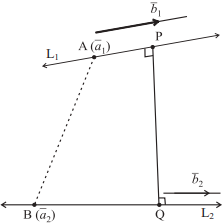
Proof: Let $\mathrm{L}_1$ and $\mathrm{L}_2$ be the lines whose equations are $\bar{r}=\bar{a}_1+\lambda_1 \bar{b}_1, \bar{r}=\bar{a}_2+\lambda_2 \bar{b}_2$ respectively. Let $P Q$ be the segment which is perpendicular to both $L_1$ and $L_2$.
To find the length of segment PQ.
Lines $L_1$ and $L_2$ pass through pointsA $\left(\bar{a}_1\right)$ and $\mathrm{B}\left(\bar{a}_2\right)$ respectively. Lines $\mathrm{L}_1$ and $\mathrm{L}_2$ are parallel to $\bar{b}_1$ and $\bar{b}_2$ respectively.
As PQ is perpendicular to both $\mathrm{L}_1$ and $\mathrm{L}_2$, it is parallel to $\bar{b}_1 \times \bar{b}_2$
The unit vector along $\overline{P Q}=$ unit vector along $\bar{b}_1 \times \bar{b}_2=\hat{n}$ (say) $\mathrm{PQ}=$ The projection of $\overline{A B}$ on $\overline{P Q}=\overline{A B} \cdot \hat{n}$
$
P Q=\left|\frac{\left(\bar{a}_2-\bar{a}_1\right) \cdot\left(\bar{b}_1 \times \bar{b}_2\right)}{\left|\bar{b}_1 \times \bar{b}_2\right|}\right|
$

Image

View full question & answer
Question 164 Marks
Find the vector equation of the plane passing through the point A(-2, 7, 5) and parallel to

vectors $\hat{4}-\hat{j}+3 \hat{k}$ and $\hat{i}+\hat{j}+\hat{k}$.

Answer
The vector equation of the plane passing through the point $A(\bar{a})$ and parallel to the

vectors $\bar{b}$ and $\bar{c}$ is

$\bar{r} \cdot(\bar{b} \times \bar{c})=\bar{a} \cdot(\bar{b} \times \bar{c}) \ldots(1)$

Here, $\bar{a}=-2 \hat{i}+7 \hat{j}+5 \hat{k}$

$\bar{b}=4 \hat{i}-\hat{j}+3 \hat{k}, \bar{c}=\hat{i}+\hat{j}+\hat{k}$

$\therefore \bar{b} \times \bar{c}=\left|\begin{array}{ccc}\vec{i} & \hat{j} & \vec{k} \\ 4 & -1 & 3 \\ 1 & 1 & 1\end{array}\right|$

$=(-1-3) \hat{i}-(4-3) \hat{j}+(4+1) \hat{k}$

$=-4 \hat{i}-\hat{j}+5 \hat{k}$

$\begin{aligned} \therefore \bar{a} \cdot(\bar{b} \times \bar{c}) & =(-2 \hat{i}+7 \hat{j}+5 \hat{k}) \cdot(-4 \hat{i}-\hat{j}+5 \hat{k}) \\ & =(-2)(-4)+(7)(-1)+(5)(5) \\ & =8-7+25=26\end{aligned}$

$\therefore$ from (1), the vector equation of the required plane is

$\bar{r} \cdot(-4 \hat{i}-\hat{j}+5 \hat{k})=26$.

View full question & answer
Question 174 Marks
Reduce the equation $\bar{r} \cdot(3 \hat{i}+4 \hat{j}+12 \hat{k})=78$ to normal form and hence find

(i) the length of the perpendicular from the origin to the plane (ii) direction cosines of the normal.

Answer
The normal form of equation of a plane is $\bar{r} \cdot \hat{n}=p$ where $\hat{n}$ is unit vector along the

normal and p is the length of perpendicular drawn from origin to the plane.

Given plane is $\vec{r} \cdot(3 \hat{i}+4 \hat{j}+12 \hat{k})=78$

$\ldots(1)$

$\bar{n}=3 \hat{i}+4 \hat{j}+12 \hat{k}$ is normal to the plane

$\therefore|\bar{n}|=\sqrt{3^2+4^2+12^2}=\sqrt{169}=13$

Dividing both sides of (1) by 13 , we get

$\bar{r} \cdot\left(\frac{3 \hat{i}+4 \hat{j}+12 \hat{k}}{13}\right)=\frac{78}{13}$

i.e. $\bar{t} \cdot\left(\frac{3}{13} \hat{i}+\frac{4}{13} \hat{j}+\frac{12}{13} \vec{k}\right)=6$

This is the normal form of the equation of plane. Comparing with $\bar{r} \cdot \hat{n}=\mathrm{p}$.

(i) the length of the perpendicular from the origin to plane is 6.

(ii) direction cosines of the normal are $\frac{3}{13}, \frac{4}{13}, \frac{12}{13}$.

View full question & answer
Question 184 Marks
Find the coordinates of the foot of the perpendicular drawn from the origin to the plane 2x + 6y – 3z = 63 .
Answer
The equation of the plane is 2x + 6y – 3z = 63. Dividing each term by

$\sqrt{2^2+6^2+(-3)^2}=\sqrt{49}=7$, we get

$\frac{2}{7} x+\frac{6}{7} y-\frac{3}{7} z=\frac{63}{7}=9$

This is the normal form of the equation of plane. ∴ the direction cosines of the perpendicular drawn from the origin to the plane are

$1=\frac{2}{7}, m=\frac{6}{7}, n=-\frac{3}{7}$

and length of perpendicular from origin to the plane is p = 9. ∴ the coordinates of the foot of the perpendicular from the origin to the plane are (lp, mp,

np) i.e. $\left(\frac{18}{7}, \frac{54}{7},-\frac{27}{7}\right)$.

View full question & answer
Question 194 Marks
Find the perpendicular distance of the origin from the plane 6x – 2y + 3z – 7 = 0.
Answer
The equation of the plane is 6x – 2y + 3z – 7 = 0 ∴ its vector equation is

$\bar{r} \cdot(6 \hat{i}-2 \hat{j}+3 \hat{k})=7 \ldots(1)$

where $\bar{r}=x \hat{i}+u \hat{i}+z \hat{k}$

$\therefore \bar{n}=6 \hat{i}-2 \hat{j}+3 \hat{k}$ is normal to the plane

$|\bar{n}|=\sqrt{6^2+(-2)^2+3^2}=\sqrt{49}=7$

Unit vector along $\bar{n}$ is

$\hat{n}=\frac{\bar{n}}{|\bar{n}|}=\frac{6 \hat{i}-2 \hat{j}+3 \hat{k}}{7}$

Dividing both sides of (1) by 7 , we get

$\bar{r} \cdot\left(\frac{6 \hat{i}-2 \hat{j}+3 \hat{k}}{7}\right)=\frac{7}{7}$

$\therefore \bar{r} \cdot \hat{n}=1$

Comparing with normal form of equation of the plane $\bar{r} \cdot \hat{n}=p_1$ it follows that length of

perpendicular from origin is 1 unit. Alternative Method: The equation of the plane is 6x – 2y + 3z – 7 = 0 i.e. 6x – 2y + 3z =

i.e. $\left(\frac{6}{6^2+(-2)^2+3^2}\right) x-\left(\frac{2}{\sqrt{6^2+(-2)^2+3^2}}\right) y+$

$\left(\frac{3}{\sqrt{6^2+(-2)^2+3^2}}\right) z=\frac{7}{\sqrt{6^2+(-2)^2+3^2}}$

i.e. $\frac{6}{7} x-\frac{2}{7} y+\frac{3}{7} z=\frac{7}{7}=1$

This is the normal form of the equation of plane. ∴ perpendicular distance of the origin from the plane is p = 1 unit.

View full question & answer