Questions · Page 2 of 3

MCQ

MCQ 512 Marks
Given below are four statements along with their respective duals. Which dual statement is not correct?
  • A
    $(p \vee q) \wedge(r \vee s),(p \wedge q) \vee(r \wedge s)$
  • B
    $(p \vee \sim q) \wedge(\sim p),(p \wedge \sim q) \vee(\sim p)$
  • C
    $(p \wedge q) \vee r,(p \vee q) \wedge r$
  • $(p \vee q) \vee s,(p \wedge q) \vee s$
Answer
Correct option: D.
$(p \vee q) \vee s,(p \wedge q) \vee s$
(D)
Dual of ${ }^{\prime}(p \vee q) \vee{ }^{\prime}$ is ${ }^{\prime}(p \wedge q) \wedge s^{\prime}$.
View full question & answer
MCQ 522 Marks
The dual of $'(p \wedge t) \vee(c \wedge \sim q)^{\prime}$ where t is a V tautology and c is a contradiction, is
  • $(p \vee c) \wedge(t \vee \sim q)$
  • B
    $(\sim p \wedge c) \wedge(t \vee q)$
  • C
    $(\sim p \vee c) \wedge(t \vee q)$
  • D
    $(\sim p \vee t) \wedge(c \vee \sim q)$
Answer
Correct option: A.
$(p \vee c) \wedge(t \vee \sim q)$
A
View full question & answer
MCQ 532 Marks
Which of the following quantified statement is false?
  • A
    $\exists x \in N$, such that $x+5 \leq 6$
  • B
    $\forall x \in \mathrm{~N}, x^2 \not \leq 0$
  • $\exists x \in \mathrm{~N}$, such that $x-1<0$
  • D
    $\exists x \in \mathrm{~N}$, such that $x^2-3 x+2=0$
Answer
Correct option: C.
$\exists x \in \mathrm{~N}$, such that $x-1<0$
(C)
Option (C) is false, since for every natural number the statement $x-1 \geq 0$ is always true.
View full question & answer
MCQ 542 Marks
If A = {4, 5, 7, 9} determine which of the following quantified statement is true. A = \{4, 5, 7, 9\}
  • A
    $\exists x \in A$, such that $x+4=7$
  • $\forall x \in \mathrm{~A}, x+1 \leq 10$
  • C
    $\forall x \in A, 2 x \leq 17$
  • D
    $\exists x \in A$, such that $x+1>10$
Answer
Correct option: B.
$\forall x \in \mathrm{~A}, x+1 \leq 10$
(B)
Here, $x=4,5,7,9$ satisfies $x+1 \leq 10$
$\therefore \quad$ option (B) is correct.
View full question & answer
MCQ 552 Marks
Using quantifier the open sentence ' $x^2>0$ ' defined on N is converted into true statement as
  • $\forall x \in \mathrm{~N}, x^2>0$
  • B
    $\forall x \in N, x^2=0$
  • C
    $\exists x \in N$, such that $x^2<0$
  • D
    $\exists x \notin N$, such that $x^2<0$
Answer
Correct option: A.
$\forall x \in \mathrm{~N}, x^2>0$
(A)
Option (A) is the true statement, since square of every natural number is positive.
View full question & answer
MCQ 562 Marks
The false statement in the following is
  • A
    $\mathrm{p} \wedge(\sim \mathrm{p})$ is a contradiction
  • B
    $\mathrm{p} \vee(\sim \mathrm{p})$ is a tautology
  • C
    $\sim(\sim p) \leftrightarrow p$ is tautology
  • $(\mathrm{p} \rightarrow \mathrm{q}) \leftrightarrow(\sim \mathrm{q} \rightarrow \sim \mathrm{p})$ is a contradiction
Answer
Correct option: D.
$(\mathrm{p} \rightarrow \mathrm{q}) \leftrightarrow(\sim \mathrm{q} \rightarrow \sim \mathrm{p})$ is a contradiction
(D) $p \rightarrow q$ is logically equivalent to $\sim q \rightarrow \sim p$
$\therefore \quad(p \rightarrow q) \leftrightarrow(\sim q \rightarrow \sim p)$ is a tautology
...[Using Shortcut 8]
But, it is given contradiction.
Hence, it is false statement.
View full question & answer
MCQ 572 Marks
Which of the following statement is a contingency?
  • A
    $(p \wedge \sim q) \vee \sim(p \wedge \sim q)$
  • B
    $(p \wedge q) \leftrightarrow(\sim p \rightarrow \sim q)$
  • C
    $(\sim q \wedge p) \vee(p \vee \sim p)$
  • D
    $(q \rightarrow p) \vee(\sim p \leftrightarrow q)$
Answer

(D) Consider option (B)

pq$\sim p$$\sim q$$p \wedge q$$\sim p \rightarrow \sim q$$\begin{array}{l}(p \wedge q) \leftrightarrow \\ (\sim p \rightarrow \sim q)\end{array}$
TTFFTTT
TFFTFTF
FTTFFFT
FFTTFTF
View full question & answer
MCQ 582 Marks
Which of the following statement is contradiction?
  • A
    $(p \wedge q) \rightarrow q$
  • $(p \wedge \sim q) \wedge(p \rightarrow q)$
  • C
    $p \rightarrow \sim(p \wedge \sim q)$
  • D
    $(p \wedge q) \vee \sim q$
Answer
Correct option: B.
$(p \wedge \sim q) \wedge(p \rightarrow q)$
(B)
consider option (B)
$(p \wedge \sim q) \wedge(p \rightarrow q)$
$\equiv \sim(p \rightarrow q) \wedge(p \rightarrow q)$
$\equiv F \quad \ldots[$ Complement Law $]$
View full question & answer
MCQ 592 Marks
$(\sim p \wedge \sim q) \wedge(q \wedge r)$ is a
  • A
    tautology
  • B
    contingency
  • contradiction
  • D
    neither tautology nor contradiction
Answer
Correct option: C.
contradiction
(C)
$(\sim p \wedge \sim q) \wedge(q \wedge r)$
$\equiv \sim p \wedge(\sim q \wedge q) \wedge r \quad \ldots[$ Associative Law $]$
$\equiv \sim p \wedge F \wedge r \quad \ldots[$ Complement Law $]$
$\equiv F \quad \ldots[$ Indentity Law $]$
∴ Given statement is contradiction.
View full question & answer
MCQ 602 Marks
Which of the following is a tautology?
  • A
    $p \rightarrow(p \wedge q)$
  • B
    $q \wedge(p \rightarrow q)$
  • $\sim(p \rightarrow q) \leftrightarrow p \wedge \sim q$
  • D
    $(p \wedge q) \leftrightarrow \sim q$
Answer
Correct option: C.
$\sim(p \rightarrow q) \leftrightarrow p \wedge \sim q$
(C)
Consider option (C)
$\sim(p \rightarrow q) \leftrightarrow(p \wedge \sim q)$
$\equiv( p \wedge \sim q ) \leftrightarrow( p \wedge \sim q )$
$\ldots[\because \sim(p \rightarrow q) \equiv p \wedge \sim q]$
$\equiv T$
...[Using Shortcut 8]
View full question & answer
MCQ 612 Marks
Which of the following statements is a tautology?
  • A
    $\sim(p \wedge \sim q) \rightarrow(p \vee q)$
  • B
    $(\sim p \vee \sim q) \rightarrow(p \wedge q)$
  • C
    $p \vee(\sim q) \rightarrow(p \wedge q)$
  • $\sim(p \vee \sim q) \rightarrow(p \vee q)$
Answer
Correct option: D.
$\sim(p \vee \sim q) \rightarrow(p \vee q)$
(D)Consider option (D)
$
\sim(p \vee \sim q) \rightarrow(p \vee q)
$
$\equiv(p \vee \sim q) \vee(p \vee q) \quad \ldots[\because p \rightarrow q \equiv \sim p \vee q]$
$\equiv p \vee(\sim q \vee q ) \quad \ldots[$ Absorption law $]$
$\equiv p \vee T \quad \ldots[$ Complement law $]$
$\equiv T$...[Identity law]
View full question & answer
MCQ 622 Marks
Which one of the following statements is not a tautology?
  • A
    $p \rightarrow(p \vee q)$
  • B
    $(p \wedge q) \rightarrow(\sim p \vee q)$
  • C
    $(p \wedge q) \rightarrow p$
  • $(p \vee q) \rightarrow(p \vee \sim q)$
Answer
Correct option: D.
$(p \vee q) \rightarrow(p \vee \sim q)$
(D)
Consider option (D)
pq$p \vee q$$\sim q$$p \vee \sim q$$\begin{array}{l}(p \vee q) \rightarrow \\ (p \vee \sim q)\end{array}$
TTTFTT
TFTTTT
FTTFFF
FFFTTT
View full question & answer
MCQ 632 Marks
$\sim(\sim p) \leftrightarrow p$ is
  • a tautology
  • B
    a contradiction
  • C
    neither a contradiction nor a tautology
  • D
    none of these
Answer
Correct option: A.
a tautology
(A)
$\sim(\sim p) \rightarrow p \equiv p \rightarrow p \quad \ldots[\because \sim(\sim p) \equiv p]$
∴ Using Shortcut 1 , we get
$p \rightarrow p \equiv T$
$\therefore \quad \sim(\sim p) \leftrightarrow p$ is a tautology.
View full question & answer
MCQ 642 Marks
Which of the following is not true for any two statements p and q?
  • A
    $\sim[p \vee(\sim q)] \equiv \sim p \wedge q$
  • B
    $(n \vee q) \vee(\sim q)$ is a tautology
  • C
    $\neg(\mathrm{p} \wedge \sim \mathrm{p})$ is a tautology
  • $\sim(p \vee q) \equiv \sim p \vee \sim q$
Answer
Correct option: D.
$\sim(p \vee q) \equiv \sim p \vee \sim q$
(D)
$\sim(p \vee q) \equiv \sim p \vee \sim q$ is not true as it contradicts De Morgan's law.
∴ Option (D) is not true.
View full question & answer
MCQ 652 Marks
The logical statement $(p \rightarrow q) \wedge(q \rightarrow \sim p)$ is equivalent to:
  • A
    p
  • B
    ∼q.
  • C
    q
  • ∼p
Answer
Correct option: D.
∼p
(D)
$(p \rightarrow q) \wedge(q \rightarrow \sim p)$
pq$\sim p$$p \rightarrow q$$q \rightarrow \sim p$$\begin{array}{c}(p \rightarrow q) \\ \wedge \\ (q \rightarrow \sim p)\end{array}$
TTFTFF
TFFFTF
FTTTTT
FFTTTT
$\therefore \quad(p \rightarrow q) \wedge(p \rightarrow \sim q)=\sim p$
View full question & answer
MCQ 662 Marks
The statement pattern $(p \wedge q) \wedge[\sim r \vee(p \wedge q)]$ $\vee(\sim p \wedge q)$ is equivalent to
  • A
    $p \wedge q$
  • B
    r
  • C
    p
  • q
Answer
Correct option: D.
q
(D)
$(p \wedge q) \wedge[\sim r \vee(p \wedge q)] \vee(\sim p \wedge q)$
$\equiv( p \wedge q ) \vee(\sim p \wedge q ) \quad \ldots[$ Absorption law $]$
$\equiv( p \vee \sim p ) \wedge q \quad \ldots[$ Distributive law $]$
$\equiv T \wedge q \quad \ldots[$ Complement law $]$
$\equiv q \quad \ldots[$ Identity law $]$
View full question & answer
MCQ 672 Marks
Which of the following is NOT equivalent to p→q.
  • A
    p is sufficient for q
  • B
    ponly if q
  • C
    q is necessary for p
  • q only if p
Answer
Correct option: D.
q only if p
D
View full question & answer
MCQ 682 Marks
Which of the following is true?
  • A
    $p \wedge \sim p \equiv T$
  • B
    $p \vee \sim p \equiv F$
  • C
    $p \rightarrow q \equiv q \rightarrow p$
  • $p \rightarrow q \equiv(\sim q) \rightarrow(\sim p)$
Answer
Correct option: D.
$p \rightarrow q \equiv(\sim q) \rightarrow(\sim p)$
(D)
$(\sim q) \rightarrow(\sim p)$ is contrapositive of $p \rightarrow q$ and hence both are logically equivalent to each other.
View full question & answer
MCQ 692 Marks
$p \wedge(p \rightarrow q)$ is logically equivalent to
  • A
    $p \vee q$
  • B
    $\sim p \vee q$
  • $p \wedge q$
  • D
    $\mathrm{p} \vee \sim \mathrm{q}$
Answer
Correct option: C.
$p \wedge q$
(C)
$\begin{array}{l}p \wedge(p \rightarrow q) \\ \equiv p \wedge(\sim p \vee q)\end{array}$
$\equiv( p \wedge \sim p ) \vee( p \wedge q ) \quad \ldots[$ Distributive law $]$
$\equiv F \vee(p \wedge q) \quad \ldots$ [Complement law]
$
\equiv p \wedge q\quad \ldots$ [Identity law]
View full question & answer
MCQ 702 Marks
Find which of the following statements convey the same meanings?
i. If it is the bride's dress then it has to be red.
ii. If it is not bride's dress then it cannot be red.
iii. If it is a red dress then it must be the bride's dress.
iv. If it is not a red dress then it can't be the bride's dress.
  • (i, iv) and (ii, iii)
  • B
    (i, ii) and (iii, iv)
  • C
    (i), (ii), (iii)
  • D
    (i, iii) and (ii, iv)
Answer
Correct option: A.
(i, iv) and (ii, iii)
(A)
b: It is the bride's dress
r : It is the red dress
i. $b \rightarrow r$
ii. $\sim b \rightarrow \sim r$
iii. $r \rightarrow b$
iv. $\sim r \rightarrow \sim b$
(i) and (iv) have the same meaning,
(ii) and (iii) have the same meaning.
View full question & answer
MCQ 712 Marks
Find out which of the following statements have the same meaning:
i. If Seema solves a problem then she is happy.
ii. If Seema does not solve a problem then she is not happy.
iii. If Seema is not happy then she hasn't solved the problem.
iv. If Seema is happy then she has solved the problem.
  • A
    (i, ii) and (iii, iv)
  • B
    i, ii, iii
  • (i, iii) and (ii, iv)
  • D
    ii, iii, iv
Answer
Correct option: C.
(i, iii) and (ii, iv)
(C)
p: Seema solves a problem
q : She is happy
i. $p \rightarrow q$
ii. $\sim p \rightarrow \sim q$
iii. $\sim q \rightarrow \sim p$
iv. $q \rightarrow p$
(i) and (iii) have the same meaning,
(ii) and (iv) have the same meaning.
View full question & answer
MCQ 722 Marks
The statement $p \rightarrow(q \rightarrow p)$ is equivalent to
  • A
    $p \rightarrow(p \wedge q)$
  • B
    $p \rightarrow(p \leftrightarrow q)$
  • C
    $p \rightarrow(p \rightarrow q)$
  • D
    $p \rightarrow(p \vee q)$
Answer
Consider option (D)
l23456
pq$q \rightarrow p$$\begin{array}{c}p \rightarrow \\ (q \rightarrow p)\end{array}$$p \vee q$$\begin{array}{c}p \rightarrow \\ (p \vee q)\end{array}$
TTTTTT
TFTTTT
FTFTTT
FFTTFT
The entries in the columns 4 and 6 are identical.
$\therefore p \rightarrow(q \rightarrow p)=p \rightarrow(p \vee q)$
View full question & answer
MCQ 732 Marks
The contrapositive of the statement "If you are born in India, then you are a citizen of India", is
  • A
    If you are a citizen of India, then you are born in India.
  • B
    If you are born in India, then you are not a citizen of India.
  • If you are not a citizen of India, then you are not born in India.
  • D
    If you are not born in India, then you are not a citizen of India.
Answer
Correct option: C.
If you are not a citizen of India, then you are not born in India.
(C)
Contrapositive of $p \rightarrow q$ is $\sim q \rightarrow \sim p$
The contrapositive of the given statement is "If you are not a citizen of India, then you are not born in India".
View full question & answer
MCQ 742 Marks
The converse of 'If x is zero then we cannot divide by x' is
  • If we cannot divide by x then x is zero.
  • B
    If we divide by x then x is non-zero.
  • C
    If x is non-zero then we can divide by x.
  • D
    If we cannot divide by x then x is non-zero.
Answer
Correct option: A.
If we cannot divide by x then x is zero.
(A)
Let $p : x$ is zero
q : we cannot divide by $x$
Converse of $p \rightarrow q$ is $q \rightarrow p$.
∴ Converse of the given statement is 'If we cannot divide by $x$ then $x$ is zero'.
View full question & answer
MCQ 752 Marks
The converse of the contrapositive of $\mathrm{p} \rightarrow \mathrm{q}$ is
  • A
    $\sim p \rightarrow q$
  • B
    $p \rightarrow \sim q$
  • $\sim p \rightarrow \sim q$
  • D
    $\sim q \rightarrow p$
Answer
Correct option: C.
$\sim p \rightarrow \sim q$
(C)
Given $p \rightarrow q$
Its contrapositive is $\sim q \rightarrow \sim p$ and converse of the contrapositive is $\sim p \rightarrow \sim q$.
View full question & answer
MCQ 762 Marks
If $\sim q \vee p$ is F, then which of the following is correct?
  • A
    $p \leftrightarrow q$ is $T$
  • $p \rightarrow q$ is $T$
  • C
    $q \rightarrow p$ is $T$
  • D
    $p \rightarrow q$ is $F$
Answer
Correct option: B.
$p \rightarrow q$ is $T$
(B)
The truth value of statement $\sim q \vee p$ is $F$
$\therefore \quad \sim q \equiv F$ and $p \equiv F$
$\begin{array}{l}\therefore \quad p \equiv F \text { and } q \equiv T \\ \therefore \quad p \rightarrow q \text { is } T\end{array}$
Alternate Method:
pq$
\sim q
$
$\sim q \vee p$$p \leftrightarrow q$$p \rightarrow q$$q \rightarrow p$
TTFTTTT
TFTTFFT
FTFFFTF
FFTTTTT
View full question & answer
MCQ 772 Marks
If $p \rightarrow(p \wedge \sim q)$ is false, the truth values of p and q are respectively
  • A
    F, F
  • B
    T, F
  • T, T
  • D
    F, T
Answer
Correct option: C.
T, T
(C)
The truth value of statement $p \rightarrow(p \wedge \sim q)$ is $F$
$\therefore \quad p \equiv T$ and $(p \wedge \sim q) \equiv F$
$\therefore \quad p = T$ and $q = T$
View full question & answer
MCQ 782 Marks
If $p \rightarrow(\sim p \vee q)$ is false, the truth values of p and q are respectively
  • A
    F, T
  • B
    F. F
  • C
    T, T
  • T, F
Answer
Correct option: D.
T, F
(D)
pq$\sim p$$\sim p \vee q$$p \rightarrow(\sim p \vee q)$
TTFTT
TFFFF
FTTTT
FFTTT

$\therefore$ From the table $p \rightarrow(\sim p \vee q)$ is false when $p$ is true and $q$ is false.
View full question & answer
MCQ 792 Marks
If p, q are true and r is false statement then which of the following is true statement?
  • A
    $(p \wedge q) \vee r$ is $F$
  • B
    $(p \wedge q) \rightarrow r$ is $T$
  • $(p \vee q) \wedge(p \vee r)$ is $T$
  • D
    $(p \rightarrow q) \leftrightarrow(p \rightarrow r)$ is $T$
Answer
Correct option: C.
$(p \vee q) \wedge(p \vee r)$ is $T$
(C)$
\begin{aligned}
(p \vee q) \wedge(p \vee r) & \equiv(T \vee T) \wedge(T \vee F) \\
& \equiv T \wedge T \equiv T
\end{aligned}
$
∴ option (C) is correct.
View full question & answer
MCQ 802 Marks
Given that p is ‘false’ and q is 'true' then the statement which is 'false' is
  • $\sim \mathrm{p} \rightarrow \sim \mathrm{q}$
  • B
    $p \rightarrow(q \wedge p)$
  • C
    $p \rightarrow \sim q$
  • D
    $q \rightarrow \sim p$
Answer
Correct option: A.
$\sim \mathrm{p} \rightarrow \sim \mathrm{q}$
(A)
$\begin{array}{l}\sim p \rightarrow \sim q \equiv \sim F \rightarrow \sim T \equiv T \rightarrow F \equiv F \\ p \rightarrow(q \wedge p) \equiv F \rightarrow(T \wedge F) \equiv F \rightarrow F \equiv T \\ p \rightarrow \sim q \equiv F \rightarrow \sim T \equiv F \rightarrow F \equiv T \\ q \rightarrow \sim p \equiv T \rightarrow \sim F \equiv T \rightarrow T \equiv T\end{array}$
View full question & answer
MCQ 812 Marks
If p is false and q is true, then
  • A
    $\mathrm{p} \wedge \mathrm{q}$ is true
  • B
    $\mathrm{p} \vee \sim \mathrm{q}$ is true
  • C
    $\mathrm{q} \rightarrow \mathrm{p}$ is true
  • $p \rightarrow q$ is true
Answer
Correct option: D.
$p \rightarrow q$ is true
(D)
$\begin{array}{l} p \wedge q = F \wedge T = F \\ p \vee \sim q \equiv F \vee \sim T \equiv F \vee F \equiv F \\ q \rightarrow p \equiv T \rightarrow F \equiv F \\ p \rightarrow q \equiv F \rightarrow T \equiv T \end{array}$
View full question & answer
MCQ 822 Marks
If p is true and q is false then the truth values of $(p \rightarrow q) \leftrightarrow(\sim q \rightarrow \sim p)$ and $(\sim p \vee q) /(\sim q / 2)$ are respectively
  • A
    F, F
  • B
    F, T
  • T, F
  • D
    T, T
Answer
Correct option: C.
T, F
(C)
$\begin{array}{l}( p \rightarrow q ) \leftrightarrow(\sim q \rightarrow \sim p ) \\ =( T \rightarrow F ) \leftrightarrow \\ \quad(\sim F \rightarrow \sim T ) \\ \equiv F \leftrightarrow( T \rightarrow F ) \\ \equiv F \leftrightarrow F \\ \equiv F \end{array}$
$\begin{array}{l}(\sim p \vee q) \wedge(\sim q \vee p) \\ \equiv(\sim T \vee F) \wedge(\sim F \vee T) \\ \equiv(F \vee F) \wedge(T \vee T) \\ \equiv F \wedge T \\ \equiv F\end{array}$
View full question & answer
MCQ 832 Marks
If p and q have truth value 'F', then the truth values of (∼p ∨ q)↔ ∼(p ∧ q) and ∼p↔(p→∼q) are respectively
  • T, T
  • B
    F, F
  • C
    T, F
  • D
    F, T
Answer
Correct option: A.
T, T
(A)
$\begin{array}{l}(\sim p \vee q) \leftrightarrow \sim(p \wedge q) \\ \equiv(\sim F \vee F) \leftrightarrow \sim(F \wedge F) \\ \equiv(T \vee F) \leftrightarrow \sim F \\ \equiv T \leftrightarrow T \\ \equiv T\end{array}$
$\begin{array}{l}\sim p \leftrightarrow( p \rightarrow \sim q ) \\ \equiv \sim F \leftrightarrow( F \rightarrow \sim F ) \\ \equiv T \leftrightarrow( F \rightarrow T ) \\ \equiv T \leftrightarrow T \\ \equiv T \end{array}$
View full question & answer
MCQ 842 Marks
Given 'p'and 'q' as true and 'r' as false, the truth values of $\sim p \wedge(q \vee \sim r)$ and $(p \rightarrow q) \wedge r$ are respectively
  • A
    T, F
  • F,F
  • C
    T,T
  • D
    F, T
Answer
Correct option: B.
F,F
(B)
$\sim p \wedge(q \vee \sim r)$
$\equiv \sim T \wedge( T \vee \sim F )$
$\equiv F \wedge( T \vee T )$
$\begin{array}{l}\equiv F \wedge T \\ \equiv F \end{array}$
$\begin{array}{l}(p \rightarrow q) \wedge r \\ \equiv(T \rightarrow T) \wedge F \\ \equiv T \wedge F \\ \equiv F\end{array}$
View full question & answer
MCQ 852 Marks
Let p: roses are red and q : the sun is a star. Then the verbal translation of $(\sim p) \vee q$ is
  • A
    Roses are not red and the sun is not a star.
  • B
    It is not true that roses are red or the sun is not a star.
  • C
    It is not true that roses are red and the sun is not a star.
  • Roses are not red or the sun is a star.
Answer
Correct option: D.
Roses are not red or the sun is a star.
(D)
$\sim p$ : roses are not red
$\sim p \vee q:$ roses are not red or the sun is a star.
View full question & answer
MCQ 862 Marks
The symbolic form of the statement 'It is not true that intelligent persons are neither polite nor helpful' is
  • A
    $\sim(p \vee q)$
  • $\sim(\sim p \wedge \sim q)$
  • C
    $\sim(\sim p \vee \sim q)$
  • D
    $\sim(p \wedge q)$
Answer
Correct option: B.
$\sim(\sim p \wedge \sim q)$
(B)
p : Intelligent persons are polite.
q : Intelligent persons are helpful.
∴ Symbolic form: $\sim(\sim p \wedge \sim q)$
View full question & answer
MCQ 872 Marks
If first part of the sentence is p and the second is q, then the symbolic form of the statement 'It is not true that Physics is not interesting or difficult' is
  • A
    $\sim(\sim p \wedge q)$
  • B
    $(\sim p \vee q)$
  • C
    $(\sim p \vee \sim q)$
  • $\sim(\sim p \vee q)$
Answer
Correct option: D.
$\sim(\sim p \vee q)$
(D)
p : Physics is interesting.
q : Physics is difficult.
$\therefore \quad$ Symbolic form: $\sim(\sim p \vee q)$
View full question & answer
MCQ 882 Marks
Assuming the first part of the sentence as p and the second as q, write the following statement symbolically:
'Irrespective of one being lucky or not, one should not stop working'
  • A
    $(p \wedge \sim p) \vee q$
  • B
    $(p \vee \sim p) \wedge q$
  • C
    $(p \vee \sim p) \wedge \sim q$
  • D
    $(p \wedge \sim p) \vee \sim q$
View full question & answer
MCQ 892 Marks
Which of the following is an incorrect statement in logic?
  • A
    Multiply the numbers 3 and 10.
  • 3 times 10 is equal to 40.
  • C
    What is the product of 3 and 10?
  • D
    10 times 3 is equal to 30.
Answer
Correct option: B.
3 times 10 is equal to 40.
(B)
'Incorrect statement' means a statement in logic with truth value false.
Options (A) and (C) are not statements in logic.
Option (D) has truth value True.
Option (B) is a statement in logic with truth value false.
View full question & answer
MCQ 902 Marks
Which of the following is not a correct statement?
  • A
    Mathematics is interesting.
  • $\sqrt{3}$ is a prime.
  • C
    $\sqrt{2}$ is irrational.
  • D
    The sun is a star.
Answer
Correct option: B.
$\sqrt{3}$ is a prime.
(B)
"Not a correct statement" means it is a statement whose truth value is false.
Option (A) is not a statement.
Options (C) and (D) are statements with truth value true.
' $\sqrt{3}$ is a prime' is false statement.
∴ Option (B) is correct.
View full question & answer
MCQ 912 Marks
The negation of 'If it is sunday then it is a holiday' is
  • A
    It is a holiday but not a sunday.
  • B
    No sunday then no holiday.
  • It is sunday, but it is not a holiday.
  • D
    No holiday therefore no sunday.
Answer
Correct option: C.
It is sunday, but it is not a holiday.
(C) p : It is Sunday
q : It is a holiday
Symbolic from p → q
$\sim( p \rightarrow q ) \equiv p \wedge \sim q$
i.e. , it is sunday, but is not a holiday
View full question & answer
MCQ 922 Marks
Which of the following statements is a tautology?
  • A
    $(\sim q \wedge p) \wedge q$
  • B
    $(\sim q \wedge p) \wedge q$
  • $(\sim q \wedge p) \vee(p \vee \sim p)$
  • D
    $(p \wedge q) \wedge(\sim(p \wedge q))$
Answer
Correct option: C.
$(\sim q \wedge p) \vee(p \vee \sim p)$
(C)
Since $p \vee \sim p \equiv T$,
$(\sim q \wedge p) \vee(p \vee \sim p) \equiv(\sim q \wedge p) \vee T$
$\equiv T$
∴ $(\sim q \wedge p) \vee(p \vee \sim p)$ is a tautology.
View full question & answer
MCQ 932 Marks
The Boolean Expression $(p \wedge \sim q) \vee q \vee(\sim p \wedge q)$ is equivalent to :
  • A
    p ^ q
  • p v q
  • C
    $p \vee \sim q$
  • D
    $\sim p \wedge q$
Answer
Correct option: B.
p v q
(B)
$(p \wedge \sim q) \vee q \vee(\sim p \wedge q)$
$\equiv[(p \vee q) \wedge(\sim q \vee q)] \vee(\sim p \wedge q)$...[Distributive law]
$\equiv[(p \vee q) \wedge T] \vee(\sim p \wedge q)$...[Complement law]
$\equiv(p \vee q) \vee(\sim p \wedge q)$ ...[Identity law]
$\equiv(p \vee q \vee \sim p) \wedge(p \vee q \vee q)$...[Distributive law]
$\equiv(T \vee q) \wedge(p \vee q)$...[Complement law and Idempotent law]
$\equiv T \wedge( p \vee q )$...[Identity law]
$\equiv p \vee q$...[Identity law]
View full question & answer
MCQ 942 Marks
A compound statement p or q is true only when
  • A
    p is true.
  • B
    q is true.
  • both p and q are true.
  • D
    none of p and q is true.
Answer
Correct option: C.
both p and q are true.
C
View full question & answer
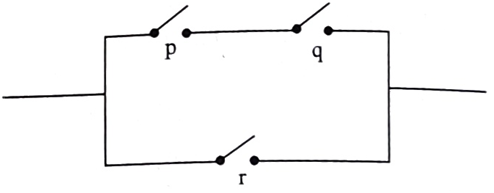
MCQ 952 Marks
The switching circuit
Image
  • $(p \wedge q) \vee(\sim p) \vee(p \wedge \sim q)$
  • B
    $(p \vee q) \vee(\sim p) \vee(p \wedge \sim q)$
  • C
    $(p \wedge q) \wedge(\sim p) \vee(p \wedge \sim q)$
  • D
    $(p \vee q) \wedge(\sim p) \vee(p \wedge \sim q)$
Answer
Correct option: A.
$(p \wedge q) \vee(\sim p) \vee(p \wedge \sim q)$
A
View full question & answer
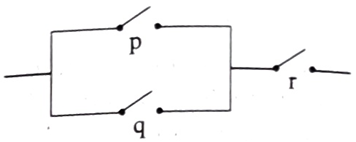
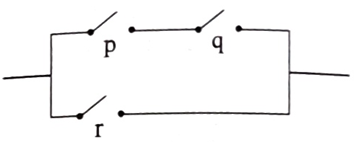
MCQ 962 Marks
If the current flows through the given circuit, then it is expressed symbolically as,
Image
  • $(p \wedge q) \vee r$
  • B
    $(p \wedge q)$
  • C
    $(p \vee q)$
  • D
    $(p \vee q) \wedge r$
Answer
Correct option: A.
$(p \wedge q) \vee r$
(A)
Current will flow in the circuit if switch $p$ and $q$ are closed or switch $r$ is closed.
It is represented by $( p \wedge q ) \vee r$.
∴ option (A) is correct.
View full question & answer
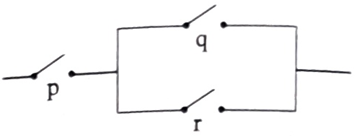
MCQ 982 Marks
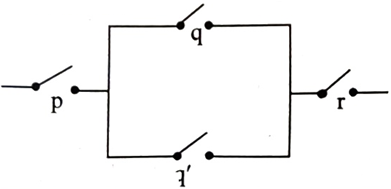
When does the current flow through the following circuit.
Image
  • A
    p. q should be closed and r is open
  • B
    р, q,r should be open
  • p, q, rshould be closed
  • D
    none of these
Answer
Correct option: C.
p, q, rshould be closed
(C)
The current will flow through the circuit if $p , q , r$ are closed or $p , q ^{\prime}, r$ are closed.
$\therefore \quad$ option (C) is the correct answer.
View full question & answer
MCQ 992 Marks
The negation of the statement "All continuous functions are differentiable"
  • A
    Some continuous functions are differentiable
  • B
    All differentiable functions are continuous
  • C
    All continuous functions are not differentiable
  • Some continuous functions are not differentiable
Answer
Correct option: D.
Some continuous functions are not differentiable
D
View full question & answer
MCQ 1002 Marks
The negation of 'For every natural number x, $x+5>4$' is.
  • A
    $\forall x \in \mathrm{~N}, x+5<4$
  • B
    $\forall x \in \mathrm{~N}, x-5<4$
  • C
    For every integer $x, x+5<4$
  • There exists a natural number x, for which $x+5 \leq 4$
Answer
Correct option: D.
There exists a natural number x, for which $x+5 \leq 4$
(D)
Given statement is ' $\forall x \in N, x+5>4$ '
$\begin{aligned}
\therefore & \sim[\forall x \in N, x+5>4]
\\ & \equiv \exists x \in N, \text { such that } x+5 \leq 4\end{aligned}$
i.e., there exists a natural number $x$, for which $x+5 \leq 4$
View full question & answer
MCQ - Page 2 - Maths STD 12 Questions - Vidyadip