MCQ 512 Marks
If $\vec{a}, \vec{b}, \vec{c}$ are mutually perpendicular vectors having magnitudes $1,2,3$ respectively, then $[\vec{a}+\vec{b}+\vec{c} \vec{b}-\vec{a} \vec{c}]=$
Answer(c) : Given, $|\vec{a}|=1,|\vec{b}|=2,|\vec{c}|=3$
$\because \quad \vec{a}, \vec{b}, \vec{c}$ are mutually perpendicular vectors
$
\because \quad \vec{a} \cdot \vec{b}=0=\vec{b} \cdot \vec{c}=\vec{c} \cdot \vec{a}
$
Now, $[\vec{a}+\vec{b}+\vec{c} \quad \vec{b}-\vec{a} \vec{c}]=[(\vec{a}+\vec{b}+\vec{c}) \times(\vec{b}-\vec{a})] \cdot \vec{c}$
$
=[\vec{a} \times \vec{b}-\vec{a} \times \vec{a}+\vec{b} \times \vec{b}-\vec{b} \times \vec{a}+\vec{c} \times \vec{b}-\vec{c} \times \vec{a}] \cdot \vec{c}
$
$
\begin{aligned}
& =[\vec{a} \times \vec{b}-0+0+\vec{a} \times \vec{b}+\vec{c} \times \vec{b}-\vec{c} \times \vec{a}] \cdot \vec{c} \\
& =[2(\vec{a} \times \vec{b})+\vec{c} \times \vec{b}-\vec{c} \times \vec{a}] \cdot \vec{c}=2(\vec{a} \times \vec{b}) \cdot \vec{c}+0-0 \\
& =2[\vec{a} \vec{b} \quad \vec{c}]=2 \vec{a} \cdot(\vec{b} \times \vec{c})=2|\vec{a}||\vec{b} \times \vec{c}| \cos 0^{\circ} \\
& =2(1)(2)(3)=12
\end{aligned}
$
View full question & answer→MCQ 522 Marks
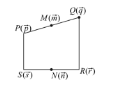
Let $P Q R S$ be a quadrilateral. If $M$ and $N$ are midpoints of the sides $P Q$ and $R S$ respectively then $P S+Q R=$
- A
$3 M N$
- B
$4 M N$
- ✓
$2 M N$
- D
$2 NM$
AnswerCorrect option: C. $2 M N$
(c): We have, $M$ and $N$ as the mid points of the sides $P Q$ and $R S$ respectively.
$
\begin{aligned}
& \therefore \vec{m}=\frac{\vec{p}+\vec{q}}{2} \\
& \text { and } \vec{n}=\frac{\vec{r}+\vec{s}}{2}
\end{aligned}
$
Now, $P S+Q R=\vec{s}-\vec{p}+\vec{r}-\vec{q}$
$
=(\vec{r}+\vec{s})-(\vec{p}+\vec{q})=2(\vec{n}-\vec{m})=2 M N
$
View full question & answer→MCQ 532 Marks
If the origin and the points $P(2,3,4), Q(1,2,3)$ and $R(x, y, z)$ are co-planar, then
- A
$x-2 y-z=0$
- B
$x+2 y+z=0$
- ✓
$x-2 y+z=0$
- D
$2 x-2 y+z=0$
AnswerCorrect option: C. $x-2 y+z=0$
(c) : Since $O, P, Q, R$ are co-planar.
$
\begin{aligned}
& \therefore[\overrightarrow{O R} \overrightarrow{O P} \overrightarrow{O Q}]=0 \\
& \Rightarrow\left|\begin{array}{lll}
x & y & z \\
2 & 3 & 4 \\
1 & 2 & 3
\end{array}\right|=0 \\
& \Rightarrow x(9-8)-y(6-4)+z(4-3)=0 \Rightarrow x-2 y+z=0
\end{aligned}
$
View full question & answer→MCQ 542 Marks
If $\vec{a}=\hat{i}+\hat{j}+\hat{k}, \vec{b}=2 \hat{i}+\lambda \hat{j}+\hat{k}, \vec{c}=\hat{i}-\hat{j}+4 \hat{k}$ and $\vec{a} \cdot(\vec{b} \times \vec{c})=10$, then $\lambda$ is equal to
Answer(a) : $\vec{a}=\hat{i}+\hat{j}+\hat{k}, \vec{b}=2 \hat{i}+\lambda \hat{j}+\hat{k}$ and $\vec{c}=\hat{i}-\hat{j}+4 \hat{k}, \vec{a} \cdot(\vec{b} \times \vec{c})=10$
$
\begin{aligned}
& \therefore \quad \vec{b} \times \vec{c}=\left|\begin{array}{ccc}
\hat{i} & \hat{j} & \hat{k} \\
2 & \lambda & 1 \\
1 & -1 & 4
\end{array}\right| \\
& =\hat{i}(4 \lambda+1)-\hat{j}(8-1)+\hat{k}(-2-\lambda) \\
& =(4 \lambda+1) \hat{i}-7 \hat{j}+(-2-\lambda) \hat{k} \\
& \because \quad \vec{a} \cdot(\vec{b} \times \vec{c})=10 \\
& \Rightarrow(\hat{i}+\hat{j}+\hat{k}) \cdot[(4 \lambda+1) \hat{i}-7 \hat{j}+(-2-\lambda) \hat{k}]=10 \\
& \Rightarrow 4 \lambda+1-7-2-\lambda=10 \\
& \Rightarrow 3 \lambda-8=10 \Rightarrow 3 \lambda=18 \Rightarrow \lambda=6
\end{aligned}
$
View full question & answer→MCQ 552 Marks
If $G(\vec{g}), H(\vec{h})$ and $P(\vec{p})$ are centroid, orthocenter and circumcenter of a triangle and $x \vec{p}+y \vec{h}+z \vec{g}=0$ then $(x, y, z) \equiv$
- A
$1,1,-2$
- ✓
$2,1,-3$
- C
$1,3,-4$
- D
$2,3,-5$
AnswerCorrect option: B. $2,1,-3$
(b) : Since centroid divides orthocentre and circumcentre in the ratio $2: 1$.
$
\therefore \quad \frac{2(\vec{p})+(1)(\vec{h})}{3}=\vec{g} \Rightarrow 2 \vec{p}+\vec{h}-3 \vec{g}=0
$
Compare it with $x \vec{p}+y \vec{h}+z \vec{g}=0$, then $(x, y, z)=(2,1,-3)$
View full question & answer→MCQ 562 Marks
If line joining points $A$ and $B$ having position vectors $6 \vec{a}-4 \vec{b}+4 \vec{c}$ and $-4 \vec{c}$ respectively, and the line joining the points $C$ and $D$ having position vectors $-\vec{a}-2 \vec{b}-3 \vec{c}$ and $\vec{a}+2 \vec{b}-5 \vec{c}$ intersect, then their point of intersection is
Answer(a) : P.V.of $A, B, C$, and $D$ are $6 \vec{a}-4 \vec{b}+4 \vec{c}$, $-4 \vec{c},-\vec{a}-2 \vec{b}-3 \vec{c}$ and $\vec{a}+2 \vec{b}-5 \vec{c}$ respectively
$
\begin{aligned}
& \Rightarrow \overrightarrow{A B}=-6 \vec{a}+4 \vec{b}-8 \vec{c} \text { and } \overrightarrow{C D}=2 \vec{a}+4 \vec{b}-2 \vec{c} \\
& \therefore \quad \vec{r}=(6 \vec{a}-4 \vec{b}+4 \vec{c})+\lambda(-6 \vec{a}+4 \vec{b}-8 \vec{c}) \\
& \text { and } \vec{r}=(-\vec{a}-2 \vec{b}-3 \vec{c})+\mu(2 \vec{a}+4 \vec{b}-2 \vec{c}) \\
& \Rightarrow(6-6 \lambda)=(-1+2 \mu) \\
&(-4+4 \lambda)=(-2+4 \mu) \\
&(4-8 \lambda)=(-3-2 \mu)
\end{aligned}
$
On solving (i), (ii) and (iii), we get
$
\lambda=1, \mu=1 / 2
$
So the point of intersection is :
$
\begin{aligned}
& (6 \vec{a}-4 \vec{b}+4 \vec{c})+1(-6 \vec{a}+4 \vec{b}-8 \vec{c}) \\
& =6 \vec{a}-4 \vec{b}+4 \vec{c}-6 \vec{a}+4 \vec{b}-8 \vec{c}=-4 \vec{c} \text { i.e., } B
\end{aligned}
$
View full question & answer→MCQ 572 Marks
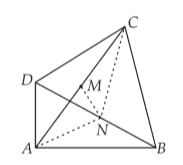
$M$ and $N$ are the midpoints of the diagonals $A C$ and $B D$ respectively of quadrilateral $A B C D$, then $\overrightarrow{A B}+\overrightarrow{A D}+\overrightarrow{C B}+\overrightarrow{C D}=$
- A
$2 \overrightarrow{M N}$
- B
$2 \overrightarrow{N M}$
- C
$4 \overrightarrow{M N}$
- D
$4 \overline{N M}$
View full question & answer→MCQ 582 Marks
If $\vec{a}=\hat{i}+\hat{j}-2 \hat{k}, \vec{b}=2 \hat{i}-\hat{j}+\hat{k}$ and $\vec{c}=3 \hat{i}-\hat{k}$ and $\vec{c}=m \vec{a}+n \vec{b}$, then $m+n=$
Answer(c) : $\vec{a}=\hat{i}+\hat{j}-2 \hat{k}, \vec{b}=2 \hat{i}-\hat{j}+\hat{k}, \vec{c}=3 \hat{i}-\hat{k}$
Also, $\vec{c}=m \vec{a}+n \vec{b}$
$\begin{aligned}
& 3 \hat{i}-\hat{k}=m(\hat{i}+\hat{j}-2 \hat{k})+n(2 \hat{i}-\hat{j}+\hat{k}) \\
& =(m+2 n) \hat{i}+(m-n) \hat{j}+(-2 m+n) \hat{k} \\
& \Rightarrow \quad m+2 n=3, m-n=0,-2 m+n=-1 \\
& \therefore \quad m-n=0 \Rightarrow m=n \\
& \text { and } m+2 n=m+2 m=3 \Rightarrow m=1 \\
& \therefore \quad m=n=1 \Rightarrow m+n=2
\end{aligned}$
View full question & answer→MCQ 592 Marks
If $\left[\begin{array}{lll}\vec{a} \times \vec{b} & \vec{b} \times \vec{c} & \vec{c} \times a\end{array}\right]=\lambda[\vec{a} \vec{b} \vec{c}]^2$, then $\lambda$ is equal to
Answer$\begin{aligned} & \text {(c) : }\left[\begin{array}{lll}\vec{a} \times \vec{b} & \vec{b} \times \vec{c} & \vec{c} \times \vec{a}\end{array}\right] \\ & =(\vec{a} \times \vec{b})\{(\vec{b} \times \vec{c}) \times(\vec{c} \times \vec{a})\} \\ & =(\vec{a} \times \vec{b})\{(\vec{b} \times \vec{c} \cdot \vec{a}) \vec{c}-(\vec{b} \times \vec{c} \cdot \vec{c}) \vec{a}\} \\ & =(\vec{a} \times \vec{b})[\vec{a} \vec{b} \vec{c}] \vec{c}=[\vec{a} \vec{b} \vec{c}][\vec{a} \vec{b} \vec{c}]=[\vec{a} \vec{b} \vec{c}]^2 \\ & \therefore \quad \text { On comparison, } \lambda=1\end{aligned}$
View full question & answer→MCQ 602 Marks
If $\vec{a}=\frac{1}{\sqrt{10}}(3 \hat{i}+\hat{k})$ and $\vec{b}=\frac{1}{7}(2 \hat{i}+3 \hat{j}-6 \hat{k})$, then the value of $(2 \vec{a}-\vec{b}) \cdot[(\vec{a} \times \vec{b}) \times(\vec{a}+2 \vec{b})]$ is
Answer$\begin{aligned} & \text {(c) : }(2 \vec{a}-\vec{b}) \cdot\{(\vec{a} \times \vec{b}) \times(\vec{a}+2 \vec{b})\} \\ & =(2 \vec{a}-\vec{b}) \cdot\{(\vec{a} \times \vec{b}) \times \vec{a}+2(\vec{a} \times \vec{b}) \times \vec{b}\} \\ & =(2 \vec{a}-\vec{b}) \cdot\{(\vec{a} \cdot \vec{a}) \vec{b}-(\vec{a} \cdot \vec{b}) \vec{a}+2(\vec{a} \cdot \vec{b}) \vec{b}-2(\vec{b} \cdot \vec{b}) \vec{a}\} \\ & =(2 \vec{a}-\vec{b}) \cdot(\vec{b}-2 \vec{a})=-4 \vec{a} \cdot \vec{a}-\vec{b} \cdot \vec{b}=-5\end{aligned}$
View full question & answer→MCQ 612 Marks
The direction cosines of a line equally inclined to three mutually perpendicular lines having direction cosines as $l_1, m_1, n _1 ; l_2, m_2, n _2$ and $l_3, m_3, n _3$ are
- A
$l_1+l_2+l_3, m_1+ m _2+ m _3, n _1+ n _2+ n _3$
- ✓
$\frac{l_1+l_2+l_3}{\sqrt{3}}, \frac{m_1+ m _2+ m _3}{\sqrt{3}}, \frac{ n _1+ n _2+ n _3}{\sqrt{3}}$
- C
$\frac{l_1+l_2+l_3}{3}, \frac{m_1+ m _2+ m _3}{3}, \frac{ n _1+ n _2+ n _3}{3}$
- D
AnswerCorrect option: B. $\frac{l_1+l_2+l_3}{\sqrt{3}}, \frac{m_1+ m _2+ m _3}{\sqrt{3}}, \frac{ n _1+ n _2+ n _3}{\sqrt{3}}$
(B) Since, the three lines are mutually perpendicular
$\therefore l_1 l_2+ m _1 m_2+ n _1 n _2=0$
$\begin{array}{l}l_2 l_3+ m _2 m_3+ n _2 n _3=0 \\ l_3 l_1+ m _3 m_1+ n _3 n _1=0\end{array}$
Also, $l_1^2+ m _1^2+ n _1^2=1$,
$l_2^2+ m _2^2+ n _2^2=1$,
$l_3^2+ m _3^2+ n _3^2=1$
Now, $\left(l_1+l_2+l_3\right)^2+\left( m _1+ m _2+ m _3\right)^2$ $+\left( n _1+ n _2+ n _3\right)^2$
$=\left(l_1^2+ m _1^2+ n _1^2\right)+\left(l_2^2+ m _2^2+ n _2^2\right)+\left(l_3^2+ m _3^2+ n _3^2\right)$
$+2\left(l_1 l_2+ m _1 m_2+ n _1 n _2\right)$ $+2\left(l_2 l_3+ m _2 m_3+ n _2 n _3\right)$
$+2\left(l_3 l_1+ m _3 m_1+ n _3 n _1\right)$
$=3$
$\Rightarrow\left(l_1+l_2+l_3\right)^2+\left( m _1+ m _2+ m _3\right)^2$ $+\left(n_1+n_2+n_3\right)^2=3$
Hence, direction cosines of required line are:
$\frac{l_1+l_2+l_3}{\sqrt{3}}, \frac{m_1+ m _2+ m _3}{\sqrt{3}}, \frac{ n _1+ n _2+ n _3}{\sqrt{3}}$
View full question & answer→MCQ 622 Marks
The angle between the lines whose direction cosines satisfy the equations $l+ m + n =0$ and $l^2= m ^2+ n ^2$ is
- A
$\frac{\pi}{6}$
- B
$\frac{\pi}{2}$
- ✓
$\frac{\pi}{3}$
- D
$\frac{\pi}{4}$
AnswerCorrect option: C. $\frac{\pi}{3}$
(C) Putting $l=- m - n$ in $l^2= m ^2+ n ^2$, we get $(- m - n )^2= m ^2+ n ^2$
$\Rightarrow m n=0 \Rightarrow m=0$ or $n=0$
If $m =0$, then $l=- n$
$\therefore \quad \frac{l}{-1}=\frac{ m }{0}=\frac{ n }{1}$
If $n =0$, then $l=- m$
$\therefore \quad \frac{l}{-1}=\frac{ m }{1}=\frac{ n }{0}$
$\therefore \quad a _1, b_1, c _1=-1,0,1$ and $a _2, b_2, c _2=-1,1,0$
$\therefore \quad$ The angle between the lines is given by
$\cos \theta=\frac{1+0+0}{\sqrt{1+0+1} \sqrt{1+1+0}}=\frac{1}{2}$
$\therefore \quad \theta=\frac{\pi}{3}$
View full question & answer→MCQ 632 Marks
The acute angle between two lines whose direction ratios are given by $l+ m - n =0$ and $l^2+ m ^2- n ^2=0$ is
- A
$\frac{\pi}{2}$
- ✓
$\frac{\pi}{3}$
- C
$\frac{\pi}{4}$
- D
$\frac{\pi}{6}$
AnswerCorrect option: B. $\frac{\pi}{3}$
(B) $l+ m - n =0$ and $l^2+ m ^2- n ^2=0$
$\Rightarrow l+ m = n$ and $l^2+ m ^2= n ^2$
Putting $l+ m = n$ in $l^2+ m ^2= n ^2$, we get $l^2+ m ^2=(l+ m )^2$
$\Rightarrow 2 l m=0 \Rightarrow l=0$ or $m =0$
If $l=0$, then $m = n$
$\therefore \quad \frac{l}{0}=\frac{ m }{1}=\frac{ n }{1}$
If $m =0$, then $l= n$
$\therefore \quad \frac{l}{1}=\frac{ m }{0}=\frac{ n }{1}$
∴ the d.r.s of the lines are proportional to $0,1,1$ and $1,0,1$.
$\therefore \quad \cos \theta=\left|\frac{0(1)+1(0)+1(1)}{\sqrt{0+1+1} \sqrt{1+0+1}}\right|=\frac{1}{2}$
$\Rightarrow \theta=\cos ^{-1}\left(\frac{1}{2}\right) \Rightarrow \theta=\frac{\pi}{3}$
View full question & answer→MCQ 642 Marks
The direction cosines $l, m, n$ of two lines are connected by the relations $l+ m + n =0, l m=0$, then the angles between them is
- ✓
$\frac{\pi}{3}$
- B
$\frac{\pi}{4}$
- C
$\frac{\pi}{2}$
- D
$0$
AnswerCorrect option: A. $\frac{\pi}{3}$
(A) $l+ m + n =0$
$\begin{array}{l}\Rightarrow l=-( m + n ) \text { and } l m=0 \Rightarrow-( m + n ) m =0 \\ \Rightarrow m=0 \text { or } m + n =0 \Rightarrow m=0 \text { or } m =- n \end{array}$
If $m =0$, then $l=- n$
$\therefore \quad \frac{l}{-1}=\frac{ m }{0}=\frac{ n }{1}$
If $m =- n$, then $l=0$
$\therefore \quad \frac{l}{0}=\frac{ m }{-1}=\frac{ n }{1}$
∴ the d.r.s of the lines are proportional to $-1,0,1$ and $0,-1,1$
∴ angle between them is
$\cos \theta=\left|\frac{0+0+1}{\sqrt{1+0+1} \sqrt{0+1+1}}\right|=\frac{1}{2}$
$\therefore \quad \theta=\frac{\pi}{3}$
View full question & answer→MCQ 652 Marks
Let $\theta$ be the angle between the lines AB and AC , where $A , B$ and C are the three points with co-ordinates $(1,2,-1),(2,0,3),(3,-1,2)$ respectively, then $\sqrt{462} \cos \theta$ is equal to
Answer(A) Given, $A \equiv(1,2,-1), B \equiv(2,0,3)$, $C \equiv(3,-1,2)$
The d.r.s of $AB =1,-2,4$ and d.r.s of $AC =2,-3,3$
$\therefore \quad \cos \theta=\left|\frac{1(2)+(-2)(-3)+4(3)}{\sqrt{1+4+16} \sqrt{4+9+9}}\right|$
$\Rightarrow \cos \theta=\frac{2+6+12}{\sqrt{21} \sqrt{22}}=\frac{20}{\sqrt{462}}$
$\Rightarrow \sqrt{462} \cos \theta=20$
View full question & answer→MCQ 662 Marks
The direction cosines of the line which is perpendicular to the lines whose direction cosines are proportional to $1,-1,2$ and $2,1,-1$ are
- ✓
$\frac{-1}{\sqrt{35}}, \frac{5}{\sqrt{35}}, \frac{3}{\sqrt{35}}$
- B
$\frac{13}{\sqrt{35}}, \frac{-1}{\sqrt{35}}, \frac{1}{\sqrt{35}}$
- C
$\frac{2}{\sqrt{3}}, \frac{5}{\sqrt{3}}, \frac{7}{\sqrt{3}}$
- D
$\frac{3}{\sqrt{35}}, \frac{5}{\sqrt{35}}, \frac{7}{\sqrt{35}}$
AnswerCorrect option: A. $\frac{-1}{\sqrt{35}}, \frac{5}{\sqrt{35}}, \frac{3}{\sqrt{35}}$
(A) The d.r.s. of the two lines are $1,-1,2$ and $2,1,-1$
Let d.r.s. of the line be $a , b , c$.
$\therefore \quad a-b+2 c=0$ ...(i)
and $2 a+b-c=0$ ...(ii)
Solving (i) and (ii), we get
$\frac{ a }{-1}=\frac{ b }{5}=\frac{ c }{3}$
∴ d.r.s. of the line are $-1,5,3$.
∴ the required d.c.s. are $\frac{-1}{\sqrt{35}}, \frac{5}{\sqrt{35}}, \frac{3}{\sqrt{35}}$.
View full question & answer→MCQ 672 Marks
If first two numbers of the direction cosines of a line joining points $(1,2,0)$ and $(3,-1, z)$ are $\frac{2}{7},-\frac{3}{7}$, then z is equal to
- A
- ✓
$\pm 6$
- C
$\pm 3$
- D
$\pm 4$
AnswerCorrect option: B. $\pm 6$
(B) $l^2+ m ^2+ n ^2=1$
$\therefore \quad\left(\frac{2}{7}\right)^2+\left(\frac{-3}{7}\right)^2+n^2=1$
$\therefore \quad n ^2=1-\frac{13}{49}=\frac{36}{49}$
Let $a , b , c$ be the d.r.s. of the line.
$\therefore \quad a=2, b=-3, c=z$
Since $n =\frac{ c }{\sqrt{ a ^2+ b ^2+ c ^2}}$
$\therefore \quad \frac{z}{\sqrt{4+9+z^2}}= \pm \frac{6}{7}$
$\begin{array}{l}\Rightarrow \frac{z^2}{13+z^2}=\frac{36}{49} \\ \Rightarrow 49 z^2-36 z^2=13 \times 36 \\ \Rightarrow z^2=36 \\ \Rightarrow z= \pm 6\end{array}$
View full question & answer→MCQ 682 Marks
A line passes through the points $(6,-7,-1)$ and $(2,-3,1)$. If the angle $\alpha$, which the line makes with the positive direction of X-axis is acute, the direction cosines of the line are
- ✓
$\frac{2}{3}, \frac{-2}{3}, \frac{-1}{3}$
- B
$\frac{2}{3}, \frac{2}{3}, \frac{-1}{3}$
- C
$\frac{2}{3}, \frac{-2}{3}, \frac{1}{3}$
- D
$\frac{2}{3}, \frac{-2}{3}, \frac{1}{3}$
AnswerCorrect option: A. $\frac{2}{3}, \frac{-2}{3}, \frac{-1}{3}$
(A) The d.r.s. of the given line are $2-6,-3+7,1+1$
i.e., $-2,2,1$. i.e., $2,-2,-1$
∵ angle $\alpha$ is acute, $\cos \alpha>0$
$\Rightarrow \cos \alpha=\frac{2}{3}$
Thus, required d.c.s are $\frac{2}{3}, \frac{-2}{3}, \frac{-1}{3}$
View full question & answer→MCQ 692 Marks
Line with direction ratios $1,1,1$ is
Answer(D) D.c.s. of the line are $\frac{1}{\sqrt{3}}, \frac{1}{\sqrt{3}}, \frac{1}{\sqrt{3}}$
$\therefore \cos \alpha=\frac{1}{\sqrt{3}}, \cos \beta=\frac{1}{\sqrt{3}}, \cos \gamma=\frac{1}{\sqrt{3}}$
Hence, line is equally inclined to axes.
View full question & answer→MCQ 702 Marks
The vector of magnitude 6 which is equally inclined to the co-ordinate axes is
- ✓
$\pm 2 \sqrt{3}(\hat{ i }+\hat{ j }+\hat{ k })$
- B
$\sqrt{3}(\hat{ i }+\hat{ j }+\hat{ k })$
- C
$\pm 2(\hat{ i }+\hat{ j }+\hat{ k })$
- D
$3 \sqrt{3}(\hat{ i }+\hat{ j }+\hat{ k })$
AnswerCorrect option: A. $\pm 2 \sqrt{3}(\hat{ i }+\hat{ j }+\hat{ k })$
(A) Since, $\cos ^2 \alpha+\cos ^2 \beta+\cos ^2 \gamma=1$
$\Rightarrow \cos ^2 \alpha+\cos ^2 \alpha+\cos ^2 \alpha=1$ $(\because \alpha=\beta=\gamma)$
$\Rightarrow \cos ^2 \alpha=\frac{1}{3} \Rightarrow \cos \alpha=\frac{1}{\sqrt{3}}$
$\therefore \quad$ The d.c.s are $\pm \frac{1}{\sqrt{3}}, \pm \frac{1}{\sqrt{3}}, \pm \frac{1}{\sqrt{3}}$.
The magnitude of the given vector is 6 .
$\therefore \quad \overline{ r }=6(\cos \alpha \hat{ i }+\cos \beta \hat{ j }+\cos \gamma \hat{ k })$
$=\frac{ \pm 6}{\sqrt{3}}(\hat{ i }+\hat{ j }+\hat{ k })= \pm 2 \sqrt{3}(\hat{ i }+\hat{ j }+\hat{ k })$
View full question & answer→MCQ 712 Marks
A line AB is inclined to OX at $45^{\circ}$ and to OY at $60^{\circ}$ and let P be any point on line AB such that $OP =12$ units. Then the position vector of ' P ' is
- A
$12\left(\frac{1}{2} \hat{ i }+\frac{1}{2} \hat{ j } \pm \frac{1}{\sqrt{2}} \hat{ k }\right)$
- B
$12\left(\frac{1}{\sqrt{2}} \hat{ i }+\frac{1}{2} \hat{ j } \pm \frac{1}{\sqrt{2}} \hat{ k }\right)$
- ✓
$12\left(\frac{1}{\sqrt{2}} \hat{ i }+\frac{1}{2} \hat{ j } \pm \frac{1}{2} \hat{ k }\right)$
- D
$12\left(\frac{1}{2} \hat{i}+\frac{1}{\sqrt{2}} \hat{j} \pm \frac{1}{\sqrt{2}} \hat{k}\right)$
AnswerCorrect option: C. $12\left(\frac{1}{\sqrt{2}} \hat{ i }+\frac{1}{2} \hat{ j } \pm \frac{1}{2} \hat{ k }\right)$
(C) We have $l=\cos 45^{\circ}=\frac{1}{\sqrt{2}}$,
$m =\cos 60^{\circ}=\frac{1}{2}$ and $n =\cos \gamma$
We know that $l^2+ m ^2+ n ^2=1$
$\therefore \quad \frac{1}{2}+\frac{1}{4}+n^2=1$
$\Rightarrow n ^2=1-\frac{3}{4}=\frac{1}{4} \Rightarrow n = \pm \frac{1}{2}$
$\Rightarrow \cos \gamma= \pm \frac{1}{2}$
$\overline{ r }= r \left(l \hat{ i } + m \hat{ j }+ n \hat{ k }\right)$
$\Rightarrow \overline{ r }=12\left(\frac{1}{\sqrt{2}} \hat{ i }+\frac{1}{2} \hat{ j } \pm \frac{1}{2} \hat{ k }\right)$
View full question & answer→MCQ 722 Marks
A line makes the same angle $\theta$, with each of the X and Z axes. If the angle $\beta$, which it makes with $Y$-axis is such that $\sin ^2 \beta=3 \sin ^2 \theta$, then $\cos ^2 \theta$ equals
- A
$\frac{2}{3}$
- B
$\frac{1}{5}$
- ✓
$\frac{3}{5}$
- D
$\frac{2}{5}$
AnswerCorrect option: C. $\frac{3}{5}$
(C) The line makes angle $\theta$ with X -axis and Z -axis and $\beta$ with Y -axis.
$\therefore l=\cos \theta, m =\cos \beta, n =\cos \theta$
$\cos ^2 \theta+\cos ^2 \beta+\cos ^2 \theta=1$
$\Rightarrow 2 \cos ^2 \theta=1-\cos ^2 \beta$
$\Rightarrow 2 \cos ^2 \theta=\sin ^2 \beta$ ...(i)
But $\sin ^2 \beta=3 \sin ^2 \theta$ ...(ii)
From (i) and (ii), we get
$3 \sin ^2 \theta=2 \cos ^2 \theta$
$\begin{array}{l}\Rightarrow 3\left(1-\cos ^2 \theta\right)=2 \cos ^2 \theta \\ \Rightarrow 3=5 \cos ^2 \theta \Rightarrow \cos ^2 \theta=\frac{3}{5}\end{array}$
View full question & answer→MCQ 732 Marks
Number of lines which make angles $\frac{\pi}{6}$ and $\frac{\pi}{4}$ with any two of $OX , OY$ and OZ are
Answer(A) Let $\alpha=\frac{\pi}{6}$ and $\beta=\frac{\pi}{4}$
$\therefore \cos \alpha=\frac{\sqrt{3}}{2}$ and $\cos \beta=\frac{1}{\sqrt{2}}$
Since $\cos ^2 \alpha+\cos ^2 \beta+\cos ^2 \gamma=1$
$\therefore \quad \frac{3}{4}+\frac{1}{2}+\cos ^2 \gamma=1$
$\Rightarrow \cos ^2 \gamma=-\frac{1}{4}$
Square of a real number cannot be negative.
∴ option (A) is the correct answer.
View full question & answer→MCQ 742 Marks
If a line makes angles $\alpha, \beta, \gamma$ with the co-ordinate axes, then
- A
$\cos 2 \alpha+\cos 2 \beta+\cos 2 \gamma-1=0$
- B
$\cos 2 \alpha+\cos 2 \beta+\cos 2 \gamma-2=0$
- ✓
$\cos 2 \alpha+\cos 2 \beta+\cos 2 \gamma+1=0$
- D
$\cos 2 \alpha+\cos 2 \beta+\cos 2 \gamma+2=0$
AnswerCorrect option: C. $\cos 2 \alpha+\cos 2 \beta+\cos 2 \gamma+1=0$
(C) $\cos ^2 \alpha+\cos ^2 \beta+\cos ^2 \gamma=1$
$\begin{array}{l}\Rightarrow \frac{1+\cos 2 \alpha}{2}+\frac{1+\cos 2 \beta}{2}+\frac{1+\cos 2 \gamma}{2}=1 \\ \Rightarrow \cos 2 \alpha+\cos 2 \beta+\cos 2 \gamma+3=2 \\ \Rightarrow \cos 2 \alpha+\cos 2 \beta+\cos 2 \gamma+1=0\end{array}$
View full question & answer→MCQ 752 Marks
If a line makes angles $\frac{\alpha}{2}, \frac{\beta}{2}, \frac{\gamma}{2}$ with positive directions of co-ordinate axes, then $\cos \alpha+\cos \beta+\cos \gamma$ is equal to
Answer(B) $\cos ^2 \frac{\alpha}{2}+\cos ^2 \frac{\beta}{2}+\cos ^2 \frac{\gamma}{2}=1$
Now, $\cos \alpha+\cos \beta+\cos \gamma$
$\begin{array}{l}=2 \cos ^2 \frac{\alpha}{2}-1+2 \cos ^2 \frac{\beta}{2}-1+2 \cos ^2 \frac{\gamma}{2}-1 \\ =2(1)-3=-1\end{array}$
View full question & answer→MCQ 762 Marks
If $\alpha, \beta, \gamma$ are the angles made by a line with the co-ordinate axes, then $\sin ^2 \alpha+\sin ^2 \beta+\sin ^2 \gamma=$
- A
$\frac{1}{2}$
- B
- ✓
- D
$\frac{3}{2}$
Answer(C) $\sin ^2 \alpha+\sin ^2 \beta+\sin ^2 \gamma$
$\begin{array}{l}=\left(1-\cos ^2 \alpha\right)+\left(1-\cos ^2 \beta\right)+\left(1-\cos ^2 \gamma\right) \\ =3-\left(\cos ^2 \alpha+\cos ^2 \beta+\cos ^2 \gamma\right)=3-(1)=2\end{array}$
View full question & answer→MCQ 772 Marks
The sum of the direction cosines of a line which makes equal angles with the positive direction of co-ordinate axes is
- A
- B
- ✓
$\sqrt{3}$
- D
$\frac{3}{\sqrt{2}}$
AnswerCorrect option: C. $\sqrt{3}$
(C) Since $\cos ^2 \alpha+\cos ^2 \beta+\cos ^2 \gamma=1$
$\Rightarrow \cos ^2 \alpha+\cos ^2 \alpha+\cos ^2 \alpha=1(\because \alpha=\beta=\gamma)$
$\Rightarrow \cos ^2 \alpha=\frac{1}{3} \Rightarrow \cos \alpha=\frac{1}{\sqrt{3}}$
Now, sum of d.c.s. $=l+m+n$
$\begin{array}{l}=\cos \alpha+\cos \alpha+\cos \alpha \\ =3 \cos \alpha=\sqrt{3}\end{array}$
View full question & answer→MCQ 782 Marks
If a line lies in the octant OXYZ and it makes equal angles with the axes, then
- A
$l= m = n =\frac{1}{\sqrt{3}}$
- ✓
$l= m = n = \pm \frac{1}{\sqrt{3}}$
- C
$l= m = n =-\frac{1}{\sqrt{3}}$
- D
$l= m = n = \pm \frac{1}{\sqrt{2}}$
AnswerCorrect option: B. $l= m = n = \pm \frac{1}{\sqrt{3}}$
(B) Since $\cos ^2 \alpha+\cos ^2 \beta+\cos ^2 \gamma=1$
$\therefore \quad \cos ^2 \alpha+\cos ^2 \alpha+\cos ^2 \alpha=1$ $\ldots .(\alpha=\beta=\gamma)$
$\begin{array}{l}\Rightarrow 3 \cos ^2 \alpha=1 \\ \Rightarrow \cos ^2 \alpha=\frac{1}{3}\end{array}$
$\Rightarrow \cos \alpha= \pm \frac{1}{\sqrt{3}}$
Now, $l= m = n =\cos \alpha$
$\therefore \quad l= m = n = \pm \frac{1}{\sqrt{3}}$
View full question & answer→MCQ 792 Marks
A line makes $45^{\circ}$ angle with positive X -axis and makes equal angles with positive $Y , Z$-axes respectively. The sum of the three angles which the line makes with positive $X , Y$, Z -axes is
- A
$180^{\circ}$
- ✓
$165^{\circ}$
- C
$150^{\circ}$
- D
$135^{\circ}$
AnswerCorrect option: B. $165^{\circ}$
(B) $\cos ^2 \alpha+\cos ^2 \beta+\cos ^2 \gamma=1$
$\Rightarrow \cos ^2 45^{\circ}+\cos ^2 \beta+\cos ^2 \beta=1$ $\ldots .(\because \beta=\gamma)$
$\Rightarrow 2 \cos ^2 \beta=1-\frac{1}{2}=\frac{1}{2}$
$\Rightarrow \cos ^2 \beta=\frac{1}{4}$
$\therefore \quad \beta=60^{\circ}=\gamma$
$\Rightarrow \alpha+\beta+\gamma=165^{\circ}$
View full question & answer→MCQ 802 Marks
A line AB in three dimensional space makes angles $45^{\circ}$ and $120^{\circ}$ with the positive X-axis and the positive Y -axis respectively. If AB makes an acute angle $\theta$ with the positive $Z$-axis, then $\theta$ equals
- ✓
$60^{\circ}$
- B
$75^{\circ}$
- C
$30^{\circ}$
- D
$45^{\circ}$
AnswerCorrect option: A. $60^{\circ}$
(A) Since $\cos ^2 \alpha+\cos ^2 \beta+\cos ^2 \gamma=1$
$\therefore \cos ^2 45^{\circ}+\cos ^2 120^{\circ}+\cos ^2 \theta=1$
$\Rightarrow \cos ^2 \theta=1-\frac{1}{2}-\frac{1}{4}=\frac{1}{4} \Rightarrow \cos \theta= \pm \frac{1}{2}$
Since $\theta$ is an acute angle
$\therefore \quad \cos \theta=\frac{1}{2} \Rightarrow \theta=60^{\circ}$
View full question & answer→MCQ 812 Marks
A straight line, making an angle of $60^{\circ}$ with each of Y and Z -axes, is inclined with X -axis at an angle of
- A
$60^{\circ}$
- B
$30^{\circ}$
- ✓
$45^{\circ}$
- D
$75^{\circ}$
AnswerCorrect option: C. $45^{\circ}$
(C) Since $\cos ^2 \alpha+\cos ^2 \beta+\cos ^2 \gamma=1$
$\therefore \quad \cos ^2 \alpha+\cos ^2 60^{\circ}+\cos ^2 60^{\circ}=1$
$\therefore \quad \cos ^2 \alpha=1-\frac{1}{4}-\frac{1}{4}=1-\frac{1}{2}=\frac{1}{2}$
$\begin{array}{l}\Rightarrow \cos \alpha= \pm \frac{1}{\sqrt{2}} \\ \Rightarrow \alpha=45^{\circ} \text { or } \alpha=135^{\circ}\end{array}$
View full question & answer→MCQ 822 Marks
If $\alpha, \beta, \gamma$ are the direction angles of a vector, and $\cos \alpha=\frac{14}{15}, \cos \beta=\frac{1}{3}$, then $\cos \gamma=$
- ✓
$\pm \frac{2}{15}$
- B
$\frac{1}{5}$
- C
$\pm \frac{1}{15}$
- D
$\frac{2}{5}$
AnswerCorrect option: A. $\pm \frac{2}{15}$
(A) $\cos ^2 \alpha+\cos ^2 \beta+\cos ^2 \gamma=1$
$\therefore \quad \cos \gamma= \pm \sqrt{1-\left(\frac{14}{15}\right)^2-\left(\frac{1}{3}\right)^2}= \pm \sqrt{\frac{8}{9}-\left(\frac{196}{225}\right)}$
$= \pm \frac{2}{15}$
View full question & answer→MCQ 832 Marks
The direction ratios of two lines are $a, b, c$ and $\frac{1}{ bc }, \frac{1}{ ca }, \frac{1}{ ab }$. The lines are
Answer(B) As $\frac{ a }{\left(\frac{1}{ bc }\right)}=\frac{ b }{\left(\frac{1}{ ca }\right)}=\frac{ c }{\left(\frac{1}{ ab }\right)}$, the lines are parallel.
View full question & answer→MCQ 842 Marks
The direction ratios of the diagonals of a cube which joins the origin to the opposite corner are (when the 3 concurrent edges of the cube are coordinate axes)
AnswerCorrect option: B. $1,1,1$
(B) The d.r.s. of the diagonal of the line joining the origin to the opposite corner of cube are $a -0, a -0, a -0$ i.e. $1,1,1$.
View full question & answer→MCQ 852 Marks
The projection of any line on co-ordinate axes be respectively $3,4,5$, then its length is
AnswerCorrect option: C. $5 \sqrt{2}$
(C) Let the length of the line segment be $r$ and its direction cosines be $l, m, n$.
∴ The projections on the co-ordinate axes are lr, mr, nr.
$\therefore \quad l r =3, mr =4$ and $nr =5$
$\therefore l^2 r ^2+ m ^2 r ^2+ n ^2 r ^2=3^2+4^2+5^2$
$\Rightarrow r ^2\left(l^2+ m ^2+ n ^2\right)=9+16+25$
$\Rightarrow r^2=50$ $\ldots .\left[\because l^2+ m ^2+ n ^2=1\right]$
$\Rightarrow r=\sqrt{50}=5 \sqrt{2}$
View full question & answer→MCQ 862 Marks
The projection of the line segment joining the points $(-1,0,3)$ and $(2,5,1)$ on the line whose direction ratios are $6,2,3$ is
- A
$\frac{10}{7}$
- ✓
$\frac{22}{7}$
- C
$\frac{18}{7}$
- D
$\frac{7}{22}$
AnswerCorrect option: B. $\frac{22}{7}$
(B) Here, $\bar{a}=3 \hat{i}+5 \hat{j}-2 \hat{k}, \bar{b}=6 \hat{i}+2 \hat{j}+3 \hat{k}$
$\therefore \quad$ Projection $=\frac{\bar{a} \cdot \bar{b}}{|b|}=\frac{18+10-6}{7}=\frac{22}{7}$
View full question & answer→MCQ 872 Marks
The co-ordinates of a point P are $(3,12,4)$ with respect to origin O , then the direction cosines of OP are
- A
$3,12,4$
- B
$\frac{1}{4}, \frac{1}{3}, \frac{1}{2}$
- C
$\frac{3}{\sqrt{13}}, \frac{1}{\sqrt{13}}, \frac{2}{\sqrt{13}}$
- ✓
$\frac{3}{13}, \frac{12}{13}, \frac{4}{13}$
AnswerCorrect option: D. $\frac{3}{13}, \frac{12}{13}, \frac{4}{13}$
(D) The d.r.s of OP are $3,12,4$
∴ The required d.c.s. are
i.e., $\frac{3}{13}, \frac{12}{13}, \frac{4}{13}$
View full question & answer→MCQ 882 Marks
The number of straight lines that are equally inclined to the three dimensional co-ordinate axes, is
Answer(B) Since
$\alpha=\beta=\gamma \Rightarrow \cos ^2 \alpha+\cos ^2 \alpha+\cos ^2 \alpha=1$
$\Rightarrow \cos \alpha=\left( \pm \frac{1}{\sqrt{3}}\right)$
So, there are four lines whose direction cosines are
$\left(\frac{1}{\sqrt{3}}, \frac{1}{\sqrt{3}}, \frac{1}{\sqrt{3}}\right),\left(\frac{-1}{\sqrt{3}}, \frac{1}{\sqrt{3}}, \frac{1}{\sqrt{3}}\right)\left(\frac{1}{\sqrt{3}}, \frac{-1}{\sqrt{3}}, \frac{1}{\sqrt{3}}\right)$, $\left(\frac{1}{\sqrt{3}}, \frac{1}{\sqrt{3}}, \frac{-1}{\sqrt{3}}\right)$.
View full question & answer→MCQ 892 Marks
The valid direction angle triplet of a line L is
- A
$\frac{\pi}{6}, \frac{\pi}{4}, \frac{\pi}{3}$
- ✓
$\frac{\pi}{4}, \frac{\pi}{3}, \frac{\pi}{3}$
- C
$\frac{\pi}{2}, \frac{\pi}{3}, \frac{\pi}{3}$
- D
$0, \frac{\pi}{3}, \frac{\pi}{3}$
AnswerCorrect option: B. $\frac{\pi}{4}, \frac{\pi}{3}, \frac{\pi}{3}$
(B) Consider option (B)
$\therefore \quad \cos ^2 \frac{\pi}{4}+\cos ^2 \frac{\pi}{3}+\cos ^2 \frac{\pi}{3}$
$=\frac{1}{2}+\frac{1}{4}+\frac{1}{4}=1$
$\therefore \quad$ correct answer is option (B).
View full question & answer→MCQ 902 Marks
Which of the triplets cannot represent direction cosines of a line?
- A
$\frac{1}{\sqrt{3}}, \frac{1}{\sqrt{3}}, \frac{1}{\sqrt{3}}$
- B
$\frac{3}{\sqrt{50}}, \frac{4}{\sqrt{50}}, \frac{5}{\sqrt{50}}$
- C
$\frac{4}{\sqrt{77}}, \frac{5}{\sqrt{77}}, \frac{6}{\sqrt{77}}$
- ✓
$\frac{2}{\sqrt{25}}, \frac{3}{\sqrt{25}}, \frac{4}{\sqrt{25}}$
AnswerCorrect option: D. $\frac{2}{\sqrt{25}}, \frac{3}{\sqrt{25}}, \frac{4}{\sqrt{25}}$
(D) We know that, $l^2+ m ^2+ n ^2=1$
Consider option (D)
$\left(\frac{2}{\sqrt{25}}\right)^2+\left(\frac{3}{\sqrt{25}}\right)^2+\left(\frac{4}{\sqrt{25}}\right)^2=\frac{4+9+16}{25}$
$=\frac{29}{25} \neq 1$
$\therefore \quad$ correct answer is option (D).
View full question & answer→MCQ 912 Marks
If $\alpha, \beta, \gamma$ are direction angles of a line, then
- A
$0 \leq \alpha, \beta, \gamma \leq \frac{\pi}{2}$
- ✓
$0 \leq \alpha, \beta, \gamma \leq \pi$
- C
$0<\alpha, \beta, \gamma<\frac{\pi}{2}$
- D
$0<\alpha, \beta, \gamma<\pi$
AnswerCorrect option: B. $0 \leq \alpha, \beta, \gamma \leq \pi$
(B) If $\alpha, \beta, \lambda$ are direction angles of any vector $\overline{ OL }$, then those of $\overline{ OL ^{\prime}}$ are $\pi-\alpha, \pi-\beta$, $\pi-\gamma$ respectively
$\therefore \quad$ correct answer is option (B).
View full question & answer→MCQ 922 Marks
Let $\bar{a}, \bar{b}$ and $\bar{c}$ be three vectors having magnitudes 1,1 and 2 respectively. If $\overline{ a } \times(\overline{ a } \times \overline{ c })+\overline{ b }=\overline{0}$, then the acute angle between $\overline{ a }$ and $\overline{ c }$ is
- A
$\frac{\pi}{4}$
- ✓
$\frac{\pi}{6}$
- C
$\frac{\pi}{3}$
- D
AnswerCorrect option: B. $\frac{\pi}{6}$
(B) Given, $|\overline{ a }|=1,|\overline{b}|=1$ and $|\overline{ c }|=2$
Also, $\overline{ a } \times(\overline{ a } \times \overline{ c })+\overline{ b }=\overline{0}$
$\Rightarrow(\overline{ a } \cdot \overline{ c }) \overline{ a }-(\overline{ a } \cdot \overline{ a }) \overline{ c }+\overline{ b }=\overline{0}$
$\Rightarrow(\overline{ a } \cdot \overline{ c }) \overline{ a }-\overline{ c }+\overline{ b }=\overline{0}$ $\ldots\left[\because \overline{ a } \cdot \overline{ a }=|\overline{ a }|^2=1\right]$
$\begin{array}{l}\Rightarrow(\overline{ a } \cdot \overline{ c }) \overline{ a }-\overline{ c }=-\overline{ b } \\ \Rightarrow|(\overline{ a } \cdot \overline{ c }) \overline{ a }-\overline{ c }|=|-\overline{ b }|\end{array}$
$\begin{array}{l}\Rightarrow|(\overline{ a } \cdot \overline{ c }) \overline{ a }-\overline{ c }|^2=|\overline{ b }|^2 \\ \Rightarrow|(\overline{ a } \cdot \overline{ c }) \overline{ a }|^2+|\overline{ c }|^2-2\{(\overline{ a } \cdot \overline{ c }) \overline{ a } \cdot \overline{ c }\}=|\overline{ b }|^2 \\ \Rightarrow(\overline{ a } \cdot \overline{ c })^2|\overline{ a }|^2+|\overline{ c }|^2-2(\overline{ a } \cdot \overline{ c })(\overline{ a } \cdot \overline{ c })=|\overline{ b }|^2\end{array}$
$\Rightarrow(\overline{ a } \cdot \overline{ c })^2\left\{|\overline{ a }|^2-2\right\}+|\overline{ c }|^2=|\overline{ b }|^2$
$\Rightarrow-(\overline{ a } \cdot \overline{ c })^2+4=1$ $\ldots\left[\because|\overline{ b }|^2=1,|\overline{ c }|^2=4\right]$
$\begin{array}{l}\Rightarrow(\bar{a} \cdot \bar{c})^2=3 \\ \Rightarrow \bar{a} \cdot \bar{c}= \pm \sqrt{3}\end{array}$
$\Rightarrow|\overline{ a }||\overline{ c }| \cos \theta=\sqrt{3}$,
where $\theta$ is an acute angle between $\overline{ a }$ and $\overline{ c }$
$\Rightarrow \cos \theta=\frac{\sqrt{3}}{2} \Rightarrow \theta=\frac{\pi}{6}$
View full question & answer→MCQ 932 Marks
Let $\overline{ a }, \overline{ b }$ and $\overline{ c }$ be non-zero vectors such that no two are collinear and $\overline{ a } \times(\overline{ b } \times \overline{ c })=\frac{1}{3}|\overline{b}||\overline{ c }| \overline{ a }$.
If $\theta$ is the acute angle between the vectors $\overline{ b }$ and $\overline{ c }$, then $\sin \theta$ equals
- ✓
$\frac{2 \sqrt{2}}{3}$
- B
$\frac{\sqrt{2}}{3}$
- C
$\frac{2}{3}$
- D
$\frac{1}{3}$
AnswerCorrect option: A. $\frac{2 \sqrt{2}}{3}$
(A) Given, $\overline{ a } \times(\overline{ b } \times \overline{ c })=\frac{1}{3}|\overline{b}||\overline{ c }| \overline{ a }$
$\Rightarrow(\overline{ a } \cdot \overline{ c }) \overline{ b }-(\overline{ a } \cdot \overline{ b }) \overline{ c }=\frac{1}{3}|\overline{b}||\overline{ c }| \overline{ a }$
$\Rightarrow(\overline{ a } \cdot \overline{ c }) \overline{ b }-\left\{(\overline{ b } \cdot \overline{ c })+\frac{1}{3}|\overline{b}||\overline{ c }|\right\} \overline{ a }=\overline{0}$
Since $\overline{ a }, \overline{ b }$ are non-collinear.
$\therefore \quad \overline{ a } \cdot \overline{ c }=0$ and $\overline{ b } \cdot \overline{ c }+\frac{1}{3}|\overline{b} \| \overline{ c }|=0$
$\Rightarrow|\overline{ b }||\overline{ c }| \cos \theta+\frac{1}{3}|\overline{b}||\overline{ c }|=0$
$\Rightarrow \cos \theta=-\frac{1}{3}$
$\Rightarrow \sin \theta=\sqrt{\frac{8}{9}}=\frac{2 \sqrt{2}}{3}$
View full question & answer→MCQ 942 Marks
Let $\hat{\alpha}, \hat{\beta}, \hat{\gamma}$ be three unit vectors such that $\hat{\alpha} \times(\hat{\beta} \times \hat{\gamma})=\frac{1}{2}(\hat{\beta} \times \hat{\gamma})$ where $\hat{\alpha} \times(\hat{\beta} \times \hat{\gamma})=(\hat{\alpha} \cdot \hat{\gamma}) \hat{\beta}-(\hat{\alpha} \cdot \hat{\beta}) \hat{\gamma}$. If $\hat{\beta}$ is not parallel to $\hat{\gamma}$, then the angle between $\hat{\alpha}$ and $\hat{\beta}$ is
- A
$\frac{5 \pi}{6}$
- B
$\frac{\pi}{6}$
- C
$\frac{\pi}{3}$
- ✓
$\frac{2 \pi}{3}$
AnswerCorrect option: D. $\frac{2 \pi}{3}$
(D) $(\hat{\alpha} \cdot \hat{\gamma}) \hat{\beta}-(\hat{\alpha} \cdot \hat{\beta}) \hat{\gamma}=\frac{1}{2} \hat{\beta}+\frac{1}{2} \hat{\gamma}$
As $\hat{\beta}$ is not parallel to $\hat{\gamma}$,
$\hat{\alpha} \cdot \hat{\beta}=-\frac{1}{2}$
$\Rightarrow|\hat{\alpha}||\hat{\beta}| \cos \theta=-\frac{1}{2}$
$\Rightarrow \cos \theta=-\frac{1}{2}$ $\ldots[\because|\hat{\alpha}|=1,|\hat{\beta}|=1]$
$\Rightarrow \theta=\frac{2 \pi}{3}$
View full question & answer→MCQ 952 Marks
Let $\overline{ a }, \overline{ b }$ and $\overline{ c }$ be three unit vectors such that $\overline{ a } \times(\overline{ b } \times \overline{ c })=\frac{\sqrt{3}}{2}(\overline{b}+\overline{ c })$. If $\overline{ b }$ is not parallel to $\overline{ c }$, then the angle between $\overline{ a }$ and $\overline{ b }$ is
- A
$\frac{\pi}{2}$
- B
$\frac{2 \pi}{3}$
- ✓
$\frac{5 \pi}{6}$
- D
$\frac{3 \pi}{4}$
AnswerCorrect option: C. $\frac{5 \pi}{6}$
(C) $\overline{ a } \times(\overline{ b } \times \overline{ c })=\frac{\sqrt{3}}{2}(\overline{b}+\overline{ c })$
$\Rightarrow(\overline{ a } \cdot \overline{ c }) \overline{ b }-(\overline{ a } \cdot \overline{ b }) \overline{ c }=\left(\frac{\sqrt{3}}{2}\right) \overline{ b }+\left(\frac{\sqrt{3}}{2}\right) \overline{ c }$
$\Rightarrow \overline{ a } \cdot \overline{ c }=\frac{\sqrt{3}}{2}$ and $\overline{ a } \cdot \overline{ b }=\frac{-\sqrt{3}}{2}$
$\Rightarrow|\overline{ a }||\overline{ b }| \cos \theta=\frac{-\sqrt{3}}{2}$
$\begin{array}{l}\Rightarrow \cos \theta=\frac{-\sqrt{3}}{2}=\cos \frac{5 \pi}{6} \\ \Rightarrow \theta=\frac{5 \pi}{6}\end{array}$
View full question & answer→MCQ 962 Marks
The unit vector which is orthogonal to the vector $3 \hat{i}+2 \hat{j}+6 \hat{k}$ and is coplanar with vectors $2 \hat{ i }+\hat{ j }+\hat{ k }$ and $\hat{ i }-\hat{ j }+\hat{ k }$ is
- A
$\frac{1}{\sqrt{41}}(2 \hat{i}-6 \hat{j}+\hat{k})$
- B
$\frac{1}{\sqrt{13}}(2 \hat{ i }-3 \hat{ j })$
- ✓
$\frac{1}{\sqrt{10}}(3 \hat{j}-\hat{k})$
- D
$\frac{1}{\sqrt{34}}(4 \hat{i}+3 \hat{j}-3 \hat{k})$
AnswerCorrect option: C. $\frac{1}{\sqrt{10}}(3 \hat{j}-\hat{k})$
(C) Let $\bar{a}=3 \hat{i}+2 \hat{j}+6 \hat{k}, \bar{b}=2 \hat{i}+\hat{j}+\hat{k}$ and $\overline{ c }=\hat{ i }-\hat{ j }+\hat{ k }$. Then, required unit vectors are given by $\bar{\alpha}= \pm \frac{\overline{ a } \times(\overline{ b } \times \overline{ c })}{|\overline{ a } \times(\overline{ b } \times \overline{ c })|}$
Now,
$\overline{ a } \times(\overline{ b } \times \overline{ c })=(\overline{ a } \cdot \overline{ c }) \overline{ b }-(\overline{ a } \cdot \overline{ b }) \overline{ c }$
$\begin{array}{l}\Rightarrow \bar{a} \times(\bar{b} \times \bar{c})=7(2 \hat{i}+\hat{j}+\hat{k})-14(\hat{i}-\hat{j}+\hat{k}) \\ \Rightarrow \bar{a} \times(\bar{b} \times \bar{c})=21 \hat{j}-7 \hat{k}\end{array}$
$\therefore|\overline{ a } \times(\overline{ b } \times \overline{ c })|=\sqrt{441+49}=7 \sqrt{10}$
Hence, required unit vectors are
$\bar{\alpha}= \pm \frac{21 \hat{j}-7 \hat{k}}{7 \sqrt{10}}= \pm \frac{1}{\sqrt{10}}(3 \hat{j}-\hat{k})$
View full question & answer→MCQ 972 Marks
If $(\bar{a} \times \bar{b}) \times \bar{c}=\bar{a} \times(\bar{b} \times \bar{c})$, where $\bar{a}, \bar{b}$ and $\bar{c}$ are any three vectors such that $\bar{a} \cdot \bar{b} \neq 0, \bar{b} \cdot \bar{c} \neq 0$, then $\overline{ a }$ and $\overline{ b }$ are
Answer(D) Given, $(\overline{ a } \times \overline{ b }) \times \overline{ c }=\overline{ a } \times(\overline{ b } \times \overline{ c })$
$\Rightarrow-\{\overline{ c } \times(\overline{ a } \times \overline{ b })\}=\overline{ a } \times(\overline{ b } \times \overline{ c }) \\ \Rightarrow-\{(\overline{ c } \cdot \overline{ b }) \overline{ a }-(\overline{ c } \cdot \overline{ a }) \overline{ b }\}=(\overline{ a } \cdot \overline{ c }) \overline{ b }-(\overline{ a } \cdot \overline{ b }) \overline{ c } \\ \Rightarrow-(\overline{ c } \cdot \overline{ b }) \overline{ a }+(\overline{ a } \cdot \overline{ c }) \overline{ b }=(\overline{ a } \cdot \overline{ c }) \overline{ b }-(\overline{ a } \cdot \overline{ b }) \overline{ c } \\ \Rightarrow-(\overline{ c } \cdot \overline{ b }) \overline{ a }=-(\overline{ a } \cdot \overline{ b }) \overline{ c } \\ \Rightarrow(\overline{ c } \cdot \overline{ b }) \overline{ a }=(\overline{ a } \cdot \overline{ b }) \overline{ c } \\ \Rightarrow \overline{ a }=\frac{(\overline{ a } \cdot \overline{ b })}{(\overline{ c } \cdot \overline{ b })} \overline{ c }$
$\Rightarrow \overline{ a }=\lambda \overline{ c }$, where $\lambda=\frac{(\overline{ a } \cdot \overline{ b })}{(\overline{ c } \cdot \overline{ b })}$
$\Rightarrow \overline{ a }$ and $\overline{ c }$ are parallel.
View full question & answer→MCQ 982 Marks
If $\overline{ a } \times(\overline{ b } \times \overline{ c })=\overline{ b } \times(\overline{ c } \times \overline{ a })$ and $[\overline{ a } \overline{ b } \overline{ c }] \neq 0$, then $\overline{ a } \times(\overline{ b } \times \overline{ c })$ is equal to
AnswerCorrect option: A. $\overline{0}$
(A) Given, $\overline{ a } \times(\overline{ b } \times \overline{ c })=\overline{ b } \times(\overline{ c } \times \overline{ a })$
$\Rightarrow(\overline{ a } \cdot \overline{ c }) \overline{ b }-(\overline{ a } \cdot \overline{ b }) \overline{ c }=(\overline{ b } \cdot \overline{ a }) \overline{ c }-(\overline{ b } \cdot \overline{ c }) \overline{ a }$
$\Rightarrow(\overline{ b } \cdot \overline{ c }) \overline{ a }+(\overline{ a } \cdot \overline{ c }) \overline{ b }+\{-2(\overline{ a } \cdot \overline{ b })\} \overline{ c }=\overline{0}$
Since $\overline{ a }, \overline{ b }, \overline{ c }$ are non-coplanar,
$\overline{ b } \cdot \overline{ c }=0, \overline{ a } \cdot \overline{ c }=0$ and $\overline{ a } \cdot \overline{ b }=0$
$\therefore \quad \overline{ a } \times(\overline{ b } \times \overline{ c })=(\overline{ a } \cdot \overline{ c }) \overline{ b }-(\overline{ a } \cdot \overline{ b }) \overline{ c }=\overline{0}$
View full question & answer→MCQ 992 Marks
If the volume of the tetrahedron formed by the coterminous edges $\bar{a}, \bar{b}$ and $\bar{c}$ is 4, then the volume of the parallelopiped formed by the coterminous edes $\bar{a} \times \bar{b}, \bar{b} \times \bar{c}$ and $\bar{c} \times \bar{a}$ is
Answer(D) Volume of tetrahedron $=\frac{1}{6}\left[\begin{array}{lll}\bar{a} & \bar{b} & \bar{c}\end{array}\right]$
$\Rightarrow 4=\frac{1}{6}\left[\begin{array}{lll}\bar{a} & \bar{b} & \bar{c}\end{array}\right] \Rightarrow\left[\begin{array}{lll}\bar{a} & \bar{b} & \bar{c}\end{array}\right]=24$
Edges of parallelopiped are $\overline{ a } \times \overline{ b }, \overline{ b } \times \overline{ c }, \overline{ c } \times \overline{ a }$
∴ Volume of parallelopiped
$=\left[\begin{array}{lll}\overline{ a } \times \overline{ b } & \overline{ b } \times \overline{ c } & \overline{ c } \times \overline{ a }\end{array}\right]$
$=[\overline{ a } \overline{ b } \overline{ c } ]^2$
$\begin{array}{l}=24^2 \\ =576 \text { sq. units }\end{array}$
View full question & answer→MCQ 1002 Marks
If $\quad \bar{a}=2 \hat{i}-3 \hat{j}+5 \hat{k}, \bar{b}=3 \hat{i}-4 \hat{j}+5 \hat{k} \quad$ and $\overline{ c }=5 \hat{ i }-3 \hat{ j }-2 \hat{ k }$, then the volume of the parallelopiped with coterminous edges $\overline{ a }+\overline{ b }, \overline{ b }+\overline{ c }, \overline{ c }+\overline{ a }$ is
Answer(D) Volume of parallelopiped
$=[\overline{ a }+\overline{ b } \ \overline{ b }+\overline{ c } \ \overline{ c }+\overline{ a }]=2[\overline{ a } \overline{ b } \overline{ c }]$
$=2\left|\begin{array}{ccc}2 & -3 & 5 \\ 3 & -4 & 5 \\ 5 & -3 & -2\end{array}\right|$
$\begin{array}{l}=2[2(8+15)+3(-6-25)+5(-9+20)] \\ =2[46-93+55] \\ =16 \text { cu. units }\end{array}$
View full question & answer→