MCQ 11 Mark
If $\bar{a} \bar{b} \bar{c}$ are non coplanar unit vectors such that $\bar{a} \times(\bar{b} \times \bar{c})=\frac{(\bar{b}+c)}{\sqrt{2}}$ then the anglebetween $\bar{a}$ and $\bar{b}$ is
- ✓
$\frac{3 \pi}{4}$
- B
$\frac{\pi}{4}$
- C
$\frac{\pi}{2}$
- D
AnswerCorrect option: A. $\frac{3 \pi}{4}$
$\frac{3 \pi}{4}$
View full question & answer→MCQ 21 Mark
Let $\bar{a}=\hat{i} \hat{j}, \bar{b}=\hat{j} \hat{k}_{\text {, }} \bar{c}=\hat{k} \hat{i}$. If $\bar{d}$ is a unit vector such that $\bar{a} \cdot \bar{d}=0=\left[\begin{array}{lll}\bar{b} & \bar{c} & \bar{d}\end{array}\right]$, then $\bar{d}$ equals.
- ✓
$\pm \frac{\hat{i}+\hat{j}-2 \hat{k}}{\sqrt{6}}$
- B
$\pm \frac{\hat{i}+\hat{j}+\hat{k}}{\sqrt{3}}$
- C
$\pm \frac{\hat{i}+\hat{j}+\hat{k}}{\sqrt{3}}$
- D
$\pm \hat{k}$
AnswerCorrect option: A. $\pm \frac{\hat{i}+\hat{j}-2 \hat{k}}{\sqrt{6}}$
$\pm \frac{\hat{i}+\hat{j}-2 \hat{k}}{\sqrt{6}}$
View full question & answer→MCQ 31 Mark
Let $\mathrm{a}, \mathrm{b}, \mathrm{c}$ be distinct non-negative numbers. If the vectors $\mathrm{a} \hat{i}+\mathrm{a} \hat{j}+\mathrm{c} \hat{k}, \hat{i}+\hat{k}$ and $\mathbf{c} \hat{i}+\mathbf{c} \hat{j}+\mathrm{b} \hat{k}$ lie in a plane, then $\mathrm{c}$ is
- A
The arithmetic mean of a and b
- ✓
The geometric mean of a and b
- C
The harmonic man of a and b
AnswerCorrect option: B. The geometric mean of a and b
The geometric mean of a and b
View full question & answer→MCQ 41 Mark
The value of $\hat{i} \cdot(\hat{j} \times \hat{k})+\hat{j} \cdot(\hat{i} \times \hat{k})+\hat{k} \cdot(\hat{i} \times \hat{j})$
View full question & answer→MCQ 51 Mark
If $\theta$ be the angle between any two vectors $\bar{a}$ and $\bar{b}$, then $|\vec{a} \cdot \vec{b}|=|\vec{a} \times \vec{b}|$, when $\theta$ is equal to
- A
$\frac{\pi}{6}$
- ✓
$\frac{\pi}{4}$
- C
$\frac{\pi}{2}$
- D
${\pi}$
AnswerCorrect option: B. $\frac{\pi}{4}$
$\frac{\pi}{4}$
View full question & answer→MCQ 61 Mark
If $\bar{a}$ and $\bar{b}$ are unit vectors, then what is the angle between $\bar{a}$ and $\bar{b}$ for $\sqrt{3} \bar{a}-\bar{b}$ to be a unit vector ?
View full question & answer→MCQ 71 Mark
The 2 vectors $\hat{j}+\hat{k}$ and $3 \hat{i}-\hat{j}+4 \hat{k}$ represents the two sides $A B$ and $A C$, respectively ofa ∆ABC. The length of the median through A is
- ✓
$\frac{\sqrt{34}}{2}$
- B
$\frac{\sqrt{48}}{2}$
- C
$\sqrt{18}$
- D
AnswerCorrect option: A. $\frac{\sqrt{34}}{2}$
$\frac{\sqrt{34}}{2}$
View full question & answer→MCQ 81 Mark
Let $\bar{p}$ and $\bar{q}$ be the position vectors of $\mathrm{P}$ and $\mathrm{Q}$ respectively, with respect to $\mathrm{O}$ and $|\bar{p}|=p_{\text {}}$,$|\bar{q}|=q$. The points $R$ and $S$ divide PQ internally and externally in the ratio $2: 3$ respectively.
If OR and OS are perpendicular then.
- ✓
$9 p^2=4 q^2$
- B
$4 p^2=9 q^2$
- C
$9 p=4 q$
- D
$4 p=9 q$
AnswerCorrect option: A. $9 p^2=4 q^2$
$9 p^2=4 q^2$
View full question & answer→MCQ 91 Mark
Let $\alpha, \beta, y$ be distinct real numbers. The points with position vectors $\alpha \hat{i}+\beta \hat{j}+\gamma k$$\beta \hat{i}+\gamma \hat{j}+\alpha \hat{k} \gamma \hat{i}+\alpha \hat{j}+\beta \hat{k}$
- A
- ✓
form an equilateral triangle
- C
- D
form a right angled triangle
AnswerCorrect option: B. form an equilateral triangle
form an equilateral triangle
View full question & answer→MCQ 101 Mark
If $|\bar{a}|=3$ and $-1 \leq k \leq 2$, then $|k \bar{a}|$ lies in the interval
View full question & answer→MCQ 111 Mark
If $\mathrm{I}, \mathrm{m}, \mathrm{n}$ are direction cosines of a line then $\hat{l}+m \hat{j}+n \hat{k}$ is
- A
- ✓
the unit vector along the line
- C
any vector along the line
- D
a vector perpendicular to the line
AnswerCorrect option: B. the unit vector along the line
the unit vector along the line
View full question & answer→MCQ 121 Mark
If $\cos \alpha, \cos \beta, \cos \gamma$ are the direction cosines of a line then the value of $\sin ^2 \alpha+\sin ^2 \beta+$ $\sin ^2 \gamma$ is
View full question & answer→MCQ 131 Mark
The line joining the points (-2, 1, -8) and (a, b, c) is parallel to the line whose direction ratios are 6, 2, 3. The value of a, b, c are
MCQ 141 Mark
The distance of the point (3, 4, 5) from Y- axis is
- A
- B
- ✓
$\sqrt{34}$
- D
$\sqrt{41}$
AnswerCorrect option: C. $\sqrt{34}$
$\sqrt{34}$
View full question & answer→MCQ 151 Mark
If α, β, γ are direction angles of a line and α = 60º, β = 45º, the γ =
MCQ 161 Mark
The volume of tetrahedron whose vertices are (1, -6, 10), (-1, -3, 7), (5, -1, λ) and (7, -4, 7) is 11 cu. units then the value of λ is
MCQ 171 Mark
If $|\bar{a}|=3,|\bar{b}|=5,|\bar{c}|=7$ and $\bar{a}+\bar{b}+\bar{c}=0$, then the angle between $\bar{a}$ and $\bar{b}$ is
- A
$\frac{\pi}{2}$
- ✓
$\frac{\pi}{3}$
- C
$\frac{\pi}{4}$
- D
$\frac{\pi}{6}$
AnswerCorrect option: B. $\frac{\pi}{3}$
$\frac{\pi}{3}$
View full question & answer→MCQ 181 Mark
If sum of two unit vectors is itself a unit vector, then the magnitude of their difference is
AnswerCorrect option: B. $\sqrt{3}$
$\sqrt{3}$
View full question & answer→MCQ 191 Mark
If $|\bar{a}|=3,|\bar{b}|=4$, then the value of $\lambda$ for which $\bar{a}+\lambda \bar{b}$ is perpendicular to $\bar{a}-\lambda \bar{b}$, is
- A
$\frac{9}{16}$
- ✓
$\frac{3}{4}$
- C
$\frac{3}{2}$
- D
$\frac{4}{3}$
AnswerCorrect option: B. $\frac{3}{4}$
$\frac{3}{4}$
View full question & answer→MCQ 201 Mark
If $|\bar{a}|=2,|\bar{b}|=3|\bar{c}|=4$ then $[\bar{a}+\bar{b} \bar{b}+\bar{c} \bar{c}-\bar{a}]$ is equal to
Answer$[\bar{a}+\bar{b} \bar{b}+\bar{c} \bar{c}-\bar{a}]=0$
$Explanation:$
$(\bar{a}+\bar{b}) \cdot[(\bar{b}+\bar{c}) \times(\bar{c}-\bar{a})] \\
=\bar{b} \times \bar{c}-\bar{b} \times \bar{a}+\bar{c} \times \bar{c}-\bar{c} \times \bar{a} \\
=(\bar{a}+\bar{b}) \cdot[\bar{b} \times \bar{c}-\bar{b} \times \bar{a}-\bar{c} \times \bar{a}] \\
=\bar{a} \cdot(\bar{b} \times \bar{c})-\bar{a} \cdot(\bar{b} \times \bar{a})-\bar{a} \cdot(\bar{c} \times \bar{a})+\bar{b} \cdot(\bar{b} \times \bar{c})-\bar{b} \cdot(\bar{b} \times \bar{a})-\bar{b} \cdot(\bar{c} \times \bar{a}) \\
=\bar{a} \cdot(\bar{b} \times \bar{c})+0+0+0+0-\bar{b} \cdot(\bar{c} \times \bar{a}) \\
=(\bar{a} \bar{b} \bar{c})-(\bar{a} \bar{b} \bar{c})=0$
View full question & answer→MCQ 212 Marks
Thevalue of $\alpha$, sothat the volume of the parallelopiped formed by $\hat{i}+\alpha \hat{j}+\hat{k} \hat{j}+\alpha \hat{k}$ and $\alpha \hat{i}+\hat{k}$ becomes maximum, is
- ✓
$\frac{-1}{\sqrt{3}}$
- B
$\frac{1}{\sqrt{3}}$
- C
$-\sqrt{3}$
- D
$\sqrt{3}$
AnswerCorrect option: A. $\frac{-1}{\sqrt{3}}$
(a) : Volume of parallelopiped formed by $\vec{a}, \vec{b}$ and $\vec{c}$ is $[\vec{a}, \vec{b} \vec{c}]$
$\therefore$ Volume of given parallelopiped $=\left|\begin{array}{lll}1 & \alpha & 1 \\ 0 & 1 & \alpha \\ \alpha & 0 & 1\end{array}\right|$ i.e., $V=1-\alpha\left(-\alpha^2\right)+1(-\alpha)$ $=\alpha^3-\alpha+1$
On differentiating w.r.t. ' $\alpha$ ', we get $\frac{d V}{d \alpha}=3 \alpha^2-1$
For maximum point, $\frac{d V}{d \alpha}=0$
$
\Rightarrow 3 \alpha^2-1=0 \Rightarrow \alpha^2=\frac{1}{3}
$
Now, $\frac{d^2 V}{d \alpha^2}=6 \alpha<0$ at $\alpha=\frac{-1}{\sqrt{3}}$
So, $\alpha=\frac{-1}{\sqrt{3}}$ is the point of maxima.
View full question & answer→MCQ 222 Marks
If $[(\vec{a}+2 \vec{b}+3 \vec{c}) \times(\bar{b}+2 \bar{c}+3 \bar{a}] \cdot(\bar{c}+2 \bar{b}+3 \bar{b})=54$, then value of $[\vec{a} \vec{b} \bar{c}]$ is
AnswerWe have,
${[(\vec{a}+2 \vec{b}+3 \vec{c}) \times(\vec{b}+2 \vec{c}+3 \vec{a})] \cdot(\vec{c}+2 \vec{a}+3 \vec{b})=54 }$
$\Rightarrow {[(\vec{a} \times \vec{b})+2(\vec{a} \times \vec{c})+4(\vec{b} \times \vec{c})+6(\vec{b} \times \vec{a})}+3(\vec{c} \times \vec{b})+9(\vec{c} \times \vec{a})] \cdot(\vec{c}+2 \vec{a}+3 \vec{b})=54$
$\Rightarrow {[(\vec{a} \times \vec{b})+2(\vec{a} \times \vec{c})+4(\vec{b} \times \vec{c})-6(\vec{a} \times \vec{b})}-3(\vec{b} \times \vec{c})-9(\vec{a} \times \vec{c})] \cdot(\vec{c}+2 \vec{a}+3 \vec{b})=54$
$\Rightarrow {[-5(\vec{a} \times \vec{b})-7(\vec{a} \times \vec{c})+(\vec{b} \times \vec{c})] \cdot(\vec{c}+2 \vec{a}+3 \vec{b})=54 }$
$\Rightarrow-5(\vec{a} \times \vec{b}) \cdot \vec{c}-21(\vec{a} \times \vec{c}) \cdot \vec{b}+2(\vec{b} \times \vec{c}) \cdot \vec{a}=54$
$\Rightarrow 18(\vec{a} \times \vec{b}) \cdot \vec{c}=54$
$\Rightarrow 18[\vec{a} \vec{b} \vec{c}]=54$
$\Rightarrow {[\vec{a} \vec{b} \vec{c}]=\frac{54}{18}=3 }$
View full question & answer→MCQ 232 Marks
The scalar product of the vector $\hat{i}+\hat{j}+\hat{k}$ with a unit vector along the sum of the vectors $2 \hat{i}+4 \hat{j}-5 \hat{k}$ and $\lambda \hat{i}+2 \hat{j}+3 \hat{k}$ is equal to $1,$ then value of $\lambda$ is
AnswerLet $\vec{a}=\hat{i}+\hat{j}+\hat{k}, \hat{b}=2 \hat{i}+4 \hat{j}-5 \hat{k}$,
$\vec{c}=\lambda \hat{i}+2 \hat{j}+3 \hat{k}$
Now, $\vec{b}+\vec{c}=(2+\lambda) \hat{i}+6 \hat{j}-2 \hat{k}$
Let $\vec{r}$ be a unit vector along $(\vec{b}+\vec{c})$.
$\therefore \vec{r}=\frac{\vec{b}+\vec{c}}{|\vec{b}+\vec{c}|}=\frac{(2+\lambda) \hat{i}+6 \hat{j}-2 \hat{k}}{\sqrt{(2+\lambda)^2+36+4}}$
$\Rightarrow \vec{r}=\frac{(2+\lambda) \hat{i}+6 \hat{j}-2 \hat{k}}{\sqrt{\lambda^2+4 \lambda+44}}$
Now, $\vec{a} \cdot \vec{r}=1$
$\Rightarrow (\hat{i}+\hat{j}+\hat{k})\left[\frac{(2+\lambda) \hat{i}+6 \hat{j}-2 \hat{k}}{\sqrt{\lambda^2+4 \lambda+44}}\right]=1$
$\Rightarrow(2+\lambda)+6-2=\sqrt{\lambda^2+4 \lambda+44}$
$\Rightarrow(\lambda+6)^2=\lambda^2+4 \lambda+44$
$\Rightarrow \lambda^2+12 \lambda+36=\lambda^2+4 \lambda+44$
$\Rightarrow 8 \lambda=8$
$\Rightarrow \lambda=1$
View full question & answer→MCQ 242 Marks
If two vertices of a triangle are $A(3,1,4)$ and $B(-4,5,-3)$ and the centroid of the triangle is $G(-1,2,1)$, then the third vertex $C$ of the triangle is
- ✓
$(2,0,2)$
- B
$(-2,0,2)$
- C
$(0,-2,2)$
- D
$(2,-2,0)$
AnswerCorrect option: A. $(2,0,2)$
Let $\overrightarrow{O A}, \overrightarrow{O B}$ and $\overrightarrow{O C}$ be the position vectors of $A, B$ and $C$ in $\triangle A B C$ and $\overline{O G}$ be the position vector of $G$.
$\therefore \overline{O A}=3 \hat{i}+\hat{j}+4 \hat{k}$
$\overline{O B}=-4 \hat{i}+5 \hat{j}-3 \hat{k}$ and $ \overline{O G}=-\hat{i}+2 \hat{j}+\hat{k}$
Let $\overline{O C}=x \hat{i}+y \hat{j}+z \hat{k}$
Since, $G$ is the centroid of the triangle.
$\therefore \overline{O G}=\frac{\overrightarrow{O A}+\overrightarrow{O B}+\overrightarrow{O C}}{3}$
$\Rightarrow 3 \overline{O G}=\overrightarrow{O A}+\overrightarrow{O B}+\overrightarrow{O C}$
$\Rightarrow 3(-\hat{i}+2 \hat{j}+\hat{k})=(3 \hat{i}+\hat{j}+4 \hat{k})+(-4 \hat{i}+5 \hat{j}-3 \hat{k})$
$\Rightarrow -3=x-1,6=6+y$ and $ 3=z+1+(x \hat{j}+z \hat{k})$
$\Rightarrow x=-2, y=0$ and $ z=2$
$\therefore$ Coordinate of vertex $ C$ are $(-2,0,2) .$
View full question & answer→MCQ 252 Marks
Let $\vec{u}, \vec{v}$ and $\vec{w}$ bethevector such that $|\vec{u}|=1 ;|\vec{v}|=2$; $|\vec{w}|=3$. If the projection $\vec{v}$ along $\vec{u}$ is equal to that of $\vec{w}$ along $\vec{u}$ and $\vec{v}, \vec{w}$ are perpendicular to each other, then $|\vec{u}-\vec{v}+\vec{w}|$ is equal to
- A
$2$
- B
$\sqrt{7}$
- ✓
$\sqrt{14}$
- D
$14$
AnswerCorrect option: C. $\sqrt{14}$
Given $|\vec{u}|=1,|\vec{v}|=2,|\vec{w}|=3$
The projection of $\vec{v}$ along $\vec{u}=\frac{\vec{v} \cdot \vec{u}}{|\vec{u}|}$ and the projection of $\vec{w}$ along $\vec{u}=\frac{\vec{w} \cdot \vec{u}}{|\vec{u}|}$
According to given condition, $\frac{\vec{v} \cdot \vec{u}}{|\vec{u}|}=\frac{\vec{w} \cdot \vec{u}}{|\vec{u}|}$
$\Rightarrow \vec{v} \cdot \vec{u}=\vec{w} \cdot \vec{u}$
Also, $\vec{v}$ and $\vec{w}$ are perpendicular
$\Rightarrow \vec{v} \cdot \vec{w}=0$
Now $, |\vec{u}-\vec{v}+\vec{w}|^2=|\vec{u}|^2+|\vec{v}|^2+|\vec{w}|^2$
$-2 \vec{u} \cdot \vec{v}-2 \vec{v} \cdot \vec{w}+2 \vec{u} \cdot \vec{w}$
$=1+4+9-2 \vec{u} \cdot \vec{v}-0+2 \vec{u} \cdot \vec{v} \ [$Using $(i)$ and $(ii)]$
$=14$
$\Rightarrow|\vec{u}-\vec{v}+\vec{w}|=\sqrt{14}$
View full question & answer→MCQ 262 Marks
Let $\vec{a}=2 \hat{i}+\hat{j}-2 \hat{k}$ and $\vec{b}=\hat{i}+\hat{j}$. If $\vec{c}$ is a vector such that $\vec{a} \cdot \vec{c}=|\vec{c}|,|\vec{c}-\vec{a}|=2 \sqrt{2}$ and the angle between $\vec{a} \times \vec{b}$ and $\vec{c}$ is $\frac{2 \pi}{3}$, then $|(\vec{a} \times \vec{b}) \times \vec{c}|=$
- A
$\frac{\sqrt{3}}{2}$
- ✓
$\frac{3 \sqrt{3}}{2}$
- C
$3 \sqrt{3}$
- D
$4 \sqrt{3}$
AnswerCorrect option: B. $\frac{3 \sqrt{3}}{2}$
$\vec{a}=2 \hat{i}+\hat{j}-2 \hat{k}$ and $\vec{b}=\hat{i}+\hat{j}$
$ \therefore \vec{a} \times \vec{b}=\left|\begin{array}{ccc} \hat{i} & \hat{j} & \hat{k} \\ 2 & 1 & -2 \\ 1 & 1 & 0 \end{array}\right|$
$=2 \hat{i}-2 \hat{j}+\hat{k}$
$ |\vec{a} \times \vec{b}|=\sqrt{4+4+1}=3$
$\Rightarrow |\vec{c}-\vec{a}|^2=8$
$ \Rightarrow|\vec{c}|^2+|\vec{a}|^2-2 \vec{a} \cdot \vec{c}=8$
$\Rightarrow |\vec{c}|^2+9-2|\vec{c}|=8 \quad[\because \vec{a} \cdot \vec{c}=|\vec{c}| \text { and }|\vec{d}|=3]$
$\Rightarrow |\vec{c}|^2-2|\vec{c}|+1=0$
$ \Rightarrow(|\vec{c}|-1)^2=0$
$ \Rightarrow(|\vec{c}|=1$
Now, consider, $|(\vec{a} \times \vec{b}) \times \vec{c}|=|\vec{a} \times \vec{b}||\vec{c}| \sin \frac{2 \pi}{3}$
$=3 \times 1 \times \sin \frac{\pi}{3} \quad\left[\because \sin \frac{2 \pi}{3}=\sin \left(\pi-\frac{\pi}{3}\right)=\sin \frac{\pi}{3}\right]$
$=\frac{3 \sqrt{3}}{2}$
View full question & answer→MCQ 272 Marks
If $|\vec{a}|=3 ;|\vec{b}|=5 ; \vec{b} \cdot \vec{c}=10$, angle between $\vec{b}$ and $\vec{c}$ is $\frac{\pi}{3}, \vec{a}$ is perpendicular to $\vec{b} \times \vec{c}$. Then the value of $|\vec{a} \times(\vec{b} \times \vec{c})|$ is
Answer(c) : Given $\vec{b} \cdot \vec{c}=10$ and angle between
$\vec{b}$ and $\vec{c}$ is $\frac{\pi}{3}$
$
\Rightarrow|\vec{b}||\vec{c}| \cos \frac{\pi}{3}=10 \Rightarrow 5|\vec{c}| \cdot \frac{1}{2}=10 \Rightarrow|\vec{c}|=4
$
Now, $\vec{a}$ is perpendicular to $\vec{b} \times \vec{c}$.
$\Rightarrow$ Angle between $\vec{a}$ and $\vec{b} \times \vec{c}$ is $\frac{\pi}{2}$.
Now, consider $|\vec{a} \times(\vec{b} \times \vec{c})|=|\vec{a}||\vec{b} \times \vec{c}| \sin \frac{\pi}{2}$
$
=3 \times|\vec{b}||\vec{c}| \sin \frac{\pi}{2} \times 1=3 \times 5 \times 4 \times 1=60
$
View full question & answer→MCQ 282 Marks
Let $\vec{a}=\hat{i}+2 \hat{j}-\hat{k}$ and $\vec{b}=\hat{i}+\hat{j}-\hat{k}$ be two vectors. If $\vec{c}$ is a vector such that $\vec{b} \times \vec{c}=\vec{b} \times \vec{a}$ and $\vec{c} \cdot \vec{a}=0$, then $\vec{c} \cdot \vec{b}$ is
- A
$\frac{1}{2}$
- B
$\frac{3}{2}$
- C
$\frac{-3}{2}$
- ✓
$\frac{-1}{2}$
AnswerCorrect option: D. $\frac{-1}{2}$
$|\vec{a}|=\sqrt{1^2+2^2+(-1)^2}=\sqrt{6}$
$|\vec{b}|=\sqrt{(1)^2+(1)^2+(-1)^2}=\sqrt{3}$
$\vec{a} \cdot \vec{b}=(\hat{i}+2 \hat{j}-\hat{k}) \cdot(\hat{i}+\hat{j}-\hat{k})$
$\Rightarrow \vec{a} \cdot \vec{b}=1+2+1=4$
Now, $\vec{b} \times \vec{c}=\vec{b} \times \vec{a} \ ($given$)$
$\Rightarrow(\vec{b} \times \vec{c})-(\vec{b} \times \vec{a})=0$
$\Rightarrow \vec{b} \times(\vec{c}-\vec{a})=0$
$\Rightarrow \vec{b}$ is parallel to $z-a$
$\Rightarrow \vec{c}-\vec{a}=\lambda \vec{b}, \lambda$ is some constant
$\Rightarrow \vec{c}=\vec{a}+\lambda \vec{b}$
Now, it is given that $\vec{c} \cdot \vec{a}=0$
$\Rightarrow(\vec{a}+\lambda \vec{b}) \cdot \vec{a}=0$
$\Rightarrow|\vec{a}|^2+\lambda \vec{b} \cdot \vec{a}=0$
$\Rightarrow 6+4 \lambda=0$
$\Rightarrow \lambda=-6 / 4=-3 / 2$
$\therefore \vec{c}=(\hat{i}+2 \hat{j}-\hat{k})-\frac{3}{2}(\hat{i}+\hat{j}-\hat{k})$
$=\frac{-\hat{i}}{2}+\frac{\hat{j}}{2}+\frac{\hat{k}}{2}$
Now, $\vec{b} \cdot \vec{c}=(\hat{i}+\hat{j}-\hat{k}) \cdot\left(\frac{-\hat{i}}{2}+\frac{\hat{j}}{2}+\frac{\hat{k}}{2}\right)$
$=\frac{-1}{2}+\frac{1}{2}-\frac{1}{2}$
$=\frac{-1}{2}$
View full question & answer→MCQ 292 Marks
If $|\vec{a}|=2,|\vec{b}|=3,|\vec{c}|=5$ and each of the angles between the vector $\vec{a}$ and $\vec{b}, \vec{b}$ and $\vec{c}, \vec{c}$ and $\vec{a}$ is $60^{\circ},$ then the value of $|\vec{a}+\vec{b}+\vec{c}|$ is
- ✓
$\sqrt{69}$
- B
$\sqrt{70}$
- C
$\sqrt{80}$
- D
$\sqrt{39}$
AnswerCorrect option: A. $\sqrt{69}$
We have,
$|\vec{a}+\vec{b}+\vec{c}|^2$
$=|\vec{a}|^2+|b|^2+|\vec{c}|^2+2 \vec{a} \cdot \vec{b}+2 \vec{b} \cdot \vec{c}+2 \vec{c} \cdot \vec{a}$
$=4+9+25+2|\vec{a}||\vec{b}| \cos 60^{\circ}+2|\vec{b}||\vec{c}| \cos 60^{\circ}$
$+2|\vec{c}||\vec{a}| \cos 60^{\circ}$
$=38+12 \times \frac{1}{2}+30 \times \frac{1}{2}+20 \times \frac{1}{2}$
$=38+6+15+10=69$
$\Rightarrow|\vec{a}+\vec{b}+\vec{c}|=\sqrt{69}$
View full question & answer→MCQ 302 Marks
Let $\vec{a}, \vec{b}, \vec{c}$ be three vectors such that $|\vec{a}|=\sqrt{3},|\vec{b}|=5, \vec{b} \cdot \vec{c}=10$ and the angle between $\vec{b}$ and $\vec{c}$ is $\frac{\pi}{3}$, If $\vec{a}$ is perpendicular to the vector $\vec{b} \times \vec{c}$, then $|\vec{a} \times(\vec{b} \times \vec{c})|$ is equal to
- A
$10 \sqrt{3}$
- B
$5 \sqrt{3}$
- C
$60$
- ✓
$30$
AnswerHere, $|\vec{a}|=\sqrt{3},|\vec{b}|=5, \vec{b} \cdot \vec{c}=10$ and angle between $\vec{b}$ and $\vec{c}$ is $\frac{\pi}{3}$
As we know that $\vec{b} \cdot \vec{c}=|\vec{b}||\vec{c}| \cos \frac{\pi}{3}$
$\Rightarrow 10=5|\vec{c}| \frac{1}{2}$
$ \Rightarrow|\vec{c}|=4$
Since $\vec{a}$ is perpendicular to $\vec{b} \times \vec{c}$.
$\Rightarrow \vec{a} \cdot(\vec{b} \times \vec{c})=0$ or angle between them is $\frac{\pi}{2}$
Now, consider $|\vec{a} \times(\vec{b} \times \vec{c})|$
$=|\vec{a}||\vec{b} \times \vec{c}| \sin \frac{\pi}{2}$
$=\sqrt{3}|\vec{b}||\vec{c}| \sin \frac{\pi}{3} \sin \frac{\pi}{2}$
$=\sqrt{3} \times 5 \times 4 \times \frac{\sqrt{3}}{2}$
$=30$
View full question & answer→MCQ 312 Marks
If $\vec{a}, \vec{b}, \vec{c}$ are three vectors with magnitudes $\sqrt{3}, 1,2$ respectively, such that $\vec{a} \times(\vec{a} \times \vec{c})+3 \vec{b}=\overrightarrow{0}$, if $\theta$ is the angle between $\vec{a}$ and $\vec{c}$, then $\sec ^2 \theta$ is
- A
- B
$\frac{3}{2}$
- ✓
$\frac{4}{3}$
- D
$\frac{2}{\sqrt{3}}$
AnswerCorrect option: C. $\frac{4}{3}$
We have, $\vec{a} \times(\vec{a} \times \vec{c})+3 \vec{b}=\overrightarrow{0}$
$\Rightarrow(\vec{a} \cdot \vec{c}) \vec{a}-(\vec{a} \cdot \vec{a}) \vec{c}+3 \vec{b}=0$
$\Rightarrow|\vec{a}||\vec{c}| \cos \theta \vec{a}-|\vec{a}|^2 \vec{c}+3 \vec{b}=0$
$\Rightarrow 2 \sqrt{3} \cos \theta \vec{a}-3 \vec{c}=-3 \vec{b} $
$\quad[\because|\vec{a}|=\sqrt{3}$ and $|\vec{c}|=2]$
On squaring both sides, we get
$(2 \sqrt{3} \cos \theta \vec{a}-3 \vec{c})^2=(-3 \vec{b})^2$
$\Rightarrow 12 \cos ^2 \theta|\vec{a}|^2+9|\vec{c}|^2-12 \sqrt{3} \cos \theta \vec{a} \cdot \vec{c}=9|\vec{b}|^2$
$\Rightarrow 36 \cos ^2 \theta+36-72 \cos ^2 \theta=9$
$\Rightarrow -36 \cos ^2 \theta+36=9$
$\Rightarrow 4 \cos ^2 \theta-4=-1 $
$\Rightarrow 4 \cos ^2 \theta=3$
$\Rightarrow \cos ^2 \theta=\frac{3}{4} $
$\Rightarrow \frac{1}{\cos ^2 \theta}=\frac{4}{3} $
$\Rightarrow \sec ^2 \theta=\frac{4}{3}$
View full question & answer→MCQ 322 Marks
If $\vec{a}, \vec{b}, \vec{c}$ are three vectors such that $|\vec{a}+\vec{b}+\vec{c}|=1$, $\vec{c}=\lambda(\vec{a} \times \vec{b})$ and $|\vec{a}|=\frac{1}{\sqrt{3}},|\vec{b}|=\frac{1}{\sqrt{2}},|\vec{c}|=\frac{1}{\sqrt{6}}$, then the angle between $\vec{a}$ and $\vec{b}$ is
- A
$\frac{\pi}{6}$
- B
$\frac{\pi}{4}$
- C
$\frac{\pi}{3}$
- ✓
$\frac{\pi}{2}$
AnswerCorrect option: D. $\frac{\pi}{2}$
Given, $|\vec{a}+\vec{b}+\vec{c}|=1$
$\Rightarrow|\vec{a}+\vec{b}+\vec{c}|^2=1$
$\Rightarrow|\vec{a}|^2+|\vec{b}|^2+|\vec{c}|^2+2 \vec{a} \cdot \vec{b}+2 \vec{b} \cdot \vec{c}+2 \vec{c} \cdot \vec{a}=1$
$\Rightarrow \frac{1}{3}+\frac{1}{2}+\frac{1}{6}+2 \vec{a} \cdot \vec{b}+2 \vec{b} \cdot(\lambda(\vec{a} \times \vec{b}))$
$+2 \vec{a} \cdot(\lambda(\vec{a} \times \vec{b}))=1$
$\Rightarrow \frac{2+3+1}{6}+2 \vec{a} \cdot \vec{b}+2 \lambda(\vec{b} \cdot(\vec{a} \times \vec{b}))+2 \lambda(\vec{a} \cdot(\vec{a} \times \vec{b}))=1$
$\Rightarrow 1+2 \vec{a} \cdot \vec{b}=1 $
$\Rightarrow 2 \vec{a} \cdot \vec{b}=0 $
$\Rightarrow \vec{a} \cdot \vec{b}=0$
$\Rightarrow$ Angle between $\vec{a} $ and $\vec{b} $ is $ \frac{\pi}{2}$
View full question & answer→MCQ 332 Marks
If $\vec{a}, \vec{b}, \vec{c}$ are unit vectors and $\theta$ is angle between $\vec{a}$ and $\vec{c}$ and $\vec{a}+2 \vec{b}+2 \vec{c}=\overrightarrow{0}$, then $|\vec{a} \times \vec{c}|=$
- A
$\frac{\sqrt{15}}{2}$
- ✓
$\frac{\sqrt{15}}{4}$
- C
$\sqrt{15}$
- D
$\frac{\sqrt{15}}{3}$
AnswerCorrect option: B. $\frac{\sqrt{15}}{4}$
We have, $\vec{a}+2 \vec{b}+2 \vec{c}=0$
$\Rightarrow \vec{a}+2 \vec{c}=-2 \vec{b} $
$\Rightarrow|\vec{a}+2 \vec{c}|^2=|2 \vec{b}|^2$
$\Rightarrow|\vec{a}|^2+4|\vec{c}|^2+4 \vec{a} \cdot \vec{c}=4|\vec{b}|^2$
$\Rightarrow 5+4 \vec{a} \cdot \vec{c}=4 \quad[\because \vec{a}, \vec{b}$ and $\vec{c} $ are unit vectors $]$
$\Rightarrow \vec{a} \cdot \vec{c}=\frac{-1}{4}$
Now, $|\vec{a} \times \vec{c}|^2+(\vec{a} \cdot \vec{c})^2=|\vec{a}|^2|\vec{c}|^2$
$\Rightarrow|\vec{a} \times \vec{c}|^2+\frac{1}{16}=1 $
$\Rightarrow|\vec{a} \times \vec{c}|^2=1-\frac{1}{16}$
$=\frac{15}{16}$
$\Rightarrow|\vec{a} \times \vec{c}|=\frac{\sqrt{15}}{4}$
View full question & answer→MCQ 342 Marks
If $\vec{a}=\hat{i}+\hat{j}+\hat{k}, \vec{b}=\hat{i}-\hat{j}+2 \hat{k}, \vec{c}=x \hat{i}+(x-2) \hat{j}-\hat{k}$ and $\vec{c}$ is linear combination of $\vec{a}$ and $\vec{b}$, then $x$ has the value
AnswerSince $\vec{c}$ is linear combination of $\vec{a}$ and $\vec{b}$, then
$\lambda \vec{a}+\mu \vec{b}=\vec{c}$
$\Rightarrow \lambda(\hat{i}+\hat{j}+\hat{k})+\mu(\hat{i}-\hat{j}+2 \hat{k})$
$=x \hat{i}+(x-2) \hat{j}-\hat{k}$
$\Rightarrow(\lambda+\mu) \hat{i}+(\lambda-\mu) \hat{j}+(\lambda+2 \mu) \hat{k}$
$=x \hat{i}+(x-2) \hat{j}-\hat{k}$
Comparing component of $\hat{i}, \hat{j}$ and $\hat{k}$, we get
$\lambda+\mu=x$
$\lambda-\mu=x-2$
$\lambda+2 \mu=-1$
Solving equation $(i), (ii)$ and $(iii)$ we get $x=-2$.
View full question & answer→MCQ 352 Marks
The position vectors of vertices of $\triangle A B C$ are $4 \hat{i}-2 \hat{j}, \hat{i}+4 \hat{j}-3 \hat{k}$ and $-\hat{i}+5 \hat{j}+\hat{k}$ respectively, then $m \angle A B C=$
- A
$\pi / 6$
- B
$\pi / 3$
- C
$\pi / 4$
- ✓
$\pi / 2$
AnswerCorrect option: D. $\pi / 2$
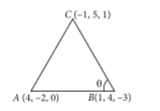
$\overrightarrow{A B}=-3 \hat{i}+6 \hat{j}-3 \hat{k}, \overrightarrow{B C}$
$=-2 \hat{i}+\hat{j}+4 \hat{k}, \overrightarrow{B A}$
$=3 \hat{i}-6 \hat{j}+3 \hat{k}$
$\overrightarrow{B A} \cdot \overrightarrow{B C}$
$=|\overrightarrow{B A}||\overrightarrow{B C}| \cos \theta$
$\Rightarrow-6-6+12$
$=\sqrt{54} \times \sqrt{21} \cos \theta$
$\Rightarrow \cos \theta=0 $
$\Rightarrow \theta=\pi / 2$ View full question & answer→MCQ 362 Marks
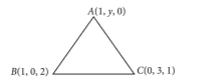
If the area of triangle with vertices $\hat{i}+y \hat{j}, \hat{i}+2 \hat{k}$ and $3 \hat{j}+\hat{k}$ is $\sqrt{6}$ sq. units, then the values of $y$ are
- A
$2,-4$
- ✓
$2,4$
- C
$-2,4$
- D
$3,4$
Answer$ \overrightarrow{A B}=(\hat{i}+2 \hat{k})-(\hat{i}+y \hat{j})$
$=-y \hat{j}+2 \hat{k}$
$B(1,0,2)$
$\overline{B C}=(3 \hat{j}+\hat{k})-(\hat{i}+2 \hat{k})$
$=-\hat{i}+3 \hat{j}-\hat{k}$
Area of $\triangle A B C=\frac{1}{2}|\overrightarrow{A B} \times \overrightarrow{B C}|$
$=\frac{1}{2}|(-y \hat{j}+2 \hat{k}) \times(-\hat{i}+3 \hat{j}-\hat{k})|$
$=\frac{1}{2}|-y \hat{k}+y \hat{i}-2 \hat{j}-6 \hat{i}|$
$=\frac{1}{2} \sqrt{(y-6)^2+2^2+y^2}$
Given that area of triangle $=\sqrt{6}$
So, $\sqrt{6}=\frac{1}{2} \sqrt{y^2-12 y+36+4+y^2}$
$\Rightarrow 2 y^2-12 y+40=24 $
$\Rightarrow y=2,4$
View full question & answer→MCQ 372 Marks
If $\vec{a}+2 \vec{b}+3 \vec{c}=\overrightarrow{0}$ and $(\vec{a} \times \vec{b})+(\vec{b} \times \vec{c})+(\vec{c} \times \vec{a})=\lambda(\vec{b} \times \vec{c})$, then $\lambda$ has the value
Answer$(\vec{a}+2 \vec{b}+3 \vec{c}) \times \vec{b}=\overrightarrow{0} \times \vec{b}$
$\Rightarrow \vec{a} \times \vec{b}+3(\vec{c} \times \vec{b})=\overrightarrow{0} \Rightarrow \vec{a} \times \vec{b}=3(\vec{b} \times \vec{c})$
Again, $(\vec{a}+2 \vec{b}+3 \vec{c}) \times \vec{a}=\overrightarrow{0} \times \vec{a}$
$\Rightarrow 2(\vec{b} \times \vec{a})+3(\vec{c} \times \vec{a})=\overrightarrow{0}$
$\Rightarrow \vec{c} \times \vec{a}=\frac{2}{3}(\vec{a} \times \vec{b})=2(\vec{b} \times \vec{c})$
So, $\vec{a} \times \vec{b}+\vec{b} \times \vec{c}+\vec{c} \times \vec{a}=6(\vec{b} \times \vec{c})$
Hence, $\lambda=6$.
View full question & answer→MCQ 382 Marks
If $\vec{a}$ and $\vec{b}$ are vectors such that $|\vec{a}|=3,|\vec{b}|=2$ and $\vec{a} \cdot \vec{b}=5,$ then $|\vec{a}-\vec{b}|=$
- A
$3$
- B
$5$
- C
$\sqrt{23}$
- ✓
$\sqrt{3}$
AnswerCorrect option: D. $\sqrt{3}$
Given that $|\vec{a}|=3,|\vec{b}|=2$ and $\vec{a} \cdot \vec{b}=5$
We know that, $|\vec{a}-\vec{b}|^2$
$=|\vec{a}|^2+|\vec{b}|^2-2 \vec{a} \cdot \vec{b}$
$=(3)^2+(2)^2-2 \times 5$
$=9+4-10=3$
$\Rightarrow |\vec{a}-\vec{b}|=\sqrt{3}$
View full question & answer→MCQ 392 Marks
The sum of the lengths of projections of $p \hat{i}+q \hat{j}+r \hat{k}$ on the co-ordinate axes, where $p=4$, $q=-5, r=7$ is
Answer(c) : Let $\vec{a}=p \hat{i}+q \hat{j}+r \hat{k}$
Projection of $\vec{a}$ on $X$-axis is given by $\frac{\vec{a} \cdot \hat{i}}{|\hat{i}|}$
$
=\frac{(p \hat{i}+q \hat{j}+r \hat{k}) \cdot \hat{i}}{1}=p=4
$
Similarly, projection of $\vec{a}$ on $Y$ and $Z$ axes are -5 and 7 respectively.
$
\begin{aligned}
\therefore \quad \text { Sum of these projections } & =|4|+|-5|+|7| \\
& =4+5+7=16 \text { units }
\end{aligned}
$
View full question & answer→MCQ 402 Marks
If angle between the vectors $\vec{a}=2 \lambda^2 \hat{i}+4 \lambda \hat{j}+\hat{k}$ and $\vec{b}=7 \hat{i}-2 \hat{j}+\lambda \hat{k}$ is obtuse, then the values of $\lambda$ is
- ✓
$\left(0, \frac{1}{2}\right)$
- B
$\left(\frac{1}{2}, \infty\right)$
- C
$(-\infty, 0)$
- D
$\left[0, \frac{1}{2}\right]$
AnswerCorrect option: A. $\left(0, \frac{1}{2}\right)$
Let $\theta$ be the angle between $\vec{a}$ and $\vec{b}$.
We know that, for obtuse angle $\theta, \cos \theta<0$
Also, $\vec{a} \cdot \vec{b}=|\vec{a}||\vec{b}| \cos \theta \quad$
i.e., $\cos \theta=\frac{\vec{a} \cdot \vec{b}}{|\vec{a}||\vec{b}|}<0$
$\Rightarrow \vec{a} \cdot \vec{b}<0 $
$\Rightarrow 14 \lambda^2-8 \lambda+\lambda<0$
$\Rightarrow 7 \lambda(2 \lambda-1)<0 $
$\Rightarrow 0<\lambda<\frac{1}{2}$
i.e. $\lambda \in\left(0, \frac{1}{2}\right)$
View full question & answer→MCQ 412 Marks
If $|\vec{a}|=5,|\vec{b}|=3,|\vec{c}|=4$ and $\vec{a}$ is perpendicular to $\vec{b}$ and $\vec{c}$ such that angle between $\vec{b}$ and $\vec{c}$ is $\frac{5 \pi}{6}$, then $[\vec{a} \vec{b} \vec{c}]=$
View full question & answer→MCQ 422 Marks
The position vector of a point that divides the line segment joining $P=(1,2,-1)$ and $Q=(-1,1,1)$ externally in the ratio $1: 2$, is
AnswerCorrect option: B. $3 \hat{i}+3 \hat{j}-3 \hat{k}$
The position vector of a point which divides joining of two points $P$ and $Q$ externally in the ratio $m: n$ is given by $\frac{m \vec{Q}-n \vec{P}}{m-n}$
Here $\vec{Q}=(-1,1,1), \vec{P}=(1,2,-1)$ and $m: n=1: 2$
$\therefore $ Position vector of the required point
$=\frac{-\hat{i}+\hat{j}+\hat{k}-2(\hat{i}+2 \hat{j}-\hat{k})}{1-2}$
$=\frac{-3 \hat{i}-3 \hat{j}+3 \hat{k}}{-1}$
$=3 \hat{i}+3 \hat{j}-3 \hat{k}$
View full question & answer→MCQ 432 Marks
Find the co-ordinates of the point which divides the join of the points $(2,-1,3)$ and $(4,3,1)$ in the ratio $3: 4$ internally.
- ✓
$\left(\frac{20}{7}, \frac{5}{7}, \frac{15}{7}\right)$
- B
$\left(\frac{13}{7}, \frac{12}{7}, \frac{5}{7}\right)$
- C
$\left(\frac{9}{7}, \frac{17}{7}, \frac{21}{7}\right)$
- D
$\left(\frac{11}{7}, \frac{30}{7}, \frac{2}{7}\right)(2020)$
AnswerCorrect option: A. $\left(\frac{20}{7}, \frac{5}{7}, \frac{15}{7}\right)$
(a) : Let the required point be $C(\vec{c})$.
i.e., $C$ divides $\overrightarrow{A B}$ in the ratio $3: 4$.
Let $\vec{a}=2 \hat{i}-\hat{j}+3 \hat{k}$ and $\vec{b}=4 \hat{i}+3 \hat{j}+\hat{k}$
Now, $\vec{c}=\frac{3 \vec{b}+4 \vec{a}}{3+4}=\frac{3(4 \hat{i}+3 \hat{j}+\hat{k})+4(2 \hat{i}-\hat{j}+3 \hat{k})}{7}$ $=\frac{20}{7} \hat{i}+\frac{5}{7} \hat{j}+\frac{15}{7} \hat{k}$
So, co-ordiantes of $C \equiv\left(\frac{20}{7}, \frac{5}{7}, \frac{15}{7}\right)$
19. (b) : The position vector of a point which divides joining of two points $P$ and $Q$ externally in the ratio $m: n$ is given by $\frac{m \vec{Q}-n \vec{P}}{m-n}$
Here $\vec{Q} \equiv(-1,1,1), \vec{P} \equiv(1,2,-1)$ and $m: n=1: 2$
$\therefore$ Position vector of the required point
$
\begin{aligned}
& =\frac{-\hat{i}+\hat{j}+\hat{k}-2(\hat{i}+2 \hat{j}-\hat{k})}{1-2}=\frac{-3 \hat{i}-3 \hat{j}+3 \hat{k}}{-1} \\
& =3 \hat{i}+3 \hat{j}-3 \hat{k}
\end{aligned}
$
View full question & answer→MCQ 442 Marks
The vectors $\vec{a}=x \hat{i}-2 \hat{j}+5 \hat{k}$ and $\vec{b}=\hat{i}+y \hat{j}-z \hat{k}$ are collinear, if
- A
$x=1, y=-2, z=-5$
- B
$x=1 / 2, y=-4, z=-10$
- C
$x=-1 / 2, y=4, z=10$
- ✓
Answer(d) : Since, $\vec{a}$ and $\vec{b}$ are collinear.
$
\therefore \quad \vec{a}=\lambda \vec{b} \Rightarrow(x \hat{i}-2 \hat{j}+5 \hat{k})=\lambda(\hat{i}+y \hat{j}-z \hat{k})
$
On comparing, we get $x=\lambda,-2=\lambda y$ and $5=-\lambda z$
For $\lambda=1$, we have $x=1, y=-2$ and $z=-5$
For $\lambda=1 / 2$, we have $x=1 / 2, y=-4$ and $z=-10$
For $\lambda=-1 / 2$, we have $x=-1 / 2, y=4$ and $z=10$
View full question & answer→MCQ 452 Marks
If the volume of the parallelopiped with coterminous edges $-p \hat{j}+5 \hat{k}, \hat{i}-\hat{j}+q \hat{k}$ and $3 \hat{i}-5 \hat{j}$ is 8 , then
- ✓
$3 p q+2=0$
- B
$3 p q-2=0$
- C
$p q+2=0$
- D
$p q-2=0$
AnswerCorrect option: A. $3 p q+2=0$
(a) : $\left|\begin{array}{lll}0 & -p & 5 \\ 1 & -1 & q \\ 3 & -5 & 0\end{array}\right|= \pm 8$
$
\begin{aligned}
& \Rightarrow p(0-3 q)+5(-5+3)= \pm 8 \Rightarrow-3 p q-10= \pm 8 \\
& \Rightarrow-3 p q-10=8 \text { or }-3 p q-10=-8 \\
& \Rightarrow 3 p q=-18 \text { or } 3 p q=-2 \\
& \Rightarrow 3 p q+18=0 \text { or } 3 p q+2=0
\end{aligned}
$
View full question & answer→MCQ 462 Marks
If $\vec{p}, \vec{q}$ and $\vec{r}$ are nonzero, noncoplanar vectors,
- A
$3[\vec{p} \vec{q} \vec{r}]$
- ✓
$[\vec{p} \vec{q} \vec{r}]$
- D
$2[\vec{p} \vec{q} \vec{r}]$
AnswerCorrect option: C. $[\vec{p} \vec{q} \vec{r}]$
(c) : We have, $[\vec{p}+\vec{q}-\vec{r} \vec{p}-\vec{q} \vec{q}-\vec{r}]$
$
\begin{aligned}
& =(\vec{p}+\vec{q}-\vec{r}) \cdot((\vec{p}-\vec{q}) \times(\vec{q}-\vec{r})) \\
& =(\vec{p}+\vec{q}-\vec{r}) \cdot(\vec{p} \times \vec{q}-\vec{p} \times \vec{r}+\vec{q} \times \vec{r}) \\
& =\vec{p} \cdot(\vec{q} \times \vec{r})-\vec{q} \cdot(\vec{p} \times \vec{r})-\vec{r} \cdot(\vec{p} \times \vec{q}) \\
& =[\vec{p} \vec{q} \vec{r}]-[\vec{q} \vec{p} \vec{r}]-[\vec{r} \vec{p} \vec{q}] \\
& =[\vec{p} \vec{q} \vec{r}]+[\vec{p} \vec{q} \vec{r}]-[\vec{p} \vec{q} \vec{r}]=[\vec{p} \vec{q} \vec{r}] .
\end{aligned}
$
View full question & answer→MCQ 472 Marks
If $\vec{a}+\vec{b}, \vec{b}+\vec{c}$ and $\vec{c}+\vec{a}$ are coterminous edges of a parallelepiped, then its volume is
- A
$3[\vec{a} \vec{c} \vec{b}]$
- ✓
$2[\vec{a} \vec{b} \vec{c}]$
- D
$4[\bar{b} \vec{a} \vec{c}]$
AnswerCorrect option: C. $2[\vec{a} \vec{b} \vec{c}]$
(c) : Required volume $=\left[\begin{array}{lll}\vec{a}+\vec{b} & \vec{b}+\vec{c} & \vec{c}+\vec{a}\end{array}\right]$
$
\begin{aligned}
& =(\vec{a}+\vec{b}) \cdot[(\vec{b}+\vec{c}) \times(\vec{c}+\vec{a})] \\
& =(\vec{a}+\vec{b}) \cdot[\vec{b} \times \vec{c}+\vec{b} \times \vec{a}+\vec{c} \times \vec{a}] \\
& =\vec{a} \cdot(\vec{b} \times \vec{c})+\vec{b} \cdot(\vec{c} \times \vec{a})=\left[\begin{array}{lll}
\vec{a} & \vec{b} & \vec{c}
\end{array}\right]+\left[\begin{array}{lll}
\vec{b} & \vec{c} & \vec{a}
\end{array}\right] \\
& =\left[\begin{array}{lll}
\vec{a} & \vec{b} & \vec{c}
\end{array}\right]+\left[\begin{array}{lll}
\vec{a} & \vec{b} & \vec{c}
\end{array}\right]=2\left[\begin{array}{lll}
\vec{a} & \vec{b} & \vec{c}
\end{array}\right] \\
&
\end{aligned}
$
View full question & answer→MCQ 482 Marks
If the vectors $x \hat{i}-3 \hat{j}+7 \hat{k}$ and $\hat{i}+y \hat{j}-z \hat{k}$ are collinear then the value of $\frac{x y^2}{z}$ is equal to
- A
$9 / 7$
- ✓
$-9 / 7$
- C
$-7 / 9$
- D
$7 / 9$
AnswerCorrect option: B. $-9 / 7$
(b) : Let $\vec{a}=x \hat{i}-3 \hat{j}+7 \hat{k}, \vec{b}=\hat{i}+y \hat{j}-z \hat{k}$
Since $\vec{a}$ and $\vec{b}$ are collinear.
$
\begin{aligned}
& \therefore \vec{a}=\lambda \vec{b} \Rightarrow x \hat{i}-3 \hat{j}+7 \hat{k}=\lambda(\hat{i}+y \hat{j}-z \hat{k}) \\
& \Rightarrow x \hat{i}-3 \hat{j}+7 \hat{k}=\lambda \hat{i}+\lambda y \hat{j}-\lambda z \hat{k}
\end{aligned}
$
$
\therefore x=\lambda,-3=\lambda y \Rightarrow y=\frac{-3}{\lambda}
$
and $7=-\lambda z \Rightarrow z=\frac{-7}{\lambda}$
So, $\frac{x y^2}{z}=\frac{\lambda \times\left(\frac{-3}{\lambda}\right)^2}{\left(\frac{-7}{\lambda}\right)}=\lambda \times \frac{9}{\lambda^2} \times \frac{\lambda}{(-7)}=\frac{-9}{7}$
View full question & answer→MCQ 492 Marks
Which of the following is NOT equal to $\vec{w} \cdot(\vec{u} \times \vec{v})$ ?
- A
$\vec{u} \cdot(\vec{v} \times \vec{w})$
- B
$\vec{v} \cdot(\vec{w} \times \vec{u})$
- C
$(\vec{u} \times \vec{v}) \cdot \vec{w}$
- ✓
$\vec{v} \cdot(\vec{u} \times \vec{w})$
AnswerCorrect option: D. $\vec{v} \cdot(\vec{u} \times \vec{w})$
(d) : Using properties of scalar triple product, we have
$
\begin{aligned}
& \vec{w} \cdot(\vec{u} \times \vec{v})=\vec{v} \cdot(\vec{w} \times \vec{u}) \\
&=\vec{u} \cdot(\vec{v} \times \vec{w}) \\
&=\vec{w} \cdot(\vec{u} \times \vec{v}) \\
&=(\vec{u} \times \vec{v}) \cdot \vec{w} \\
& \therefore \quad \vec{w} \cdot(\vec{u} \times \vec{v}) \neq \vec{v} \cdot(\vec{u} \times \vec{w})
\end{aligned}
$
(option (a))
(option (c))
$\therefore \vec{w} \cdot(\vec{u} \times \vec{v}) \neq \vec{v} \cdot(\vec{u} \times \vec{w})$
(option (d))
View full question & answer→MCQ 502 Marks
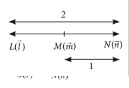
$L$ and $M$ are two points with position vectors $2 \vec{a}-\vec{b}$ and $\vec{a}+2 \vec{b}$ respectively. The position vector of the point $N$ which divides the line segment $L M$ in the ratio $2: 1$ externally is
- A
$3 \vec{b}$
- B
$4 \vec{b}$
- ✓
$5 \vec{b}$
- D
$3 \vec{a}+4 \hat{b}$
AnswerCorrect option: C. $5 \vec{b}$
(c) : $\therefore \vec{r}=\frac{2(\vec{m})-\vec{l}}{2-1}$
$
\Rightarrow \quad \vec{n}=2(\vec{a}+2 \vec{b})-(2 \vec{a}-\vec{b})
$
$
\Rightarrow \vec{n}=2 \vec{a}+4 \vec{b}-2 \vec{a}+\vec{b}=5 \vec{b}
$
View full question & answer→