MCQ 1512 Marks
$\hat{ i } \cdot(\hat{ j } \times \hat{ k })+\hat{ j } \cdot(\hat{ k } \times \hat{ i })+\hat{ k } \cdot(\hat{ i } \times \hat{ j })$ is equal to
Answer(D) $\hat{i} \cdot(\hat{j} \times \hat{k})+\hat{j} \cdot(\hat{k} \times \hat{i})+\hat{k} \cdot(\hat{i} \times \hat{j})$
$=\hat{i} \cdot \hat{i}+\hat{j} \cdot \hat{j}+\hat{k} \cdot \hat{k}=3$
View full question & answer→MCQ 1522 Marks
If $\bar{\alpha}=2 \hat{i}+3 \hat{j}-\hat{k}, \bar{\beta}=-\hat{i}+2 \hat{j}-4 \hat{k} $ and $\bar{\gamma}=\hat{ i }+\hat{ j }+\hat{ k }$, then $(\bar{\alpha} \times \bar{\beta}) \cdot(\bar{\alpha} \times \bar{\gamma})$ is equal to
Answer(D) $\bar{\alpha} \times \bar{\beta}=\left|\begin{array}{ccc}\hat{i} & \hat{j} & \hat{k} \\ 2 & 3 & -1 \\ -1 & 2 & -4\end{array}\right|=-10 \hat{i}+9 \hat{j}+7 \hat{k}$
and $\bar{\alpha} \times \bar{\gamma}=\left|\begin{array}{ccc}\hat{i} & \hat{j} & \hat{k} \\ 2 & 3 & -1 \\ 1 & 1 & 1\end{array}\right|=4 \hat{i}-3 \hat{j}-\hat{k}$
$\therefore (\bar{\alpha} \times \bar{\beta}) \cdot(\bar{\alpha} \times \bar{\gamma})=-40-27-7=-74$
View full question & answer→MCQ 1532 Marks
Let $\bar{x}=\hat{ i }+\hat{ j }$ and $\bar{y}=3 \hat{ i }-2 \hat{ k }$. Then the vector $\overline{ r }$ of magnitude $\sqrt{21}$ satisfying $\overline{ r } \times \bar{x}=\bar{y} \times \bar{x}$ and $\overline{ r } \times \bar{y}=\bar{x} \times \bar{y}$ is
- A
$-\hat{ i }+4 \hat{ j }-2 \hat{ k }$
- B
$-\hat{ i }-4 \hat{ j }-2 \hat{ k }$
- ✓
$4 \hat{i}+\hat{j}-2 \hat{k}$
- D
$4 \hat{i}-\hat{j}-2 \hat{k}$
AnswerCorrect option: C. $4 \hat{i}+\hat{j}-2 \hat{k}$
(C) Only option (C) satisfy the conditions $\overline{ r } \times \bar{x}=\bar{y} \times \bar{x}$ and $\overline{ r } \times \bar{y}=\bar{x} \times \bar{y}$
View full question & answer→MCQ 1542 Marks
Let $\overline{ u }=\hat{ i }+\hat{ j }, \overline{ v }=\hat{ i }-\hat{ j }$ and $\overline{ w }=\hat{ i }+2 \hat{ j }+3 \hat{ k }$. If $\hat{ n }$ is a unit vector such that $\overline{ u } \cdot \hat{ n }=0$ and $\overline{ v } \cdot \hat{ n }=0$, then $|\overline{ w } \cdot \hat{ n }|$ is equal to
Answer(A) We have, $\overline{ u } \cdot \hat{ n }=0$ and $\overline{ v } \cdot \hat{ n }=0$
$\therefore \quad \hat{ n } \perp \overline{ u }$ and $\hat{ n } \perp \overline{ v }$
$\Rightarrow \hat{n}= \pm \frac{\overline{u} \times \overline{v}}{|\overline{u} \times \overline{v}|}$
Now, $\bar{u} \times \bar{v}=(\hat{i}+\hat{j}) \times(\hat{i}-\hat{j})=-2 \hat{k}$
$\therefore \hat{ n }= \pm \hat{ k }$
$\text {Hence, }|\overline{ w } \cdot \hat{ n }|=|(\hat{ i }+2 \hat{ j }+3 \hat{ k }) \cdot( \pm \hat{ k })|=3$
View full question & answer→MCQ 1552 Marks
The number of vectors of unit length perpendicular to vectors $\overline{ a }=(1,1,0)$ and $\bar{b}=(0,1,1)$ is
Answer(C) The vector perpendicular to $\overline{ a }$ and $\overline{ b }$ is
$\overline{ a } \times \overline{ b }=\left|\begin{array}{ccc}\hat{ i } & \hat{ j } & \hat{ k } \\ 1 & 1 & 0 \\ 0 & 1 & 0\end{array}\right|=\hat{ i }-\hat{ j }+\hat{ k }$
Since the length of this vector is $\sqrt{3}$, the unit vector perpendicular to $\overline{ a }$ and $\overline{ b }$ is $\pm \frac{\overline{ a } \times \overline{ b }}{|\overline{ a } \times \overline{ b }|}= \pm \frac{1}{\sqrt{3}}(\hat{ i }-\hat{ j }+\hat{ k })$
Hence, there are two such vectors.
View full question & answer→MCQ 1562 Marks
If $A (-1,2,3), B (1,1,1)$ and $C (2,-1,3)$ are points on a plane. The unit normal vectors to the plane $A B C$ is
- ✓
$\pm\left(\frac{2 \hat{i}+2 \hat{j}+\hat{k}}{3}\right)$
- B
$\pm\left(\frac{2 \hat{i}-2 \hat{j}+\hat{k}}{3}\right)$
- C
$\pm\left(\frac{2 \hat{i}-2 \hat{j}-\hat{k}}{3}\right)$
- D
$-\left(\frac{2 \hat{i}+2 \hat{j}+\hat{k}}{6}\right)$
AnswerCorrect option: A. $\pm\left(\frac{2 \hat{i}+2 \hat{j}+\hat{k}}{3}\right)$
(A) $\overline{ AB }=2 \hat{ i }-\hat{ j }-2 \hat{ k }, \quad \overline{ AC }=3 \hat{ i }-3 \hat{ j }+0 \hat{ k }$
$\Rightarrow \overline{ AB } \times \overline{ AC }=\left|\begin{array}{ccc}\hat{ i } & \hat{ j } & \hat{ k } \\ 2 & -1 & -2 \\ 3 & -3 & 0\end{array}\right|$
$=(-6 \hat{ i }-6 \hat{ j }-3 \hat{ k })$
∴ Unit vectors $= \pm\left(\frac{2 \hat{i}+2 \hat{j}+\hat{k}}{3}\right)$
View full question & answer→MCQ 1572 Marks
Let $A =(\alpha, 1,2 \alpha)$, $B=(3,1,2)$ and $\overline{ C }=4 \hat{ i }-\hat{ j }+3 \hat{ k }$. If $\overline{ AB } \times \overline{ C }$ $=6 \hat{ i }+9 \hat{ j }-5 \hat{ k }$, then $\alpha^2+\alpha+5=$
Answer(B) $\overline{ AB }=(3-\alpha) \hat{ i }+0 \hat{ j }+(2-2 \alpha) \hat{ k }$
$\overline{ AB } \times \overline{ C }=\left|\begin{array}{ccc}\hat{ i } & \hat{ j } & \hat{ k } \\ 3-\alpha & 0 & 2-2 \alpha \\ 4 & -1 & 3\end{array}\right|$
$=(2-2 \alpha) \hat{ i }-(5 \alpha+1) \hat{ j }+(\alpha-3) \hat{ k }$
$\overline{ AB } \times \overline{ C }=6 \hat{ i }+9 \hat{ j }-5 \hat{ k }$
$\therefore \quad(2-2 \alpha) \hat{ i }-(5 \alpha+1) \hat{ j }+(\alpha-3) \hat{ k }=6 \hat{ i }+9 \hat{ j }-5 \hat{ k }$
$\begin{aligned} & \Rightarrow \alpha-3=-5 \Rightarrow \alpha=-2 \\ \therefore & \alpha^2+\alpha+5=7\end{aligned}$
View full question & answer→MCQ 1582 Marks
If $\bar{a}=2 \hat{i}+3 \hat{j}-5 \hat{k}, \bar{b}=m \hat{i}+n \hat{j}+12 \hat{k}$ and $\bar{a} \times \bar{b}=0$ then $(m, n)=$
- ✓
$\left(\frac{-24}{5}, \frac{-36}{5}\right)$
- B
$\left(\frac{-24}{5}, \frac{36}{5}\right)$
- C
$\left(\frac{24}{5}, \frac{-36}{5}\right)$
- D
$\left(\frac{24}{5}, \frac{36}{5}\right)$
AnswerCorrect option: A. $\left(\frac{-24}{5}, \frac{-36}{5}\right)$
(A) Given that $\overline{ a } \times \overline{ b }=0$
$\therefore \quad \overline{ a } \| \overline{ b }$
$\begin{array}{l}\Rightarrow \frac{2}{m}=\frac{3}{n}=\frac{-5}{12} \\ \Rightarrow m=\frac{-24}{5} \text { and } n=\frac{-36}{5}\end{array}$
View full question & answer→MCQ 1592 Marks
If $\overline{ a } \times \overline{ b }=\overline{ b } \times \overline{ c } \neq 0$, then for any scalar $\lambda$,
- A
$\overline{ a }-\overline{ b }=\lambda(\overline{ c }-\overline{ b })$
- B
$\overline{ b }+\overline{ c }=\lambda \overline{ a }$
- C
$\overline{ a }+\overline{ b }=\lambda \overline{ c }$
- ✓
$\bar{a}+\bar{c}=\lambda \bar{b}$
AnswerCorrect option: D. $\bar{a}+\bar{c}=\lambda \bar{b}$
(D) Given, $\overline{ a } \times \overline{ b }=\overline{ b } \times \overline{ c }$
$\Rightarrow \overline{ a } \times \overline{ b }=-(\overline{ c } \times \overline{ b }) \\ \Rightarrow \overline{ a } \times \overline{ b }+\overline{ c } \times \overline{ b }=\overline{0} \\ \Rightarrow(\overline{ a }+\overline{ c }) \times \overline{ b }=\overline{0} \\ \Rightarrow \overline{ a }+\overline{ c }=\lambda \overline{ b }$
View full question & answer→MCQ 1602 Marks
If ABC is an equilateral triangle of side a , then the value of $\overline{ AB } \cdot \overline{ BC }+\overline{ BC } \cdot \overline{ CA }+\overline{ CA } \cdot \overline{ AB }$ is equal to
- A
$\frac{3 a ^2}{2}$
- B
$3 a^2$
- ✓
$-\frac{3 a ^2}{2}$
- D
$-3 a^2$
AnswerCorrect option: C. $-\frac{3 a ^2}{2}$
(C) We have,
$\overline{ AB }+\overline{ BC }+\overline{ CA }=\overline{0}$
$\Rightarrow|\overline{ AB }+\overline{ BC }+\overline{ CA }|^2=0$
$\Rightarrow |\overline{ AB }|^2+|\overline{ BC }|^2+|\overline{ CA }|^2$
$+2(\overline{ AB } \cdot \overline{ BC }+\overline{ BC } \cdot \overline{ CA }+\overline{ CA } \cdot \overline{ AB })=0$
$\Rightarrow \overline{ AB } \cdot \overline{ BC }+\overline{ BC } \cdot \overline{ CA }+\overline{ CA } \cdot \overline{ AB }=-\frac{3 a ^2}{2}$
View full question & answer→MCQ 1612 Marks
If in a right angled triangle ABC , the hypotenuse $AB = p$, Then $\overline{ AB } \cdot \overline{ AC }+\overline{ BC } \cdot \overline{ BA }+\overline{ CA } \cdot \overline{ CB }$ is equal to
- A
$3 p^2$
- B
$\frac{3 p ^2}{2}$
- ✓
$p ^2$
- D
$\frac{ p ^2}{2}$
AnswerCorrect option: C. $p ^2$
(C)
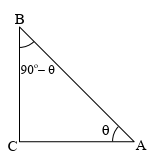
$\overline{ AB } \cdot \overline{ AC }+\overline{ BC } \cdot \overline{ BA }+\overline{ CA } \cdot \overline{ CB }$
$\begin{array}{l}=( AB )( AC ) \cos \theta+( BC )( BA ) \cos \left(90^{\circ}-\theta\right)+0 \\ = AB ( AC \cos \theta+ BC \sin \theta)\end{array}$
$= AB \left(\frac{( AC )^2}{ AB }+\frac{( BC )^2}{ AB }\right)$
$\begin{array}{l}= AC ^2+ BC ^2 \\ = AB ^2= p ^2\end{array}$ View full question & answer→MCQ 1622 Marks
The values of ' $a$ ' for which the points $A, B, C$ with position vectors $2 \hat{i}-\hat{j}+\hat{k}, \hat{i}-3 \hat{j}-5 \hat{k}$ and $a\hat{i}-3 \hat{j}+\hat{k}$ respectively are the vertices of a right angled triangle with $C =\pi / 2$ are
- ✓
- B
$-2 and -1$
- C
$-2 and 1$
- D
Answer(A) Given,
$\overline{ AB }=-\hat{ i }-2 \hat{ j }-6 \hat{ k }, \overline{ BC }=( a -1) \hat{ i }+6 \hat{ k }$ and $\overline{ CA }=(2- a ) \hat{ i }+2 \hat{ j }$
It is given that $\triangle ABC$ is right angled at C .
$\therefore \quad \overline{ CB } \cdot \overline{ CA }=0$
$\begin{array}{l}\Rightarrow((1-a) \hat{i}-6 \hat{k}) \cdot((2-a) \hat{i}+2 \hat{j})=0 \\ \Rightarrow(1-a)(2-a)=0 \\ \Rightarrow a=1,2\end{array}$
View full question & answer→MCQ 1632 Marks
A vector of magnitude 4 which is equally inclined to the vector $\hat{i}+\hat{j}, \hat{j}+\hat{k}$ and $\hat{k}+\hat{i}$ is
- A
$\pm \frac{4}{\sqrt{3}}(\hat{ i }-\hat{ j }-\hat{ k })$
- B
$\pm \frac{4}{\sqrt{3}}(\hat{i}+\hat{j}-\hat{k})$
- ✓
$\pm \frac{4}{\sqrt{3}}(\hat{ i }+\hat{ j }+\hat{ k })$
- D
AnswerCorrect option: C. $\pm \frac{4}{\sqrt{3}}(\hat{ i }+\hat{ j }+\hat{ k })$
(C) Let the required vector be $\overline{ r }=x \hat{ i }+y \hat{ j }+z \hat{ k }$.
Then, $|\overline{ r }|=4$
$\Rightarrow x^2+y^2+z^2=16$ ...(i)
Now, $\bar{r}$ is equally inclined to the vectors $\hat{i}+\hat{j}, \hat{j}+\hat{k}$ and $\hat{k}+\hat{i}$.
$\therefore \quad \frac{\overline{ r } \cdot(\hat{ i }+\hat{ j })}{|\overrightarrow{ r }| \sqrt{2}}=\frac{\overline{ r } \cdot(\hat{ j }+\hat{ k })}{|\overline{ r }| \sqrt{2}}=\frac{\overline{ r } \cdot(\hat{ k }+\hat{ i })}{|\overline{ r }| \sqrt{2}}$
$\begin{array}{l}\Rightarrow x+y=y+z=z+x=\lambda(\text { say }) \\ \Rightarrow 2(x+y+z)=3 \lambda \\ \Rightarrow x+y+z=\frac{3 \lambda}{2}\end{array}$
Now, $x+y=\lambda$ and $x+y+z=\frac{3 \lambda}{2}$
$\Rightarrow z=\frac{\lambda}{2}$
Similarly, we have $x=y=\frac{\lambda}{2}$
Substituting these values in (i), we get $\lambda= \pm \frac{8}{\sqrt{3}}$
Hence, $\bar{r}= \pm \frac{8}{2 \sqrt{3}}(\hat{i}+\hat{j}+\hat{k})= \pm \frac{4}{\sqrt{3}}(\hat{i}+\hat{j}+\hat{k})$
View full question & answer→MCQ 1642 Marks
If the angle between $\bar{a}$ and $\bar{b}$ is $\frac{2 \pi}{3}$ and the projection of $\bar{a}$ in the direction of $\overline{ b }$ is -2 , then $|\overline{a}|=$
Answer(C) $\frac{\overline{ a \cdot} \overline{ b }}{|\overline{ b }|}=-2$
$\Rightarrow \frac{|\overline{ a }||\overline{ b }| \cos \theta}{|\overline{ b }|}=-2$
$\Rightarrow|\overline{ a }| \cos \frac{2 \pi}{3}=-2$
$\Rightarrow|\overline{ a }|\left(-\frac{1}{2}\right)=-2$
$\Rightarrow|\overline{ a }|=4$
View full question & answer→MCQ 1652 Marks
For $A (1,-2,4), B (5,-1,7), C (3,6,-2), D(4,5,-1)$, the projection of $\overline{A B}$ on $\overline{C D}$ is __________.
AnswerCorrect option: D. $(2,-2,2)$
(D) $\overline{A B}=4 \hat{i}+\hat{j}+3 \hat{k}, \overline{C D}=\hat{i}-\hat{j}+\hat{k}$
Projection of $\overline{ AB }$ on $\overline{ CD }=\left(\frac{\overline{ AB } \cdot \overline{ CD }}{|\overline{ CD }|}\right) \cdot \hat{ c }$ $\ldots[\hat{ c }$ is unit vector along $\overline{ CD }]$
$=\left(\frac{4-1+3}{\sqrt{3}}\right)\left(\frac{\hat{i}-\hat{j}+\hat{k}}{\sqrt{3}}\right)=2 \hat{i}-2 \hat{j}+2 \hat{k}$
View full question & answer→MCQ 1662 Marks
Let $\bar{a}, \bar{b}, \bar{c}$ be three unit vectors such that $|\overline{ a }+\overline{ b }+\overline{ c }|=1$ and $\overline{ a } \perp \overline{ b }$. If $\overline{ c }$ makes angles $\delta, \beta$ with $\overline{ a }, \overline{ b }$ respectively, then $\cos \delta+\cos \beta$ is equal to
Answer(B) Since $\bar{a} \perp \bar{b}$
$\therefore \quad \overline{ a } \cdot \overline{ b }=0$
Also, $\overline{ c } \cdot \overline{ a }=\cos \delta$ and $\overline{ c } \cdot \overline{ b }=\cos \beta$
Now, $|\overline{ a }+\overline{ b }+\overline{ c }|=1$
$\Rightarrow|\overline{ a }+\overline{ b }+\overline{ c }|^2=1$
$\begin{array}{l}\Rightarrow|\overline{ a }|^2+|\overline{ b }|^2+|\overline{ c }|^2+2(\overline{ a } \cdot \overline{ b }+\overline{ b } \cdot \overline{ c }+\overline{ c } \cdot \overline{ a })=1 \\ \Rightarrow 1+1+1+2(\cos \delta+\cos \beta)=1 \\ \Rightarrow \cos \delta+\cos \beta=-1\end{array}$
View full question & answer→MCQ 1672 Marks
Each of the angle between the vectors $\overline{ a }, \overline{ b }$ and $\overline{ c }$ is equal to $60^{\circ}$. If $|\overline{ a }|=4,|\overline{b}|=2$ and $|\overline{ c }|$ $=6$, then $|\overline{ a }+\overline{ b }+\overline{ c }|=$
Answer(A) $(\overline{ a }+\overline{ b }+\overline{ c })^2=|\overline{ a }|^2+|\overline{ b }|^2+|\overline{ c }|^2+2(\overline{ a } \cdot \overline{ b }+\overline{ b } \cdot \overline{ c }+\overline{ c } \cdot \overline{ a })$
$=|\overline{ a }|^2+|\overline{ b }|^2+|\overline{ c }|^2$ $+2(|\overline{ a }||\overline{ b }| \cos \theta+|\overline{ b }||\overline{ c }| \cos \theta+|\overline{ c }||\overline{ a }| \cos \theta)$
$\begin{array}{l}=16+4+36+2(4+6+12) \\ =100\end{array}$
$\therefore|\overline{ a }+\overline{ b }+\overline{ c }|=10$
View full question & answer→MCQ 1682 Marks
Let $\overline{ a }, \overline{ b }, \overline{ c }$ be three vectors such that $\bar{a} \perp(\bar{b}+\bar{c}), \bar{b} \perp(\bar{c}+\bar{a})$ and $\bar{c} \perp(\bar{a}+\bar{b})$.
If $|\overline{ a }|=1,|\overline{b}|=2,|\overline{ c }|=3$, then $|\overline{ a }+\overline{ b }+\overline{ c }|$ is
- A
$\sqrt{6}$
- B
- ✓
$\sqrt{14}$
- D
AnswerCorrect option: C. $\sqrt{14}$
(C) Given, $\bar{a} \perp(\bar{b}+\bar{c}), \bar{b} \perp(\bar{c}+\bar{a})$ and $\bar{c} \perp(\bar{a}+\bar{b})$
$\begin{array}{l}\Rightarrow \overline{ a } \cdot \overline{ b }+\overline{ a } \cdot \overline{ c }=0, \overline{b} \cdot \overline{ c }+\overline{ b } \cdot \overline{ a }=0, \overline{ c } \cdot \overline{ a }+\overline{ c } \cdot \overline{ b }=0 \\ \Rightarrow \overline{ a } \cdot \overline{ b }+\overline{ b } \cdot \overline{ c }+\overline{ c } \cdot \overline{ a }=0\end{array}$
Now, $|\overline{ a }+\overline{ b }+\overline{ c }|^2=|\overline{ a }|^2+|\overline{ b }|^2+|\overline{ c }|^2$ $+2(\overline{ a } \cdot \overline{ b }+\overline{ b } \cdot \overline{ c }+\overline{ c } \cdot \overline{ a })$
$\begin{array}{l}\Rightarrow|\overline{ a }+\overline{ b }+\overline{ c }|^2=1+4+9=14 \\ \Rightarrow|\overline{ a }+\overline{ b }+\overline{ c }|=\sqrt{14}\end{array}$
View full question & answer→MCQ 1692 Marks
If two out of three vectors $\bar{a}, \bar{b}, \bar{c}$ are unit vectors such that $\bar{a}+\bar{b}+\bar{c}=\overline{0}$ and $2(\bar{a} \cdot \bar{b}+\bar{b} \cdot \bar{c}+\bar{c} \cdot \bar{a})$, then the length of the third vector is
Answer(C) Let $|\overline{ a }|=1$ and $|\overline{ b }|=1$
Given, $\bar{a}+\bar{b}+\bar{c}=\overline{0}$
$\begin{array}{l}\Rightarrow|\overline{ a }+\overline{ b }+\overline{ c }|^2=0 \\ \Rightarrow|\overline{ a }|^2+|\overline{ b }|^2+|\overline{ c }|^2+2(\overline{ a } \cdot \overline{ b }+\overline{ b } \cdot \overline{ c }+\overline{ c } \cdot \overline{ a })=0 \\ \Rightarrow 1+1+|\overline{ c }|^2-3=0 \Rightarrow|\overline{ c }|^2=1\end{array}$
View full question & answer→MCQ 1702 Marks
Let $\overline{ a }, \overline{ b }$ and $\overline{ c }$ be vectors with magnitudes 3, 4 and 5 respectively and $\bar{a}+\bar{b}+\bar{c}=0$, then the values of $\bar{a} \cdot \bar{b}+\bar{b} \cdot \bar{c}+\bar{c} \cdot \bar{a}$ is
Answer(D) We have, $\bar{a}+\bar{b}+\bar{c}=0$
Squaring both sides, we get
$|\overline{ a }|^2+|\overline{ b }|^2+|\overline{ c }|^2+2(\overline{ a } \cdot \overline{ b }+\overline{ b } \cdot \overline{ c }+\overline{ c } \cdot \overline{ a })=0$
$\begin{array}{l}\Rightarrow 2(\bar{a} \cdot \bar{b}+\bar{b} \cdot \bar{c}+\bar{c} \cdot \bar{a})=-(9+16+25) \\ \Rightarrow \bar{a} \cdot \bar{b}+\bar{b} \cdot \bar{c}+\bar{c} \cdot \bar{a}=-25\end{array}$
View full question & answer→MCQ 1712 Marks
If $\bar{a}, \bar{b}, \bar{c}$ are unit vectors such that $\bar{a}+\bar{b}+\bar{c}=\overline{0}$, then $\bar{a} \cdot \bar{b}+\bar{b} \cdot \bar{c}+\bar{c} \cdot \bar{a}=$
- A
- B
- ✓
$-\frac{3}{2}$
- D
$\frac{3}{2}$
AnswerCorrect option: C. $-\frac{3}{2}$
(C) Squaring $(\bar{a}+\bar{b}+\bar{c})=\overline{0}$, we get
$|\overline{ a }|^2+|\overline{ b }|^2+|\overline{ c }|^2+2(\overline{ a } \cdot \overline{ b }+\overline{ b } \cdot \overline{ c }+\overline{ c } \cdot \overline{ a })=0$
$\begin{array}{l}\Rightarrow 2(\overline{ a } \cdot \overline{ b }+\overline{ b } \cdot \overline{ c }+\overline{ c } \cdot \overline{ a })=-3 \\ \Rightarrow \overline{ a } \cdot \overline{ b }+\overline{ b } \cdot \overline{ c }+\overline{ c } \cdot \overline{ a }=-\frac{3}{2}\end{array}$
View full question & answer→MCQ 1722 Marks
If $\bar{a}+\bar{b}+\bar{c}=\overline{0}$, then the angle $\theta$ between $\bar{b}$ and $\bar{c}$ is given by
- ✓
$\cos \theta=\frac{a^2-b^2-c^2}{2 b c}$
- B
$\cos \theta=\frac{b^2+c^2-a^2}{2 b c}$
- C
$\cos \theta=\frac{a^2+b^2-c^2}{2 a b}$
- D
$\cos \theta=\frac{a^2-b^2+c^2}{2 a b}$
AnswerCorrect option: A. $\cos \theta=\frac{a^2-b^2-c^2}{2 b c}$
(A) $\bar{a}+\bar{b}+\bar{c}=\overline{0}$
${l}\Rightarrow \overline{ b }+\overline{ c }=-\overline{ a } \\ \Rightarrow|\overline{ b }+\overline{ c }|=|-\overline{ a }| \\ \Rightarrow|\overline{ b }+\overline{ c }|^2=|-\overline{ a }|^2$
$\Rightarrow(\overline{ b }+\overline{ c }) \cdot(\overline{ b }+\overline{ c })=|-\overline{ a }|^2 \\ \Rightarrow b^2+ c ^2+2 \overline{b} \cdot \overline{ c }= a ^2 \\ \Rightarrow b^2+ c ^2+2 bc \cos \theta= a ^2$
$\Rightarrow \cos \theta=\frac{a^2-b^2-c^2}{2 b c}$
View full question & answer→MCQ 1732 Marks
If $|\bar{a}+\bar{b}|>|\bar{a}-\bar{b}|$, then the angle between $\bar{a}$ and $\bar{b}$ is
Answer(A) $|\overline{ a }+\overline{ b }|>|\overline{ a }-\overline{ b }|$
Squaring both sides, we get
$\overline{ a }^2+\overline{ b }^2+2 \overline{ a } \cdot \overline{ b }>\overline{ a }^2+\overline{ b }^2-2 \overline{ a } \cdot \overline{ b }$
$\begin{array}{l}\Rightarrow 4 \overline{ a } \cdot \overline{ b }>0 \\ \Rightarrow \cos \theta>0\end{array}$
Hence, $\theta<90^{\circ}$ (acute).
View full question & answer→MCQ 1742 Marks
If $\theta$ is the angle between the unit vectors $\overline{ a }$ and $\overline{ b }$, then $\cos \frac{\theta}{2}=$
- A
$\frac{1}{2}|\overline{ a }-\overline{ b }|$
- ✓
$\frac{1}{2}|\bar{a}+\bar{b}|$
- C
$\frac{|\overline{ a }-\overline{ b }|}{|\overline{ a }+\overline{ b }|}$
- D
$\frac{|\bar{a}+\bar{b}|}{|\bar{a}-\bar{b}|}$
AnswerCorrect option: B. $\frac{1}{2}|\bar{a}+\bar{b}|$
(B) $(\overline{ a }+\overline{ b }) \cdot(\overline{ a }+\overline{ b })=|\overline{ a }|^2+|\overline{ b }|^2+2 \overline{ a } \cdot \overline{ b }$
$\Rightarrow|\bar{a}+\bar{b}|^2=2.2 \cos ^2 \frac{\theta}{2}$
$\Rightarrow \cos \frac{\theta}{2}=\frac{1}{2}|\overline{ a }+\overline{ b }|$
View full question & answer→MCQ 1752 Marks
If $\bar{a}$ and $\bar{b}$ be two unit vectors and $\theta$ is the angle between them, then $|\overline{ a }-\overline{ b }|$ is equal to
- A
$\sin \left(\frac{\theta}{2}\right)$
- ✓
$2 \sin \left(\frac{\theta}{2}\right)$
- C
$\cos \left(\frac{\theta}{2}\right)$
- D
$2 \cos \left(\frac{\theta}{2}\right)$
AnswerCorrect option: B. $2 \sin \left(\frac{\theta}{2}\right)$
(B) $|\overline{ a }-\overline{ b }|^2=(\overline{ a }-\overline{ b }) \cdot(\overline{ a }-\overline{ b })$
$=\bar{a} \cdot \bar{a}-\bar{a} \cdot \bar{b}-b \cdot \bar{a}+\bar{b} \cdot \bar{b}$
$=1-2 \overline{ a } \cdot \overline{ b }+1$ $\ldots[\because|\overline{ a }|=|\overline{ b }|=1]$
$=2-2 \cdot 1 \cdot 1 \cdot \cos \theta=2(1-\cos \theta)$
$=2\left(2 \sin ^2 \frac{\theta}{2}\right)$
$=4 \sin ^2 \frac{\theta}{2}$
$\therefore|\overline{ a }-\overline{ b }|=2 \sin \frac{\theta}{2}$
View full question & answer→MCQ 1762 Marks
If $|\bar{a}|=3,|\bar{b}|=4$ and the angle between $\bar{a}$ and $\overline{ b }$ is $120^{\circ}$, then $|4 \overline{ a }+3 \overline{b}|$ is equal to
Answer(D) $|4 \overline{ a }+3 \overline{b}|^2=16|\overline{ a }|^2+9|\overline{b}|^2+24|\overline{ a }||\overline{ b }| \cos 120^{\circ}$
$=144+144+288\left(\frac{-1}{2}\right)$
$=144$
$\Rightarrow|4 \overline{ a }+3 \overline{b}|=12$
View full question & answer→MCQ 1772 Marks
If three vectors $\bar{a}, \bar{b}, \bar{c}$ satisfy $\bar{a}+\bar{b}+\bar{c}=0$ and $|\overline{ a }|=3,|\overline{b}|=5,|\overline{ c }|=7$, then the angle between $\bar{a}$ and $\bar{b}$ is
- A
$\frac{2 \pi}{3}$
- B
$\frac{\pi}{6}$
- ✓
$\frac{\pi}{3}$
- D
$\frac{5 \pi}{6}$
AnswerCorrect option: C. $\frac{\pi}{3}$
(C) Given, $\overline{ a }+\overline{ b }+\overline{ c }=\overline{0}$
$\Rightarrow \overline{ a }+\overline{ b }=-\overline{ c }$
Squaring on both sides, we get
$|\overline{ a }|^2+|\overline{ b }|^2+2|\overline{ a }||\overline{ b }| \cos \theta=|-\overline{ c }|^2$
$\Rightarrow 9+25+30 \cos \theta=49$
$\Rightarrow \cos \theta=\frac{1}{2}$
$\Rightarrow \theta=\frac{\pi}{3}$
View full question & answer→MCQ 1782 Marks
Angle between vectors $\bar{a}$ and $\bar{b}$, where $\bar{a}, \bar{b}$ and $\overline{ c }$ are unit vectors satisfying $\bar{a}+\bar{b}+\sqrt{3} \bar{c}=\overline{0}$, is
- A
$\frac{\pi}{6}$
- B
$\frac{\pi}{4}$
- ✓
$\frac{\pi}{3}$
- D
$\frac{\pi}{2}$
AnswerCorrect option: C. $\frac{\pi}{3}$
(C) Given,
$\overline{ a }+\overline{ b }+\sqrt{3} \overline{ c }=\overline{0}$
$\Rightarrow \overline{ a }+\overline{ b }=-\sqrt{3} \overline{ c } \\ \Rightarrow|\overline{ a }+\overline{ b }|=\sqrt{3}|\overline{ c }| \\ \Rightarrow|\overline{ a }+\overline{ b }|^2=3|\overline{ c }|^2 \\ \Rightarrow|\overline{ a }|^2+|\overline{ b }|^2+2|\overline{ a }||\overline{ b }| \cos \theta=3|\overline{ c }|^2$
where $\theta$ is the angle between $\overline{ a }$ and $\overline{ b }$
$\Rightarrow 1+1+2 \cos \theta=3$
$\Rightarrow \cos \theta=\frac{1}{2}$
$\Rightarrow \theta=\frac{\pi}{3}$
View full question & answer→MCQ 1792 Marks
If $\bar{a}$ and $\bar{b}$ are unit vectors, then what is the angle between $\overline{ a }$ and $\overline{ b }$ for $\sqrt{3} \overline{ a }-\overline{ b }$ to be a unit vector?
- ✓
$30^{\circ}$
- B
$45^{\circ}$
- C
$60^{\circ}$
- D
$90^{\circ}$
AnswerCorrect option: A. $30^{\circ}$
(A) $|\overline{ a }|=|\overline{ b }|=1$
and $|\sqrt{3} \overline{ a }-\overline{ b }|=1$
$\begin{array}{l}\Rightarrow|\sqrt{3} \bar{a}-\bar{b}|^2=1^2 \\ \Rightarrow 3|\bar{a}|^2+|\bar{b}|^2-2 \sqrt{3}|\bar{a}||\bar{b}| \cos \theta=1\end{array}$
$\Rightarrow \cos \theta=\frac{\sqrt{3}}{2}$
$\Rightarrow \theta=30^{\circ}$
View full question & answer→MCQ 1802 Marks
$\bar{a}$ and $\bar{b}$ are unit vectors. If $\bar{a}+\bar{b}$ is a unit vector, then the angle between $\overline{ a }$ and $\overline{ b }$ is
- A
$\frac{\pi}{4}$
- B
$\frac{\pi}{3}$
- ✓
$\frac{2 \pi}{3}$
- D
$\frac{3 \pi}{2}$
AnswerCorrect option: C. $\frac{2 \pi}{3}$
(C) $|\overline{ a }+\overline{ b }|=1$
$\Rightarrow|\overline{ a }+\overline{ b }|^2=1$
$\Rightarrow(\overline{ a }+\overline{ b }) \cdot(\overline{ a }+\overline{ b })=1 \\ \Rightarrow \overline{ a } \cdot \overline{ a }+2 \overline{ a } \cdot \overline{ b }+\overline{ b } \cdot \overline{ b }=1 \\ \Rightarrow 1+2 ab \cos \theta+1=1 \\ \Rightarrow 2 \times 1 \times 1 \times \cos \theta=-1 \\ \Rightarrow \cos \theta=-\frac{1}{2} \\ \Rightarrow \theta=\frac{2 \pi}{3}$
View full question & answer→MCQ 1812 Marks
If the magnitude of $\bar{a}, \bar{b}$ and $\bar{a}+\bar{b}$ are respectively 3,4 and 5, then the magnitude of $(\bar{a}-\bar{b})$ is
Answer(D) $|\overline{ a }+\overline{ b }|^2+|\overline{ a }-\overline{ b }|^2=2|\overline{ a }|^2+2|\overline{b}|^2$
$\begin{array}{l}\Rightarrow 5^2+|\bar{a}-\bar{b}|^2=2(3)^2+2(4)^2 \\ \Rightarrow|\bar{a}-\bar{b}|^2=25 \\ \Rightarrow|\bar{a}-\bar{b}|=5\end{array}$
View full question & answer→MCQ 1822 Marks
Let $\overline{a}=\hat{i}-2 \hat{j}+3 \hat{k}$. If $\bar{b}$ is a vector such that $\overline{ a } \cdot \overline{ b }=|\overline{ b }|^2$ and $|\overline{ a }-\overline{ b }|=\sqrt{7}$, then $|\overline{ b }|=$
- ✓
$\sqrt{7}$
- B
$7$
- C
$21$
- D
$14$
AnswerCorrect option: A. $\sqrt{7}$
(A) $\overline{ a }=\hat{ i }-2 \hat{ j }+3 \hat{ k } \Rightarrow|\overline{ a }|=\sqrt{14}$
$|\overline{ a }-\overline{ b }|=\sqrt{7}$
$\therefore|\overline{ a }-\overline{ b }|^2=7$
$\Rightarrow|\overline{ a }|^2+|\overline{ b }|^2-2 \overline{ a } \cdot \overline{ b }=7$
$\Rightarrow 14+|\overline{ b }|^2-2|\overline{b}|^2=7$ $\ldots\left[\because \overline{ a } \cdot \overline{ b }=|\overline{ b }|^2\right]$
$\Rightarrow|\overline{ b }|^2=7$
$\Rightarrow|\overline{ b }|=\sqrt{7}$
View full question & answer→MCQ 1832 Marks
If $\bar{a}, \bar{b}, \bar{c}$ are three vectors such that $\bar{c}=\bar{a}+\bar{b}$ and $\overline{ a } \cdot \overline{ b }=0$, then
- A
$a^2+b^2+c^2=0$
- B
$a^2-b^2=0$
- ✓
$a^2+b^2=c^2$
- D
$a^2-b^2=c^2$
AnswerCorrect option: C. $a^2+b^2=c^2$
(C) $\overline{ c }=\overline{ a }+\overline{ b }$
$\Rightarrow|\overline{ c }|=|\overline{ a }+\overline{ b }|$
$\Rightarrow|\overline{ c }|^2=|\overline{ a }+\overline{ b }|^2=(\overline{ a }+\overline{ b }) \cdot(\overline{ a }+\overline{ b })$
$\Rightarrow c ^2= a ^2+ b ^2+2 \overline{ a } \cdot \overline{ b }= a ^2+ b ^2$ $\ldots[\because \overline{ a } \cdot \overline{ b }=0]$
View full question & answer→MCQ 1842 Marks
If $|\overline{ a }|=|\overline{ b }|$, then $(\overline{ a }+\overline{ b }) \cdot(\overline{ a }-\overline{ b })$ is
Answer(C) $(\overline{ a }+\overline{ b }) \cdot(\overline{ a }-\overline{ b })=\overline{ a } \cdot \overline{ a }+\overline{ b } \cdot \overline{ a }-\overline{ b } \cdot \overline{ a }-\overline{ b } \cdot \overline{ b }$
$=\overline{ a } \cdot \overline{ a }-\overline{ b } \cdot \overline{ b }$
$=|\overline{ a }|^2-|\overline{ b }|^2$
$=0$ $\ldots .[\because|\overline{ a }|=|\overline{ b }|]$
View full question & answer→MCQ 1852 Marks
The unit vector in the ZOX plane making angles $45^{\circ}$ and $60^{\circ}$ respectively with $\overline{ a }=2 \hat{ i }+2 \hat{ j }-\hat{ k }$ and $\bar{b}=\hat{j}-\hat{k}$, is
- A
$\frac{1}{\sqrt{2}}(-\hat{ i }+\hat{ k })$
- ✓
$\frac{1}{\sqrt{2}}(\hat{ i }-\hat{ k })$
- C
$\frac{\sqrt{3}}{2} \hat{ i }+\frac{1}{2} \hat{ k }$
- D
AnswerCorrect option: B. $\frac{1}{\sqrt{2}}(\hat{ i }-\hat{ k })$
(B) Let the required vector be $\overline{ r }=x \hat{ i }+y \hat{ k }$
Since $\bar{r}$ is a unit vector.
$\therefore \quad x^2+y^2=1$
It is given that $\overline{ r }$ makes $45^{\circ}$ and $60^{\circ}$ angles with $\overline{ a }$ and $\overline{ b }$ respectively.
$\therefore \quad \cos 45^{\circ}=\frac{\overline{ r } \cdot \overline{ a }}{|\overline{ a }||\overline{ r }|}$ and $\cos 60^{\circ}=\frac{\overline{ r } \cdot \overline{ b }}{|\overline{ r }||\overline{ b }|}$
$\Rightarrow \frac{1}{\sqrt{2}}=\frac{2 x-y}{3}$ and $\frac{1}{2}=-\frac{y}{\sqrt{2}}$
$\Rightarrow 2 x-y=\frac{3}{\sqrt{2}}$ and $y=-\frac{1}{\sqrt{2}}$
$\Rightarrow x=\frac{1}{\sqrt{2}}, \quad y=-\frac{1}{\sqrt{2}}$
Hence, $\bar{r}=\frac{1}{\sqrt{2}}(\hat{i}-\hat{k})$
View full question & answer→MCQ 1862 Marks
The vectors $\overline{ AB }=3 \hat{ i }-2 \hat{ j }+2 \hat{ k }$ and $\overline{ BC }=-\hat{ i }-2 \hat{ k }$ are the adjacent sides of a parallelogram. The angle between its diagonals is
- A
$30^{\circ}$
- ✓
$45^{\circ}$
- C
$60^{\circ}$
- D
$75^{\circ}$
AnswerCorrect option: B. $45^{\circ}$
(B) Let $\overline{ a }=3 \hat{ i }-2 \hat{ j }+2 \hat{ k }$ and $\overline{ b }=-\hat{ i }-2 \hat{ k }$
$\therefore \quad$ The diagonals $d _1$ and $d _2$ are $\overline{ a }+\overline{ b }$ and $\overline{ a }-\overline{ b }$ respectively.
$d _1=(3 \hat{ i }-2 \hat{ j }+2 \hat{ k })+(-\hat{ i }-2 \hat{ k })=2 \hat{ i }-2 \hat{ j }$
$d _2=4 \hat{ i }-2 \hat{ j }+4 \hat{ k }$
$\therefore \quad \cos \theta=\frac{\overline{d_1} \cdot \overline{d_2}}{\left|\overline{d_1}\right|\left|\overline{d_2}\right|}=\frac{(2 \hat{i}-2 \hat{j}) \cdot(4 \hat{i}-2 \hat{j}+4 \hat{k})}{\sqrt{8} \cdot \sqrt{36}}$
$=\frac{12}{12 \sqrt{2}}=\frac{1}{\sqrt{2}}$
$\Rightarrow \theta=45^{\circ}$
View full question & answer→MCQ 1872 Marks
If $\bar{a}, \bar{b}$ are unit vectors such that the vector $\overline{ a }+3 \overline{b}$ is perpendicular to $7 \overline{ a }-5 \overline{b}$ and $\overline{ a }-4 \overline{b}$ is perpendicular to $7 \bar{a}-2 \bar{b}$, then the angle between $\bar{a}$ and $\bar{b}$ is
- A
$\frac{\pi}{6}$
- B
$\frac{\pi}{4}$
- ✓
$\frac{\pi}{3}$
- D
$\frac{\pi}{2}$
AnswerCorrect option: C. $\frac{\pi}{3}$
(C) Let $\theta$ be the angle between $\overline{ a }$ and $\overline{ b }$.
Now, $(\overline{ a }+3 \overline{b}) \perp(7 \overline{ a }-5 \overline{b})$
$\begin{array}{l}\Rightarrow(\overline{ a }+3 \overline{b}) \cdot(7 \overline{ a }-5 \overline{b})=0 \\ \Rightarrow 7|\overline{ a }|^2+16(\overline{ a } \cdot \overline{ b })-15|\overline{b}|^2=0 \\ \Rightarrow 7+16 \cos \theta-15=0 \\ \Rightarrow \cos \theta=\frac{1}{2} \\ \Rightarrow \theta=\frac{\pi}{3}\end{array}$
Also, $(\overline{ a }-4 \overline{b}) \perp(7 \overline{ a }-2 \overline{b})$
$\begin{array}{l}\Rightarrow(\overline{ a }-4 \overline{b}) \cdot(7 \overline{ a }-2 \overline{b})=0 \\ \Rightarrow 7|\overline{ a }|^2+8|b|^2-30(\overline{ a } \cdot \overline{ b })=0 \\ \Rightarrow 15-30 \cos \theta=0 \Rightarrow \cos \theta=\frac{1}{2} \\ \Rightarrow \theta=\frac{\pi}{3}\end{array}$
View full question & answer→MCQ 1882 Marks
Let $\overline{ a }$ and $\overline{ b }$ be two unit vectors. If the vectors $\overline{ c }=\overline{ a }+2 \overline{b}$ and $\overline{ d }=5 \overline{ a }-4 \overline{b}$ are perpendicular to each other, then the angle between $\overline{ a }$ and $\overline{ b }$ is
- A
$\frac{\pi}{6}$
- B
$\frac{\pi}{2}$
- ✓
$\frac{\pi}{3}$
- D
$\frac{\pi}{4}$
AnswerCorrect option: C. $\frac{\pi}{3}$
(C) Let $\theta$ be the angle between $\overline{ a }$ and $\overline{ b }$.
Since $\bar{c}=\bar{a}+2 \bar{b}$ and $\bar{d}=5 \bar{a}-4 \bar{b}$ are perpendicular to each other.
$\therefore \quad \overline{ c } \cdot \overline{ d }=0$
$\Rightarrow(\overline{ a }+2 \overline{b}) \cdot(5 \overline{ a }-4 \overline{b})=0 \\ \Rightarrow 5(\overline{ a } \cdot \overline{ a })+6(\overline{ a } \cdot \overline{ b })-8(\overline{b} \cdot \overline{ b })=0 \\ \Rightarrow 5|\overline{ a }|^2+6|\overline{ a }||\overline{ b }| \cos \theta-8|\overline{b}|^2=0 \\ \Rightarrow 5+6 \cos \theta-8=0 \\ \Rightarrow \cos \theta=\frac{1}{2} \\ \Rightarrow \theta=\frac{\pi}{3}$
View full question & answer→MCQ 1892 Marks
If $\bar{a}$ and $\bar{b}$ are adjacent sides of a rhombus, then
- A
$\bar{a} \cdot \bar{b}=0$
- B
$\overline{ a } \times \overline{ b }=0$
- ✓
$\overline{ a } \cdot \overline{ a }=\overline{ b } \cdot \overline{ b }$
- D
AnswerCorrect option: C. $\overline{ a } \cdot \overline{ a }=\overline{ b } \cdot \overline{ b }$
(C) $\overline{ a } \cdot \overline{ a }=|\overline{ a }||\overline{ a }| \cos \theta=|\overline{ a }|^2$ $\left(\because \theta=0^{\circ}\right)$
and $\overline{ b } \cdot \overline{ b }=|\overline{ b }||\overline{ b }| \cos \theta=|\overline{ b }|^2$
$\because \quad a$ and $b$ are sides of rhombus
$\therefore \quad|\overline{ a }|=|\overline{ b }|$
Hence, $\overline{ a } \cdot \overline{ a }=\overline{ b } \cdot \overline{ b }$
View full question & answer→MCQ 1902 Marks
If $\bar{a}, \bar{b}, \bar{c}$ are non-zero vectors such that $\overline{ a } \cdot \overline{ b }=\overline{ a } \cdot \overline{ c }$, then which statement is true?
- A
$\overline{ b }=\overline{ c }$
- B
$\bar{a} \perp(\bar{b}-\bar{c})$
- ✓
$\bar{b}=\bar{c}$ or $\bar{a} \perp(\bar{b}-\bar{c})$
- D
AnswerCorrect option: C. $\bar{b}=\bar{c}$ or $\bar{a} \perp(\bar{b}-\bar{c})$
(C) $\overline{ a } \cdot \overline{ b }=\overline{ a } \cdot \overline{ c }$
$\begin{array}{l}\Rightarrow \overline{ a } \cdot \overline{ b }-\overline{ a } \cdot \overline{ c }=0 \\ \Rightarrow \overline{ a } \cdot(\overline{ b }-\overline{ c })=0 \\ \Rightarrow \text { Either } \overline{ b }-\overline{ c }=0 \text { or } \overline{ a }=0 \\ \Rightarrow \overline{b}=\overline{ c } \text { or } \overline{ a } \perp(\overline{ b }-\overline{ c })\end{array}$
View full question & answer→MCQ 1912 Marks
If $|\bar{x}|=|\bar{y}|$ $=|\bar{x}+\bar{y}|=$ 1, then $|\bar{x}-\bar{y}|=$
AnswerCorrect option: B. $\sqrt{3}$
(B) $|\bar{x}+\bar{y}|=1$
$\Rightarrow|\bar{x}+\bar{y}|^2=1$
$\Rightarrow|\bar{x}|^2+|\bar{y}|^2+2 \bar{x} \cdot \bar{y}=1$
$\begin{array}{l}\Rightarrow 1+1+2 \bar{x} \cdot \bar{y}=1 \\ \Rightarrow \bar{x} \cdot \bar{y}=-\frac{1}{2}\end{array}$
Now, $|\bar{x}-\bar{y}|^2=|\bar{x}|^2+|\bar{y}|^2-2 \bar{x} \cdot \bar{y}$
$=1+1-2\left(-\frac{1}{2}\right)$
$=3$
$\Rightarrow|\bar{x}-\bar{y}|=\sqrt{3}$
View full question & answer→MCQ 1922 Marks
If $\overline{ a }$ has magnitude 5 and points north-east and vector $\overline{ b }$ has magnitude 5 and points northwest, then $|\overline{ a }-\overline{ b }|=$
- A
- B
- C
$7 \sqrt{3}$
- ✓
$5 \sqrt{2}$
AnswerCorrect option: D. $5 \sqrt{2}$
(D) Since $\overline{ a } \perp \overline{ b } \Rightarrow \overline{ a } \cdot \overline{ b }=0$
Now, $|\overline{ a }-\overline{ b }|^2=|\overline{ a }|^2+|\overline{ b }|^2-2 \overline{ a } \cdot \overline{ b }$
$\begin{array}{l}=25+25 \\ =50\end{array}$
$\Rightarrow|\overline{ a }-\overline{ b }|=5 \sqrt{2}$
View full question & answer→MCQ 1932 Marks
If the orthocentre and centroid of a triangle are $(-3,5,2)$ and $(3,3,4)$ respectively, then its circumcentre is
- ✓
$(6,2,5)$
- B
$(6,2,-5)$
- C
$(6,-2,5)$
- D
$(6,-2,-5)$
AnswerCorrect option: A. $(6,2,5)$
(A) Let the co-ordinates of circumcentre be $(x, y, z)$.
Co-ordinates of orthocentre and centroid are $(-3,5,2)$ and $(3,3,4)$ respectively.
We know that, centroid of triangle divides the line segment joining its orthocentre and circumcentre in the ratio $2: 1$.
$\therefore \quad\left(\frac{2 x-3}{3}, \frac{2 y+5}{3}, \frac{2 z+2}{3}\right) \equiv(3,3,4)$
$\Rightarrow \frac{2 x-3}{3}=3, \frac{2 y+5}{3}=3, \frac{2 z+2}{3}=4$
$\Rightarrow x=6, y=2, z=5$
View full question & answer→MCQ 1942 Marks
Assertion (A) : If $(-1,3,2)$ and $(5,3,2)$ are respectively the orthocentre and circumcentre of a triangle, then $(3,3,2)$ is its centroid.
Reason (R) : Centroid of a triangle divides the line segment joining the orthocentre and the circumcentre in the ratio $1: 2$.
- A
A and R are true and R is the correct explaination to A .
- B
A and R are true but R is not the correct explaination to A .
- ✓
- D
Answer(C) We know that, centroid of a triangle divides the line segment joining the orthocentre and circumcentre in the ratio $2: 1$.
The co-ordinates of orthocentre and circumcentre are $(-1,3,2),(5,3,2)$ respectively.
∴ Co-ordinates of centroid
$\equiv\left(\frac{2(5)+1(-1)}{2+1}, \frac{2(3)+1(3)}{2+1}, \frac{2(2)+1(2)}{2+1}\right)$
$\equiv(3,3,2)$
View full question & answer→MCQ 1952 Marks
In $\triangle A B C, L, M, N$ are points on $BC , CA , AB$ respectively, dividing them in the ratio $1: 2$, $2: 3,3: 5$. If the point K divides AB in the ratio $5: 3$, then $\frac{|\overline{ AL }+\overline{ BM }+\overline{ CN }|}{|\overline{ CK }|}=$
- ✓
$\frac{1}{15}$
- B
$\frac{2}{5}$
- C
$\frac{5}{8}$
- D
$\frac{3}{5}$
AnswerCorrect option: A. $\frac{1}{15}$
(A) K be $\overline{ a }, \overline{ b }, \overline{ c }, \bar{l}, \overline{m}, \overline{ n }$ and $\overline{ k }$ respectively.
$\bar{l}=\frac{2 \overline{b}+\overline{ c }}{3}, \overline{m}=\frac{2 \overline{ a }+3 \overline{ c }}{5}, \overline{ n }=\frac{3 \overline{b}+5 \overline{ a }}{8}$,
$\overline{ k }=\frac{5 \overline{b}+3 \overline{ a }}{8}$
$\frac{|\overline{ AL }+\overline{ BM }+\overline{ CN }|}{|\overline{ CK }|}$
$=\frac{\left|\frac{2 \bar{b}+\bar{c}}{3}-\bar{a}+\frac{2 \bar{a}+3 \bar{c}}{5}-\bar{b} \frac{3 \bar{b}+5 \bar{a}}{8} \bar{c}\right|}{\left|\frac{5 \bar{b}+3 \bar{a}}{8}-\bar{c}\right|}$
$=\frac{\left|\frac{1}{120}[80 \bar{b}+40 \bar{c}-120 \bar{a}+48 \bar{a}+72 \bar{c}-120 \bar{b}+45 \bar{b}+75 \bar{a}-120 \bar{c}]\right|}{\left|\frac{1}{8}[5 \bar{b}+3 \bar{a}-8 \bar{c}]\right|}$
$=\frac{\left|\frac{1}{120}[3 \bar{a}+5 \bar{b}-8 \bar{c}]\right|}{\left|\frac{1}{8}[3 \bar{a}+5 \bar{b}-8 \bar{c}]\right|}$
$=\frac{1}{15}$
View full question & answer→MCQ 1962 Marks
Let the position vectors of two points A and B be $\bar{a}+\bar{b}+\bar{c}$ and $\bar{a}-2 \bar{b}+3 \bar{c}$ respectively. If the points P and Q divide AB in the ratio $1: 3$ internally and externally respectively, then $3|\overline{ AB }|=$
AnswerCorrect option: A. $4|\overline{ PQ }|$
(A) $A=\bar{a}+\bar{b}+\bar{c} B=\bar{a}-2 \bar{b}+3 \bar{c}$
$P$ divides internally in ratio $1: 3$
$\therefore \quad \overline{ P }=\frac{3(\overline{ a }+\overline{ b }+\overline{ c })+1(\overline{ a }-2 \overline{b}+3 \overline{ c })}{3+1}$
$=\frac{4 \overline{ a }+\overline{ b }+6 \overline{ c }}{4}$
$=\overline{ a }+\frac{\overline{ b }}{4}+\frac{3}{2} \overline{ c }$
$Q$ divides externally in ratio $1: 3$
$\therefore \quad \overline{ Q }=\frac{3(\overline{ a }+\overline{ b }+\overline{ c })-1(\overline{ a }-2 \overline{b}+3 \overline{ c })}{3-1}$
$=\frac{2 \overline{ a }+5 \overline{b}}{2}$
$=\overline{ a }+\frac{5}{2} \overline{b}$
$\overline{ AB }=\overline{ a }-2 \overline{b}+3 \overline{ c }-(\overline{ a }+\overline{ b }+\overline{ c })$
$=-3 \bar{b}+2 \bar{c}$
$\overline{ PQ }=\overline{ a }-\frac{5}{2} \overline{b}-\left(\overline{ a }+\frac{\overline{ b }}{4}+\frac{3}{2} \overline{ c }\right)$
$=\frac{-9}{4} \overline{b}-\frac{3}{2} \overline{ c }$
$3|\overline{ AB }|=3 \sqrt{(-3)^2+2^2}$
$=3 \sqrt{13}$
$|\overline{ PQ }|=\sqrt{\left(\frac{-9}{4}\right)^2+\left(\frac{-3}{2}\right)^2}$
$=\sqrt{\frac{81}{16}+\frac{9}{4}}$
$=\sqrt{\frac{9}{4}\left(\frac{9}{4}+1\right)}$
$=\frac{3}{2} \sqrt{\frac{13}{4}}$
$=\frac{3}{4} \sqrt{13}$
$\therefore \quad 4|\overline{ PQ }|=3 \sqrt{13}$
$\therefore \quad 3|\overline{ AB }|=4|\overline{ PQ }|$
View full question & answer→MCQ 1972 Marks
In $\triangle A B C, P$ is the mid point of $BC , Q$ divides CA internally in the ratio $2: 1$ and R divides AB externally in the ratio $1: 2$, then
- A
R divides PQ externally in the ratio $2: 1$
- ✓
$P, Q, R$ are collinear
- C
$P$ divides QR externally in the ratio $3: 2$
- D
Q divides PR internally in the ratio $3: 2$
AnswerCorrect option: B. $P, Q, R$ are collinear
(B) $P (\overline{ p })$ is midpoint of BC
$\therefore \quad \bar{p}=\frac{\bar{b}+\bar{c}}{2}$
$\Rightarrow 2 \overline{ p }=\overline{ b }+\overline{ c }$ ...(i)
$Q(\bar{q})$ divides CA internally in the ratio 2:1
$\therefore \quad \overline{ q }=\frac{2 \overline{ a }+\overline{ c }}{3}$
$\Rightarrow 3 \overline{ q }=2 \overline{ a }+\overline{ c }$ ...(ii)
$R(\overline{ r })$ divides $A B$ externally in the ratio $1: 2$
$\overline{ r }=\frac{\overline{ b }-2 \overline{ a }}{1-2}$
$=\frac{2 \bar{p}-3 \bar{q}}{-1}$ .....[From (i) and (ii)]
$\therefore \quad \overline{ r }=-2 \overline{ p }+3 \overline{ q }$
∴ points $P , Q$ and R are collinear.
View full question & answer→MCQ 1982 Marks
If $2\bar{a}$$+\bar{b}$$=3 \overline{ c }$, then A divides BC in the ratio
- ✓
$3: 1$ externally
- B
$3: 1$ internally
- C
$1: 3$ externally
- D
$1: 3$ internally
AnswerCorrect option: A. $3: 1$ externally
(A) $2 \overline{ a }+\overline{ b }=3 \overline{ c }$
$\Rightarrow 2 \overline{ a }=3 \overline{ c }-\overline{ b }$
$\Rightarrow \overline{ a }=\frac{3 \overline{ c }-\overline{ b }}{2}=\frac{3 \overline{ c }-\overline{ b }}{3-1}$
∴ A divides BC in the ratio $3: 1$ externally.
View full question & answer→MCQ 1992 Marks
$\bar{a}, \bar{b}$ are position vectors of points $A$ and $B$. If $P$ divides $A B$ in the ratio $3: 1$ and $Q$ is the mid-point of $A P$, then position vector of $Q$ will be
- A
$\frac{1}{2}(\bar{a}-\bar{b})$
- B
$\frac{1}{2}(\bar{a}+\bar{b})$
- ✓
$\frac{1}{8}(5 \bar{a}+3 \bar{b})$
- D
$\frac{1}{8}(5 \bar{a}-3 \bar{b})$
AnswerCorrect option: C. $\frac{1}{8}(5 \bar{a}+3 \bar{b})$
(C) $P (\overline{ p })$ divide AB internally in the ratio $3: 1$.
$\therefore \quad \overline{ p }=\frac{3 \overline{b}+\overline{ a }}{4}$
$Q(\bar{q})$ is midpoint of AP
$\therefore \quad \bar{q}=\frac{\bar{a}+\bar{p}}{2}=\frac{\bar{a}+\frac{3 \bar{b}+\bar{a}}{4}}{2}=\frac{5 \bar{a}+3 \bar{b}}{8}$
View full question & answer→MCQ 2002 Marks
If $\overline{ OA }=\hat{i}+3 \hat{j}-2 \hat{k}$ and $\overline{ OB }=3 \hat{i}+\hat{j}-2 \hat{k}$, then vector $\overline{ OC }$ which bisects $\angle AOB$ is equal to
- A
$\hat{ i }-\hat{ j }-\hat{ k }$
- B
$2(\hat{i}+\hat{j}+\hat{k})$
- C
$-\hat{ i }+\hat{ j }-\hat{ k }$
- ✓
$2(\hat{i}+\hat{j}-\hat{k})$
AnswerCorrect option: D. $2(\hat{i}+\hat{j}-\hat{k})$
(D)
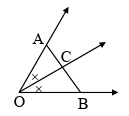
$\begin{array}{l}|\overline{ OA }|=\sqrt{1+9+4}=\sqrt{14} \\ |\overline{ OB }|=\sqrt{9+1+4}=\sqrt{14}\end{array}$
$\therefore \quad OA = OB$
Let C be any point on angle bisector and on line $A B$
$\therefore \quad C$ is midpoint of AB
$\therefore \quad \bar{c}=\frac{\bar{a}+\bar{b}}{2}=2 \hat{i}+2 \hat{j}-2 \hat{k}$ View full question & answer→