MCQ 11 Mark
In a series LCR circuit the phase difference between the voltage and the current is 45°. Then the power factor will be
MCQ 21 Mark
In an $A C$ circuit, e and $i$ are given by $e=150 \sin (150 t ) V$ and $i=150 \sin \left(150 t+\frac{\pi}{3}\right) A$. the power dissipated in the circuit is
View full question & answer→MCQ 31 Mark
In a circuit L, C & R are connected in series with an alternating voltage of frequency f. the current leads the voltage by 450. The value of C is
- A
$\frac{1}{\pi f(2 \pi f L-R)}$
- ✓
$\frac{1}{2 \pi f(2 \pi f L-R)}$
- C
$\frac{1}{\pi f(2 \pi f L+R)}$
- D
$\frac{1}{2 \pi f(2 \pi f L+R)}$
AnswerCorrect option: B. $\frac{1}{2 \pi f(2 \pi f L-R)}$
$\frac{1}{2 \pi f(2 \pi f L-R)}$
View full question & answer→MCQ 41 Mark
A resistor of $500 \Omega$ and an inductance of $0.5 H$ are in series with an $AC$ source which is given by $V=100 \sqrt{2} \sin (1000 t)$. The power factor of the combination
- ✓
$\frac{1}{\sqrt{2}}$
- B
$\frac{1}{\sqrt{3}}$
- C
- D
AnswerCorrect option: A. $\frac{1}{\sqrt{2}}$
$\frac{1}{\sqrt{2}}$
View full question & answer→MCQ 51 Mark
If the RMS current in a $50 Hz AC$ circuit is $5 A$, the value of the current $\frac{1}{300}$ seconds after its value becomes zero is
- A
$5 \sqrt{2} A$
- ✓
$5 \sqrt{\frac{3}{2}} A$
- C
$\frac{5}{6} A$
- D
$\frac{5}{\sqrt{2}} A$
AnswerCorrect option: B. $5 \sqrt{\frac{3}{2}} A$
$5 \sqrt{\frac{3}{2}} A$
View full question & answer→MCQ 61 Mark
The coil of a.c. generator has 100 turns, each of crosssectional area $2 m ^2$. It is rotating at constant angular speed $30 rad / s$, in a uniform magnetic field of $2 \times 10^{-2} T$. If the total resistance of the circuit is $600 \Omega$ then maximum power dissipated in the circuit is
- A
$6 W$
- B
$9 W$
- ✓
$12 W$
- D
$24 W$
AnswerCorrect option: C. $12 W$
(c) : Given, $N=100, A=2 m ^2, \omega=30 rad / s$
$
B=2 \times 10^{-2} T , R=600 \Omega
$
$
\varepsilon_{\max }=N B A \omega=100 \times 2 \times 10^{-2} \times 2 \times 30=120 V
$
$P_{\max }=\varepsilon_{ max } \times I_{\max }=\frac{\varepsilon_{\max } \times I_{\max }}{2}=\frac{\varepsilon_{\max }^2}{2 R }$ tivate Windov
thus, $P_{\max }=\frac{\varepsilon_{\max }^2}{R}=\frac{120 \times 120}{2 \times 600}=12 W$
View full question & answer→MCQ 71 Mark
An $e.m.f. E=4 \cos (1000 t)$ volt is applied to an $L R$ circuit of inductance $3 \ mH$ and resistance $4 \Omega$. The maximum current in the circuit is
- A
$\frac{4}{\sqrt{7}} A$
- B
$1.0 A$
- C
$\frac{4}{7} A$
- ✓
$0.8 A$
AnswerCorrect option: D. $0.8 A$
$\text {(d) : Given, } E=4 \cos (1000 t), L=3 \ mH , R=4 \Omega$
$ E=E_0 \cos \omega t ; \omega=1000 \ rad / s$
$Z=\sqrt{R^2+(\omega L)^2}$
$=\sqrt{4^2+\left(1000 \times 3 \times 10^{-3}\right)^2}$
$Z=5 \Omega ; i=\frac{E_0}{Z}=\frac{4}{5}=0.8 A $
View full question & answer→MCQ 81 Mark
An alternating voltage of frequency ' $\omega$ ' is induced in electric circuit consisting of an inductance ' $L$ ' and capacitance ' $C$ ', connected in parallal. Then across the inductance coil
- A
current is maximum when $\omega^2=\frac{1}{L C}$
- B
- C
voltage is minimum when $\omega^2=\frac{1}{L C}$
- ✓
voltage is maximum when $\omega^2=\frac{1}{L C}$
AnswerCorrect option: D. voltage is maximum when $\omega^2=\frac{1}{L C}$
(d) : In LC parallel circuits, the current is minimum when $\omega=\frac{1}{\sqrt{L C}}$ and current and voltage are an angle $90^{\circ}$.
So, voltage is maximum when current is minimum.
View full question & answer→MCQ 91 Mark
The reactance of capacitor at $50 Hz$ is $5 \Omega$. If the frequency is increased to $100 Hz$, the new reactance is
- A
$5 \Omega$
- B
$10 \Omega$
- ✓
$2.5 \Omega$
- D
$125 \Omega$
AnswerCorrect option: C. $2.5 \Omega$
(c) : Given, $X_C=5 \Omega, f=50 Hz , f^{\prime}=100 Hz , X_C^{\prime}=$ ?
$
\begin{aligned}
& X_C=\frac{1}{2 \pi f C}, X_C^{\prime}=\frac{1}{2 \pi f^{\prime} C } \\
& \frac{X_C^{\prime}}{X_C}=\frac{f}{f^{\prime}} \Rightarrow X_C^{\prime}=\frac{5 \times 50}{100}=2.5 \Omega
\end{aligned}
$
View full question & answer→MCQ 101 Mark
A capacitor, an inductor and an electric bulb are connected in series to an a.c. supply of variable frequency. As the frequency of the supply is increased gradually, then the electric bulb is found to
- A
- B
- ✓
increase, reach a maximum and then decrease in brightness.
- D
show no change in brightness.
AnswerCorrect option: C. increase, reach a maximum and then decrease in brightness.
(c) : When frequency increases, impedance first decreases and then increases.
So, the brightness first increases, then reaches its maximum and then decreases.
View full question & answer→MCQ 111 Mark
In an $AC$ circuit, the current is $i=5 \sin \left(100 t-\frac{\pi}{2}\right) A$ and voltage is $e=200 \sin (100 t)$ volt. Power consumption in the circuit is $\left(\cos 90^{\circ}=0\right)$
- A
$200 W$
- ✓
$0 W$
- C
$40 W$
- D
$1000 W$
Answer(b) : $i=5 \sin (100 t-\pi / 2) ; e=200 \sin (100 t)$ as $\phi=\pi / 2$ $P=E_{\text {ras }} I_{\text {rms }} \cos \phi=0 W$
View full question & answer→MCQ 121 Mark
An alternating voltage $E=200 \sqrt{2} \sin (100 t)$ volt is connected to a $1 \mu F$ capacitor through an $a.c.$ ammeter. The reading of the ammeter shall be
- A
$10\ mA$
- ✓
$20\ mA$
- C
$40\ mA$
- D
$80\ mA$
AnswerCorrect option: B. $20\ mA$
Given, $E=200 \sqrt{2} \sin (100 t) V$
$C=1 \mu F , \omega=100\ rad / s$
$X_C=\frac{1}{\omega C}=\frac{1 \times 10^6}{100 \times 1}=10^4 \Omega ;$
$i_{ rms }=\frac{E_{ rms }}{X_C}=\frac{E_0}{\sqrt{2} X_C}=\frac{200 \sqrt{2}}{\sqrt{2} X_C}$
$i_{ rms }=\frac{200}{10^4} \times 10^3\ mA =20\ mA $
View full question & answer→MCQ 131 Mark
A coil having an inductance of $\frac{1}{\pi} H$ is connected in series with a resistance of $300 \Omega$. If $20 V$ from a $200 Hz$ source are impressed across the combination, the value of the phase angle between the voltage and the current is
- A
$\tan ^{-1}\left(\frac{5}{4}\right)$
- B
$\tan ^{-1}\left(\frac{4}{5}\right)$
- C
$\tan ^{-1}\left(\frac{3}{4}\right)$
- ✓
$\tan ^{-1}\left(\frac{4}{3}\right)$
AnswerCorrect option: D. $\tan ^{-1}\left(\frac{4}{3}\right)$
(d) : Given, $L=\frac{1}{\pi} H , R=300 \Omega, f=200 Hz$
$
\tan \phi=\frac{X_L}{R}=\frac{2 \pi f L}{R}=\frac{2 \pi \times 200 \times \frac{1}{\pi}}{300} ; \phi=\tan ^{-1}\left(\frac{4}{3}\right)
$
View full question & answer→MCQ 141 Mark
What will be the phase difference between virtual voltage and virtual current when current in the circuit is wattless?
- A
$60^{\circ}$
- B
$45^{\circ}$
- ✓
$90^{\circ}$
- D
$180^{\circ}$
AnswerCorrect option: C. $90^{\circ}$
(c) : $P=E_{ rms \times} I_{ rms ,} \cos \phi$
As current is wattless, so $\cos \phi=0 ; \phi=90^{\circ}$
View full question & answer→MCQ 151 Mark
The power factor of an $R-L$ circuit is $\frac{1}{\sqrt{2}}$. If the frequency of $A C$ is doubled power factor will now be
- A
$\frac{1}{\sqrt{3}}$
- ✓
$\frac{1}{\sqrt{5}}$
- C
$\frac{1}{\sqrt{7}}$
- D
$\frac{1}{\sqrt{11}}$
AnswerCorrect option: B. $\frac{1}{\sqrt{5}}$
(b) : For $R$ - $L$ circuit, power factor is
$
\cos \phi=\frac{R}{\sqrt{R^2+X_L^2}}
$
$\frac{1}{\sqrt{2}}=\frac{R}{\sqrt{R^2+\omega^2 L^2}}$. . . . . (i)
$\cos \phi^{\prime}=\frac{R}{\sqrt{R^2+(2 \omega)^2 L^2}}$. . . . . .(ii)
From equation (i), $\frac{1}{2}=\frac{R^2}{R^2+\omega^2 L^2}$
$
R^2+\omega^2 L^2=2 R^2 ; R^2=\omega^2 L^2
$
By substituting this value in equation (ii).
$
\cos \phi^{\prime}=\frac{R}{\sqrt{R^2+4 R^2}}=\frac{1}{\sqrt{5}}
$
View full question & answer→MCQ 161 Mark
The reciprocal of the total effective resistance of $L C R$ a.c. circuit is called
- A
- ✓
- C
- D
inductive and capacitive reactance
Answer(b) : Admittance $=\frac{1}{Z}$
View full question & answer→MCQ 171 Mark
An alternating voltage is applied to a series $L C R$ circuit. If the current leads the voltage by $45^{\circ}$, then $\left(\tan 45^{\circ}=1\right)$
- ✓
$X_L=X_C-R$
- B
$X_L=X_C+R$
- C
$X_C=\sqrt{X_L^2+R^2}$
- D
$X_L=\sqrt{X_C^2+R^2}$
AnswerCorrect option: A. $X_L=X_C-R$
(a) : As, $\tan \phi=\frac{X_C-X_L}{R}$
$
\therefore \tan 45^{\circ}=\frac{X_C-X_L}{R} \text { or } R=X_C-X_L \text { or } X_L=X_C-R
$
View full question & answer→MCQ 181 Mark
For a purely inductive or a purely capacitive circuit, the power factor is
Answer(a) : For a purely inductive or a purely capactive circuit, resistance $R=0$
Power factor, $\cos \phi=\frac{R}{Z}=0$
View full question & answer→MCQ 191 Mark
In $L C$ parallel resonance circuit, choose the wrong statement.
AnswerCorrect option: D. At resonance, resonant frequency $=\sqrt{L C}$.
(d) : In $L C$ parallel resonance circuit, at resonance
$
\begin{aligned}
& X_L=X_C \\
& \Rightarrow \omega L=\frac{1}{\omega C} \Rightarrow \omega=\frac{1}{\sqrt{L C}}
\end{aligned}
$
View full question & answer→MCQ 201 Mark
In an $L C R$ series circuit, if the angular frequency is gradually increased then match the following columns
| Column-1 | Column-2 |
| A. | Capacitive reactance | i. | will continuously increase |
| B. | Inductive reactance | ii. | will remain constant |
| C. | Resistance | iii. | will first decrease and then increase |
| D. | Total impedance | iv. | will continuously decrease |
- A
-(i), (B)-(iii), (c)-(iv), (D)-(ii)
- ✓
(A)-(iv), -(i), (c)-(ii), (D)-(iii)
- C
(A)-(i), (B)-(iv), -(ii), (D)-(iii)
- D
(A)-(ii), (B)-(iii), (c)-(i), -(iv)
AnswerCorrect option: B. (A)-(iv), -(i), (c)-(ii), (D)-(iii)
(b) : As $X_C=\frac{1}{\omega C}$ i.e. $X_C \propto \frac{1}{\omega}$
As $\omega$ increased, $X_C$ decreases.
$
X_L=\omega \text { Li.e., } X_L \propto \omega
$
As $\omega$ increases, $X_L$ will be increases.
- $R$ is will not be affected as it is not a function of $\omega$.
- Total impedance will be minimum at resonance.
View full question & answer→MCQ 211 Mark
The instantaneous value of current and voltge in an $AC$ circuit are given by $I=6 \sin (100 \pi t+\pi / 4)$ and $V=5 \sin (100 \pi t-\pi / 4)$ then
- A
voltage leads the current by $45^{\circ}$
- B
current leads the voltage by $45^{\circ}$
- C
voltage leads the current by $90^{\circ}$
- ✓
current leads the voltage by 9 a
AnswerCorrect option: D. current leads the voltage by 9 a
(d): The phase difference between instantaneous values of current and voltage is $\frac{\pi}{4}-\left(\frac{-\pi}{4}\right)=\frac{\pi}{2}$ i.e., the current leads the voltage by $90^{\circ}$.
View full question & answer→MCQ 221 Mark
A circuit of negligible resistance has an inductor of $0.16 H$ and capacitor of $25 \mu F$ connected in series with an alternating voltage source. The resonating frequency of the circuit is
- A
$\frac{200}{\pi}$
- ✓
$\frac{250}{\pi}$
- C
$\frac{400}{\pi}$
- D
$\frac{150}{\pi}$
AnswerCorrect option: B. $\frac{250}{\pi}$
(b) : At resonance, $X_C=X_L$
$
\begin{aligned}
& \frac{1}{\omega C}=\omega L \Rightarrow \omega^2=\frac{1}{L C} \\
& \Rightarrow \omega=\frac{1}{\sqrt{L C}}=\frac{1}{\sqrt{(0.16 H ) \times\left(25 \times 10^{-6} F \right)}} \\
& \Rightarrow \omega=2 \pi v=\frac{1}{2 \times 10^{-3}} \Rightarrow v=\frac{250}{\pi}
\end{aligned}
$
View full question & answer→MCQ 231 Mark
In the circuit shown, the voltage $V_1$, across capacitor $C$
- A
is in phase with the source voltage $V$
- B
leads the source voltage $V$ by $90^{\circ}$
- C
leads the source voltage $V$ by an angle between $0^{\circ}$ and $90^{\circ}$
- ✓
lags behind the source voltage $V$ by an angle between $0^{\circ}$ and $90^{\circ}$.
AnswerCorrect option: D. lags behind the source voltage $V$ by an angle between $0^{\circ}$ and $90^{\circ}$.
(d) : The phasor diagram is as shown in the figure.
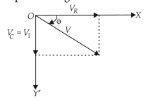
View full question & answer→MCQ 241 Mark
In the series LCR circuit shown, the impedance is
- A
$200 \Omega$
- B
$100 \Omega$
- C
$300 \Omega$
- ✓
$500 \Omega$
AnswerCorrect option: D. $500 \Omega$
(d) : Here, $L=1 H , C =20 \mu F =20 \times 10^{-6} F$
$
\begin{aligned}
& R=300 \Omega, v=\frac{50}{\pi} Hz \\
& X_L=2 \pi \nu L=2 \times \pi \times \frac{50}{\pi} \times 1=100 \Omega \\
& X_C=\frac{1}{2 \pi v C}=\frac{1}{2 \times \pi \times \frac{50}{\pi} \times 20 \times 10^{-6}}=500 \Omega
\end{aligned}
$
The impedance of the series LCR circuit is
$
\begin{aligned}
& Z=\sqrt{R^2+\left(X_C-X_L\right)^2}=\sqrt{(300)^2+(500-100)^2} \\
& =\sqrt{(300)^2+(400)^2}=500 \Omega
\end{aligned}
$
View full question & answer→MCQ 251 Mark
An alternating voltage is given by $E=100 \sin (\omega t+\pi / 6) V$.The voltage will be maximum for the first time when $t=[T=$ periodic time $]$
- A
$T / 12$
- B
$T / 2$
- ✓
$T / 6$
- D
$T / 3$
AnswerCorrect option: C. $T / 6$
(c) : Given, $E=100 \sin \left(\omega t+\frac{\pi}{6}\right) V$ For, $E$ to be $E_{\max }, \sin \left(\omega t+\frac{\pi}{6}\right)=1=\sin \frac{\pi}{2}$
$
\begin{aligned}
& \Rightarrow \omega t+\frac{\pi}{6}=\frac{\pi}{2} \Rightarrow \omega t=\frac{\pi}{2}-\frac{\pi}{6}=\frac{\pi}{3} \\
& \Rightarrow \frac{2 \pi}{T} t=\frac{\pi}{3} \\
& \Rightarrow t=\frac{T}{6}
\end{aligned}
$
View full question & answer→MCQ 261 Mark
In a series $L C R$ circuit $R=300 \Omega, L=0.9 H , C=2 \mu F$, $\omega=1000 rad / s$. The impedance of the circuit is
- ✓
$500 \Omega$
- B
$1300 \Omega$
- C
$400 \Omega$
- D
$900 \Omega$
AnswerCorrect option: A. $500 \Omega$
(a) : Given, $R=300 \Omega, L=0.9 H , C=2 \mu F$ and $\omega=1000 rad / sec$
Inductive reactance, $X_L=\omega L=1000 \times 0.9=900 \Omega$ and capacitive reactance,
$
X_C=\frac{1}{\omega C}=\frac{1}{10^3 \times 2 \times 10^{-6}}=500 \Omega
$
$\therefore \quad$ Impedance of a series $L C R$ circuit is
$
\begin{aligned}
& Z=\sqrt{R^2+\left(X_L-X_C\right)^2} \\
& =\sqrt{(300)^2+(900-500)^2}=\sqrt{250000} ; Z=500 \Omega
\end{aligned}
$
View full question & answer→MCQ 271 Mark
An alternating voltage $c=200 \sqrt{2} \sin (100 t)$ volt is connected to $1 \mu F$ capacitor through a.c. ammeter. The reading of ammeter is
- A
$5\ mA$
- B
$10\ mA$
- C
$15\ mA$
- ✓
$20\ mA$
AnswerCorrect option: D. $20\ mA$
Since applied alternating voltage is $e=e_0 \sin \omega t=200 \sqrt{2} \sin (100 t)$
$e_0=200 \sqrt{2} V ,$
$\omega=100\ rad / s$
The ammeter will read the value of $I_{r m s}$
$I_{r m s}=\frac{V_{r m s}}{X_c}$
$=\frac{V_0 \omega C}{\sqrt{2}}$
$=\frac{200 \sqrt{2} \times 100 \times 10^{-6}}{\sqrt{2}}$
$=2 \times 10^{-2} A$
$=20\ mA$
View full question & answer→MCQ 281 Mark
In series $L C R$ circuit $R=18 \Omega$ and impedance is $33 \Omega$. An rms voltage $220 V$ is applied across the circuit. The true power consumed in a.c. circuit is
- A
$220 W$
- B
$400 W$
- C
$600 W$
- D
$800 W$
Answer
$
\begin{aligned}
& \text { (d) : Given } R=18 \Omega, Z=33 \Omega \\
& V_{\text {rms }}=220 V \\
& P=V_{\text {rms }} I_{\text {rms }} \cos \phi \\
& =V_{\text {rms }} \frac{V_{\text {rms }}}{Z} \cdot \frac{R}{Z}=\frac{220 \times 220 \times 18}{33 \times 33} \\
& P=800 W
\end{aligned}
$
View full question & answer→Question 291 Mark
Answer(d) : At parallel resonance, $L$ and $C$ are connected in parallel combination and current is minimum. So graph (4) is correct option.
View full question & answer→MCQ 301 Mark
The $L C$ parallel resonant circuit
- ✓
has a very high impedance
- B
- C
acts as resistance of very low value
- D
AnswerCorrect option: A. has a very high impedance
(a) : The $L C$ parallel resonant circuit has a very high impedance, hence a very low current.
View full question & answer→MCQ 311 Mark
In LCR series circuit, an alternating e.m.f. e and current $i$ are given by the equations $e=100 \sin (100 f)$ volt, $t=100 \sin \left(100 t+\frac{\pi}{3}\right) mA$. The average power dissipated in the circuit will be
- A
$100 W$
- B
$10 W$
- C
$5 W$
- ✓
$2.5 W$
AnswerCorrect option: D. $2.5 W$
(d) : Here, $e=100 \sin (100 t)$ volt
$
\begin{aligned}
& i=100 \sin \left(100 t+\frac{\pi}{3}\right) mA \\
& \therefore e_0=100 \text { volt } \\
& i_0=100 mA =100 \times 10^{-3} A ; \phi=\frac{\pi}{3}
\end{aligned}
$
Average power dissipated in the circuit is
$
\begin{aligned}
P_{\text {av }} & =\frac{1}{2} e_0 i_0 \cos \phi \\
& =\frac{1}{2} \times 100 \times 100 \times 10^{-3} \times \cos \frac{\pi}{3} \\
& =\frac{1}{2} \times 10 \times \frac{1}{2}=\frac{5}{2} W =2.5 W
\end{aligned}
$
View full question & answer→