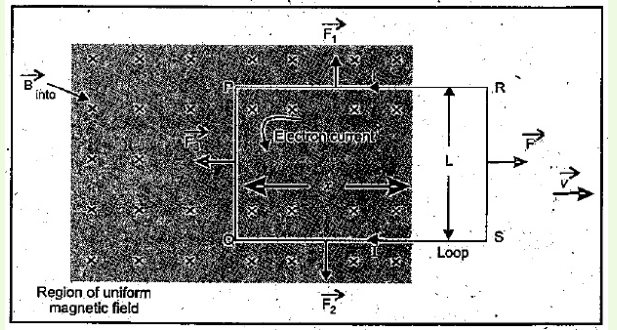
Let us consider a rectangular wire loop PQRS of width l, and its plane perpendicular to a uniform magnetic field. The loop is being pulled out of magnetic field at a constant speed v. At any instant, let 'x' be the length of loop in the magnetic field. As the loop moves towards right, the area of the loop inside the field changes by dA=ldx=lvdt. So the change in magnetic flux is given by
\(d \phi= BdA = Blvdt\)
so \(\frac{ d \phi}{ dt }=\frac{ Blvdt }{ dt }= Bvl\)
Its direction is given by Fleming's left and rule.
So, the forces \(F_1\) and \(F_2\) on wires \(P R\) and \(Q S\) respectively are equal in magnitude and opposite in direction and have the same line of action. Hence they balance each other. There is no force on the wire RS as it lies outside the field. The force \(\overrightarrow{ F _3}\) on the wire \(PQ\) has magnitude \(F _3= IBL\) directed towards left. To move the loop with constant velocity \(\overrightarrow{ v }\) an external force must be applied. So work done by the external agent is given by
\(dw = Fdx =- IlBdx =- IBdA\)
\(=- Id \phi_{ m }\)
So rate of doing work \(P =\frac{ dw }{ dt }\)
\(= I \left(-\frac{ d \phi_{ m }}{ dt }\right)\)
but \(P = EI\)
so \(E =-\frac{ d \phi_{ m }}{ dt }\)