MCQ 11 Mark
A charged particle is in motion having initial velocity $\vec{V}$ when it enter into a region of uniform magnetic field perpendicular to $\vec{V}$. Because of the magnetic force the kinetic energy of the particle will
View full question & answer→MCQ 21 Mark
A conducting thick copper rod of length $1$ m carries a current of $15$ A and is located on the Earth's equator. There the magnetic flux lines of the Earth's magnetic field are horizontal, with the field of $1.3 \times 10-4 T$, south to north. The magnitude and direction of the force on the rod, when it is oriented so that current flows from west to east, are
- A
$14 \times 10-4 N$, downward.
- ✓
$20 \times 10-4 N$, downward.
- C
$14 \times 10-4 N$, upward.
- D
$20 \times 10-4 N$, upward.
AnswerCorrect option: B. $20 \times 10-4 N$, downward.
$20 \times 10^{-4} N$, upward.
View full question & answer→MCQ 31 Mark
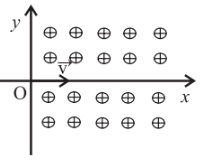
A proton enters a perpendicular uniform magnetic field B at origin along the positive x axis with a velocity v as shown in the figure. Then it will follow the following path. [The magnetic field is directed into the paper].
- A
It will continue to move along positive x axis.
- B
It will move along a curved path, bending towards positive x axis.
- ✓
It will move along a curved path, bending towards negative y axis.
- D
It will move along a sinusoidal path along the positive x axis.
AnswerCorrect option: C. It will move along a curved path, bending towards negative y axis.
It will move along a curved path, bending towards negative y axis.
View full question & answer→MCQ 41 Mark
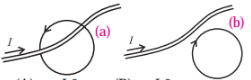
ii) Figure $a$, b show two Amperian loops associated with the conductors carrying current I in the sense shown. The $\oint \vec{B} \cdot d \vec{l}$ in the cases a and $b$ will be, respectively,
- ✓
$-\mu_a I, 0$
- B
$\mu_\theta I, 0$
- C
$0, \mu_0 I$
- D
$0,-\mu_0 I$
AnswerCorrect option: A. $-\mu_a I, 0$
$-\mu_a I, 0$
View full question & answer→MCQ 51 Mark
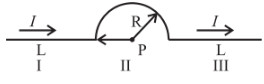
A conductor has 3 segments; two straight and of length L each and a semicircular with radius R. It carries a current I. What is the magnetic field B at point P?
- A
$\frac{\mu_0}{4 \pi} \frac{I}{R}$
- B
$\frac{\mu_0}{4 \pi} \frac{I}{R^2}$
- ✓
$\frac{\mu_0}{4} \frac{I}{R}$
- D
$\frac{\mu_0}{4} \frac{I}{v}$
AnswerCorrect option: C. $\frac{\mu_0}{4} \frac{I}{R}$
$\frac{\mu_0}{4} \frac{I}{R}$
View full question & answer→MCQ 61 Mark
10 A current is flowing in two straight parallel wires in the same direction. Force of attraction between them is $1 \times 10^{-3} N$. If the current is doubled in both the wires the force will be
- A
$1 \times 10^{-3} N$
- B
$2 \times 10^{-3} N$
- C
$4 \times 10^{-3} N$
- D
$0.25 \times 10^{-3} N$
Answer(c) : In case of straight parallel wires, force$F=\frac{\mu_0}{4 \pi} \cdot \frac{2 I_1 I_2}{r}$
If current is doubled $F^{\prime}=\frac{\mu_0}{4 \pi} \frac{2 \times 2 I_1 \times 2 I_2}{r}=4 F$$\therefore \quad F^{\prime}=4 \times 1 \times 10^{-3}=4 \times 10^{-3} N$
View full question & answer→MCQ 71 Mark
The magnetic field at a point $P$ situated at perpendicular distance $' R\ '$ from a long straight wire carrying a current of $12 A$ is $3 \times 10^{-3} Wb / m ^2$. The value of $' R\ '$ in $mm$ is [ $\left.\mu_0=4 \pi \times 10^{-7} Wb / Am \right]$
AnswerGiven, $i=12 A , B=3 \times 10^{-5} Wb / m ^2$
$B=\frac{\mu_0}{4 \pi} \cdot \frac{2 i}{R} ; 3 \times 10^{-5}$
$=10^{-7} \times \frac{2 \times 12}{R}$
$R=\frac{2 \times 12 \times 10^{-7}}{3 \times 10^{-5}}$
$=8 \times 10^{-2} m$
$=80\ mm$
View full question & answer→MCQ 81 Mark
When a charge of $3 C$ is placed in uniform magnetic field, it experiences a force of $3000 N$. Within this field, potential difference between two points separated by a distance of $1\ cm$ is
- ✓
$10 V$
- B
$90 V$
- C
$1000 V$
- D
$3000 V$
AnswerCorrect option: A. $10 V$
Given, $q=3 C ,$
$F=3000 N , $
$V=?,$
$r=1 \ cm$
$E=\frac{F}{q}=\frac{3000}{3}=1000 N / C$
$E \times r=V$ or $V=1000 \times \frac{1}{100}=10 V $
View full question & answer→MCQ 91 Mark
A charge ' $q$ ' moves with velocity ' $v$ ' through electric (E) as well as magnetic field (B). Then the force acting on it is
- A
$q(\vec{v} \times \vec{B})$
- B
$q(\vec{B} \times \vec{v})$
- C
$q(\vec{E} \times \vec{v})$
- ✓
$q \vec{E}+q(\vec{v} \times \vec{B})$
AnswerCorrect option: D. $q \vec{E}+q(\vec{v} \times \vec{B})$
(d) : Lorentz Force, $\vec{F}=q \vec{E}+q(\vec{v} \times \vec{B})$
View full question & answer→MCQ 101 Mark
An electron (mass $m$ ) is accelerated through a potential difference of ' $V$ " and then it enters in a magnetic field of induction ' $B$ ' normal to the lines. The radius of the circular path is $(e=$ electronic charge)
- A
$\sqrt{\frac{2 e V}{m}}$
- ✓
$\sqrt{\frac{2 V m}{e B^2}}$
- C
$\sqrt{\frac{2 V m}{e B}}$
- D
$\sqrt{\frac{2 V m}{e^2 B}}$
AnswerCorrect option: B. $\sqrt{\frac{2 V m}{e B^2}}$
(b) : As, $KE =\frac{B^2 q^2 r^2}{2 m} ; e V=\frac{B^2 e^2 r^2}{2 m}$$\frac{2 m V}{e B^2}=r^2 ; =\sqrt{\frac{2 V m}{e B^2}}$
View full question & answer→MCQ 111 Mark
A long straight wire carrying a current of $25 A$ rests on the table. Another wire $P Q$ of length $1 m$ and mass $2.5 g$ carries the same current but in the opposite direction. The wire $P Q$ is free to slide up and down. To what height will wire $P Q$ rise? $\left(\mu_0=4 \pi \times 10^{-7} SI\right.$ unit)
- A
$3 mm$
- ✓
$4 mm$
- C
$5 mm$
- D
$8 mm$
AnswerCorrect option: B. $4 mm$
(b) : Charge, $q=\frac{\Delta \phi}{R}$
$
q=\frac{N\left(B_2-B_1\right) A}{R}=\frac{N \pi r^2\left(B_2-B_1\right)}{R}
$
Here, $N=1000$ turns
$
\begin{aligned}
& B_2=0.012 T ; B_1=0 \\
& q=\frac{1000 \times \pi \times\left(10^{-2}\right)^2 \times(0.012-0)}{(200+400)} \\
& q=6.3 \mu C \quad
\end{aligned}
$
View full question & answer→MCQ 121 Mark
A long wire is bent into a circular coil of one turn and then into a circular coil of smaller radius having $n$ turns. If the same current passes in both the cases, the ratio of magnetic fields produced at the centre for one turn to that of $n$ turns is
- A
$1: n$
- B
$n: 1$
- ✓
$1: n^2$
- D
$n^2: 1$
AnswerCorrect option: C. $1: n^2$
$PQ=1m ;$
$m=2.5 g$
$F=B I l=m g ......(i)$
$B=\frac{\mu_0}{2 \pi} \cdot \frac{I}{h}$ Put in $(i)$
$\frac{\mu_0}{2 \pi} \cdot \frac{I}{h} I l=m g$
$h=\frac{\mu_0 I^2 l}{2 \pi m g}$
$=\frac{4 \pi \times 10^{-7}}{2 \pi} \times \frac{25 \times 25 \times 1}{2.5 \times 10^{-3} \times 10}$
$h=5 \times 10^{-3} m$
$=5\ mm$
View full question & answer→MCQ 131 Mark
A straight wire carrying a current $(I)$ is turned into a circular loop. If the magnitude of the magnetic moment associated with it is ${ }^M M$, then the length of the wire will be
AnswerCorrect option: C. $\left[\frac{4 M \pi}{I}\right]^{\frac{1}{2}}$
Let the length of the wire be is $l$ and radius of circular loop is $r$.
$ \therefore l=2 \pi r$
$M=I A=I \times \pi r^2$
$=I \times \pi\left(\frac{l}{2 \pi}\right)^2$
$\Rightarrow M=\frac{I \pi l^2}{4 \pi^2}$
or $=\sqrt{\frac{4 M \pi}{I}}$
View full question & answer→MCQ 141 Mark
A solenoid of length $0.4 m$ and having $500$ turns of wire carries a current $3 A$. A thin coil having $10$ turns of wire and radius $0.1 m$ carries current $0.4 A$. The torque required to hold the coil in the middle of the solenoid with its axis perpendicular to the axis of the solenoid is $( \mu_0=4 \pi \times 10^{-7} SI$ units, $\left.\pi^2=10\right)\left(\sin 90^{\circ}=1\right)$
- A
$3 \times 10^{-6} N m$
- B
$12 \times 10^{-6} N m$
- ✓
$6 \times 10^{-6} N m$
- D
$24 \times 10^{-6} N m$
AnswerCorrect option: C. $6 \times 10^{-6} N m$
For solenoid, $l=0.4 m , N=500, i=3 A$
For thin coil, $N^{\prime}=10, r=0.1 m , I=0.4 A$
Magneic field due to solenoid, $B=\mu_0 n i=\mu_0 \times \frac{500}{0.4} \times 3$
Torque $=N^{\prime} I A B \sin \theta$
$=10 \times 0.4 \times \pi \times 0.1^2 \times \frac{\mu_0 \times 500 \times 3}{0.4} \times \sin 90^{\circ}$
$=\frac{4 \times \pi \times 0.01 \times 4 \pi \times 10^{-7} \times 500 \times 3}{0.4}$
$=6 \times 10^{-6} N m $
View full question & answer→MCQ 151 Mark
Two circular coils made from same wire but radius of $1^{\text {st }}$ coil is twice that of $2^{\text {nd }}$ coil. If magnetic field at their centres is same then ratio of potential difference applied across them is ( $1^{\text {st }}$ to $2^{\text {nd }}$ coil)
View full question & answer→MCQ 161 Mark
A bar magnet having a magnetic moment of $2.0 \times 10^5 JT ^{-1}$, is placed along the direction of uniform magnetic field of magnitude $B=14 \times 10^{-5} T$. The work done in rotating the magnet slowly through $60^{\circ}$ from the direction of field is
AnswerCorrect option: A. $14 J$
(a) : Given, $B=2 \times 10^5 J / T , B=14 \times 10^{-5} T$, $\theta_1=0^{\circ}, \theta_2=60^{\circ}$; Work done, $U=-M B\left(\cos \theta_1+\cos\theta_2\right)$ $U=-2 \times 10^5 \times 14 \times 10^{-5}\left[\cos 0^{\circ}-\cos60^{\circ}\right]$ $U=-28[1-1 / 2]=-14 J$; So, work done is $14 J$.
View full question & answer→MCQ 171 Mark
The electric current in a circular coil of $2$ turns produces a magnetic induction $B_1$ at its centre. The coil is unwound and is rewound into a circular coil of $5$ turns and the same current produces a is is
- A
$\frac{5}{2}$
- ✓
$\frac{25}{4}$
- C
$\frac{5}{4}$
- D
$\frac{25}{2}$
AnswerCorrect option: B. $\frac{25}{4}$
Let the radius of coils is $R_1$ and $R_2$
$2 \times 2 \pi R_1=5 \times 2 \pi R_2$
$2 R_1=5 R_2.......(i)$
$B_1=2 \times \frac{\mu_0 I}{2 R_1}, B_2$
$=\frac{5 \mu_0 I}{2 R_2};\frac{B_2}{B_1}$
$=\frac{5}{2} \frac{R_1}{R_2}$
$=\frac{5}{2} \times \frac{5}{2}($ From $( i ))$
$\frac{B_2}{B_1}=\frac{25}{4}$
View full question & answer→MCQ 181 Mark
The charge which will flow through a galvanometer of resistance $200 \Omega$ circular coil of $1000$ turns wound on a wooden stick $20\ mm$ in diameter, if a magnetic field $B=0.012 T$ parallel to the axis of the stick decreased suddenly to zero, is nearly
- A
$63 \mu C$
- ✓
$6.3 \mu C$
- C
$630 \mu C$
- D
$0.63 \mu C$
AnswerCorrect option: B. $6.3 \mu C$
Charge, $q=\frac{\Delta Q}{R}$$q=\frac{N\left(B_2-B_1\right) A}{R}=\frac{N \pi r^2\left(B_2-B_1\right)}{R}$
Here, $N=1000$ turns$B_2=0.012 T ;$
$B_1=0$
$q=\frac{1000 \times \pi \times\left(10^{-2}\right)^2 \times(0.012-0)}{(200+400)}$
$q=6.3 \mu C \quad$
View full question & answer→MCQ 191 Mark
A long solenoid has $200$ turns per $cm$ and carriers a current $i$. The magnetic field at its centre is $6.28 \times 10^{-2} Wb / m ^2$. Another long solenoid has $100$ turns per $cm$ and it carries a current $i / 3$. The value of magnetic field at its centre is nearly
- A
$1.05 \times 10^{-3} Wb / m ^2$
- B
$1.05 \times 10^{-5} Wb / m ^2$
- C
$1.05 \times 10^{-4} Wb / m ^2$
- ✓
$1.05 \times 10^{-2} Wb / m ^2$
AnswerCorrect option: D. $1.05 \times 10^{-2} Wb / m ^2$
Magnetic field due to a long solenoid is given by, $B=\mu_0 n I$
$B=6.28 \times 10^{-2} wb / m ^2 ; n=200 \times 10^{-2}$
$6.28 \times 10^{-2}=\mu_0 \times 200 \times 10^{-2} \times I ......(i)$
Magnetic field when another solenoid has $100$ turns per $cm$ and current is $\frac{I}{3},$
then,$B=\mu_0 \times 100 \times 10^{-2} \times \frac{I}{3}......(ii)$
From equation $(i)$ and $(ii), B=1.05 \times 10^{-2} Wb / m ^2$
View full question & answer→MCQ 201 Mark
A proton moving in perpendicular magnetic field possess energy $ ' E\ '.$ The strength of magnetic field is increased four times. But the proton is constrained to move in the path of same radius. The kinetic energy of proton will increase
- A
$12$ times
- B
$8$ times
- C
$4$ times
- ✓
$16$ times
AnswerCorrect option: D. $16$ times
When a charge $' q\ '$ is moving with speed $' v\ '$ in a perpendicular magnetic field $B$, it performs uniform circular motion.
Fore due to magnetic field is, $F=q(v \times B)......(i)$
Here, velocity of proton is perpendicular to magnetic field.
Magnitude of force is, $F=v B q. . . . . . (ii)$
The centripetal force acting on charge is the force acting due to magnetic field on the charge,
i.e., $\frac{m v^2}{R}=q v B$
$\therefore v=\frac{q B R}{m}......(iii)$
Kinetic energy of proton,
$K.E =\frac{1}{2} m v^2$
$K . E =\left(\frac{1}{2}\right) m\left(\frac{q^2 B^2 R^2}{m^2}\right)$
$K . E =\frac{q^2 B^2 R^2}{2 m}......(iv)$
As charge $q$, mass $M$ and radius $R$ are constant in both cases.
$\therefore \text { K.E } \propto B^2 K.E \propto B^2=4^2 B=16 B$
View full question & answer→MCQ 211 Mark
A loop of flexible wire or irregular shape carrying current is placed in an external magnetic field. Identify the effect of the field on the wire.
- A
loop assumes circular shape with its plane normal to the field
- B
wire gets stretched to become straight
- C
loop assumes circular shape with its plane parallel to the field
- D
shape of the loop remains unchanged
View full question & answer→MCQ 221 Mark
A charged particle carrying charge $1 \mu C$ is moving with velocity $(2 \hat{i}+3 \hat{j}+4 \hat{k}) m s ^{-1}$. If an external magnetic field of $(5 \hat{i}+3 \hat{j}-6 \hat{k}) \times 10^{-3} T$ exists in the region where the particle is moving, then the force on the particle is $\vec{F} \times 10^{-9} N$. The vector $\vec{F}$ is
- A
$-0.30 \hat{i}+0.32 \hat{j}-0.09 \hat{k}$
- ✓
$-30 \hat{i}+32 \hat{j}-9 \hat{k}$
- C
$-300 \hat{i}+320 \hat{j}-90 \hat{k}$
- D
$-3.0 \hat{i}+3.2 \hat{j}-0.9 \hat{k}$
AnswerCorrect option: B. $-30 \hat{i}+32 \hat{j}-9 \hat{k}$
Given : $q=1 \mu C ; \vec{v}=2 \hat{i}+3 \hat{j}+4 \hat{k} m / s$
$\vec{B}=(5 \hat{i}+3 \hat{j}-6 \hat{k}) \times 10^{-3} T ; \vec{F}_M=\vec{F} \times 10^{-9} N$
Magnetic force, $\vec{F}_M=q(\vec{v} \times \vec{B})$
$ \vec{v} \times \vec{B}=\hat{i} \hat{j} \hat{k}$
$2 3 4$
$5 3 -6| \times 10^{-3}$
$=[\hat{i}(-18-12)-\hat{j}(-12-20)+\hat{k}(6-15)] \times 10^{-3}$
$=(-30 \hat{j}+32 \hat{j}-9 \hat{k}) \times 10^{-3}$
$\therefore \vec{F}_M=1 \times 10^{-6} \times 10^{-3}(-30 \hat{i}+32 \hat{j}-9 \hat{k})$
$\vec{F}_M=(-30 \hat{i}+32 \hat{j}-9 \hat{k}) \times 10^{-9} N$
So $, \vec{F}=-30 \hat{i}+32 \hat{j}-9 \hat{k}$
View full question & answer→MCQ 231 Mark
A straight wire of length $2 m$ carries a current of $10 A$. If this wire is placed in a uniform magnetic field of $0.15 T$ making an angle of $45^{\circ}$ with the magnetic field, the applied force on the wire will be
- A
$1.5 N$
- B
$3 N$
- C
$3 \sqrt{2} N$
- D
$\frac{3}{\sqrt{2}} N$
Answer(d) : Force on a current carrying wire in a uniform magnetic field is $\vec{F}=I(\vec{l} \times \vec{B})$$\begin{aligned}F & =I l B \sin \theta \\\text { Here, } I & =10 A , l=2 m , B=0.15 T , \theta=45^{\circ} \\\therefore \quad F & =(10 A )(2 m )(0.15 T ) \sin 45^{\circ}=\frac{3}{\sqrt{2}} N\end{aligned}$
View full question & answer→MCQ 241 Mark
To produce a magnetic field of $\pi$ tesla at the centre of circular loop of diameter $1 m$, the current flowing through loop is
- A
$5 \times 10^6 A$
- B
$10^7 A$
- ✓
$2.5 \times 10^6 A$
- D
$2 \times 10^6 A$
AnswerCorrect option: C. $2.5 \times 10^6 A$
(c) : $I=\frac{2 Br }{\mu_0}=\frac{2 \times \pi \times 0.5}{4 \pi \times 10^{-7}}=2.5 \times 10^6 A$
View full question & answer→MCQ 251 Mark
A proton and an $\alpha-$particle (with their masses in the ratio $1: 4$ and charges in the ratio of $1 : 2$ are accelerated from rest through a potential difference $V$. If a uniform magnetic field $(B)$ is set up perpendicular to their velocities, the ratio of the radii $r_p: r_\alpha$ of the circular paths described by them will be
- A
$1: 3$
- ✓
$1: \sqrt{2}$
- C
$1: 2$
- D
$1: \sqrt{3}$
AnswerCorrect option: B. $1: \sqrt{2}$
We know that $r=\frac{m v}{B q}=\frac{\sqrt{2 m q V}}{B q}$
$=\frac{1}{B} \sqrt{\frac{2 m V}{q}}$
$\Rightarrow r \propto \sqrt{\frac{m}{q}}$
Given $\frac{m_p}{m_\alpha}=\frac{1}{4} ; \frac{q_p}{q_\alpha}=\frac{1}{2}$
$\frac{r_p}{r_\alpha}=\sqrt{\frac{m_p q_\alpha}{q_p m_\alpha}}$
$=\sqrt{\left(\frac{1}{4}\right)\left(\frac{2}{1}\right)}$
$=\frac{1}{\sqrt{2}}$
View full question & answer→MCQ 261 Mark
A circular coil of wire consisting of $100$ turns each of radius $9 \ cm$ carries a current of $0.4 A$. The magnitude of the magnetic field at the centre of coil is$\left[\mu_0=12.56 \times 10^{-7} \text { S.I. unit }\right]$
- A
$2.4 \times 10^{-11} T$
- B
$2.79 \times 10^{-5} T$
- ✓
$2.79 \times 10^{-4} T$
- D
$2.79 \times 10^{-3} T$
AnswerCorrect option: C. $2.79 \times 10^{-4} T$
Magnitude of magnetic field at the centre of the coil is $B_{\text {centre }}=\frac{\mu_0 n I}{2 R}$
$=\frac{12.56 \times 10^{-7} \times 100 \times 0.4}{2 \times 9 \times 10^{-2}}$
$=2.79 \times 10^{-4} T $
View full question & answer→MCQ 271 Mark
Torque acting on a rectangular coil carrying current $I$ situated parallel to magnetic field of induction $B$ having number of turns $n$ and area $A$ is
Answer(c) Torque acting on a rectangular coil carrying current list = $\vec{\tau}=\vec{m} \times \vec{B}$
Now, for the coil having n number of turns and area A. we can write that $\vec{m}=n I \vec{A}$
So, torque, $\vec{\tau}=n I(\vec{A} \times \vec{B})$
View full question & answer→MCQ 281 Mark
The magnitude of magnetic induction at a point on the axis at a large distance $(r)$ from the centre of circular coil of ' $n$ ' turns, and area ' $A$ ' carrying current $(I)$ is given by
- A
$B_{\text {axis }}=\frac{\mu_0}{4 \pi} \cdot \frac{n A}{I r^3}$
- B
$B_{\text {avis }}=\frac{\mu_0}{4 \pi} \cdot \frac{2 n I A}{r^3}$
- C
$B_{\text {axis }}=\frac{\mu_0}{4 \pi} \cdot \frac{2 n I}{A r^3}$
- D
$B_{\text {adds }}=\frac{\mu_0}{4 \pi} \cdot \frac{n I A}{r^3}$
Answer(b) : From Biot-Savarts law, magnetic field on the axis of a circular coil with current is
$B=\frac{\mu_0}{4 \pi} \times \frac{2 \pi a^2 n I}{\left(a^2+r^2\right)^3 r}$ [a is the radius of the circular coil]
for r>>a; B=$\frac{\mu_0}{4 \pi} \cdot \frac{2 n I A}{r^3}$
View full question & answer→MCQ 291 Mark
Two parallel conductors carrying unequal currents in the same direction _______
- A
neither attract nor repel each other
- B
- ✓
- D
will have rotational motion.
Answer(c) Two parallel conductors carrying unequal currents in the same direction will attract each other whereas two parallel conductors carrying currents in opposite direction will repel each other.
View full question & answer→MCQ 301 Mark
A current of $1 A$ is flowing on the sides of an equilateral triangle of side $4.5 \times 10^{-2} m$. The magnetic field at the centre of the triangle will be
- A
$4 \times 10^{-5} Wb / m ^2$
- B
$8 \times 10^{-5} Wb / m ^2$
- C
$2 \times 10^{-5} Wb / m ^2$
- D
Answer(a) : $B_{ nct }=3 \frac{\mu_0 I}{4 \pi a}\left(\cos 30^{\circ}+\cos 30^{\circ}\right)$
$=\frac{3 \times\left(10^{-7}\right) \times 1}{\frac{\left(4.5 \times 10^{-2}\right)}{(2 \sqrt{3})}}\left(2 \times \frac{\sqrt{3}}{2}\right)$$B_{\text {net }}=\frac{2 \times 9 \times 10^{-5}}{4.5}=4 \times 10^{-5} Wb / m ^2$
View full question & answer→MCQ 311 Mark
A circular coil carrying current ' $T$ ' has radius ' $R$ ' and magnetic field at the centre is ' $B$ '. At what distance from the centre along the axis of the same coil, the magnetic field will be $\frac{B}{8}$ ?
- A
$R \sqrt{2}$
- ✓
$R \sqrt{3}$
- C
$2 R$
- D
$3 R$
AnswerCorrect option: B. $R \sqrt{3}$
(b) : Sensitivity of a moving coil galvanometer is given by,
$
S_i=\frac{n B A}{c}
$
So, $S_i$ will increase with increase in $n$ or $B$ or $A$ but with decrease in $c$.
View full question & answer→MCQ 321 Mark
The deflection in galvanometer falls to $\left(\frac{1}{4}\right)^{\text {th }}$ when it is shunted by $3 \Omega$. If additional shunt of $2 \Omega$ is connected to earlier shunt, the deflection in galvanometer falls to
- A
$\frac{1}{2}$
- B
$\left(\frac{1}{3}\right)^{\text {rd }}$
- C
$\left(\frac{1}{4}\right)^{ th }$
- ✓
$\left(\frac{1}{8.5}\right)^{\text {th }}$
AnswerCorrect option: D. $\left(\frac{1}{8.5}\right)^{\text {th }}$
(d) : In first case, when galvanometer of resistance $R$ is shunted by $3 \Omega$ resistance.
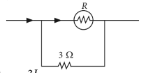
$
\begin{aligned}
& V^{\prime}=\left(I-\frac{I}{4}\right) \times 3=\frac{3 I}{4} \times 3 \\
& \Rightarrow \frac{R I}{4}=\frac{3 I}{4} \times 3 \Rightarrow R=9 \Omega
\end{aligned}
$
Now when additional shunt of $2 \Omega$ is connected
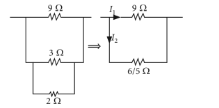
View full question & answer→MCQ 331 Mark
An alternating electric field of frequency ' $u$ ' is applied across the dees (radius $R$ ) of a cyclotron to accelerate protons (mass $m$ ). The operating magnetic field ' $B$ ' used and K.E. of the proton beam produced by it are respectively ( $e=$ charge on proton)
- ✓
$\frac{2 \pi m v}{e}, 2 \pi^2 m v^2 R^2$
- B
$\frac{2 \pi^2 m v}{e^2}, 4 \pi^2 m v^2 R^2$
- C
$\frac{\pi m v}{e}, \pi^2 m v^2 R^2$
- D
$\frac{2 \pi^2 m^2 v^2}{e}, 2 \pi^2 m^2 v^2 R^2$
AnswerCorrect option: A. $\frac{2 \pi m v}{e}, 2 \pi^2 m v^2 R^2$
(a) : For a cyclotron,
Time period, $T=1 / v =\frac{2 \pi m}{e B}$
$
\Rightarrow B=\frac{2 \pi m}{e} v
$. . . . .(i)
Momentum,
$
\begin{aligned}
& p=e B R=e \times \frac{2 \pi m v}{e} R ......(using (i)) \\
& =2 \pi m v R \\
& KE =\frac{p^2}{2 m}=\frac{(2 \pi m v R)^2}{2 m}=2 \pi^2 m v^2 R^2 \\
&
\end{aligned}
$
View full question & answer→MCQ 341 Mark
Sensitivity of moving coil galvanometer is $s$. If a shunt of $\left(\frac{1}{8}\right)^{\text {th }}$ of the resistance of galvanometer is connected to moving coil galvanometer, its sensitivity becomes
- A
$\frac{s}{3}$
- B
$\frac{s}{6}$
- ✓
$\frac{s}{9}$
- D
$\frac{s}{12}$
AnswerCorrect option: C. $\frac{s}{9}$
(c) : Given, $S=\frac{G}{8}, S=\frac{G}{n-1}$
$\begin{array}{c}\frac{G}{8}=\frac{G}{n-1}
\\n-1=8 \Rightarrow n=9\end{array}$
Since range of galvanometer is increased 9 times.
$\therefore \quad$ Its sensitivity decreases$\therefore \quad s^{\prime}=\frac{s}{9}$
View full question & answer→MCQ 351 Mark
The magnetic field $(B)$ inside a long solenoid having $n$, turns per unit length and carrying current $I$ when iron core is kept in it is ( $\mu_0=$ permeability of vacuum, $\chi=$ magnetic susceptibility)
- A
$\mu_0 n I(1-\chi)$
- B
$\mu_0 n I \gamma$
- C
$\mu_0 n I^2(1+\chi)$
- ✓
$\mu_0 n I(1+\chi)$
AnswerCorrect option: D. $\mu_0 n I(1+\chi)$
(d) : Magnetic field inside a long solenoid with an iron core inside it is $B=\mu n I$
$
\text { But } \mu=\mu_0(1+\chi)
$
$
\therefore B=\mu_0(1+\chi) n I
$
View full question & answer→MCQ 361 Mark
Two particles $X$ and $Y$ having equal charges after being accelerated through same potential difference enter a region of uniform magnetic field and describe a circular paths of radii $r_1$ and $r_2$ respectively. The ratio of the mass of $X$ to that of $Y$ is
AnswerCorrect option: D. $\left[\frac{r_1}{r_2}\right]^2$
(d) : Radius of circular path described by a particle of charge $q$ and mass $m$ after being accelerated through a potential difference $V$ is
$
R=\frac{1}{B} \sqrt{\frac{2 V m}{q}}
$
Since, $B, V$ and $q$ are same for both the particles,
$
\therefore \quad \frac{r_1}{r_2}=\sqrt{\frac{m_x}{m_y}} \text { or } \frac{m_x}{m_y}=\left(\frac{r_1}{r_2}\right)^2
$
View full question & answer→MCQ 371 Mark
A galvanometer of resistance $30 \Omega$ is connected to a battery of emf $2 V$ with $1970 \Omega$ resistance in series. A full scale deflection of 20 divisions is obtained in the galvanometer. To reduce the deflection to 10 divisions, the resistance in series required is
- A
$4030 \Omega$
- B
$4000 \Omega$
- ✓
$3970 \Omega$
- D
$2000 \Omega$
AnswerCorrect option: C. $3970 \Omega$
(c) : Let the current which produces full scale deflection in the galvanometer be $I_{ r }$
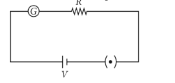
$\begin{aligned} & \text { Then } \begin{aligned} & I_s=\frac{V}{R+G}=\frac{2 V }{(1970+30) \Omega}=\frac{2 V }{2000 \Omega} \\ &=1 \times 10^{-3} A \\ & \therefore \quad \text { For half-scale deflection, } \frac{I_s}{2}=\frac{V}{R^{\prime}+G} \\ & \Rightarrow \quad \frac{1 \times 10^{-3}}{2}=\frac{2}{R^{\prime}+30} \\ & \Rightarrow \quad R^{\prime}+30=4000 \text { or } R^{\prime}=3970 \Omega\end{aligned}\end{aligned}$ View full question & answer→MCQ 381 Mark
A range of galvanometer is ' $V$ ', when $50 \Omega$ resistance is connected in series. Its range gets doubled when $500 \Omega$ resistance is connected in series. Galvanometer resistance is
- A
$100 \Omega$
- B
$200 \Omega$
- C
$300 \Omega$
- ✓
$400 \Omega$
AnswerCorrect option: D. $400 \Omega$
(d) : To convert MCG into voltmeter, high resistance $(R)$ is connected in series and given by
$
\begin{aligned}
& R=\frac{V}{I_g}-G \\
& \text { Case I }: R_1=50 \Omega, V_1=V \\
& \therefore \quad 50=\frac{V}{I_g}-G \quad \ldots \text { (i) } \\
& \text { Case II }: R_2=500 \Omega, V_2=2 V, G=? \\
& \therefore \quad 500=\frac{2 V}{I_g}-G \\
& 500=2(50+G)-G \quad[\text { Using eqn. (i) }] \\
& 500=100+2 G-G \quad \therefore G=400 \Omega .
\end{aligned}
$
Case II: $R_2=500 \Omega, V_2=2 V , G=$ ?
View full question & answer→MCQ 391 Mark
In cyclotron, for a given magnet, radius of the semicircle traced by positive ion is directly proportional to ( $v=$ velocity of positive ion)
- A
$v^{-2}$
- B
$v^{-1}$
- ✓
$v$
- D
$v^2$
Answer(c) : Radius of the semicircle traced by positive ion is given by
$
r=\frac{m v}{q B}
$
where $m$ and $q$ be mass and charge of positive ion. So, for a given magnet, $r \propto v$
View full question & answer→MCQ 401 Mark
A very long solenoid has 8400 windings and a length of $7 m$. If the field inside is $2 ir x$ iO T, the current in the windings is about $\left[\mu_0 / 4 \pi=10^{-7} T \cdot m / A \right]$
- A
$0.42 A$
- B
$0.83 A$
- ✓
$4.2 A$
- D
$8.3 A$.
AnswerCorrect option: C. $4.2 A$
(c): $4.2 A$
View full question & answer→MCQ 411 Mark
A toroid with a circular cross section has a current $I$ in its windings. The total number of windings is $N$. The total current through an Amperian loop of radius $r$ equal to the mean radius of the toroid is
- A
- B
- ✓
$NI$
- D
$\frac{N I}{2 \pi r}$
View full question & answer→MCQ 421 Mark
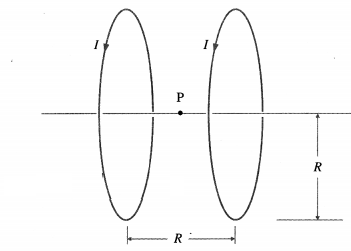
Two circular coaxial coils, each of N turns and radius R, are separated by a distance R. They carry equal currents I in the same direction. If the magnetic induction at P, on the common axis and midway between the coils, due to the left hand coil is B, then the total induction at P is
- ✓
$2 B$
- B
$B$
- C
$\frac{1}{2} B$
- D
View full question & answer→MCQ 431 Mark
Two diametrically opposite points of a uniform metal ring (radius, R) are connected to the terminals of a battery. If the current drawn from the battery is 1 , the magnetic induction at the centre of the ring has a magnitude
- A
$\frac{\mu_0 I}{R}$
- B
$\frac{\mu_0 I}{2 R}$
- C
$\frac{\mu_0 I}{4 R}$
- ✓
View full question & answer→MCQ 441 Mark
Three straight, parallel wires are coplanar and perpendicular to the plane of the page. The currents $I_1$ and $I_3$ are directed out of the page. If the wire $3$ experiences no force due to the currents $I_1$ and $I_2,$ then the current in the wire $2$ is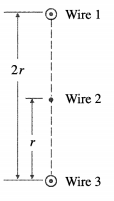
- A
$I_2=2 l_1$ and directed into the page
- ✓
$I_2=0.5 l_1$ and directed into the page
- C
$I_2=2 l_1$ and directed out of the page
- D
$l _2=0.5 l _1$ and directed out of the page.
AnswerCorrect option: B. $I_2=0.5 l_1$ and directed into the page
$I_2=0.5 l_1$ and directed into the page
View full question & answer→MCQ 451 Mark
Two circular coils 1 and 2 have both their radi and number of turns in the ratio $1: 2$. If the currents in them are in the ratio $2: 1$, the magnitudes of the magnetic inductions at the centres of the coils are in the ratio
- A
$1: 1$
- ✓
$2: 1$
- C
$1: 2$
- D
$1: 8$.
AnswerCorrect option: B. $2: 1$
$2: 1$
View full question & answer→MCQ 461 Mark
A wire of length $L$ is first formed into a loop of one turn and then as a loop of two turns. The same current $I$ is passed through the wire in the two cases. The ratio of the magnitude of the magnetic field induction at the centre of the single-turn loop to that at the centre of the double-turn loop is
- A
- B
- C
$\frac{1}{2}$
- ✓
$\frac{1}{4}$
AnswerCorrect option: D. $\frac{1}{4}$
$\frac{1}{4}$
View full question & answer→MCQ 471 Mark
Two long, straight, parallel wires are $5 \ cm$ apart and carry currents $I_1$ and $I_2$ in the same direction. If $2I_1 = 3I_2,$ then at a point $P, 2 \ cm$ from wire $2,$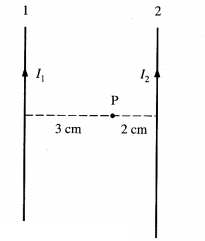
- A
$\overrightarrow{B_1}=\overrightarrow{B_2}$
- ✓
$\overrightarrow{B_1}=-\overrightarrow{B_2}$
- C
$\frac{B_1}{B_2}=\frac{9}{4}$
- D
$\frac{B_1}{B_2}=\frac{4}{9}$.
AnswerCorrect option: B. $\overrightarrow{B_1}=-\overrightarrow{B_2}$
$\overrightarrow{B_1}=-\overrightarrow{B_2}$
View full question & answer→MCQ 481 Mark
Two points, $A$ and $B$, are at distances $r_A$ and $r_B$ from a long, straight, current-carrying conductor. If $r _{ B }=2 r _{ A }$, the magnitudes of the magnetic inductions at the two points are related by
- A
$B_A=B_B$
- B
$B_A=2 B_B$
- C
$B_A=4 B_B$
- D
$B_B=2 B_A$
Answer$B_{ A }=2 B_{ B }$
View full question & answer→MCQ 491 Mark
The magnetic potential energy of a coil of dipole moment $\vec{\mu}$ and area vector $\vec{A}$ placed in a magnetic $\vec{B}$ is maximum for which of the following cases?
Answer$\vec{B} \uparrow \downarrow \vec{A}$
View full question & answer→MCQ 501 Mark
When a current is passed through a suspended moving-coil galvanometer, the deflection of the coil is 9 . Then, in the usual notation, the expression $\frac{\mu B}{\theta}$ is
- A
the torsion constant of the helical spring
- B
the magnetic dipole moment of the current-carrying coil
- C
the current through the coil
- ✓
the torsion constant of the suspension fibre.
AnswerCorrect option: D. the torsion constant of the suspension fibre.
the torsion constant of the suspension fibre.
View full question & answer→MCQ 511 Mark
When a current is passed through a suspended moving-coil galvanometer, the deflection of the coil is arrested by
- ✓
the elastic torsion of the suspension fibre
- B
the elastic winding of the helical spring
- C
the friction at the point of suspension
- D
the changing magnetic flux through the coil.
AnswerCorrect option: A. the elastic torsion of the suspension fibre
the elastic torsion of the suspension fibre
View full question & answer→MCQ 521 Mark
A rectangular coil of dipole moment fi, free to rotate, is placed in a uniform magnetic field B with its plane parallel to the magnetic lines of force. Then, the coil will
AnswerCorrect option: C. not experience any torque
not experience any torque
View full question & answer→MCQ 531 Mark
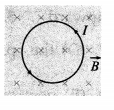
A current loop of magnetic dipole moment 0.1 A-m2 is oriented with the plane of the loop perpendicular to a uniform 1.50 T magnetic field, as shown. The torque that the magnetic field exerts on the current loop is
- A
$0.15 N \cdot m$
- ✓
$0.075 N \cdot m$
- C
$-0.075 N \cdot m$
- D
$-0.15 N \cdot m$.
AnswerCorrect option: B. $0.075 N \cdot m$
$0.075 N \cdot m$
View full question & answer→MCQ 541 Mark
A circular loop of area $\sqrt{2} cm ^2$ and carrying a current of $10 \mu A$ is placed in a magnetic field $\vec{B}$ with its plane parallel to $\vec{B}(B=15 mT )$. When the loop has rotated through an angle of $45^*$, the magnitude of the torque exerted on this loop is
- A
- ✓
$15 \times 10^{-12} N - m$
- C
$15 \times 10^{-8} N \cdot m$
- D
$15 \times 10^{-2} N \cdot m$
AnswerCorrect option: B. $15 \times 10^{-12} N - m$
$15 \times 10^{-12} N - m$
View full question & answer→MCQ 551 Mark
A 30-turn coil of diameter $2 cm$ carries a current of $10 mA$. When it is placed in a uniform magnetic field of $0.05 T$, the magnitude of the maximum torque that could be exerted on the coil by the magnetic field is
- A
$1.88 \times 10^{-5 }{N \cdot m$
- ✓
$4.7 \times 10^{-6} N - m$
- C
$4.7 \times 10^{-7} N \cdot m$
- D
$1.88 \times 10^{-8} N - m$.
AnswerCorrect option: B. $4.7 \times 10^{-6} N - m$
$4.7 \times 10^{-6} N - m$
View full question & answer→MCQ 561 Mark
A straight wire along the $y$-axis carries a current of $4 A$. The wire is placed in a uniform magnetic field $(0.02 T)(\hat{i}+\hat{j})$. If the current in the wire is directed towards the negative $y$ axis, the force per unit length on the wire is
- A
- B
$-(0.08 N / m ) \hat{ k }$
- C
$(0.08 N / m )(\hat{ i }-\hat{ j })$
- ✓
$(0.08 N / m ) \hat{ k }$
AnswerCorrect option: D. $(0.08 N / m ) \hat{ k }$
$(0.08 N / m ) \hat{ k }$
View full question & answer→MCQ 571 Mark
A charged particle enters a uniform magnetic field initially travelling perpendicular to the field lines and is bent in a circular arc of radius $R$. If the particle had the same charge but: double the mass and were travelling twice as fast, the radius of its circular arc would be
- A
$2 R$
- ✓
$4 R$
- C
$R$
- D
$\frac{1}{4} R$
View full question & answer→MCQ 581 Mark
The following four cases show a positive charge moving into a magnetic field $\vec{B}$ with velocity $\vec{v}$. In which of the cases are the forces opposite in direction?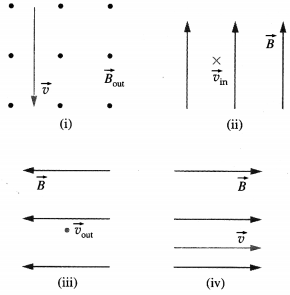
View full question & answer→MCQ 591 Mark
A charged particle moving with a velocity $\vec{v}$ enters a region of uniform magnetic field $\vec{B}$ such that the pitch of the resulting helical motion is equal to the radius of the helix. The angle between $\vec{v}$ and $\vec{B}$ is
AnswerCorrect option: A. $\tan ^{-1} 2 \pi$
$\tan ^{-1} 2 \pi$
View full question & answer→MCQ 601 Mark
$A$ charged particle moving with a velocity $\vec{v}$ enters a region of uniform magnetic field $\vec{B}$. If the velocity has a component parallel to $\vec{B}$, which of the following quantities is independent of $|\vec{v}|$ ?
AnswerCorrect option: A. Period T of its circular motion
Period T of its circular motion
View full question & answer→MCQ 611 Mark
If $R$ is the radius of the dees and $B$ the magnitude of the magnetic field induction in which positive charges ( $q$ ) of mass $m$ escape from the cyclotron, then their maximum speed $v_{\max }$ is
- A
$\frac{q R}{B m}$
- B
$\frac{q m}{B R}$
- ✓
$\frac{q B R}{m}$
- D
$\frac{m}{q B R}$
AnswerCorrect option: C. $\frac{q B R}{m}$
$\frac{q B R}{m}$
View full question & answer→MCQ 621 Mark
Cyclotron cannot accelerate
MCQ 631 Mark
In a cyclotron, charged particles are accelerated by
- A
the electrostatic deflector plate
- B
the electric field in the dees
- C
the magnetic field in the dees
- ✓
the p.d. across the gap between the dees.
AnswerCorrect option: D. the p.d. across the gap between the dees.
the p.d. across the gap between the dees.
View full question & answer→MCQ 641 Mark
A doubly ionized helium nucleus (charge $=3.2 \times 10^{-19} C$ ) enters a region of uniform magnetic field with a velocity $\left(10^3 m / s \right) \hat{ 1 }$. The magnetic induction in the region is $20 mT$ directed towards the positive $x$-axis. The force on the ion is
View full question & answer→ (2)
(2)


