Question types

Magnetic Fields due to Electric Current question types

190 questions across 4 question groups — pick any mix to generate a Physics paper with step-by-step answer keys.

190
Questions
4
Question groups
5
Question types
Sample Questions

Magnetic Fields due to Electric Current questions

One sample from each question group in this chapter. Select any group above to see the full set with answer keys.

A charged particle is in motion having initial velocity $\vec{V}$ when it enter into a region of uniform magnetic field perpendicular to $\vec{V}$. Because of the magnetic force the kinetic energy of the particle will
  • remain uncharged.
  • B
    get reduced.
  • C
    increase.
  • D
    be reduced to zero.

Answer: A.

View full solution
A conducting thick copper rod of length $1$ m carries a current of $15$ A and is located on the Earth's equator. There the magnetic flux lines of the Earth's magnetic field are horizontal, with the field of $1.3 \times 10-4 T$, south to north. The magnitude and direction of the force on the rod, when it is oriented so that current flows from west to east, are
  • A
    $14 \times 10-4 N$, downward.
  • $20 \times 10-4 N$, downward.
  • C
    $14 \times 10-4 N$, upward.
  • D
    $20 \times 10-4 N$, upward.

Answer: B.

View full solution
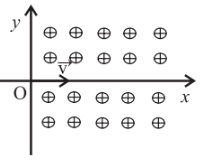
A proton enters a perpendicular uniform magnetic field B at origin along the positive x axis with a velocity v as shown in the figure. Then it will follow the following path. [The magnetic field is directed into the paper].

Image

  • A
    It will continue to move along positive x axis.
  • B
    It will move along a curved path, bending towards positive x axis.
  • It will move along a curved path, bending towards negative y axis.
  • D
    It will move along a sinusoidal path along the positive x axis.

Answer: C.

View full solution
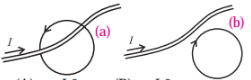
ii) Figure $a$, b show two Amperian loops associated with the conductors carrying current I in the sense shown. The $\oint \vec{B} \cdot d \vec{l}$ in the cases a and $b$ will be, respectively,

Image

  • $-\mu_a I, 0$
  • B
    $\mu_\theta I, 0$
  • C
    $0, \mu_0 I$
  • D
    $0,-\mu_0 I$

Answer: A.

View full solution
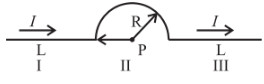
A conductor has 3 segments; two straight and of length L each and a semicircular with radius R. It carries a current I. What is the magnetic field B at point P?

Image
  • A
    $\frac{\mu_0}{4 \pi} \frac{I}{R}$
  • B
    $\frac{\mu_0}{4 \pi} \frac{I}{R^2}$
  • $\frac{\mu_0}{4} \frac{I}{R}$
  • D
    $\frac{\mu_0}{4} \frac{I}{v}$

Answer: C.

View full solution
Let us look at a charged particle which is moving in a circle with a constant speed. This is uniform circular motion that you have studied earlier. Thus, there must be a net force acting on the particle, directed towards the centre of the circle. As the speed is constant, the force also must be constant, always perpendicular to the velocity of the particle at any given instant of time. Such a force is provided by the uniform magnetic field $\vec{B}$ perpendicular to the plane of the circle along which the charged particle moves.
View full solution
So far we have used the constant $\mu 0$ everywhere. This means in each such case, we have carried out the evaluation in free space (vacuum). $\mu 0$ is the permeability of free space.
View full solution
 A very long straight wire carries a current 5.2 A. What is the magnitude of the magnetic field at a distance 3.1 cm from the wire? $\left[\mu_0=4 \pi \times 10^{-7} T \cdot m / A \right]$
View full solution
Calculate the value of magnetic field at a distance of $2 \ cm$ from a very long straight wire carrying a current of $5 \ A$ (Given: $\mu_0$ $\left.=4 \pi \times 10^{-7} Wb / Am \right)$.
View full solution
You must have noticed high tension power transmission lines, the power lines on the big tall steel towers. Strong magnetic fields are created by these lines. Care has to be taken to reduce the exposure levels to less than 0.5 milligauss (mG).
View full solution
How does the coil in a motor rotate by a full rotation? In a motor, we require continuous rotation of the current carrying coil. As the plane of the coil tends to become parallel to the magnetic field $\vec{B}$, the current in the coil is reversed externally. Referring to Fig. the segment ab occupies the position cd. At this position of rotation, the current is reversed. Instead of from $b$ to $a$, it flows from $a$ to $b$, force $\vec{F}_{ m }$ continues to act in the same direction so that the torque continues to rotate the coil. The reversal of the current is achieved by using a commutator which connects the wires of the power supply to the coil via carbon brush contacts.
View full solution
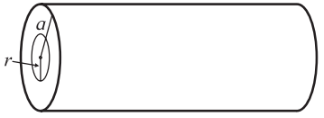
Figure shows a section of a very long cylindrical wire of diameter a, carrying a current I. The current density which is in the direction of the central axis of the wire varies linearly with radial distance r from the axis according to the relation $J = J _{ o } r / a$. Obtain the magnetic field B inside the wire at a distance r from its centre.
$Jr$


Image
View full solution
Two long parallel wires going into the plane of the paper are separated by a distance $R$, and carry a current I each in the same direction. Show that the magnitude of the magnetic field at a point $P$ equidistant from the wires and subtending angle $\theta$ from the plane containing the wires, is $B =\frac{\mu_0}{\pi} \frac{I}{R} \sin 2 \theta$ What is the direction of the magnetic field?
View full solution
Using electrostatic analogue, obtain the magnetic field $\vec{B}_{\text {equator }}$ at a distance $d$ on the perpendicular bisector of a magnetic dipole of magnetic length $2 l$ and moment $\vec{M}$. For far field, verify that
$\vec{B}_{\text {equator }}=\left(\frac{\mu_0}{4 \pi}\right) \frac{-\vec{M}}{\left(d^2+l^2\right)^{3 / 2}}$
View full solution

Generate a Magnetic Fields due to Electric Current paper free

Pick question groups from the list above, set marks and difficulty, and export a branded PDF with step-by-step answer keys. First 3 chapters free — no signup.

Download App