Questions

Answer the following in Brief

Take a timed test

29 questions · self-marked practice — reveal the answer and mark yourself.

Question 13 Marks
Effective magneton numbers for iron group ions (No. of Bohr magnetons)
Ion Electron configuration Magnetic moment (in terms of /$i_B$)
$Fe^3 +$ [Ar] $3s^23p^63d^5$ $5.9$
$Fe^2^+$ [Ar] $3s^23p^63d^6$ $5.4$
$Co^2^+$​​​​​​​ [Ar] $3s^23p^63d^7$ $4.8$
$n^{2+}$​​​​​​​ [Ar] $3s^23p^63d^8$ $3.2$
(Courtsey: Introduction to solid state physics by Charles Kittel, pg. $306$ )
These magnetic moments are calculated from the experimental value of magnetic susceptibility. In several ions the magnetic moment is due to both orbital and spin angular momenta.
Answer
In terms of Bohr magneton $(µ_B)$, the effective magnetic moments of some iron group ions are as follows. In several cases, the magnetic moment is due to both orbital and spin angular momenta.
Ion Configuration Effective magnetic moment in terms of
Bohr magneton (B.M) (Expreimental
values)
$Fe^(3)+$ $3d^(5)$ $5.9$
$Fe^(2+)$ $3d^(6)$ $5.4$
$Co^(2+)$ $3d^(7)$ $4.8$
$n^(2+)$ $3d^(8)$ $3.2$
View full question & answer
Question 23 Marks
Exchange Interaction: This exchange interaction in stronger than usual dipole-dipole interaction by an order of magnitude. Due to this exchange interaction, all the atomic dipole moments in a domain get aligned with each other. Find out more about the origin of exchange interaction.
Answer
Exchange Interaction :
Quantum mechanical exchange interaction be-tween two neighbouring spin magnetic moments in a ferromagnetic material arises as a consequence of the overlap between the magnetic orbitals of two adjacent atoms. The exchange interaction in particular for 3d metals is stronger than the dipole-dipole interaction by an order of magnitude. Due to this, all the atomic dipole moments in a domain get aligned with each other and each domain is spontaneously magnetized to saturation. (Quantum mechanics and exchange interaction are beyond the scope of the syllabus.)
View full question & answer
Question 33 Marks
What is soft magnetic material?
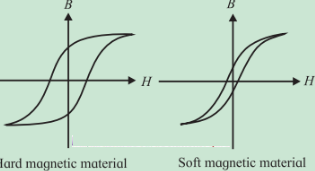
Soft ferromagntic materials can be easily magnetized and demagnetized.

Image
Hysteresis loop for hard and soft ferramagnetic materials.

Answer
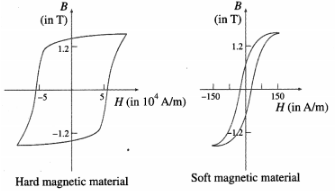
A soft magnetic material, usually iron-based, has high permeability, low retentivity and low coercivity. In other words, it does not have appreciable hysteresis, i.e., its hysteresis loop is very narrow. Such a material magnetizes and demagnetizes more easily, by small external fields.

Image

View full question & answer
Question 43 Marks
You have already studied in earlier classes that a short bar magnet suspended freely always aligns in North South direction. Now if you try to forcefully move and bring it in the direction along East West and leave it free, you will observe that the magnet starts turning about the axis of suspension. Do you know from where does the torque which is necessary for rotational motion come from? (as studied in rotational dynamics a torque is necessary for rotational motion).
Answer
Suspend a short bar magnet such that it can rotate freely in a horizontal plane. Let it come to rest along the magnetic meridian. Rotate the magnet through some angle and release it. You will see that the magnet turns about the vertical axis in trying to return back to its equilibrium position along the magnetic meridian. Where does the torque for the rotational motion come from?

Take another bar magnet and bring it near the suspended magnet resting in the magnetic meridian. Observe the interaction between the like and unlike poles of the two magnets facing each other. Does the suspended magnet rotate continuously or rotate through certain angle and remain stable? Note down your observations and conclusions.

View full question & answer
Question 53 Marks
Explain one application of electromagnet.
Answer
Applications of an electromagnet:
  1. Electromagnets are used in electric bells, loud speakers and circuit breakers.
  2. Large electromagnets are used in junkyard cranes and industrial cranes to lift iron scraps.
  3. Superconducting electromagnets are used in MRI and NMR machines, as well as in particle accelerators of cyclotron family.
  4. Electromagnets are used in data storage devices such as computer hard disks and magnetic tapes.
View full question & answer
Question 63 Marks
What does the hysteresis loop represents?
Answer
A magnetic hysteresis loop is a closed curve obtained by plotting the magnetic flux density B of a ferromagnetic material against the corresponding magnetizing field H when the material is taken through a complete magnetizing cycle. The area enclosed by the loop represents the hysteresis loss per unit volume in taking the material through the magnetizing cycle.
View full question & answer
Question 73 Marks
Obtain and expression for orbital magnetic moment of an electron rotating about the nucleus in an atom.
Answer

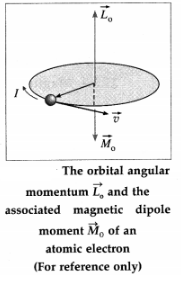
In the Bohr model of a hydrogen atom, the electron of charge - e performs
a uniform circular motion around the positively charged nucleus. Let $r, v$ and $T$ be the orbital radius, speed and period of motion of the electron. Then,
$
\mathrm{T}=\frac{2 \pi r}{v}
$
Therefore, the orbital magnetic moment asso-ciated with this orbital current loop has a magnitude,
$
\mathrm{l}=\frac{e}{T}=\frac{e v}{2 \pi r}
$
Therefore, the magnetic dipole moment associated with this electronic current loop has a magnitude
$\mathrm{M}_0=$ current $\times$ area of the loop
$
=I\left(\pi r^2\right)=\frac{e v}{2 \pi r} \times \pi r^2=\frac{1}{2} e v r
$
Multiplying and dividing the right hand side of the above expression by the electron mass $m_e$,
$
\mathrm{M}_0=\frac{e}{2 m_{\mathrm{e}}}\left(\mathrm{m}_{\mathrm{e}} \mathrm{Vr}\right)=\frac{e}{2 m_{\mathrm{e}}} L_0
$
where $L_0=m_e v r$ is the magnitude of the orbital angular momentum of the electron. $M$ is opposite to $\vec{L}_0$.
$
\therefore \vec{M}_0=-\frac{e}{2 m_e} \overrightarrow{L_0}
$
which is the required expression.
According to Bohr's second postulate of stationary orbits in his theory of hydrogen atom, the angular momentum of the electron in the nth stationary orbit is equal to $\mathrm{n} \frac{h}{2 \pi}$, where $\mathrm{h}$ is the Planck constant and $\mathrm{n}$ is a positive integer. Thus, for an orbital electron,
Image
$
\mathrm{L}_0=\mathrm{m}_{\mathrm{e}} \mathrm{vr}=\frac{n h}{2 \pi}
$
Substituting for $L_0$ in Eq. (4),
$
\mathrm{M}_0=\frac{e n h}{4 \pi m_{\mathrm{e}}}
$
For $\mathrm{n}=1, \mathrm{M}_0=\frac{e n h}{4 \pi m_{\mathrm{e}}}$
The quantity $\frac{e n h}{4 \pi m_{\mathrm{e}}}$ is a fundamental constant called the Bohr magneton, $\mu_B \cdot \mu_B=9.274 \times 10^{-24} \mathrm{~J} / \mathrm{T}\left(\right.$ or $\left.A \cdot \mathrm{m}^2\right)=5.788 \times 10^{-5} \mathrm{eV} / \mathrm{T}$.
[ Notes : (1) Magnetic dipole moment is conventionally denoted by $\mu$. (2) The magnetic moment of an atom is expressed in terms of Bohr magneton $\left(v \mu_{\mathrm{B}}\right)$. (3) According to quantum mechanics, an atomic electron also has an intrinsic spin angular momentum and an associated spin magnetic moment of magnitude $\mu_5$. It is this spin magnetic moment that gives rise to magnetism in matter. (4) The total magnetic moment of the atom is the vector sum of its orbital magnetic moment and spin magnetic moment.]
View full question & answer
Question 83 Marks
Discuss the Curie law for paramagnetic material.
Answer
Curie’s law : The magnetization of a paramagnetic material is directly proportional to the external magnetic field and inversely proportional to the absolute temperature of the material.

If a paramagnetic material at an absolute temperature T is placed in an external magnetic field of induction , the magnitude of its magnetization
$
M _z \propto \frac{B_{\text {ext }}}{T} \therefore M _z=C \frac{B_{\text {ext }}}{T}
$
where the proportionality constant $C$ is called the Curie constant.
[Notes : (1) The above law, discovered experimentally in 1895 by Pierre Curie (1859-1906) French physcist, is true only for values of Bext/ $T$ below about 0.5 tesla per kelvin.
(2) $[ C ]=\left[ M _z \cdot T \right] /\left[ B _{ ext }\right]=\left[ L ^{-1} I \cdot \Theta\right] /\left[ MT ^{-2} I ^{-1}\right]$
$
=\left[ M ^{-1} L ^{-1} T ^2 I ^2{ }^{\Theta}\right]
$
where $\Theta$ denotes the dimension of temperature.]

View full question & answer
Question 93 Marks
What should be retentivity and coercivity of permanent magnet?
Answer
A permanent magnet should have a large zero-field magnetization and should need a very large reverse field to demagnetize. In other words, it should have a very broad hysteresis loop with high retentivity and very high coercivity.
View full question & answer
Question 103 Marks
Which property of soft iron makes it useful for preparing electromagnet?
Answer
An electromagnet should become magnetic when a current is passed through its coil but should lose its magnetism once the current is switched off. Hence, the ferromagnetic core (usually iron-based) used for an electromagnet should have high permeability and low retentivity, i.e., it should be magnetically ‘soft’.
View full question & answer
Question 113 Marks
What is a magnetically hard material?
Answer
A ‘hard’ magnetic material, such as $\text{ALNICO} ($an alloy of aluminium, nickel and cobalt$),$ has high permeability, high retentivity and very high coercivity$-$ of the orders of $1$ tesla and $10^4$ ampere per metre, respectively. In other words, it has a large zero$-$field magnetization, and large reverse field needed to demagnetize. Its hysteresis loop is very broad. Such a material can be made into a permanent magnet, that is, its magnetization will persist indefinitely if it is subsequently exposed only to weak magnetic fields.
View full question & answer
Question 123 Marks
What is an electromagnet?
Answer
An electromagnet is an insulated coil wrapped around a ferromagnetic core $($usually a soft iron$)$ of high permeability and low retentivity. When a current is passed through the coil$-a$ solenoid or toroid, the ferromagnetic material magnifies the magnetic field of the coil, the magnification factor being the relative permeability$ (\mu / \mu _0)$ of the core. The magnetic field of the current$-$carrying coil magnetizes the core material, thereby producing a much larger field than the coil would produce by itself.
View full question & answer
Question 133 Marks
What is a ‘soft’ magnetic material?###What is meant by a ‘soft’ iron?
Answer
A soft magnetic material, usually iron-based, has high permeability, low retentivity and low coercivity. In other words, it does not have appreciable hysteresis, i.e., its hysteresis loop is very narrow. Such a material magnetizes and demagnetizes more easily, by small external fields.
View full question & answer
Question 143 Marks
Which magnetic materials have
(i) relative permeability > 1
(ii) relative permeability <1?
Answer
(i) Both paramagnetic and ferromagnetic materials have relative permeability (μr) greater than 1. μr is only slightly greater than 1 for a paramagnetic material. μr is very high for a ferromagnetic material and is a function of the magnetizing field (also called the magnetic field intensity).(ii) μr is slightly less than 1 for a diamagnetic material.
View full question & answer
Question 153 Marks
The relative permeability of two materials are $0.999$ and $1.001.$ Identify the materials.
Answer
A material with relative permeability $\mu _r \leq 1$ is diamagnetic while the one with $\mu _r \geq 1$ is paramagnetic.
View full question & answer
Question 163 Marks
Name two materials that have small and positive magnetic susceptibility.
Answer
Platinum and Chromium have small and positive magnetic susceptibility.
View full question & answer
Question 173 Marks
Give one example each of a diamagnetic material and a paramagnetic material.
Answer
Bismuth is a diamagnetic material and aluminium is a paramagnetic material.
View full question & answer
Question 183 Marks
Name two materials that have negative magnetic susceptibility.
Answer
Copper and gold have negative magnetic susceptibility.
View full question & answer
Question 193 Marks
What is diamagnetism?
Answer
A material which is weakly repelled by a magnet and whose atoms/molecules do not possess a net magnetic moment in the absence of an external magnetic field is called a diamagnetic material. When a diamagnetic material is placed in a mag-netic field, it acquires a small net induced magnetic moment directed opposite to the field. The induced magnetism exhibited by such materials is called diamagnetism.
View full question & answer
Question 203 Marks
Find the magnetization of a bar magnet of length $10 \ cm$ and cross-sectional area $4 \ cm ^2$, if the magnetic moment is $2 A \cdot m ^2$.
Answer
Data $: L =0.1 m , A =4 \times 10^{-4} m ^2, M =2 A \cdot m ^2$
Magnetization, $M _{ z }=\frac{M}{V}$
$=\frac{M}{L A}=\frac{2}{(0.1)\left(4 \times 10^{-4}\right)}$
$=\frac{10^4}{0.2}$
$=5 \times 10^4 A / m$
View full question & answer
Question 213 Marks
A bar magnet made of steel has magnetic moment $2.5 A \cdot m ^2$ and mass $6.6 \times 10^{-3} \ kg$. Given that the density of steel is $7.9 \times 10^3 \ kg / m ^3$, find the intensity of magnetization of the magnet. $(2$ marks $)$
Answer
Data : $M=2.5 A \cdot m ^2, $
$m =6.6 \times 10^{-3} \ kg , $
$\rho=7.9 \times 10^3 \ kg / m ^3$
Volume, $V=\frac{m}{\rho}$
The intensity of magnetization of the magnet is
$M _z== M \cdot \frac{\rho}{m}$
$=2.5 \times \frac{M}{V}=2.992 \times 10^6 A / m$
$[$Note : Intensity of magnetization $=$ magnetization. $]$
View full question & answer
Question 223 Marks
Write the relation between relative permeability and magnetic susceptibility.
Answer
$\mu_r=1-\chi_m$, where $\mu_r$ is the relative permeability and $\chi_m$ is the magnetic susceptibility of a substance.
View full question & answer
Question 233 Marks
A bar magnet (volume $1.5 \times 10^{-5} 5 m ^3$ ) has a uniform magnetization of 6000 Aim. What is its magnetic dipole moment?
Answer
$M _{ z }=$
$
\therefore M = M _{ z } V =(6000)\left(1.5 \times 10^{-5}\right)
$
$=9 \times 10^{-2} A \cdot m ^2$ is the magnetic dipole moment of the magnet.
View full question & answer
Question 243 Marks
A coil has $1000$ turns, each of area $0.5 m ^2$. What is the magnetic moment of the coil when it carries a current of $1 \ mA$ ?
Answer
Magnetic moment $M = \ce{NIA}$
$=1000 \times 1 \times 10^{-3} \times 0.5$
$=0.5 A \cdot m ^2$
View full question & answer
Question 253 Marks
The frequency of revolution of the electron in the second Bohr orbit in the hydrogen atom is $8.22 \times 10^{14} Hz$. What is the corresponding electric ' current? $[e =1.6 \times 10^{-19} C ]$
Answer
$\text { I }=\frac{e}{T}=\text { ef }$
$=\left(1.6 \times 10^{-19}\right)\left(8.22 \times 10^{14}\right)$
$=1.315 \times 10^{-4} A$
is the corresponding electric current.
View full question & answer
Question 263 Marks
If the frequency of revolution of a proton $\left( q =1.6 \times 10^{-19} C \right)$ in a uniform magnetic induction is $10^6 \ Hz,$ what is the corresponding electric current?
Answer
$\text { I }=\frac{q}{T}=q f=\left(1.6 \times 10^{-19}\right)\left(10^6\right)$
$=1.6 \times 10^{-13} A$
is the corresponding electric current.
View full question & answer
Question 273 Marks
What is the magnetic moment of an electron due to its orbital motion?
Answer
The orbital magnetic moment of an electron, of charge $e$ and revolving with speed $v$ in an orbit of radius $r$, is $\frac{1}{2}$ evr.
View full question & answer
Question 283 Marks
As the electron revolves in the second Bohr orbit in the hydrogen atom, the corresponding current is $($about$) 1.3 \times 10^{-4} A$. If the area of the orbit is $($about$) 1.4 \times 10^{-19} m ^2$, what is the $($approximate$)$ equivalent magnetic moment?
Answer
$M=I A=\left(1.3 \times 10^{-4}\right)\left(1.4 \times 10^{-19}\right)$
$=1.82 \times 10^{-23} A \cdot m ^2$   is the $($approximate$)$ equivalent magnetic moment. 
View full question & answer
Question 293 Marks
A current-carrying coil with magnetic moment $\vec{M}\left( M =5 A \cdot m ^2\right)$ is placed in a uniform magnetic field of induction $\vec{B}\left( B =0.2 Wb / m ^2\right)$ such that the angle between $\vec{M}$ and $\vec{B}$ is $30^{\circ}$. What is the torque acting on the coil?
Answer
$\tau= MB \sin \theta=(5)(0.2) \sin 30^{\circ}=0.5 N \cdot m$ is the torque acting on the coil.
View full question & answer