- Motion of a car on a banked road:
For the vehicle to go round the curved track at a reasonable speed without skidding, the greater centripetal force is managed for it by raising the outer edge of the track a little above the inner edge. It is called banking of circular tracks.
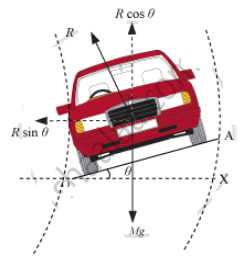
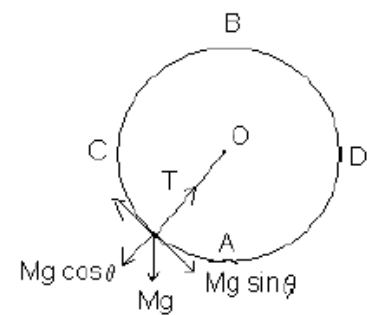
Consider a vehicle of weight Mg, moving round a curved path of radius r, with a speed v, on a road banked through angleθ.
The vehicle is under the action of the following forces:
- The weight Mg acting vertically downwards
- The reaction R of the ground to the vehicle, acting along the normal to the banked road OA in the upward direction
The vertical component R cos θ of the normal reaction R will balance the weight of the vehicle and the horizontal component R sin θ will provide the necessary centripetal force to the vehicle. Thus,
R cosθ = Mg …(i)
\(R \sin \theta=\frac{M v^2}{r} \ldots \ldots .\). (ii)
On dividing equation (ii) by equation (i), we get
\(\frac{R \sin \theta}{R \cos \theta}=\frac{M v^2 / r}{M} g\)
\(\tan \theta=\frac{v^2}{r g}\)
As the vehicle moves along the circular banked road OA, the force of friction between the road and the tyres of the vehicle, F = μR, acts in the direction AO.
The frictional force can be resolved into two components:
- μ R sinθ in the downward direction
- μ R cosθ in the inward direction
Since there is no motion along the vertical,
R cos θ = Mg + μ R sinθ ……. (iii)
Let vmax be the maximum permissible speed of the vehicle. The centripetal force is now provided by the components R sinθ and μ Mg cosθ, i.e.,
\(R \sin \theta+\mu R \cos \theta=\frac{M v_{\max }^2}{r}\).....(iv)
From equation(iii),we have
Mg = R cosθ (1−μ tanθ)…(v)
Again from equation (iv), we have
\(\frac{M v_{\max }{ }^2}{r}\)
= R cosθ (μ + tanθ) …(vi)
On dividing equation (iv) by (v), we have
\(\frac{v_{\max }^2}{g r}=\frac{\mu+\tan \theta}{1-\tan \theta}\)
\(\Rightarrow v_{\max }=\left(\left(g r \frac{\mu+\tan \theta}{1-\mu \tan \theta}\right)^{1 / 2}\right.\)
Maximum optimum speed depends on:
1) Radius of the curved path,
2) Coefficient of friction
3) angle on inclination
Regards