Questions

5 Mark Question

Take a timed test

3 questions · self-marked practice — reveal the answer and mark yourself.

Question 15 Marks
Construct a frequency distribution table for the following marks obtained by 25 students in a history test in class VI of a school:
9, 17, 12, 20, 9, 18, 25, 17, 19, 9, 12, 9, 18, 17, 19, 20, 25, 9, 12, 17, 19, 19, 20, 9
  1. What is the range of marks?
  2. What is the highest mark?
  3. Which mark is occurring more frequently?
View full question & answer
Question 25 Marks
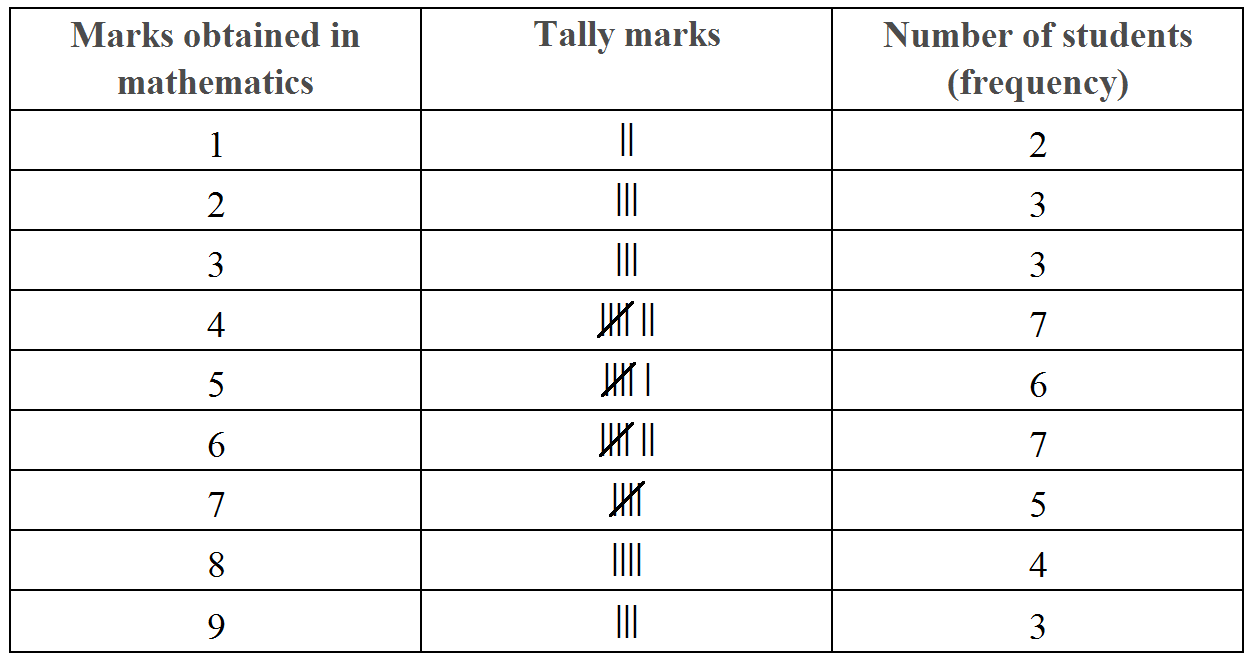
In a mathematics test following marks were obtained by 40 students of class VI. Arrange these marks in a table using, tally marks.
8
1
3
7
6
5
5
4
4
2
4
9
5
3
7
1
6
5
2
7
7
3
8
4
2
8
9
5
8
6
7
4
5
6
9
6
4
4
6
6
  1. Find how many students obtained marks equal to or more than 7?
  2. How many students obtained marks below 4?
Answer
Frequency distribution of the given marks in Mathematics:
  1. Number of students who have obtained marks equal to or more than 7
= frequency of 7 + frequency of 8 + frequency of 9 = 5 + 4 + 3 = 12
  1. Numbers of students who have scored below
4 = Frequency of 1 + frequency of 2 + frequency of 3 = 2 + 3 + 3 = 8
View full question & answer
Question 35 Marks
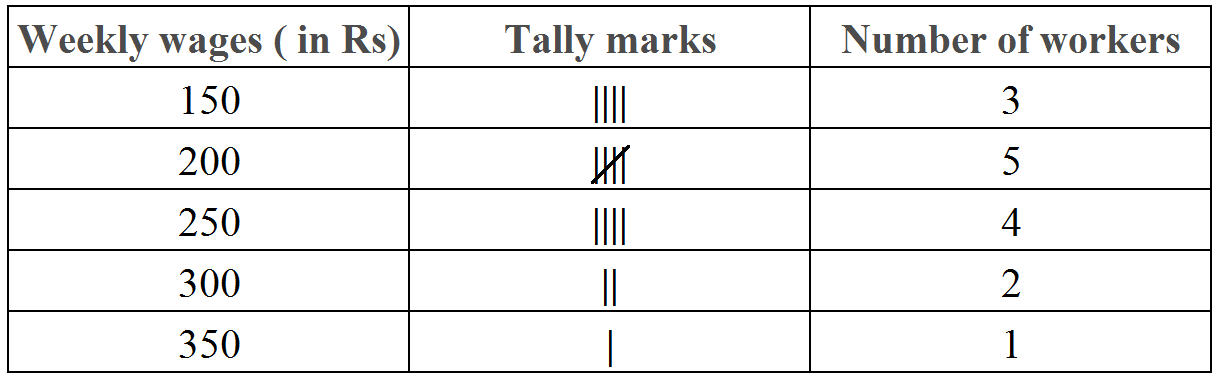
Following figures relate the weekly wages (in Rs.) of 15 workers in a factory:
300, 250, 200, 250, 200, 150, 350, 200, 250, 200, 150, 300, 150, 200, 250
Prepare a frequency table
  1. What is the range in wages (in Rs.)?
  2. How many Workers are getting Rs. 350?
  3. How many of workers are getting the minimum wages?
Answer
Frequency distribution of the given weekly wages of 15 workers:
  1. Minimum wages = Rs. 150 Maximum wage = Rs. 350
Therefore, Range = Maximum wage - Minimum wage
= Rs. 350 - Rs. 150
= Rs. 200
  1. Number of workers getting Rs. 350 = 1 worker
  2. Here, Minimum wages Rs. 150 Number of workers getting Rs. 150 = 3 workers.
Therefore, number of workers getting minimum wages = 3 workers.
View full question & answer