Question
Construct a frequency distribution table for the following marks obtained by 25 students in a history test in class VI of a school:
9, 17, 12, 20, 9, 18, 25, 17, 19, 9, 12, 9, 18, 17, 19, 20, 25, 9, 12, 17, 19, 19, 20, 9
  1. What is the range of marks?
  2. What is the highest mark?
  3. Which mark is occurring more frequently?
Answer

Get the step-by-step solution for this question inside the Vidyadip app.

Get the answer in the app

Need a full question paper?

Generate a complete, print-ready paper with questions like this in minutes — across 16+ boards, with answer keys.

Start Generating Free

Similar questions

Draw a line AB. Take a point P on it. Draw a line passing through P and perpendicular to AB.
Complete the following table:
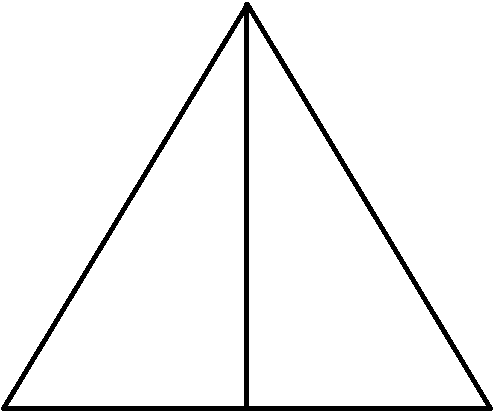
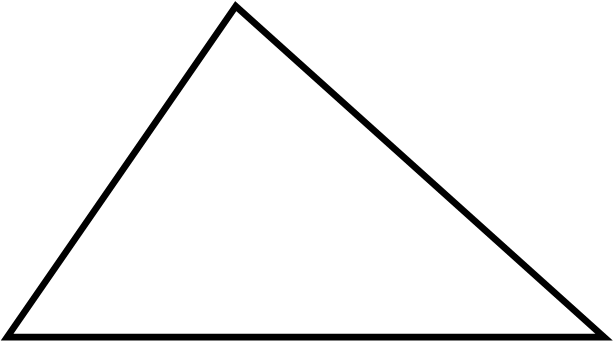
No. Shapes Rough figure Number of lines of symmetry
(i) Scalene triangle 0
(ii) Isosceles triangle 1
(iii) Equilateral triangle    
(iv) Rectangle    
(v) Square    
(vi) Parallelogram    
(vii) Rhombus    
(viii) Line    
(ix) Line segment    
(x) Angle    
(xi) Isosceles trapezium    
(xii) Kite    
(xiii) Arrow head    
(xiv) Semi-circle    
(xv) Circle    
(xvi) Regular pentagon    
(xvii) Regular pentagon    
Convert into improper fractions:
i. $7 \frac{2}{5}$
ii. $5 \frac{1}{6}$
iii. $4 \frac{3}{4}$
iv. $2 \frac{5}{9}$
v. $1 \frac{5}{7}$
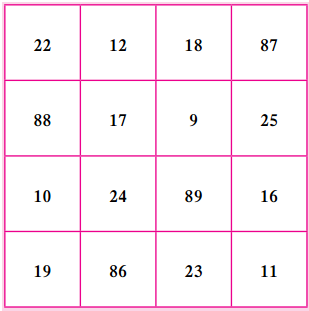
Ramanujan’s Magic square.

Image

  • Add the four numbers in the rows, the columns and along the diagonals of this square.
  • What is the sum?
  • Is it the same every time?
  • What is the peculiarity?
  • Look at the numbers in the first row, 22 – 12 – 1887. Find out why this date is special.

Obtain and read a biography of the great Indian mathematician Srinivasa Ramanujan.

Draw a line AB and take two points C and E on opposite sides of AB. Through C, draw $\text{CD}\perp\text{AB}$ and through E draw $\text{EF}\perp\text{AB}.$ Using ruler and compassed.
Draw a line AB. Take a point P outside it. Deaw a line passing through P and perpendicular to AB.
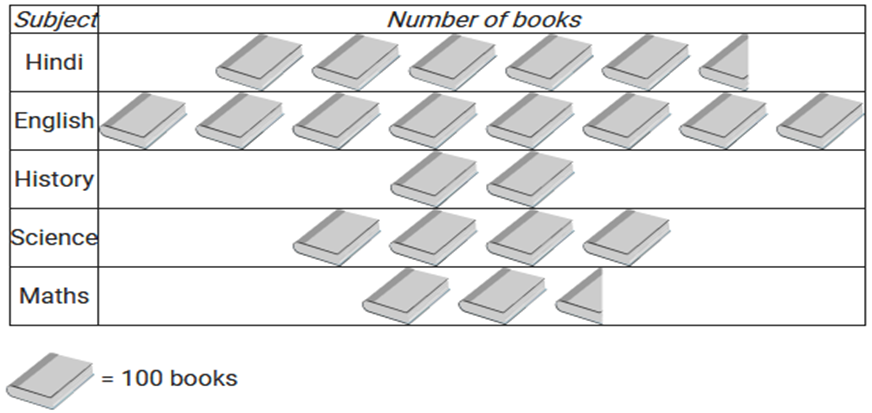
The pictograph shown different subject books which are kept in a library.
  1. How many English books are there in the library?
  2. How many maths books are there?
  3. Which books are maxmimum in number?
  4. Which books are minimum in number?
Find out the LCM of the following numbers.
i. 9,15
ii. 2,3,5
iii. 12,28
iv. 15,20
v. 8,11
Construct $\angle\text{AOB}=85^\circ$ with the help of a protractor. Draw a ray OX bisecting $\angle\text{AOB}.$
Use a pair of compasses and construct the following angles:
$22\frac{1}{2}^\circ$