MCQ 11 Mark
Mark the correct alternative in the following: The $\ce{LCM}$ of $100$ and $101$ is:
AnswerCorrect option: A. $10100$
$100 = 1 \times 2 \times 2 \times 5 \times 5$
$101 = 1 \times 101$
Since, $100$ is a composite number and $101$ is a prime number.
Thus, their $\ce{LCM} = 100 \times 101 = 10100$
Hence, the correct answer is option $(a).$
View full question & answer→MCQ 21 Mark
Mark the correct alternative in the following: Every counting number has an infinite number of
AnswerMultiples are what we get after multiplying the number by any number
Thus, every counting number has an infinite number of multiples
Hence, the correct answer is option $(b).$
View full question & answer→MCQ 31 Mark
Mark the correct alternative in the following: Which of the following numbers is not divisible by $4?$
- A
$78536$
- B
$1264$
- ✓
$6421$
- D
$7935$
AnswerCorrect option: C. $6421$
$6421$
View full question & answer→MCQ 41 Mark
Mark the correct alternative in the following: The least prime is:
Answer$2$ is the least prime number. It is the only even prime number.
View full question & answer→MCQ 51 Mark
Mark the correct alternative in the following: Which of the following numbers is a perfect number?
AnswerA perfect number is a positive number that equals the sum of its divisors, excluding itself.
Divisors of $12 = 1, 2, 3, 4, 6, 12$
Divisors of $28 = 1, 2, 4, 7, 14, 28$
Divisors of $8 = 1, 2 , 4, 8$
Divisors of $16 = 1, 2, 4, 8, 16$
In $28,$ the sum of divisors except itself, $1 + 2 + 4 + 7 + 14$ is $28.$
Hence, the correct answer is option $(b).$
View full question & answer→MCQ 61 Mark
Mark the correct alternative in the following: What least number should be replaced by $^*$ so that the number $37610^*2$ is exactly divisible by $9?$
AnswerA number is divisible by $9$ if the sum of its digits is divisible by $9.$
The sum of digits in $37610^*2$ is $3 + 7+ 6 + 1 + 0 + 2 = 19$
For divisble by $9$ we have to add $8$ in $19$ i.e., $8 + 19 = 27,$ which is divisible by $9.$
View full question & answer→MCQ 71 Mark
Mark the correct alternative in the following: The $\ce{HCF}$ of two consecutive odd numbers is:
- ✓
$1$
- B
$2$
- C
$0$
- D
Non$-$existant.
AnswerWe know that the common factor of two consecutive odd numbers is $1.$
Thus, $\ce{HCF}$ of two consecutive odd numbers is $1.$
View full question & answer→MCQ 81 Mark
Mark the correct alternative in the following: The $\text{LCM}$ of $24,36$ and $40$ is:
AnswerWe have:
$24=2 \times 2 \times 2 \times 3=2^3 \times 3$
$36=2 \times 2 \times 3 \times 3=2^2 \times 3^2$
$40=2 \times 2 \times 2 \times 5=2^3 \times 5$
Here, $2,3,$ and $5$ are the prime factors.
Highest powers of $2,3,$ and $5$ are $3,2$, and $1,$ respectively.
$\therefore \text{LCM}$ of $24,36 $, and $40=2^3 \times 3^2 \times 5=8 \times 9 \times 5=360$
View full question & answer→MCQ 91 Mark
Mark the correct alternative in the following: The greatest four digit number which when divided by $18$ and $12$ leaves a remainder of $4$ in each case is:
- ✓
$9976$
- B
$ 9940$
- C
$9904$
- D
$9868$
AnswerCorrect option: A. $9976$
$18=1 \times 2 \times 3 \times 3=2^1 \times 3^2$
$12=1 \times 2 \times 2 \times 3=2^2 \times 3^1$
$\text{LCM}$ of $18$ and $12=2^2 \times 3^2=36$
Largest $4-$ digit number is $9999$
Now, if we divide $9999$ by $36 ,$ we will get $277.75$ as quotient.
The integer just less than $277.75$ is $277$
$\therefore$ Required number $=(36 \times 277)+4=9972+4=9976$
Hence, the correct answer is option $(a)$.
View full question & answer→MCQ 101 Mark
Mark the correct alternative in the following: What least value should be given to $^*$ so that the number $6342^*1$ is divisible by $3$?
AnswerSum of the given digits $= 6 + 3 + 4 + 2 + 1 = 16$
We know that multiple of $3$ greater than $16$ is $18.$
$\therefore 18 - 16 = 2$
Therefore, the smallest required digit is $2.$
View full question & answer→MCQ 111 Mark
Mark the correct alternatiue in the following: The ratio of two numbers is $3 : 4$ and their $\ce{HCF}$ is $4.$ Their $\ce{LCM}$ is:
AnswerTwo numbers are $3 \times \ce{HCF}$ and $4 \times \ce{HCF}$
i.e. $3 \times 4 = 12$ and $4 \times 4 = 16$
$\ce{LCM}$ of $12$ and $16 = 48$
View full question & answer→MCQ 121 Mark
Mark the correct alternative in the following: Which of the following numbers is a perfect number?
AnswerA number for which the sum of all its factors is equal to twice the number is called a perfect number.
Factors of $28$ are $1, 2, 4, 7, 14,$ and $28.$
Sum of factors of $28 = 1 + 2 + 4 + 7 + 14 + 28 = 56 = 2 \times 28$
Hence, $28$ is a perfect number.
View full question & answer→MCQ 131 Mark
Mark the correct alternative in the following: The number of factors of $1080$ is:
Answer$1080=2 \times 2 \times 2 \times 3 \times 3 \times 3 \times 5=2^3 \times 3^3 \times 5^1$
Thus, the total number of factors ig given by
$(3+1)(3+1)(1+1)=32$
Hence, the correct answer is option $(a).$
View full question & answer→MCQ 141 Mark
Mark the correct alternative in the following: The $\ce{HCF}$ of first $100$ natural numbers is:
AnswerThe $\ce{HCF}$ of first $100$ natural numbers is $1$ because there are some prime numbers like $2, 3, 5$ and so on which can't have common factor other than $1.$
Hence, the correct answer is option $(c).$
View full question & answer→MCQ 151 Mark
Mark the correct alternative in the following: The least number exactly divisible by $36$ and $24$ is:
Answer$36=2 \times 2 \times 3 \times 3=2^2 \times 3^2$
$24=2 \times 2 \times 2 \times 3=2^3 \times 3^1$
$\text{LCM}$ of $36$ and $24=2^3 \times 3^2=72$
Hence, the correct answer is option $(b)$.
View full question & answer→MCQ 161 Mark
Mark the correct alternative in the following: Which of the following numbers is divisible by $6?$
- A
$1258$
- B
$61233$
- C
$901352$
- ✓
$1790184$
AnswerCorrect option: D. $1790184$
A number divisible by $2$ and $3$ is also divisible by $6.$
Since, $1790184$ is an even number
Therefore, it is divisible by $2.$
The sum of digits in $1790184$ is $1 + 7 + 9 + 0 + 1 + 8 + 4 = 30,$ which is divisible by $3.$
Therefore, $1790184$ is divisible by $6.$
Hence, the correct answer is option $(d).$
View full question & answer→MCQ 171 Mark
Mark the correct alternatiue in the following: If the $\ce{HCF}$ of two number is $16$ and their product is $3072,$ then their $\ce{LCM}$ is:
AnswerWe know:
$\ce{HCF} \times \ce{LCM} =$ Product of two numbers
$\because 16 \times \ce{LCM} = 3,072$
$\therefore \ce{LCM} = 3,07216=192$
View full question & answer→MCQ 181 Mark
Mark the correct alternative in the following: From the numbers $2, 3, 4, 5, 6, 7, 8, 9$ how many pairs of co$-$primes can be formed?
AnswerWe can form $19$ pairs of co primes from the $2, 3, 4, 5, 6, 7, 8, 9$ which are given below,
$(2, 3), (2, 5), (2, 7), (2, 9), (3, 4),(3, 5), (3, 7), (3, 8), (4, 5), (4, 7), (4, 9), (5, 6), (5, 7), (5, 8), (5, 9), (6, 7), (7, 8), (7, 9)$ and $(8, 9)$
Hence, the correct answer is option $(a).$
View full question & answer→MCQ 191 Mark
Mark the correct alternatiue in the following: The smallest number which when diminished by $3$ is divisible by $11,28,36$ and $45$ is:
AnswerRequired smallest number $= \ce{LCM}$ of $(11, 28, 36, 45) + 3 = 13,860 + 3 = 13,863$
View full question & answer→MCQ 201 Mark
Mark the correct alternative in the following:Which of the following is a prime number?
Answer$139 = 1 \times 139$
The number $139$ has only two factors, $1$ and $139.$
Hence, it is a prime number.
View full question & answer→MCQ 211 Mark
Mark the correct alternative in the following: If $1^*548$ is divisible by $3,$ which of the following digits can replace $^*?$
AnswerSum of the given digits $= 1 + 5 + 4 + 8 = 18$
Since $18$ is a multiple of $3,$ the required digit is $0.$
View full question & answer→MCQ 221 Mark
Mark the correct alternative in the following: Which of the following numbers is divisible by $11?$
- A
$7138965$
- ✓
$10000001$
- C
$10834$
- D
$901154$
AnswerCorrect option: B. $10000001$
A number is divisible by $11$ if the difference of the sums of alternating digits is divisible by $11.$
Sum of the digits at odd places $= 1 + 0 + 0 + 0 = 1$
Sum of the digits at even places $= 0 + 0 + 0 + 1 = 1$
Required difference, $1 - 1 = 0$
Since, $0$ is divisible by $11.$
Therefore, $10000001$ is divisible by $11.$
Hence, the correct answer is option $(b).$
View full question & answer→MCQ 231 Mark
Mark the correct alternative in the following: If $1^*548$ is divisible by $3,$ then $^*$ can take the value:
AnswerSum of the given digits $= 1 + 5 + 4 + 8 = 18$
Since $18$ is a multiple of $3,$ the required digit is $0.$
View full question & answer→MCQ 241 Mark
Mark the correct alternatiue in the following: The least number divisible by $15,20,24,32$ and $36$ is:
AnswerCorrect option: A. $1440$
The least number divisible by $15, 20, 24, 32,$ and $36$ can be found by taking their $\ce{LCM}$ as:
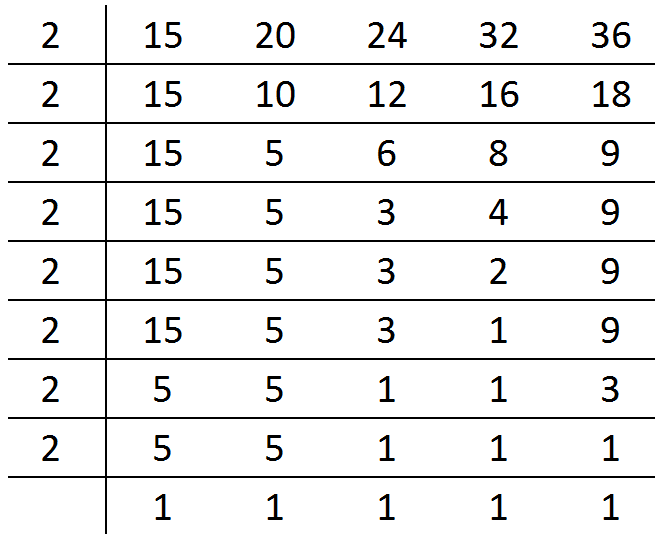
$\therefore \ce{LCM}$ of $15, 20, 24, 32$ and $36 = 2 \times 2 \times 2 \times 2 \times 2 \times 3 \times 3 \times 5 = 1,440$
Hence, $1,440$ is the least number that is divisible by $15, 20, 24, 32$ and $36.$ View full question & answer→MCQ 251 Mark
Mark the correct alternative in the following: The $\ce{HCF}$ of an even number and an odd number is:
- A
$1$
- B
$2$
- C
$0$
- ✓
Non$-$existant.
AnswerCorrect option: D. Non$-$existant.
$\ce{HCF}$ of $8$ and $21$ is $1.$
$\ce{HCF}$ of $6$ and $9$ is $3.$
$\ce{HCF}$ of $9$ and $36$ is $9.$
So there is no fixed number that can be the $\ce{HCF}$ of an even number and an odd number.
View full question & answer→MCQ 261 Mark
Mark the correct alternative in the following: Which of the following numbers is prime?
Answer$(A). 23 = 1 \times 23,$
$23$ has only two factors $1$ and $23,$ Therfore, it is a prime number.
$(B). 51 = 1 \times 3 \times 17,$
$51$ has three factors $1, 3$ and $17,$ Therfore, it is a composite number.
$(C). 38 = 1 \times 2 \times 19,$
$38$ has three factors $1, 2$ and $19,$ Therfore, it is a composite number.
$(D). 26 = 1 \times 2 \times 13,$
$26$ has three factors $1, 2$ and $13,$ Therefore, it is a composite number.
Hence, the correct answer is option $(a).$
View full question & answer→MCQ 271 Mark
Mark the correct alternative in the following: If the number $2345a , 60b$ is exactly divisible by $3$ and $5,$ then the maximum value of $a + b$ is:
AnswerA number is divisible by $5$ if its last digit is either $0$ or $5$ out of which $5$ is maxim
$\therefore b = 5$
A number is divisible by $3$ if the sum of its digits is divisible by $3$
$2 + 3 + 4 + 5 + 6 + 0 + 5 = 25$
So, we can add maximum $8$ to $25$ which will give us $33$ which is divisible by $3$
$\therefore a = 8$
Now, $a + b = 8 + 5 = 13$
Hence, the correct answer is option $(b).$
View full question & answer→MCQ 281 Mark
Mark the correct alternative in the following: The sum of the prime numbers between $60$ and $75$ is:
AnswerPrime numbers between $60$ and $75$ are $61, 67, 71,$ and $73.$
Their sum is given by: $61 + 67 + 71 + 73 = 272$
View full question & answer→MCQ 291 Mark
Mark the correct alternative in the following: The number of primes between $90$ and $100$ is
AnswerThere is only one prime number between $90$ and $100,$ i.e. $97.$
View full question & answer→MCQ 301 Mark
Mark the correct alternative in the following: Which of the following numbers is divisible by $4?$
- A
$8675231$
- ✓
$9843212$
- C
$1234567$
- D
$543123$
AnswerCorrect option: B. $9843212$
Here, the number formed by the last two digits is $12,$ which is divisible by $4.$
Therefore, $98,43,212$ is divisible by $4.$
View full question & answer→MCQ 311 Mark
Mark the correct alternative in the following: Which of the following are not twin$-$primes?
- A
$3, 5$
- B
$5, 7$
- C
$11, 13$
- ✓
$17, 23$
AnswerCorrect option: D. $17, 23$
Pairs of prime numbers that differ by $2$ are called twin primes.
The difference between $17$ and $23$ is $6.$
Hence, $17$ and $23$ are not twin primes.
View full question & answer→MCQ 321 Mark
Mark the correct alternative in the following: What least number be assigned to $^*$ so that number $653^*47$ is divisible by $11?$
AnswerSum of the digits at odd places $= 6 + 3 + 4 = 13$
Sum of the digits at even places $= 5 + ^* + 7 = 12 + ^*$
Difference $= 13 - [12 + ^*] = 1 − ^*$
If $6,53,^*47$ is divisible by $11,$ then $1 - ^*$ must be zero or multiple of $11.$
$1 - ^* = 0$ or $11$
$^* = 1$ or $- 10$
But $^*$ is a digit, so $^*$ must be $1.$
View full question & answer→MCQ 331 Mark
Mark the correct alternative in the following: The $\ce{HCF}$ of two consecutive natural numbers is:
- A
$0$
- ✓
$1$
- C
$2$
- D
Non$-$existant.
AnswerThe $\ce{HCF}$ of any two consecutive natural numbers is $1$ because two consecutive natural numbers are always co$-$prime.
View full question & answer→MCQ 341 Mark
Mark the correct alternative in the following: Which one of the following is a prime number?
Answer$373 = 1 \times 373$
The number $373$ has only two factors, $1$ and $373.$
Hence, it is a prime number.
View full question & answer→MCQ 351 Mark
Mark the correct alternative in the following:The $\text{GCD}$ of two numbers is $17$ and their $\text{LCM}$ is $765$. How many pairs of values can the numbers assume?
Answer$\text{GCD}$ of two numbers is $17$
So, the numbers can be $17a$ and $17b.$
Now $, 17a \times 17b = 17 \times 765$
$\Rightarrow ab = 45$
So, we can get two pairs
$a = 5$ and $b = 9$ or $a = 9$ and $b = 5$
Thus, the numbers are $17 \times 5 = 85$ and $17 \times 9 = 153$.
Also, we can get the other pair $17 \times 1 = 17$ and $765.$
Hence, the correct answer is option $(b)$.
View full question & answer→MCQ 361 Mark
Mark the correct alternative in the following: Which of the following numbers is divisible by $6?$
- ✓
$7908432$
- B
$68719402$
- C
$45982014$
- D
$451236$
AnswerCorrect option: A. $7908432$
A number divisible by $6$ must also be divisible by $3$ and $2$ as $6$ is a multiple of $3$ and $2.$
In $79,08,432,$ the sum of the digits $= 7 + 9 + 0 + 8 + 4 + 3 + 2 = 33$
Since $33$ is a multiple of $3,$ this number is divisible by $3.$
Also, since the last digit is $2,$ it is also divisible by $2.$
Therefore, $79,08,432$ is divisible by $6.$
In number $4,59,82,014,$ the sum of the digits $= 4 + 5 + 9 + 8 + 2 + 0 + 1 + 4 = 33.$
Since $33$ is a multiple of $3,$ this number is divisible by $3.$
Also, since the last digit is $4,$ it is also divisible by $2.$
So, $4,59,82,014$ is also divisible by $6.$
View full question & answer→MCQ 371 Mark
Mark the correct alternative in the following: Which one of the following numbers is divisible by $3?$
- A
$27326$
- B
$42356$
- ✓
$73545$
- D
$45326$
AnswerCorrect option: C. $73545$
Sum of the digits in $73,545 = 7 + 3 + 5 + 4 + 5 = 24$
Since $24$ is divisible by $3, 73545$ is divisible by $3.$
View full question & answer→MCQ 381 Mark
Mark the correct alternative in the following: Which of the following are co$-$primes?
- A
$8,10$
- ✓
$9,10$
- C
$6,8$
- D
$5,18$
AnswerCorrect option: B. $9,10$
$9 = 3 \times 3 \times 1$
$10 = 2 \times 5 \times 1$
Though both $9$ and $10$ are composite numbers, the only factor common to them is $1.$
Therefore, $9$ and $10$ are co$-$primes.
View full question & answer→MCQ 391 Mark
Mark the correct alternative in the following : The $\text{HCF}$ of $100$ and $101$ is:
Answer$100 = 1 \times 2 \times 2 \times 5 \times 5$
$101 = 1 \times 101$
Since, $100$ is a composite number and $101$ is a prime number.
Thus, their $\text{HCF}$ is $1$.
Hence, the correct answer is option $(a).$
View full question & answer→MCQ 401 Mark
Mark the correct alternative in the following: The $\ce{HCF}$ of two consecutive even numbers is:
- A
$1$
- ✓
$2$
- C
$0$
- D
Non$-$existant.
Answer$\ce{HCF}$ of two consecutive even numbers is always $2.$
For example:
$\ce{HCF}$ of $4$ and $6$ is $2.$
$\ce{HCF}$ of $10$ and $12$ is $2$ and so on.
View full question & answer→MCQ 411 Mark
Mark the correct alternative in the following: Which of the following numbers are twin primes?
- ✓
$3, 5$
- B
$5, 11$
- C
$3, 11$
- D
$13, 17$
AnswerCorrect option: A. $3, 5$
Twin primes are pairs of primes which differ by two.
In $(3, 5),$ the difference between the two primes is $2.$
Therefore, $(3, 5)$ are twin primes.
Hence, the correct answer is option $(a)$
View full question & answer→MCQ 421 Mark
Mark the correct alternatiue in the following: If $x$ and $y$ are two co$-$primes, then their $\ce{LCM}$ is
AnswerThe $\ce{LCM}$ of two co$-$prime numbers is equal to their product.
Thus, $\ce{LCM}$ of $'x\ '$ and $'y\ '$ will be $xy.$
View full question & answer→MCQ 431 Mark
Mark the correct alternative in the following: Which of the following numbers is a perfect number?
AnswerA number for which the sum of all its factors is equal to twice the number is called a perfect number.
Factors of $6$ are $1, 2, 3,$ and $6.$
Sum of the factors of $6 = 1 + 2 + 3 + 6 = 12 = 2 \times 6$
Hence, $6$ is a perfect number.
View full question & answer→MCQ 441 Mark
Mark the correct alternative in the following: What least number be assigned to $^*$ so that the number $63576^*2$ is divisible by $8?$
AnswerThe given number is divisible by $8$ if the number formed by its last three digits is divisible by $8.$
Hence, $63,57,6^*2$ is divisible by $8$ if $6^*2$ is divisible by $8.$
Thus, the least value of $^*$ will be $3.$
View full question & answer→MCQ 451 Mark
Mark the correct alternative in the following : The smallest prime just greater than the $\text{HCF}$ of $84$ and $144$ is:
Answer$84=1 \times 2 \times 2 \times 3 \times 7=2^2 \times 3^1 \times 7^1$
$144=1 \times 2 \times 2 \times 2 \times 2 \times 3 \times 3=2^4 \times 3^2$
$\text{HCF}$ of $84$ and $144=2^2 \times 3^1=12$
Prime number just greater than $12$ is $13$.
Hence, the correct answer is option $(d)$.
View full question & answer→MCQ 461 Mark
Mark the correct alternative in the following: Which one of the following numbers is exactly divisible by $11?$
- A
$235641$
- B
$245642$
- C
$315624$
- ✓
$415624$
AnswerCorrect option: D. $415624$
Sum of digits at odd places $= 4 + 5 + 2 = 11$
Sum of digits at even places $= 1 + 6 + 4 = 11$
Difference of these two sums $= 11 - 11 = 0$
Therefore, $4,15,624$ is divisible by $11.$
View full question & answer→MCQ 471 Mark
Mark the correct alternative in the following: The greatest five digit number exactly divisible by $9$ and $13$ is:
- A
$99945$
- ✓
$99918$
- C
$99964$
- D
$99972$
AnswerCorrect option: B. $99918$
$\ce{LCM}$ of $9$ and $13 = 9 \times 13 = 117$
Largest $5-$digit number is $99999$
Now, if we divide $99999$ by $117,$ we will get $854.69$ as quotient.
The integer just less than $854.69$ is $854$
$\therefore$ Required number $= 117 \times 854 = 99918$
Hence, the correct answer is option $(b).$
View full question & answer→MCQ 481 Mark
Mark the correct alternative in the following: Which of the following numbers is divisible by $9?$
- ✓
$9076185$
- B
$92106345$
- C
$10349576$
- D
$95103476$
AnswerCorrect option: A. $9076185$
In $90,76,185:$
Sum of the digits $= 9 + 0 + 7 + 6 + 1 + 8 + 5 = 36$
Since $36$ is divisible by $9, 9076185$ is divisible by $9.$
View full question & answer→MCQ 491 Mark
Mark the correct alternative in the following : $5*2$ is a three digit number with $*$ as a missing digit. If the number is divisible by $6,$ the missing digit is.
AnswerA number divisible by $6$ must also be divisible by $3$ as $6$ is a multiple of $3$.
Sum of the given digits $= 5 + 2 = 7$
We know that multiple of $3$ greater than $7$ is $9$.
$\therefore 9 - 7 = 2$
Therefore, the required digit is $2$.
View full question & answer→MCQ 501 Mark
Mark the correct alternative in the following: Which of the following is a prime number?
Answer$263 = 1 \times 263$
The number $263$ has only two factors, $1$ and $263.$
Hence, it is a prime number.
View full question & answer→MCQ 511 Mark
Mark the correct alternative in the following : What least value should be given to $*$ so that the number $915*26$ is divisible by $9$?
AnswerA number is divisible by $9$ if the sum of its digits is a multiple of $9$.
Sum of the given digits $= 9 + 1 + 5 + 2 + 6 = 23$
We know that multiple of $9$ greater than $23$ is $27$.
$\therefore 27 - 23 = 4$
Hence, the smallest required digit is $4$.
View full question & answer→MCQ 521 Mark
Mark the correct alternatiue in the following : Three numbers are in the ratio $\{1 : 2 : 3\}$ and their $\text{HCF}$ is $6,$ the numbers are :
- A
$\{4, 8, 12\}$
- B
$\{5,1 0, 15\}$
- ✓
$\{6, 12, 18\}$
- D
$\{10, 20, 30\}$
AnswerCorrect option: C. $\{6, 12, 18\}$
Three numbers are $1\times \text{HCF}, 2 \times \text{HCF},$ and $3 \times \text{HCF},$
i.e. $1 \times 6 = 6, 2 \times 6 = 12,$ and $3 \times 6 = 18$.
Thus, the numbers are $\{6, 12, 18\}$.
View full question & answer→MCQ 531 Mark
Mark the correct alternative in the following: Which of the following numbers is divisible by $11?$
- A
$1111111$
- ✓
$22222222$
- C
$3333333$
- D
$4444444$
AnswerCorrect option: B. $22222222$
In $2,22,22,222,$ the difference of the sum of alternate digits $2 + 2 + 2 + 2 = 8$ and $2 + 2 + 2 +2 = 8$ is zero.
Hence, the number is divisible by $11.$
View full question & answer→