Questions

2 Mark Question

Take a timed test

6 questions · self-marked practice — reveal the answer and mark yourself.

Question 12 Marks
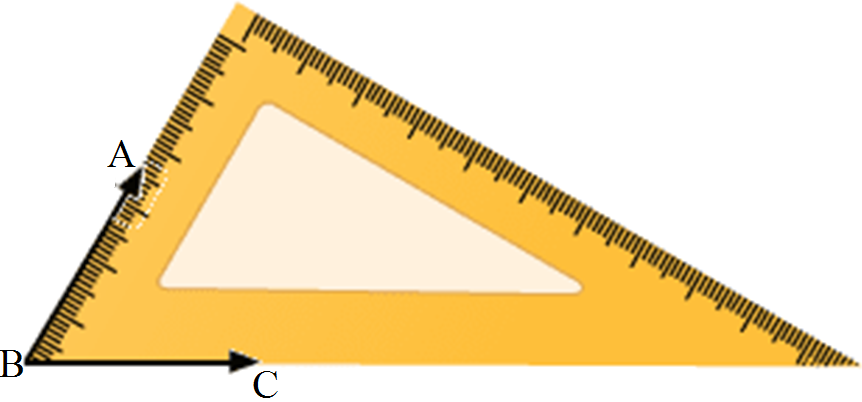
Construct the following angles using set-squares:
60°
Answer
60° Place 30° set-square as shown in the figure. Draw the rays BA and BC along the edges from the vertex of 60° The angle so formed is 60° $\angle\text{ABC}=60^{\circ}$
View full question & answer
Question 22 Marks
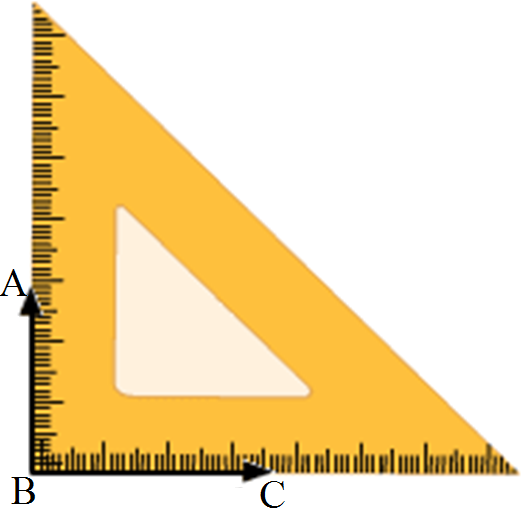
Construct the following angles using set-squares:
90°
Answer
90° Place = 90° set-square as shown in the figure. Draw two rays BC and BA along the edges from the vertex of 90° angle. The angle so formed is 90° angle. $\angle\text{ABC}=90^{\circ}$
View full question & answer
Question 32 Marks
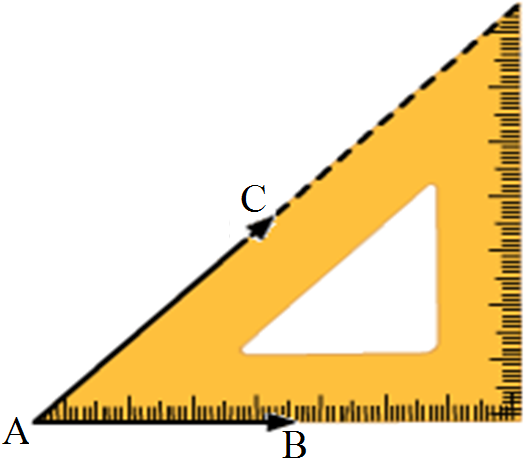
Construct the following angles using set-squares: $45^{\circ}$
Answer
$45^{\circ}$ Place $45^{\circ}$ set-square. Draw two rays $A B$ and $A C$ along the edges from the vertex from the vertex of $45^{\circ}$ angle of the set- square.
The angleso formed is a $45^{\circ}$ angle.
$\angle\text{BAC}=45^{\circ}$
View full question & answer
Question 42 Marks
Mark two points, A and B on a piece of paper and join them. Measure this length. For each of the following draw a line segment CD that is:
Equal to the segment AB.
Answer
Mark two points, A and B on a piece of paper and join them as follows:
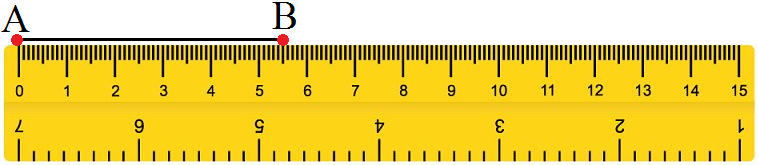
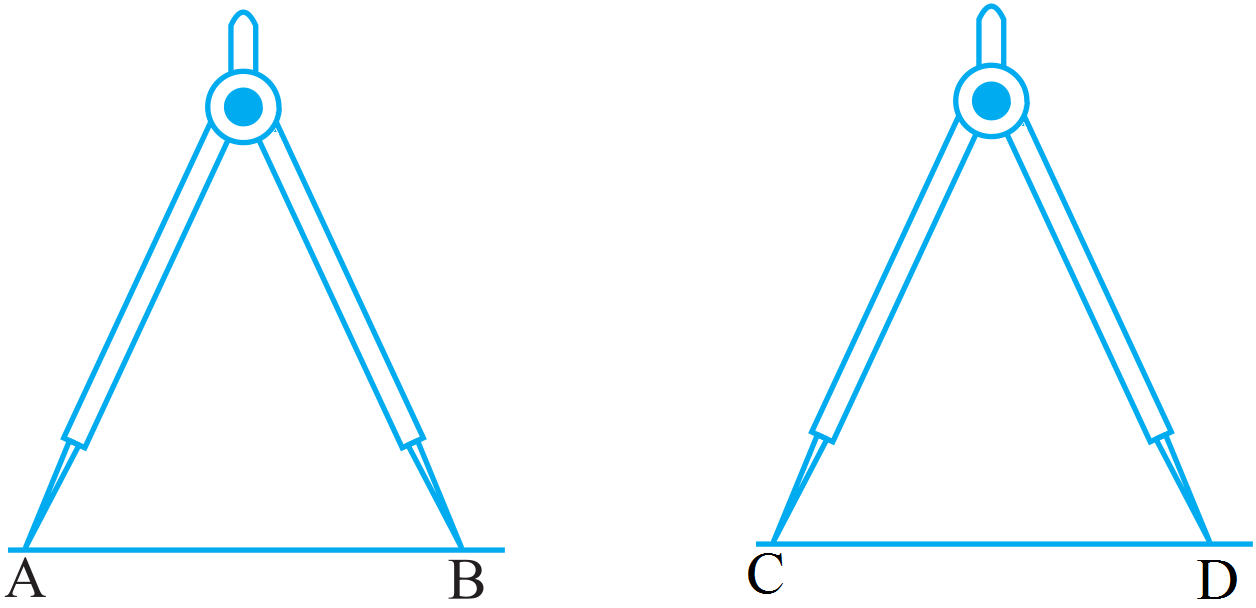
To measure the length of AB, place the ruler with its edge along AB, such that the zero mark of the cm side of the ruler coincides with point A, as shown in the figure. Now, read the mark on the ruler, which corresponds to the point B. The reading on the ruler at point B is the length of the line segment AB. Here, AB = 5.6cm To draw the line segment CD equal to AB, take a divider and open it, such that the end-point of one of its arms is at A and the end-point of the second arm is at B, as shown in the figure. Then, lift the divider and without disturbing its opening, place the end-points of both hands on the paper, where we have to draw CD.
View full question & answer
Question 52 Marks
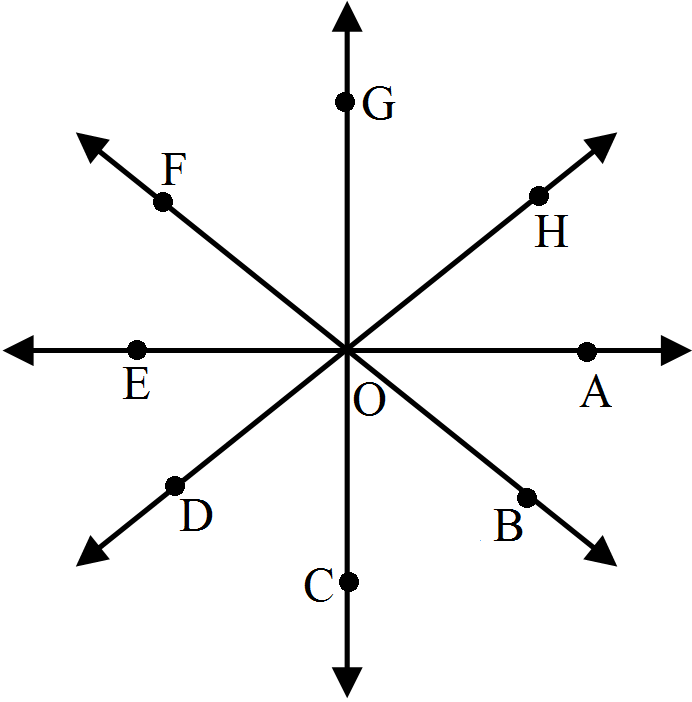
How many rays are represented in Fig.? Name them.
Answer
We know that a ray has fixed starting point and it can be drawn to infinity. If we take 0 as starting point, we will have a ray in every given direction.
So, our rays are, $\overrightarrow{\text{OA}},\overrightarrow{\text{OB}},\overrightarrow{\text{OC}},\overrightarrow{\text{OD}},\overrightarrow{\text{OE}},\overrightarrow{\text{OF}},\overrightarrow{\text{OG}},\overrightarrow{\text{OH}}.$
Thus, the number of rays in the figure is 8.
View full question & answer
Question 62 Marks
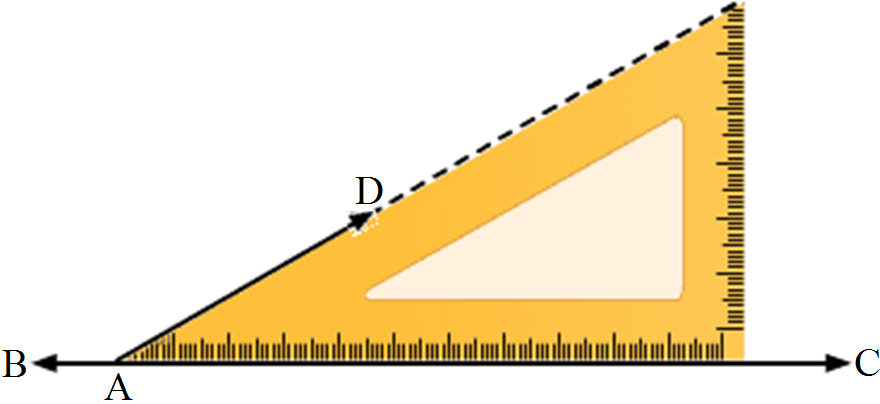
Given a line BC and a point A on it, construct a ray AD using set squares so that $\angle DAC$ is: $30^{\circ}$
Answer
Draw a line $B C$ and take a point $A$ on it. Place $30^{\circ}$ set-square on the line $B C$ such that its vertex of $30^{\circ}$ angle lies on point $A$ and one edgecoincides with the ray $A B$ as shown in figure. Draw the ray $A D$.

Thus $\angle DAC$ is the required angle of $30^{\circ}$.
View full question & answer