Questions

5 Mark Question

Take a timed test

21 questions · self-marked practice — reveal the answer and mark yourself.

Question 15 Marks
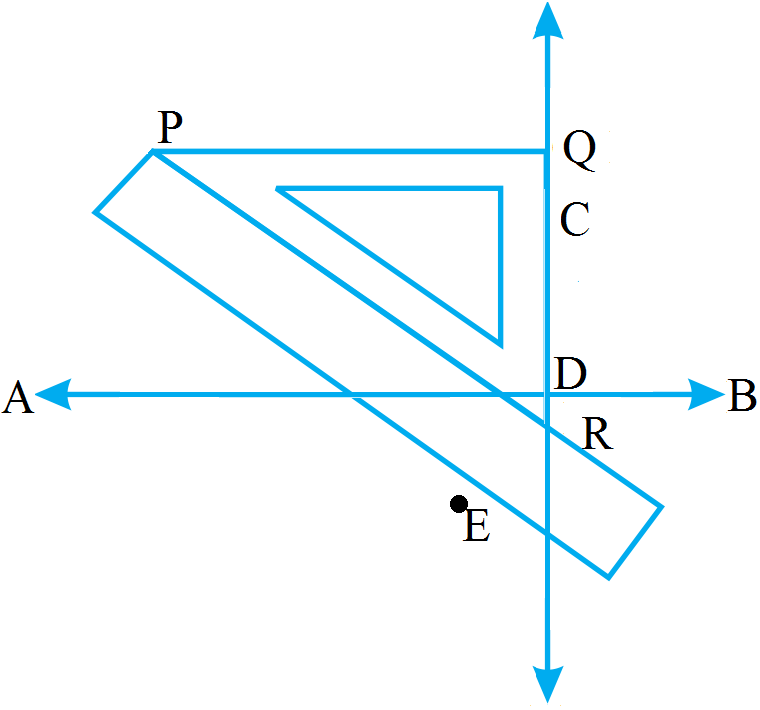
Draw a line l. Take a point A, not lying on l. Draw a line m such that $\text{m}\perp\text{l}$ and passing through A. Using ruler and a set-square.
Answer
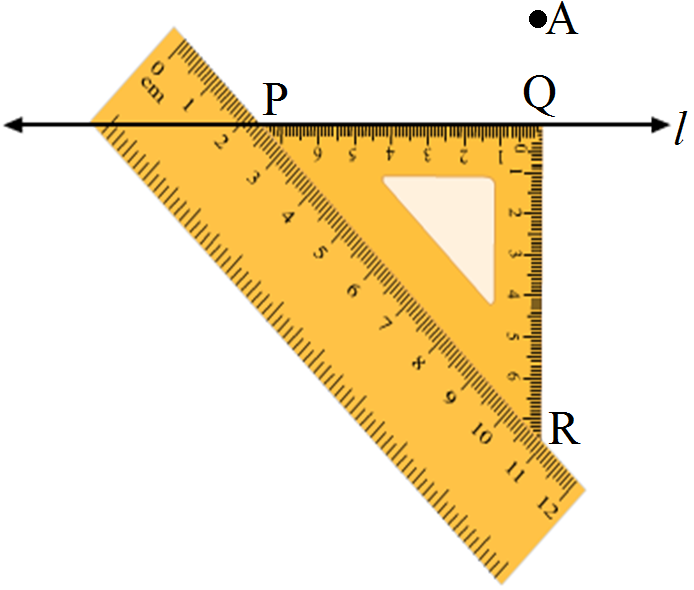
We draw a line L and take a point A outside it.
Place a set square PQR such that its one arm PQ of the right angle is along the line L.
Without disturbing the position of set-square, place a ruler along its edge PR.
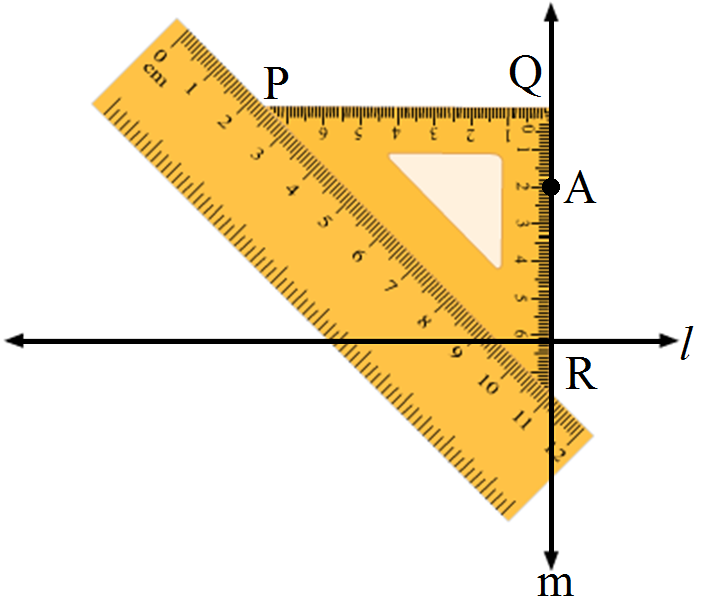
Now, without disturbing the position of the ruler, slide the set-square along the ruler until its arm QR reaches point A.
Without disturbing the position of the set-square, draw a line m.
Line m is the required line perpendicular to line L.
View full question & answer
Question 25 Marks
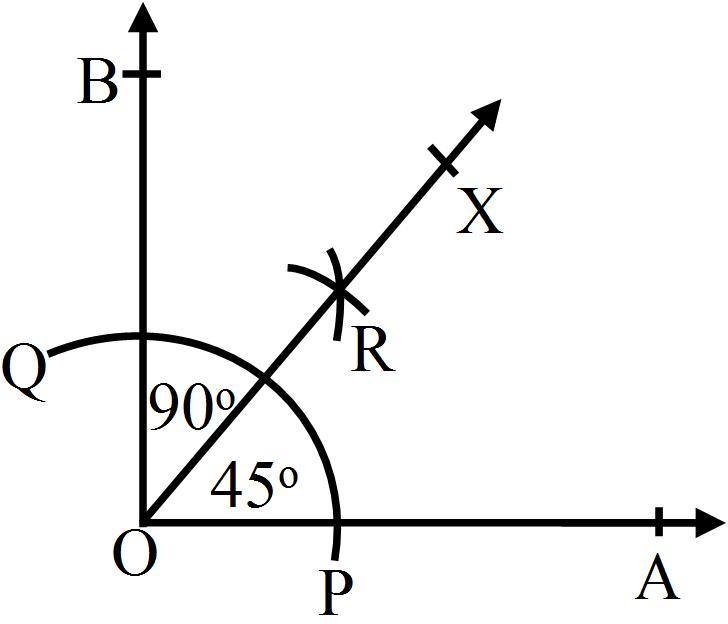
Using protractor, draw a right angle. Bisect it to get an angle of measure 45°.
Answer
We know that a right angle is of 90°.
Draw a ray OA.
With the help of a protractor, draw an $\angle\text{AOB}$ of 90°.
With centre at O and a convenient radius, draw an arc cutting sides OA and OB at P and Q, respectively.
With centre at P and radius more than half of PQ, draw an arc.
With the same radius and centre at Q, draw another arc intersecting the previous arc at R.
Join O and R and extend it to X.
$\angle\text{AOX}$ is the required angle of 45°.
$\angle\text{AOB}=90^{\circ}$
$\angle\text{AOX}=45^{\circ}$
View full question & answer
Question 35 Marks
Using your protractor, draw an angle of measure 108°. With this angle as given, draw an angle of 54°.
Answer
Draw a ray OA.
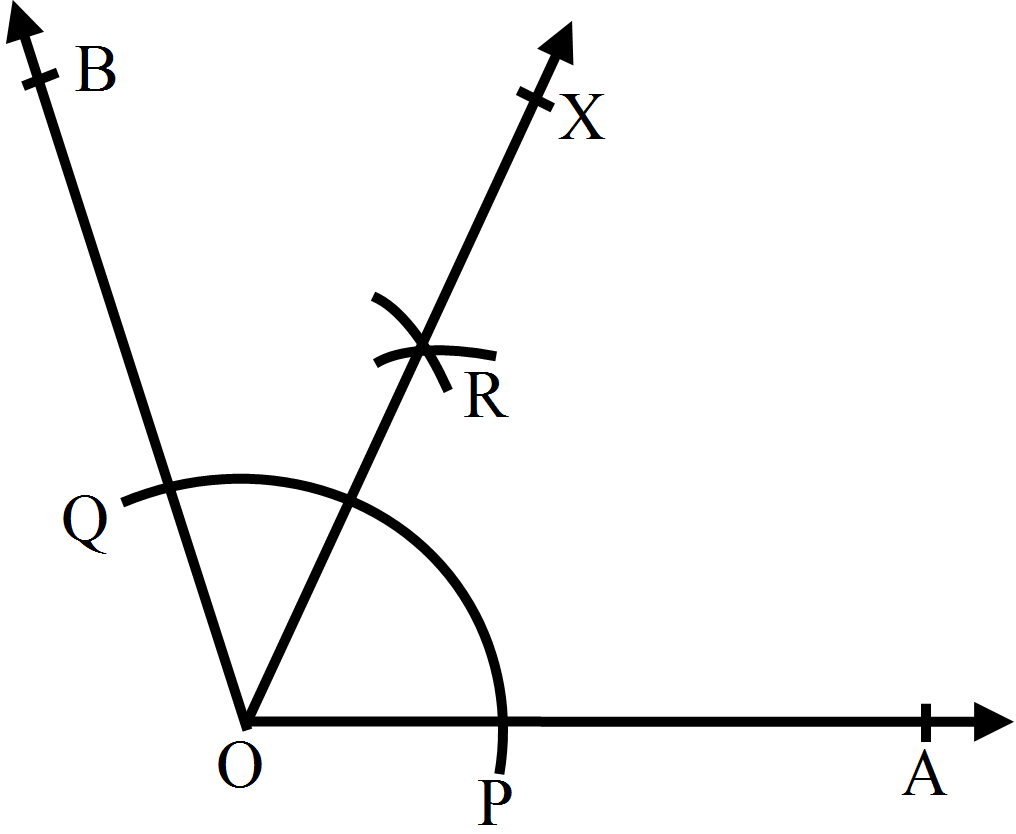
With the help of a protractor, construct an angle $\angle\text{AOB}$ of 108°.
Since, $\frac{108}{2}=54^{\circ}$
Therefore, 54° is half of 108°.
To get the angle of 54°, we need to bisect the angle of 108°.
With centre at O and a convenient radius, draw an arc cutting sides OA and OB at P and Q, respectively.
With centre at P and radius more than half of PQ, draw an arc.
With the same radius and centre at Q, draw another arc intersecting the previous arc at R.
Join O and R and extend it to X.
$\angle\text{AOX}$ is the required angle of 54°.
View full question & answer
Question 45 Marks
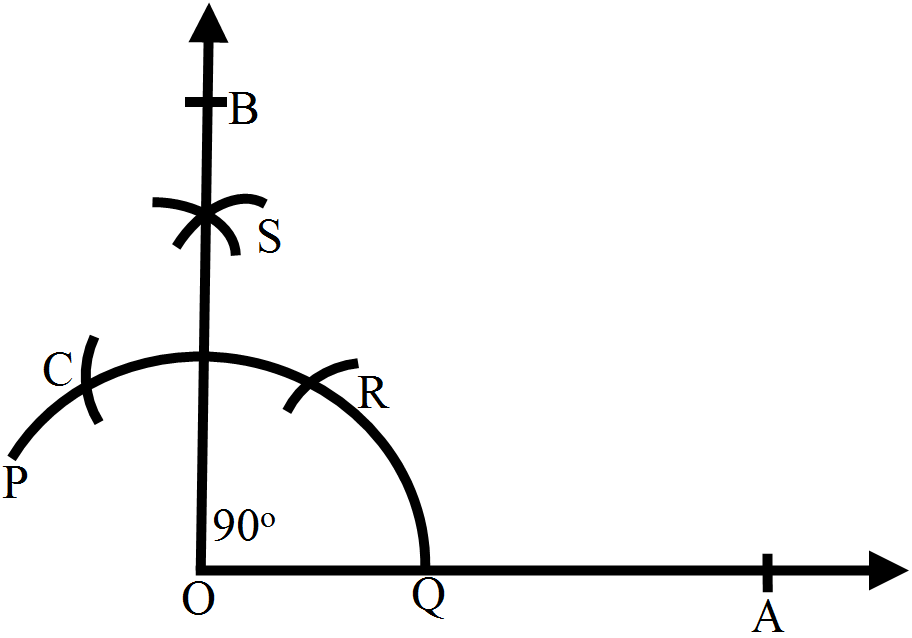
Using ruler and compasses only, draw a right angle.
Answer
Draw a ray OA.
With a convenient radius and centre at O, draw an arc PQ with the help of a compass intersecting the ray OA at P.
With the same radius and centre at P, draw another arc intersecting the arc PQ at R.
With the same radius and centre at R, draw an arc cutting the arc PQ at C, opposite P.
Taking C and R as the centre, draw two arcs of radius more than half of CR that intersect each other at S.
Join O and S and extend the line to B.
$\angle\text{AOB}$ is the required angle of 90°.
View full question & answer
Question 55 Marks
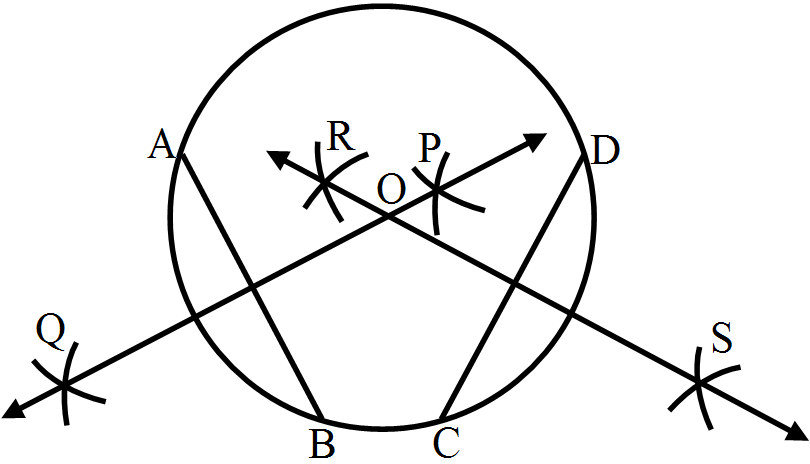
Draw a circle with centre at point O. Draw its two chords AB and CD such that AB is not parallel to CD. Draw the perpendicular bisectors of AB and CD. At what point do they intersect?
Answer
Draw a circle with centre at 0. We draw two chords AB and CD as shown in the figure.
  1. With A as centre and radius more than half of AB, draw arcs on both sides of AB.
  2. With the same radius and B as centre, draw arcs cutting the arcs of step (i) at P and Q.
  3. Join P and Q.
  4. With C as centre and radius more than half of CD, draw arcs on both sides of CD.
  5. With the same radius and D as centre, draw arcs cutting the arcs of step (iv) at R and S.
  6. Join R and S.
We draw the line segments of perpendicular bisector of AB and CD.
We see that the perpendicular bisector of AB and CD meet at 0, the centre of the circle.
View full question & answer
Question 65 Marks
Draw a line segment of length 10cm and bisect it. Further bisect one of the equal parts and measure its length.
Answer
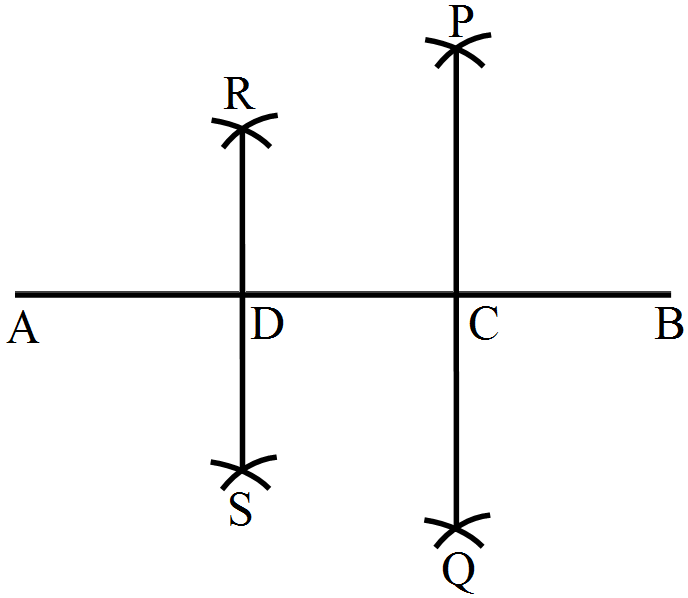
Draw a line segment AB of length 10cm and bisect it.
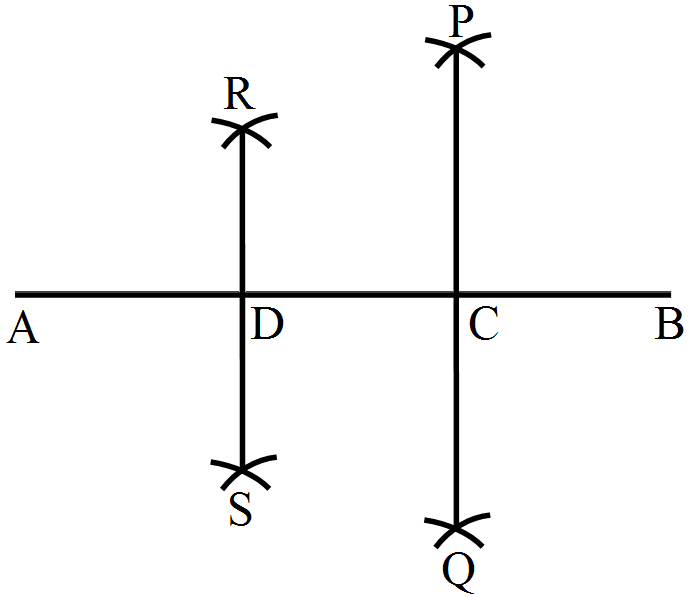
  1. With A as centre and radius more than half of AB, draw arcs on both sides of AB.
  2. With the same radius and B as centre, draw arcs cutting the arcs of step (i) at P and Q, respectively.
  3. Join P and Q. Line PQ intersects line AB at C.
  4. With A as centre and radius more than half of AC, draw arcs on both sides of AB.
  5. With the same radius and C as centre, draw arcs cutting the arcs of step (iv) at R and S, respectively.
  6. Join R and S.
Line RS intersects AC at D.
If we measure AD with the ruler, we have AD = 2.5cm
View full question & answer
Question 75 Marks
Draw a line segment AB and bisect it. Bisect one of the equal parts to obtain a line segment of length $\frac{1}{2}(\text{AB}).$
Answer
Draw a line segment AB.
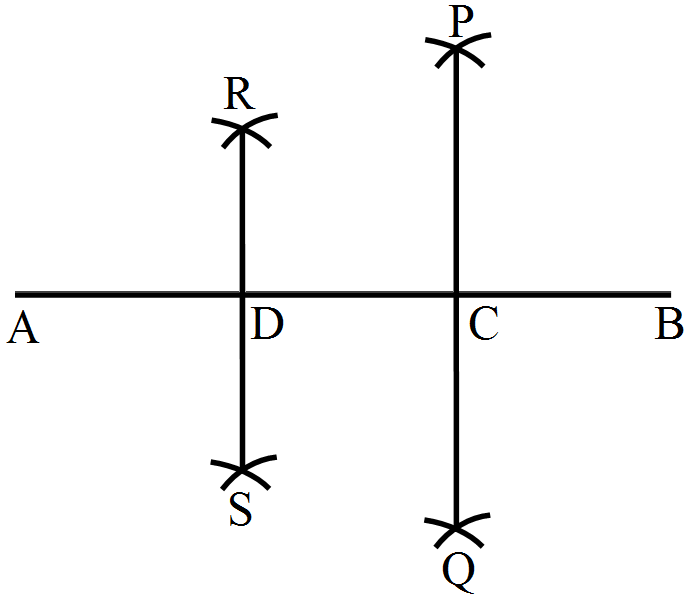
  1. With A as centre and radius more than half of AB, draw arcs on both sides of AB.
  2. With the same radius and B as centre, draw arcs cutting the arcs drawn in step (i) at P and Q.
  3. Join P and Q. PQ intersects AB at C.
  4. With A as centre and radius more than half of AC, draw arcs on both sides of AC.
  5. With the same radius and C as centre, draw arcs cutting the arcs drawn in step (iv) at R and S.
  6. Join R and S. RS intersects AB at D.
Now, AC and CB are equal.
Both are $\frac{1}{2}(\text{AB}).$ Again, divide AC at D.
So, AD and AC are of same length, i.e., $\frac{1}{4}\text{(AB)}.$
View full question & answer
Question 85 Marks
Draw a line l. Take a point A, not lying on l. Draw a line m such that $\text{m}\perp\text{l}$ and passing through A. Using ruler and compasses.
Answer
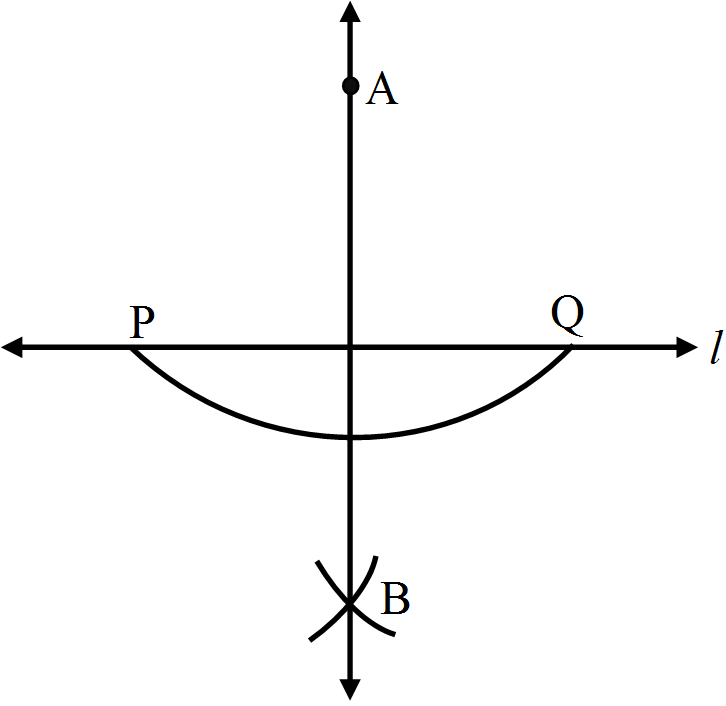
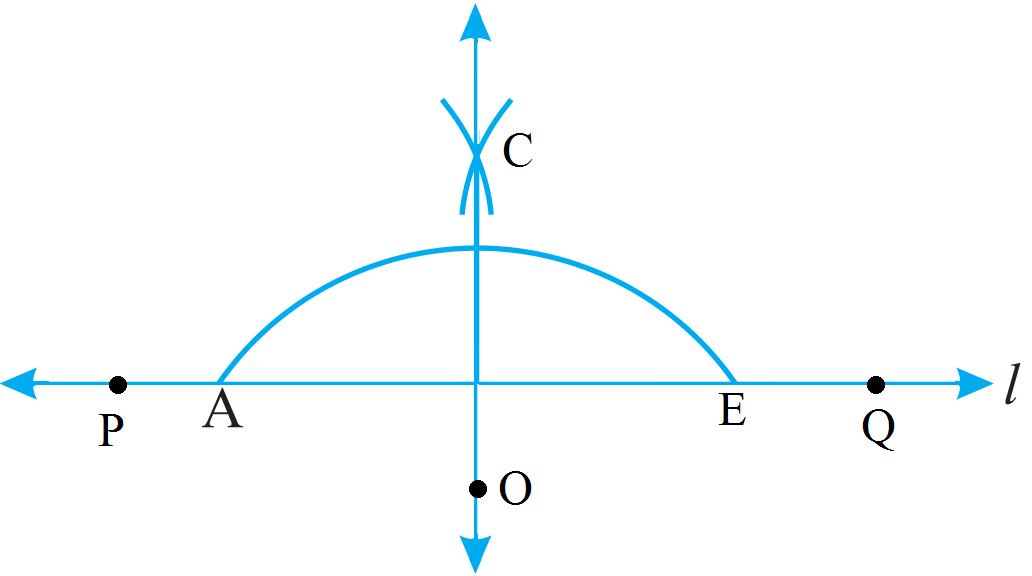
With A as centre, draw an arc PQ, which intersects line L at points P and Q.
Without disturbing the compass and taking P and Q as centres, we construct two arcs such that they intersect each other.
The point where both arcs intersect is B.
Join points A and B and extend it in both directions. This is the required line.
View full question & answer
Question 95 Marks
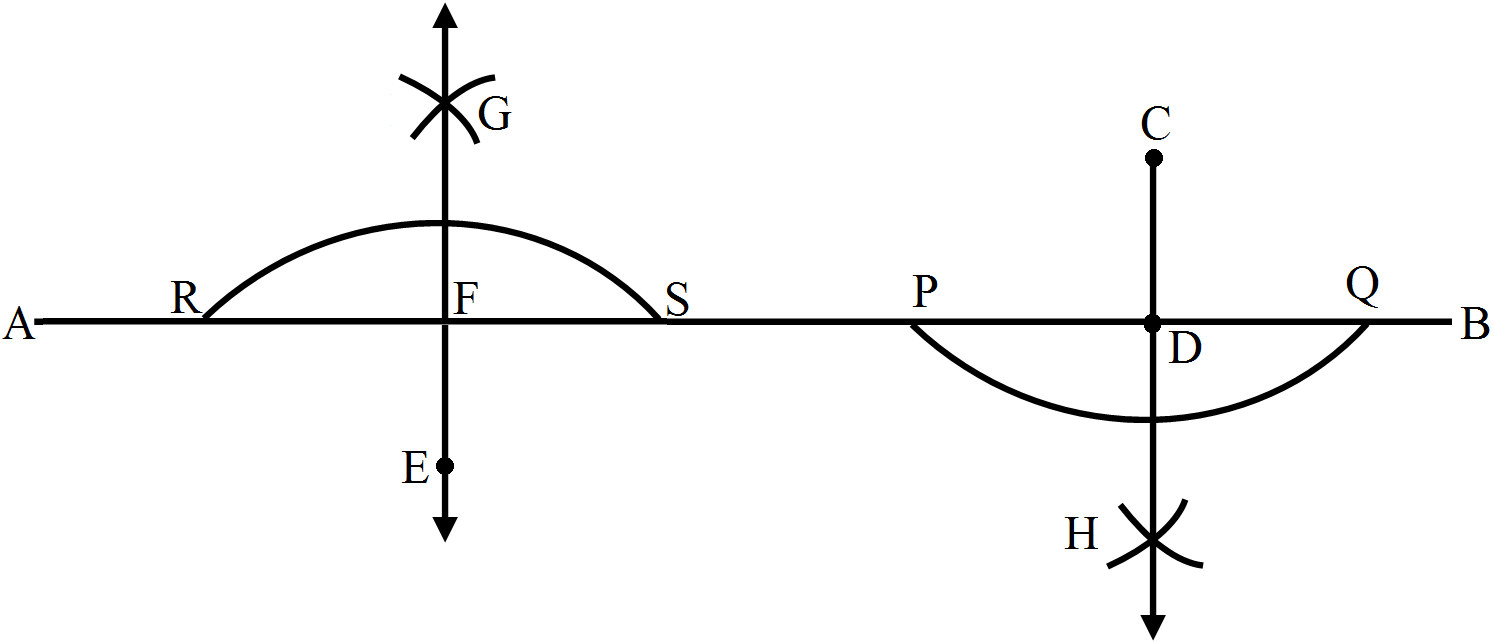
Draw a line AB and take two points C and E on opposite sides of AB. Through C, draw $\text{CD}\perp\text{AB}$ and through E draw $\text{EF}\perp\text{AB}.$ Using ruler and compassed.
Answer
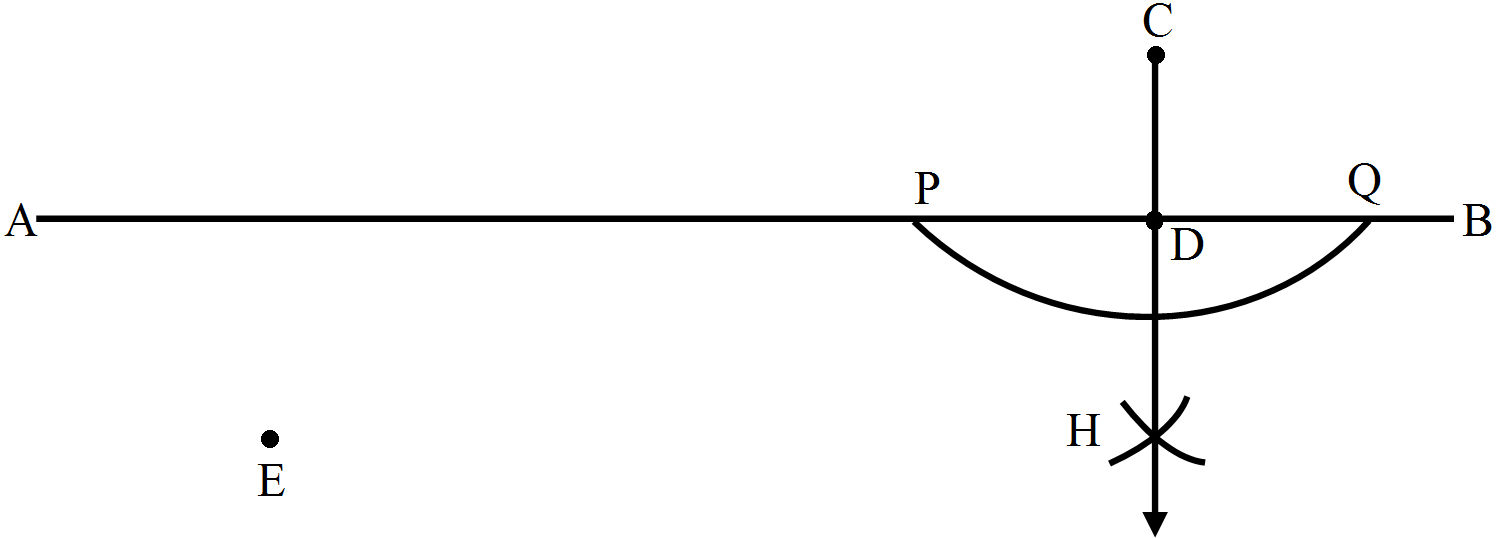
Draw a line AB and take two points C and E on its opposite sides.
With C as centre, draw an arc PQ, which intersects line AB at P and Q.
Taking P and Q as centres, construct two arcs, such that they intersect each other at H.
Join points H and C. HC crosses AB at D.
We have $\text{CD}\perp\text{AB}.$
Similarly, take E as centre and draw an arc RS.
Taking R and S as centres, draw two arcs which intersect each other at G.
Join points G and E. GE crosses AB at F.
We have $\text{EF}\bot\text{AB}.$

View full question & answer
Question 105 Marks
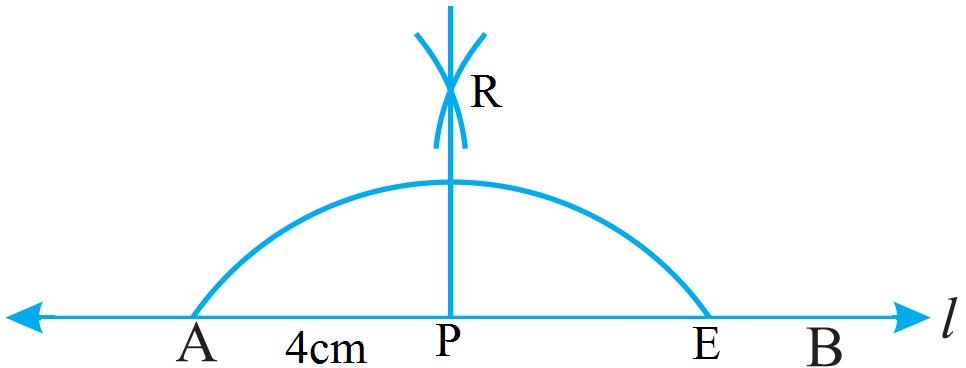
Draw a line segment AB of length 10cm. Mark a point P on AB such that AP = 4cm. Draw a line through P perpendicular to AB.
Answer
We draw line L and take a point A on it.
Using a ruler and a compass, we mark a point B, 10cm from A, on the line L.
AB is the required line segment of 10cm.
Again, we mark a point P, which is 4cm from A, in the direction of B.
With P as centre, take a radius of 4cm and construct an arc intersecting the line L at two points A and E.
With A and E as centres, take a radius of 6cm and construct two arcs intersecting each other at R.
We join PR and extend it. PR is the required line, which is perpendicular to AB.
View full question & answer
Question 115 Marks
Draw a line segment AB and by ruler and compasses, obtain a line segment of length $\frac{3}{4}(\text{AB}).$
Answer
Draw a line segment AB using the ruler.
  1. With A as centre and radius more than half of AB, draw arcs on both sides of AB.
  2. With the same radius and B as centre, draw arcs cutting the arcs drawn in step (i) at P and Q.
  3. Join P and Q. PQ intersects AB at C.
  4. With A as centre and radius more than half of AB, draw arcs on both sides of AC.
  5. With the same radius and C as centre, draw arcs cutting the arcs drawn in step (iv) at R and S.
  6. Join R and S. RS intersects AB at D.
Bisect AC again and mark the point of bisection as D.
So, we have: AD $=\frac{1}{4}\text{(AB)},$
DC $=\frac{1}{4}\text{(AB)}$ and CB $=\frac{1}{2}\text{(AB)}$
Therefore, DB $=\frac{1}{4}(\text{AB})+\frac{1}{2}(\text{AB})=\frac{3}{4}(\text{AB})$
Thus, DB is the required line segment of length $\frac{3}{4}(\text{AB}).$
View full question & answer
Question 125 Marks
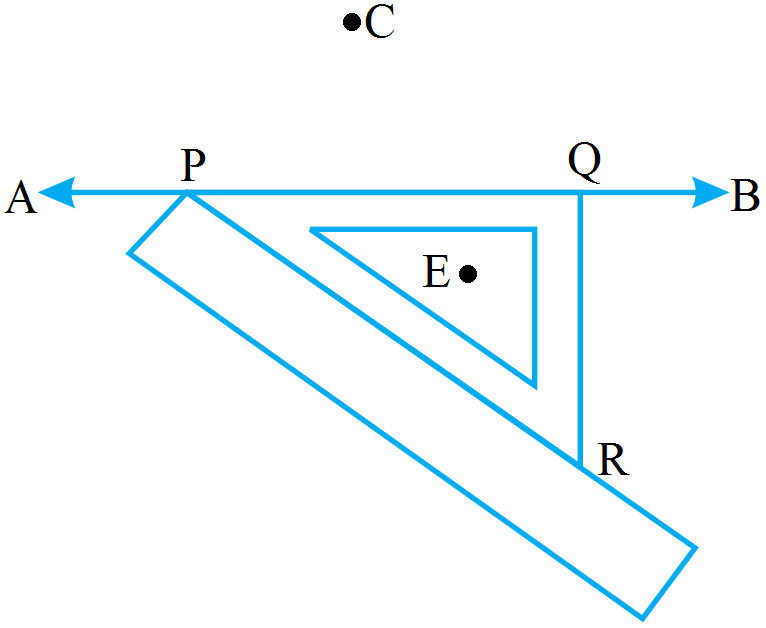
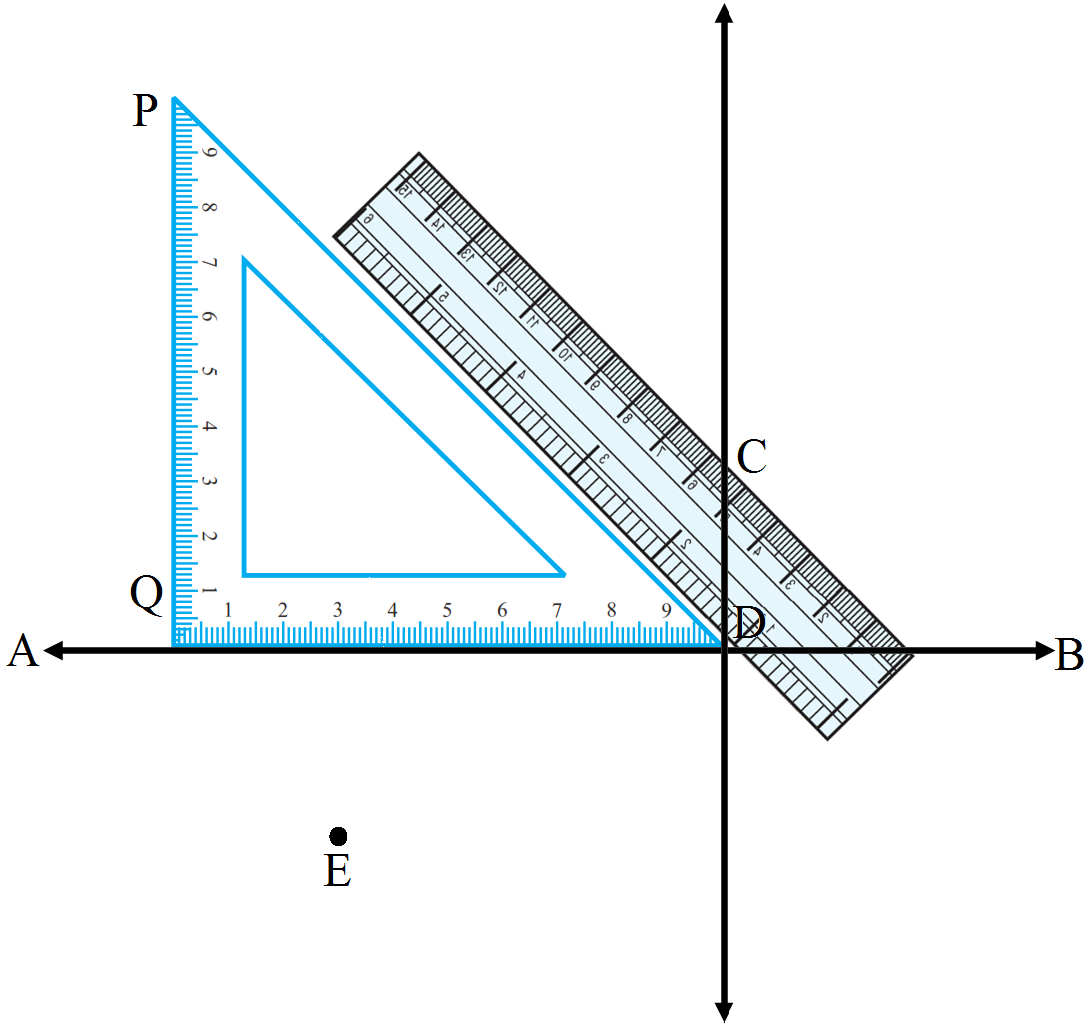
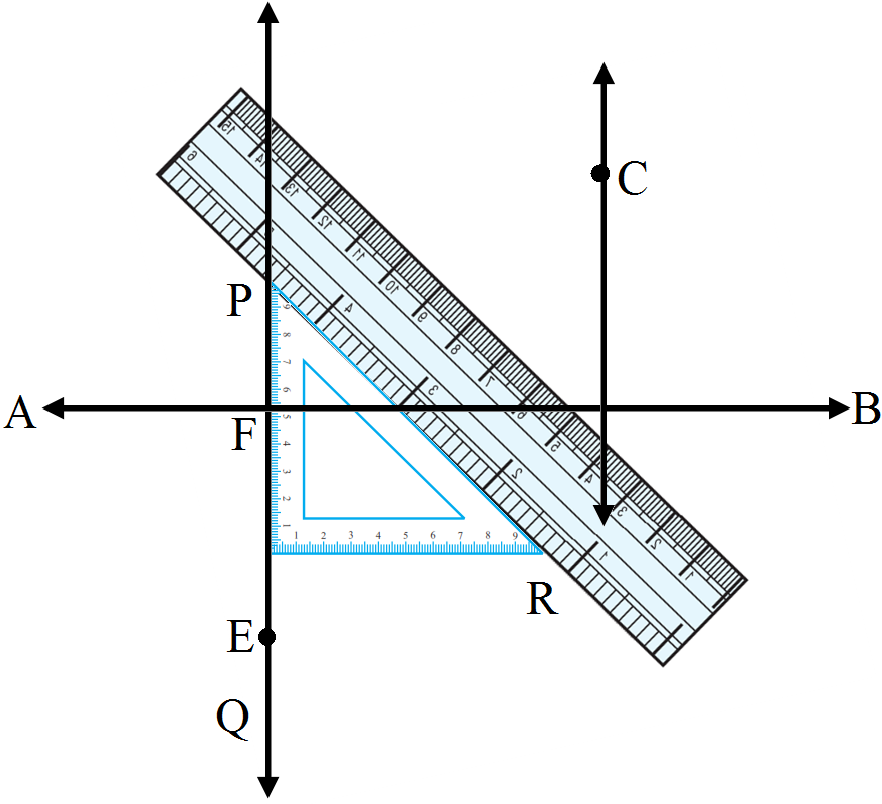
Draw a line AB and take two points C and E on opposite sides of AB. Through C, draw $\text{CD}\perp\text{AB}$ and through E draw $\text{EF}\perp\text{AB}.$ ruler and set-squares.
Answer
Draw a line AB and take two points C and E on the opposite sides of the line AB.
On the side of E, place a set-square PQR, such that its one arm PQ of the right angle is along the line AB. Without disturbing the position of the set-square, place a ruler along its edge PR.
Now, without disturbing the position of the ruler, slide the set square along the ruler until the arm QR reaches point C.
Without disturbing the position of the set-square, draw a line CD, where D is a point on AB.
CD is the required line and $\text{CD}\perp\text{AB}.$
We repeat the same process starting with taking set-square on the side of E, we draw a line $\text{EF}\perp\text{AB}.$


View full question & answer
Question 135 Marks
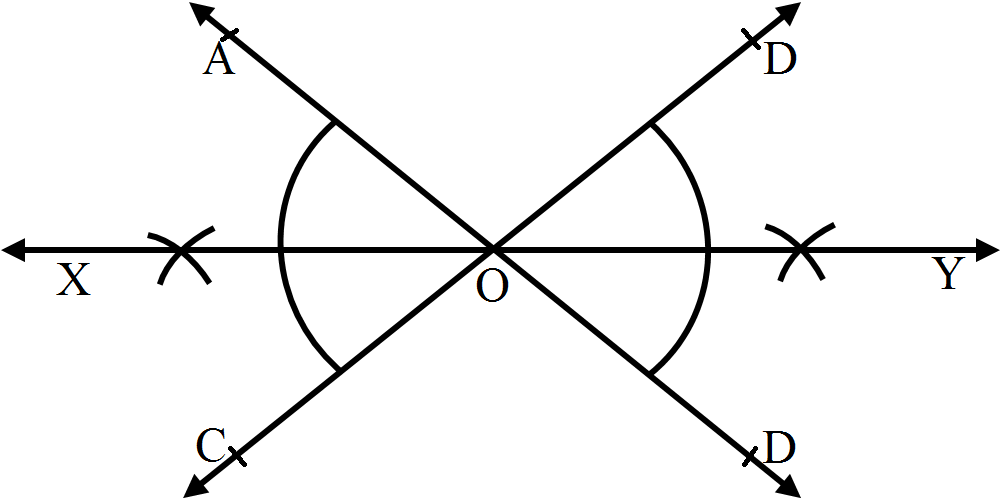
Draw a pair of vertically opposite angles. Bisect each of the two angles. Verify that the bisecting rays are in the same line.
Answer
Draw two lines AB and CD intersecting each other at O.
We know that the vertically opposite angles are equal.
Therefore, $\angle\text{BOC}=\angle\text{AOD}$ and
$\angle\text{AOC}=\angle\text{BOD}.$
We bisect angle AOC and draw the bisecting ray as OX.
Similarly, we bisect angle BOD and draw the bisecting ray as OY.
Now, $\angle\text{XOA}+\angle\text{AOD}+\angle\text{DOY}$
$=\frac{1}{2}\angle\text{AOC}+\angle\text{AOD}+\frac{1}{2}\angle\text{BOD}$
$=\frac{1}{2}\angle\text{BOD}+\angle\text{AOD}+\frac{1}{2}\angle\text{BOD}$
$[\text{As,}\angle\text{AOC}=\angle\text{BOD}]$
$=\angle\text{AOD}+\angle\text{BOD}$
Since, AB is a line.
Therefore, $\angle\text{AOD}$ and $\angle\text{BOD}$ are supplementary angles and the sum of these two angles will be 180°.
Therefore, $\angle\text{XOA}+\angle\text{AOD}+\angle\text{DOY}=180^{\circ}$
We know that the angles on one side of a straight line will always add to 180°.
Also, the sum of the angles is 180°.
Therefore, XY is a straight line.
Thus, OX and OY are in the same line.
View full question & answer
Question 145 Marks
Construct the following angles with the help of a protractor:
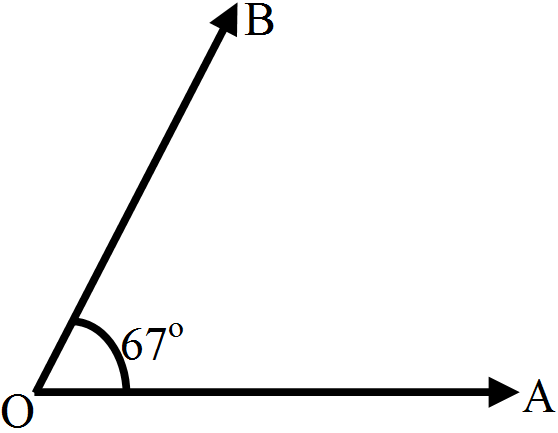
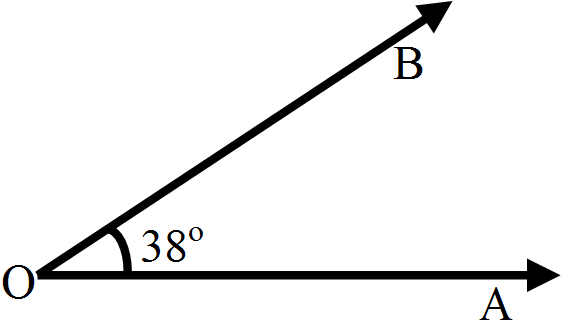
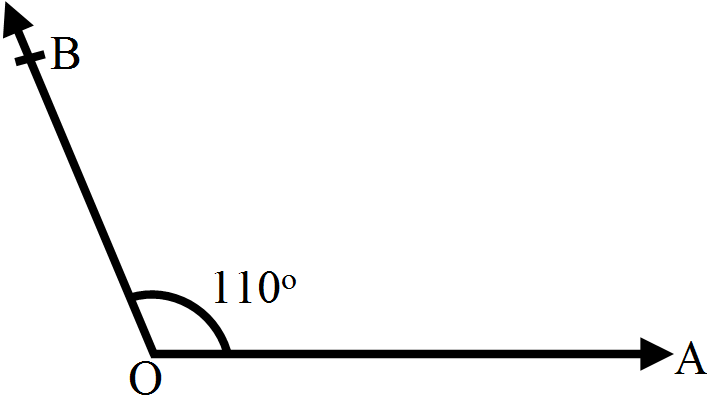
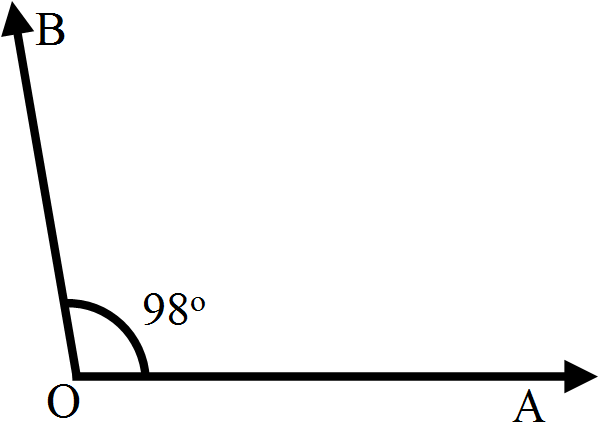
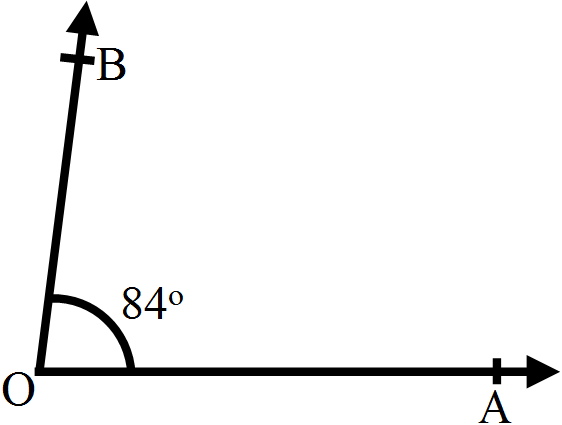
$45^\circ, 67^\circ, 38^\circ, 110^\circ, 179^\circ, 98^\circ, 84^\circ$
Answer
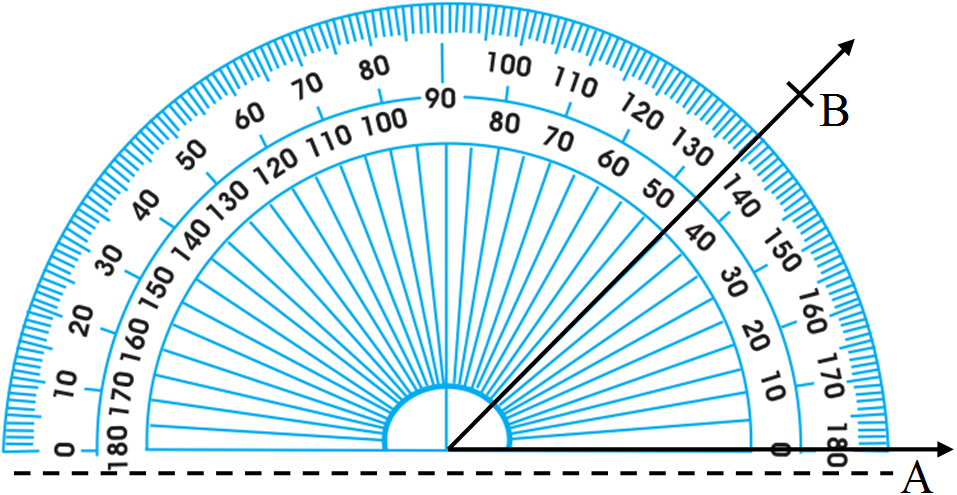
$45^\circ$ We draw a ray OA. We place the protractor on OA such that its centre coincides with the point O and the diameter of the protractor coincides with OA. We mark a point B against the mark of $45^\circ$ on the protractor. We remove the protractor and draw OB. $\angle\text{AOB}$ is the required angle of $45^\circ.$
                                                                                 
Similarly, we draw the angles $67^\circ, 38^\circ, 110^\circ, 179^\circ, 98^\circ$ and $84^\circ.$​​​​​​​


View full question & answer
Question 155 Marks
Using a protractor, draw $\angle\text{BAC}$ of measure 70°. On side AC, take a point P, such that AP = 2cm. From P draw a line perpendicular to AB.
Answer
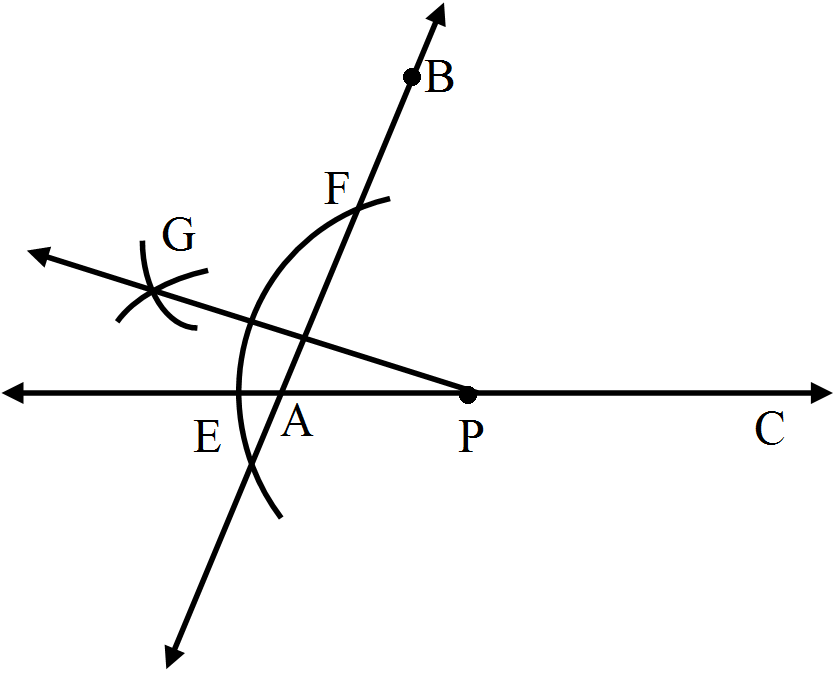
Draw a line segment AC on a line L
  1. Take a protractor and place it on the segment AC such that segment AC coincides with the line of diameter of protractor and middle of this line coincides with point A.
  2. Counting from the right side, mark the point as B at the point of 70° of the protractor and draw AB.
  3. Now, measuring 2cm from A on AC, mark a point P.
  4. With P as centre, draw an arc intersecting line 1 at points E and F.
  5. Using the same radius and E and F as centres, construct two arcs that intersect at point G on the other side.
  6. Join PG.
View full question & answer
Question 165 Marks
Draw a line segment PQ of length 12cm. Mark a point O outside this segment. Draw a line through O perpendicular to PQ.
Answer
Draw a line L and take a point P on it.
Using a ruler and a compass, mark a point Q on the line L, where PQ = 12cm.
Mark a point Q outside PQ.
Now, with O as centre, draw an arc of appropriate radius such that the arc cuts the line at points A and B.
Taking A and B as centres, construct two arcs such that they intersect each other at C.
Join OC. OC is the required line, which is perpendicular to PQ.
View full question & answer
Question 175 Marks
Draw a line segment AB of length 8cm. At each end of this line segment, draw a line perpendicular to AB. Are these two lines parallel?
Answer
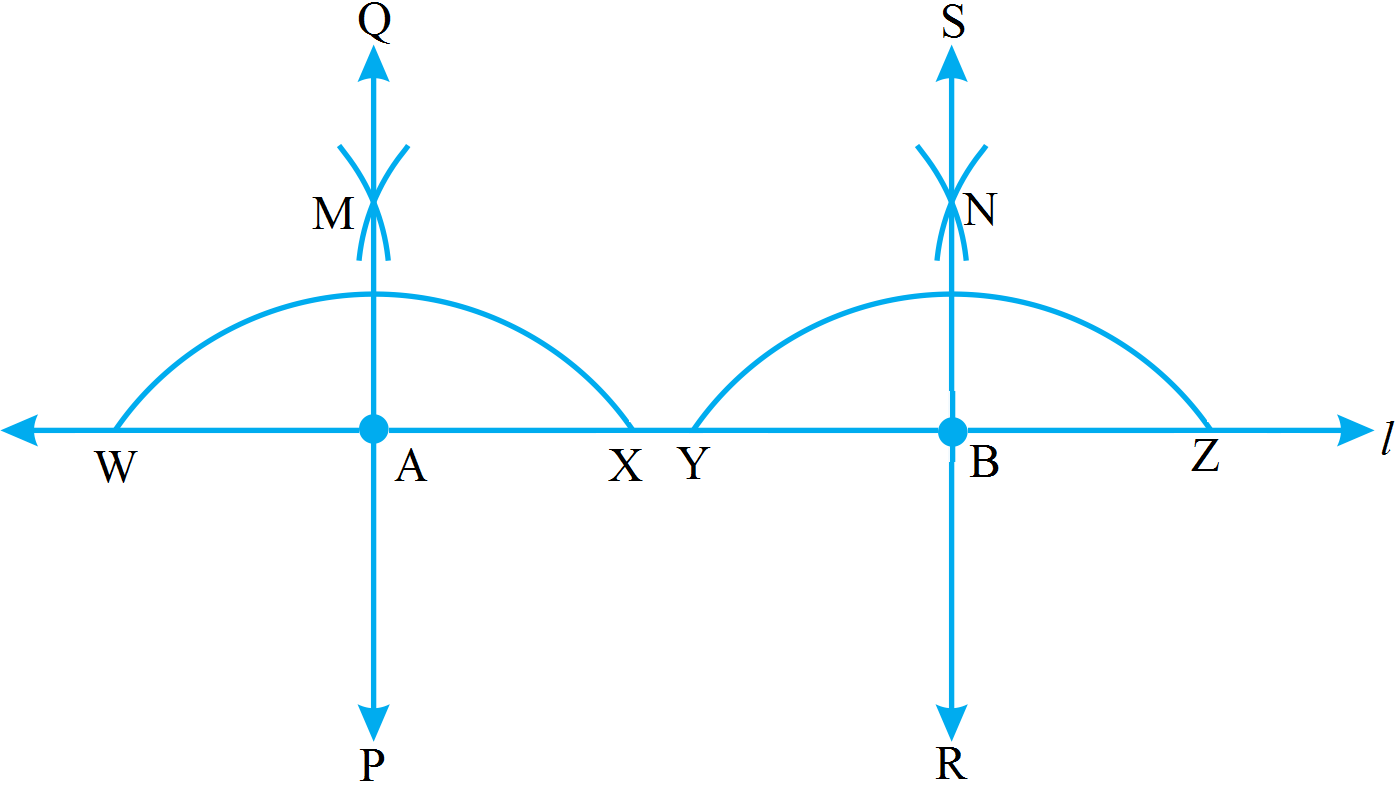
  1. Take a convenient radius with A as centre and draw an arc intersecting the line at points W and X.
  2. With W and X as centres and radius greater than AW, construct two arcs intersecting each other at M.
  3. Join AM and extend it in both directions to P and Q.
  4. Take a convenient radius with B as centre and draw an arc intersecting the line at points Y and Z.
  5. With Y and Z as centres and a radius greater than YB, construct two arcs intersecting each other at N.
  6. Join BN and extend it in both directions to S and R.
Let the lines perpendicular at A and B be PQ and RS, respectively.
Since, $\angle\text{QAB}=90^{\circ}$ and $\angle\text{ABR}=90^{\circ}$
Therefore, $\angle\text{QAB}=\angle\text{ABR}.$
When two parallel lines are intersected by a third line, the two alternate interior angles are equal.
Since, $\angle\text{QAB}=\angle\text{ABR}$
Therefore, PQ and RS are parallel.
View full question & answer
Question 185 Marks
Using a protractor, draw an angle of measure 72°. With this angle as given, draw angles of measure 36° and 54°.
Answer
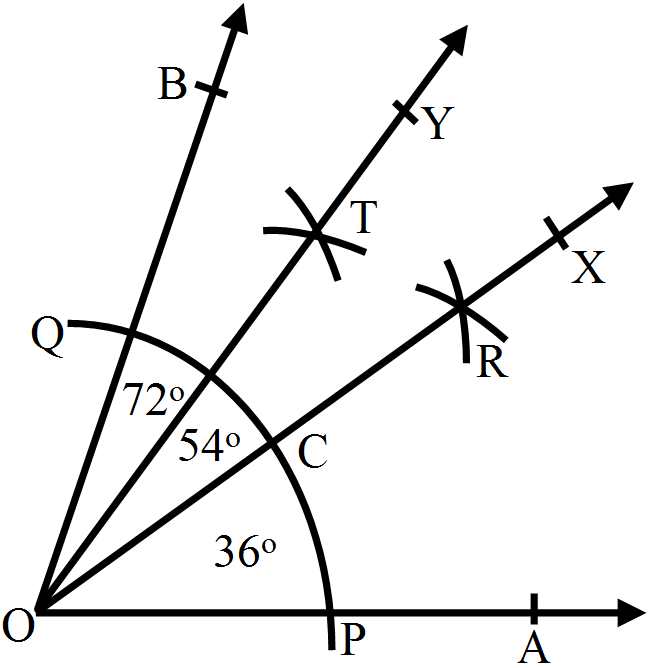
Draw a ray OA.
With the help of a protractor, draw an angle $\angle\text{AOB}$ of 72°.
With a convenient radius and centre at O, draw an arc cutting sides OA and OB at P and Q, respectively.
With P and Q as centres and radius more than half of PQ, draw two arcs cutting each other at R.
Join O and R and extend it to X.
OR intersects arc PQ at C.
With C and Q as centres and radius more than half of CQ, draw two arcs cutting each other at T.
Join O and T and extend it to Y.
Now, OX bisects $\angle\text{AOB}$
Therefore, $\angle\text{AOX}=\angle\text{BOX}=\frac{72}{2}=36^{\circ}$
Again, OY bisects $\angle\text{BOX}$
Therefore, $\angle\text{XOY}=\angle\text{BOY}=\frac{36}{2}=18^{\circ}$
Therefore, $\angle\text{AOX}$ is the required angle of 36° and $\angle\text{AOY}=\angle\text{AOX}+\angle\text{XOY}=36^{\circ}+18^{\circ}=54^{\circ}$
Therefore, $\angle\text{AOY}$ is the required angle of 54°.
View full question & answer
Question 195 Marks
Using ruler and compasses only, draw an angle of measure 135°.
Answer
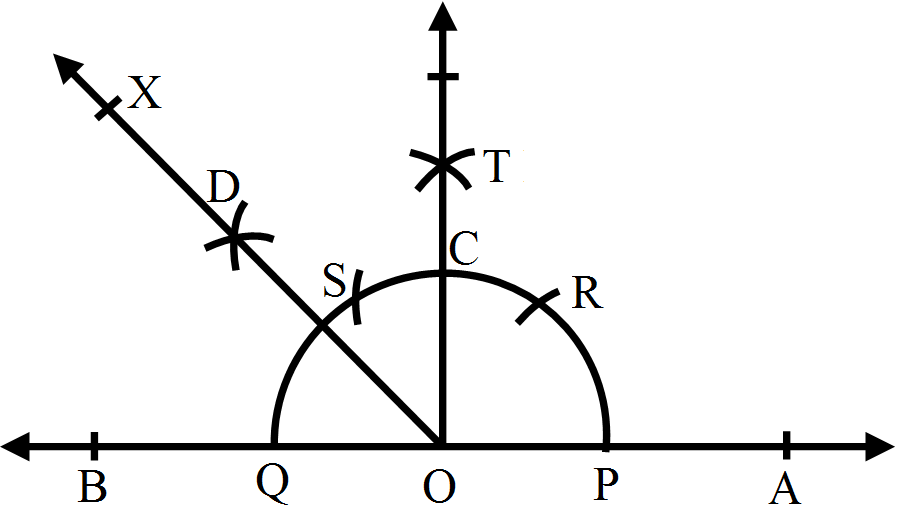
We draw a line AB and mark a point O on it.
With ​a convenient radius and centre at O, draw an arc PQ with the help of a compass intersecting the line AB at P and Q.
With the same radius and centre at P, draw another arc intersecting the arc PQ at R.
With the same radius and centre at Q, draw one more arc intersecting the arc PQ at S, opposite to P.
Taking S and R as centres and radius more than half of SR, draw two arcs intersecting each other at T.
Join O and T intersecting the arc PQ at C.
Taking C and Q as centres and radius more than half of CQ, draw two arcs intersecting each other at D.
Join O and D and extend it to X to form the ray OX.
$\angle\text{AOX}$ is the required angle of measure 135°.
View full question & answer
Question 205 Marks
Using a protractor, draw $\angle\text{BAC}$ of measure 45°. Take a point P in the interior of $\angle\text{BAC}.$ From P draw line segments PM and PN such that $\text{PM}\perp\text{AB}$ and $\text{PN}\perp\text{AC},$ Measure $\angle\text{MPN}.$
Answer
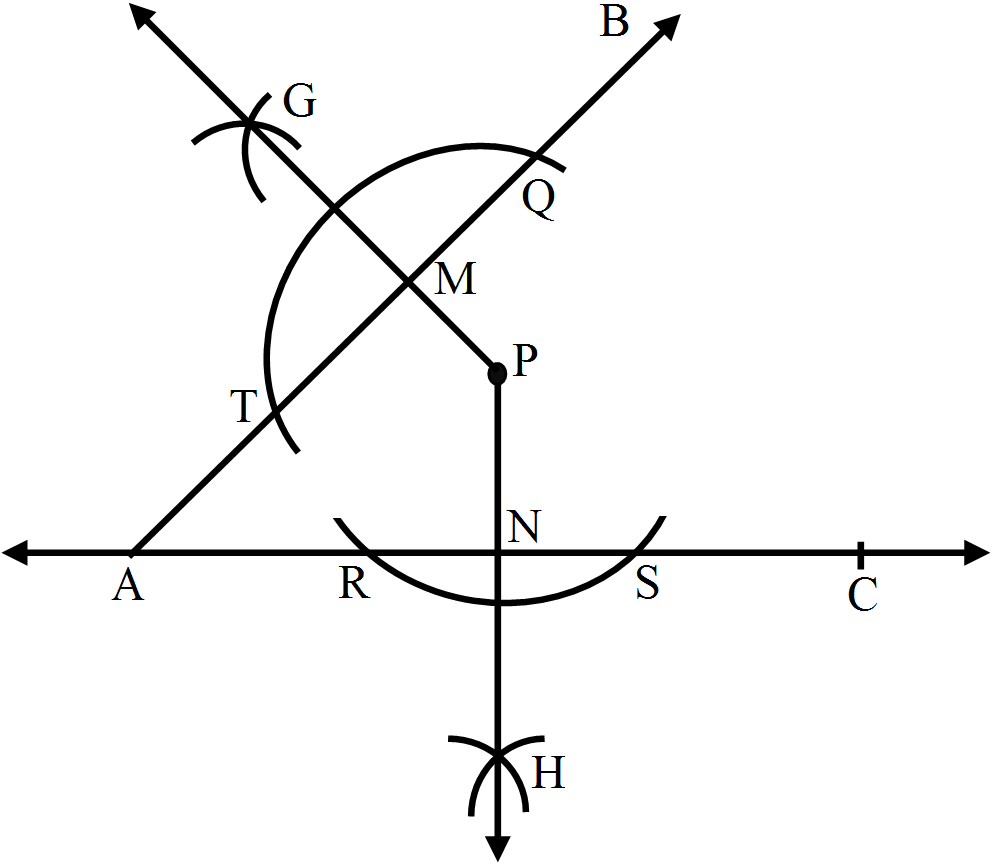
  1. Draw a line segment A on the line L .
  2. Take a protractor and place it on the segment AC such that AC coincides with the line of the diameter of the protractor and the middle point of the line coincides with point A.
  3. Counting from the right side, mark a point as B at the point of 45° of protractor and draw a line segment AB.
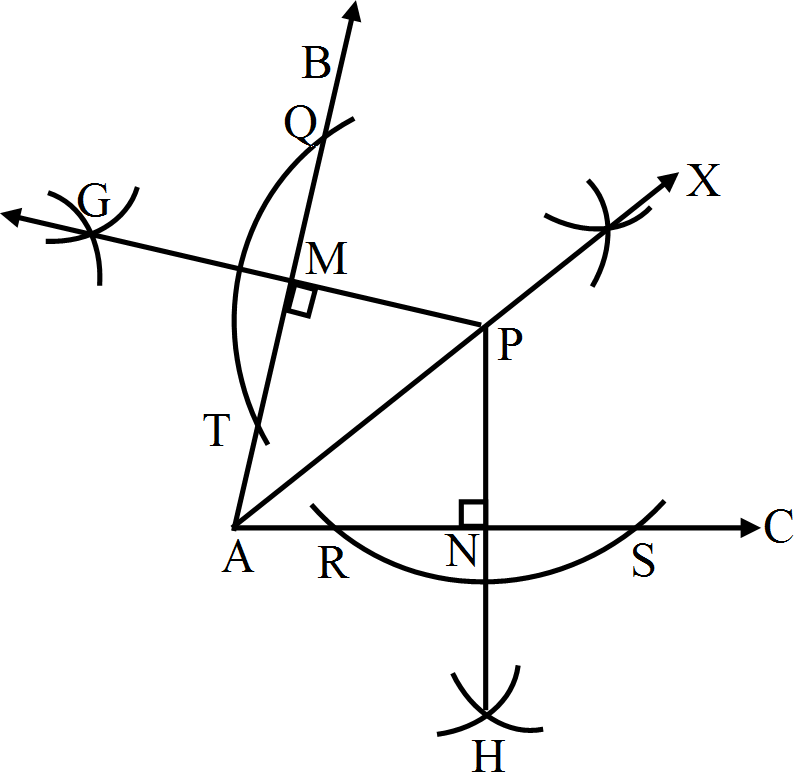
  4. Take a convenient radius with P as centre, construct an arc intersecting the line segments AB at T and Q and AC at R and S.
  5. Using the same radius and with T and Q as centres, construct two arcs intersecting at G on the other side.
  6. Using the same radius and with R and S as centres, construct two arcs intersecting at H on the other side.
  7. Join PG and PH which intersects AB and AC at M and N, respectively.
On measuring $\angle\text{MPN}$ using a protractor, we get it equal to 135°.
View full question & answer
Question 215 Marks
Draw an angle and label it as $\angle\text{BAC}.$ Draw its bisector ray AX and take a point P on it. From P draw line segments PM and PN, such that $\text{PM}\perp\text{AB}$ and $\text{PN}\perp\text{AC},$ where M and N are respectively points on rays AB and AC. Measure PM and PN. Are the two lengths equal?
Answer
  1. Draw $\angle\text{BAC}$ on the line segment AC.
With a convenient radius and A as centre, draw an arc from AB and AC.
  1. The points where arc cuts AB and AC, take both points as centres and draw two small arcs intersecting at X. Now, draw AX.
  2. Take a point P on the ray AX.
  3. Take a convenient radius with P as centre and construct an arc intersecting the line segments AB at T and Q and AC at R and S, respectively.
  4. Using the same radius and with T and Q as centres, construct two arcs intersecting at G on the other side.
  5. Using the same radius and with R and S as centres, construct two arcs intersecting at H on the other side.
  6. Join PG and PH, which intersects AB and AC at M and N, respectively.
On measuring PM and PN using a ruler, we find that both are equal.
View full question & answer