Questions

3 Mark Question

Take a timed test

35 questions · self-marked practice — reveal the answer and mark yourself.

Question 13 Marks
What will happen to the area of a rectangle if its
Length and breadth are trebled.
Answer
If the length and breadth of a rectangle are trebled.
Let the initial length and breadth be l and b, respectively.
Original area = l × b = lb
Now,
the length and breadth are trebled which means they become three times of their original value.
Therefore New length = 3l
New breadth = 3b
New area = 3l × 3b = 9lb
Thus, the area of the rectangle will become 9 times that of its original area.
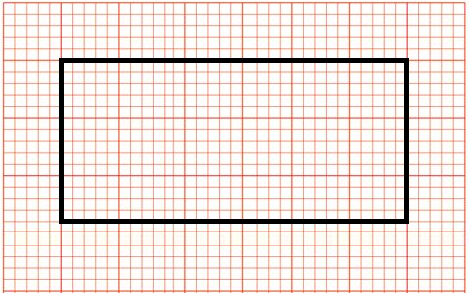
View full question & answer
Question 23 Marks
Find the perimeter of a rectangle whose area is $500\ cm^2$ and breadth is $20\ cm.$
Answer
Area $= 500\ cm^2$
Breadth $= 20\ cm$
Area of rectangle = (Length × Breadth)
Therefore Length $=\frac{\text{Area}}{\text{Breadth}}$
$=\frac{500}{20}=25\text{cm}$
Perimeter of a rectangle = 2(Length + Breadth)
$= 2(25 + 20)\ cm$
$= 2 \times 45\ cm$
$= 90\ cm$
View full question & answer
Question 33 Marks
What will happen to the area of a square if its side is:
Tripled.
Answer
Let the original side of the square be s.
Original area $= s \times s = s^2$
If the side of a square is tripled, new side will be equal to 3s.
New area $= 3s \times 3s = 9s^2$​​​​​​​
This means that the area becomes 9 times that of the original area.
View full question & answer
Question 43 Marks
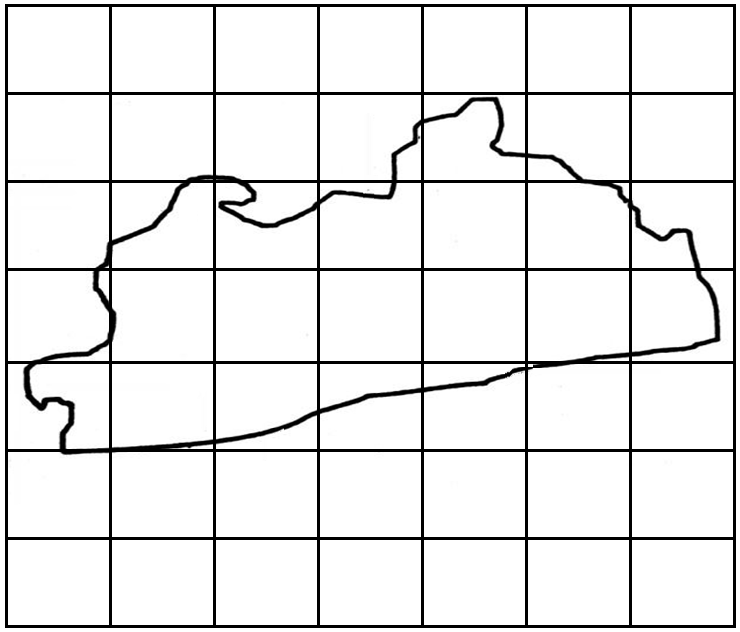
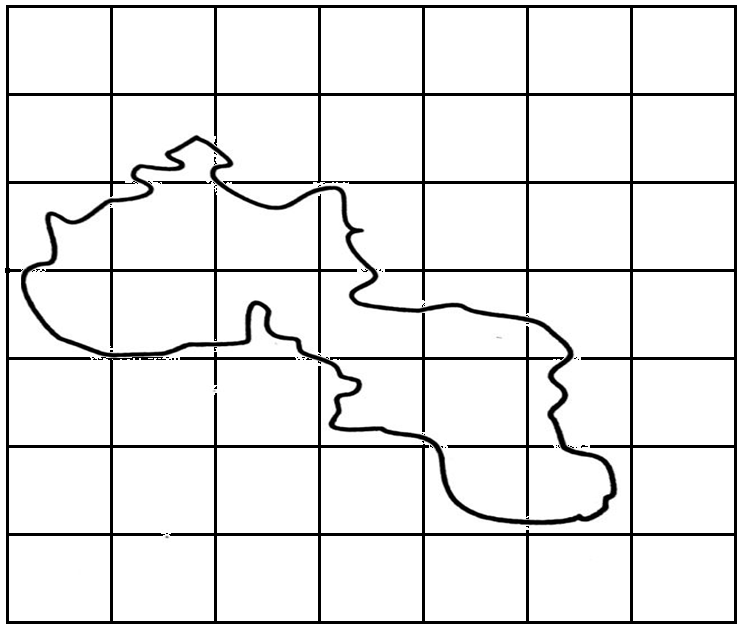
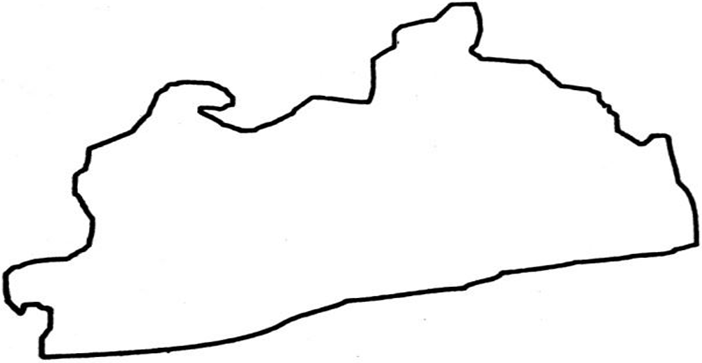
Using tracing paper and centimeter graph paper to compare the areas of the following pairs of figure:

Answer


Using tracing paper, we traced the figure on a graph paper.
This figure contains $8$ complete squares, $11$ more than half squares and $10$ less than half squares.
Let us assume that the area of one square is $1cm^2.$
If we neglect the less than half squares and consider the area of more than half squares as equal to area of complete square, we get:
Area of this shape $= (8 + 11) = 19cm^2$
On comparing the areas of these two shapes, we get that the area of Fig.(ii) is more than that of Fig.(i).
View full question & answer
Question 53 Marks
The side of a square field is 65m. What is the length of the fence required all around it?
Answer
Side of the square field = 65m
Length of the fence around the square field = Perimeter of the square field = 4 × (Side of the square)
Perimeter of the square field = 4 × 65 = 260m
Thus, the length of the fence around the square filed = 260m
View full question & answer
Question 63 Marks
How many tiles with dimension $5\ cm$ and $12\ cm$ will be needed to fit a region whose length and breadth are respectively?
$70\ cm$ and $36\ cm$
Answer
Dimension of the tile $=5 cm \times 12 cm$ Dimension of the region $=70 cm \times 36 cm$
Area of the tile $=5 cm \times 12 cm$
$=60 cm^2$
Area of the region $=70 cm \times 36 cm$
$=2,520 cm^2$
Number of tiles required to cover the region $=\frac{\text{Area of the region}}{\text{Area of one tile}}$
$=\frac{2520}{42}=42\text{tiles}$
View full question & answer
Question 73 Marks
The dimensions of a photographs are 30cm × 20cm. What length of wooden frame is needed to frame the picture?
Answer
Dimensions of the photograph = 30cm × 20cm
So, the required length of wooden frame = Perimeter of the photograph
= 2(Length + Breadth)
= 2(30 + 20)cm
= 2 × 50cm
= 100cm
View full question & answer
Question 83 Marks
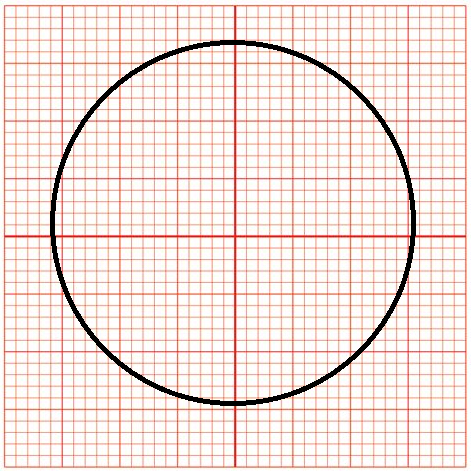
Draw any circle on the graph paper, Count the squares and use them to estimate the area the area of the circular region.
Answer

This circle on the squared paper consists of $21$ complete squares, $15$ more than half squares and 8 less than half squares.
Let us assume that the area of $1$ square is $1\ cm^2$.
If we neglect the less than half squares while approximating more than half square as equal to a complete square, we get:
Area of this shape $= (21 + 15) = 36cm^2$
View full question & answer
Question 93 Marks
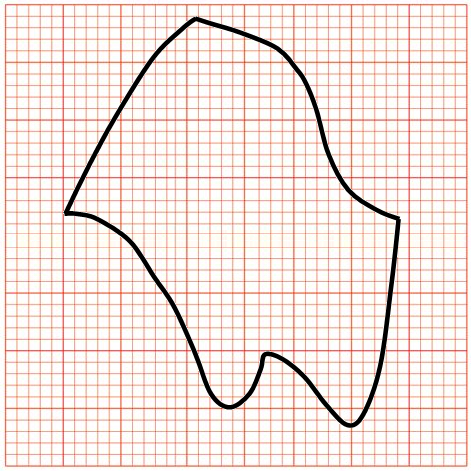
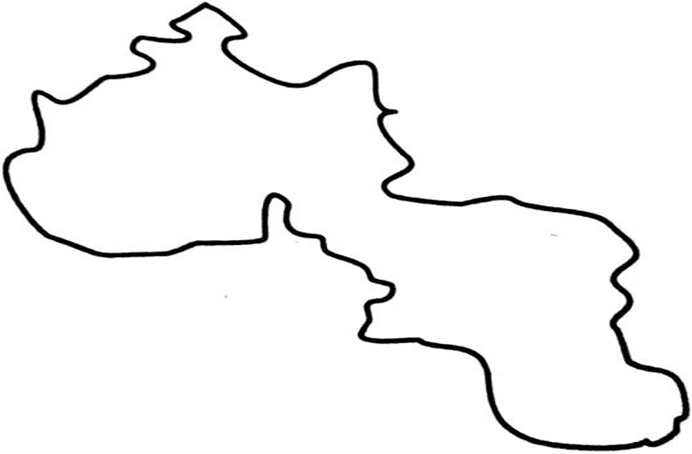
On a squared paper, draw any irregular closed figure. Find the approximate area by counting the number of squares complete, more than half and exactly half.
Answer
Any irregular figure:
This figure consists of $10$ complete squares, $1$ exactly half square, $7$ more than half squares and $6$ less than half squares.
If we assume that the area of one complete square is $1cm^2,$
Then the area of this shape $= (10 + 1 \times 12 + 7 \times 1) = 17.5cm^2$

View full question & answer
Question 103 Marks
A marble tile measures $15\ cm \times 20\ cm$. How many tiles will be required to cover a wall of size $4\ m \times 6\ m$?
Answer
Dimensions of the tile $= 15\ cm \times 20\ cm$
Dimensions of the wall $= 4\ m \times 6\ m = 400\ cm \times 600\ cm$ (Since, $1\ m = 10\ cm$)
Area of the tile $= 15\ cm \times 2\ cm = 300\ cm^2$
Area of the wall $= 400\ cm \times 600\ cm$
$= 2,40,000\ cm^2$​​​​​​​
Number of tiles required to cover the well $=\frac{\text{Area of wall}}{\text{Area of one tile}}$
$=\frac{2400}{300}=800\text{tiles}$
View full question & answer
Question 113 Marks
To fix fence wires in a garden, 70m long and 50m wide, Arvind bought metal pipes for bosts, he fixed a post every 5 metres apart. Each post was 2m long. What is total length of the pipes he bought for the posts?
Answer
Length of the garden = 70m
Breadth of the garden = 50m
Perimeter of the garden = 2(Length + Breadth)
= 2(70 + 50)
= 2 × 120
= 240m
On the perimeter of the garden, it is given that Arvind fixes a post every 5 metres apart.
So, the number of posts required $=\frac{240}{5}=48$
Since, Length of each post = 2m
View full question & answer
Question 123 Marks
How many tiles with dimension $5\ cm$ and $12\ cm$ will be needed to fit a region whose length and breadth are respectively?
$100\ cm$ and $144\ cm$
Answer
Dimension of the tile $=5 cm \times 12 cm$
Dimension of the region $=100 cm \times 144 cm$
Area of the tile $=5 cm \times 12 cm$
$=60 cm^2$
Area of the region $=100 cm \times 144 cm$
$=14,400 cm^2$
Number of tiles required to cover the region $=\frac{\text { Area of region }}{\text { Area of one tile }}$
$=\frac{14400}{60}=240 \text { tiles }$
View full question & answer
Question 133 Marks
A square piece of land has each side equal to 100m. If 3 layers of metal wire has to be used to fence it, what is the length of the wire needed?
Answer
Side of the square field = 100m
Wire required to fence the square field = Perimeter of the square field = 4 × (Side of the square field Perimeter)
= 4 × 100
= 400m
This perimeter is the length of wire required to fence one layer.
Therefore, the length of wire required to fence three layers = 3 × 400m = 1200m
View full question & answer
Question 143 Marks
The length of a rectangular fields is 100m. If its perimeter is 300m, what is its breadth?
Answer
Length of the rectangular field = 100m Perimeter of the rectangular field = 300m Perimeter of a rectangle = 2(Length + Breadth) Applying the above formula, we get: Breadth of the rectangular field $=\frac{\text{Perimeter}}{2}-\text{Length}$ $=\frac{300}{2}-100$$=150-100$
$=50\text{m}$
View full question & answer
Question 153 Marks
A rectangular piece of lawn is 55m wide and 98m long. Find the length of the fence around it.
Answer
Length of the lawn = 98m
Breadth of the lawn = 55m
Length of the fence around the lawn = Perimeter of the lawn = 2 × (Length + Breadth)
Perimeter of the lawn = 2(98 + 55)m = 2(153) = 306m
Thus, the length of the fence around the lawn = 306m
View full question & answer
Question 163 Marks
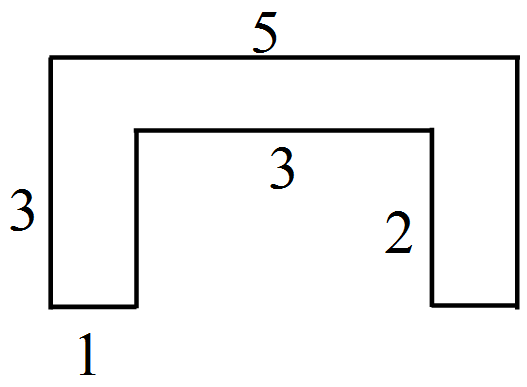
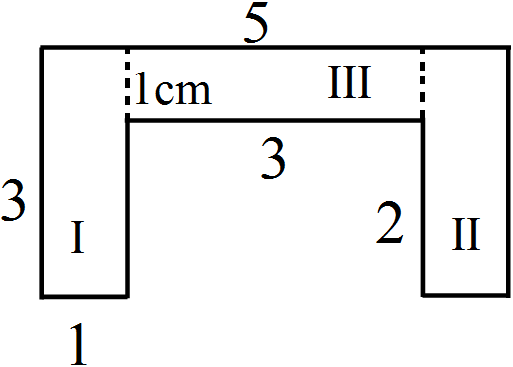
The following figure have been split into rectangles. Find the area. (The measures are given in centimeter)
Answer
This figure consists of three rectangles I, II and III.


Area of rectangle I $=$ (Length $\times$ Breadth)
$=(3 \times 1)$
$=3 cm^2$
Similarly, area of rectangle II $=$ (Length $\times$ Breadth)
$=(3 \times 1)$
$=3 cm^2$
Area of rectangle III=(Length $\times$ Breadth)
$=(3 \times 1)$
$=3 cm^2$
Thus, the total area of this figure = (Area of rectangle I + area of rectangle II + area of rectangle III)
$=(3+3+3)$
$=9 cm^2$
​​​​​​​
View full question & answer
Question 173 Marks
Find the cost of fencing a rectangular park of length 175m and breadth 125m at the rate of Rs. 12 per meter.
Answer
Length of the park = 175m
Breadth of the park = 125m
Perimeter of the park = 2(Length + Breadth)
= 2(175 + 125)
= 2 × 300
= 600m
Rate of fencing = Rs. 12 per meter
Cost of fencing = Rs. 12 × 600
= Rs. 7,200
View full question & answer
Question 183 Marks
What will happen to the area of a rectangle if its.
Length is doubled and breadth is same.
Answer
If the length is doubled and the breadth is same.
Let the initial length and breadth be l and b, respectively.
Original area = l × b = lb
Now, length is doubled and breadth remains same.
Therefore New length = 2l
New breadth = b
New area = 2l × b = 2lb
Thus, the area of the rectangle will become 2 times that of its original area.
View full question & answer
Question 193 Marks
The total cost of flooring a room at Rs. $85$ per $m ^2$ is Rs. $5100$ . If the length of the room is 8 metres, then find its breadth.
Answer
As, the total cost of flooring = Rs. $5100$ and
The rate of flooring = Rs. $85 per m^2$
So, the area of the floor $=\frac{\text{total cost of the flooring}}{\text{Rate of the flooring}}$
$=\frac{5100}{85}$
$=60\text{m}^{2}$
Also, the length of the room = $8m$
Now, the breadth of the room $=\frac{\text{Area of the floor}}{\text{Length of the room}}$
$=\frac{60}{8}$
$=\frac{15}{2}$
$=7.5\text{m}$
So, the breadth of the room is $7.5m.$
View full question & answer
Question 203 Marks
A room is $12.5\ m$ long and $8\ m$ wide. A square carpet of side $8\ m$is laid on its floor. Find the area of the floor which is not carpeted.
Answer
We have,
Length of the room = $12.5\ m,$
Breadth of the room =$8\ m$ and
Side of the square carpet = $8\ m$
The area of the room = (Length $\times$ Breadth)
$= 12.5 \times 8$
$= 100m^2$
Also, the area of the square carpet = (Side $\times$ Side)
$= 8 \times 8$
$= 64m^2​​​​​​​$​​​​​​​
Now, the area of the floor which is not carpeted = (Area of the room - Area of the carpet)
$= 100 - 64$
$= 36m^2$​​​​​​​
View full question & answer
Question 213 Marks
A wire of length 20m is to be folded in the form of a rectangle. How many rectangles can be formed by folding the wire if the sides are positive integers in metres?
Answer
It is given that a wire of length 20 m is to be folded in the form of a rectangle;
Therefore, we have: Perimeter of the rectangle = 20m
⇒ 2 (Length + Breadth) = 20m
⇒ (Length + Breadth) $=\frac{20}{2}=10\text{m}$
Since, length and breadth are positive integers in metres, therefore, the possible dimensions are:
(1m, 9m), (2m, 8m), (3m, 7m), (4m, 6m) and (5m, 5m)
Thus, five rectangles can be formed with the given wire.
View full question & answer
Question 223 Marks
What will happen to the area of a square if its side is:
Increased by half of it.
Answer
Let the original side of the square be s.
Original area = $s \times s = s^2$
If the side of a square is increased by half of it, new side
$=\Big(\text{s}+\frac{1}{2}\text{s}\Big)=\frac{3}{2}\text{s}$
$\text{New area}=\frac{3}{2}\text{s}\times\frac{3}{2}\text{s}=\frac{9}{4}\text{s}$
This means that the area becomes $\frac{9}{4}$ times that of the original area.
View full question & answer
Question 233 Marks
Area of a rectangle of breadth $17cm$ is $340cm^2.$ Find the perimeter of the rectangle.
Answer
Area of the rectangle = $340cm^2$
Breadth of the rectangle = $17cm$
Applying the formula:
Length of a rectangle $=\frac{\text{Area}}{\text{Breadth}}$
We get:
Length of the rectangle $=\frac{340}{17}=20\text{cm}$
Perimeter of rectangle = 2(Length + Breadth)
$= 2(20 + 17)$
$= 2 × 37$
$= 74cm$
View full question & answer
Question 243 Marks
What will happen to the area of a rectangle if its.
Length is doubled and breadth is halved.
Answer
If the Length is doubled and breadth is halved.
Let the initial length and breadth be land b, respectively.
Original area =l × b = lb
Now, length is doubled and breadth is halved.
Therefore New length = 2l
New breadth $=\frac{\text{b}}{2}$
New area $=2\text{l}\times\frac{\text{b}}{2}=\text{lb}$
New area is also lb.
This means that the areas remain the same.
View full question & answer
Question 253 Marks
The perimeter of a regular pentagon is 100cm. How long is each sides?
Answer
A regular pentagon is a closed polygon having five sides of equal length. Perimeter of the regular pentagon = 100cm Perimeter of the regular pentagon = 5(Side of the regular pentagon) Therefore, side of the regular pentagon $=\frac{\text{Perimeter}}{2}$ $=\frac{100}{5}$$=20\text{cm}$
View full question & answer
Question 263 Marks
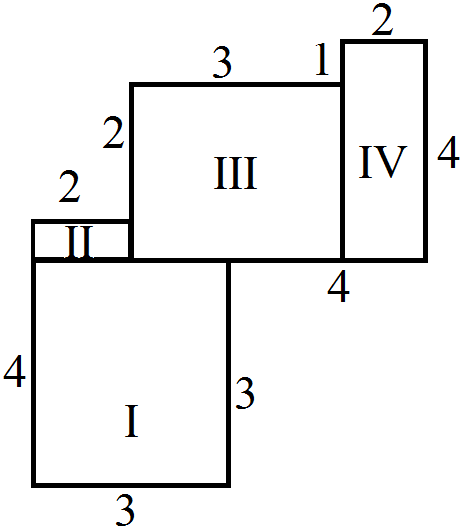
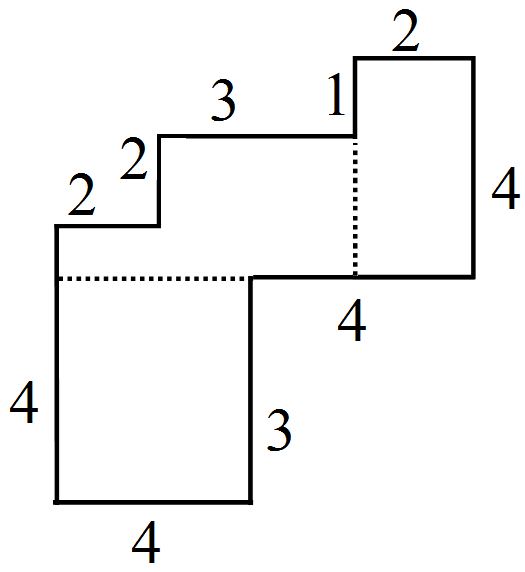
The following figure have been split into rectangles. Find the area. (The measures are given in centimeter)
Answer
This figure consists of two rectangles II and IV and two squares I and III.
Area of square $I =($ Side $\times$ Side $)=(3 \times 3)=9 cm^2$
Similarity, area of rectangle II $=($ Side $\times$ Side $)=(2 \times 1)=2 cm^2$
Area of square III $=($ Side $\times$ Side $)=(3 \times 3)=9 cm^2$
Area of rectangle IV $=($ Side $\times$ Side $)=(2 \times 4)=8 cm^2$
Thus, the total area of this figure = (Area of square I + Area of rectangle II + Area of square III + Area of rectangleIV)
$=(9+2+9+8)=28 cm^2$

View full question & answer
Question 273 Marks
A rectangle has the area equal to that of a square of side $80cm$. If the breadth of the rectangle is $20cm$, Find its length.
Answer
Side of the square = $80cm$
Area of square = (Side \times Side)
$= 80 \times 80$
$= 6400cm^2$
Given that:
Area of the rectangle = Area of the square = $6400cm^2$
Breadth of the rectangle = $20cm$
Applying the formula:
Length of the rectangle $=\frac{\text{Area}}{\text{Breadth}}$
We get:
Length of the rectangle $=\frac{6400}{20}=320\text{cm}$
View full question & answer
Question 283 Marks
A marble tile measures $10 cm \times 12 cm$. How many tiles will be required to cover a wall of size $3 m \times 4 m$ ? Also, find the total cost of the tiles at the rate of $Rs 2$ per tile.
Answer
Dimension of the tile $=10 cm \times 12 cm$
Dimension of the wall $=3 m \times 4 m$
$=300 cm \times 400 cm \text { (Since, } 1 m=100 cm)$
Area of the tile $=10 cm \times 12 cm$
$=120 cm^2$
Area of the wall $=300 cm \times 400 cm$
$=1,20,000 cm^2$
Number of tiles required to cover the wall $=\frac{\text { Area of wall }}{\text { Area of one tile }}$
$=\frac{120000}{120}=1000 \text { tiles }$
Cost of tiles at the rate of Rs. 2 per tile $=2 \times 1,000$
$=\text { Rs. } 2,000$
View full question & answer
Question 293 Marks
Shikha runs around a square of side 75m. Priya runs around a rectangle with length 60m and breadth 45m. Who covers the smaller distance?
Answer
Shikha and Priya, while running around the square and rectangular field respectively, actually cover a distance equal to the perimeters of these fields.
Distance covered by Shikha = Perimeter of the square
= 4 × 75m = 300m
Similarly, distance covered by Priya = Perimeter of the rectangle
= 2(60 + 45)
= 2 × 105 = 210m
Thus, it is evident that the distance covered by Priya is less than that covered by Shikha.
View full question & answer
Question 303 Marks
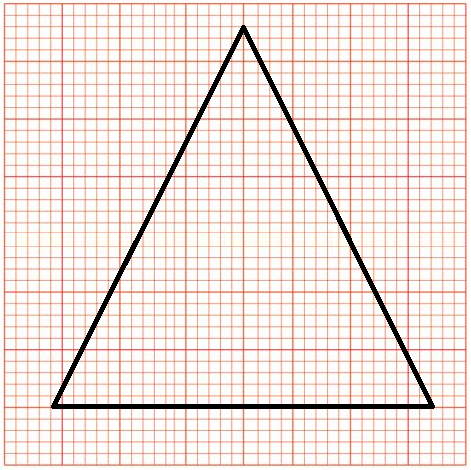
On a squared paper, draw a triangle Find the approximate area by counting the number of squares complete, more than half and exactly half.
Answer
A triangle: This triangle contains $4$ complete squares, $6$ more than half squares and $6$ less than half squares.
If we assume that the area of one complete square is $1cm^2$,
Then the area of this shape $= (4 + 6 \times 1) = 10cm^2$

View full question & answer
Question 313 Marks
One tile of a square plot is $250\ m$, find the cost of leveling it at the rate of $Rs\ 2$ per square meter.
Answer
$\text { Side of the square plot }=250 m$
$\text { Area of the square plot }=(\text { Side } \times \text { Side })$
$=250 \times 250$
$=62,500 m^2$
Rate of leveling the plot $=$ Rs. 2 per $m ^2$
Cost of leveling the square plot $=$ Rs. $62,500 \times 2$
$=\text { Rs. 1,25,000 }$
View full question & answer
Question 323 Marks
Using tracing paper and centimeter graph paper to compare the areas of the following pairs of figure:
Answer


Using tracing paper, we traced the figure on a graph paper.
This figure contains $4$ complete squares, $9$ more than half squares and $9$ less than half squares. Let us assume that the area of one square is $1cm^2$​​​​​​​
If we neglect the less than half squares and consider the area of more than half squares as equal to area of complete square, we get:
Area of this shape $= (4 + 9) = 13cm^2$​​​​​​​​​​​​​​
View full question & answer
Question 333 Marks
On a squared paper, draw a rectangle Find the approximate area by counting the number of squares complete, more than half and exactly half.
Answer
A rectangle: This contains $18$ complete squares.
If we assume that the area of one complete square is $1\ cm^2,$
Then the area o this rectangle will be $18\ cm^2.$

View full question & answer
Question 343 Marks
A rectangular piece of land measure 0.7km by 0.5km. Each side is to be fenced with four rows of wires. What length of the wire is needed?
Answer
Dimensions of the rectangular land = 0.7km × 0.5km
Perimeter of the rectangular land = 2(Length + Breadth)
= 2 (0.7 + 0.5)km
= 2 × 1.2km = 2.4km
This perimeter is equal to one row of wire required to fence the land.
Therefore, length of wire required to fence the land with four rows of wire = 4 × 2.4km
= 9.6km
View full question & answer
Question 353 Marks
Two sides of a triangle are 15cm and 20cm. The perimeter of the triangles is 50cm. What is the third side?
Answer
Given: Perimeter = 50cm
Length of the first side = 15cm
Length of the second side = 20cm
We have to find the length of the third side.
Perimeter of a triangle = Sum of all three sides of the triangle
Length of the third side = (Perimeter of the triangle) - (Sum of the length of the other two sides)
= 50 - (15 + 20)
= 50 - 35 = 15cm
View full question & answer