Use straws or sticks to make all the kinds of angles that you have learnt about.
Question types
Angles and Pairs of Angles question types
40 questions across 5 question groups — pick any mix to generate a Maths paper with step-by-step answer keys.
40
Questions
5
Question groups
5
Question types
01
1 Mark Question
5 Q→022 Mark Question
20 Q→033 Mark Question
5 Q→045 Mark Question
5 Q→054 Mark Question
5 Q→Sample Questions
Angles and Pairs of Angles questions
One sample from each question group in this chapter. Select any group above to see the full set with answer keys.
View full solution →
Observe the adjacent figure and answer the following questions.

- Name the angle in the figure alongside.
- Name the rays whose origin is point B
Observe the adjacent figure and answer the following questions.
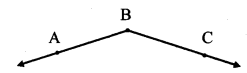
- Name the rays in the figure alongside.
- Name the origin of the rays
- Name the angle in the given figure
Are the ray PM and PT opposite rays? Give reasons for your answer.
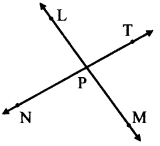
Name the pairs of opposite rays in the figure alongside.
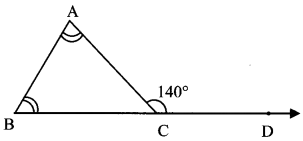
∠ACD is an exterior angle of ∆ABC. The measures of ∠A and ∠B are equal. If m∠ACD = 140°, find the measures of the angles ∠A and ∠B.
Observe the figure and answer the following questions.T is a point on line AB.
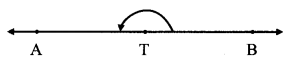
- What kind of angle is ∠ATB ?
- What is its measure ?
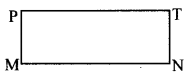
₹PTNM is a rectangle. Write the names of the pairs of supplementary angles.
Write the measures of the supplements of the angles given below : a°
Write the measures of the supplements of the angles given below : 0°
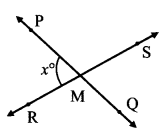
Lines PQ and RS intersect at point M. m∠PMR = x°.What are the measures of ∠PMS, ∠SMQ and ∠QMR ?
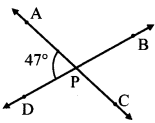
Lines AC and BD intersect at point P. m∠APD = 47° Find the measures of ∠APB, ∠BPC, ∠CPD.
The difference between the measures of the two angles of a complementary pair is 40°. Find the measures of the two angles.
In ΔXYZ, m∠Y = 90°. What kind of a pair do ∠X and ∠Z make ?
Observe the figure and complete the table for ∠AWB.
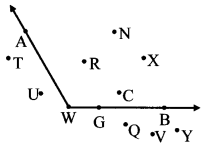
| Points in the interior | |
| Points in the exterior | |
| Points on the arms of the angles |
Observe the table given below and draw your conclusion
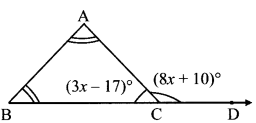
In the isosceles triangle ABC, ∠A and ∠B are equal. ∠ACD is an exterior angle of ∆ABC. The measures of ∠ACB and ∠ACD are (3x – 17)° and (8x + 10)° respectively. Find the measures of ∠ACB and ∠ACD. Also find the measures of ∠A and ∠B.
Observe the adjacent figure and answer the following questions :
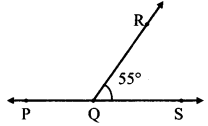
- Write the names of the angles in the figure alongside.
- What type of a pair of angles is it?
- Which arms of the angles are not the common arms?
- m∠PQR = __.
- m∠RQS = __.
Draw the pairs of angles as described below. If that is not possible, say why.
i. Complementary angles that are not adjacent.
ii. Angles in a linear pair which are not supplementary.
iii. Complementary angles that do not form a linear pair.
iv. Adjacent angles which are not in linear pair.
v. Angles which are neither complementary nor adjacent.
vi. Angles in a linear pair which are complementary.
i. Complementary angles that are not adjacent.
ii. Angles in a linear pair which are not supplementary.
iii. Complementary angles that do not form a linear pair.
iv. Adjacent angles which are not in linear pair.
v. Angles which are neither complementary nor adjacent.
vi. Angles in a linear pair which are complementary.
The measures of some angles are given below. Use them to make pairs of complementary and supplementary angles.
m∠B = 60°
m∠N = 30°
m∠Y = 90°
m∠J = 150°
m∠D = 75°
m∠E = 0°
m∠F = 15°
m∠G = 120°
m∠B = 60°
m∠N = 30°
m∠Y = 90°
m∠J = 150°
m∠D = 75°
m∠E = 0°
m∠F = 15°
m∠G = 120°
Using the measures of the angles given in the figure alongside, find the measures of the remaining three angles.
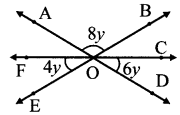
If ∠A and ∠B are supplementary angles and m∠B = (x + 20)°, then what would be m∠A ?
If m∠A = 70°, what is the measure of the supplement of the complement of ∠A ?
(y – 20)° and (y + 30)° are the measures of complementary angles. Find the measure of each angle.
Are the following pairs adjacent angles? If not, state the reason.
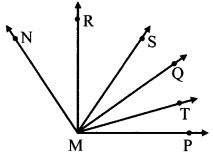
- ∠PMQ and ∠RMQ
- ∠RMQ and ∠SMR
- ∠RMS and ∠RMT
- ∠SMT and ∠RMS
Generate a Angles and Pairs of Angles paper free
Pick question groups from the list above, set marks and difficulty, and export a branded PDF with step-by-step answer keys. First 3 chapters free — no signup.