Questions

3 Mark Question

Take a timed test

16 questions · self-marked practice — reveal the answer and mark yourself.

Question 13 Marks
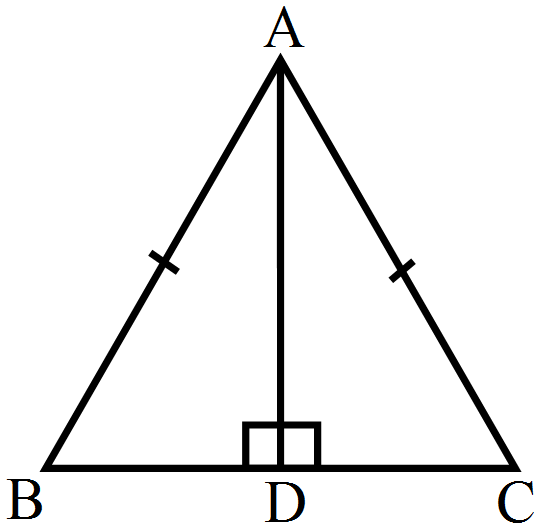
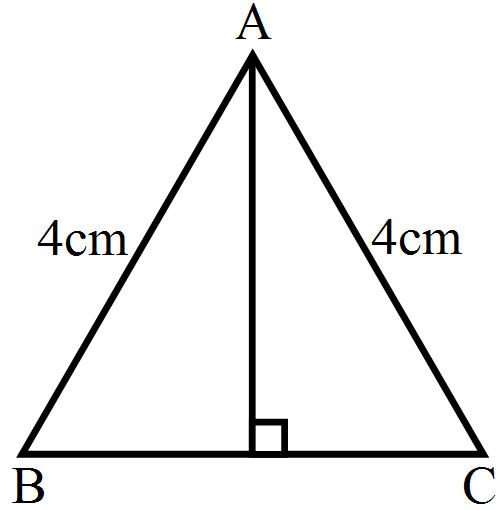
In each of the following pairs of right triangles, the measures of some parts are indicated along side. State by the application of RHS congruence condition which are congruent. State each result in symbolic form.
Answer
In figure,
AD = AD (common)
hypoteuse AC = hypoteuse AB
$\angle\text{ADB}+\angle\text{ADC}=180^\circ$ (Linear pair)
$\Rightarrow\angle\text{ADB}+90^\circ=180^\circ$
$\Rightarrow\angle\text{ADB}=180^\circ-90^\circ$
$\angle\text{ADB}=90^\circ$
$\angle\text{ADB}=\angle\text{ADC}=90^\circ$
Therefore, by RHS, $\triangle\text{ADB}\cong\triangle\text{ADC}$.
View full question & answer
Question 23 Marks
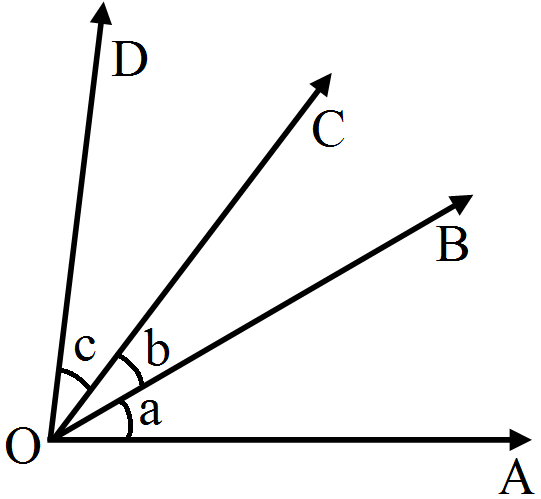
In figure, a = b = c, name the angle which is congruent to $\angle\text{AOC}$
Answer

We have,
$\angle\text{AOB}=\angle\text{BOC}=\angle\text{COD}$
$\therefore\angle\text{AOB}=\angle\text{COD}$
Also, $\angle\text{AOB}+\angle\text{BOC}=\angle\text{BOC}+\angle\text{COD}$
$\angle\text{AOC}=\angle\text{BOD}$
Hence, $\angle\text{BOD}$ is congruent to $\angle\text{AOC}.$
View full question & answer
Question 33 Marks
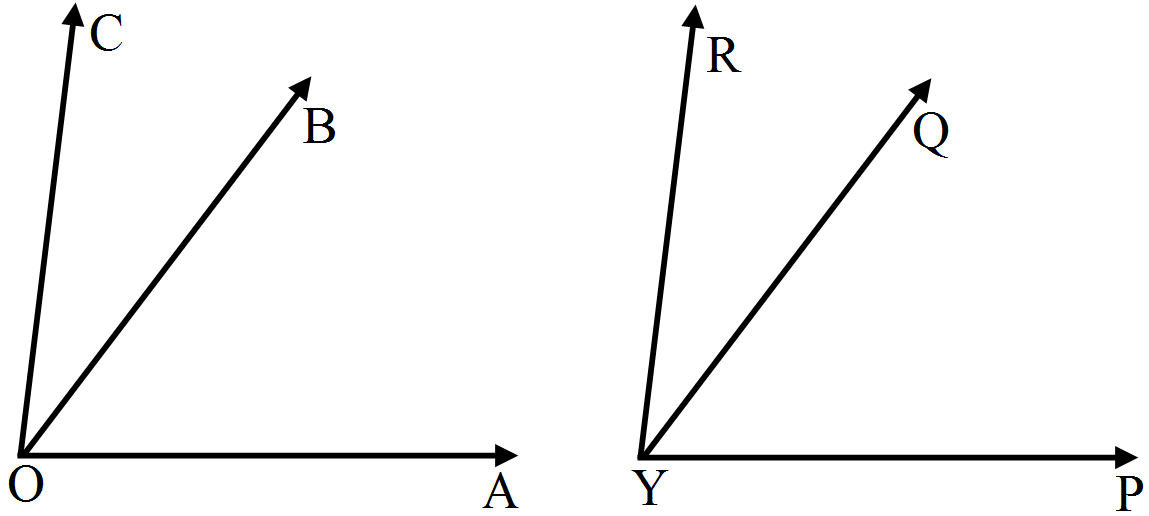
In figure, $\angle\text{AOC}\cong\angle\text{PYR}$ and $\angle\text{AOC}\cong\angle\text{PYR}$. Name the angle which is congruent to $\angle\text{AOB}.$
Answer
$\angle\text{AOC}\cong\angle\text{PYR}\ ...(\text{i})$
Also, $\angle\text{BOC}\cong\angle\text{QYR}$
Now, $\angle\text{AOC}=\angle\text{AOB}+\angle\text{BOC}$ and $\angle\text{PYR}=\angle\text{PYQ}+\angle\text{QYR}$
By putting the value of $\angle\text{AOC}$ and $\angle\text{PYR}$ in equation (i), we get:
$\angle\text{AOB}+\angle\text{BOC}\cong\angle\text{PYQ}+\angle\text{QYR}$
$\angle\text{AOB}\cong\angle\text{PYQ}$ $(\because \angle\text{BOC}\cong\angle\text{QYR})$
Hence, $\angle\text{AOB}\cong\angle\text{PYQ}$
View full question & answer
Question 43 Marks
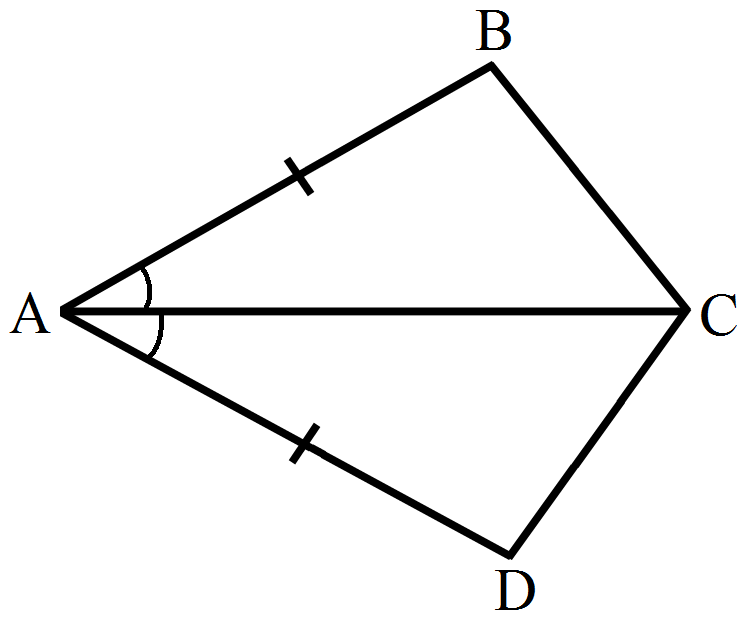
In Figure, AB = AD and $\angle\text{BAC}=\angle\text{DAC}$.
  1. State in symbolic form the congruence of two triangles ABC and ADC that is true.
  2. Complete each of the following, so as to make it true:
  1. $\angle\text{ABC}$ =
  2. $\angle\text{ACD}$ =
  3. Line segment AC bisects and .
​​​​​​​
Answer
  1. AB = AD (given)
$\angle\text{BAC}=\angle\text{DAC}$ (given)
AC = CA (common)
Therefore by SAS condition of congruency, $\triangle\text{ABC}\cong\triangle\text{ADC}$
  1.  
  1. $\angle\text{ABC}=\angle\text{ADC}$ (c.p.c.t)
  2. $\angle\text{ACD}=\angle\text{ACB}$ (c.p.c.t)
  3. Line segment AC bisects AD and AB.
View full question & answer
Question 53 Marks
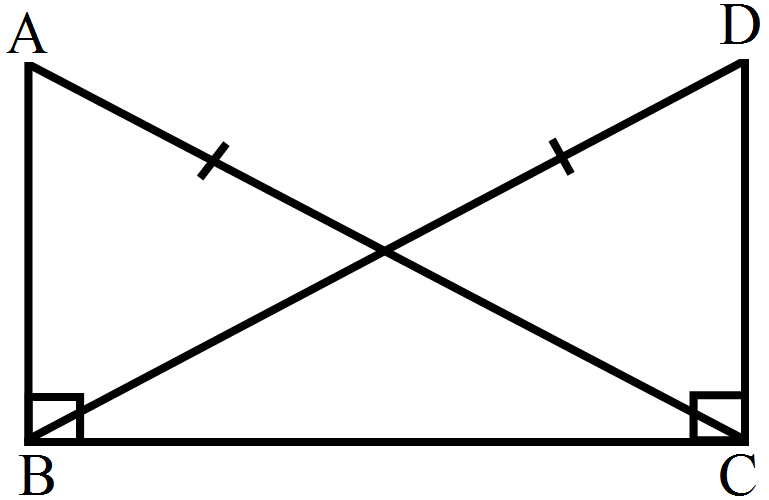
Draw a right triangle ABC. Use RHS condition to construct another triangle congruent to it.
Answer

Consider $\triangle\text{ABC}$ with $\angle\text{B}$ as right angle.
We know construct another right angle triangle on base BC, such that
$\angle\text{C}$ is a right angle and AB = DC
Also, BC = CB
Therefore, by RHS, $\triangle\text{ABC}\cong\triangle\text{DCB}$
View full question & answer
Question 63 Marks
Is it correct to say that any two right angles are congruent? Give reasons to justify your answer.
Answer
Two right angles are congruent to each other because they both measure 90 degrees.
We know that two angles are congruent if they have the same measure.
View full question & answer
Question 73 Marks
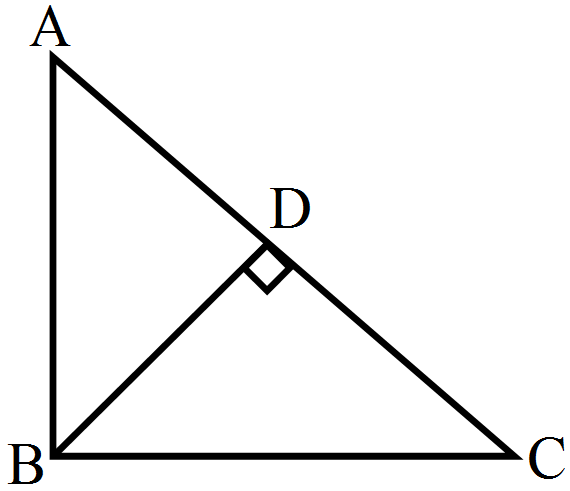
In each of the following pairs of right triangles, the measures of some parts are indicated along side. State by the application of RHS congruence condition which are congruent. State each result in symbolic form.
Answer
In figure,
BD = DB
hypoteuse AB = hypoteuse BC
$\Rightarrow\angle\text{BDA}+\angle\text{BDC}=180^\circ$
$\Rightarrow\angle\text{BDA}+90^\circ=180^\circ$
$\Rightarrow\angle\text{BDA}=180^\circ-90^\circ$
$\angle\text{BDA}=90^\circ$
$\angle\text{BDA}=\angle\text{BDC}=90^\circ$
Therefore, by RHS, $\triangle\text{ABD}\cong\triangle\text{CBD}$.
View full question & answer
Question 83 Marks
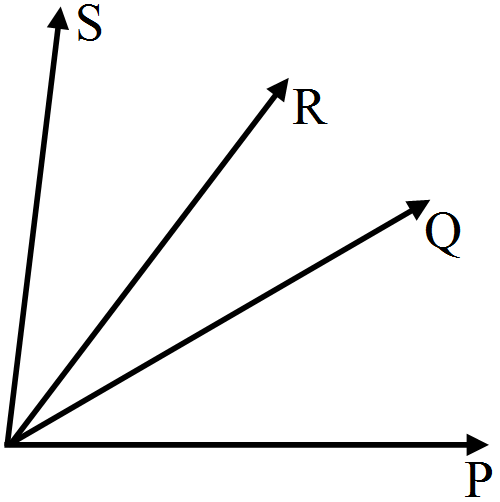
In Figure, $\angle\text{POQ}\cong\angle\text{ROS}$, can we say that $\angle\text{POR}\cong\angle\text{QOS}$
Answer
We have, $\angle\text{POQ}\cong\angle\text{ROS}\ ...(\text{i})$ Also, $\angle\text{ROQ}\cong\angle\text{ROQ}$ (same angle) Therefore, adding $\angle\text{ROQ}$ to both sides of (i), we get: $\angle\text{POQ}+\angle\text{ROQ}\cong\angle\text{ROQ}+\angle\text{ROS}$ $\therefore\angle\text{ROQ}\cong\angle\text{ROQ}$ Hence proved.
View full question & answer
Question 93 Marks
$\triangle\text{ABC}$ is isoseles with AB = AC. Also, $\text{AD}\perp\text{BC}$ meeting BC in D. Are the two triangles ABD and ACD congruent? State in symbolic form. Which congruence condtion do you use? Which side of $\triangle\text{ADC}$ equals BD? Which angle of $\triangle\text{ADC}$ equals $\angle\text{B}?$
Answer

We have AB = AC ...(i)
AD = DA (common) ...(ii)
and $\angle\text{ADC}=\angle\text{ADB}$ ($\text{AD}\perp\text{BC}$ at point D) ...(iii)
Therefore from (i), (ii) and (iii) by RHS congruence condition,
$\triangle\text{ABD}\cong\triangle\text{ACD}$
Now, the triangles are congurent.
Therefore, BD = CD. and $\angle\text{ABD}=\angle\text{ACD}$ (c.p.c.t.)
View full question & answer
Question 103 Marks
Triangles ABC and PQR are both isosceles with AB = AC and PO = PR respectively. If also, AB = PQ and BC = QR, are the two triangles congruent? Which condition do you use?It $\angle\text{B}=50^\circ,$ what is the measure of $\angle\text{R}?$
Answer
We have AB = AC in isosceles $\triangle\text{ABC}$
And PQ = PR in isosceles $\triangle\text{PQR}.$
Also, we are given that AB = PQ and QR = BC.
Therefore, AC = PR (AB = AC, PQ = PR and AB = PQ)
Hence, $\triangle\text{ABC}\cong​​\triangle\text{PQR}$
Now,
$\angle\text{ABC}=​​\angle\text{PQR}$ (Since triangles are congruent) However, $\triangle\text{PQR}$ is isosceles.
Therefore, $\angle\text{PRQ}=​​\angle\text{PQR}=\angle\text{ABC}=50^\circ$
View full question & answer
Question 113 Marks
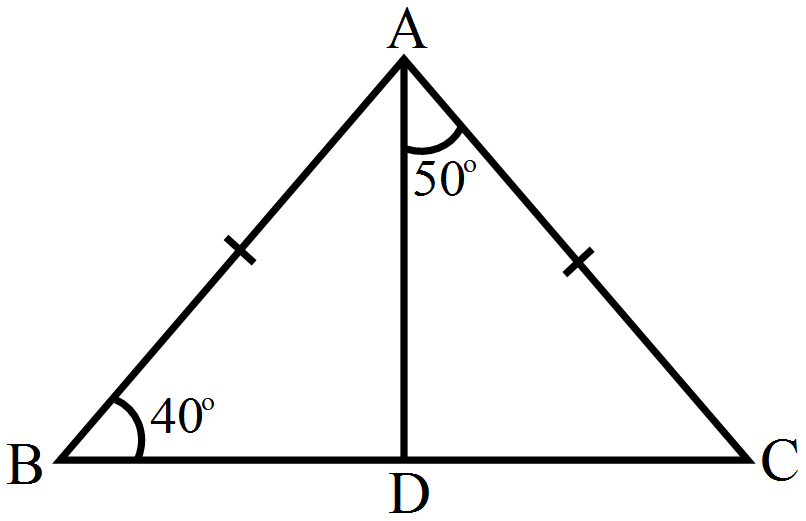
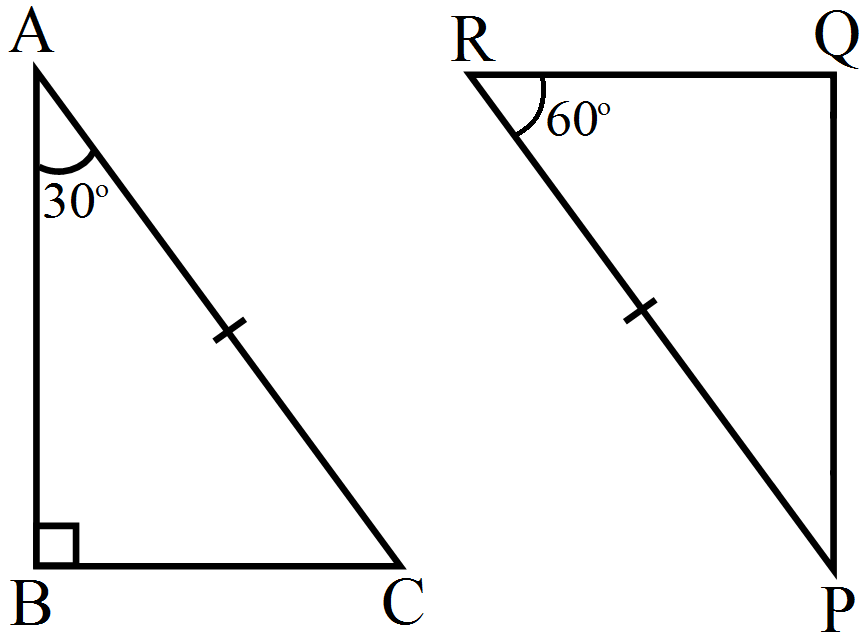
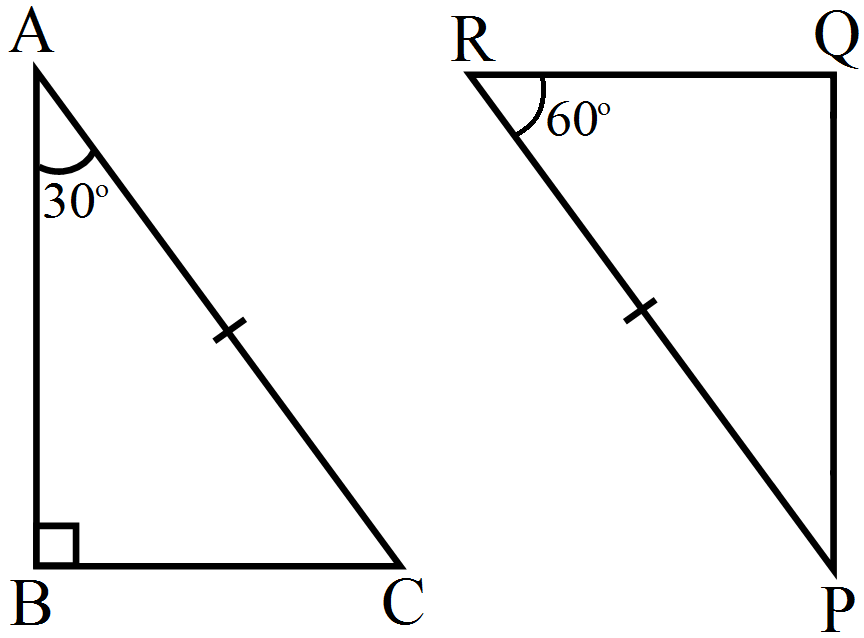
Which of the following pairs of triangle are congruent by ASA condition?
Answer

In $\triangle\text{ABC},$
Now AB =AC (Given)
$\angle\text{ABD}=\angle\text{ACD}=40^\circ$ (Angles opposite to equal sides)
$\Rightarrow\angle\text{ABD}+\angle\text{ACD}+\angle\text{BAC}=180^\circ$ (Angle sum property)
$\Rightarrow40^\circ+40^\circ+\angle\text{BAC}=180^\circ$
$\Rightarrow\angle\text{BAC}=180^\circ-80^\circ$
$\angle\text{BAC}=100^\circ$
Now,
$\angle\text{BAD}+\angle\text{DAC}=\angle\text{BAC}$
$\Rightarrow\angle\text{BAD}=\angle\text{BAC}-\angle\text{DAC}$
$\Rightarrow\angle\text{BAD}=100^\circ-50^\circ$
$\angle\text{BAD}=50^\circ$
$\therefore\angle\text{BAD}=\angle\text{CAD}=50^\circ$
Therefore, by ASA, $\triangle\text{ABD}\cong\triangle\text{ADC}$.
View full question & answer
Question 123 Marks
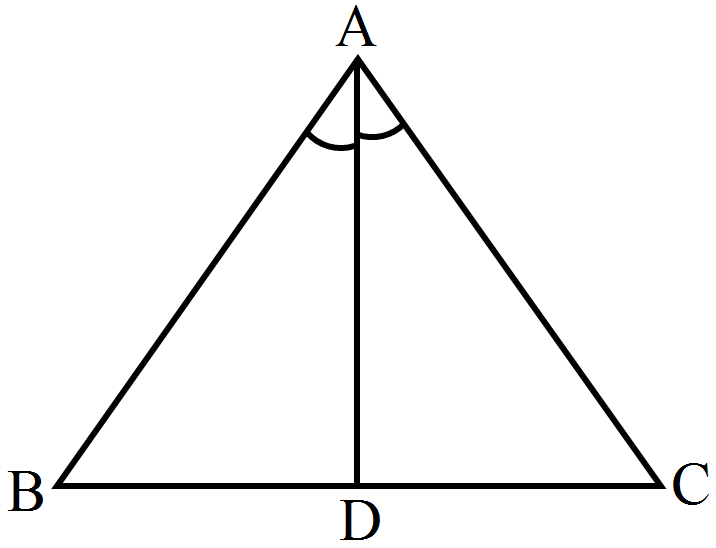
In figure, AD bisects A and AD and $\text{AD}\perp\text{BC}$.
  1. Is $\triangle\text{ADB}\cong\triangle\text{ADC}?$
  2. State the three pairs of matching parts you have used in (i)
  3. Is it true to say that BD = DC?
Answer
  1. Yes, $\triangle\text{ADB}\cong\triangle\text{ADC},$ by ASA criterion of congruency.
  2. We have used $\angle\text{BAD}=\angle\text{CAD}$, $\angle\text{ADB}=\angle\text{ADC}=90^\circ$
  3. Since, $\text{AD}\perp\text{BC}$ and AD = DA.
  4. Yes, BD = DC since, $\triangle\text{ADB}\cong\triangle\text{ADC}$.
View full question & answer
Question 133 Marks
Which of the following pairs of triangle are congruent by ASA condition?
Answer

In $\triangle\text{ABC},$
$\Rightarrow\angle\text{A}+\angle\text{B}+\angle\text{C}=180^\circ$ (Angle sum property)
$\Rightarrow\angle\text{C}=180^\circ-\angle\text{A}-\angle\text{B}$
$\Rightarrow\angle\text{C}=180^\circ-30^\circ-90^\circ$
$\angle\text{C}=60^\circ$
In $\triangle\text{PQR},$
$\Rightarrow\angle\text{P}+\angle\text{Q}+\angle\text{R}=180^\circ$ (Angle sum property)
$\Rightarrow\angle\text{P}=180^\circ-\angle\text{Q}-\angle\text{R}$
$\Rightarrow\angle\text{P}=180^\circ-60^\circ-90^\circ$
$\angle\text{P}=30^\circ$
Now,
$\angle\text{BAC}=\angle\text{QPR}=30^\circ$
$\angle\text{BCA}=\angle\text{PRQ}=60^\circ$
and AC = PR (Given)
Therefore, by ASA, $\triangle\text{ABC}\cong\triangle\text{PQR}$.
View full question & answer
Question 143 Marks
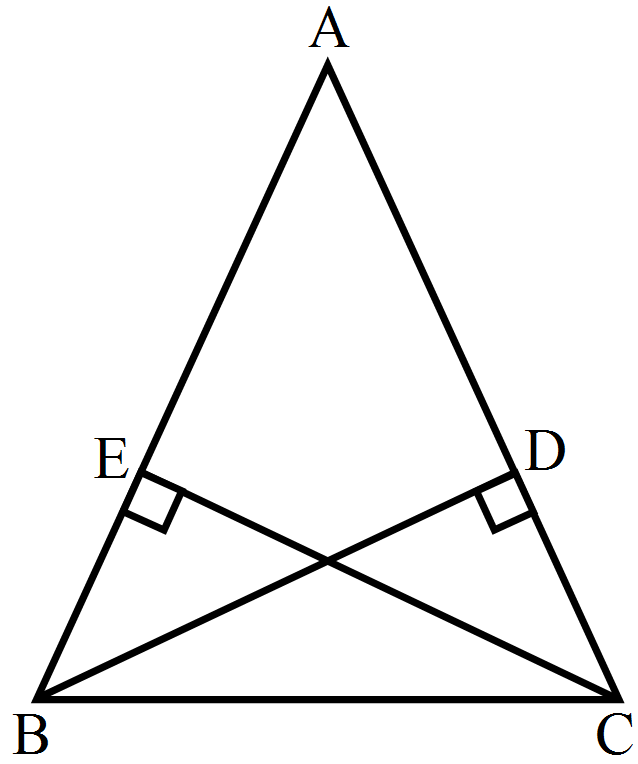
In figure, BD and CE are altitudes of $\triangle\text{ABC}$ and BD = CE.
  1. Is $\triangle\text{BCD}\cong\triangle\text{CBE}?$
  2. State the three pairs of matching parts you have used to answer (i).
Answer

  1. Yes, $\triangle\text{BCD}\cong\triangle\text{CBE}$ by RHS congruence condition.
  2. We have used, hypotenuse BC = hypotenuse CB
BD = CE (given in question)
and $\angle\text{BDC}=\angle\text{CEB}=90^\circ$
View full question & answer
Question 153 Marks
Explain the concept of congruence of figures with the help of certain examples.
Answer
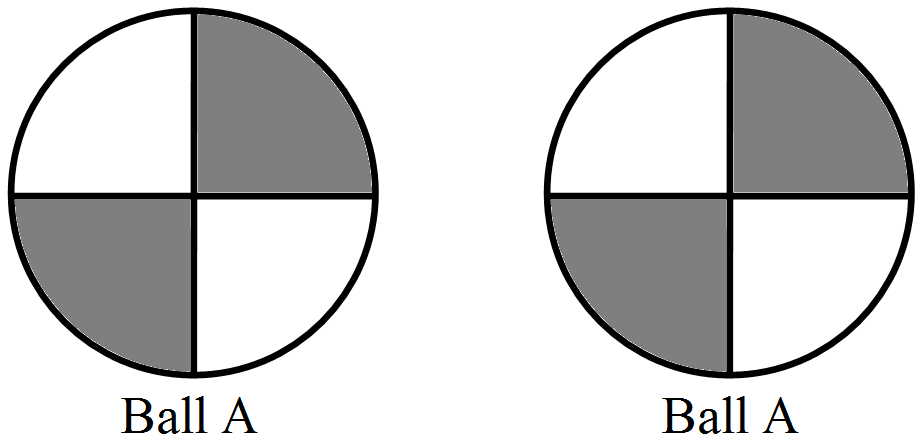
Congruent objects or figures are exact copies of each other or we can say mirror images of each other. The relation of two objects being congruent is called congruence.Consider Ball A and Ball B. These two balls are congruent.

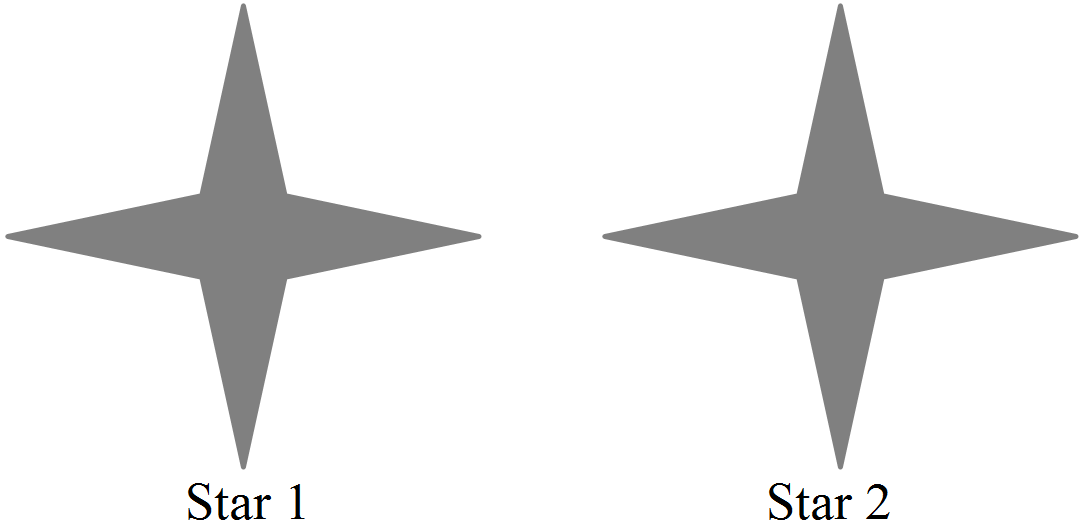
Now consider the two stars below. Star A and Star B are exactly the same in size, colour and shape. These are congruent stars.
View full question & answer
Question 163 Marks
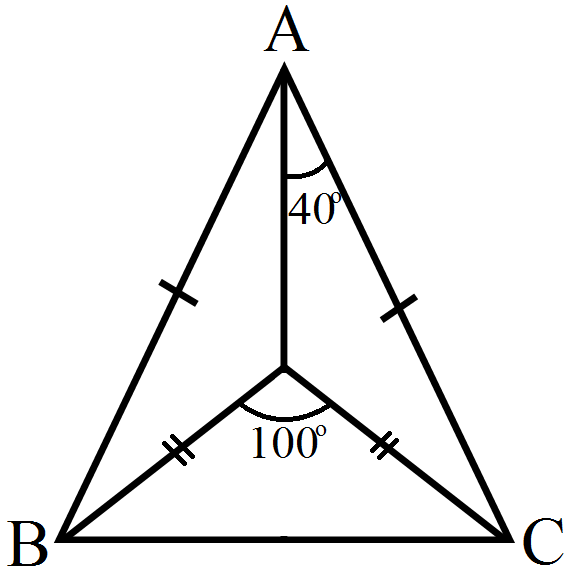
ABC and DBC are both isosceles triangles on a common base BC such that A and D lie on the same side of BC. Are triangles ADB and ADC congruent? Which condition do you use? If $​​\angle\text{BAC}=40^\circ$ and $​​\angle\text{BDC}=100^\circ,$then find $\angle\text{ADB}.$
Answer

YES $\triangle\text{ADB}\cong​\triangle\text{ADC}$ (By SSS)
AB = AC , DB = DC and AD= DA
$\angle\text{BAD}=\angle\text{CAD}$ (C.P.C.T)
$\angle\text{BAD}+\angle\text{CAD}=40^\circ$
$\Rightarrow2​​\angle\text{BAD}=40^\circ$
$\Rightarrow​​\angle\text{BAD}=\frac{40^\circ}{2}$
$\angle\text{BAD}=20^\circ$
$\angle\text{ABC}+\angle\text{BCA}+\angle\text{BAC}=180^\circ$ (Angle sum property)
Since $\triangle\text{ABC}$ is an isosceles triangle,
$\angle\text{ABC}=\angle\text{BCA}$
$\angle\text{ABC}+\angle\text{ABC}+40^\circ=180^\circ$
$\Rightarrow2​​\angle\text{ABC}=180^\circ-40^\circ$
$\Rightarrow2​​\angle\text{ABC}=140^\circ$
$\Rightarrow​​\angle\text{ABC}=\frac{140^\circ}{2}$
$\angle\text{ABC}=70^\circ$
$\angle\text{DBC}+\angle\text{BCD}+\angle\text{BDC}=180^\circ$ (Angle sum property)
Since $\triangle\text{ABC}$ is an isosceles triangle,
$\angle\text{DBC}=\angle\text{BCD}$
$\angle\text{DBC}+\angle\text{DBC}+100^\circ=180^\circ$
$\Rightarrow2​​\angle\text{DBC}=180^\circ-100^\circ$
$\Rightarrow2​​\angle\text{DBC}=80^\circ$
$\Rightarrow​​\angle\text{DBC}=\frac{80^\circ}{2}$
View full question & answer