Question 13 Marks
Find the area ofa recta[gular plot, one side of whtch is 48m and lts diagonal is so m.
AnswerLength of rectangular plot (l) = 48m and its diagonal = 50m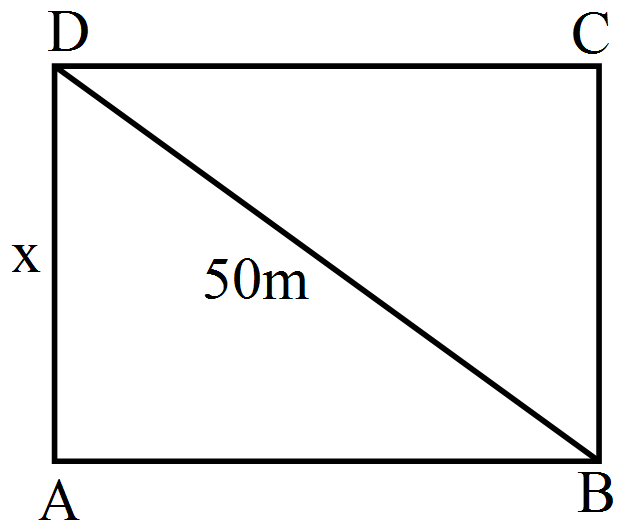
$\therefore$ Second side (b) $=\sqrt{50^2-48^2}$ $=\sqrt{2500-2304}$ $=\sqrt{196}=14\text{m}$ $\therefore\text{Area l}\times\text{b}$ $=48\times14=672\text{m}^2$ View full question & answer→Question 23 Marks
Find the area of a right triangle whose base is 1.2m and hypotenuse 3.7m.
AnswerIn right angled $\triangle ABC$,
Base $B C=1.2 m$
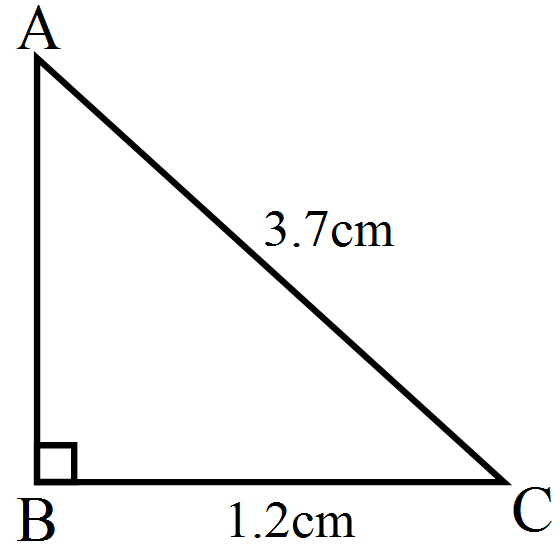
and hypotenuse $AC =3.7 m$
But $A C^2=A B^2+B C^2$ (Pythagoras Theorem)
$\Rightarrow(3.7)^2=A B^2+(1.2)^2$
$\Rightarrow 13.69=A B^2+1.44$
$\Rightarrow A B^2=13.69-1.44$
$\Rightarrow A B^2=12.25=(3.5)^2$
$\Rightarrow AB =3.5 m$
Now, area of $\triangle ABC =\frac{1}{2} \times$ Base $\times$ Altitude
$=\frac{1}{2} \times 1.2 \times 3.5 m^2=2.1 m^2$ View full question & answer→Question 33 Marks
A diagonal of a quadrilateral is 26cm and the perpendiculars drawn to it from the opposite vertices are 12.8cm and 11.2cm. Find the area of the quadrilateral.
AnswerIn quadrilateral ABCD,
diagonal AC = 26cm
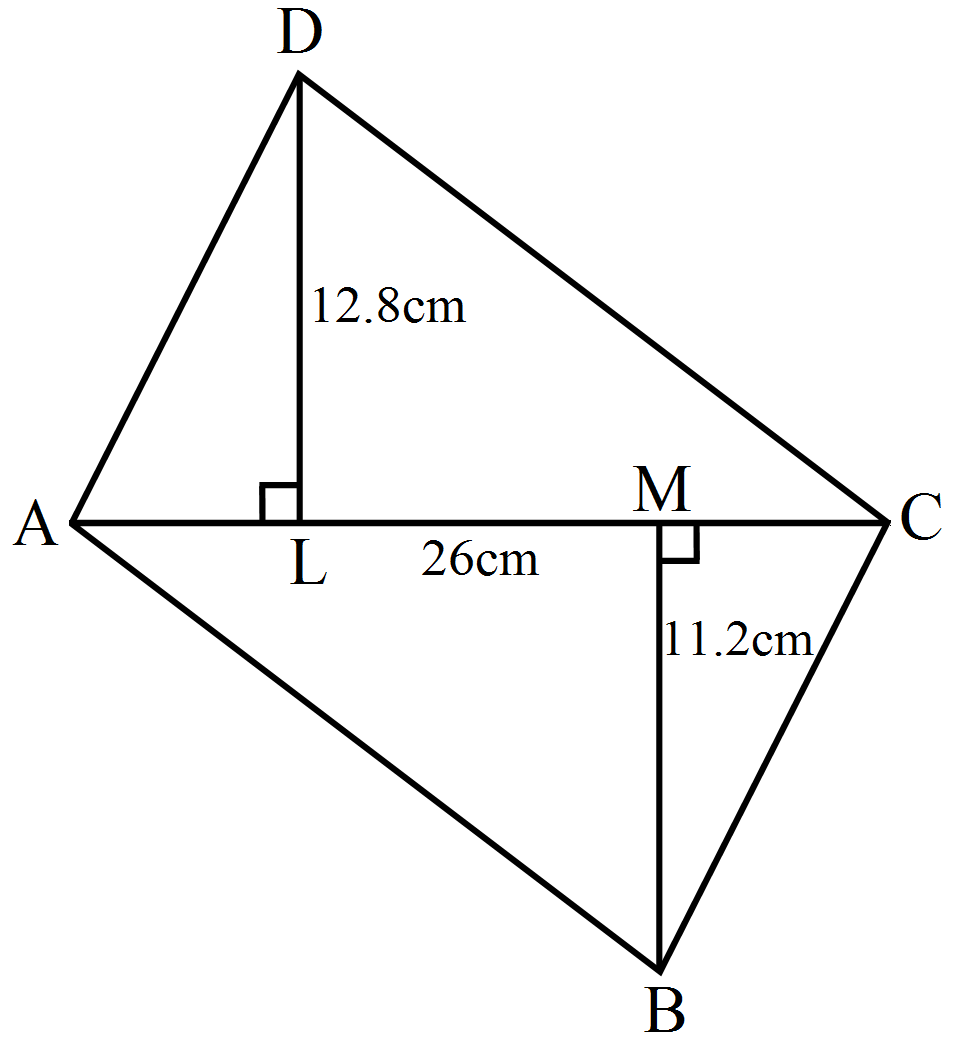
and perpendiculars DL = 12.8cm, BM = 11.2cm
Area of quadrilateral ABCD
$=\frac{1}{2}(\text{Sum of perpendicular)}\times\text{diagonal})$
$=\frac{1}{2}(12.8+11.2)\times26\text{cm}^2$
$=\frac{1}{2}\times24\times26=312\text{cm}^2$ View full question & answer→Question 43 Marks
A room is 9 m by 8 m by 6.5 m . It has one door of dimensions ( $2 m \times 1.5 m$ ) and four windows each of dimensions ( $1.5 m \times 1 m$ ). Find the cost of painting the walls at Rs 50 per $m ^2$.
AnswerLength $=9 m$; Breadth $=8 m$
Height $=6.5 m$
Area of the four walls $=\{2(1+b) \times h\}$ sq. units
$=\{2(9+8) \times 6.5\} m^2=\{34 \times 6.5) m^2=221 m^2$
Area of one door $=(2 \times 1.5) m ^2=3 m^2$
Area of one window $=(1.5 \times 1) m ^2=1.5 m^2$
Area of four windows $=(4 \times 1.5) m ^2=6 m^2$
Total area of one door and four windows $=(3+6) m ^2=9 m^2$
Area to be painted $=(221-9) m ^2=212 m^2$
Rate of painting $=$ Rs 50 per $m ^2$
Total cost of painting $=\operatorname{Rs}(212 \times 50)=\operatorname{Rs} 10,600$
View full question & answer→Question 53 Marks
A 115-m-long and 64-m-broad lawn has two roads at right angles, one 2 m wide, running parallel to its length, and the other 2.5 m wide, running parallel to its breadth. Find the cost of gravelling the roads at Rs 60 per $m ^2$.
AnswerLength of lawn $(I)=115 m$
and breadth $(b)=64 m$
Width of road parallel to length $=2 m$
and width of road parallel to breadth $=2.5 m$
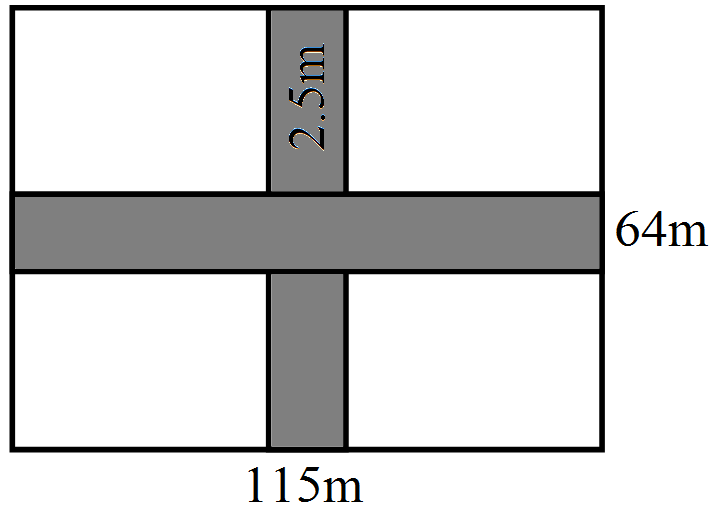
Area of roads $=(115 \times 2+64 \times 2.5-2 \times 2.5) m ^2$
$=(230+160-5) m ^2=(390-5) m ^2=385 m^2$
Cost of gravelling = Rs. $60 m^2$
Total cost = Rs.$60 \times 385=$ Rs. $23100$ View full question & answer→Question 63 Marks
The area of a rhombus is equal to the area of a triangle whose base and the corresponding height are 24.8 cm and 16.5 cm respectively. If one of the diagonals of the rhombus is 22 cm , find the lenght of the other diagonal.
AnswerArea of a triangle $=\frac{1}{2} \times$ Base $\times$ Height
$=\left(\frac{1}{2} \times 24.8 \times 16.5\right) cm^2=204.6 cm^2$
Given:
Area of the rhombus = Area of the triangle
Area of the rhombus $=204.6 cm^2$
Area of the rhombus $=\frac{1}{2} \times$ (Product of the diagonals)
Given:
Length of one diagonal $=22 cm$
$\therefore$ Length of the other diagonal $=\left(\frac{204.6 \times 4}{22}\right) cm$
$=18.6 cm$
View full question & answer→Question 73 Marks
The area of a parallelogram is $3385 m^2$. If its altitude is twice the corresponding base, find the base and the altitude.
AnswerLet the base of the parallelogram be $\times m$.
The, the altitude of the parallelogram will be $2 \times m$.
It is given that the area of the parallelogram is $338 m^2$.
Area of a parallelogram $=$ Base $\times$ Altitude
$\Rightarrow 338=x \times 2 x$
$\Rightarrow 338=2 x^2$
$\Rightarrow x^2=169 m^2$
$\Rightarrow x=13 m$ Base $=x m=13 m$
Altitude $=2 \times m =(2 \times 13) m =26 m$
View full question & answer→Question 83 Marks
In the following figures, find the area of the shaded region.
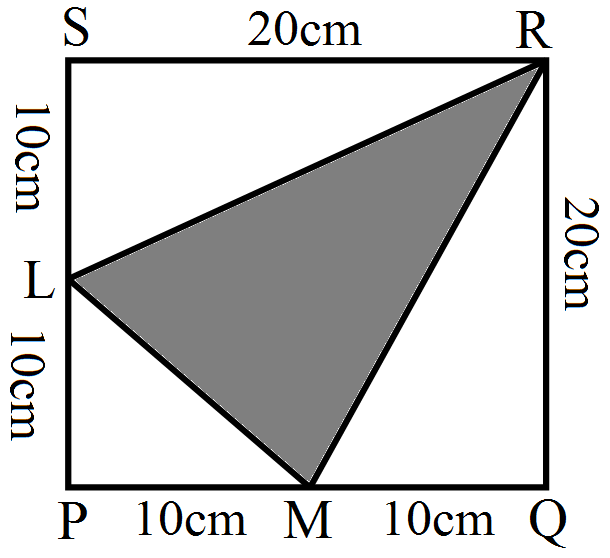
AnswerSide of square = 20cm
Area of square $=\text{a}^2=(20)^2=400\text{cm}^2$
Area of right $\triangle\text{LPM}=\frac{1}{2}\times10\times10\text{cm}^2=50\text{cm}^2$
Area of right $\triangle\text{RMQ}=\frac{1}{2}\times10\times20=100\text{cm}^2$
and area of right $=\triangle\text{RSL}=\frac{1}{2}\times20\times10=100\text{cm}^2$
Area of shaded region $=400-(50+100+100)\text{cm}^2$
$=400-250=150\text{cm}^2$ View full question & answer→Question 93 Marks
The adjacent sides of a parallelogram are 15cm and 8cm. If the distance between the longer sides is 4cm, find the distance between the shorter sides.
AnswerABCD is a parallelogram with side AB of length 15cm and the corresponding altitude AE of length 4cm. The adjacent side AD is of length 8cm and the corresponding altitude is CF.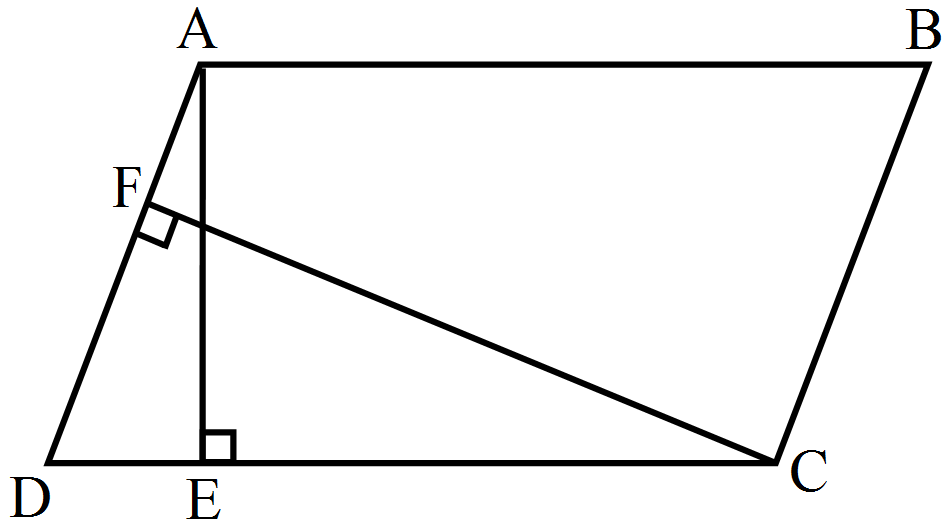
Area of a parallelogram = Base × Height We have two altitudes and two corresponding bases. $\therefore$ AD × CF = AB × AE ⇒ 8cm × CF = 15cm × 4cm $\Rightarrow\text{CF}=\Big(\frac{15\times4}{8}\big)\text{cm}=7.5\text{cm}$ Hence, the distance between the shorter sides is 7.5cm. View full question & answer→Question 103 Marks
Calculate the area of the shaded region in each of the figures given below:
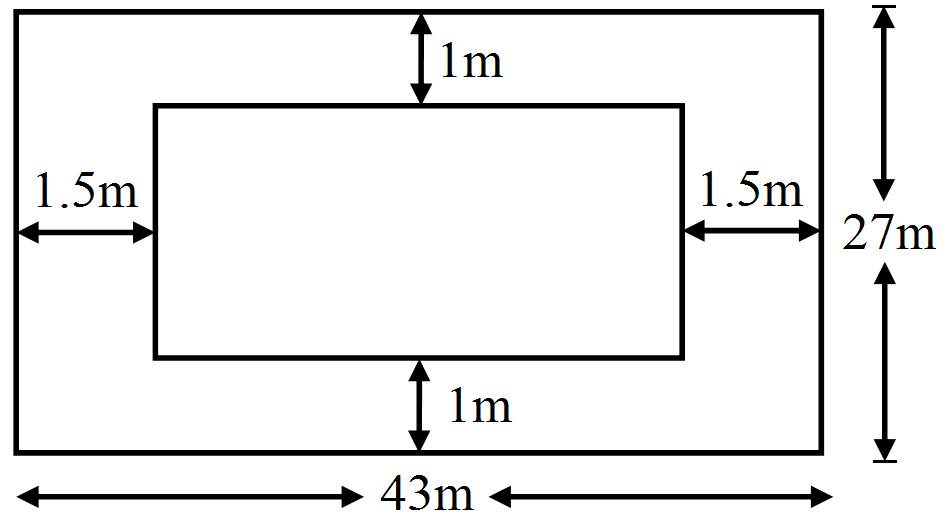
Answer$\text { Outer length }=43 m$
$\text { and breadth }=27 m$
$\text { Area }=43 \times 27=1161 m^2$
$\text { Inner length }=43-2 \times 1.5=43-3=40 m$
$\text { and breadth }=27-2 \times 1=27-2=25 m$
$\text { Inner area }=40 \times 25=1000 m^2$
$\text { Area of shaded portion }=1161-1000=161 m^2$
View full question & answer→Question 113 Marks
A square lawn has a 2-m-wide path surrounding it. If the area of the path is $136m^2$, find the area of the lawn.
AnswerLet $A B C D$ be the square lawn
and PQRS be the outer boundary of the square path
Let one side of the lawn ( $A B$ ) be $\times m$
Area of the square lawn $=x^2$
Length $P Q=(x m+2 m+2 m)=(x+4) m$
Area of PQRS $=(x+4)^2=\left(x^2+8 x+16\right) m^2$
Now, Area of the path =Area of PQRS - Area of the square lawn
$\Rightarrow 136=x^2+8 x+16 x-x^2$
$\Rightarrow 136=8 x+16$
$\Rightarrow 136-16=8 x$
$\Rightarrow 120=8 x$
$\Rightarrow x=15$
Side of the laws $=15 m$
Area of the lawn $=(\text { Side })^2=(15 m)^2=225 m^2$
View full question & answer→Question 123 Marks
In the given figure, ABCD is a rectangle with length = 36m and breadth = 24m. In $\triangle\text{ADE},\text{EF}\perp\text{AD}$ and EF = 15m. Calculate the area of the shaded region.
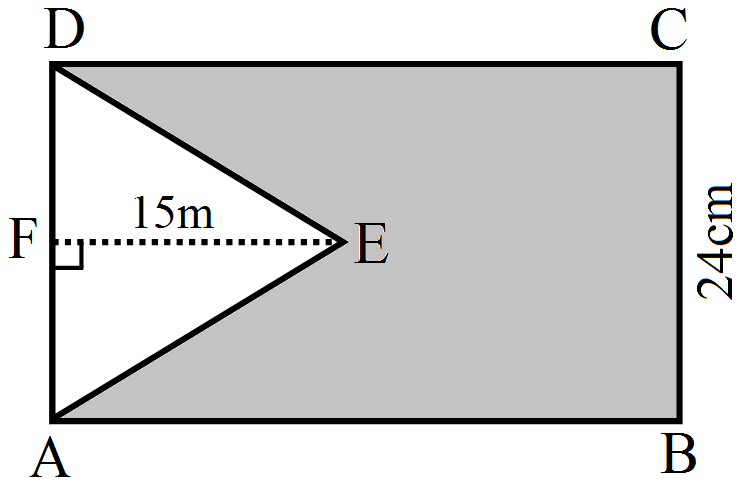
Answer$A B C D$ is a rectangle in which $A B=36 m$
and $B C=24 m$
In $\triangle AED$,
$E F=15 m$
$A D=B C=24 m$
Now area of rectangle $A B C D=1 \times b$
$=36 \times 24 cm^2=864 cm^2$
Area of $\triangle AED =\frac{1}{2} \times AD \times EF$
$=\frac{1}{2} \times 24 \times 15 cm^2=180 cm^2$
Area of shaded portion $=864-180=684 m^2$
View full question & answer→Question 133 Marks
In the given figure, all steps are 0.5m high. Find the area of the shaded region
.
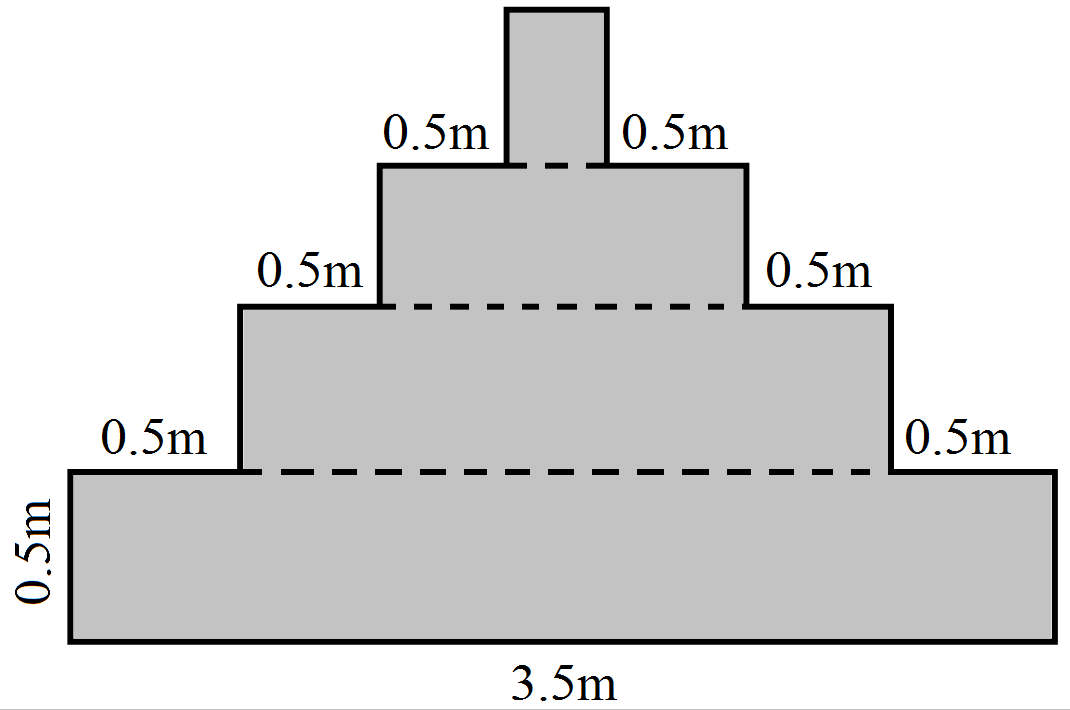
AnswerDividing the figure an shown
Area of rectangle $I =3.5 \times 0.5 m^2=1.75 m^2$
Area of rectangle II $=(3.5-2 \times 0.5) \times 0.5=(3.5-1) \times 0.5=2.5 \times 0.5=1.25 m^2$
Area of rectangle III $=(2.5-1) \times 0.5=1.5 \times 0.5=0.75 m^2$
Area of rectangle IV $=(1.5-1.0) \times 0.5 \times 0.5=0.25 m^2$
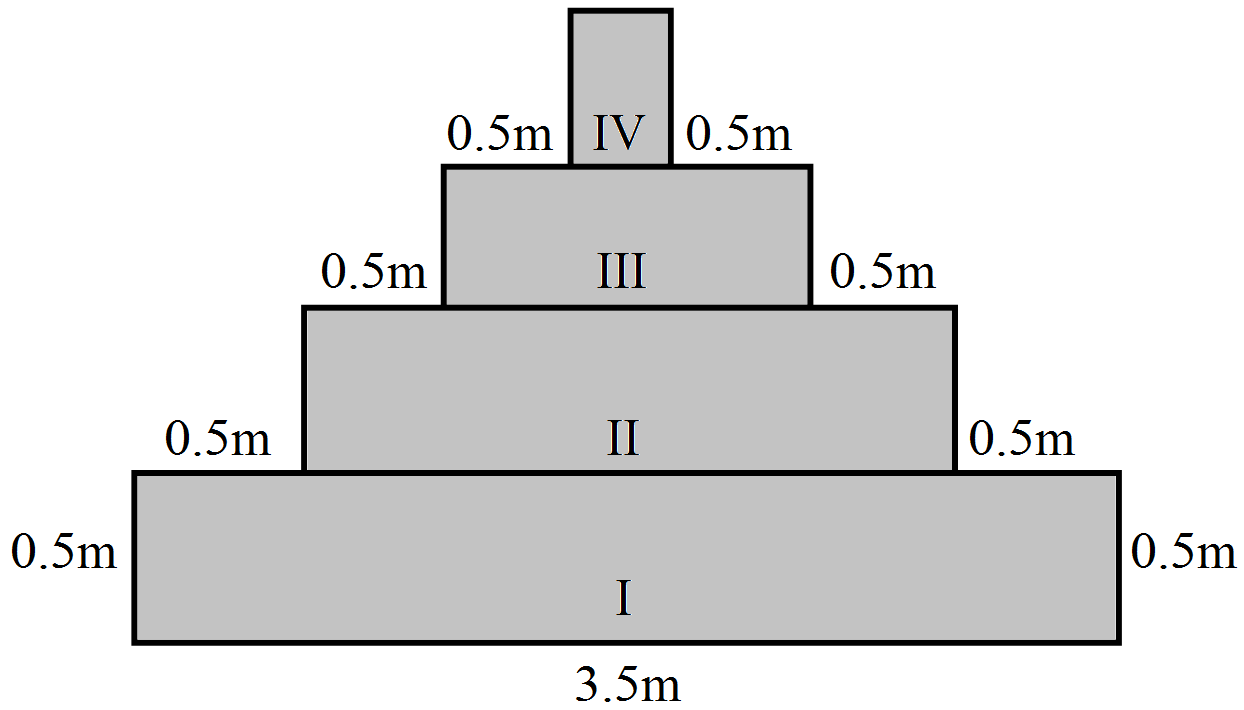
Total area of shaded portion $=(1.75+1.25+0.75+0.25) m ^2=4 m^2$ View full question & answer→Question 143 Marks
The legs of a right triangle are in the ratio $3: 4$ and its area is $1014 cm^2$. Find the lengths of its legs.
AnswerLeag of a right angled triagle $=3: 4$
Let one leg (base) $=3 x$
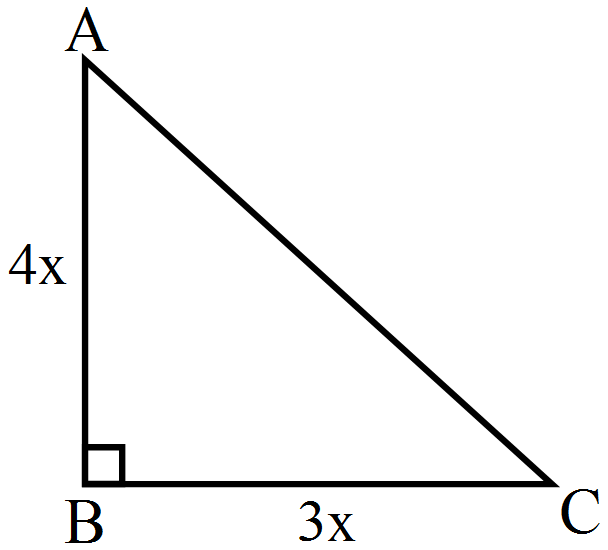
Then second leg (altitude) = 4x
Area $=\frac{1}{2}\times\text{Base}\times\text{Altitude}$
$=\frac{1}2{}\times3\text{x}\times4\text{x}=6\text{x}^2$
$6\text{x}^2=1014$
$=\text{x}^2=\frac{1014}{6}=169=(13)^2$
$\text{x}=13$
one leg'(Base) = 3x = 3 × 13 = 39cm
and second leg (altitude) = 4x = 4 × 13 = 52cm View full question & answer→Question 153 Marks
Find the area of the triangle in which
a = 91m, b = 98m, c = 105m.
Answera = 91m, b = 98m, c = 105m
$\therefore\text{s}=\frac{\text{a + b + c}}{2}$
$=\frac{91+98+105}{2}=\frac{294}{2}=147$
$\therefore\text{Area}=\sqrt{\text{s(s}-\text{a})\text{(s}-\text{b})\text{(s}-\text{c})}$
$=\sqrt{147(147-91)(147-98)(147-105)}$
$=\sqrt{147\times56\times49\times42}$
$=\sqrt{7\times7\times3\times7\times2\times2\times2\times7\times7\times7\times2\times3}$
$=2\times2\times3\times7\times7\times7\times=4116\text{m}^2$
View full question & answer→Question 163 Marks
A wire is looped in the form of a circle of radius 35cm. If it is rebent in the form of a square, what will be the length of each side of the square?
AnswerIt is given that the radius of the circle is 35cm.
Length of the wire = Circumference of the circle
⇒ Circumference of the circle $=2\pi\text{r}=\Big(2\times\frac{22}{7}\times35\Big)\text{cm}=220\text{cm}$
Let the wire be bent into the form of a square of side a cm.
Perimeter of the square = 220cm
⇒ 4a = 220
$\Rightarrow\text{a}=\Big(\frac{220}{4}\Big)\text{cm}=55\text{cm}$
Hence, each side of the square will be 55cm.
View full question & answer→Question 173 Marks
The diameter of the wheel of a cycle is 70cm. How far will it go in 250 revolutions?
AnswerIt may be noted that in one revolution, the cycle covers a distance equal to the circumference of the wheel.
Diameter of the wheel = 70cm
$\therefore$ Circumference of the wheel $=\pi\text{d}=\Big(\frac{22}{7}\times70\Big)\text{cm}=220\text{cm}$
Thus, the cycle covers 220cm in one revolution.
$\therefore$ Distance covered by the cycle in 250 revolutions = (220 × 250)cm
= 55000cm
= 550m [since 1m = 100cm]
Hence, the cycle will cover 550m in 250 revolutions.
View full question & answer→Question 183 Marks
The circumference of a circle exceeds its diameter by 30cm. Find the radius of the circle.
Answer(Circumference) - (Diameter) = 30cm
$\therefore(2\pi\text{r}-2\text{r})=30$
$\Rightarrow2\text{r}(\pi-1)=30$
$\Rightarrow2\text{r}\Big(\frac{22}{7}-1\Big)=30$
$\Rightarrow2\text{r}\times\frac{15}{7}=30$
$\Rightarrow\text{r}=\Big(30\times\frac{7}{30}\Big)=7$
$\therefore$ Radius of the given circle = 7cm
View full question & answer→Question 193 Marks
A verandah is 40 m long and 15 m broad. It is to be paved with stones, each measuring 6 dm by 5 dm . Find the number of stones required.
AnswerLength of verandah $(1)=40 m$
Breadth (b) $=15 m$
Area $= I \times b =40 \times 15=600 m^2$
Length of one stone $=6 dm =\frac{6}{10} m$
and breadth $=5 dm =\frac{5}{10} m$
Area of one stone $=\frac{6}{10} \times \frac{5}{10}$
$=\frac{30}{100}=\frac{3}{10} m^2$
$\therefore$ Number of stones
$=\frac{\text { Total area of verandah }}{\text { area of one stone }}$
$=\frac{600}{\frac{3}{10}}=\frac{600 \times 10}{3}$
$=2000$
View full question & answer→Question 203 Marks
A rectangular sheet of acrylic is 34 cm by 24 cm . From it, 64 circular buttons, each of diameter 3.5 cm , have been cut out. Find the area of the remaining sheet.
AnswerLength of rectangular sheet $(1)=34 cm$
and breadth (b) $=24 cm$
Area $=1 \times b=34 \times 24 cm^2=816 cm^2$
Diameter of one button $=3.5 cm$
Radius $( r )=\frac{3.5}{2} cm$
and area of one button $=\pi r ^2$
$=\frac{22}{7} \times \frac{3.5}{2} \times \frac{3.5}{2} cm^2 \\
=9.625 cm$
Area of 64 buttons $=9.625 \times 64 cm^2=616 cm^2$
Area of remaining sheet $=816-616=200 cm^2$
View full question & answer→Question 213 Marks
Find the area of a rhombus, the lengths of whose diagonals are:
8dm 5cm and 5dm 6cm.
AnswerLength of one diagonal = 8dm 5cm = (8 × 10 + 5)cm = 85cm [since 1dm = 10cm] Length of the other diagonal = 5dm 6cm = (5 × 10 + 6)cm = 56cm $\therefore$ Area of the rhombus $=\frac{1}{2}\times\text{(Product of the diagonals)}$ $=\Big(\frac{1}{2}\times85\times56\Big)\text{cm}^2$$=2380\text{cm}^2$
View full question & answer→Question 223 Marks
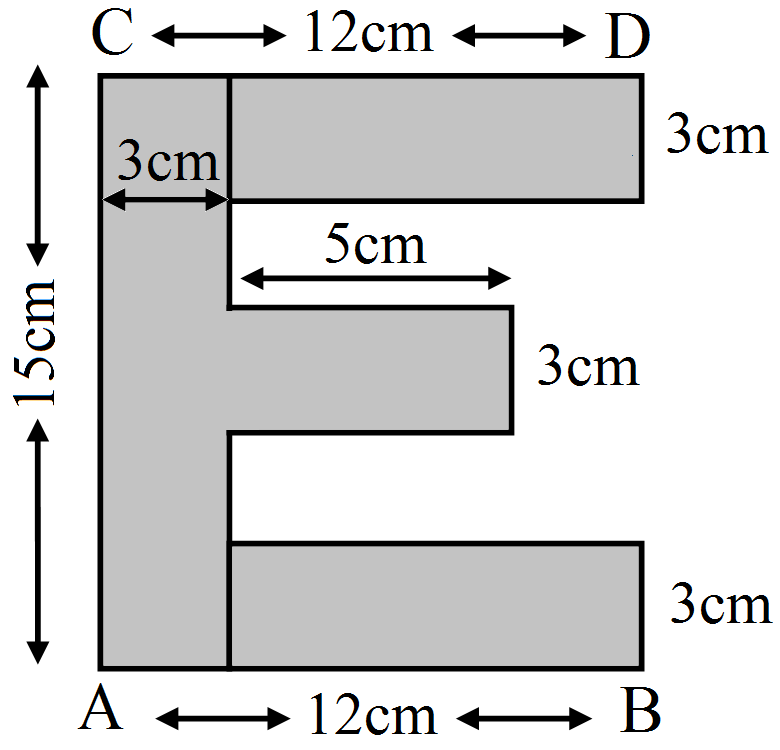
Calculate the area of the shaded region in each of the figures given below. Fig. (ii) has uniform width of 3cm and it is given that AB = CD.
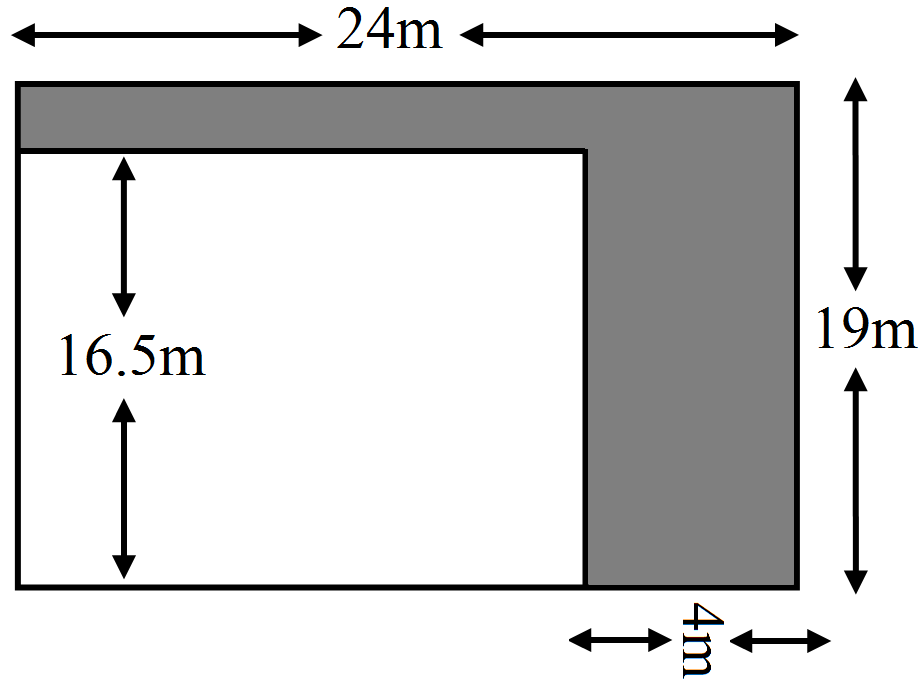
Answeri. Outer length $=24 m$
and breadth $=19 m$
Area $=24 \times 19=456 m^2$
Length of unshaded portion $=24-4=20 m$
and breadth $=16.5 m$
Area of unshaded portion $=20 \times 16.5 m^2=330.0 m^2$
Area of shaded portion $=456-330=126 m^2$
ii. Dividing the figure an shown
Area of rectangle $I =15 \times 3 cm^2=45 cm^2$
Area of rectangle II $=(12-3) \times 3=9 \times 3=27 cm^2$
Area of rectangle III $=5 \times 3=15 cm^2$
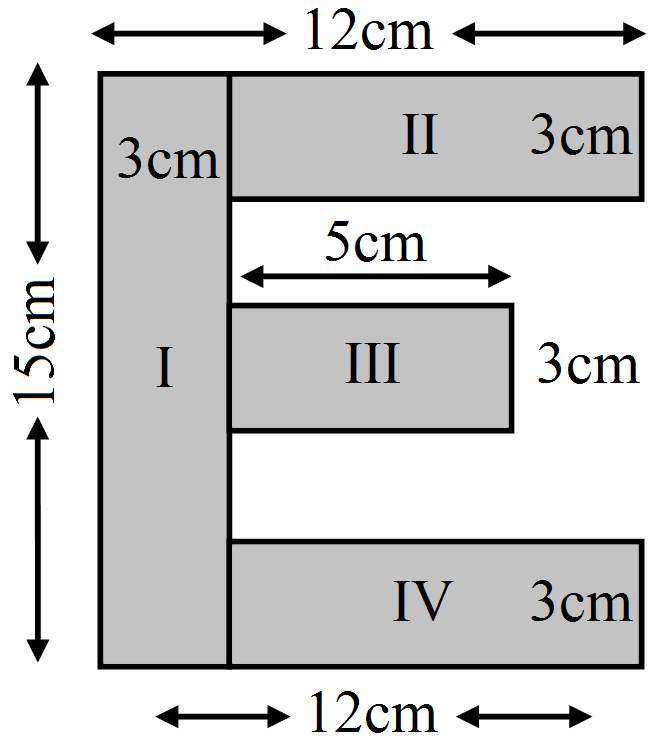
and area of rectangle IV $=(12-3) \times 3=9 \times 3=27 cm^2$
Total area of shaded portion $=45+27+15+27=114 cm^2$ View full question & answer→Question 233 Marks
A horse is tethered to one corner of a rectangular field, 60m by 40m, by a rope 14m long. On how much area can the horse graze?
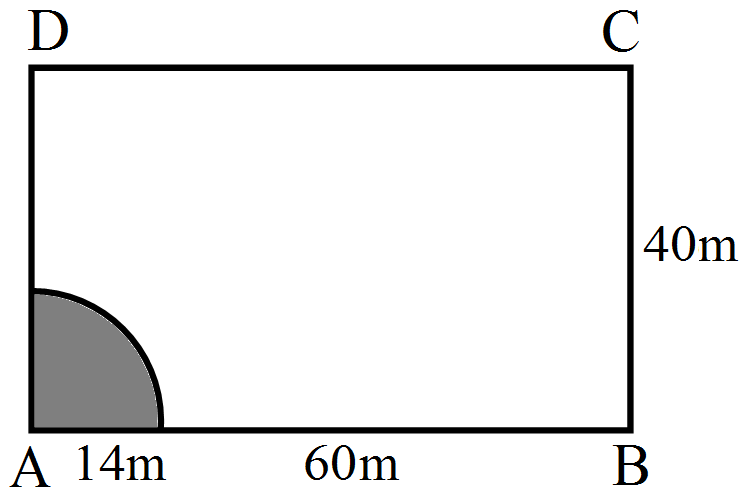
AnswerLength of field = 60m
and breadth = 40m
Length of rope = 14m
Area covered by the horse
$=\frac{1}{4}$ of area of circle $=\frac{1}{4}\times\pi\text{r}^2$
$=\frac{1}{4}\times\frac{22}{7}\times14\times14=154\text{cm}^2$
View full question & answer→Question 243 Marks
Calculate the area of the shaded region in each of the figures given below:
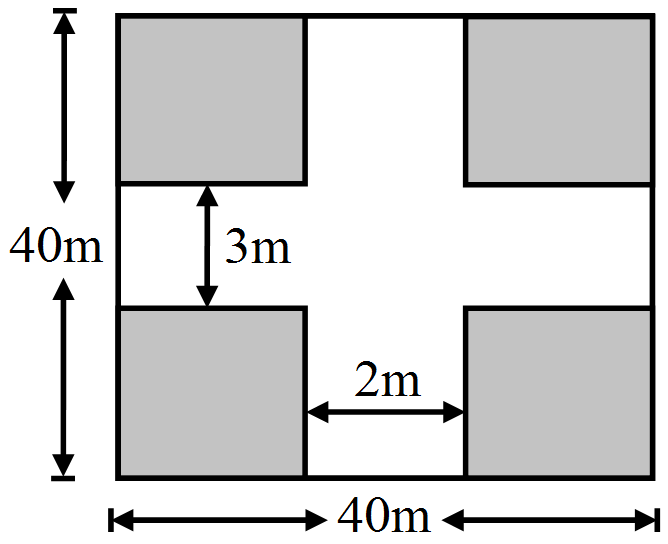
AnswerSide of square (a) $=40 m$
Area $=(a)^2=40 \times 40=1600 m^2$
Area of larger road $=40 \times 3=120 m^2$
and area of shorter road $=40 \times 2=80 m^2$
Area of roads $=(120+80)-3 \times 2=200-6=194 m^2$
Area of shaded portion $=(1600-194) m ^2=1406 m^2$
View full question & answer→Question 253 Marks
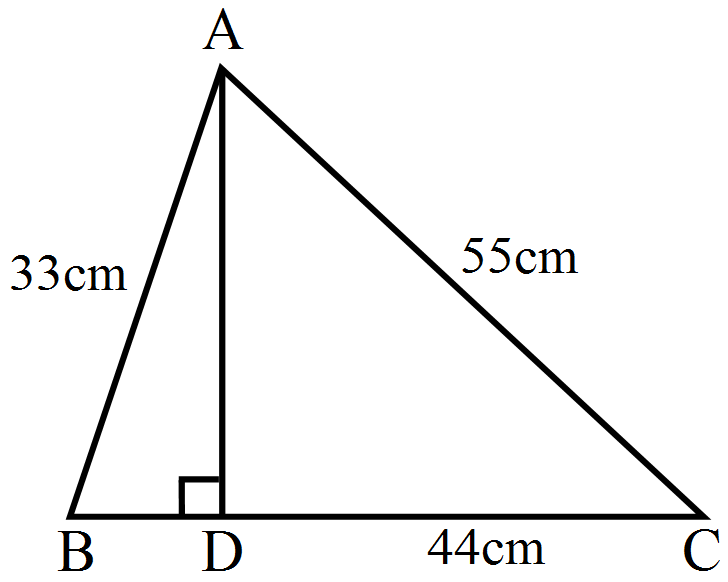
The lengths of the sides of a triangle are 33cm, 44cm and 55 respectively. Find the area of the triangle and hence find the height corresponding to the side measuring 44cm.
AnswerLet a =33cm, b = 44cm, c = 55cm
$\therefore\text{s}=\frac{\text{a + b + c}}{2}$
$=\frac{33+44+55}{2}$
$=\frac{132}{2}=66$
$\therefore\text{Area}=\sqrt{\text{s(s}-\text{a})(\text{s}-\text{b})(\text{s}-\text{c})}$
$=\sqrt{66(66-33)(66-44)(66-55)}$
$=\sqrt{66\times33\times22\times11}$
$=\sqrt{2\times3\times11\times3\times11\times2\times11\times11}$
$=2\times3\times11\times11=726\text{cm}^2$
Let base $=44\text{cm}$
then height $=\frac{\text{Area}\times2}{\text{Base}}$
$=\frac{726\times2}{44}$
$=33\text{cm}$ View full question & answer→Question 263 Marks
The, area of a rectangular field is $3584 m^2$ and its length is 64 m . A boy runs around the fleld at the rate of $6 km / h$. How long will he take to go 5 times around it?
AnswerArea of rectangular field $=3584 m^2$
Length $=64 m$
Area $=3584$
Breadth $=\frac{\text { Area }}{\text { Length }}$
$=\frac{3584}{64}=56 m$
Now perimeter $=2(1+b)=2(64+56) m =2 \times 120=240 m$
Distance covered in 5 rounds $=240 \times 5=1200 m$
Speed $=6 km / h$
Time take $=\frac{1200}{1000} \times \frac{60}{6}=12$ minutes ( 1 hour $=60$ minutes)
View full question & answer→Question 273 Marks
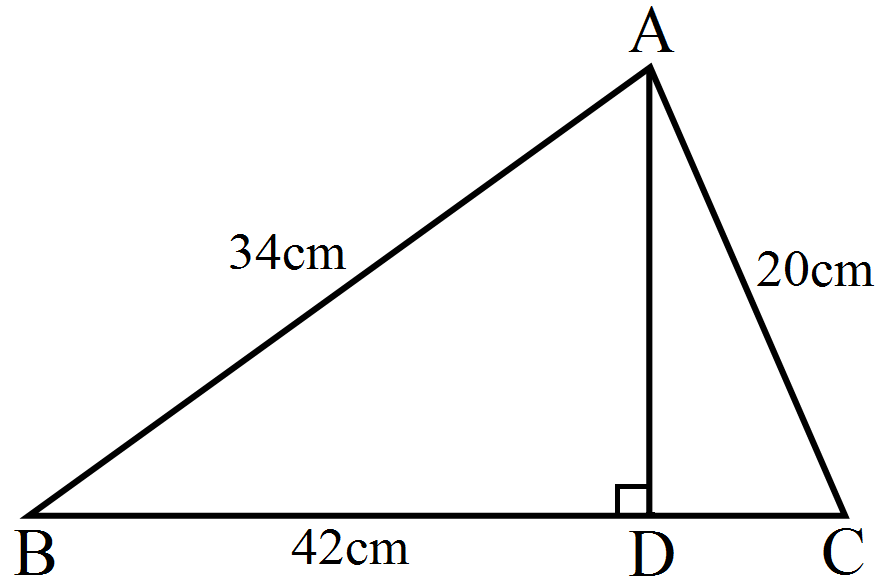
The sides of a triangle are 42cm, 34cm and 20cm. Calculate its area and the length of the height on the longest side.
AnswerLet a = 42cm, b = 34cm, c = 20cm
$\therefore\text{s}=\frac{\text{a + b + c}}{2}$
$=\frac{42+34+20}{2}$
$=\frac{96}{2}=48$
$\therefore\text{Area}=\sqrt{\text{s(s}-\text{a})\text{(s}-\text{b})\text{(s}-\text{c})}$
$=\sqrt{48(48-42)(48-34)(48-20)}$
$=\sqrt{48\times6\times14\times28}$
$=\sqrt{2\times2\times2\times2\times3\times3\times2\times2\times7\times7\times2\times2}$
$=2\times2\times2\times2\times3\times7=336\text{cm}^2$
Longest side (Base) $=42\text{cm}$
$\therefore$ Height on longest side $=\frac{\text{Area}\times2}{\text{Base}}$
$=\frac{336\times2}{42}\text{cm}=16\text{cm}$ View full question & answer→Question 283 Marks
Find the area of quadrilateral ABCD in which diagonal BD = 24cm. $\text{AL}\perp\text{BD}$ and $\text{CM}\perp\text{BD}$ such that AL = 5cm and CM = 8cm.
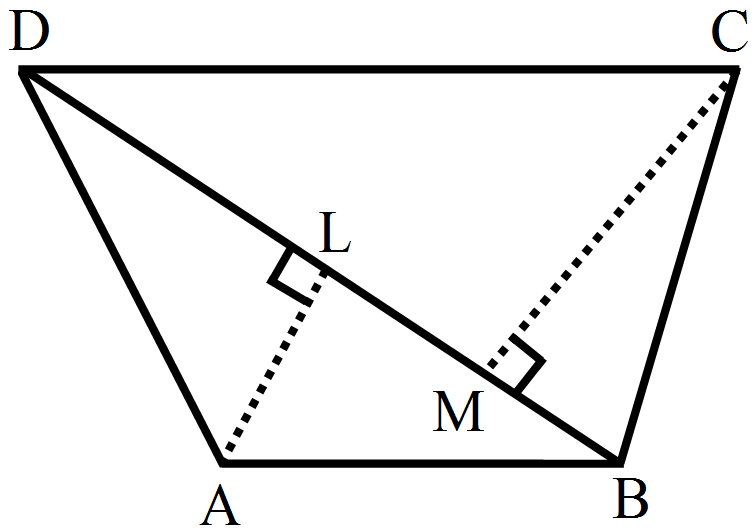
AnswerIn the quadrilateral ABCD
BD = 24cm
$\text{AL}\perp\text{BD}$ and $\text{CM}\perp\text{BD}$
AL = 5cm and CM = 8cm
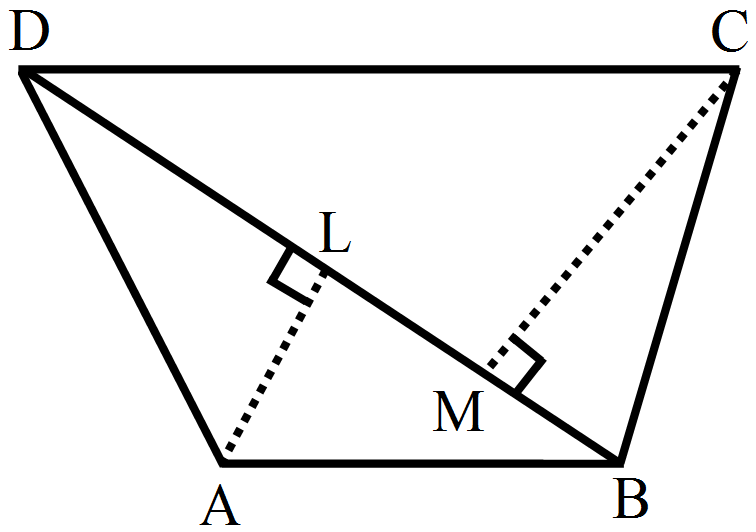
Now area of $\triangle\text{ABD}=\frac{1}{2}\text{bh}$
$=\frac{1}{2}\times\text{BD}\times\text{AL}=\frac{1}{2}\times24\times5\text{cm}^2$
$=60\text{cm}^2$
and area of $\triangle\text{CBD}=\frac{1}{2}\text{BD}\times\text{CM}$
$=\frac{1}{2}\times24\times8\text{cm}^2=96\text{cm}^2$
$\therefore$ Total area of quadrilateral ABCD
$=60+96=156\text{cm}^2$ View full question & answer→Question 293 Marks
A rectangular field is 50m by 40m. It has two roads through its centre, running parallel to its sides. The width of the longer and the shorter roads are 2m and 2.5-m-respectively. Find the area of the roads and the area of the remaining portion of the field.
AnswerLength of field $(I)=50 m$
and breadth (b) $=40 m$
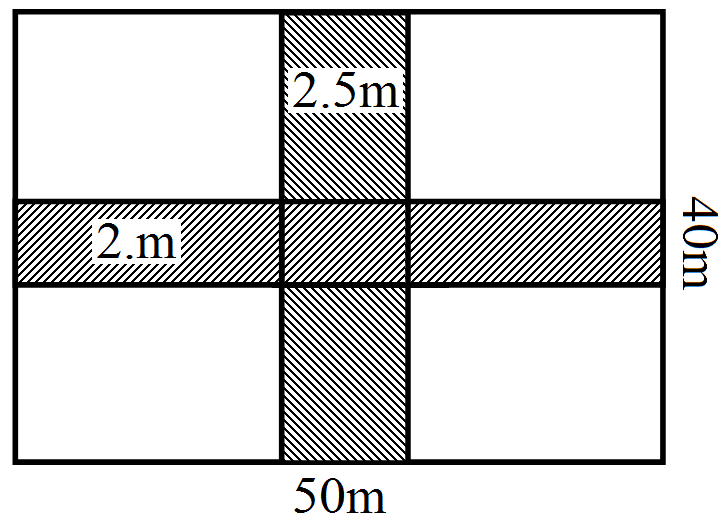
Width of road parallel to length $=2 m$
and width of road parallel to breadth $=2.5 m$
Area of roads $=50 \times 2+40 \times 2.5-2.5 \times 2=(100+100-5) m ^2=195 m^2$
and area of remaining portion $=50 \times 40-195=2000-195=1805 m^2$ View full question & answer→Question 303 Marks
A piece of wire is bent in the shape of an equilateral triangle each of whose sides measures 8.8cm. This wire is rebent to form a circular ring. What is the diameter of the ring?
AnswerLength of the wire = Perimeter of the equilateral triangle = 3 × Side of the equilateral triangle = (3 × 8.8)cm = 26.4cm Let the wire be bent into the form of a circle of radius r cm. Circumference of the circle = 26.4cm$\Rightarrow2\pi\text{r}=26.4$
$\Rightarrow2\times\frac{22}{7}\times\text{r}=26.4$
$\Rightarrow\text{r}\Big(\frac{26.4\times7}{2\times22}\Big)\text{cm}=4.2\text{cm}$
$\therefore$ Diameter = 2r = (2 × 4.2)cm = 8.4cm Hence, the diameter of the ring is 8.4cm.
View full question & answer→Question 313 Marks
The area of four walls of a room is $120 m^2$. If the length of the room is twice its breadth and the height is 4 m , find the area of the floor.
AnswerArea of 4 walls $=120 m^2$
Height $(h)=4 m$.
Let breadth (b) $=x$
and length $(I)=2 x$
Area of 4 walls $=2(1+h) \times h$
$=2(2 x+x) \times 4=8 \times 3 x=24 x$
$24 x =120$
$x =\frac{120}{24}=5$
Length of room $=2 x =2 \times 5=10 m$
and breadth $=x=5 m$
Area of floor $=1 \times b=10 \times 5=50 m^2$
View full question & answer→Question 323 Marks
The sides of a rectangular park are in the ratio $4: 3$. If its area is $1728 m^2$, find the cost of fencing it at ₹ 30 per metre.
AnswerRatio in the sides of a rectangle $=4: 3$
Area $=1728 cm^2$
Let length $=4 x,$
then breadth $=3 x$
Area $=1 \times b$
$1728=4 x \times 3 x$
$\Rightarrow 12 x^2=1728$
$\Rightarrow x^2=144=(12)^2$
$\Rightarrow x=12$
Length $=4 x =4 \times 12=48 m$
and breadth $=3 m=3 \times 12=36 m$
Now perimeter $=2(1+b)=2(48+36) m =2 \times 84=168 m$
Rate of fencing $=$ Rs. 30 per metre
Total cost $=168 \times 30=$ Rs. 5040
View full question & answer→Question 333 Marks
A rhombus has the same perimeter as the circumference of a circle. If each side of the rhombus measures 33cm, find the radius of the circle.
AnswerCircumference of the circle = Perimeter of the rhombus
= 4 × Side of the rhombus = (4 × 33)cm = 132cm
$\therefore$ Circumference of the circle = 132cm
$\Rightarrow2\pi\text{r}=132$
$\Rightarrow2\times\frac{22}{7}\times\text{r}=132$
$\Rightarrow\text{r}=\Big(\frac{132\times7}{2\times22}\Big)\text{cm}=21\text{cm}$
Hence, the radius of the circle is 21cm.
View full question & answer→Question 343 Marks
A wire is in the shape of a square of side 10cm. If the wire is rebent into a rectangle of length 12cm, find its breadth. Which figure encloses more area and by how much?
AnswerSide of a square wire $=10 cm$
Perimeter $=4 a =4 \times 10 cm=40 cm$
or perimeter of rectangle $=40 cm$
Length of rectangle $=12 cm$
Breadth $=\frac{40}{2}-12=20-12=8 cm$
Now area of square $=a^2=(10)^2=100 cm^2$
and area of rectangle $= I \times b =12 \times 8=96 cm^2$
Difference in areas $=100-96=4 cm^2$
View full question & answer→Question 353 Marks
The area of a circle is $1381 m^2$. Find its circumference.
AnswerArea of a circle $=1386\text{m}^2$
$\therefore\text{Radius (r)}=\sqrt{\frac{\text{Area}}{\pi}}=\sqrt{\frac{1386\times7}{22}}\text{m}$
$=\sqrt{441}=21\text{m}$
$\therefore\text{Circumference}=2\pi\text{r}=2\times\frac{22}{7}\times21\text{m}$
$=132\text{m}$
View full question & answer→Question 363 Marks
The sides of a triangle are in the ratio 13 : 14 : 15 and its perimeter is 84cm. Find the area of the triangle.
AnswerPerimeter of the triangle = 84cm
Ratio in side = 13 : 14 : 15
Sum of ratios = 13 + 14 + 15 = 42
Let then first side $=\frac{84\times13}{42}=26\text{cm}$
Second side $=\frac{84\times14}{42}=28\text{cm}$
Third side $=\frac{84\times15}{42}=30\text{cm}$
Now $\text{s}=\frac{\text{a + b + c}}{2}$
$=\frac{84}{2}=42$
$\therefore\text{Area}=\sqrt{\text{s(s}-\text{a})\text{(s}-\text{b})\text{(s}-\text{c})}$
$=\sqrt{42(42-26)(42-28)(42-30)}$
$=\sqrt{42\times16\times14\times12}$
$=\sqrt{2\times3\times7\times2\times2\times2\times2\times2\times7\times2\times2\times3}$
$=2\times2\times2\times2\times3\times7=336\text{cm}^2$
View full question & answer→Question 373 Marks
A steel wire when bent in the form of a square encloses an area of $121 cm^2$. The same wire is bent in the form of a circle. find the area of the circle.
AnswerLet a be one side of the square.
Area of the square $=121 cm^2$ (given)
$\Rightarrow a^2=121$
$\Rightarrow a=11 cm(\text { since } 11 \times 11=121)$
Perimeter of the square $=4 \times$ side $=4 a =(4 \times 11) cm =44 cm$
Length of the wire $=$ Perimeter of the square
$=44 cm$
The wire is bent in the form of a circle.
Circumference of a circle $=$ Length of the wire
$\therefore$ Circumference of a circle $=44 cm$
$\Rightarrow 2 \pi r=44$
$\Rightarrow\left(2 \times \frac{22}{7} \times r\right)=44$
$\Rightarrow r=\left(\frac{44 \times 7}{2 \times 22}\right)=7 cm$
$\therefore$ Area of the circle $=\pi r ^2$
$=\left(\frac{22}{7} \times 7 \times 7\right) cm^2$
$=154 cm^2$
View full question & answer→Question 383 Marks
In the given figure, four equal circles are described about the four corners of a square so that each circle touches two of the circle as shown in the figure. find the area of the shaded region, each side of the square measuring 14cm.
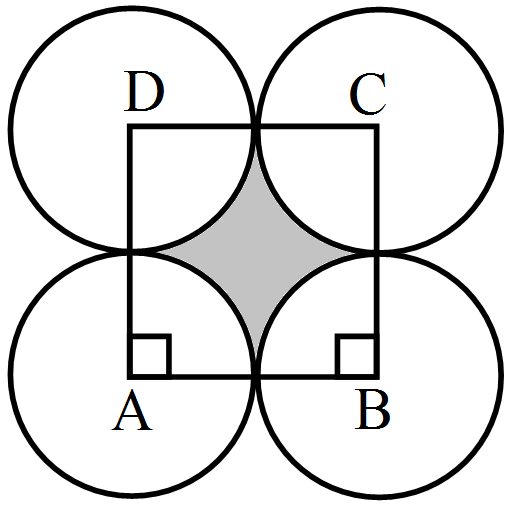
AnswerEach side of square $=14 cm$
Area of square $=a^2=14 \times 14=196 cm^2$
Radius of each circle at each corner of square $=\frac{14}{2}=7 cm$
$\therefore$ Area of the quadrant $=\frac{1}{4} \times \pi r ^2$
$=\frac{1}{4} \times \frac{22}{7} \times 7 \times 7=\frac{77}{2} cm^2$
and Area of 4 quadrant $=\frac{77}{2} \times 4$
$=154 cm^2$
Area of shaded portion = Area of square - area of 4 quadrants
$=196-154=42 cm^2$
View full question & answer→Question 393 Marks
A room is 8.5 m long, 6.5 m broad and 3.4 m high. It has two doors, each measuring ( 1.5 m by 1 m ) and two windows, each measuring ( 2 m by 1 m$)$. Find the cost of painting its four walls at Rs 160 per $m ^2$.
AnswerLength of a room $(1)=8.5 m$
Breadth $(b)=6.5 m$
and height $( h )=3.4 m$
Area of four walls $=2(I+b) \times h$
$=2(8.5+6.5) \times 3.4 m^2$
$=2 \times 15 \times 3.4 m^2$
$=30 \times 3.4=102.0 m^2$
Area of two doors of size $1.5 m \times 1 m=2 \times 1.5 \times 1 m=3 m^2$
and area of two windows of size $2 m \times 1 m=2 \times 2 \times 1=4 m^2$
Area of remaining portion $=102-(3+4)=102-7 m^2=95 m^2$
Rate of painting $=$ Rs. 160 per $m ^2$
Total cost $=$ Rs. $160 \times 95=$ Rs. 15200
View full question & answer→Question 403 Marks
Find the area of a rhombus, the lengths of whose diagonals are:
16cm and 28cm.
AnswerLength of one diagonal = 16cm
Length of the other diagonal = 28cm
$\therefore$ Area of the rhombus $=\frac{1}{2}\times(\text{Product of the diagonals)}$
$=\Big(\frac{1}{2}\times16\times28\Big)\text{cm}^2=224\text{cm}^2$
View full question & answer→Question 413 Marks
one slde of a parallelogram ts 18 cm long and Its area Is $153 cm^2$. Ftnd the distance of the glven slde from Its opposlte side.
AnswerBase of the parallelogram $=18 cm$
Area of the parallelogram $=153 cm^2$
$\therefore$ Area of the parallelogram $=$ Base $\times$ Height
$\Rightarrow$ Height $=\frac{\text { Area of the parallelogram }}{\text { Base }}$
$=\left(\frac{153}{18}\right) cm=8.5 cm$
Hence, the distance of the given side from its opposite side is 8.5 cm .
View full question & answer→Question 423 Marks
Find the radius of a circle whose area is $616 cm^2$.
AnswerLet the radius of the circle be r cm
Area $=(\pi\text{r}^2)\text{cm}^2$
$\pi\text{r}^2=616$
$\Rightarrow\frac{22}{7}\times\text{r}\times\text{r}=616$
$\Rightarrow\text{r}^2=\Big(\frac{616\times7}{22}\Big)=196$
$\Rightarrow\text{r}=\sqrt{196}=14\text{cm}$
Hence, the radius of he given circle is 14cm.
View full question & answer→Question 433 Marks
Find the area of a rectangular plot on side of which is 48m and its diagonal 50m.
AnswerWe know that all the angles of a rectangle are $90^{\circ}$ and the diagonal divides the rectangle into two right angled triangles.
So, one side of the triangle will be 48 m and the diagonal, which is 50 m , will be the hypotenuse.
According to Pythagoras theorem:
Perpendicular $=\sqrt{(\text { Hypotenuse })^2-(\text { Base })^2}$
Perpendicular $=\sqrt{(50)^2-(48)^2}$
$\therefore$ Other side of the rectangular plot $=14 m$
$\therefore$ Area of the rectangular plot $=48 m \times 14 m=672 m^2$
Hence, the area of a rectangular plot is $672 m^2$.
View full question & answer→Question 443 Marks
The area of a rhombus is $119 cm^2$ and its perimeter is 56 cm . Find its height.
AnswerPerimeter of the rhombus $=56 cm$
Area of the rhombus $=119 cm^2$
Side of the rhombus $=\frac{\text { perimeter }}{4}=\left(\frac{56}{4}\right) cm =14 cm$
Area of a rhombus $=$ Base $\times$ Height
$\therefore$ Height of the rhombus $=\frac{\text { Area }}{\text { Base }}$
$=\left(\frac{119}{14}\right) cm$
$=8.5 cm$
View full question & answer→Question 453 Marks
A godown is 50m long, 40m broad and 10m high. Find the cost of whitewashing its four walls and ceiling at Rs 20 per square metre.
AnswerLength of go down $( I )=50 m$
$\text { Breadth }(b)=40 m$
$\text { and height }(h)=10 m$
$\text { Area of } 4 \text { walls }=2(l+b) \times h$
$=2(50+40) \times 10 m$
$=2 \times 90 \times 10=1800 m^2$
and area of ceiling $=1 \times b=50 \times 40=2000 m^2$
Total area of walls and ceiling $=1800+2000=3800 m^2$
Rate of whitewashing $=$ Rs. 20 per $m ^2$
Total cost $=$ Rs. $20 \times 3800=$ Rs. 76000
View full question & answer→Question 463 Marks
In the following figures, find the area of the shaded region.
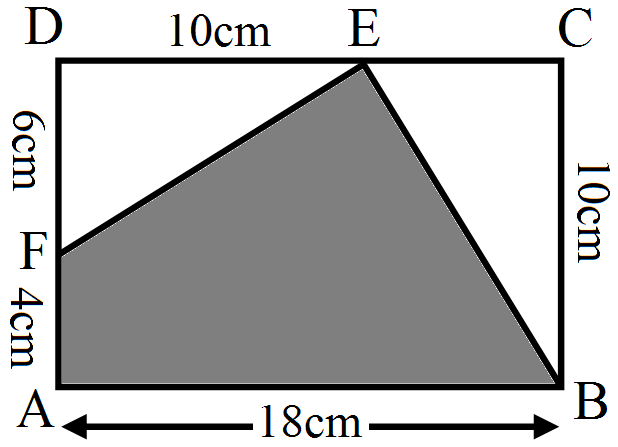
AnswerLength of rectangle (l) = 18cm
and breadth (b) = 10cm
Area = l × b
= 18 × 10 = 180cm²
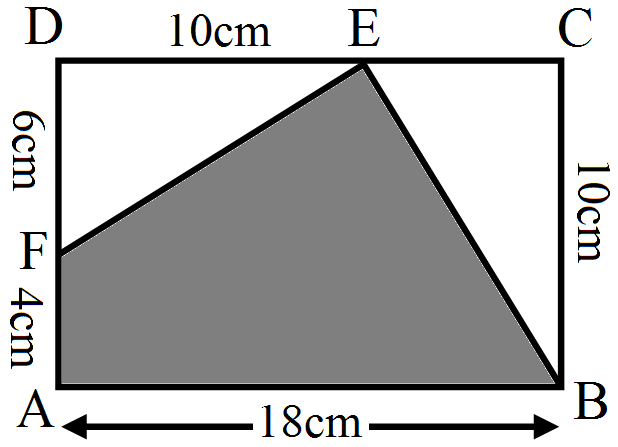
Area of right $\triangle\text{EBC}=\frac{1}{2}\times10\times8=40\text{cm}^2$
and area of right $\triangle\text{EDF}=\frac{1}{2}\times10\times6=30\text{cm}^2$
Area of shaded region $=180-(40+30)=180-70=110\text{cm}^2$ View full question & answer→Question 473 Marks
The area of a rhombus is $148.8 cm^2$. If one of its diagonals is 19.2 cm , find the length of the other diagonal.
AnswerArea of a rhombus $=\frac{1}{2} \times$ (Product of the diagonals)
Given:
Length of one diagonal $=19.2 cm$
Area of the rhombus $=148.8 cm^2$
$\therefore$ Length of the other diagonal $=\left(\frac{148.8 \times 8}{19.2}\right) cm =15.5 cm$
View full question & answer→Question 483 Marks
A room 9.5 m long and 6 m wide is surrounded by a $1.25- m$-long verandah. Calculate cost of cementing the floor of this verandah at Rs 80 per $m ^2$.
AnswerLength' of room $( I )=9.5 m$
Breadth (b) $=6 m$
Width of outer verandah $=1.25 m$
Outer length $(L)=9.5+2 \times 1.25=9.5+2.5=12.0 m$
and breadth $(B)=6+2 \times 1.25=6+2.5=8.5 m$
Area of verandah $=$ Outer area - Inner area $= L \times B - I \times b$
$=(12.0 \times 8.5-9.5 \times 6) m^2-(102.0-57.0) m^2=45 m^2$
Rate of cementing $=$ Rs. 15 per $m ^2$
Total cost $=$ Rs. $80 \times 45=$ Rs. 3600
View full question & answer→Question 493 Marks
A square lawn is surrounded by a path 2.5 m wide. If the area of the path is $165 m^2$, find the area of the lawn.
AnswerArea of path $=165 m^2$
Width of path $=2.5 m$.
Let side of square lawn $= x m$..
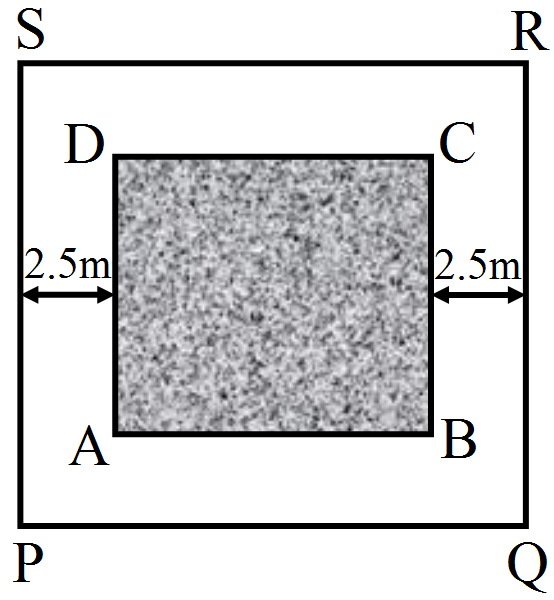
$\text { Outer side }=x+2 \times 2.5=(x+5) m$
$\text { Area of path }=(x+5) 2-x^2$
$\Rightarrow x^2+10 x+25-x^2=165$
$\Rightarrow 10 x=165-25=140$
$\Rightarrow x=\frac{140}{10}=14 m$
Side of lawn $=14 m$
and area of lawn $=(14)^2 m^2=196 m^2$ View full question & answer→Question 503 Marks
A rectangular lawn 70 m by 50 m has two roads, each 5 m wide, running through its middle, one parallel to its length and the other parallel to its breadth. Find the cost of constructing the roads at Rs 120 per $m ^2$.
AnswerLength of lawn $(1)=70 m$
Breadth (b) $=50 m$
Width of crossing roads $=5 m$
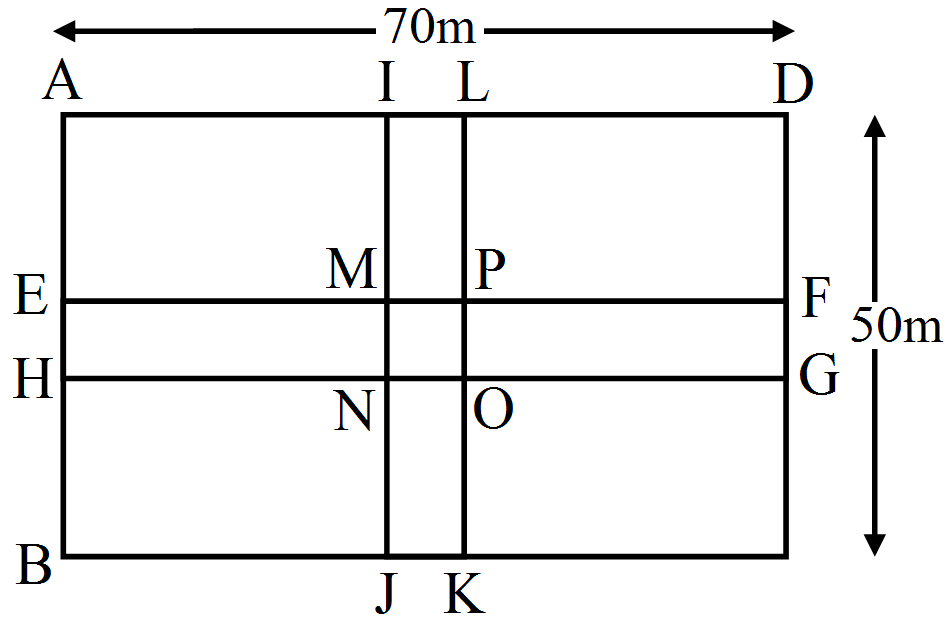
$\text { Area of roads }=70 \times 5+50 \times 5-(5)^2$
$=350+250-(5)^2$
$=600-25=575 m^2$
$\text { Cost of constructing }=\text { Rs. } 120 \text { per } m ^2$
$\text { Total cost Rs. } 120 \times 575=\text { Rs. } 69000$ View full question & answer→