Questions · Page 2 of 2

3 Mark Question

Question 513 Marks
A racetrack is in the form of a ring whose inner circumference is 528m and the outer circumference is 616m. Find the width of the track.
Answer
Let the inner and outer radii of the track be r metres and R metres, respectively.
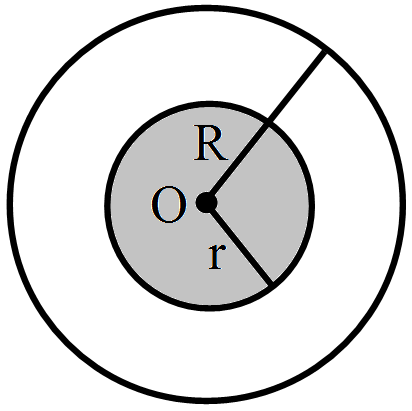
Then, $2\pi\text{r}=528$
$2\pi\text{R}=616$
$\Rightarrow2\times\frac{22}{7}\times\text{r}=528$
$2\times\frac{22}{7}\times\text{R}=616$
$\Rightarrow\text{r}=\Big(528\times\frac{7}{44}\Big)=84$
$\text{R}=\Big(616\times\frac{7}{44}\Big)=98$
⇒ (R - r) = (98 - 84)m = 14m
Hence, the width of the track is 14m.
View full question & answer
Question 523 Marks
How long will a man take to make a round of a circular field of radius 21m, cycling at the speed of 8km/h?
Answer
Radius of the circular field, r = 21m
Circumference $=2\pi\text{r}$
$=2\times\frac{22}{7}\times21\text{m}=132\text{m}$
Speed of cyclist = 8km/hr = 8000m/hr
$\therefore$ Time taken for making one round
$=\frac{132\times60}{8000}$ [60minutes = 1hr]
$=\frac{99}{100}\text{minutes}$
$=\frac{99}{100}\times60\sec.$
$=\frac{594}{10}=59.4\text{ seconds}$
View full question & answer
Question 533 Marks
The base of a parallelogram is twice its height. If the area of the parallelogram is $512 cm^2$. find the base and the height.
Answer
Let the height of the parallelogram be $\times cm$.
Then, the base of the parallelogram will be $2 \times cm$.
It is given that the area of the parallelogram is $512 cm^2$.
Area of a parallelogram $=$ Base $\times$ Height
$\therefore 512 cm^2=2 x \times x$
$512 cm^2=2 x^2$
$\Rightarrow x^2=\left(\frac{512}{2}\right) cm^2=256 cm^2$
$\Rightarrow x^2=(16 cm)^2$
$\Rightarrow x=16 cm$
$\therefore \text { Base }=2 x=2 \times 16$
$=32 cm$
Height $=x=16 cm$
View full question & answer
Question 543 Marks
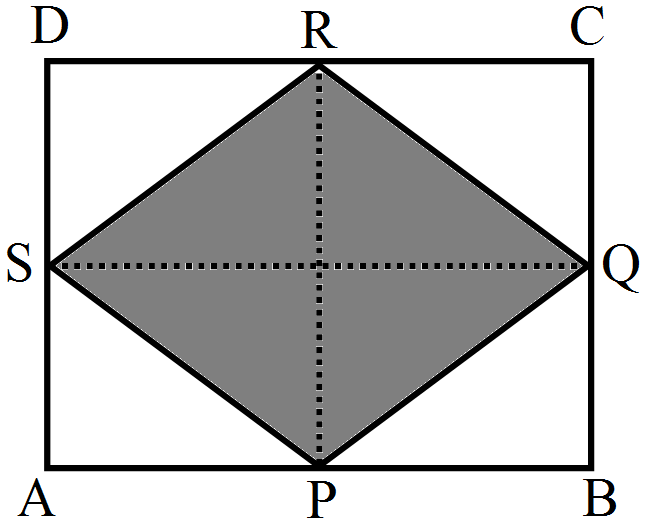
In the given figure, ABCD is a rectangle in which AB = 40cm and BC = 25cm. If P, Q, R, S be the midpoints of AB, BC, CD and DA respectively, find the area of the shaded region.
Answer
In the fig. ABCD is a rectangle in which AB = 40cm, BC = 25cm.
P, Q, R and S and the mid points of sides, PQ, QR, RS and SP respectively
Then PQRS is a rhombus.
Now, join PR and QS.
PR = BC = 25cm and QS = AB = 40cm
Area of PQRS $=\frac{1}{2}\times\text{PR}\times\text{QS}$
$=\frac{1}{2}\times25\times40=500\text{cm}^2$
View full question & answer
Question 553 Marks
The length and breadth of a rectangular piece of land are in the ratio of 5 : 3. If the total cost of fencing it at Rs 24 per metre is Rs 9600, find its length and breadth.
Answer
Ratio in length and breadth of a rectangular piece of land = 5 : 3
Cost of fencing = Rs. 9600
and rate = Rs. 24 per m
Perimeter $=\frac{9600}{24}=400\text{m}$
Let length = 5x
Then breadth = 3x
Perimeter = 2(l + b)
⇒ 400 = 2(5x + 3x)
⇒ 400 = 2 × 8x = 16x
⇒ 16x = 400
⇒ x = 25
Length of the land = 5x = 5 × 25 = 125m
and width = 3x = 3 × 25 = 75m
View full question & answer
Question 563 Marks
The area of a circle is $616 cm^2$. Find its circumference.
Answer
Area of the circle $=616\text{cm}^2$
$\therefore\text{Radius (r)}=\sqrt{\frac{\text{Area}}{\pi}}=\frac{616\times7}{22}$
$=\sqrt{28\times7}=\sqrt{196}=14\text{cm}$
$\therefore$ Circumference $=2\pi\text{r}=2\times\frac{22}{7}\times14\text{cm}$
$=88\text{cm}$
View full question & answer
Question 573 Marks
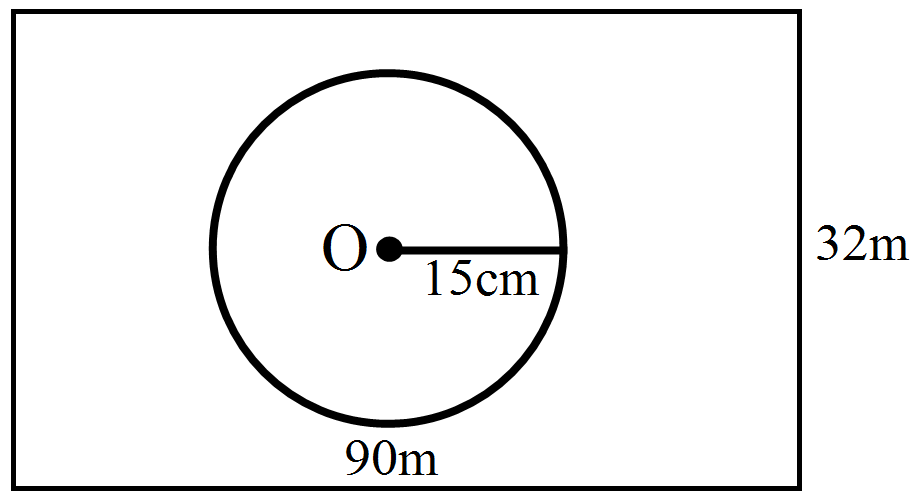
A rectangular ground is 90m long and 32m broad. In the middle of the ground there is a circular tank of radius 14 metres. Find the cost of turfing the remaining portion at the rate of Rs 50 per square metre.

Answer
Area of the rectangular ground $=90 m \times 32 m=(90 \times 32) m ^2=2880 m^2$
Given:
Radius of the circular tank $(r)=14 m$
$\therefore$ Area covered by the circular tank $=\pi r ^2=\left(\frac{22}{7} \times 14 \times 14\right) m ^2$
$=616 m^2$
$\therefore$ Remaining portion of the rectangular ground for turfing = (Area of the rectangular ground - Area covered by the circular tank)
$=(2880-616) m^2=2264 m^2$
Rate of turfing $=$ Rs 50 per sq. metre
$\therefore$ Total cost of turfing the remaining ground $=$ Rs $(50 \times 2264)=$ Rs $1,13,200$
View full question & answer
Question 583 Marks
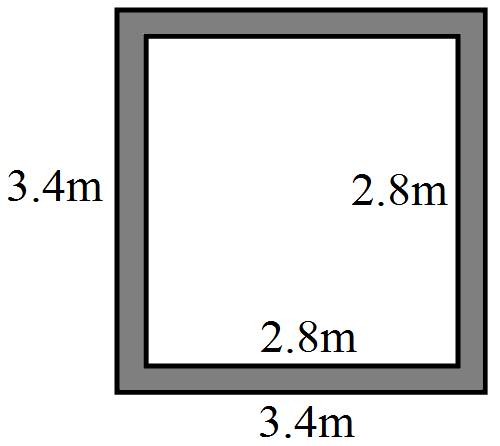
Each side of a square flower bed is 2m 80cm long. It is extended by digging a strip 30cm wide all around it. Find the area of the enlarged flower bed and also the increase in the area of the flower bed.
Answer
Each side of square bed $( a )=2 m 80 cm=2.8 m$
Width of strip $=30 cm$
Outer side $(A)=2.8 m+2 \times 30 cm=2.8+0.6=3.4 m$
Outer area $=(3.4 m)^2=11.56 m^2$


Inner area $=(2.8)^2=7.84 m^2$
Area of increased bed flower $=11.56-7.84=3.72 m^2$
View full question & answer
Question 593 Marks
A wire in the form of a rectangle 18.7cm long and 14.3cm wide is reshaped and bent into the form of a circle. Find the radius of the circle so formed.
Answer
Length of the wire = Perimeter of the rectangle
= 2(l + b) = 2 × (18.7 + 14.3)cm = 66cm
Let the wire be bent into the form of a circle of radius r cm.
Circumference of the circle = 66cm
$\Rightarrow2\pi\text{r}=66$
$\Rightarrow\Big(2\times\frac{22}7{}\times\text{r}\Big)=66$
$\Rightarrow\text{r}=\Big(\frac{66\times7}{2\times22}\Big)\text{cm}=10.5\text{cm}$
Hence, the radius of the circle formed is 10.5cm.
View full question & answer
Question 603 Marks
The area of the 4 walls of a room is $77 m^2$. The length and breadth of the room are 7.5 m and 3.5 m respectively. Find the height of the room.
Answer
Area of 4 walls of a room $=77 m^2$
Length of room $(I)=7.5 m$
and breadth (b) $=3.5 m$
Let $h$ be the height,
then area of four walls $=2(1+b) h$
$\Rightarrow 2(7.5+3.5) h=77$
$\Rightarrow 2 \times 11 \times h=77$
$\Rightarrow h=\frac{77}{2 \times 11}$
Height of room $=3.5 m$
View full question & answer
Question 613 Marks
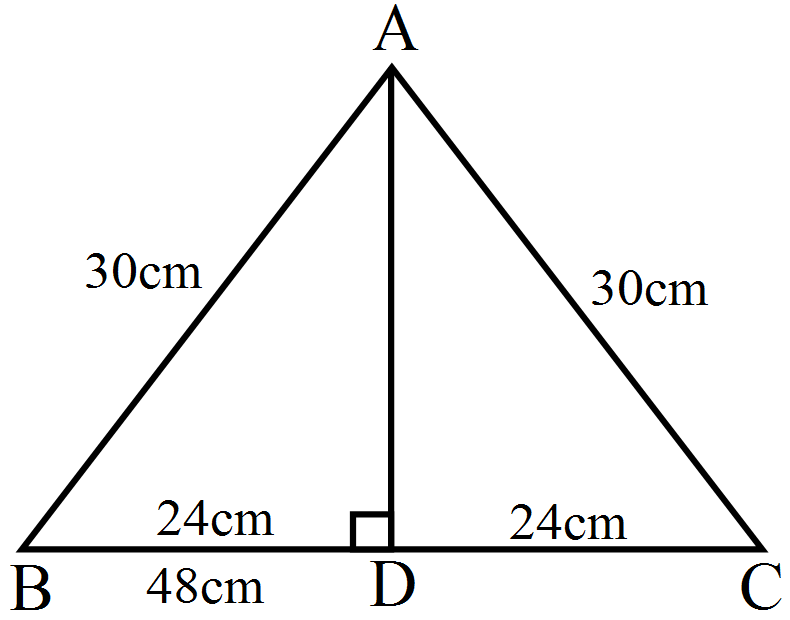
The base of an isosceles triangle is 48cm and one of its equal sides is 30cm. Find the area of the triangle.
Answer
In isosceles $\triangle\text{ABC}$
Base BC $=48\text{cm}$
and AB = AC $=30\text{cm}$
Let $\text{AD}\perp\text{BC}$

Then $\text{BD = DC}=\frac{48}{2}=24\text{cm}$
In right $\triangle\text{ABD},$
$\text{AB}^2=\text{AD}^2+\text{BD}^2$ (Pythagoras Theorem)
$\Rightarrow(30)^2=(24)^2+(\text{AD})^2$
$\Rightarrow900=576+\text{AD}^2$
$\Rightarrow\text{AD}^2=900-576=324=(18)^2$
$\therefore\text{AD}=18\text{cm}$
Now, area of triangle $=\frac{\text{Base}\times\text{Altitude}}{2}$
$=\frac{48\times18}{2}=432\text{cm}^2$
View full question & answer
Question 623 Marks
The area of a square field is $\frac{1}{2}$ hectare. Find the length of its diagonal in metres.
Hint: 1 hectare $=10000 m^2$.
Answer
Area of the square $=\Big\{\frac{1}{2}\times(\text{Diagonal})^2\Big\}\text{sq. units}$
Given:
Area of the square field $=\frac{1}{2}$ hectare
$=\left(\frac{1}{2} \times 10000\right) m^2=5000 m^2\left[\text { since } 1 \text { hectare }=10000 m^2\right]$
Diagonal of the square $=\sqrt{2\times\text{Area of the square}}$
$=\big(\sqrt{2\times5000}\big)\text{m}=100\text{m}$
$\therefore$ Length of the diagonal of the square field = 100m
View full question & answer
Question 633 Marks
Find the cost of carpeting a room 13m by 9m with a carpet of width 75cm at the rate of Rs 105 per metre.
Answer
Length of a room $=13 m$
Breadth $=9 m$
Area of floor $=1 \times b=13 \times 9 m^2=117 m^2$
or area of carpet $=117 m^2$
Width $=75 cm=\frac{75}{100}=\frac{3}{4} m$
Length of carpet $=$ Area $\div$ Width
$=117 \div \frac{3}{4}$
$=117 \times \frac{4}{3} m$
$=39 \times 4=156 m$
Rate $=$ Rs. 105 per m
Total cost $=$ Rs. $156 \times 105=$ Rs. 16380
View full question & answer
Question 643 Marks
A rectangular lawn is 30m by 20m. It has two roads each 2m wide running in the middle of it, one parallel to the length and the other parallel to the breadth. Find the area of the roads.
Answer
Let $A B C D$ be the rectangular park
EFGH and IJKL are the two rectangular roads with width 2 m .
Length of the rectangular park $A D=30 cm$
Breadth of the rectangular park $C D=20 cm$
Area of the road $EFGH =30 m \times 2 m=60 m^2$
Area of the road $IJKL =20 m \times 2 m=40 m^2$
Clearly, area of MNOP is common to the two roads.
Area of MNOP $=2 m \times 2 m=4 m^2$
Area of the roads $=$ Area $(E F G H)+$ Area (IJKL) - Area (MNOP)
$=(60+40) m^2-4 m^2=96 m^2$
View full question & answer
Question 653 Marks
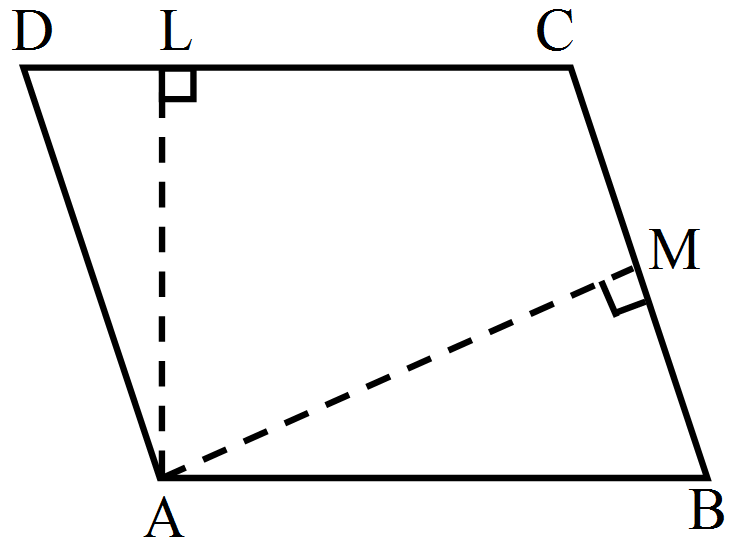
In a parallelogram ABCD, AB = 18cm, BC = 12cm. $\text{AL}\perp\text{DC}$ and $\text{AM}\perp\text{BC}.$


If AL = 6.4cm, find the length of AM.
 
Answer
Base, $AB =18 cm$
Height, $A L=6.4 cm$
$\therefore$ Area of the parallelogram $A B C D=$ Base $\times$ Height
$=(18 cm \times 6.4 cm)=115.2 cm^2 \ldots(i)$
Now, taking BC as the base:
Area of the parallelogram $ABCD =$ Base $\times$ Height $=(12 cm \times$ AM) $\ldots$ (ii)
From equation (i) and (ii):
$12 cm \times AM=115.2 cm^2$
$\Rightarrow AM=\left(\frac{115.2}{12}\right) cm$
$=9.6 cm$
View full question & answer
Question 663 Marks
Find the area of a right triangle having base $=24 cm$ and hypotenuse $=25 cm$.
Answer
Consider $\triangle ABC$ Here, $\angle B =90^{\circ}$
$AB & =24 cm$
$AC & =25 cm$
Now, $A B^2+B C^2=A C^2$
$B C^2=A C^2-A B^2=\left(25^2-24^2\right)=(625-576)=49$
$BC=(\sqrt{49}) cm=7 cm$
Area of $\triangle ABC =\frac{1}{2} \times BC \times AB$ squints
$=\frac{1}{2} \times 7 \times 24 cm^2=84 cm^2$
Hence, area of the right angled triangle is $84 cm^2$.
View full question & answer
Question 673 Marks
The area of a rhombus is $441 cm^2$ and its height is 17.5 cm . Find the length of each side of the rhombus.
Answer
Given:
Height of the rhombus $=17.5 cm$
Area of the rhombus $=441 cm^2$
We know:
Area of a rhombus $=$ Base $\times$ Height
$\therefore$ Base of the rhombus $=\frac{\text { Area }}{\text { Height }}$
$=\left(\frac{441}{17.5}\right) cm=25.2 cm$
Hence, each side of a rhombus is 25.2 cm .
View full question & answer
Question 683 Marks
The area of a square is $16200 m^2$. Find the length of its diagonal.
Answer
We know:
Area of a square $=\left\{\frac{1}{2} \times(\text { Diagonal })^2\right\}$ sq. units
Diagonal of the square $=\sqrt{2 \times \text { Area of square units }}$
$=(\sqrt{2 \times 16200}) m=180 m$
$\therefore$ Length of the diagonal of the square $=180 m$
View full question & answer
Question 693 Marks
Find the distance covered by the wheel of a bus in 2000 rotations if the diameter of the wheel is 98cm.
Answer
It may be noted that in one rotation, the bus covers a distance equal to the circumference of the wheel.
Now, diameter of the wheel = 98cm
$\therefore$ Circumference of the wheel $=\pi\text{d}=\Big(\frac{22}{7}\times98\Big)\text{cm}=308\text{cm}$
Thus, the bus travels 308cm in one rotation.
$\therefore$ Distance covered by the bus in 2000 rotations = (308 × 2000)cm
= 616000cm
= 6160m [since 1m = 100cm]
View full question & answer
Question 703 Marks
The circumference of a circle is 35.2m. Find its area.
Answer
Let the radius of the circle be r m.
Then, its circumference will be $(2\pi\text{r})\text{m}$
$\therefore(2\pi\text{r})=35.2$
$\Rightarrow\Big(2\times\frac{22}{7}\times\text{r}\Big)=35.2$
$\Rightarrow\text{r}=\Big(\frac{35.2\times7}{2\times22}\Big)=5.6$
$\therefore$ Area of the circle $=\pi\text{r}^2$
$=\Big(\frac{22}{7}\times5.6\times5.6\Big)\text{m}^2=98.56\text{m}^2$
View full question & answer
Question 713 Marks
The cost of carpeting a room 15m long with a carpet of width 75cm at Rs 80 per metre is Rs 19200. Find the width of the room.
Answer
Cost of carpeting a room = Rs. 19200
Rate = Rs. 80 per m
Length of carpet $=\frac{19200}{80}\text{m}=240\text{m}$
Width of carpet $=75\text{cm}=\frac{75}{100}=\frac{3}{4}\text{m}$
Area of carpet $=240\times\frac{3}{4}=180\text{m}^2$
Length of a room $=15\text{m}$
Width $=\frac{\text{Area}}{\text{Length}}$
$=\frac{180}{15}=12\text{m}$
View full question & answer
Question 723 Marks
A wire in a circular shape of radius 28cm. If it is bent in the form of a square, what will be the area of the square formed?
Answer
Radius of circular wire $=28 m$
Circumference $=2 \pi r =2 \times \frac{22}{7} \times 28 cm=176 cm$
Perimeter of the square formed by this wire $=176 cm$
Side $(a)=\frac{176}{4}=44 cm$
Area of square so formed $=a^2=(44)^2 cm^2=1936 cm^2$
View full question & answer
Question 733 Marks
Find the area of the triangle in which
a = 52m, b = 56cm, c = 60cm.
Answer
a = 52m, b = 56cm, c = 60cm
$\text{s}=\frac{\text{a + b + c}}{2}$
$=\frac{52+56+60}{2}=\frac{168}{2}=84$
$\therefore\text{Area}=\sqrt{\text{s(s}-\text{a})\text{(s}-\text{b})\text{(s}-\text{c})}$
$=\sqrt{84(84-52)(84-56)(84-60)}$
$=\sqrt{84\times32\times28\times24}$
$=\sqrt{2\times2\times3\times7\times2\times2\times2\times2\times2\times2\times2\times7\times2\times2\times2\times3}$
$=2\times2\times2\times2\times2\times2\times3\times7=1344\text{cm}^2$
View full question & answer
Question 743 Marks
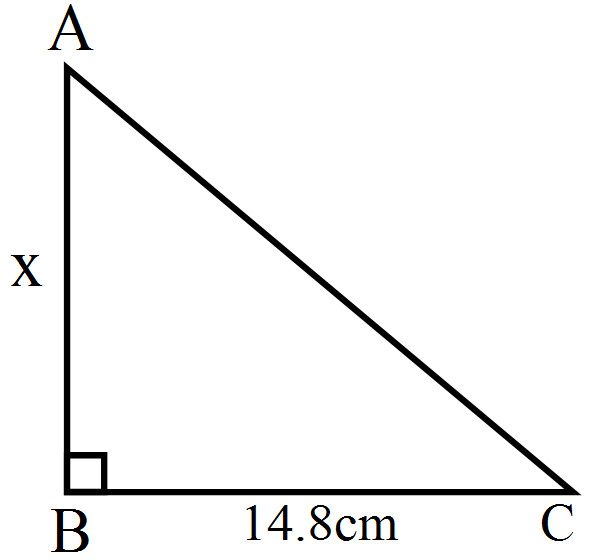
The area of right triangular region is $129.5 cm^2$. If one of the sides containing the right angle is 14.8 cm , find the other one.
Answer
Area of the right angled triangle = $129.5cm^2$

Base (one side) = 14.8cm
$\therefore$ Altitude (second side)
$=\frac{\text{Area}\times2}{\text{Base}}$
$=\frac{129.5\times2}{14.8}$
$=\frac{1295\times2\times100}{100\times148}=17.5\text{cm}$
View full question & answer
Question 753 Marks
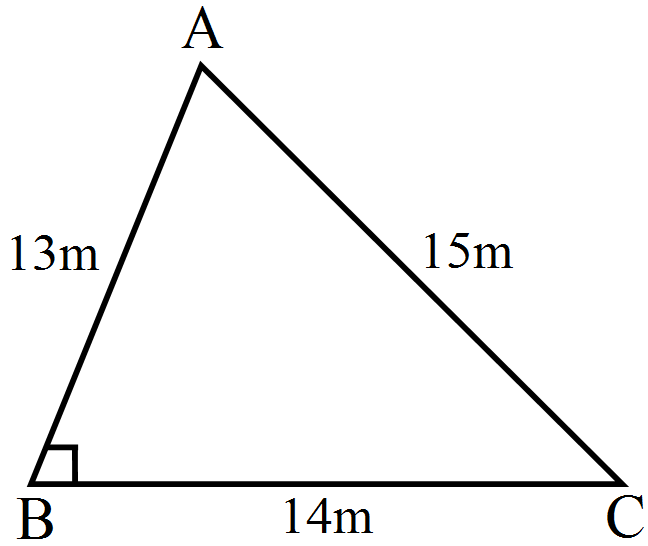
Find the area of the triangle in which
a = 13m, b = 14m, c = 15m.
Answer
a = 13m, b = 14m, c = 15m

$\therefore\text{s}=\frac{\text{a + b + c}}{2}$
$=\frac{13+14+15}{2}=\frac{42}{2}=21$
$\therefore\text{Area}=\sqrt{\text{s(s}-\text{a})\text{(s}-\text{b})\text{(s}-\text{c})}$
$=\sqrt{21(21-13)(21-14)(21-15)}$
$=\sqrt{21\times8\times7\times6}=\sqrt{7056}=84\text{cm}^2$
View full question & answer
Question 763 Marks
The area of the 4 walls of a room is $168 m^2$. The breadth and height of the room are 10 m and 4 m respectively. Find the length of the room.
Answer
Area of 4 walls of a room $=168 m^2$
Breadth of the room (b) $=10 m$
and height $(h)=4 m$.
Let I be the length of room
$2(I+b) h=168$
$\Rightarrow 2(I+10) \times 4=168$
$\Rightarrow 1+10=\frac{168}{2 \times 4}=21$
$\Rightarrow I=21-10=11 m$
Length of the room $=11 m$
 
View full question & answer
Question 773 Marks
The ratio of the radii of two circle is $5: 3$. Find the ratio of their circumferences.
Answer
Let the radii of the given circles be $5 x$ and $3 x$, respectively.
Let their circumferences be $C_1$ and $C_2$, respectively.
$C_1=2 \times \pi \times 5 x=10 \pi x$
$C_2=2 \times \pi \times 3 x=6 \pi x$
$\therefore \frac{C_1}{C_2}=\frac{10 \pi x}{6 \pi x}=\frac{5}{3}$
$\Rightarrow C_1: C_2=5: 3$
Hence, the ratio of the circumference of the given circle is $5: 3$.
View full question & answer
Question 783 Marks
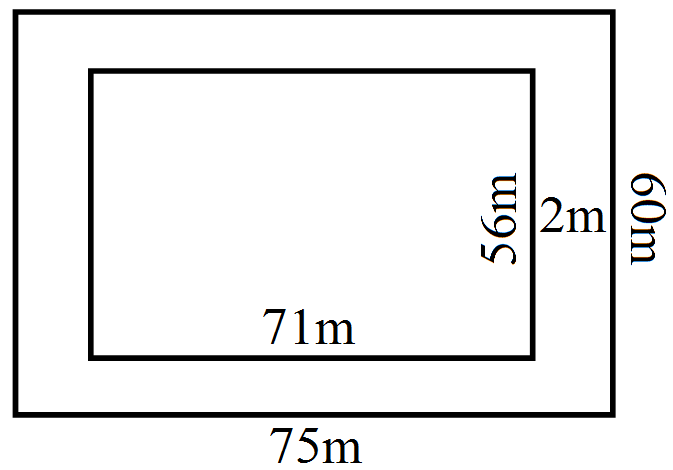
A rectangular grassy plot is 75 m long and 60 m broad. If has path of width 2 m all around it on the inside. Find the area of the path and cost and of constructing it at Rs 125 per $m ^2$.
Answer
Outer length of plot $(L)=75 m$

and breadth $(B)=60 m$

Width of path inside $=2 m$


Inner length $(I)=75-2 \times 2=75-4=71 m$

and width (b) $=60-2 \times 2=60-4=56 m$

Area of the path $= L \times B - I \times b =(75 \times 60-71 \times 56) m ^2=4500-3976=524 m^2$

Rate of constructing it = Rs. 125 per $m ^2$

Total cost $=$ Rs. $524 \times 125=$ Rs. 65500
View full question & answer
Question 793 Marks
One circle has radius of 98cm and a second concentric circle has a radius of 1m 26cm. How much longer is the circumference of the second circle than that of the first?
Answer
We know that the concentric circles are circles that form within each other, around a common centre point.
Radius of the inner circle, r = 98cm
$\therefore$ Circumference of the inner circle $=2\pi\text{r}$
$=\Big(2\times\frac{22}{7}\times98\Big)\text{cm}=616\text{cm}$
Radius of the outer circle, R = 1m 26cm = 126cm [since 1m = 100cm]
$\therefore$ Circumference of the outer circle $=2\pi\text{R}$
$=\Big(2\times\frac{22}{7}\times126\Big)\text{cm}=792\text{cm}$
$\therefore$ Difference in the lengths of the circumference of the circles = (792 - 616)cm = 176cm
Hence, the circumference of the second circle is 176cm larger than that of the first circle.
View full question & answer
Question 803 Marks
The base of a triangular field is three times its height. If the cost of cultivating the field at Rs 1080 per hectare is Rs 14580, find its base and height.
Answer
Total cost of cultivating the field = Rs. 14580
Rate of cultivating the field = Rs. 1080 per hectare
$\text { Area of the field }=\left(\frac{\text { Total cost }}{\text { Rate per hectare }}\right) \text { hectare }$
$=\left(\frac{14580}{1080}\right) \text { hectare }$
$=13.5 \text { hectare }$
$=(13.5 \times 10000) m^2=135000 m^2 \text { [Since } 1 \text { hectare }=10000 m^2 \text { ] }$
Let the height of the filde be x m .
Then, its base will be $3 \times m$.
$\text { Area of the filde }=\left(\frac{1}{2} \times 3 x \times x\right)$
$\therefore\left(\frac{3 x^2}{2}\right)=135000$
$\Rightarrow x^2=\left(135000 \times \frac{2}{3}\right)=90000$
$\Rightarrow x=\sqrt{90000}=300$
$\therefore \text { Base }=(3 \times 300)=900 m$
$\text { Height }=300 m$
View full question & answer
Question 813 Marks
Find the length of the largest pole that can be placed in a hall 10m long, 10m wide and 5m high.
Answer
Length of hall (l) = 10m
Breadth (b) = 10m
and height (h) = 5m
Longest pole which can be placed in it
$=\sqrt{\text{l}^2+\text{b}^2+\text{h}^2}$
$=\sqrt{(10)^2+(10)^2+(5)^2}=\sqrt{100+100+25}\text{m}$
$=\sqrt{225}=15\text{m}$
View full question & answer
Question 823 Marks
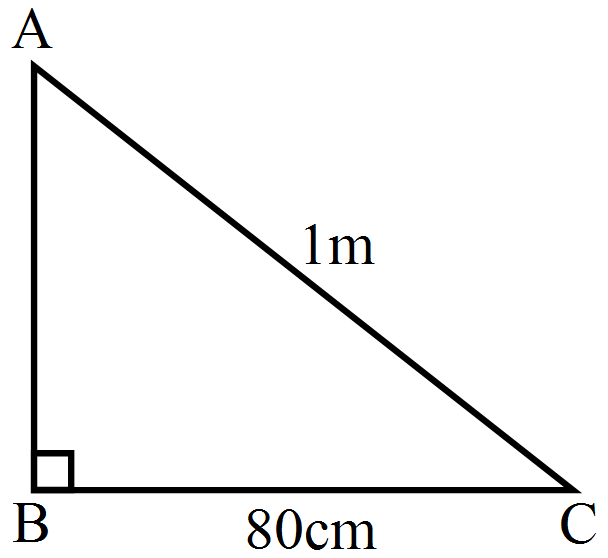
One side of a right-angled triangular scarf is 80 cm and its longest side is 1 m . Find its cost at the rate of Rs 250 per $m ^2$.
Answer
One side BC of a right triangular scarf $=80 cm$


and longest side $A C=1 m=100 cm$

By Pythagoras Theorem,

$A C^2=A B^2+B C^2$

$\Rightarrow(100)^2=A B^2+(80)^2$

$\Rightarrow 10000=A B^2+6400$

$\Rightarrow A B^2=10000-6400$

$\Rightarrow A B^2=3600=(60)^2$

$\Rightarrow A B=60$

Second side $=60 cm$

Area of the scarf $=\frac{1}{2} \times b \times h$

$=\frac{1}{2} \times 80 \times 60 cm^2=2400 cm^2$

Rate of cost $=$ Rs. 250 per $m ^2$

Total cost $=\frac{2400}{100 \times 100} \times 250=$ Rs. 60
View full question & answer
Question 833 Marks
The area of a square plot is $6084 m^2$. Find the length of the wire which can go four times along the boundary of the plot.
Answer
Area of the square plot $=6084 m^2$
Side of the square plot $=(\sqrt{\text { Area }})$
$=(\sqrt{6084}) m$
$=(\sqrt{78 \times 78}) m=78 m$
$\therefore$ Perimeter of the square plot $=4 \times$ side $=(4 \times 78) m =312 m$
312 m wire is needed to go along the boundary of the square plot once.
Required length of the wire that can go four times along the boundary $=4 \times$ Perimeter of the square plot
$=(4 \times 312) m=1248 m$
View full question & answer
Question 843 Marks
The radius of the wheel of a car is 35cm. How many revolutions will it make to travel 33km?
Answer
Radius of the wheel = 35cm
Circumference of the wheel $=2\pi$
$=\Big(2\times\frac{22}{7}\times35\Big)\text{cm}=(44\times5)\text{cm}$
$=220\text{cm}$
Distance covered by the wheel in 1 revolution $=\Big(\frac{11}{5}\Big)\text{m}$
Now, $\Big(\frac{11}{5}\Big)\text{m}$ is covered by the car in 1 revolution.
Thus, (33 × 1000)m will be covered by the car in $\Big(1\times\frac{5}{11}\times33\times1000\Big)$ revolutions,
i.e. 15000 revolutions.
$\therefore$ Required number of revolutions = 15000
View full question & answer
Question 853 Marks
The length and breadth of a rectangular park are in the ratio $5: 2$. A 2.5 -m-wide path running all around the outside of the aprk has an area of $305 m^2$. Find the dimensions of the park.
Answer
Ratio in length and breadth of a park $=5: 2$
Width of path outside it $=2.5 m$
Area of path $=305 m^2$
Let Inner length $(1)=5 x$
and breadth $(b)=2 x$
Outer length $(L)=5 x+2 \times 2.5=(5 x+5) m$
Width $(B)=2 x+2 \times 2.5=(2 x+5) m$
Area of path $=$ Outer area - Inner area
$\Rightarrow(5 x+5)(2 x+5)-5 x \times 2 x=305 \\
\Rightarrow 10 x^2+10 x+25 x+25-10 x^2=305 \\
\Rightarrow 35 x=305-25=280 \\
\Rightarrow x=8$
Length of park $=5 x=5 \times 8=40 m$
and breadth $=2 x =2 \times 8=16 m$
Dimensions of park $=40 m$ by 16 m
View full question & answer
Question 863 Marks
The circumference of a circle is 264cm. Find its area.
Answer
Let the radius of the circle be r cm.
Circumference $=(2\pi\text{r})\text{cm}$
$\therefore(2\pi\text{r})=264$
$\Rightarrow\Big(2\times\frac{22}{7}\times\text{r}\Big)=264$
$\Rightarrow\text{r}=\Big(\frac{264\times7}{2\times22}\Big)=42$
$\therefore$ Area of the circle $=\pi\text{r}^2$
$=\Big(\frac{22}{7}\times42\times42\Big)\text{cm}^2$
$=5544\text{cm}^2$
View full question & answer
Question 873 Marks
The height of a parallelogram is one-third of its base. If the area of the parallelogram is $108 cm^2$, find its base and height.
Answer
Let the base of the parallelogram be x cm .
Then, the height of the parallelogram will be $\frac{1}{3} x cm$.
It is given that the area of the parallelogram is $108 cm^2$.
Area of a parallelogram $=$ Base $\times$ Height
$\therefore 108 cm^2=x \times \frac{1}{3} x$
$108 cm^2=\frac{1}{3} x^2$
$\Rightarrow x^2=(108 \times 3) cm^2=324 cm^2$
$\Rightarrow x^2=(18 cm)^2$
$\Rightarrow x=18 cm$
$\therefore \text { Base }=x=18 cm$
$\text { Height }=\frac{1}{3} x=\left(\frac{1}{3} \times 18\right) cm$
$=6 cm$
View full question & answer