Carbohydrates are made up of carbon, hydrogen oxygen and nitrogen.
Question types
Nutrition in Living Organisms question types
56 questions across 9 question groups — pick any mix to generate a Science paper with step-by-step answer keys.
56
Questions
9
Question groups
5
Question types
01
Write True or False, correct and rewrite the false statements.
14 Q→02Answer the following questions:[1 M]
2 Q→03Give scientific reasons:
9 Q→04Answer the following questions: [2 M]
3 Q→05Do as instructed:[2 M]
16 Q→06Answer the following questions:[3 M]
7 Q→07Do as instructed[4M]
2 Q→08Match the following.
2 Q→09Answer the following questions:[5 M]
1 Q→Sample Questions
Nutrition in Living Organisms questions
One sample from each question group in this chapter. Select any group above to see the full set with answer keys.
View full solution →
Phloem transports the food from leaves to other parts of the plant.
Carbondixode is given out during the process of photosynthesis.
Decomposers obtain their food from living organisms.
The chloroplasts present in the leaves contain chlorophyll.
Why does the pitcher plant feed on insects even though it produces food by photosynthesis?
Write the uses of yeast and mushrooms.
Butterflies have a long tube-like proboscis.
Insectivorous plants are attractively coloured.
Cuscuta is a total parasite while Loranthus is a partial parasite.
Decomposers are important for the ecosystem
Tapeworm is an endoparasite.
How do plants produce their own food?
Why does the pitcher plant feed on insects even though it produces food by photosynthesis?
Write the uses of yeast and mushrooms.
Classify the animals according to the type of food they eat.
microbes, vulture, monkey, tiger, lion, goat, cow, buffalo, crow, hyena, human, chimpanzee
microbes, vulture, monkey, tiger, lion, goat, cow, buffalo, crow, hyena, human, chimpanzee
What are called saprophytic plants? Give Examples.
Write about Drosera burmanii.
What is symbiotic nutrition? Give one example of it.
Name the micro-organisms which help in biological fixation of nitrogen. How?
How does ingestion occur in unicellular animals like amoeba?
1.Which part of the loranthus plant carries out photosynthesis?
2.From where do they obtain minerals and water?
3.Why is loranthus known as a partially parasitic plant?
2.From where do they obtain minerals and water?
3.Why is loranthus known as a partially parasitic plant?
Why is plant food not produced in any other parts of the plant except the green ones?
What damage or harm do ectoparasitic and endoparasitic animals cause?
The number of heterotrophs found in desert regions is smaller. However, they are found in greater numbers in the sea. Why is this so?
Observe the diagram and answer the following questions.
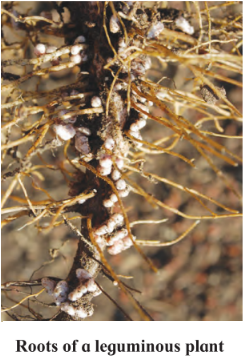
1.What is shown in the picture?
2.What is the importance of these types of plants?
3.What is the process called?
4.Explain the process.
Observe the diagram and answer the following questions.
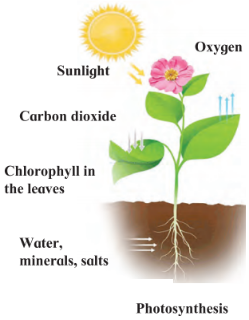
1.Name the process shown in the picture.
2.Which type of plants use the above process for their nutrition?
3.What is the pigment in the leaf that helps in the above process?
4.Give the chemical equation of the above process?
5.What is the importance of this process to living things?
| Column ‘A’ | Column ‘B’ |
| 1. Endoparasite | a. Vulture |
| 2. Ectoparasite | b. Human |
| 3. Seed eating animals | c. Tapeworm |
| 4. Fruit eating animals | d. Bed bug |
| 5. Scavenger | e. granivores |
| 6. Omnivore | f. frugivores |
| Column ‘A’ | Column ‘B’ |
| 1. Parasitic plant | a. Mushroom |
| 2. Parasitic plant | b. Lichen |
| 3. Saprophytic plant | c. Drosera |
| 4. Symbiotic plant | d. Cuscuta |
Write the role of different nutrients like nitrogen, phosphorus, potassium, magnesium, Iron, manganese and zinc and effects of their deficiency on plants.
Generate a Nutrition in Living Organisms paper free
Pick question groups from the list above, set marks and difficulty, and export a branded PDF with step-by-step answer keys. First 3 chapters free — no signup.